
This blog originally appeared at The Washington Post.
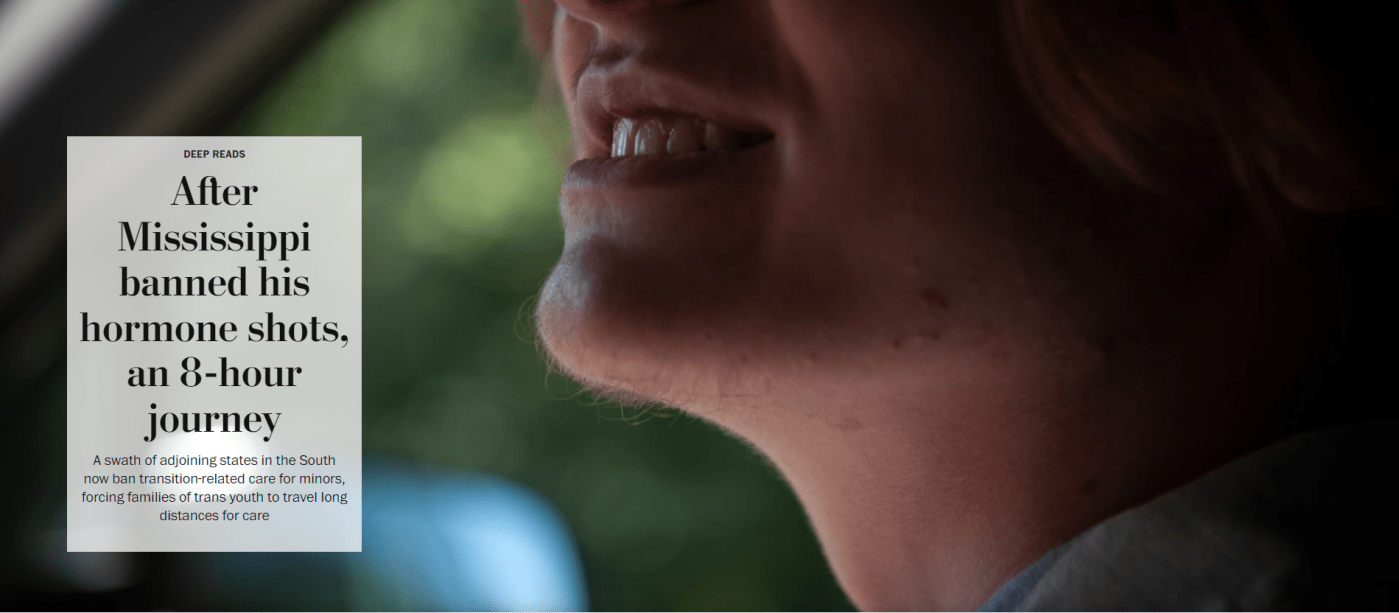
A swath of adjoining states in the South now ban transition-related care for minors, forcing families of trans youth to travel long distances for care.
Like any family, Katie and her son Ray had their road trip staples. They always packed sour peach candy. They talked more than they listened to music, and they played a game they called Nature. Anyone who spotted an animal racked up points, though the exact number depended on the species and an in-the-moment car vote.
Katie wanted to win. She looked for turtles as she pulled her SUV onto the highway around 9 one morning in early May, but her eyes went blurry with fear. She couldn’t make out anything in the distance.
“I’ll play once we get closer,” she told Ray.
Katie had done all she could to prepare for this trip. She’d asked a relative to pick up her two younger boys from school. She’d researched how to change a tire, and she’d spent hours on Google Maps, searching for the closest Walgreens in Alabama. She’d finally found a destination in Thomasville, a rural town nearly 200 miles from their suburban Mississippi home, but much remained unclear. Would they make it by noon for Ray’s telehealth appointment? Would the pharmacy give him testosterone?
Katie looked at her boy, a thin 17-year-old with wavy hair and an easy grin, and she asked herself the question that had begun to matter least: Was she breaking the law?
Two months earlier, Mississippi had banned transgender young people, like Ray, from accessing hormones or other gender-transition treatments. By mid-spring, nearly half the country had passed similar bills, according to the Movement Advancement Project, and now, 1 in 3 trans children lives in a state with a ban. Conservative lawmakers said they’d pushed the bills to protect young people, but Katie felt like they’d done the opposite. Testosterone had allowed her son to embody himself for the first time. Ray was present, happy. The ban would take that happiness away.
Across the country, families were doing everything they could to protect their trans children. Some uprooted their lives in red states for the promise of protections in blue ones. Others filed lawsuits. Katie couldn’t afford to move, and she needed a solution faster than the courts could offer, so she’d settled on a cheaper, quicker plan: She’d take a day off from her nursing job, and she and Ray would travel out of state for his medical care.
“It says we’ll be there by 11:48,” she said.

Katie and Ray on the road on May 4. Mississippi passed a law in late February banning transgender minors from accessing gender-transition treatments.
She knew that Mississippi’s law contained a rare aid-and-abet clause that prohibited adults from helping a minor transition. She didn’t understand the particulars, and she didn’t know what would happen to her if she broke it, but she cared less about penalties than she did about Ray, and so, the day the ban passed, she decided she’d do anything to keep her son well. (Katie and her family spoke to The Washington Post on the condition that they be identified by only their first names out of concern they could face legal consequences.)
Initially, Katie didn’t know where to go. Nearly every state within 700 miles had banned gender-affirming care for minors, and a trip to Illinois would have taken three days. She didn’t have vacation time or hotel money to spare, so the Midwest was out. The best option, she decided, was a tenuous one. A year earlier, Alabama lawmakers had passed one of the country’s first bans, but a judge had temporarily blocked the legislation, which meant teenagers could still get hormones there, at least for now.
“I guess I’m just going to Meridian, then a little farther,” she said. “I know how to get to Meridian, right?”
“I have faith in you,” Ray said.
He reached across the console, and Katie’s stomach twisted. She had told Ray she would fix this one way or another, and he believed her. But Katie couldn’t control lawmakers, and she had no idea what the pharmacist would do.
The border appeared a few minutes after 11, and Katie relaxed just a bit. She grabbed Ray’s hand.
“Welcome to sweet home Alabama,” she said. “Where you’re safe, for now.”

Katie drives across the state line into Alabama, one of the few places they could go to get Ray’s medication.
Care disrupted
Katie used to think Ray was lucky to be born when he was. Earlier generations of trans people had little or no access to gender-affirming care, but by 2019, when 13-year-old Ray told Katie he was a boy, even conservative states like Mississippi had a handful of providers who knew how to help him.
Nearly every major medical association has endorsed gender-affirming care for minors since 2012, and by the time Katie and Ray’s dad, Jody, found a pediatric endocrinologistat an LGBTQ clinic at the University of Mississippi Medical Center, the treatment was fairly standardized. Ray saw a therapist for a year, then, when he turned 15, a doctor prescribed Depo-Provera, an estrogen suppressantsometimes used as a puberty blocker. The clinic staff monitored his bloodwork and bone density.
At the time, no state prohibited transgender children from taking puberty blockers or cross-sex hormones. But in March 2021, a month after Ray started blockers, Arkansas passed a ban.
Katie figured Arkansas was an anomaly. A year passed, and in February 2022, she gave Ray his first testosterone shot. Then, seemingly overnight, the mood shifted. Texas authorities opened child abuse investigations into families with transgender children, and Alabama lawmakers approved the country’s second ban. Human Rights Campaign workers told Katie they believed Mississippi might be next.
No, Katie told them. Mississippi wouldn’t do that. The trans community was so small, it hardly seemed worth the public resources. Ray didn’t know any other kids receiving gender-affirming care, and public hospital data shows that the LGBTQ clinic treated just nine minors in fiscal 2020, and only 15 in fiscal 2023. None had surgery.
Katie understood some Mississippians might be slow to accept trans people. She hadn’t wanted to believe Ray at first, and her heart broke when he first cut his hip-length blonde hair to his chin. But she’d listened to him, and she’d trusted his doctors, and she’d seen the difference the care made in his life.
click here to see full blog: https://www.washingtonpost.com/dc-md-va/interactive/2023/mississippi-youth-transgender-care-ban-aftermath/
 fleeredstates.blog
You must be logged in to post a comment.