
This blog originally appeared at The Guardian.
Court turns away case on law implemented over a century ago with explicit goal of preventing Black people from voting
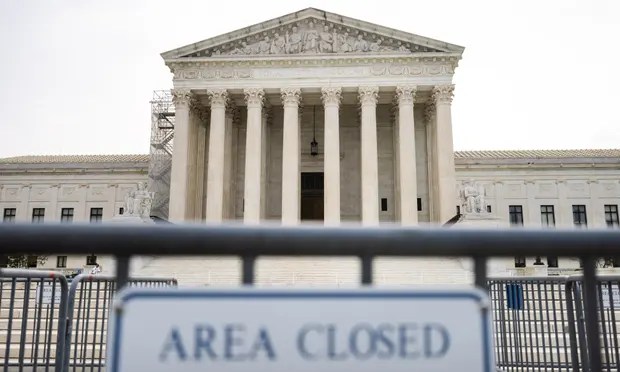
The supreme court did not say why it was rejecting the case (it takes four votes on the court to grant review). Photograph: Jim Lo Scalzo/EPA.
The US Supreme Court declined to hear a case challenging Mississippi’s voting rights rules for individuals with felony convictions, upholding a policy that was established over a century ago with the explicit purpose of disenfranchising Black people. Those convicted of 23 specific felonies in Mississippi permanently lose their right to vote, a list determined during the state’s 1890 constitutional convention with the intention of targeting crimes believed to be more likely committed by Black individuals. The convention’s president made it clear that the goal was to exclude Black people from voting. The list of disenfranchising crimes has remained largely unchanged since then, with some amendments made over the years.
It continued to have a staggering effect in Mississippi. Sixteen per cent of the Black voting-age population remains blocked from casting a ballot, as well as 10% of the overall voting age population, according to an estimate by The Sentencing Project, a criminal justice non-profit. The state is about 38% Black, but Black people make up more than half of Mississippi’s disenfranchised population.
Challengers to the law argued that the policy was unconstitutional because it bore the “discriminatory taint” from the 1890 constitution. One of the plaintiffs was Roy Harness, a social worker in his late 60s who is permanently barred from voting because he was convicted of forgery decades ago. Forgery was one of the original crimes included in the list of disenfranchising offenses.
“It makes me feel bad. I’ve served my country, nation … got a degree and [I] still can’t vote, no matter what you do to prove yourself,” Harness told the Guardian in 2022.
Once a person loses their right to vote in Mississippi it is essentially impossible to get it back. To do so, a disenfranchised person must get the legislature to approve an individualized bill on their behalf by a supermajority in both chambers and then have the governor approve the bill. There are no online instructions or applications, and lawmakers can reject or deny an application for any reason.
Hardly anyone successfully makes it through the process. Between 1997 and 2022, an average of seven people successfully made it through the process each year, according to Blake Feldman, a criminal justice researcher in Mississippi.
Both a federal district judge and the US court of appeals for the fifth circuit upheld Mississippi’s policy. The modifications to the policy in 1950 and 1968, the fifth circuit noted, got rid of any discrimination in the original policy.
The supreme court did not say on Friday why it was rejecting the case (it takes four votes on the court to grant review) and Justices Ketanji Brown Jackson and Sonia Sotomayor were the only two justices who noted their dissent from the denial. Jackson wrote an opinion saying the fifth circuit had committed “two egregious analytical errors that ought to be corrected”.
First, she wrote, even though Mississippi voters removed a crime in 1950 and added two more in 1968, the substance of many of the original crimes from 1890 remained intact. That means that the list is still discriminatory, she wrote in a dissent that was joined by Sotomayor.
“The “remaining crimes” from [the list of crimes] pernicious origin still work the very harm the 1890 Convention intended – denying Black Mississippians the vote,” she wrote.
She also took issue with a conclusion from the fifth circuit that the list of crimes would have been enacted absent discriminatory intent. A taskforce and Mississippi lawmakers studied whether to amend the list of crimes in the 1980s, nearly a century after the convention and chose not to. “Subsequent legislative attention to Mississippi’s election laws indicates that Section 241 was carefully evaluated before the legislature opted to leave it unchanged.
click here to see full blog: https://www.theguardian.com/law/2023/jun/30/us-supreme-court-mississippi-voting-rights-case-black-voters
 fleeredstates.blog
You must be logged in to post a comment.