
This blog originally appeared at AP News.
In recent local school board elections across the U.S., voters rejected conservative candidates advocating for book bans and limitations on discussions about race and gender in classrooms.
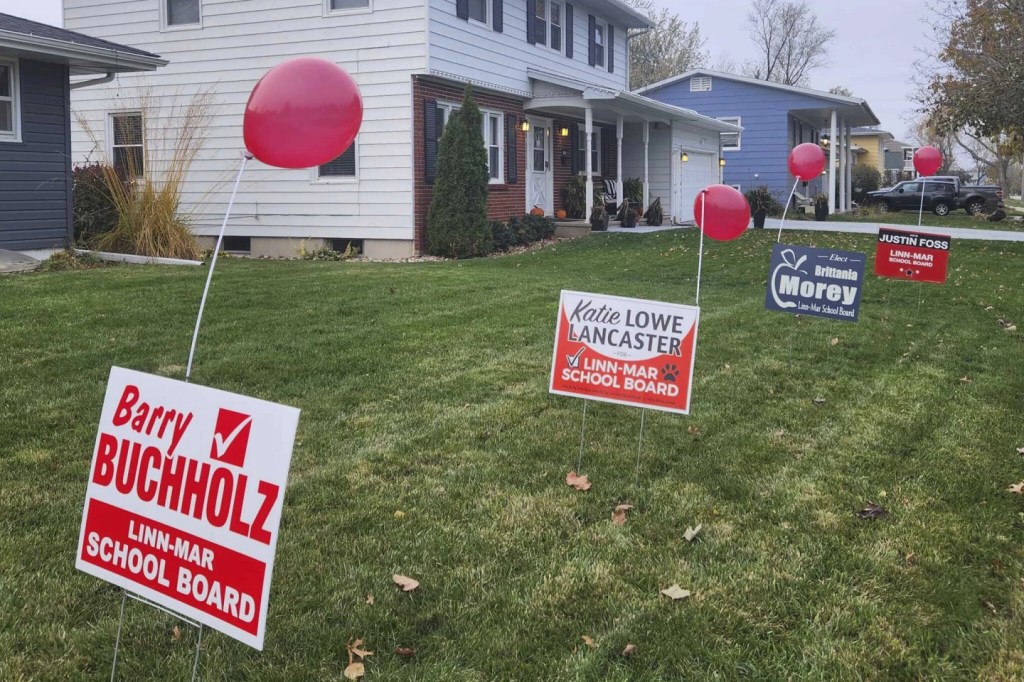
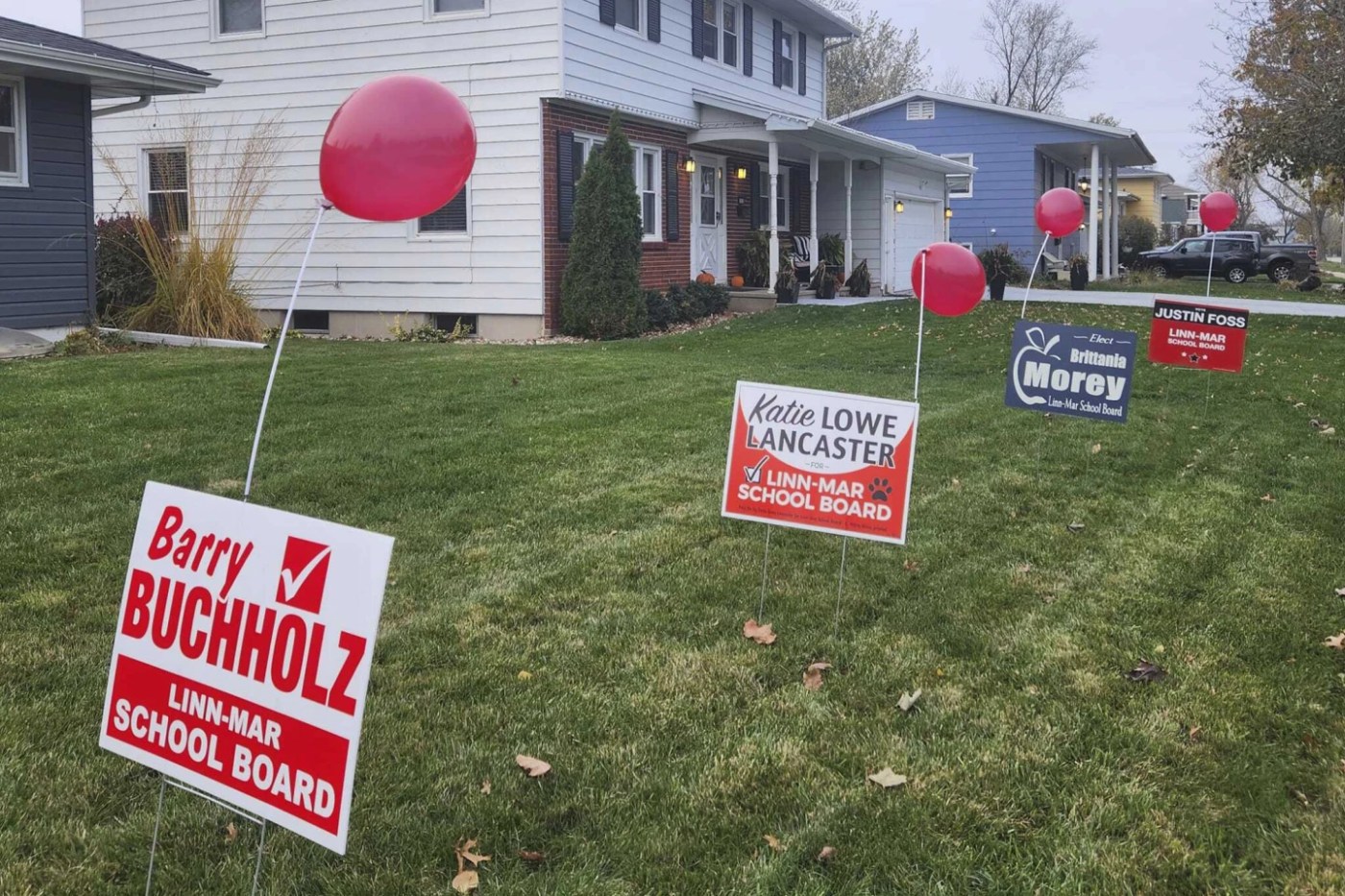
This photo provided by Mary Jo Carlson shows balloons attached to yard signs of four school board candidates who defeated Moms for Liberty-backed candidates in the Lin-Mar Community School District, located outside Cedar Rapids, Iowa, Wednesday, Nov.8,2023. Voters across the U.S. largely rebuked conservative candidates on Tuesday, Nov.7, in school board races across the country. (Mary Jo Carlson via AP)
In recent years, down-ballot elections have increasingly reflected national issues, with liberal and moderate candidates prevailing in key races across states like Iowa, Pennsylvania, and Virginia. The American Federation of Teachers reported that candidates endorsed by conservative groups like Moms for Liberty and the 1776 Project lost around 70% of their races in this week’s elections, a claim contested by those groups.
“They don’t want to engage in this banning of books or censoring of honest history or undermining who kids are,” Randi Weingarten, the teachers union president told The Associated Press on Wednesday, characterizing the candidates who won as “pro-public school.”
The 1776 Project reported a 58% success rate for their endorsed candidates, many in conservative areas. Moms for Liberty, operating in suburban swing districts, claimed a 40% success rate. In Pennsylvania’s York County, the 1776 Project’s PAC stated that 36 out of 37 endorsed candidates won. Conservatives secured control in Texas’ third-largest district, Cypress-Fairbanks, and made gains in Minnesota’s largest district, Anoka-Hennepin. Tina Descovich, a Moms for Liberty founder, noted that the recent elections brought the total of their winning candidates to 365 in the past two years.
Descovich emphasized the need for increased effort and investment in their candidates, highlighting the challenge posed by well-established political operations of teachers unions. School boards, although typically nonpartisan, play a crucial role in managing community institutions, influencing curriculum standards, negotiating with teachers unions, and setting property tax rates. In Pennsylvania, Democratic victories in school boards were notable, especially in districts where GOP-led boards adopted controversial policies affecting transgender students and LGBTQ+ history curriculum. Turn PA Blue reported Democrats gaining control of at least seven school boards and making progress in several others.
In the Central Bucks School District near Philadelphia, Democrats achieved significant wins, flipping three seats, including the removal of the incumbent school board president, and maintaining control of two others, securing a majority. Similar successes were observed in two other Bucks County boards. Contentious school board meetings in Central Bucks featured students reporting incidents of slurs, hate speech, and violence at school, prompting calls for the board to address the issues. Policies prohibiting the use of chosen names and pronouns without parental consent and promoting “neutrality” on LGBTQ+ topics stirred strong opinions and motivated voters for change, according to Bonnie Chang, chairperson for Turn Bucks Blue.
In Virginia, school board politics have been marked by controversy since 2021, following the election of Republican Gov. Glenn Youngkin, who emphasized supporting “parents’ rights” in education. Youngkin has criticized school boards restricting the disclosure of a child’s transgender identity to parents and is working to reverse accommodations for transgender students. In Spotsylvania County, on the outskirts of Washington, D.C., all four GOP-backed candidates were defeated by more liberal contenders. The conservative board in that county was among the first to implement Youngkin’s reforms, including removing 13 books from libraries, with some members suggesting they should be burned. One such member, Kirk Twigg, lost his reelection bid by nearly 25 points. Tamara Quick, a mother of five in Spotsylvania County, expressed relief about the election results, stating she would leave the county if the conservative board remained.
“I believe people truly understood the significance of education,” Quick remarked. She criticized the current board for lacking focus on education and being consumed with power struggles and unnecessary battles. “They were just worried about how many books they could ban,” she added.
In Loudoun County, another Virginia exurban area marked by two years of school board controversies, especially regarding policies for transgender students, candidates endorsed by Democrats secured victories or were leading in six out of nine school board races. However, two Democratic incumbents faced defeat or were behind.
Meanwhile, in Iowa, three candidates supported by Moms for Liberty experienced losses in a district outside Cedar Rapids, which had gained national attention for its support of transgender students.
The Linn-Mar Community School District race drew attention after the school board adopted a policy allowing students to request support for their gender identity without parental permission. Former Vice President Mike Pence rallied opponents before withdrawing from the 2024 presidential race.
Laws signed by Gov. Kim Reynolds limited transgender students’ bathroom use and banned gender-affirming medical care, rendering much of the policy unenforceable. Brittania Morey, reelected with support from those opposing Moms for Liberty-endorsed candidates, sees this as a rejection of the belief that public schools have a hidden indoctrination agenda.
 fleeredstates.blog
You must be logged in to post a comment.