
This blog originally appeared at The Guardian.
The Supreme Court is set to review a request from the Justice Ministry to declare the ‘international LGBT public movement’ as an extremist organization.
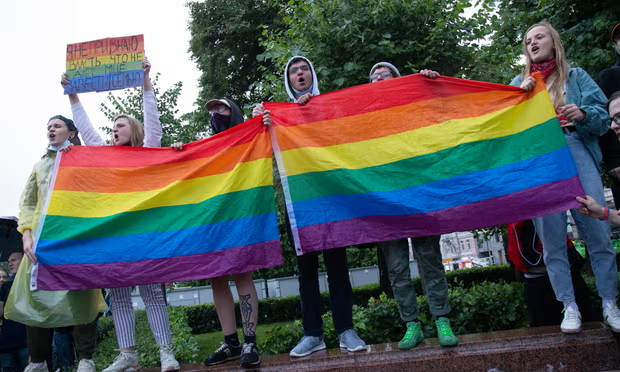
The Russian Justice Ministry has initiated legal proceedings in the Supreme Court to label an “international LGBT public movement” as extremist, marking another assault on the already marginalized LGBTQ+ community in the country.
In an online statement, the ministry declared that the Russian authorities have identified “signs and manifestations of extremist nature” in the activities of the LGBT movement in Russia, citing concerns about the “incitement of social and religious discord.”
The ministry did not elaborate on the definition of the “international LGBT public movement” or how this designation would be implemented. The lawsuit is anticipated to be reviewed by Russia’s supreme court later this month.
Historically, the Kremlin has utilized the extremist classification to prosecute various entities, including human rights groups, independent media, and political opposition, including associates of Kremlin critic Alexei Navalny, resulting in lengthy jail sentences for some.
Since the commencement of the conflict in Ukraine, Vladimir Putin has initiated a renewed campaign to endorse “traditional values,” with anti-gay rhetoric becoming a focal point of his political agenda. In earlier addresses, Putin accused the West of “progressing toward open satanism,” citing the advocacy for gay and transgender rights in Europe as an illustration.
During a recent speech on Friday, the Russian president reiterated his contempt for the LGBTQ+ community, specifically referring to transgender individuals as “transformers.”
The lawsuit filed on Friday follows a series of recent laws aimed at suppressing LGBTQ+ rights in Russia. Earlier this year, Putin endorsed a law prohibiting “LGBT propaganda” among adults. The legislation criminalized any activity perceived as an effort to promote what Russia terms “non-traditional sexual relations” – be it in film, online, advertising, or public spaces.
In the aftermath of this law, Moscow’s Bolshoi theatre removed a contemporary ballet about the Russian dancer Rudolf Nureyev from its repertoire. Additionally, bookstores and cinemas withdrew all content featuring LGBTQ+ themes.
Certain measures taken by the Kremlin to suppress the LGBTQ+ movement have faced ridicule from critics due to their perceived absurdity. Recently, a well-known Russian television channel edited out a rainbow from K-pop music videos, prompting a request from the Russian Duma to officially declare that there is no association between rainbows and the LGBTQ+ community.
In a parallel move over the summer, Russian lawmakers prohibited medical interventions and administrative procedures that would enable individuals to undergo gender changes.
The proposed bill faced condemnation from human rights activists on Friday, with critics arguing that the measures were a move to establish an internal enemy amid Russia’s ongoing conflict in Ukraine.
Igor Kochetkov, the leader of the human rights organization Russian LGBT Network, asserted that the bill was a component of Moscow’s strategy to “fabricate imaginary enemies” within the context of its ideology promoting ‘traditional values’. He further characterized this ideology as increasingly totalitarian.
Kochetkov highlighted the vagueness in the bill’s language, emphasizing that there is no concrete entity called an “international LGBT movement.” However, he expressed a clear concern that, in his interpretation, the legislation would render all legal activities of LGBT organizations impossible in Russia.
 fleeredstates.blog
You must be logged in to post a comment.