
This blog was originally appeared at Washington Post.
Candidates endorsed by the Democratic Party retained all 12 seats on the Fairfax County School Board in the election held on Tuesday, as per unofficial state results.
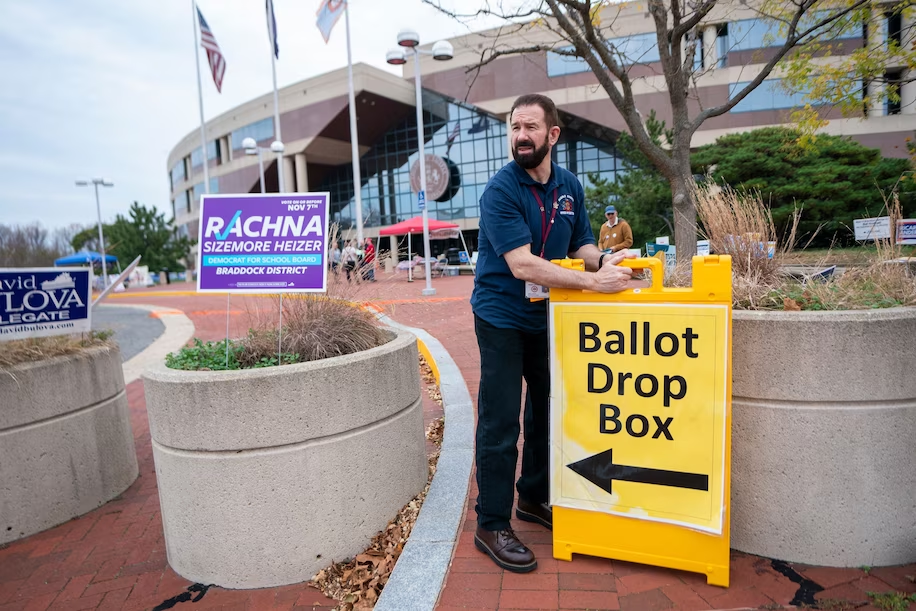
There were nine district and three vacant at-large slots contested in the election. Incumbents sought reelection in the Hunter Mill, Mason, and Providence districts. Additionally, one at-large member vacated the seat to run in the Braddock District, resulting in a board with over half of its members being newcomers.
Despite school board races being nonpartisan, the vast majority of candidates in Tuesday’s election received endorsements from local political parties, highlighting the growing politicization of school boards. This year, the Fairfax County Democratic Committee conducted an open election for its endorsements, and the unofficial results suggest voter approval of the Democratic-backed school board’s actions during the past four years. This period was characterized by some challenges as the district resisted certain policies advocated by Governor Glenn Youngkin (R).
The election results indicate public dissatisfaction with political attacks on the state’s renowned public schools and teachers, according to Karl Frisch, who is leading in the reelection race for the Providence District. Fairfax County residents have expressed a desire for safe, inclusive schools, exceptional educators, and equal access to opportunities for every student, Frisch added. The Fairfax board oversees Virginia’s largest school district, responsible for nearly 200 schools and over 180,000 students. Their responsibilities include setting priorities for the district’s $3.5 billion budget, implementing a new seven-year strategic plan, and addressing pandemic-induced learning loss.
The school board has often found itself at odds with Youngkin, who, during his 2021 campaign, capitalized on the parental discontent stemming from school closures during the pandemic. This approach has since become a model for Republicans nationwide running on education-related issues.

Since assuming office, Youngkin has implemented executive orders to prohibit “inherently divisive” subjects in school curricula and to permit parents to opt their children out of mask mandates. Additionally, his education department has revamped the state’s history standards and eliminated protections for transgender students in schools, which were established by Youngkin’s predecessor.
At virtually every juncture, Fairfax schools resisted the governor’s directives. The school board spearheaded a coalition of seven school districts in a legal challenge to halt the governor’s mask-optional mandate, which the state legislature subsequently enshrined into law. Despite Youngkin’s initial executive order on his first day in office, which prohibited “inherently divisive concepts” and dismantled numerous equity initiatives at the state level, the district proceeded to adopt an educational equity plan in June.
Tensions resurfaced in the summer when the state approved Youngkin’s contentious model policies for the treatment of transgender students in K-12 public schools. Fairfax County Public Schools openly rebuffed the governor’s new policies.
The election results manifest the endorsement for opposition to the Youngkin administration. In almost every race, candidates backed by the Democratic Party outperformed their Republican-endorsed counterparts.
In the competition for the three at-large seats, Democratic-endorsed candidates Kyle McDaniel, Ryan L. McElveen, and Ilryong Moon were in the lead against three Republican-endorsed and three independent candidates. If the results remain unchanged, McElveen and Moon would both make a return to the board after serving in previous terms, while McDaniel, a pilot, would be a newcomer to the governing body.
In the Braddock District, Rachna Sizemore Heizer, currently serving as an at-large member on the board, was in the lead against Priscilla DeStefano. Robyn Lady, a former counselor and director of student services in FCPS, was leading the race against Paul Bartkowski for the Dranesville seat.
In the Franconia District, Marcia St. John-Cunning was leading in the race against Kevin Pinkney. St. John-Cunning had faced a temporary disqualification due to an error in her petition forms, revealed in a complaint by the Eighth Congressional District Republican Party. However, a judge later overturned that decision, reinstating St. John-Cunning, who had worked for Fairfax County Public Schools as a family liaison and family engagement regional representative.
In the Hunter Mill District, incumbent Melanie Meren was set to retain her seat, surpassing Harry Jackson, a candidate who stirred controversy within the local GOP and faced several issues during his school board campaign. Meren, initially elected in 2019, expressed her commitment to strengthening existing board relationships and concentrating on strategies to retain staff in a questionnaire with The Washington Post.
In the Mason District, incumbent Ricardy Anderson took the lead over Kristin Ball. Anderson, elected to the board in 2019, emphasized the need to secure additional funding to tackle teacher shortages. In the Mount Vernon district, Mateo Dunne was in the lead against Stori Zimmerman. Karl Frisch, elected to the Providence District in 2019, was leading in his reelection bid against Tony Sabio.
In the Springfield District, Sandy Anderson was leading against independent candidate Peter Bixby-Eberhardt and Republican-backed Debra Tisler. The final seat, in the Sully District, seemed to be going to Seema Dixit, who competed against Cynthia Walsh. Dixit, co-founder of the Women Empowerment Foundation, expressed a commitment to closing opportunity gaps and addressing learning loss in a questionnaire for The Washington Post.
On Tuesday, Steven Larsen, a 62-year-old retiree, proudly sported the Republican Party pin on his jacket outside Belle View Elementary School. Having just voted for Stori Zimmerman, the GOP-endorsed candidate in the Mount Vernon school district, Larsen, whose wife recently retired as a schoolteacher, expressed concerns about the direction of Fairfax County schools. He wasn’t taken aback by the local school board’s resistance to many of Youngkin’s initiatives.
Many voters at the polls on Tuesday expressed a desire for less political influence on the school board.
Pilar Sanders, 38, a lifelong resident of the Fairfax area who cast her vote at Belle View Elementary School, acknowledged the political nature of the region. She emphasized her preference for a focus on education rather than excessive political involvement, considering the significant number of her friends who are schoolteachers.
Fairfax County Board of Supervisors Chairman Jeffrey C. McKay (D) engaged with voters at a precinct in West Springfield High School. Some voters expressed concerns about schools resisting inclusive environments and advocating for what is often termed as parents’ rights.
McKay shared his apprehension about the ongoing discourse surrounding public education. However, he expressed optimism about the response from Fairfax County voters, emphasizing their intelligence. Recognizing the school system’s crucial role as an economic magnet for the county, he underscored the need to safeguard its reputation, as people are drawn to Fairfax County for its quality schools.
Despite the focus on contentious topics, a significant number of candidates in the election centered their campaigns on common themes. These included addressing the learning setbacks caused by the pandemic, retaining high-quality teachers, and maintaining a non-political stance on the board.
Doug Ying, who has young children about to enter the school system, emphasized his search for candidates advocating for increased teacher salaries and the development of robust schools. He was present outside the Fox Mill Elementary School precinct with his 2-year-old daughter.
“We are fortunate to have outstanding public school districts in this area. Ensuring we can attract and retain top talent is crucial,” emphasized Ying, a Democrat. “As we plan to stay in this area while our kids grow up, maintaining or even enhancing the current standard of education is a priority for us.”
Contributions to this report were made by Omari Daniels.
 fleeredstates.blog
You must be logged in to post a comment.