
This blog originally appeared at Search Engine Journal.

Examine the data-backed rationale for emphasizing content at the bottom of the marketing funnel, optimizing return on investment, and leveraging SEO resources effectively.
Ring in the holiday season by revisiting some of the standout articles from SEJ in 2023.
The Festive Flashback series, spanning from December 21 to January 5, offers a daily revisit to noteworthy events, foundational principles, practical strategies, and insights from thought leaders.
The year 2023 has been marked by significant developments in the SEO industry, and our contributors have crafted exceptional articles to capture and elucidate these transformative shifts.
Dive into the top articles of 2023, providing ample food for thought as you navigate your way into the new year, 2024.
The SEO landscape firmly recognizes the importance of search intent, advising marketers to closely align their strategies with this concept, especially when targeting organic keywords.
However, while many SEO articles delve into explaining search intent (as seen in these insightful SEJ pieces on crafting content that meets search intent and comprehending user search patterns), most don’t explicitly outline how companies should strategically prioritize keywords.
In particular, the majority of discussions on search intent acknowledge the spectrum of search queries, spanning from informational (individuals seeking to acquire knowledge about a topic) to comparative (individuals comparing solutions to their problem) to transactional (individuals intending to make a purchase).
This is commonly represented as a marketing funnel.
But when it comes to advising on how to leverage search intent for SEO success, the prevailing suggestion is to ensure you possess a range of content that addresses the entire spectrum of search intent—encompassing informational, mid-funnel, and transactional content.
We hold a different perspective.
In our experience collaborating with numerous brands over several years to develop SEO-focused content, we’ve discovered that most companies benefit from prioritizing bottom-of-the-funnel content. It’s often more effective to concentrate efforts on content aimed at users closer to making a transaction and then gradually extend the focus to upper-funnel content.
Why?
As SEO resources are limited, prioritizing bottom-of-funnel content (such as search queries with “transactional” search intent) becomes crucial due to its significantly higher return on investment (ROI) for SEO expenditure.
In this article, we will elucidate our rationale and present data substantiating this thesis.
SEO Resources Are Limited: Not All Keywords Can Be Effectively Targeted
The common advice to “ensure you create content for every stage of the funnel” would be feasible if businesses had unlimited SEO resources—such as an abundance of writers for content creation, a surplus of SEO strategists for keyword selection and SERP analysis, and an extensive budget for link building.
However, no brand possesses such unlimited resources.
Furthermore, the notion that AI-assisted writing simplifies the production of vast amounts of content doesn’t change this reality.
Certainly, while AI tools can generate thousands of pieces much faster than humans, it doesn’t guarantee that all of them will rank well or meet the quality standards necessary to engage potential customers and drive conversions.
Certainly, if multiple websites are creating similar AI-assisted content to target the same keywords, Google will likely rely on factors such as content quality and backlinks to differentiate and determine which sites to rank higher.
When it comes to content quality, the articles that stand out for a particular keyword are likely those with the highest degree of originality and specific personal expertise. Google has explicitly expressed a preference for such traits, requiring human input.
Backlinks have long been recognized as a key ranking factor in SEO. In a landscape where numerous sites generate similar AI-generated content for the same keywords, it’s reasonable to assume that backlinks will remain, if not become more, crucial.
Irrespective of the content production method, SEO resources are limited. There’s a finite amount of employee hours, a capped writing budget (even with AI use), and a constrained link-building budget for everyone.
This necessitates prioritizing the keywords you intend to target.
The most logical approach to prioritization is directing SEO efforts toward activities that yield the highest return on investment, specifically in terms of leads and sales.
In our experience, prioritizing bottom-of-funnel and transactional keywords has proven to be the most effective strategy.
Keywords at the bottom of the funnel consistently demonstrate significantly higher conversion rates compared to other search intents.
In conclusion, to affirm that bottom-of-the-funnel content converts substantially more than any other type, the initial step involves measuring and diligently tracking SEO-driven conversions.
This might seem evident, but in reality, many SEO and content teams neglect this; they often presume that more traffic is better, and their entire strategy revolves around traffic growth.
You can assess SEO conversion using various analytics tools, but generally, the process involves the following steps:
- Clearly outline what constitutes a conversion. For SaaS or sales-oriented enterprises, this might involve actions like completing a lead form or initiating a trial. For e-commerce businesses, an actual transaction would be considered a conversion.
- Establish a goal within your analytics platform to track this conversion event.
- Generate reports indicating the number of conversions associated with various landing pages on your site. This can be achieved through different attribution models, such as first or last click, depending on your analytics platform. Nonetheless, having any data in this regard is better than having none.
By doing this, you will inevitably discover what we’ve learned through over 5 years, working with dozens of brands and creating hundreds of SEO pieces.
Pages on your site that rank for bottom-of-funnel keywords typically convert at multiple single-digit percentages (1% – 5%), while pages ranking for top-of-funnel, informational keywords usually convert at a fraction of a percent (0.01% – 0.5%).
In essence, the disparity in conversion rates between bottom-of-funnel and top-of-funnel keywords isn’t just a marginal 10%, 20%, or 50% — it’s several times over.
This is highlighted by data from over 60 content pieces for a software client. On average, pages targeting bottom-of-funnel queries converted at a rate 25 times higher than articles focusing on mid to top-of-funnel queries.
Bottom-of-funnel posts demonstrated a 4.78% conversion rate, in stark contrast to the 0.19% conversion rate observed for top-of-funnel posts. This analysis is derived from over 60 posts created for a client.
Even when factoring in the higher traffic volume for top-of-funnel pieces, the absolute number of conversions from only 20 bottom-of-funnel pieces exceeded that of 40 top-of-funnel pieces by threefold:
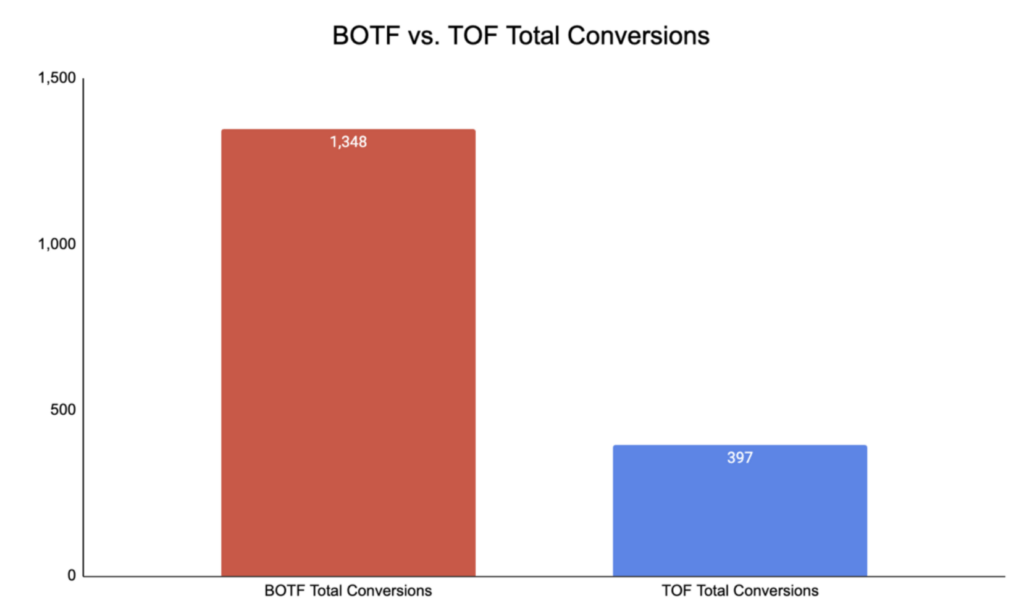
Twenty bottom-of-funnel posts yielded 1,348 conversions, surpassing the 397 conversions generated by 40 top-of-funnel posts.
To underscore, the 1,350 conversions from bottom-of-funnel content were derived from only 22 pieces, whereas the 400 conversions from top-of-funnel content were from 42 articles.
Moreover, it’s worth noting that the articles categorized as “top of funnel” in this study still retained some purchase intent. We pursued them only after exploring most bottom-of-funnel keywords and selected the keywords strategically to guarantee they still held some potential for conversion.
Hence, it’s reasonable to consider them more as “mid-funnel” rather than strictly “top of funnel.” Many companies focus the majority of their content and SEO efforts solely on top-of-funnel keywords that convert to leads or sales at or below the conversion rates mentioned earlier.
It’s a regrettable misallocation of SEO efforts, in our view.
Why Do Top-of-Funnel, Informational Keywords Have Such Low Conversion Rates?
The rationale for pursuing top-of-funnel keywords often centers on their high search volumes.
Therefore, the idea is that by targeting top-of-funnel keywords, you can expose your brand to a large audience that may eventually require a product or service similar to yours.
However, as indicated by the data and supported by our extensive experience, the number of steps needed to convert top-of-funnel traffic into actual conversions is so substantial that the conversion rates are extremely low.
More precisely, the path from an individual searching for an informational top-of-funnel query on Google to becoming a customer involves:
- They initiate a search on Google for the query.
- They click on your search result.
- They read the article.
- Some fraction of these users either return to your site on pure memory or give their email to download a white paper or gated resource.
- Some fraction of those users open subsequent drip emails.
- Then at some point, some fraction of those users will need your product or service and reach out.
Each of these steps has a small conversion rate, so in combination, the entire journey has an absolutely minuscule conversion rate.
To the extent that the data above indicates a potentially greater search volume for these top-of-funnel queries compared to transactional queries, the minuscule conversion rates fail to compensate.
There exist a greater number of bottom-of-funnel keywords than one might realize.
If you subscribe to the idea that focusing on bottom-of-the-funnel keywords is a more effective utilization of limited SEO resources than dispersing content evenly across the entire range of search intent, the crucial next step is to address the question: “Which keywords in my domain indicate bottom-of-the-funnel intent and boast high conversion rates, and how abundant are they?”
We’ve observed that a significant number of SEO professionals and marketers possess a narrow perspective on which keywords indicate bottom-of-the-funnel intent, meaning they exhibit some degree of transaction or buying intent.
From our experience, bottom-of-the-funnel keywords can be categorized into three common buckets, with only the first one being widely recognized as indicative of a bottom-of-the-funnel intent.
1. Keywords Reflecting Product Categories
If we consider a hypothetical business that’s widely known, such as SEO software, the evident transactional keywords include phrases like “SEO software” or “best SEO tools.”
Certainly, these are highly effective keywords at the bottom of the sales funnel, and they are crucial for any SEO software brand to target.
In our approach to Bottom of the Funnel (BOTF) SEO, which we refer to as Pain Point SEO, these are termed “category keywords.” This designation stems from users directly searching for the name of the product or service category on Google.
The majority of SEO and marketing teams are cognizant of these keywords and typically direct their efforts toward them, often optimizing the homepage or a couple of landing pages.
However, what we’ve discovered is that numerous teams perceive this as covering the entirety of bottom-of-funnel or transactional keywords. They concentrate on a handful of category keywords and allocate the remaining effort to producing blog content aimed at ranking for top-of-funnel search terms.
Yet, there exist numerous other high-converting search terms that we’ve observed many brands tend to overlook. Instead, they prioritize creating content to target top-of-funnel keywords with lower conversion rates.
2. Keywords for Comparisons
More precisely, another category of keywords that yields exceptionally high conversion rates is what we term as comparison keywords.
These keywords indicate that the searcher is evaluating various options, like “salesforce vs pipedrive” or “adidas vs nike women’s running shoes.”
In various discussions about search intent, this is often classified as a mid-funnel query. According to this perspective, the searcher might not be ready for a transaction but is engaged in product research.
In discussions about search intent, this is frequently labeled as a mid-funnel query. The rationale is that the searcher, at this point, might not be prepared for a transaction but is primarily conducting product research.
However, based on our analysis of the conversion rates of numerous pages ranking for comparison keywords, they frequently exhibit conversion rates just as high as the category keywords mentioned earlier.
Consequently, from my perspective, companies aiming to optimize ROI from SEO should actively pursue comparison keywords.
They ought to pinpoint every comparison keyword associated with their top competitors, with any noticeable search volume, and guarantee the existence of a dedicated page on their site to rank for each one.
3. Keywords Associated with Jobs To Be Done
The last category among the three that we’ve identified as capable of generating conversions through SEO is keywords related to Jobs To Be Done.
This is the most extensive among these three categories of high-buying-intent keywords, implying that there are typically a significantly larger number of jobs to be done keywords than category or comparison.
Brands often overlook or don’t prioritize this category as conversion-generating. This is because these queries don’t overtly express a user’s search for or comparison of product options but indicate that the user has a problem your product happens to solve.
In the context of our SEO software example, these would encompass queries such as “how to conduct competitor keyword research,” “how to determine the search volume of keywords,” or “how to track the keywords a site ranks for.”
If your SEO software product includes features that enable users to perform these tasks, our experience suggests that achieving a ranking for keywords like these will result in conversions.
Usually, the conversion rate of these keywords is slightly lower than that of category or comparison keywords.
Nevertheless, they still outperform top-of-funnel queries like “SEO strategy,” “best SEO tips,” or even “digital marketing strategies.” These are the common top-of-funnel keywords that companies pursue, but they often lack significant buying intent.
 fleeredstates.blog
You must be logged in to post a comment.