
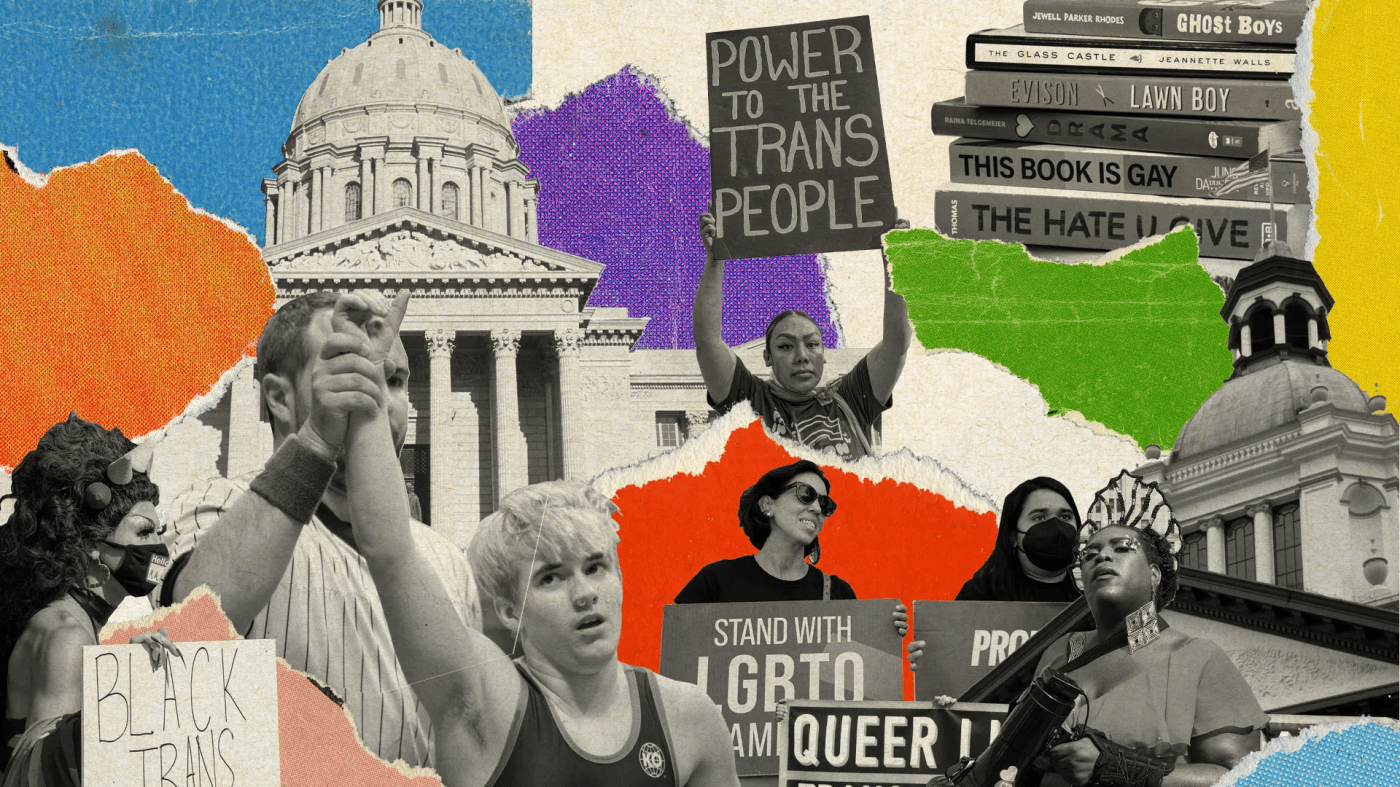
This blog originally appeared at THEM.
Politicians opposed to transgender rights will likely stay occupied this year, but LGBTQ+ activists and allies remain resolute in their determination to persist.
Following a year marked by a barrage of legislation aimed at LGBTQ+ Americans, the community braces for yet another potentially record-breaking legislative session in 2024. In 2023 alone, over 500 bills were introduced seeking to curtail rights and protections for queer and trans individuals, spanning issues from restroom access to gender-affirming healthcare. LGBTQ+ advocates foresee no respite in this brisk legislative pace, particularly with a looming presidential election. Former President Donald Trump, eyeing a return to the White House, has already hinted at a federal transition ban, vowing to enact an executive order on day one, instructing all federal agencies to halt support for sex or gender transition at any age.
While the specifics of upcoming state legislative agendas remain uncertain, experts note that the political landscape is taking shape. Erin Reed, an independent journalist covering anti-LGBTQ+ legislation nationwide, suggests that insights into the trajectory of 2024 can be gleaned from Republican bills pre-filed ahead of the next round of legislative sessions. In Missouri, for instance, Republicans have pre-filed over 20 bills targeting LGBTQ+ rights for the upcoming session, including measures permitting teachers to refuse to use trans students’ pronouns and shielding doctors from lawsuits for denying gender-affirming care. Lawmakers in New Hampshire and South Carolina have also begun introducing their own bills; in South Carolina, a pre-filed bill seeks to impose criminal penalties on trans individuals using bathrooms aligning with their gender.
Florida, for its part, got a jump on the 2024 session with a November 2023 bill, HB 599, seeking to expand the state’s existing “Don’t Say Gay” law to the workplace. If passed, it would ban any mandatory “training, instruction, or other activity on sexual orientation, gender identity, or gender expression.” HB 599’s passage, according to Reed, would likely “have the effect of outlawing LGBTQ+ nonprofits” in Florida, and she believes the bill could be a bellwether for similar efforts across the country. “Many times we see what happens in Florida spiderweb throughout the nation,” she tells Them. “They generally tend to be the first ones to drop these kinds of things.”
“Biggest Bang for Their Buck”
Gillian Branstetter of the American Civil Liberties Union (ACLU) highlights the ongoing budget battle in Congress as yet another indicator of the trajectory of the anti-LGBTQ+ movement in 2024. According to Branstetter, House lawmakers attempted to introduce at least 45 anti-LGBTQ+ amendments into the National Defense Authorization Act (NDAA) budget, including provisions aimed at prohibiting government buildings from displaying Pride flags and defunding gender-affirming care at the federal level. Branstetter, a communications strategist with the ACLU’s LGBT and Women’s Rights Project, notes that these proposals would have also restricted public funds from supporting gender-affirming care for trans individuals of any age.
These amendments within the NDAA, Branstetter argues, reflect a determination among Republicans to persist in their efforts, particularly following the enactment of comprehensive bans on gender-affirming care for trans youth in 21 states. She predicts that GOP lawmakers nationwide are likely to emulate states like Oklahoma and South Carolina, where legislation has been introduced to ban gender-affirming healthcare until the age of 26.
Furthermore, several states have already begun imposing restrictions on adult care: in Missouri, Attorney General Andrew Bailey implemented an “emergency rule” in April imposing stringent limitations on trans healthcare for patients of all ages. Similarly, Florida’s ban on trans medical care, signed into law in May, has hindered providers’ ability to offer gender-affirming care by mandating that such care must be administered in person by a physician, effectively excluding nurse practitioners, who typically provide the majority of trans healthcare in the state.
Looking ahead to 2024, Branstetter anticipates an expansion of trans healthcare restrictions by Republicans, characterizing it as part of a broader trend among GOP lawmakers to maximize their impact. She cites the example of Kansas’ “Women’s Bill of Rights,” which redefined sex based solely on reproductive biology at birth, prompting the Kansas Department of Health to cease correcting trans people’s birth certificates and prompting attempts by the state’s attorney general to block updates to gender markers on driver’s licenses.
Branstetter suggests, “Their aim seems to be to generate a catchy headline like ‘Kansas state legislator moves forward with ‘Women’s Bill of Rights.'” However, she points out that most people’s expectations of a ‘Women’s Bill of Rights’ would include protections such as abortion rights, workplace non-discrimination, equal pay, paid leave, childcare access, and safety from violence. Contrary to these expectations, the proposed laws do not provide such protections. Rather ironically, they are being put forward by the same politicians who are simultaneously enacting abortion bans and restricting access to contraception.
While organizations like the ACLU are actively working to block the enforcement of Kansas’s law, the likelihood of lawsuits challenging anti-LGBTQ+ legislation doesn’t seem to deter the introduction of similar bills. This year alone, at least six states have implemented restrictions on drag performances, many of which have been either temporarily halted or completely invalidated. Yet, according to Reed, these setbacks don’t dissuade proponents on the right. She explains that during Ohio’s recent discussion on its own drag ban, the sponsor argued that his legislation was distinct, despite its similarities to previous bills.
“I’ve thoroughly reviewed the bills,” Reed states, “and they’re essentially identical. If anything, the legal victories against these laws only embolden politicians to push them through. They understand that even if a court strikes them down, there’s no real consequence for them. And if they happen to win in court, then the bans on drag performances can be enforced.”
Doubling Down
Overall, experts predict that conservative lawmakers will intensify their efforts in 2024, doubling down on familiar tactics seen in previous years, ranging from imposing more bans on LGBTQ+ curricula to imposing additional restrictions on youth participating in sports. Despite this trend, some GOP-led states like Georgia and Nebraska have yet to enact limitations on trans sports participation, and only eight states currently have “Don’t Say Gay” laws in effect. According to ACLU data, a total of 233 bills aimed at educational institutions were introduced in 2023, with some of these proposals likely to resurface in the upcoming year.
As Republican legislators persist in advancing legislation that disproportionately targets LGBTQ+ individuals, concerns arise regarding the potential impact on the most vulnerable members of the community. Observers fear that in 2024, the GOP will pivot towards targeting trans individuals who must travel to more affirming states to access necessary medical care. With the increasing restrictions on trans health treatments, at least 14 states, along with Washington, D.C., have enacted laws or executive orders to shield patients from prosecution if they seek gender-affirming care across state lines. In a bid to impede such care provision, Idaho has repeatedly introduced legislation over two years that would classify parents and guardians as felons if they take a minor out of state for transition-related treatment.
However, according to Heron Greenesmith, deputy director of the Transgender Law Center, the reality is that certain individuals will be able to navigate around these laws: those with privilege and access. They argue that the ones most affected will be “those who cannot take extraordinary measures to access gender-affirming care.” Greenesmith explains to Them, “Banning interstate travel means that those who can afford fines or legal representation can still access it, while those who cannot afford these resources will be unable to do so.” This, they emphasize, particularly impacts low-income transgender individuals, who are disproportionately Black, Indigenous, and people of color, as well as transgender individuals with disabilities.
Nevertheless, despite the ongoing battles on the horizon, experts maintain a largely optimistic outlook regarding the future of LGBTQ+ equality. According to the National Center for Transgender Equality (NCTE), a significant 56% of this year’s unprecedented number of anti-LGBTQ+ bills were successfully defeated and did not progress into law. Only 14% managed to pass, leaving the remainder to be carried over into 2024. Additionally, nearly all of the 19 trans youth healthcare bans enacted in 2023 are currently facing legal challenges.
Ash Orr, the press relations manager for NCTE, emphasizes, “It’s crucial to recognize that the backlash we’re witnessing indicates our strength.” Orr illustrates, “As an example, they first ignore you, then they laugh at you, then they fight you, then you win. We’ve progressed beyond being ignored, and even past being ridiculed. We’re now in the midst of the fight, marking a historic moment. I firmly believe that our generation has the potential to achieve this goal, more so than any before or after us.”
https://www.them.us/story/lgbtq-rights-in-2024-what-is-at-stake
 fleeredstates.blog
You must be logged in to post a comment.