
This blog is originally appeared at Visual Capitalist
U.S. States Paying Above the Federal Minimum Wage
This information was originally featured on our Voronoi app. Download it for free on iOS or Android to explore incredible data-driven charts from a variety of trusted sources.
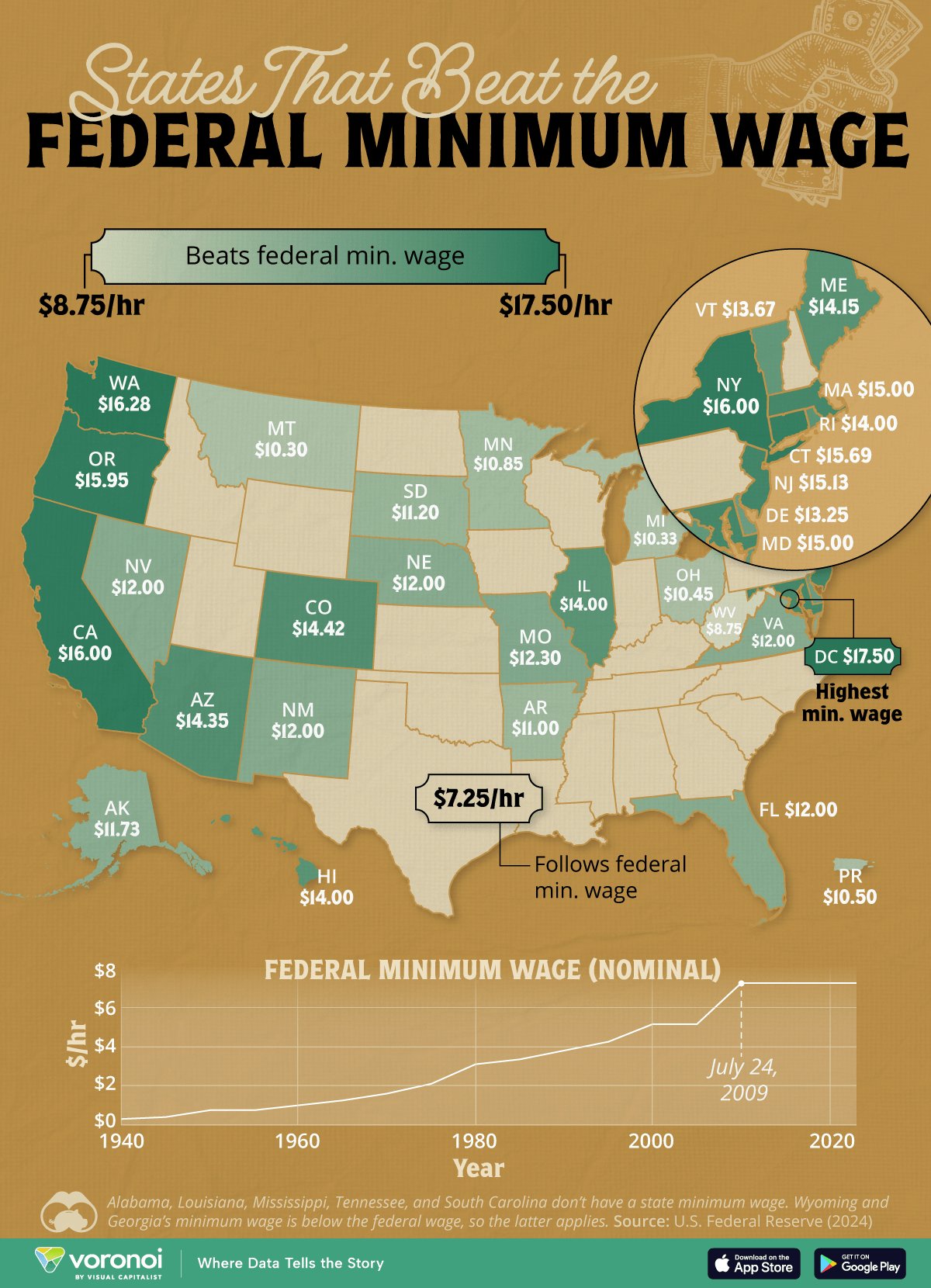
The federal minimum wage, set at $7.25 per hour, has seen a steady decline in its real value since its last increase 15 years ago.
While discussions about raising it continue, many states have proactively raised their own minimum wages.
In this graphic, we highlight the U.S. states that offer wages above the federal minimum, along with their respective minimum wage rates. The data for this graphic is sourced from the Federal Reserve as of 2024.
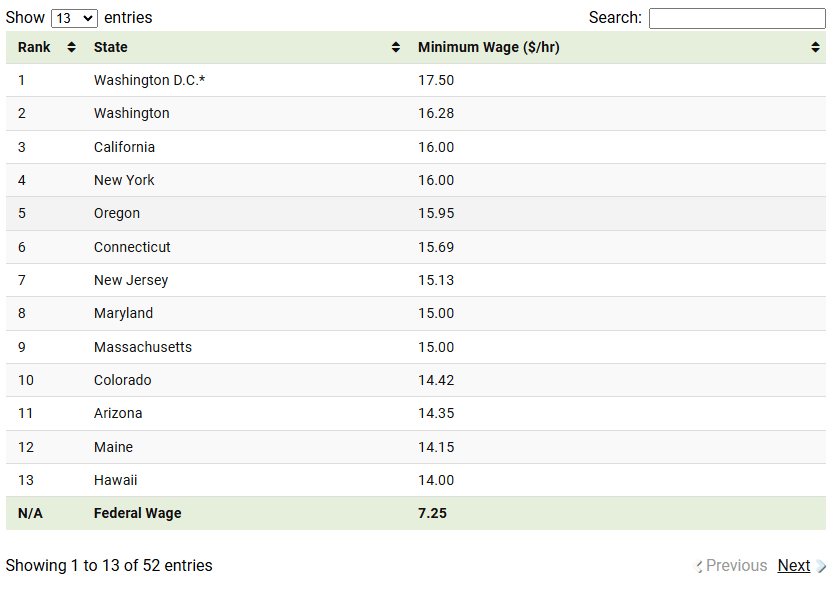
Ranked: State Minimum Wages
A total of thirty states have established minimum wages that exceed the federal minimum of $7.25 per hour.
*Federal district.
Among these states, Washington has the highest minimum wage at $16.28 per hour, closely followed by California at $16.00 per hour. Both states are known for their high cost of living, as illustrated by how little $100 can stretch in each.
However, the top spot nationwide belongs to Washington D.C., where the minimum wage is set at $17.50 per hour and is adjusted according to inflation.
Eighteen states either align with the federal minimum wage or lack a state minimum altogether, making the federal wage applicable in those areas.
Meanwhile, two states—Wyoming and Georgia—have established minimum wages below $7.25 per hour, which means the federal minimum wage applies instead.
What is the Minimum Wage Discourse?
The minimum wage debate in the U.S. centers around two primary opposing perspectives. Advocates for raising the minimum wage argue that doing so is essential for improving the living standards of low-wage workers, alleviating poverty, and addressing income inequality. They contend that moderate increases in the minimum wage have little effect on employment levels and can actually enhance consumer spending.
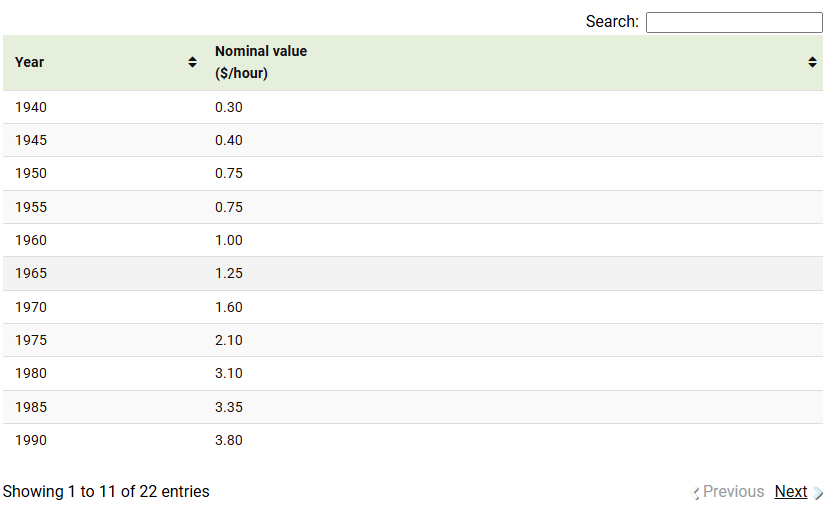
A significant aspect of their argument is that the federal minimum wage has gone without an increase for an extended period, marking the longest stretch since its establishment in 1938.
On the other hand, critics argue that substantial increases in the minimum wage could result in job losses, particularly affecting low-skilled and younger workers, which might inadvertently raise poverty rates for certain groups.
They contend that such hikes could price low-skilled workers out of the job market and negatively impact small businesses with narrow profit margins. Both sides reference economic studies to bolster their arguments, but the debate ultimately mirrors deeper societal values regarding fairness, opportunity, and the government’s role in the economy.
Since 2017, the Raise the Wage Act has been introduced in Congress annually to propose an increase in the federal minimum wage. However, none of these bills have successfully passed through the legislature thus far.
Learn More on the Voronoi App
Current proposals to “Raise the Wage” aim to elevate the minimum to $17/hour. In our feature on the Share of Workers Earning Less Than $17/Hour, we map out which states would experience the most significant changes.
 fleeredstates.blog
Leave a comment