Police Now Say They Haven’t Ruled Out Fight as a Factor in Nex Benedict’s Death

This blog originally appeared at THEM.

Officials had previously said that Benedict “did not die as a result of trauma.”
This article contains a description of violence against a gender nonconforming person.

Police in Owasso, Oklahoma, now say they have not ruled out the fight at school as a cause in the death of 16-year-old Nex Benedict earlier this month, after initially stating that the high schooler did not die as a result of “trauma.”

Benedict, whom friends say used he/him and they/them pronouns, died suddenly on February 8 following an alleged attack in an Owasso High School (OHS) girl’s bathroom the previous day. In video footage of a police interview released by the Owasso Police Department (OPD), the trans teen, who was of Choctaw ancestry, said he was physically beaten by three older girls. Benedict’s mother, Sue, told The Independent that during the fight, Nex had hit his head on the floor and afterward had bruising around his eyes and scratches on the back of his head. However, on February 21, the Owasso police department (OPD) stated that preliminary findings from Benedict’s autopsy indicated they “did not die as a result of trauma,” leading some news media to report that the fight played no role in their death.

In comments to NBC this week, OPD spokesperson Lt. Nick Boatman clarified that the department did not believe the fight was entirely unrelated to Benedict’s death. “We did not interpret that in any way,” Boatman said, referring to the term “trauma” as it appeared in the medical report, and added that “people shouldn’t make assumptions either way.” Boatman also told NBC the department has no timeline on when toxicology reports will be completed, saying such reports can take months, and confirmed no arrests had been made nor charges filed in the case as of February 26.

Boatman said that OPD released its statement last week in response to a “fury of misinformation on social media,” including the allegation that Benedict needed to be carried to the school nurse’s office on February 7, which Boatman claimed was untrue. That allegation seems to have originated from an anonymous source who spoke to local news station KJRH shortly after Benedict’s death, claiming to be the mother of the other victim of the attack.

In bodycam footage of OPD officer Caleb Thompson’s interview with Benedict and their mother on February 7, Benedict alleges that the three attackers were girls who had bullied them and their friends for at least a week, by calling them names and throwing things at them “[b]ecause of the way we dress.” Benedict said that day he poured water on one of the girls in retaliation, after which “they came at me […] started beating the shit out of me,” he recalled. Thompson can be heard in the video responding that if charges were filed, a court could find Benedict at fault because he “initiated” the fight, which would likely be seen as “mutual.”

“[They’re] the one who started the domino effect. If [they] had never done that, we may not even be here,” Thompson tells Nex and their mother Sue Benedict in the video.

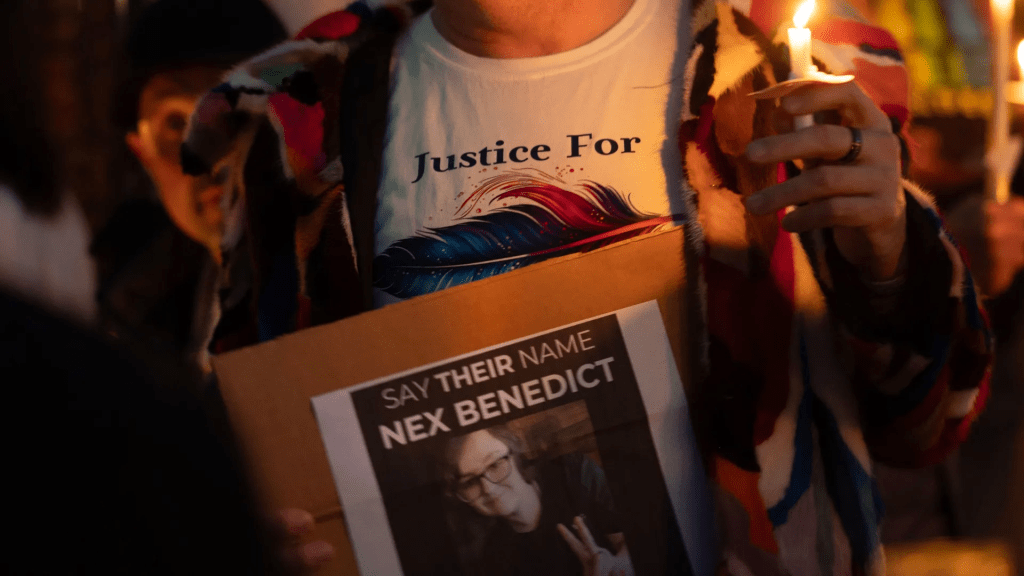
Approximately 40 of the teen’s classmates at OHS staged a walkout on Monday to protest what they described as unchecked anti-LGBTQ+ bullying at their school. LGBTQ+ and Native communities across Oklahoma have mourned Benedict’s untimely passing, with adults and students alike expressing their grief at a candlelight vigil in Owasso on February 25.

“For some reason, it feels like I’m always looking for them wherever I go, even though I was there at the funeral,” Benedict’s classmate Ally told mourners at the Sunday night vigil. “I always scan crowds, hoping they’ll come back to our class. I miss them a lot.”
https://www.them.us/story/nex-benedict-police-say-they-havent-ruled-out-fight-factor-death?utm_source=nl&utm_brand=them&utm_mailing=THEM_weekly_022824&utm_campaign=aud-dev&utm_medium=email&bxid=647003a05dfaff5d630fbb31&cndid=74113754&hasha=90d5433b1347095329a6ab5df0bd392d&hashb=555b342b6918faf1a5515da1bc4cf5731fa62fa0&hashc=f4ee38a7ae4ef690cecccbdd27678ec522f6d3c6f45bef0cc5001fd7abe7557b&esrc=bouncex-test&utm_term=THEM_Daily

Lesbian lawyer Nicole Berner confirmed as federal appeals court judge

This blog originally appeared at ADVOCATE.

Berner will make history as the first openly LGBTQ+ member to serve on the U.S. Court of Appeals for the Fourth Circuit.

Nicole Berner, a lesbian attorney known for her advocacy in labor and reproductive rights, along with her landmark parental rights case in Israel, has been confirmed by the U.S. Senate as the first openly LGBTQ+ judge on the U.S. Court of Appeals for the Fourth Circuit.

According to The Washington Post, Berner was confirmed on Tuesday by a vote of 50-47. All Republicans who voted opposed her confirmation, along with one Democrat, Joe Manchin of West Virginia.

Democratic Sen. Ben Cardin of Maryland emphasized the importance of a diverse judiciary before the vote, stating that a more inclusive bench better represents the population served by judges and enhances judicial decision-making. Both Cardin and Maryland’s other U.S. senator, Democrat Chris Van Hollen, supported President Joe Biden’s nomination of Berner, who resides in Maryland.

The Fourth Circuit covers Maryland, North Carolina, South Carolina, Virginia, and West Virginia. According to the Post, the court has shifted from being one of the most conservative to one of the most liberal in the nation over the past decade.

Berner served as a staff attorney at Planned Parenthood Federation of America from 2004 to 2006. She then held several legal roles at the Service Employees International Union, eventually becoming general counsel in 2017. Additionally, she is a partner at James & Hoffman, a labor and employment litigation firm located in Washington, D.C.

Nicole Berner was instrumental in a groundbreaking case for parental rights for same-sex couples in Israel. While residing in the country with her then-wife, Ruti Kadish, in 2000, Berner initiated legal action against the national government to secure recognition as the adoptive mother of Kadish’s biological son, Matan. Her efforts were successful, marking Matan as the first child in Israel legally acknowledged to have two mothers.

During her tenure at Planned Parenthood, Berner actively opposed abortion restrictions and advocated for access to the abortion medication mifepristone. At the Service Employees International Union (SEIU), where she rose to the position of general counsel in 2017, she represented workers in numerous cases involving labor rights. Berner also participated in legal briefs supporting marriage equality, defending the Affordable Care Act, and challenging immigration policies imposed by Donald Trump.

“Ms. Berner is a brilliant lawyer who has defended and advanced our civil and human rights, including the rights of working people, reproductive rights, and LGBTQ rights,” stated Maya Wiley, president and CEO of the Leadership Conference on Civil and Human Rights, which backed Berner’s confirmation. “Her dedication to equal justice is evident across her life and legal career, and we eagerly anticipate her contributions from the bench.”

“In addition to becoming the first openly LGBTQ+ judge on the Fourth Circuit, Nicole Berner is only the third woman from the LGBTQ+ community to serve on any federal appeals court. Her appointment marks the 11th LGBTQ+ person appointed to the federal courts by President Biden, matching the record set by President Barack Obama. Berner also holds the distinction of being the first Jewish judge on the Fourth Circuit in many years.

“Her confirmation brings essential lived experiences to the court and sends a powerful message to young LGBTQ+ lawyers, law students, and aspiring judges that they have a place on the federal bench,” stated Maya Wiley. “This is significant because the demographic and professional diversity she represents is sorely lacking in our federal courts, and it helps to enhance judicial decision-making, strengthen public trust, and bolster our democracy.”

“People for the American Way President Svante Myrick expressed great satisfaction with Nicole Berner’s confirmation. ‘We are thrilled by today’s confirmation of Nicole Berner, whose exceptional legal acumen, extensive experience, and dedication to justice will undoubtedly make her an outstanding federal judge,’ he stated.

“Myrick further praised Berner’s altruism, highlighting her advocacy for workers at SEIU and her defense of reproductive rights at Planned Parenthood. He also noted her early career contributions, including the establishment of an organization supporting Israeli women affected by violence and her leadership in democracy workshops for Arab and Jewish children. ‘Her confirmation underscores the critical importance of continuing to confirm President Biden’s judicial nominees,’ Myrick concluded.”

https://www.advocate.com/news/nicole-berner-lesbian-judge-confirmed

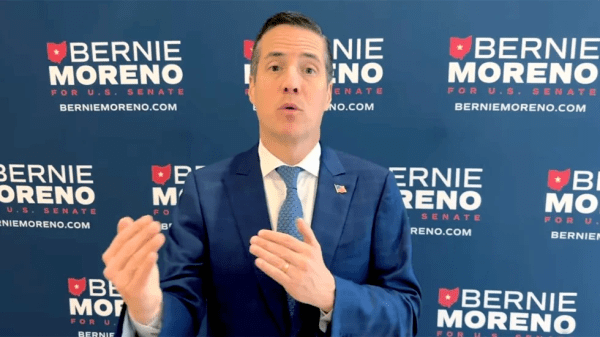
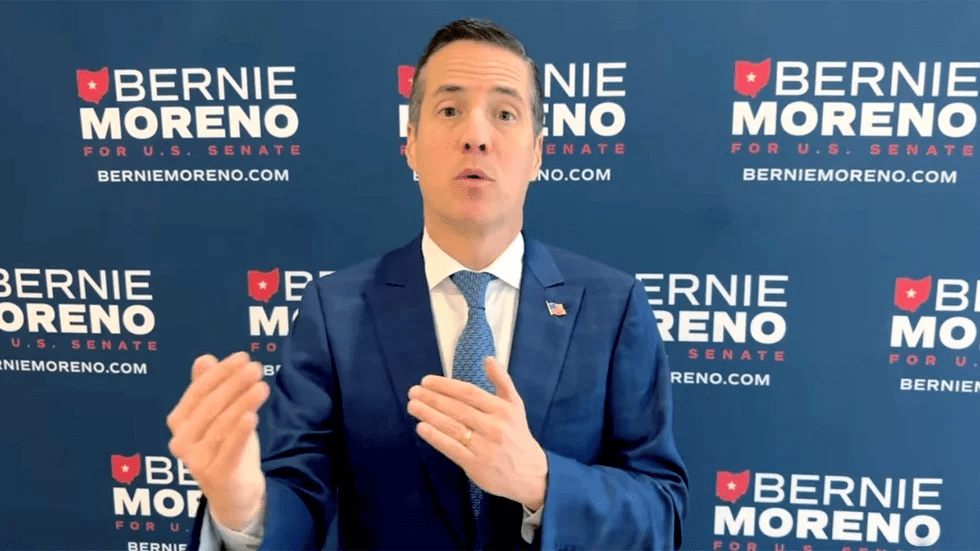
Trump ally Bernie Moreno wins the Republican primary for U.S. Senate in Ohio

This blog originally appeared at ADVOCATE.

He will face Democrat Sherrod Brown, who is supportive of LGBTQ rights, in November. Meanwhile, trans woman Arienne Childrey won her primary for the Ohio House.

Bernie Moreno, an ally of Donald Trump, has secured the Republican nomination for U.S. Senate from Ohio and will challenge Democratic incumbent Sherrod Brown, a longtime supporter of LGBTQ+ rights, in November.

Moreno won Tuesday’s primary against two more traditional Republicans, state Sen. Matt Dolan and Ohio Secretary of State Frank LaRose. With 93 percent of the vote counted, Moreno had 50.5 percent, Dolan 32.8 percent, and LaRose 16.7 percent, according to The New York Times.

A car dealer and political newcomer, Moreno once expressed LGBTQ-friendly views, supporting the Gay Games held in Ohio in 2014 both financially and through an opinion column in Crain’s Cleveland Business. However, his recent public stances have shifted towards an anti-LGBTQ+ perspective.

He also faced scrutiny over a profile that briefly appeared on a dating website called Adult Friend Finder in 2008, which sought sexual liaisons with men, as reported by the Associated Press. Moreno’s team has stated to The Advocate, the AP, and other media that the profile was created as a prank by an intern at Moreno’s business.

Moreno was a critic of Trump just a few years ago and once said he could never vote for Trump, according to CNN’s KFile. However, now he and the former president are enthusiastically supporting each other.

Brown is one of the Republicans’ top targets this year, as Ohio is trending increasingly conservative and he is its only remaining statewide Democratic elected official, other than judges. He remains popular, however, while continuing to take progressive positions, including support for LGBTQ+ rights. He has consistently received perfect scores on the Human Rights Campaign’s Congressional Scorecard during his three terms in the Senate. He faced no opposition in the Democratic primary.

Leading up to the primary, a Democratic group ran ads highlighting Moreno’s conservatism and his connections to Trump. This suggests the party “viewed him as the weakest candidate against Brown,” CNN reports.

Several other states also held primaries on Tuesday, mainly for presidential preferences and some down-ballot races. In Ohio, transgender candidate Arienne Childrey, a Democrat, won her primary for the state House of Representatives in District 84, facing no opposition except for a write-in campaign. She had previously faced the threat of disqualification for not listing her deadname on official paperwork, but her county elections board ultimately decided not to disqualify her.

In November, Childrey will compete against Republican incumbent Angela King, who has sponsored a bill to ban drag shows in certain venues and subject performers to criminal penalties. King also supported legislation restricting gender-affirming care and trans participation in school sports, which passed after lawmakers overrode Governor Mike DeWine’s veto.

Another LGBTQ+ candidate for the Ohio House, gay man Eli Bohnert, lost the District 6 Democratic primary to Christine Cockley.

In Illinois, openly LGBTQ+ officeholders Eric Sorensen (U.S. House), Kelly Cassidy (Illinois House), and Mike Simmons (Illinois Senate) all ran unopposed in their primaries. All three are Democrats.

https://www.advocate.com/politics/bernie-moreno-ohio-republican-primary

Iowa Supreme Court Upholds Six-Week Abortion Ban | WashingtonPost

This blog originally appeared at WASHINGTON POST.

The ban, enacted last summer, was part of a broader effort by conservative states to restrict abortion following the U.S. Supreme Court’s decision to overturn Roe v. Wade.

Iowa’s Supreme Court on Friday upheld a six-week abortion ban, marking one of the latest rulings to restrict access to the procedure since the U.S. Supreme Court’s 2022 decision to end federal protections for abortion.

The measure prohibits abortions after six weeks of pregnancy, the point at which fetal cardiac activity can typically be detected. Planned Parenthood and other organizations had sued to block the law and initially secured a preliminary injunction from a lower court, temporarily maintaining legal access to abortion up to 22 weeks of pregnancy in the state.

In a 4-3 decision, the judges ruled that the law, passed by the Republican-led legislature in 2023, is constitutional. This decision reverses a temporary restraining order issued by a district court last year, allowing the ongoing lawsuit at that level to proceed.

The Supreme Court’s ruling once again alters the landscape of reproductive health in Iowa, where around 4,000 women sought abortions last year. Most women will now have to travel outside the state to terminate a pregnancy. The law includes limited exceptions for cases of rape, incest, or if the woman’s life is in danger.

Abortion providers in Iowa have been preparing for months in anticipation of the court’s ruling, according to Ruth Richardson, president of Planned Parenthood North Central States, which operates three abortion care facilities in Iowa.

In anticipation of a potential ban, Planned Parenthood has expanded its locations in neighboring states, doubling the number of patient beds in Omaha and moving to a larger site in Mankato, Minnesota.

During the court’s oral arguments on April 11, the justices questioned lawyers from both sides about previous rulings that first expanded and then limited the scope of abortion protections in the state. They also debated whether this case should have been sent back to a lower court for further review.

The law will restrict abortions to a timeframe in which many women are unaware they are pregnant. The exceptions apply only if a sexual assault is reported to law enforcement or a healthcare provider within 45 days for rape and 145 days for incest. Medical exceptions include cases of fetal abnormalities “incompatible with life” or if the pregnancy endangers the woman’s life.

Across the country, abortion continues to be a contentious issue at both the federal and state levels.

In an opinion Thursday, the U.S. Supreme Court permitted physicians in Idaho to resume performing emergency abortions while litigation continues in the lower courts. However, the ruling does not settle whether a long-standing federal law mandates that doctors nationwide perform the procedure when they believe a woman’s health is in danger.

And two weeks ago, the court unanimously preserved access to mifepristone, the medication now used in over 60 percent of U.S. abortions.

These decisions followed a pair of significant state judicial rulings this spring. Florida’s Supreme Court determined that abortion rights are not protected by the state’s constitution, paving the way for one of the country’s strictest bans to take effect on May 1. Meanwhile, Arizona’s Supreme Court revived an 1864 law prohibiting abortion except to save a mother’s life and punishing providers with jail time. However, amid a storm of condemnation, the legislature and governor repealed the law before it could take effect this summer.

A recent analysis by The Washington Post reveals that more than one in three women aged 15 to 44 now reside in states where abortion is fully or mostly prohibited, encompassing 18 states. Iowa’s legislature initially passed an abortion ban in 2018, which was permanently blocked by the courts. Last summer, Governor Kim Reynolds, a staunch Republican opponent of abortion, convened a special session of lawmakers to pass a new six-week ban. Although quickly enjoined by a district court judge, the regulatory process continued.

Critics, including legal experts, have raised concerns about the rules subsequently adopted by the state Board of Medicine, citing their vagueness and lack of specificity on when doctors can intervene to save a pregnant patient’s life and how providers who violate the law would be penalized.

The topic continues to be highly contentious within the state, despite a majority of Iowans supporting legal abortion in most situations. According to a Des Moines Register/Mediacom Iowa Poll from last year, 61 percent of residents believe abortion should be legal in most or all cases, while 35 percent are opposed.

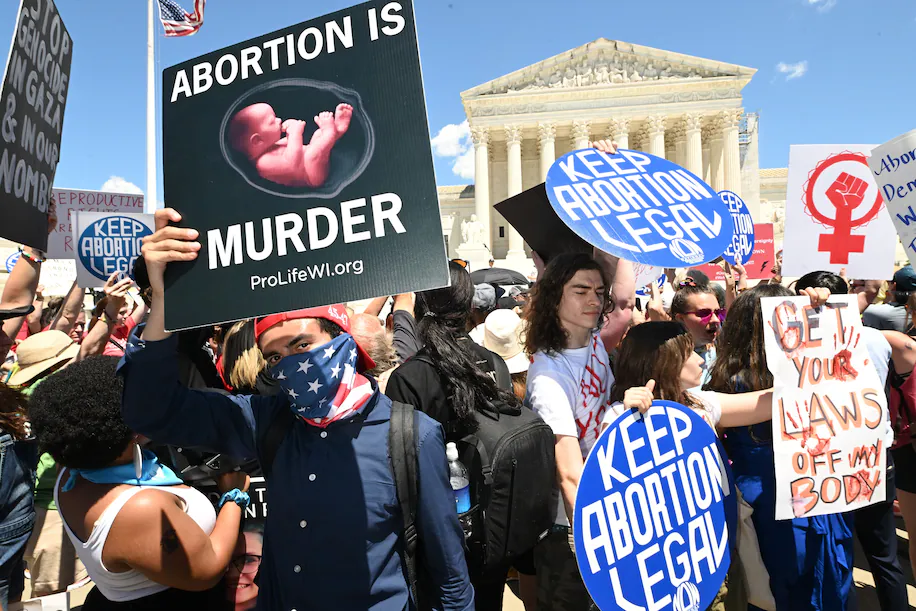
Over the weekend, hundreds of abortion opponents gathered at the Capitol in Des Moines ahead of the anticipated ruling.

SAN ANTONIO NEWS: Congressman Chip Roy of San Antonio expresses desire to ‘ethnic cleanse’ white progressives

This blog originally appeared at SAN ANTONIO CURRENT.

In a tweet defending Donald Trump’s plan to deport 20 million migrants, Roy said he wants to deport “white progressive Democrats – with a special bonus for rich ones with an Ivy League degree.”

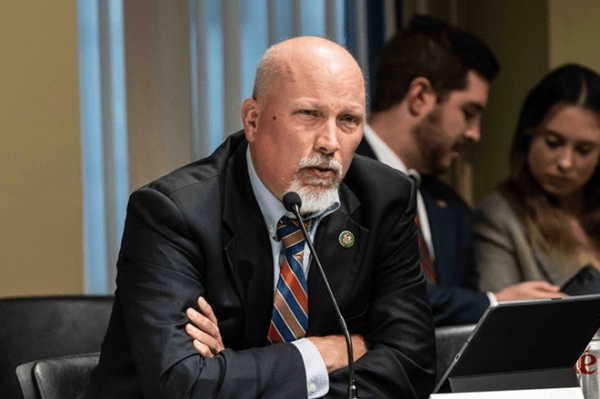
U.S. Rep. Chip Roy, a Republican representing a district covering parts of North San Antonio, advocated for the removal of progressives in a recent tirade posted on social media platform X.

The GOP congressman, known for his provocative remarks in politics, tweeted in support of Trump’s proposal to deport approximately 20 million migrants if elected president. Critics on social media have likened Trump’s plan to ethnic cleansing.

“I’ll tell you what – I do support ‘ethnic cleansing’ by deporting white progressive Democrats, especially those with Ivy League degrees and wealth,” Roy tweeted. “I have strong feelings about ‘those individuals.’

For context, Roy holds a bachelor’s degree from the University of Virginia and a law degree from the University of Texas at Austin—both prestigious institutions, though not Ivy League.

Roy’s remark was prompted by a tweet from Will Stancil, an attorney and research fellow at the Institute of Metropolitan Opportunity in Minneapolis, criticizing Trump’s deportation proposal.

“Deporting 20 million people is tantamount to ethnic cleansing,” Stancil tweeted. “That’s roughly the population of New York State or half of the Midwest. It represents 6% of the entire population—a person from every classroom, workplace, or street. It includes small children, working mothers, and entire families.”

While scholars have debated the definition of ethnic cleansing, it generally denotes the forced expulsion of a particular ethnic group or minority. Surprisingly, it is not recognized as an independent crime under international law, as per the United Nations.

Ethnic cleansing differs from genocide, which involves the systematic extermination of a specific ethnic group and constitutes a clear violation of international law.

Regardless, a remark suggesting “ethnic cleansing” by a sitting U.S. Congressman — even if intended humorously — sparked outrage on social media.

“Disgusting and racist! Shame on you!” tweeted user @DavidSmuts in response to Roy.

“Congressman, being so divisive all the time is harmful,” added user @isaiahmartin.

San Antonio U.S. Rep. Chip Roy Faces Backlash After Controversial “Ethnic Cleansing” Remark

In a tweet defending Donald Trump’s proposed deportation of 20 million migrants, U.S. Rep. Chip Roy, whose district covers parts of North San Antonio, sparked outrage with a call to “cleanse” progressives.

The GOP congressman, known for his provocative political style, tweeted in support of Trump’s deportation plans, which some critics on social media have likened to ethnic cleansing.

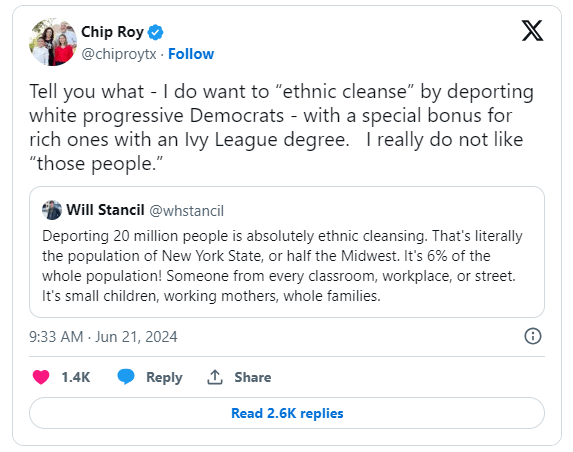
“Tell you what – I do want to ‘ethnic cleanse’ by deporting white progressive Democrats – with a special bonus for rich ones with an Ivy League degree,” Roy tweeted. “I really do not like ‘those people.'”

For the record, Roy holds degrees from the University of Virginia and the University of Texas at Austin, prestigious institutions though not Ivy League.

Roy’s comment was prompted by a tweet from Will Stancil, an attorney and research fellow at the Institute of Metropolitan Opportunity in Minneapolis, who strongly criticized Trump’s deportation proposal.

“Deporting 20 million people is absolutely ethnic cleansing,” Stancil wrote. “That’s literally the population of New York State, or half of the Midwest. It’s 6% of the whole population! Someone from every classroom, workplace, or street. It includes small children, working mothers, and whole families.”

While scholars debate the term “ethnic cleansing,” it generally refers to the forced removal of a specific ethnic group or minority and is not recognized as a standalone crime under international law by the United Nations. This differs from genocide, which involves the systematic extermination of an ethnic group and is a clear violation of international law.

Regardless, Roy’s reference to “ethnic cleansing”—even if intended humorously—prompted strong reactions on social media.

“Disgusting racist! Shame on you!” tweeted user @DavidSmuts in response to Roy.

“Congressman, being so divisive all the time isn’t healthy,” added user @isaiahmartin.

Some voices, however, supported Roy’s statement.

“We’re with you brother,” commented user @chrischownyk. “It’s time to take back our constitutional republic.”

This isn’t the first time Roy—a former chief of staff to U.S. Sen. Ted Cruz—has stirred controversy with outspoken remarks. Recently, he warned on the House Floor that Biden administration immigration policies could lead to the imposition of “Sharia Law” on Americans. In 2020, during Passover, Roy compared COVID stay-at-home orders to actions in “Nazi Germany” on a conservative talk show.

Roy faces reelection in November amid continued scrutiny of his outspoken style and controversial statements.

https://www.sacurrent.com/news/san-antonio-us-rep-chip-roy-says-he-wants-to-ethnic-cleanse-white-progressives-34866152?fbclid=IwZXh0bgNhZW0CMTEAAR3bvjHdw7qF15uDNa7j14-N_Q1GkhA5baF-poNCLLuAM4vaaLwXse2lci4_aem_WChhV_-hkbj4MMC9RQnFnQ&sfnsn=mo

Reasons Why Some Regret Their Move to Texas After the Pandemic

This blog originally appeared at YAHOO FINANCE.

The COVID-19 pandemic in 2020 sparked a significant wave of migration among Americans. Many residents of costly and densely populated areas saw an opportunity. With the shift to remote work and a growing preference for greater physical distance between neighbors, urban dwellers were able to relocate from places like New York and California to states such as Texas and Florida.

During the pandemic, Texas ranked second only to Florida in terms of states with the highest net migration rates. However, four years later, many who relocated to the Lone Star State are reconsidering their decision to uproot and move their families there.

I’ve observed several reasons why some individuals who moved to Texas post-pandemic might be experiencing regrets,” said Jolean Olson, a veteran in the Texas housing market at Olson Home Buyers. “While Texas offers numerous benefits, such as a lower cost of living, no state income tax, and a thriving job market, there are also challenges and downsides that have become apparent to some new residents.”

Next point: Here are some reasons people may regret moving to Texas post-pandemic.

Extreme Weather Conditions

“Texas has earned a reputation for its scorching summers and frequent severe weather events, including hurricanes, tornadoes, and flash floods, among others.

“Many new residents may not have anticipated the intensity of Texas summers, where temperatures often surpass 100 degrees Fahrenheit,” Olson remarked.

Moreover, Olson highlighted the impact of the severe winter storm that struck Texas in early 2021. This event led to shortages of essential resources like water and widespread power outages across the state. According to Olson, the storm underscored “the state’s susceptibility to extreme weather and its inadequate infrastructure to manage such emergencies.”

Infrastructure and Public Services

“The surge of new residents has strained Texas’s infrastructure and public services,” Olson explained.

Cities such as Austin, Dallas, and Houston have experienced escalating traffic congestion on both highways and local roads, leading to longer commute times and heightened frustration for drivers.

“Compared to other states, public transportation options in Texas are limited, which can pose a significant adjustment for individuals accustomed to more extensive transit networks,” Olson added.

Housing Market Pressures

“Although Texas has long been recognized for its affordable housing, the pandemic-driven influx has sharply increased home prices and rental rates,” Olson noted. “Many newcomers who anticipated affordable housing options are now contending with a competitive and costly market.”

Olson highlighted how the heightened housing market activity has led to more intense bidding wars, rising property taxes, and, in some cases, “disappointment for those unable to secure their desired homes within their budget.”

Higher Property Taxes

Purchasing a house is just the beginning of the challenges for property owners in Texas. Property taxes, as highlighted in WalletHub’s 2024 report, rank Texas seventh-highest in the nation. For new residents, this can come as a surprise, potentially offsetting the savings from Texas’s lack of state income tax. This scenario is especially pronounced for those relocating from states with significantly lower average property tax rates.

Cultural and Lifestyle Adjustments

Texas boasts a unique cultural identity that can be both captivating and challenging for newcomers to acclimate to.

“Texas has a distinct cultural identity that may not appeal to everyone,” Olson emphasized, noting that “the political atmosphere leans more conservative compared to states such as California or New York, which can be a substantial shift for individuals with differing perspectives.”

Furthermore, Olson pointed out that life in Texas, especially outside its major cities, “tends to be more suburban and less cosmopolitan, which might not meet the expectations of those coming from more urbanized areas.”

Employment Market Realities

Securing a suitable job that aligns with one’s skills and provides a sufficient income for a family can be challenging in Texas, despite the state’s reputation for a robust and thriving job market.

“Many newcomers have discovered that the available job opportunities don’t always align with their skill sets or salary expectations,” noted Olson. “Competition for higher-paying positions has also intensified due to the influx of new residents, making it more difficult for some to land their desired roles.”

Education System Concerns

According to Olson, the quality of public education in Texas varies significantly. “While some districts excel, others suffer from underfunding and lower educational outcomes,” she noted.

Depending on the location within Texas, the school system can be a point of disappointment. “Families moving here with school-aged children might find the public education options in their chosen communities lacking, which can lead to added stress and even relocation within the state,” Olson explained.

Overall, while Texas has many positives, Olson emphasized the importance of considering various factors before deciding to move there. “Texas offers numerous advantages, but potential residents should carefully weigh these against the challenges,” she advised. “Understanding the complete picture of life in Texas, beyond the initial allure, is crucial for making an informed decision.”

“As a real estate professional, I always recommend thorough research and ideally visiting the areas under consideration to ensure they align with your expectations and needs,” Olson concluded.

https://finance.yahoo.com/news/why-many-regret-moving-texas-170009198.html?guccounter=1&guce_referrer=aHR0cDovL20uZmFjZWJvb2suY29tLw&guce_referrer_sig=AQAAAEx-buRShvjrUCtko65f-JHKRFqezdoSXcL7x9gf7wCwWe4fN4QT7GEzJCuQtuO3_dNDIyxt-qK9DugdXCBz_f53ozPUD2NIvPe1e37S2UmuftTLI9bVE4dIo_lNqIIvljcDmVlBWSJLW0JqPCZXbkqwt6-1ACkhcXPwbdgbP7K3

Judge rules that DeSantis’s ban on transgender care is unconstitutional

This blog originally appeared at WASHINGTON POST.

A federal judge blocked most provisions of the law pushed by Florida Gov. Ron DeSantis that banned gender-affirming care for children and restricted it for adults.

“The decision, issued on Tuesday, struck down most of a law supported by Florida Governor Ron DeSantis (R) that severely restricted transgender healthcare for adults and completely banned it for children.

U.S. District Judge Robert L. Hinkle rejected a prevailing argument from the DeSantis administration that denied the existence of transgender individuals, emphasizing in his ruling that “gender identity is real” and that the state cannot withhold treatment from them. Hinkle drew parallels between prejudice against transgender people and discrimination rooted in racism and misogyny.

“Florida has enacted legislation and regulations that prohibit gender-affirming care for minors, even when it is medically necessary,” Hinkle wrote. “This ban violates the Constitution.”

The decision, which arose from a lawsuit filed by parents of transgender children and adults, was celebrated by many in the LGBTQ community as a significant triumph. While several states have recently banned gender-transition care for minors, Florida’s law was the first to restrict care for adults.”

Under the legislation, nurse practitioners were prohibited from prescribing hormones to transgender adults. Although doctors could technically provide care, a shortage of physicians meant that many transgender adults struggled to find accessible treatment. Some individuals left the state, while others went without necessary medical care.

Joey Knoll, who established Spektrum Health in Orlando in 2018 to provide healthcare to transgender individuals, stated that Hinkle’s ruling allows him and his team to promptly address a backlog of over 300 patients awaiting hormone prescriptions.

“Judge Hinkle clearly identified this as a situation involving bias and discrimination,” Knoll remarked. “He thoroughly examined the evidence and acknowledged that fact.”

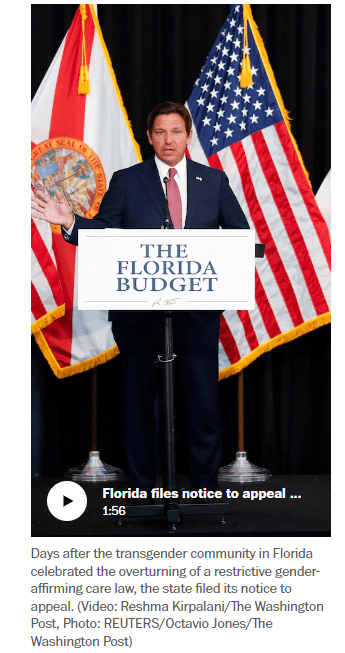
Jeremy Redfern, press secretary for Governor DeSantis, indicated that the state plans to appeal the decision.

“In an email, Redfern wrote, ‘Under Governor Ron DeSantis, Florida will continue to fight to ensure children are not chemically or physically mutilated in the name of radical, new age ‘gender ideology.’ He added that the law limiting transgender care was passed by elected representatives to protect the children of this state and that Hinkle was wrong to override their wishes.”

“These procedures do permanent, life-altering damage to children, and history will look back on this fad in horror,” Redfern wrote.

In his decision, Hinkle, appointed by President Bill Clinton, referenced statements from DeSantis and Republican legislators regarding “mutilating our children,” yet noted the state provided no evidence that such surgeries have ever occurred in Florida.

The plaintiffs in the lawsuit did not contest the restrictions on surgeries.

Judge Hinkle also criticized the “frenzied rhetoric” from Tallahassee, highlighting a lawmaker who publicly referred to transgender witnesses during a committee hearing on a related bill as “mutants” and “demons,” which he described as “direct evidence of that member’s animosity.”

Furthermore, the law, in conjunction with regulations from the state’s Health Care Administration board, mandated that healthcare providers obtain patient signatures on lengthy forms that Hinkle deemed “inaccurate and misleading in significant ways.”

One of the Floridians who sued, Lucien Hamel, said the decision was a relief.

“The state has no place interfering in people’s private medical decisions, and I’m relieved that I can once again get the healthcare that I need here in Florida,” Hamel said in a statement released by the lawyers who represented him and others in the case.

The mother of another plaintiff, who sued under the name Susan Doe to protect her daughter’s identity, also cheered the ruling.

One of the plaintiffs in the lawsuit, Lucien Hamel, expressed relief at the decision.

“The state has no right to interfere in people’s private medical decisions, and I’m relieved that I can once again access the healthcare I need here in Florida,” Hamel said in a statement issued by the attorneys representing him and others involved in the case.

The mother of another plaintiff, identified as Susan Doe to protect her daughter’s identity, also celebrated the ruling.

“This decision means I won’t have to witness my daughter suffering unnecessarily because I couldn’t provide her with the care she needs,” she remarked in a statement. “Seeing Susan’s anxiety over this ban has been one of the most difficult challenges we’ve faced as parents. All we ever wanted was to alleviate that fear and support her in continuing to be the happy, confident child she is today.”

Judge calls DeSantis ban on transgender care unconstitutional https://www.washingtonpost.com/nation/2024/06/11/florida-lgbtq-trans-health/

Every Louisiana Public School Classroom Now Required to Display the Ten Commandments

This blog originally appeared at THEM.

All Public School Classrooms in Louisiana Are Now Required to Display the Ten Commandments

The law went into effect this week and applies to all public K-12 schools as well as private schools that receive government funding.

Louisiana Governor Jeff Landry signed a new law this week requiring all public and state-funded schools to prominently display the “Ten Commandments,” making Louisiana the first U.S. state to implement such a policy.

Landry, a Republican, signed House Bill 71 into law on Wednesday, following its approval in the House by a 79-16 vote late last month. The law, which takes effect immediately, mandates that all public schools and private educational institutions receiving government funding display the Ten Commandments in every classroom and office building. The law specifies the language to be used for each commandment, requires the displays to be at least 11 by 14 inches in size, and ensures the text is the “central focus of the poster” and “printed in a large, easily readable font.” (Perhaps they’ll make an exception for Papyrus.)

Louisiana is now the only U.S. state requiring schools to display the Ten Commandments. However, since 2001, Mississippi has mandated state schools to post the motto “In God We Trust,” a requirement Louisiana matched last year.

HB 71 was authored by GOP Rep. Dodie Horton, who has been in office since 2015. Horton is also the chief sponsor of HB 122, which recently passed both chambers of the state legislature and awaits Governor Landry’s signature. This bill would prohibit K-12 teachers from discussing sexual orientation or gender with students under most circumstances, an effort Horton first attempted unsuccessfully in 2022.

During the debate on HB 71 in April, Horton expressed her intent to integrate more conservative Christian principles into state law, as reported by the Times-Picayune.

“I’m not concerned with an atheist. I’m not concerned with a Muslim,” Horton said, referring to non-Christian teachers. “I’m concerned with our children looking and seeing what God’s law is.”

However, Horton’s rhetoric contrasts with other Republicans, such as Sen. J. Adam Bass, who argued that the bill’s purpose was “not solely religious.” According to the Times-Picayune, Bass maintained that the commandments hold “historical significance” to the U.S. as “one of many documents that display the history of our country and foundation of our legal system.”

On Wednesday, the same day Landry signed HB 71 into law, representatives from the American Civil Liberties Union, the ACLU of Louisiana, Americans United for Separation of Church and State, and the Freedom from Religion Foundation announced their intention to challenge the law in a joint statement.

“The displays mandated by HB 71 will result in unconstitutional religious coercion of students, who are legally required to attend school and are thus a captive audience for school-sponsored religious messages,” the groups wrote. “Even among those who may believe in some version of the Ten Commandments, the particular text that they adhere to can differ by religious denomination or tradition. The government should not be taking sides in this theological debate, and it certainly should not be coercing students to submit day in and day out to unavoidable promotions of religious doctrine.”

https://www.them.us/story/ten-commandments-law-louisiana

Utah’s Anti-Trans Bathroom Snitch Line Got 12,000 Tips. None Could Be Verified.

This blog originally appeared at THEM.

Utah’s Anti-Trans Bathroom Snitch Line Got 12,000 Tips. None Could Be Verified

Six Weeks After Launch, Utah’s Anti-Trans Bathroom Tip Line Received 12,000 Reports, None Verified

Six weeks after Utah Republicans introduced a public “snitch form” to report transgender individuals using bathrooms in government facilities, the state auditor’s office has received over 12,000 reports—none of which could be verified.

The tip line was established following the passage of HB 257, sponsored by second-term GOP Rep. Kera Birkeland. The law mandates that all government bathrooms and locker rooms be designated based on a person’s assigned sex at birth. It also requires government institutions to create their own “privacy compliance plan” in accordance with the law. Violations are classified as criminal trespass offenses, a class A misdemeanor in Utah.

However, shortly after the form went live in early May, it was inundated with spam, including numerous memes and at least one picture of bull testicles.

Since its launch, the form has received more than 12,000 submissions, Utah Auditor John Dougall confirmed to the Salt Lake Tribune this week. Just five of those were deemed “plausible,” Dougall said, but his office was “unable to substantiate” any of them. In essence, the tip line has produced no verifiable cases.

The closest Dougall reportedly came to finding a case to pursue was from a report against the state Department of Corrections, which did not come through the online form. According to the Tribune, Dougall’s office received a letter earlier this month alleging that an employee in the administrative offices allowed an individual to use a sex-designated restroom that did not align with their sex. However, Dougall confirmed he was unable to substantiate the complaint.

Dougall also noted that he has instructed state agencies to adopt “privacy compliance plans,” but there has been significant confusion about how to implement these plans. According to a statement from Dougall’s office to the Tribune, “there is a lack of clarity regarding which entity has the duty to adopt a privacy compliance plan in situations when multiple entities either share use or control of facilities for which a plan is required.” Essentially, the overlapping jurisdiction of government facilities complicates the establishment and oversight of these policies.

In summary, Utah Republicans have likely invested hundreds of work hours and significant taxpayer dollars on a tip line that, in a month and a half, has primarily been used for trolling. Utah Auditor John Dougall has been particularly critical of this debacle. He has released multiple videos on social media mocking his new role as a government “bathroom monitor” and criticizing Rep. Kera Birkeland and other legislators for enacting HB 257.

“It seems like this part of the bill was more about show than substance,” remarked John Dougall in a video filmed in a public bathroom and released in mid-May. “But it wouldn’t be the first time the legislature did something like that, would it?”

https://www.them.us/story/utah-anti-trans-bathroom-tipline-none-verified

Supreme Court to decide whether states can restrict gender-affirming care for minors | CNN Politics

This blog originally appeared at CNN.

Supreme Court to rule on states’ ability to limit gender-affirming care for minors

CNN – The Supreme Court agreed on Monday to hear the Biden administration’s challenge to Tennessee’s transgender care ban, addressing the contentious issue of gender-affirming care in depth for the first time.

The Tennessee law, enacted last year, prohibits hormone therapy and puberty blockers for minors and imposes civil penalties on doctors who violate these prohibitions. This law is part of a growing trend of state legislation targeting transgender care.

According to the Human Rights Campaign, nearly half of U.S. states have enacted bans on transgender care for minors.

The case is scheduled to be heard this fall.

“The Supreme Court was always going to have to resolve how state bans on gender-affirming medical care can be reconciled with its approach to sex-based discrimination,” said Steve Vladeck, CNN Supreme Court analyst and professor at the University of Texas School of Law. “Today’s grant sets up this issue as one of the early blockbusters for the Court’s upcoming term.”

Laws in Kentucky and Tennessee were challenged by the Biden administration and families of transgender minors. However, the Supreme Court only agreed to hear the Biden administration’s challenge against the Tennessee law.

In September, the 6th US Circuit Court of Appeals in Cincinnati reversed a district court ruling that had blocked the enforcement of the gender-affirming care ban. This decision allowed the ban to take effect.

Republican lawmakers supporting the ban argue that decisions about gender-affirming care should be made once an individual reaches adulthood. Opponents contend that these laws not only violate the civil rights of transgender youth but also infringe on parents’ rights to make medical decisions for their children.

Tennessee’s law prohibits medical providers from performing procedures that “enable a minor to identify with, or live as, a purported identity inconsistent with the minor’s sex” or “treat purported discomfort or distress from a discordance between the minor’s sex and asserted identity.”

Legal battles over similar bans have been progressing through federal courts for over a year. In April, the Supreme Court temporarily allowed Idaho officials to enforce a strict statewide ban on gender-affirming care for most minors, though it did not resolve the underlying legal questions.

Several advocacy groups for transgender youth have urged the Supreme Court to strike down Tennessee’s law.

“It’s simple: Everyone deserves access to the medical care that they need, and transgender and non-binary young people are no exception,” said Kelley Robinson, president of the Human Rights Campaign. “No politician should be able to interfere in decisions that are best made between families and doctors, particularly when that care is necessary and best practice.”

Lucas Cameron-Vaughn, an attorney with the American Civil Liberties Union of Tennessee, criticized state lawmakers for using the bans to “fuel divisions for their own political gain.”

“It’s crucial to recognize that for trans youth and their families, this isn’t about politics,” Cameron-Vaughn said. “It’s about the fundamental freedom to access vital, life-saving healthcare.”

Tennessee Attorney General Jonathan Skrmetti, a Republican, expressed his eagerness to defend the law.

“This case will bring much-needed clarity to whether the Constitution contains special protections for gender identity,” he said.

Blog at WordPress.com.

Up ↑