Military Personnel with Transgender Connections View NDAA Provision as a ‘Slap in the Face’

This blog is originally appeared at The Hill

Military Veterans, Families, and Service Members with Transgender Children Decry NDAA Provision as a ‘Slap in the Face’

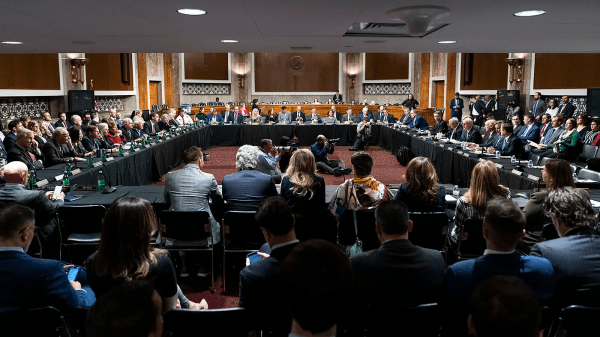
Military veterans, active-duty service members, and families with transgender children are condemning a provision in Congress’s annual defense policy bill that targets certain medical treatments for transgender minors, calling it a “slap in the face” based on misinformation and a lack of understanding about the transgender community.

The provision, included in the compromised version of the National Defense Authorization Act (NDAA) negotiated by the House and Senate, would block TRICARE, the military’s health insurance program, from covering gender dysphoria treatments for minors that could potentially lead to sterilization, applying to individuals under the age of 18.

Senate Provision Would Have Explicitly Banned Coverage for Gender-Affirming Hormone Therapy and Puberty Blockers for Minors

A more specific provision, adopted by the Senate Armed Services Committee in its defense bill in July, sought to explicitly prohibit coverage for “affirming hormone therapy” and puberty blockers, as well as other medical treatments for gender dysphoria—distress stemming from a mismatch between an individual’s gender identity and sex assigned at birth—if they “could result in sterilization” for minors.

Hormone treatments, which typically involve doses of testosterone or estrogen, can have mixed effects on fertility, while puberty blockers, used to delay physical changes like breast development or voice deepening, are not known to significantly affect fertility on their own.

Branden Marty, a Navy veteran with a transgender daughter, criticized such policies, noting that they reflect a broader failure to listen to medical experts. “With policies like this, and we’ve seen them in states and at the federal level, legislators and politicians and leaders within our system of government are not listening to experts,” Marty said.

He emphasized that gender-affirming care is about working with healthcare professionals to provide support to families, helping transgender and nonbinary children understand their identities, and ensuring they can live healthy, fulfilling lives at school and home. “It’s about helping a child understand themselves and develop a positive self-appreciation,” he added.

Major Medical Groups Affirm Gender-Affirming Care as Medically Necessary, Lifesaving, and Essential

Leading medical organizations have consistently stated that gender-affirming healthcare for both transgender adults and minors is medically necessary and can be lifesaving. These groups strongly oppose efforts by state and federal governments to restrict access to such treatments, arguing that they are essential for the well-being and mental health of transgender individuals.

Other GOP-backed proposals to reverse the Pentagon’s abortion travel policy and prohibit TRICARE from covering gender-affirming care for transgender service members were removed from the final version of the bill. This suggests that Republicans believe the ban on care for transgender minors will be sufficient to secure broader support for the measure, even if other contentious provisions are excluded.

Democrats Push Back Against NDAA Over Transgender Care Prohibition; White House Remains Silent on Veto

At least one Democrat, House Armed Services Committee Ranking Member Adam Smith (D-Wash.), has announced he will vote against the NDAA over its prohibition on gender-affirming care for transgender minors. Other Democrats, including Rep. Seth Moulton (D-Mass.), also refused to advance the bill on Tuesday, citing the “ideological riders” attached to the legislation, which typically enjoys bipartisan support.

On Tuesday, House Armed Services Committee Chair Mike Rogers (R-Ala.) stated that he disagreed with the inclusion of the healthcare provision in the final NDAA and was not involved in its decision. However, he stopped short of opposing the overall $883.7 billion defense package.

The White House has not yet indicated whether President Biden, who has previously pledged to veto legislation that discriminates against transgender people, would sign the bill in its current form.

Speaker Mike Johnson Defends NDAA Provision as Victory for Troops; Air Force Chief Disagrees on “Lethality” Impact

During a news conference on Tuesday, Speaker Mike Johnson (R-La.) hailed the provision barring TRICARE coverage for gender-affirming care for minors as a victory “for our troops and for our country.”

“We spent a lot of time and effort working on it,” Johnson said of the negotiated NDAA text, emphasizing that service members and their families deserve the best support possible. In a statement on Sunday, Johnson argued that “woke ideology” had infiltrated the military, and that permanently banning transgender medical treatment for minors would help refocus the military on “lethality.”

However, an Air Force chief, who requested anonymity due to his active-duty status, expressed disagreement with Johnson’s characterization, stating that he saw no connection between the provision and improving the “lethality” of the U.S. armed services.

Air Force Chief and Spouse Criticize NDAA Provision, Argue It Undermines Military Readiness

“As someone who has served for over 20 years and is involved in high-level decision-making on the morale, health, welfare, training, readiness, and equipping of service members, I cannot link those things,” said an Air Force chief, identified only as “J,” in an interview with The Hill.

“I don’t understand how he [Speaker Johnson] comes to that conclusion, because, in my mind, it doesn’t make sense at all. Taking away something that families are relying on distracts us from the mission and the task at hand to remain as lethal as we are,” said J, whose teenage daughter is transgender and currently receives medical care covered by TRICARE.

J’s spouse, referred to only as “H,” also weighed in, criticizing the provision’s potential impact on military families. “You can’t say this is going to help our military when you’re scaring military families,” H said, expressing concern about the stress and uncertainty the provision could create for service members and their loved ones.

Military Families Weigh Impact of NDAA Provision on Health Care and Future Service

If the NDAA passes in its current form, “J” and “H,” who live on the West Coast, are considering supplemental health insurance or paying out-of-pocket for their child’s care—options that could put significant strain on the family’s finances. With more than two decades of military service and just two-and-a-half years remaining on his commitment, “J” is also rethinking his future in the military.

“I have a strong desire and propensity to continue to serve, but this will definitely weigh on my and my family’s decision to continue serving,” said “J.” “It’s difficult, but my family’s got to come first.”

Ann, a military veteran and spouse of a senior Pentagon officer, echoed similar concerns. Her teenage son is transgender, and she explained that the latest NDAA adds another layer of complexity to their family’s ability to relocate and maintain stability. Ann, who requested to be identified only by her middle name due to her husband’s active duty status, expressed frustration with the uncertainty the provision creates for families like hers.

Military Families Feel Increasing Pressure as Gender-Affirming Care Restrictions Spread

“The country is kind of closing in on us, like we’re running out of places to go,” Ann said, reflecting on the growing restrictions surrounding gender-affirming care. “Especially with something like the NDAA and just seeing the writing on the wall about a national ban on gender-affirming care.” She referenced one of President-elect Trump’s campaign promises, adding, “The little safety bubbles are getting smaller and smaller.”

Since 2021, more than half of the U.S. states have either heavily restricted or outright banned some forms of transition-related care for minors—and, in some cases, adults. The Supreme Court also appears poised to uphold a Tennessee law that bans gender-affirming care for youth, further escalating concerns among families in similar situations.

Ann, a military veteran who served eight years, including a 15-month combat tour in Iraq, and her husband, a four-time combat deployer who served in Iraq and Afghanistan, have spent roughly five years apart due to their service. The couple now faces the additional strain of navigating an increasingly hostile landscape for transgender care while managing the demands of military life.

Transgender Child Thriving with Gender-Affirming Care, but Family Faces Uncertainty with NDAA Provision

Now relocated to Virginia, Ann shared that her transgender child is “thriving” with the support of gender-affirming care provided through TRICARE. He enjoys fencing, watching sports, and playing in his school’s band. Academically, he has excelled, though Ann noted that his geometry class this year has been a bit “humbling.”

“Trans kids are kids. They are, the overwhelming majority, thriving and doing well and contributing to their community,” Ann said. “They’re happy and they’re healthy, and that’s like all that parents want, right?”

However, while Ann’s husband is not yet ready to retire, the potential loss of coverage for their son’s care would force the family to rethink their future. “If coverage for our son’s healthcare is taken away, that’s pretty much marking the end of the road,” Ann said, expressing the deep uncertainty and frustration many military families like hers are grappling with in light of the proposed policy changes.

Military Spouses Express Concern Over NDAA Provision and Its Impact on Transgender Service Members and Their Families

“If that’s the way we’re going to be treated … if that’s the tone that Congress and the government wants to set, then that’s pretty unfortunate,” said Ann, reflecting on the potential consequences of the NDAA provision. “You’re going to lose combat experience; you’re going to lose leaders with decades of valuable experience that the military needs.” She continued, “It’s a scary world out there, so it’s a pretty sad state of affairs for our national security that you’re going to ask folks to make that decision and not support their families.”

“C,” a veteran spouse whose husband served in the military for 26 years, described the NDAA’s gender-affirming care provision as “an enormous slap in the face.” She, too, has concerns about the direction the military is taking. “C” requested that she be identified only by her first initial because her transgender child, now an adult, is not publicly out as trans.

“C” and her husband both come from military families, and their child had plans to follow in their footsteps with a military career. But with the ban on TRICARE coverage for transgender healthcare and the looming possibility that President-elect Trump may reinstate a policy barring transgender people from serving openly, “C” worries about whether the military will remain a safe place for her child. “It’s all they’ve ever wanted — to be like their dad, to carry on a family tradition of service to the country,” she said. “I don’t think I can truly even express how devastating it would be for them to not be able to fulfill those dreams.”

Similarly, “B,” a military spouse from the Southwest, expressed concern about the long-term implications of the NDAA provision. While the measure doesn’t directly affect her own daughter, an 18-year-old college student, she fears it could set a troubling precedent. “This is kind of a slippery slope,” said “B,” who requested anonymity because her husband, an airman, is actively serving. “If this becomes the first federal law to prevent transgender youth from getting this healthcare, what’s to stop [Congress] from removing TRICARE coverage for trans people of all ages?”

“B” continued, “I do get concerned about that moving forward, that this could impact my daughter, this could impact older trans adults. I don’t know where this ends, so I think it’s a really dangerous road to start down.”

Her daughter, who has been accessing gender-affirming care through TRICARE, came out to “B” and her husband when she was just 12. “It was a very steep learning curve for us … I had never even heard the word ‘cisgender’ before,” said “B.” They sought advice from medical professionals, mental health providers, and other parents before making the decision to support their daughter’s medical transition. “This wasn’t something that we went into blindly or quickly,” she emphasized.

In 2021, while living in Texas, the family was forced to split up after the state began investigating parents who provided their children with gender-affirming medical treatments, with Republican Gov. Greg Abbott calling it “abusive.” “B” fled Texas with their daughter, who had to restart her senior year of high school, while “B”’s husband, unable to leave his post, stayed behind. The family has since reunited, but “B” declined to disclose their current location, citing privacy and safety concerns.

“My spouse is active-duty military. If these lawmakers saw him in the hallway in Congress, they would shake his hand and thank him for his service,” said “B.” “They trust him with sensitive information, and they trust him with the security of the nation, but somehow they can’t trust him with making informed medical decisions for his own child?”


Gay Teacher Awarded $90,000 After School Punished Her for Supporting LGBTQ+ Students

This blog is originally appeared at LGBTQ Nation

Gay Spanish teacher has won $90,000 after suing her school district for allegedly punishing her for supporting LGBTQ+ students.

Eileen Brennock filed a lawsuit claiming she was subjected to a hostile work environment at Mountain View Middle School in Oregon’s Newberg School District. According to Brennock, the hostility stemmed from her speaking out against Principal Terry McElligot, who, she alleges, told staff at a September 2021 meeting that it was unacceptable to tell students it is okay to be LGBTQ+, as reported by Oregon Live/The Oregonian.

She also claims the now-retired administrator instructed staff not to display Black Lives Matter or Pride signs in their classrooms to avoid “poking the bear.” At the time, the school board had recently implemented a policy banning both types of displays, though a judge later ruled that policy unconstitutional a year after its enactment.
The lawsuit claims that after the meeting, Brennock reported McElligot’s alleged statements to Assistant Principal Lindsey Kopacek, who dismissed her concerns, telling Brennock that McElligot never made those comments and that she must have imagined them “due to cortisol and stress levels.”

Brennock responded that if a student told her they were gay, she would say, “Me too!”

Following this exchange, the lawsuit states that Brennock endured a hostile work environment and filed a complaint with the Oregon Department of Education. Even after the department ruled in her favor, Brennock allegedly continued to face harassment from school officials. The department found that the school had violated its agreement, failing, among other things, to implement required staff training on LGBTQ+ issues.

Brennock also accused the district’s former superintendent, Stephens Phillips, of using a gay slur. She further claimed that the district altered the wording in an anti-discrimination presentation to refer to LGBTQ+ identities as a “lifestyle” and LGBTQ+ people as being from the “opposite side of the fence.”

The school district denied McElligot’s use of hateful language at the staff meeting but argued that even if she had said it, it wouldn’t have been discriminatory because it was “not intended to be.”

The Oregon Department of Education disagreed, stating in its ruling that the district “misunderstands what constitutes discrimination under the law.” The ruling emphasized that the alleged comments “clearly articulated that teacher conduct toward students belonging to certain protected classes should be different than conduct toward other students.”

Although the school district did not admit liability in the settlement, it agreed to publicly commit to fostering an inclusive environment for both students and staff. The district also promised to make discrimination complaint forms available online and in print starting the next school year.

Nancy Mace to “double down” on anti-trans rhetoric following alleged assault – but did she fabricate the story?

This blog is originally appeared at LGBTQ Nation


Mace faces accusations of staging a “self-serving publicity stunt.”

A 33-year-old man has been arrested for allegedly assaulting Rep. Nancy Mace (R-SC) in retaliation for her recent opposition to trans rights.

“I was physically accosted at the Capitol tonight by a pro-tr*ns man,” Mace wrote on X. It’s unclear why she chose to censor the word “trans,” but given her outspoken anti-trans views, she may be signaling that she considers it a term to be stigmatized.

“One new brace for my wrist and some ice for my arm and it’ll heal just fine,” she continued. “The Capitol police arrested the guy. Your tr*ns violence and threats on my life will only make me double down. FAFO. #HoldTheLine.”

A statement from U.S. Capitol Police confirmed that foster youth advocate James McIntyre of Illinois was arrested for allegedly assaulting Mace after lawfully entering the building through security. According to sources who spoke to Axios, the incident occurred during an event for the Foster Youth Caucus, of which Mace is a co-chair.

However, three eyewitnesses have accused Mace of fabricating the assault, claiming that she and McIntyre simply exchanged a standard handshake, during which he asked the Congresswoman to protect trans rights.

“From what I saw, it was a normal handshake and interaction that I would expect any legislator to have with a constituent,” former foster youth and LGBTQ+ rights advocate Elliot Hinkle told Imprint.

Hinkle further noted that McIntyre’s arrest – he is also a former foster youth – sends a troubling message: “It sends a chilling effect of, you’re not actually safe to go to Capitol Hill and share an opinion that is true for you, that isn’t violent — because right now if you do, a congressperson might say that they were physically assaulted and call the police on you. So how would a young person in care feel safe?”

In a Facebook post, foster youth advocate Lisa Dickson expressed her frustration with Mace’s actions at the event: “I want to express deep disappointment in the fact that Congresswoman Nancy Mace came to a national foster youth event, told participating youth that it was a safe space — and literally had one of them arrested by Capitol police for simply shaking her hand and asking about trans rights.”

She added in a follow-up: “Today was not the day or the time for a self-serving publicity stunt – especially not a politician lashing out at a vulnerable young person who just took her at her word that, when helping foster youth, ‘all suggestions are welcome.’”

Mace, who has long espoused anti-trans views, has escalated her rhetoric since trans Rep.-elect Sarah McBride (D-DE) won her race for Congress in November.

In response to McBride becoming the first trans person ever elected to Congress, Mace introduced a resolution to ban trans women from using women’s facilities at the Capitol, as well as legislation to bar trans people from using restrooms on all federal property. This comes despite the fact that trans people have been working at and visiting the Capitol for years without incident, and McBride, as a member of Congress, would receive her own private bathroom.

Although Mace’s resolution has not yet been voted on, Speaker Mike Johnson (R-LA) has already instituted a rule prohibiting trans people from using restrooms that correspond with their gender at the Capitol complex.

Over the past several weeks, Mace has continued to escalate her anti-trans rhetoric, even casually using an anti-trans slur in reference to protestors.

After a group of trans rights protestors demonstrated against her, she filmed a social media video in which she said, “Alright, so some tr***y protestors showed up at the Capitol today to protest my bathroom bill, but they got arrested, poor things. So I have a message for the protestors who got arrested. You ready?”

She then took out a bullhorn, despite already being audible through her microphone, and proceeded to read the standard Miranda rights into the bullhorn while facing a police officer. “You have the right to remain silent. Anything you say can and will be used against you in a court of law.”

Her use of the slur sparked widespread backlash.

And now, it appears that Mace is regularly using the bigoted term in her rhetoric.

“My staff has arrived to another wonderful morning in Washington, DC. Good morning, tr*nnies. #HoldTheLine”
— Rep. Nancy Mace (@RepNancyMace), December 9, 2024.

Mace has been leveraging transphobia as a cornerstone of her political career since before she was elected to Congress. In her first campaign, she falsely claimed that a law requiring “transgender equality in the military” existed, blaming her Democratic opponent for it and suggesting that it would result in a Marine Corps base in her district being shut down. The claim was entirely fabricated—no such law existed, and the Marine base remains operational today—but it helped her secure a seat in Congress.

In her second run for office, Mace ran an ad accusing her opponent of providing “SEX CHANGE SURGERY. PUBERTY BLOCKERS. GENDER CHANGING HORMONES. FOR CHILDREN?” Despite the fact that her opponent was a doctor at a hospital that did not provide gender-affirming care, the smear campaign was effective, leading to the opponent’s forced resignation.

Mace’s record on LGBTQ+ rights is abysmal, scoring just 15 and 14 out of 100 on the Human Rights Campaign’s Congressional Scorecard. She has voted against the Equality Act, which would ban federal discrimination against LGBTQ+ people, and opposed the reauthorization of the Violence Against Women Act because it included protections for transgender inmates.

In her ongoing crusade against trans rights, Mace has referred to Rep.-elect Sarah McBride (D-DE) as “it” and as a “man,” and has made efforts to block McBride from using women’s restrooms at the Capitol. In addition, she has started selling anti-trans t-shirts and has stated that it’s “offensive” for McBride to believe she is “equal” to other congresswomen.

Teen gangs are pressuring gay men into falsely confessing to pedophilia as part of a disturbing “pedo hunting” trend on TikTok.

This blog is originally appeared at LGBTQ Nation

Police are taking proactive measures against teenage gangs targeting gay men in “pedo hunts” in the Sydney area.

New South Wales (NSW) Police have been conducting multiple strike forces and investigations for almost a year, focusing on assaults across the city’s northern beaches, as well as its western and south-western suburbs, according to the Sydney Morning Herald.

Nearly a dozen coordinated attacks have been linked to mostly teenage gangs, though police believe the actual number is likely higher.

In each case, the victims were gay men who had arranged to meet someone from a dating app like Grindr in public parks. Instead of a consensual encounter, the men were ambushed by multiple teenagers who taunted, beat, and robbed them, sometimes using weapons. Several victims were coerced into falsely confessing to being pedophiles while being filmed, which led investigators to discover videos of the assaults online, including an Instagram account called “pedohunting_syd.”

The attacks and videos, which have spread on platforms like TikTok, are part of a growing trend known as “pedo hunting,” according to police.

Seven attacks occurred within five days in April, prompting police to form Strike Force Section to address the violence. On April 2, a 16-year-old was assaulted in a public park, and a 21-year-old was followed by four men in a car, who asked if he was gay or Muslim before attacking and robbing him and a friend.

At least five boys, aged 14 to 17, have been charged with assault, robbery, “corporal violence,” and possessing unauthorized firearms. Authorities are labeling the gang as a terror group.

A second unit, Strike Force Dividing, has made arrests in connection with similar incidents on Sydney’s northern beaches, charging 14 youths with assault and extortion.

In one case, a gang led by a 21-year-old was intercepted before they could carry out an attack. Another gang, including two juveniles and an 18-year-old leader, was apprehended while heading south out of Sydney.

Investigators have also linked a member of the “pedo hunt” gangs to the attempted murder of a far-right Christian preacher, who was repeatedly stabbed in front of his congregation. “Extremist material” was found on the 16-year-old’s phone, and he and six other individuals, who communicated through a group chat, were charged with terror-related offenses.

Historically, gay men in the Sydney area suffered violent attacks from the 1970s to the 2000s while police largely ignored the issue. The NSW government and police have since apologized for their failure to address these hate crimes and secure justice for the victims.

The recent attacks are being treated with the utmost seriousness, according to a police spokeswoman.

These incidents bear similarities to violent acts carried out by ultra-nationalists in Russia a decade ago, who used social media to lure gay victims to meetings, where they were harassed, beaten, humiliated, and forced to perform degrading acts with objects.

New Jersey’s governor has recently signed a law prohibiting book bans to ensure that children can “read freely.”

This blog is originally appeared at LGBTQ Nation.

The Freedom to Read Act safeguards both books and the librarians who curate them.

On Monday, New Jersey Governor Phil Murphy (D) signed the Freedom to Read Act into law, making it illegal for libraries and public schools to ban books.

“Across the nation, we have seen attempts to suppress and censor the stories and experiences of others,” Murphy said in a statement. “I’m proud to amplify the voices of our past and present, as there is no better way for our children to prepare for the future than to read freely.”

On social media, Murphy also emphasized that “reading freely is key to helping our children become lifelong learners.”

“Part of our responsibility as educators and education policymakers is to empower students by providing access to diverse ideas, knowledge, and perspectives,” said New Jersey Acting Education Commissioner Kevin Dehmer. “The Freedom to Read Act demonstrates our commitment to the educational excellence that defines our state. Through this legislation, we are protecting the integrity of our libraries, curated by dedicated professionals, and ensuring these resources are available to help every student grow as a critical thinker.”

Though the law will not take effect for a year, both the New Jersey state librarian and state education commissioner can begin implementing it as necessary. The law stipulates that libraries cannot ban books based on the origin, background, or views presented in the text or by its authors. Librarians are also prohibited from removing books they personally disagree with.

Additionally, school boards and library governing bodies are required to establish policies for curating and removing materials, as well as implementing systems for addressing book challenges.

The legislation also shields public library staff from criminal and civil liability for actions taken in good faith under the law, such as stocking “diverse and inclusive material” and providing residents access to all library materials.

New Jersey joins other states like Illinois, California, and Maryland, which have enacted similar measures in response to the rising trend of book banning. Last year, Illinois became the first state to pass such a bill, addressing the growing national concern over restricted access to books.

A recent report from the free-speech nonprofit PEN America revealed a significant surge in book bans during the 2023-2024 school year, with more than 10,000 books banned across the U.S. This is a sharp increase from the 3,362 books banned the previous year.

PEN America highlighted that banned books often include titles featuring romance, sexual experiences, rape or sexual abuse, as well as works with LGBTQ+ themes or those addressing race, racism, and characters of color.

Florida and Iowa have led the nation in book bans, recording over 8,000 instances between the two states. These bans are largely driven by stricter laws aimed at limiting access to certain books.

The organization also noted that these figures likely undercount the total number of book bans, as many go unreported. Schools have also implemented “soft” book bans, including policies that discourage students from checking out certain books, restricting who can access specific materials, canceling book fairs, and removing classroom collections.

Republicans Canceled a Pizza Party Over Transgender Concerns—Then Something Unexpected Happened

This blog is originally appeared at LGBTQ Nation

City council members attempted to defund a weekly pizza party for LGBTQ+ students. However, what happened next took everyone by surprise.

In the small town of Ellensburg, Washington, pizza has become an unlikely source of controversy.

City council member Joshua Thompson claims that the weekly pizza gatherings for LGBTQ+ students are influencing high schoolers to adopt a “gay lifestyle” or explore transgender identities, framing the popular dish as a catalyst for these changes.

City council member Joshua Thompson sparked controversy when he declared that the weekly Pizza Klatch at Ellensburg High School—a safe space for LGBTQ+ students and allies—was a “target on minors” and claimed it was influencing students to adopt gay or transgender identities.

During a council meeting in the Yakima Valley town of Ellensburg, Washington (population 18,703), Thompson proposed cutting the $1,400 annual funding for the program, which provides pizza and a supportive environment for an average of 27 students each week. The program, initiated by the Ellensburg Diversity, Equity, and Inclusion (DEI) Commission in 2023, aims to foster connection and safety for LGBTQ+ youth.

Councilwoman Sarah Beauchamp, a mother of an LGBTQ+ child, strongly defended the funding, emphasizing its importance for students’ well-being. “$1,400 a year for these kids to hang out and have friendships,” she said. “We are not making them transgender. We’re not turning them homosexual by having a place for them to gather and feel safe.”

Thompson’s motion to defund the pizza program failed, as did a compromise amendment requiring parental permission for students to attend. Ultimately, the council voted 4–3 to approve the DEI Commission’s $10,000 budget request but excluded the $1,400 for the weekly pizza gatherings.

However, the funding shortfall was quickly addressed by Ellensburg resident Steve Verhey, a former council candidate who raised over $2,200 through an online fundraiser within days. “I’m a little bit annoyed at having to do the city council’s job for them,” Verhey told KNDO News. “The city council’s job is to keep everyone who lives in Ellensburg safe and to give them the conditions they need to thrive.”

Thanks to community support, the Pizza Klatch will continue to provide a welcoming space for LGBTQ+ students—funded entirely by private donations—for another year and beyond.

Marriage Rates Soar in NYC as Couples Rush to Wed Before Donald Trump Takes Office

This blog is originally appeared at LGBTQ Nation

New York City officials have corroborated reports from other local jurisdictions: there has been a noticeable uptick in the number of marriages across the country, often referred to as the “Trump bump.”

While the city doesn’t record details about couples’ gender or immigration status, anecdotal evidence suggests that many of these marriages stem from concerns about the potential rollback of marriage equality for same-sex couples under a possible second Trump administration.

The New York City Clerk’s Office, which manages the Marriage Bureau, reported 8,537 marriage license appointments in November 2024—the month Donald Trump was re-elected for a second term. This marks a 33% increase compared to November 2023, according to data provided by the agency to The City.

In the weeks leading up to the 2024 election, New York City recorded approximately 1,500 marriage license appointments per week. That number surged to 2,365 in the week immediately following Donald Trump’s re-election, representing a 55% increase. Appointments remained above average for the rest of November but dipped to 1,914 by the week ending December 3.

“We already fought for it. I don’t want to have to do it again,” said Ryan Addario, 36, referencing marriage equality as he exited the Marriage Bureau in Lower Manhattan with his new husband, Nicholas Caycedo, 39. The Bronx residents joined other couples voicing concerns about the future of same-sex marriage under a conservative Supreme Court.

“I just didn’t want to have any potential obstacles,” Addario explained.

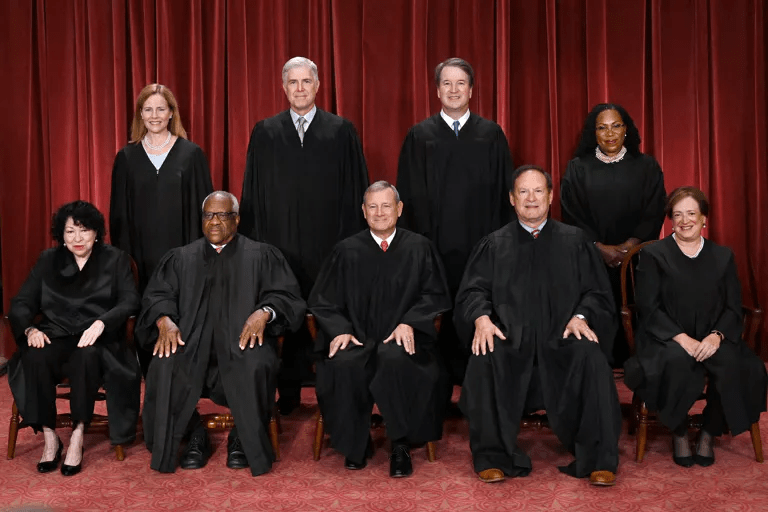
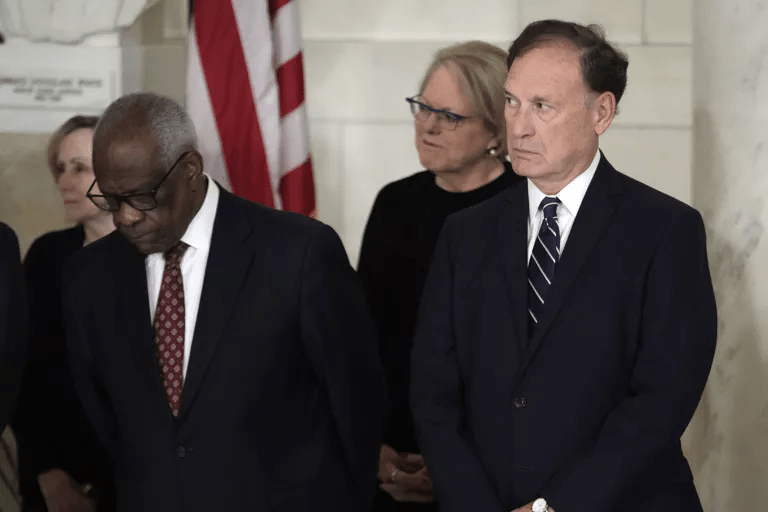
Many couples interviewed shared similar fears that the 2015 Obergefell v. Hodges decision, which legalized same-sex marriage, could be overturned by the Court’s conservative supermajority. Justices Clarence Thomas and Samuel Alito have previously signaled their willingness to revisit the ruling.

Although Donald Trump has not campaigned on overturning marriage equality, his administration’s anti-LGBTQ+ appointees and policies have left many concerned. Trump’s incoming press secretary, Karoline Leavitt, dismissed these fears, stating to NBC News that concerns over marriage equality are “sadly mistaken” and fueled by “media fear-mongering.” She emphasized that overturning the decision “was never a campaign promise.”

However, legal experts warn that future changes remain possible. Slate’s legal analyst Mark Joseph Stern recently suggested on the Outward podcast that while the current 6–3 conservative majority might not immediately overturn marriage equality, a further shift—such as replacing Justice Sonia Sotomayor under Trump—could create the conditions for such a reversal.

Attorney Diana Adams, executive director of the Chosen Family Law Center, advised same-sex couples, particularly those with children, to secure their legal relationships through marriage. “Having a legal connection to your child, having a legal connection to your partner is very, very helpful,” Adams said. “If you were intending to get married, this is the time to get married.”

Some newlyweds may have simply been celebrating Trump’s electoral success as a New Yorker. Trump significantly improved his 2020 margins in his native Queens and won nearly 70% of Staten Island’s vote in 2024. Data on borough-specific marriage rates, however, was unavailable.

Outside the Marriage Bureau, the mood was a mix of urgency and joy. “There’s so much uncertainty in the world right now,” said Caycedo. “The one thing that is certain is our love. And I was like, ‘let’s surrender to that.’”

Christian commentator says trans people should be “erased from the earth” in vicious SCOTUS rant

This blog is originally appeared at LGBTQ Nation

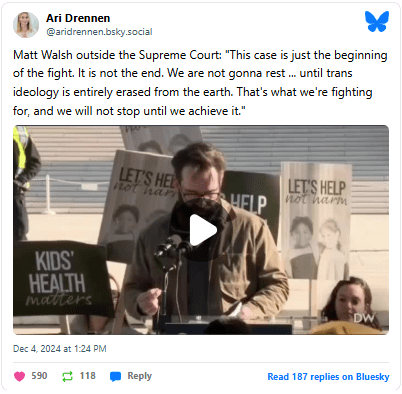
Anti-trans activist and far-right provocateur Matt Walsh demanded that transgender individuals be “completely erased from the earth” during an anti-trans rally outside the Supreme Court on Tuesday.

That morning, oral arguments commenced in the case of United States v. Skrmetti, which challenges Tennessee’s ban on gender-affirming care for transgender minors. The outcome of this case is expected to shape the future of gender-affirming care access across the country.

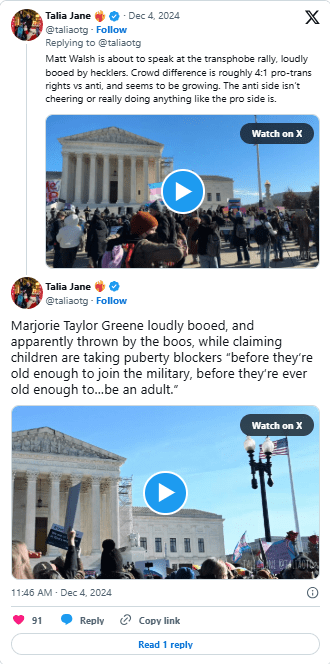
Walsh was joined by other anti-trans figures, including Rep. Marjorie Taylor Greene (R-GA), as they spoke outside the Supreme Court while pro-trans rights activists attempted to drown out their message. The New Republic reports that there were approximately four times as many pro-trans protesters as anti-trans ones.

“Children have a right to be protected from all of those people over there who want to harm them and damage them and destroy them, and they will be,” Walsh declared.

“So to the trans activists over there who are claiming this is all about the rights of children, I say again: Yes, you’re right, it is. They have a right to be protected from you. Children have a right to be protected from all of those people over there who want to harm them and damage them and destroy them.”

“They are gonna lose,” he continued. “They are losing right now. We are not going to let them harm our children. This case is just the beginning of the fight. It is not the end. We are not gonna rest until every child is protected, until trans ideology is entirely erased from the earth. That’s what we’re fighting for, and we will not stop until we achieve it.”

Walsh also stated, “There’s no such thing as a ‘trans kid.’ That doesn’t exist. Those kids are not trans. They are confused, and their confusion has been exploited by quacks and abusers. They are abuse victims. They are not trans kids.”

Walsh, the author of Church of Cowards, is known for producing anti-trans documentaries and promoting harmful rhetoric online. He has advocated against no-fault divorce and compared raising gay children to human trafficking or amputating limbs. He has also faced accusations of defending those who commit child sexual abuse.

Moreover, Walsh has stated that “two men shouldn’t be allowed to adopt,” opposed diversity initiatives within the Republican National Committee, and has relentlessly attacked transgender people. His actions include starring in a feature-length comedy film intended to mock trans women and girls fighting for the right to compete in sports in alignment with their gender.

In a November 7, 2022, appearance on conservative podcaster Joe Rogan’s show, Walsh described homosexuality as a result of humans being a “fallen species,” attributing it to “our fallen human nature” and “proclivities towards sin,” explaining his opposition to same-sex marriage.

Marjorie Taylor Greene faced boos from the audience as she delivered a fiery speech opposing transgender rights, attributing the issue to “Satan.”

This blog is originally appeared at LGBTQ Nation

She argued that transgender youth should be denied medical care, claiming, “God created male and female in His image.” However, the crowd reacted with clear disapproval.

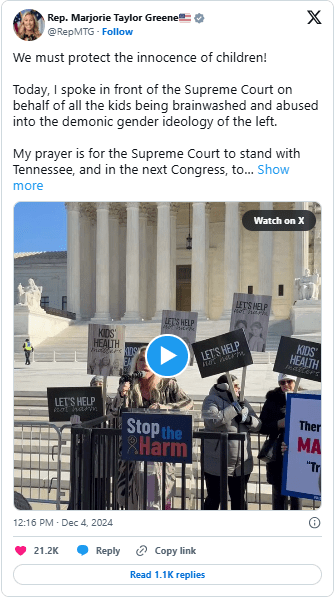
Rep. Marjorie Taylor Greene (R-GA), a leading voice against transgender rights in the U.S., delivered a speech yesterday in front of the Supreme Court as oral arguments were underway regarding Tennessee’s ban on gender-affirming care.

Her remarks were met with resounding boos from the crowd.

A viral video captures Marjorie Taylor Greene passionately condemning gender-affirming care for trans youth, claiming it involves a “…chemical castration pill to destroy their bodies before they’re ever old enough to vote…” The crowd’s boos grew so loud that much of her speech was drowned out.

Greene shared the full video of her speech on X, where she began by declaring, “God created male and female, in His image, He created us,” emphasizing that her opposition to trans rights is rooted in her religious beliefs rather than concerns about children’s health.

The boos from the crowd were audible in her video as well, and she addressed them directly.

“What you’re hearing is the outcry from the demons and those that worship evil, who are abusing our children, brainwashing our children to believe the lies that come directly from Satan!” she proclaimed as the crowd continued to jeer.

Undeterred, Greene returned to her prepared remarks, touting her federal bill to ban gender-affirming care and highlighting its support from figures like Donald Trump and J.D. Vance.

Yesterday, the Supreme Court heard oral arguments in a case challenging Tennessee’s ban on gender-affirming care for transgender youth. The law, which has been contested by several trans families, is argued to be unconstitutionally sexist. Plaintiffs claim it discriminates by allowing some individuals to access specific medical treatments while denying them to others based solely on their sex assigned at birth.

Outside the courthouse, both pro- and anti-trans protestors gathered. According to The New Republic, the pro-trans contingent significantly outnumbered their opponents, with approximately four times as many supporters advocating for transgender rights.

LIVE UPDATES: Supreme Court Hears Arguments in Case Challenging Gender-Affirming Care Ban

This blog is originally appeared at LGBTQ Nation


SCOTUS adjourns, concluding the oral arguments.

The Supreme Court has adjourned early, bringing an end to the oral argument session. A ruling in the case of US v. Skrmetti is expected to be issued by June 2025.

Tennessee Attorney Compares Trans Care to Lobotomies

Tennessee’s Solicitor General, Matthew Rice, in response to a question from Justice Brett Kavanaugh about why laws regulating gender-affirming care shouldn’t be left to the states, compared gender-affirming care to the discredited medical practice of lobotomies—removing part of the brain to treat mental illnesses.

He falsely claimed that lobotomies were widely supported by the medical community in the early 1900s, suggesting that gender-affirming care should be regulated in a similar manner. However, as Alejandra Caraballo, an attorney and instructor at Harvard Law CyberLaw Clinic, points out on BlueSky, leading medical organizations at the time opposed lobotomies, making Rice’s comparison highly inaccurate.

Sotomayor Asks How Banning Gender-Affirming Care Protects the Public

Justice Sonia Sotomayor questions how Tennessee Solicitor General Matthew Rice’s claims about banning gender-affirming care protect the public, emphasizing that “when you’re 1% of the population, it’s very hard to see how the democratic process will protect you.”

The Court’s decision could have broader implications, potentially affecting gender-affirming care for adults as well. If the Court accepts Tennessee’s argument about the possible medical risks, this reasoning could be used in future cases to restrict all forms of care.

Justice Amy Coney Barrett asks how Rice’s policies would apply to issues like bathrooms or sports. Rice attempts to distinguish transgender-based challenges from sex-based challenges, arguing that this case is about the medical risks of transgender healthcare, while bathroom and sports cases focus on gender rights and equity. However, he provides minimal rationale for how this distinction would work.

Justice Ketanji Brown Jackson raises concerns about how the gender-affirming care ban mirrors past racist laws, noting that both seek to deny access to public services based on personal characteristics.

Rice tries to differentiate gender-affirming treatments like hormone replacement therapy and puberty blockers, arguing that the medical justification differs when these treatments are administered to transgender children versus cisgender ones. Jackson counters, pointing out that the treatments affect the body similarly, and suggests that Rice is contradicting his own argument about the dangers of these treatments by claiming they have different effects based on gender identity.

Tennessee’s Lawyer Begins Arguments Against Gender-Affirming Care and Immediately Confuses Everyone

Tennessee Solicitor General Matthew Rice takes the floor, arguing in favor of restricting gender-affirming care and allowing Tennessee’s ban to take effect. He asserts that gender-affirming care for minors offers no benefits, a position that contradicts the views of leading medical organizations such as the Endocrine Society, the American Academy of Pediatrics, and the American Psychological Association.

Justice Sonia Sotomayor challenges this, noting that “every medical treatment has risks, even Aspirin,” and emphasizing that there is no valid reason to restrict gender-affirming care on those grounds. She also points out that halting the development of sex-based characteristics is inherently sex-based and therefore discriminatory. Justice Ketanji Brown Jackson echoes this argument, pushing back against Rice’s claims that the issue is not sex-based, highlighting that attempting to restrict breast growth, for example, is inherently sex-based.

The Court’s confusion deepens when Rice argues that boys with gynecomastia—a condition causing enlarged breast tissue—who take puberty blockers lack a “medical purpose” for doing so, further muddling his argument and drawing continued pushback from the Justices.

“6th Circuit Got It Wrong,” Strangio Says, Citing Flawed Reasoning for Upholding Health Care Ban

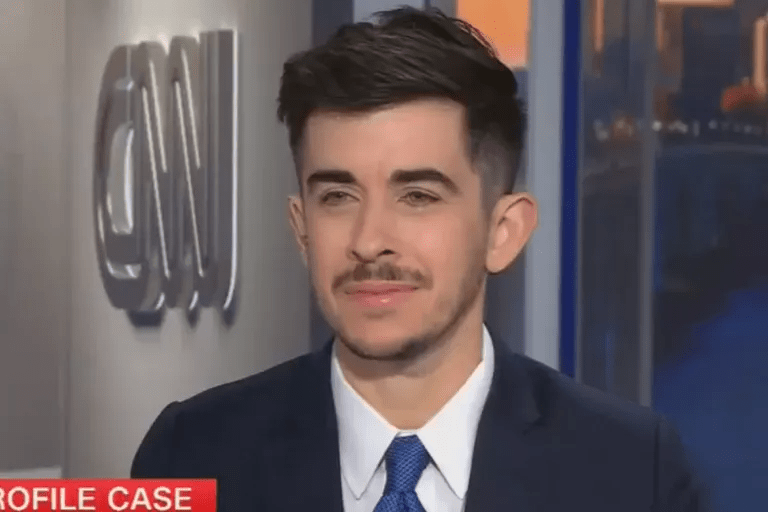
ACLU attorney Chase Strangio argues that the 6th Circuit Court of Appeals “got it wrong” in reinstating Tennessee’s S.B. 1 ban on gender-affirming care, asserting that the court incorrectly applied rational basis review to the case. He argues that intermediate scrutiny should have been applied instead.

Rational basis review is a type of judicial review used to assess whether governments are acting in accordance with regulations. In contrast, intermediate scrutiny involves a more rigorous constitutional review to determine if a legal action aligns with the U.S. Constitution, specifically the Equal Protection Clause of the 14th Amendment, which prohibits sex-based discrimination.

In response to Justice Amy Coney Barrett, Strangio also emphasizes that these issues are deeply intertwined with advocacy for gay rights, referencing historical bans on cross-dressing and transgender people entering the military—issues that have also impacted gay individuals.

Strangio further addressed Justice Brett Kavanaugh’s attempt to shift the discussion to transgender people in sports, briefly arguing that anti-discrimination measures could be used to support the inclusion of trans women athletes, while clarifying that this is not the central focus of the current case.

Justice Samuel Alito questioned ACLU lawyer Chase Strangio, asking whether gender identity is immutable, citing detransitioners and gender fluidity as reasons to suggest it might not be. Strangio responded by emphasizing that there is strong evidence supporting the idea that the underlying basis of gender is immutable. He explained that while individuals may experience changes in their conception of their gender identity, their gender itself is not something that can be willingly altered. What remains constant, he said, is that their gender is different from the sex assigned at birth.

Alito then compared trans people to individuals with schizophrenia, suggesting that both could have different treatments. Strangio rejected this comparison, arguing that these are fundamentally different issues. He clarified that, regardless of any variations in how trans people experience their identities, being trans is an immutable status that does not shift in the same way mental illnesses do.

Chase Strangio Draws from Court’s Role in Pandemic Regulations & Says Transition Regret is Rare

ACLU lawyer Chase Strangio drew parallels between the Court’s involvement in pandemic regulations and its role in evaluating gender-affirming care, emphasizing that the Court should respect expert medical opinions in both contexts. He also addressed concerns about transition regret, pointing out that it is rare and that the overwhelming majority of individuals who pursue gender-affirming care report positive outcomes. Strangio argued that this underscores the importance of allowing access to such care, as it is supported by medical evidence and expertise. ACLU lawyer Chase Strangio, the first openly trans person to argue before the Supreme Court, drew from the Court’s role in regulating public health during the COVID-19 pandemic to argue against Tennessee’s S.B. 1, asserting that SCOTUS should rule against the ban in the interest of the common good. He used the same rationale the Court applied in reviewing public health policies during the pandemic to advocate for the preservation of gender-affirming care.

Strangio also addressed claims about high regret and detransition rates, arguing that such figures are often misrepresented to serve a particular agenda. He referenced the ACLU’s reply brief submitted to SCOTUS, which details the organization’s response to these mischaracterizations.

In response to questioning from Justice Alito, Strangio maintained that gender-affirming care for minors is life-saving, noting that it significantly reduces the risk of suicide. He also pointed out that, contrary to claims in the Cass Review, numerous studies show improved mental health outcomes for transgender individuals following gender-affirming care.

Justice Ketanji Brown Jackson argued that the ban on gender-affirming care is discriminatory, highlighting how it targets a specific group based on their gender identity. She pointed out that such policies are a direct violation of equal protection principles.

ACLU lawyer Chase Strangio then spoke, making history as one of the leading voices in the case. Strangio reiterated the importance of respecting expert medical opinions and legal protections for transgender individuals, advocating for the right to gender-affirming care. His powerful arguments further cemented his role in the ongoing fight for transgender rights.

In response to a line of questioning from Justices Elena Kagan and Amy Coney Barrett, Justice Ketanji Brown Jackson illustrates how denying transgender people medical care is discriminatory, highlighting that such care is often granted to cisgender individuals. Jackson compares these discriminatory policies to those implemented in the 1950s and 1960s on the basis of race, referencing Loving v. Virginia, which overturned bans on interracial marriage.

U.S. Solicitor General Elizabeth Prelogar echoes this argument, drawing parallels between the logic used in Loving and the current case.

Shortly thereafter, Chase Strangio, the first openly trans lawyer to speak before the Supreme Court, argues in favor of overturning S.B. 1. Strangio, representing the American Civil Liberties Union and the plaintiffs, responds to Justice Clarence Thomas’s question about his proposed solution, stating that he would want to ensure gender-affirming care for minors is authorized, particularly for his plaintiffs.

Kavanaugh Presses Lawyer on Constitutionality & Veers into Asking About Sports

Justice Brett Kavanaugh presses ACLU lawyer Chase Strangio on the constitutionality of gender-affirming care bans, questioning whether such regulations are in line with constitutional protections. Kavanaugh’s line of questioning shifts when he asks about the implications for transgender athletes in sports, seeking to understand how anti-discrimination measures in this case could apply to sports-related issues. Strangio responds, emphasizing that while the inclusion of trans athletes is an important issue, it is distinct from the core question at hand, which focuses on the legality and necessity of gender-affirming care.

Supreme Court Justice Brett Kavanaugh asks U.S. Solicitor General Elizabeth Prelogar why SCOTUS should apply intermediate scrutiny (a type of judicial review to assess constitutionality) to Tennessee’s S.B. 1. Prelogar argues that by imposing restrictions based on assigned sex at birth, the law violates the Equal Protection Clause of the Constitution, which inherently calls for additional scrutiny.

Kavanaugh then shifts to a separate line of questioning, bringing up the issue of trans women in women’s sports. This leads Prelogar to admit that she believes there should be restrictions on trans women in sports. However, she tries to pivot back to arguing that such restrictions on gender-affirming care should not be in place.

Research indicates that trans women do not have an inherent advantage in sports after transitioning for the prescribed amount of time. Studies have shown their performance to be on par with cisgender women, and there is no evidence of trans women disproportionately dominating women’s sports.

Fertility Issues Don’t Just Affect Trans People, But Intersex People Too, Lawyer Argues at SCOTUS

During arguments at the Supreme Court, a lawyer emphasized that fertility issues are not exclusive to transgender individuals but also affect intersex people. The lawyer argued that restrictions on gender-affirming care could have broader implications, including for intersex individuals who may face similar challenges in accessing reproductive healthcare. This point was raised to highlight the intersection of medical and legal issues affecting both trans and intersex communities.

In response to a line of questioning from Supreme Court Justice Brett Kavanaugh about how gender-affirming care could impact fertility—one of the arguments for banning such care being that trans kids might face fertility issues later in life—U.S. Solicitor General Elizabeth Prelogar argues that while fertility issues are indeed a concern in transgender care, they are not unique to trans individuals. Prelogar points out that there are solutions available for these issues, which are also found in treatments allowed under S.B. 1, such as invasive surgeries on intersex infants.

Intersex individuals, whose genitalia do not align with typical male or female expectations, are often subjected to invasive surgeries in infancy, which can permanently restrict their ability to have children due to forced conformity to societal norms. Despite these concerns, many anti-transgender policies, including S.B. 1, allow for gender-affirming care for intersex minors, even though advocates call for restrictions on mandatory conforming surgeries and treatments.

Additionally, many intersex individuals identify as transgender, linking these issues inextricably in discussions about gender-affirming care and reproductive rights.

Sam Alito Brings Up Restrictions on Women’s Rights to Oppose Trans Care

Justice Samuel Alito raised concerns about restrictions on women’s rights while arguing against the case for gender-affirming care. He suggested that limiting certain aspects of gender-affirming care could be justified by broader discussions around women’s rights. In his questioning, Alito implied that policies restricting transgender care could be seen as part of a larger debate about the rights of women, sparking further discussions about the intersection of gender, rights, and healthcare.

Supreme Court Justice Samuel Alito argued that previous SCOTUS rulings, particularly Dobbs v. Jackson Women’s Health Organization (which overturned Roe v. Wade) and Geduldig v. Aiello (which allowed the denial of insurance benefits for work loss due to pregnancy), do not support the claim that Tennessee’s S.B. 1 constitutes sex-based discrimination. He pointed out that both rulings suggested that restrictions on pregnancy-related insurance coverage and abortion do not qualify as sex-based discrimination.

U.S. Solicitor General Elizabeth Prelogar countered, asserting that neither of these rulings applies to the current case. She argued that the previous decisions refer to more individualized healthcare concerns, which are unrelated to the broader, sex-based characteristics addressed by hormone replacement therapy and puberty blockers. These treatments, Prelogar emphasized, are inherently sex-based and therefore should not be governed by the same arguments made in those earlier rulings.

Justice Sonia Sotomayor joined the conversation, echoing Prelogar’s points that the issue at hand is fundamentally about sex classification. She also reiterated her criticisms of the Cass Review and responded to Alito’s claims about European countries restricting care, pointing out the inaccuracies in those statements. Sotomayor pressed for further clarity, helping to illuminate key aspects of Prelogar’s arguments.

U.S. Solicitor General States Her Case as Conservative Justices Bring Up Cass Review

U.S. Solicitor General Elizabeth Prelogar presented her case before the Supreme Court, defending the constitutionality of gender-affirming care and challenging the restrictions posed by Tennessee’s S.B. 1. As she argued, conservative justices, including Justices Samuel Alito and Brett Kavanaugh, raised concerns about the findings in the Cass Review, which suggests that gender-affirming care for minors may lead to negative psychological and medical outcomes.

Prelogar countered these claims by stressing that the Cass Review’s conclusions are not representative of the broader medical consensus. She pointed out that numerous studies and expert medical organizations, including the American Medical Association and the American Academy of Pediatrics, strongly support gender-affirming care as effective and essential for the well-being of transgender minors.

Her responses focused on the scientific evidence and medical expertise backing gender-affirming care, challenging the use of the Cass Review as a central argument for limiting such care.

U.S. Solicitor General Elizabeth Prelogar began outlining her case that Tennessee’s S.B. 1 constitutes discrimination based on biological sex. She argued that because testosterone and estrogen affect individuals differently depending on whether they were assigned male or female at birth, and because these medications vary based on assigned sex, the restriction of gender-affirming care amounts to sex-based discrimination.

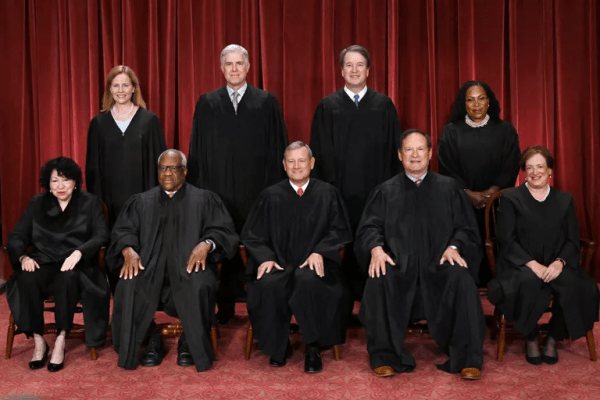
Supreme Court Justices Clarence Thomas, Samuel Alito, and Chief Justice John Roberts then began their questioning. Alito referenced the controversial Cass Review, a report from the United Kingdom that has been used to justify restricting puberty blockers. The report has faced criticism from the World Professional Association for Transgender Health and Yale researchers for its unscientific approach.

Justice Thomas sought clarification on the specific effects of hormone treatments on youth, while Chief Justice Roberts asked about the Court’s role in regulating individualized care and whether such decisions should be left to the states.

Prelogar maintained that, regardless of the specific details or arguments presented, S.B. 1 is fundamentally discriminatory, emphasizing that no other medications are subject to such broad restrictions in other countries.

All three justices who questioned Prelogar were appointed by Republican presidents.

Supreme Court Hearing on Oral Arguments Begins; Protesters on Both Sides Outside Court

The Supreme Court hearing on the challenge to Tennessee’s S.B. 1 began, with oral arguments being presented inside the Court. Outside the building, protesters gathered on both sides of the issue, with supporters of transgender rights advocating for the protection of gender-affirming care, while opponents of the policy voiced their support for the restrictions. The atmosphere outside was charged with emotion as both sides made their voices heard in what is expected to be a pivotal case for transgender rights and healthcare access.

Live coverage of the oral arguments presented to SCOTUS is beginning on C-SPAN, with the session set to last until approximately 2 p.m. Eastern, when the oral arguments will conclude.

As the courthouse prepares for cameras inside, reporters outside the building are focusing on protests from both sides of the debate. While advocates for transgender care are present, they are scarcely featured in media coverage. In contrast, disproportionate attention is given to opponents of transgender care, including pseudoscience activist groups like Do No Harm and Gays Against Groomers, as well as anti-trans politicians such as Rep. Gary Palmer (R-AL).

People’s Lives Have Been Turned Upside-Down by Gender-Affirming Care Bans

The ongoing gender-affirming care bans have had a profound impact on many individuals, turning their lives upside-down. For transgender youth and their families, these bans have created uncertainty and fear, as they are now faced with limited access to essential healthcare. Many are grappling with the emotional and physical toll of losing access to treatments that are crucial for their well-being, while others are forced to relocate or seek care in more supportive states. The broader consequences of these bans are reshaping lives, highlighting the personal struggles tied to the political and legal battles surrounding transgender rights.

One family from Texas shared their experience of living out of their van in a truck stop in Connecticut, driven by the increased cost of living after relocating to escape Texas’ anti-trans laws. Another parent who made a similar move from Texas to Connecticut remarked that while Connecticut launched a campaign inviting families from anti-trans states to relocate, the state did little to address the issue of affordability. These families are facing significant financial and emotional challenges as they seek safety and access to gender-affirming care in a more supportive environment.

The Trans Rights Supreme Court Case Is Also About Whether Sexism Is Now Legally Allowed in America

The ongoing Supreme Court case challenging gender-affirming care is not just about healthcare access for transgender individuals—it also raises broader questions about whether sexism is now legally permissible in the United States. At the heart of the case is the argument that restricting gender-affirming care based on assigned sex at birth constitutes sex-based discrimination, which may set a dangerous legal precedent. If the Court rules in favor of such bans, it could embolden future policies that discriminate on the basis of sex, further entrenching harmful gender stereotypes and limiting the rights of transgender individuals and other marginalized groups.

Slate’s legal writer Mark Joseph Stern explained in an article the critical stakes in U.S. v. Skrmetti, the challenge to Tennessee’s gender-affirming care ban currently being heard by the Supreme Court. Stern outlines how this case goes beyond the rights of transgender individuals, addressing broader questions about gender equality and the legal protections against sexism.

Stern notes that the pro-trans side argues that banning a trans boy from receiving testosterone therapy while allowing a cisgender boy to receive the same treatment is blatantly sexist. The only difference between the two is their assigned sex at birth, which makes the restriction inherently discriminatory. However, the appeals court disagreed, creating a new “biological difference” exception and arguing that the ban hurts both trans boys and trans girls equally, thereby making it not a violation of sex-based discrimination.

According to Stern, Skrmetti isn’t just about transgender rights—it’s a case that questions the future of gender equality under the law. The key legal issue is whether laws that deny medical care based on sex should trigger heightened scrutiny by the courts. Stern emphasizes that, according to long-established legal precedent, the answer should be yes. If the Court rules otherwise, it could undermine constitutional protections against sex discrimination and pave the way for laws enforcing harmful gender stereotypes. While transgender Americans would be most immediately affected, Stern argues that the case has broader implications for everyone’s ability to reject rigid gender roles without facing state-enforced oppression.

LIVE UPDATES: Supreme Court Hears Arguments in Challenge to Gender-Affirming Care Ban
By Mira Lazine

Today, the United States Supreme Court is hearing oral arguments in the case United States v. Skrmetti, which centers on Tennessee’s 2023 bill, S.B. 1, that bans gender-affirming care for minors. While no decision will be made today, the arguments presented are expected to have far-reaching implications for transgender rights across the nation, particularly concerning access to gender-affirming care for minors.

The case involves three families of transgender youth in Tennessee who are challenging the state’s ban on providing their children with life-saving healthcare. The ban also impacts several doctors who seek to provide care to consenting patients. The U.S. District Court for the Middle District of Tennessee initially ruled to overturn the ban, but the 6th Circuit Court of Appeals allowed it to go back into effect, prompting the case to be brought before the Supreme Court for a final ruling.

The plaintiffs in this case are supported by the Biden-Harris administration and the Department of Justice, which challenge the legality of such a broad ban on gender-affirming care. They are represented by the American Civil Liberties Union (ACLU) and attorney Chase Strangio, along with Lambda Legal and Akin Gump Strauss Hauer & Feld LLP. On the opposing side, Tennessee Attorney General Jonathan Skrmetti, along with Tennessee Solicitor General Matthew Rice, represents the state of Tennessee. The United States government is also involved as a third party and is represented by U.S. Solicitor General Elizabeth Prelogar.

Blog at WordPress.com.

Up ↑