A major LGBTQ+ activist was brutally stabbed & Uganda’s anti-gay law is to blame

This blog originally appeared at LGBTQ Nation.

Police treated the activist as a criminal, raiding his home while he was still recovering in search of evidence to prove he was gay.

The resurgence of anti-LGBTQ+ bills and draconian laws in Africa has led to a surge of homophobic attacks across the continent, further endangering LGBTQ+ people whose lives were already at risk.

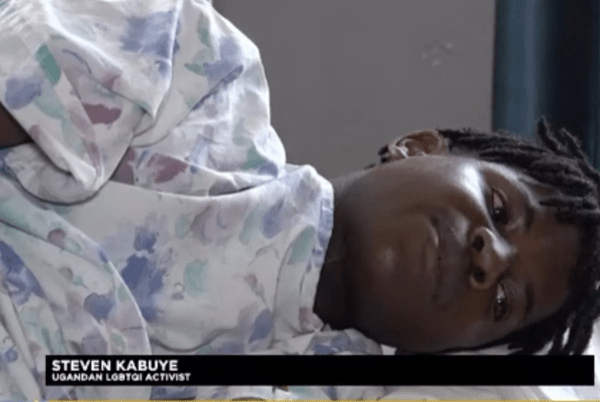
These anti-LGBTQ+ laws not only criminalize same-sex relationships but also systematically target LGBTQ+ activists. Steven Kabuye, a prominent Ugandan LGBTQ+ rights activist, was recently stabbed and left for dead outside his home by two men on a motorcycle who had been following him for a number of days. Graphic video footage shared on X shows Kabuye writhing in pain, a visible laceration stretched across his arm and a knife embedded in his abdomen.

Kabuye, an activist and editor of Coloured Voices Media Foundation-Truth to LGBTQ Uganda, was ambushed on his way to work. His helmet-wearing assailants swung the knife at him, aiming at his neck, which he shields with his right arm in the video. As he attempted to flee, the attackers chased him and stabbed him in the stomach. Kabuye was discovered by residents and taken to a nearby hospital for emergency surgery.

Uganda’s president, Yoweri Museveni, recently signed into law one of the most severe anti-gay bills in the world. The Anti-Homosexuality Act of 2023 stipulates long prison sentences and capital punishments for “aggravated homosexuality.” It has also intensified homophobic sentiment nationwide. A surge in attacks and arrests has been reported all over the country since the signing of the law. LGBTQ+ rights activists said the bill has led to a rise in abuse, including torture, rape, and evictions, against LGBTQ+ Ugandans by private citizens.

Kabuye, who is still recovering, disclosed on X that he’s already been harassed by the police since the attack. He said they forcefully entered his house searching for lubricants, rainbow flags, or any other incriminating items they could use as evidence to charge him under the Anti-Homosexuality Act. He said he believes the failed attempt on his life was a planned assassination.

A similar incident happened in 2011 in the tragic story of David Kato, a Ugandan teacher and LGBTQ+ rights activist. Considered a father of Uganda’s gay rights movement, Kato was murdered in cold blood after winning a court victory over a tabloid that called for homosexuals to be killed.

Kabuye went on to reveal that after being denied entry into his home, police arrested his flatmate and tortured and threatened him with forced anal examinations in a bid to get him to confess that he and Steven were lovers – at the same time asking him to stop the international community from putting pressure on them or he would be falsely charged with attempted murder.

Kabuye wrote on X, “When they came to get a statement from me, they kept on asking me questions like, ‘Who sponsors you?, How and when did you become gay? Have you ever engaged in any sexual activities with any man?’ Questions unrelated to the case at hand. They just didn’t want to accept it was a hate crime or an attempted murder/assassination.”

Another LGBTQ+ activist, Ronald Agaba, who has been speaking up and demanding justice for Kabuye, said the Ugandan police are trying to cover up the crime and are busy blaming the victim. He went on to post screenshots of the death threats he’s been receiving since he spoke up.

“Police won’t help you. Uganda is not for homosexuals” one X user said. 

“Look at this Gay, run for your life in Uganda because we’re killing the so-called LGBTQ,” another added.

Other victims around the country include Arianna, a transgender woman who was falsely accused in a viral TikTok video of forcing young men to take hormones. She came home after shopping one day to find an angry mob gathered outside her front door. “When they saw me, they started grabbing me and shouting that I needed to die,” she told The Guardian. “The only thing I remember next was waking up in a hospital.”

The new law also targets activists with 20 years of imprisonment for promoting homosexuality, leading to a crackdown on human rights organizations and the criminalization of any LGBTQ+ advocacy. A Ugandan MP, Hon. Cecilia Ogwal, who was one of the 387 members of Uganda Parliament to support the Anti-Homosexuality Act, called LGBTQ+ advocates “A force from the bottom of Hell” and urged Ugandans to “destroy” these LGBTQ+ forces.

Jane, a 24-year-old Ugandan activist, told LGBTQ Nation she is scared for her life and has been in hiding. “I’ve been receiving death threats online lately. One person promised to hunt me down, rape me, and slit my neck “ she said. “The disheartening part about this is that I can’t even report this to the police. The police are even the ones terrorizing us and encouraging this behavior.”

LGBTQ+ activists and campaigners in Africa have made no secret of their stance and how they feel about the new law. A petition was filed in the Constitutional Court to challenge it, but it’s uncertain if there will be a positive outcome. Court hearings began last month, but no ruling has been made yet.

Among the people to file the petition were the only two MPs who voted against the bill, Fox Odoi-Oywelowo and Paul Kwizera Bucyana, as well as prominent rights activists Pepe Onziema and Frank Mugisha. Additional petitions were filed by the Ugandan Human Rights Awareness and Promotion Forum and a host of international groups.

Activist Jackline Kemigisa wrote in OpenDemocracy that she joined the petition “because the law’s vaguely defined offense of ‘promotion of homosexuality’” endangers her “work and freedom as a journalist and researcher covering queer and feminist movements in Uganda.”

“Should my work, in which I write about minority communities with fairness and dignity, be deemed ‘promotion of homosexuality’ under Section 11 of the new law, I would face up to 20 years in prison,” she said.

Another Ugandan activist, Kira, explained how the new law has changed her life. “Uganda has always been homophobic,” she told LGBTQ Nation, “but since this new bill was signed things have changed. Prior to the new law, getting catcalled was the worst thing that could happen to you in public as people rarely attack you unprovoked. But the new law has emboldened them.”

“They publicly attack us now based on perception, some of them even go as far as stalking and ambushing us in our homes. Being a masculine-presenting woman, I’m scared to go out in public these days because not being traditionally feminine enough could possibly get me killed. We almost lost a friend last month after he was beaten up by a mob in the market for his feminine mannerisms.”

According to Reuters, Uganda’s Constitutional Court began hearing a challenge on December 18th that says the law violates constitutionally protected rights. A panel of five judges told the petitioners they would be notified when a ruling was reached.

“To be honest I don’t have any faith in our judiciary or this entire case having a positive outcome,” John Mukasa, a queer rights activist and medical officer living in Uganda told LGBTQ Nation. “Homosexuality is a very controversial subject in Africa and homophobia has eaten deeply into our society.”

“Our politicians are exploiting this hate for their own benefit in the disguise of protecting African cultures and would continue to do so no matter the cost. Uganda has a myriad of problems from insecurity to multidimensional poverty and hunger, these anti-laws are just being used to distract people from the problems that actually matter.”

This set of laws was pushed by American Evangelical ministers

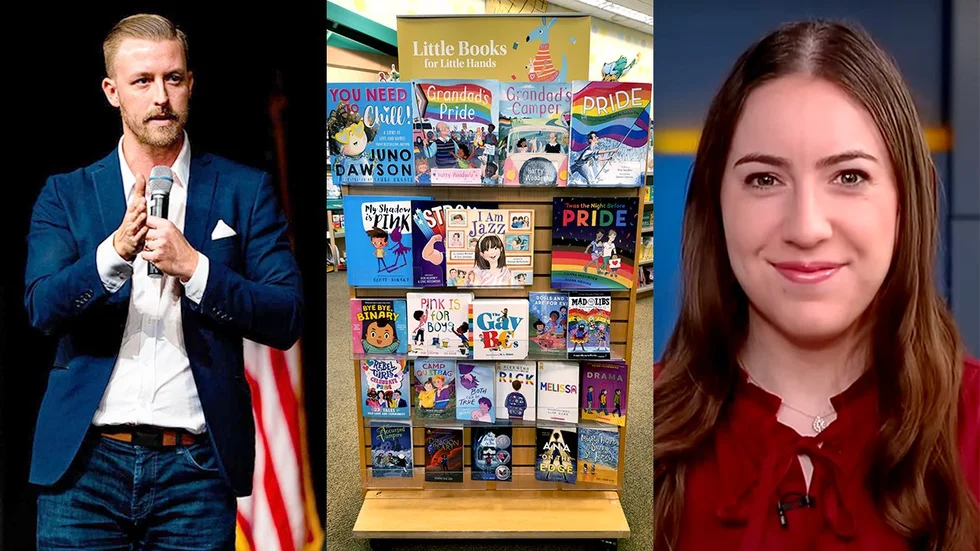
Oklahoma appoints Libs of TikTok creator – who allegedly inspired school bomb threats – to library committee

An announcement in Oklahoma caused shockwaves in educational and political circles as the individual behind the anti-LGBTQ+ social media account “Libs of TikTok” was appointed to a government position.

Even after Oklahoma schools suffered a series of bomb threats after she posted about them, the state government is bringing her in to advise about books in libraries.

Chaya Raichik, the individual associated with the controversial “Libs of TikTok” account, has been appointed to the Library Media Advisory Committee of the Oklahoma State Department of Education. The appointment has sparked widespread criticism, raising concerns about Raichik’s lack of educational background, her involvement in stirring controversies, and potential implications of stochastic terrorism.

State Superintendent Ryan Walters, a Republican, announced Chaya Raichik’s appointment to the Library Media Advisory Committee of the Oklahoma State Department of Education last week. Walters praised Raichik for being on the “front lines” against what he referred to as “the radical left’s” agenda in schools.

“Her unique perspective is invaluable as part of my plan to make Oklahoma schools safer for kids and friendly to parents,” Walters said in a statement.

Chaya Raichik, a former Brooklyn real estate agent, has been a full-time right-wing online provocateur since her Libs of TikTok account gained attention and support, amassing more than 2.8 million followers. Despite being labeled as a right-wing extremist, she was temporarily removed from the Anti-Defamation League’s glossary of extremism due to a legal threat. Raichik neither resides in Oklahoma nor has a background in education or children’s development.

Raichik has made false and inflammatory assertions, including labeling the LGBTQ+ community as an “evil cult” and suggesting that teachers, particularly those who identify with the community, aim to “groom kids.”

Mickey Dollens, a Democratic state representative in Oklahoma, raised concerns about the appointment, questioning State Superintendent Ryan Walters’ decision.

“Why did Superintendent Walters appoint a social media influencer to the state’s Library Media Advisory Committee? What are her qualifications? Is she a librarian? No. Education background? No. Does she even live in Oklahoma?” Dollens asked.

The appointment has faced criticism from various quarters, including GLAAD and the Human Rights Campaign.

GLAAD president and CEO Sarah Kate Ellis shared her thoughts on the matter in a statement to The Advocate.

“Book bans are at a record high because a fringe few extremists are deliberately gaming the system at everyone else’s expense, including students, educators, and taxpayers. It’s obvious that education advisory committee members should have an education background, a close connection to the community they serve, and a record that does not include spreading lies and encouraging disparagement and violence that endangers every student, school, and family,” Ellis said, noting “Oklahomans should see this for the farce it is: an appointment that deserves an F on its face, and an A for trolling, which this particular social media extremist excels at for her own profit.”

The Human Rights Campaign (HRC) also criticized the selection of Chaya Raichik.

Oklahoma State Superintendent Walters’s decision to legitimize an internet troll who takes glee in causing direct harm to innocent people is a violation of his duty to the citizens of his state, particularly the LGBTQ+ community of Oklahoma,” HRC spokesperson Delphine Luneau told The Advocate.

“This is just another example of the MAGA mindset that prioritizes antagonizing marginalized people over actually doing the true work of government to make lives better for everyone,” she continued.

The Library Media Advisory Committee, to which Raichik has been appointed, is tasked with the goal of “removing pornographic or sexualized content” from public school libraries. The committee operates on a voluntary basis, with no compensation provided to its members, all of whom are appointed by Superintendent Ryan Walters, according to Oklahoma public radio station KOSU.

According to the state education department, the committee is composed of parents, active and retired librarians, and English literature teachers.

Following Libs of TikTok posts, a USA Today investigation revealed a pattern of threats, including bomb threats to schools, libraries, and hospitals across the United States. Collaborating with Media Matters for America, the investigation confirmed dozens of threats linked to Raichik’s posts since February 2022, indicating an escalating pattern of hostility and danger following her attention.

In Oklahoma, there have been alarming instances of bomb threats following posts by Libs of TikTok. For example, in August, Union Public Schools in Tulsa faced a series of bomb threats over six days, which began shortly after Raichik shared a critical post about one of its school librarians. The threats significantly disrupted school operations and caused widespread fear and anxiety in the community.

Experts have accused Raichik’s account and social media activity of engaging in what’s known as stochastic terrorism—an allegation Raichik has mocked.

Stochastic terrorism refers to public speech that incites random acts of violence, which is statistically predictable but unpredictable for individuals. Raichik’s posts have been linked to threats that, according to experts, fit the pattern of stochastic terrorism.


In response to a post by Walters on X (formerly Twitter), Alejandra Caraballo, a clinical instructor at the Harvard Law School Cyberlaw Clinic and trans rights activist, criticized the appointment.

“You named a terrorist to your advisory board who incited bomb threats for weeks against a school library in Tulsa,” Caraballo wrote in a comment to Walters.

The Advocate reached out to Walters’ office to inquire about Racihik’s new role, but did not receive a response.

State Equality Index 2023 – Human Rights Campaign

This blog originally appeared at Human Rights Campaign.

The Human Rights Campaign State Equality Index (SEI) is a comprehensive state-by-state report that offers a review of statewide laws and policies impacting LGBTQ+ individuals and their families.

The SEI rates all 50 states plus Washington, D.C. in six areas of law and assigns the states to one of four distinct categories.

Check your state’s scorecard by texting SEI to 472472 from your mobile phone. (msg & data rates may apply. Text STOP to quit, HELP for info.)

Indiana Republicans want to re-write the law to eliminate the word “gender”

This blog originally appeared at LGBTQ Nation.

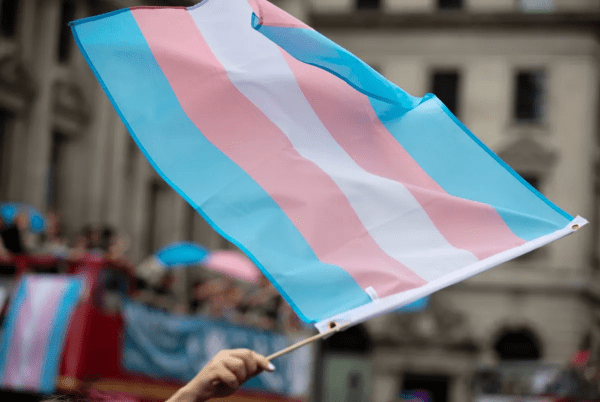
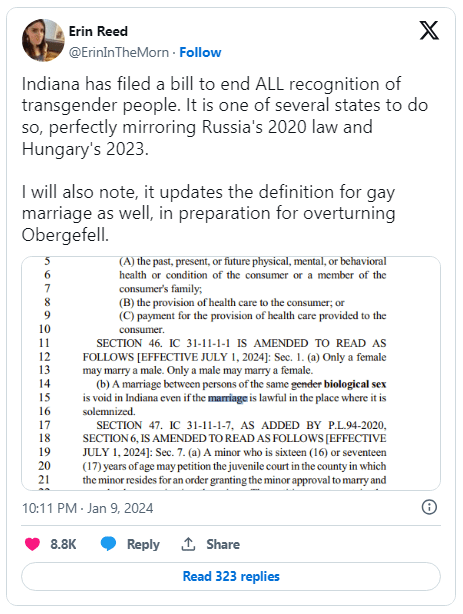
A new bill put forward by Indiana Republican lawmakers aims to legally erase transgender individuals and reassert the state’s prohibition on same-sex marriage.

The bill also says, “Only a female may marry a male. Only a male may marry a female.”

H.B. 1291 proposes the removal of the term “gender” from state laws, substituting it with “biological sex,” even within anti-discrimination statutes. The bill seeks to redefine “male” and “female” based on an individual’s ability to produce sperm or ova, along with redefining other gender-related terms based on physical characteristics.

The proposed bill, H.B. 1291, would effectively eliminate trans identity from legal considerations, prohibiting transgender individuals from updating gender markers on official documents to align with their lived experiences.

It says that intersex people are male or female “but for a medically verifiable genetic disorder of sex development,” which is related to a common conservative idea that all intersex people can be easily categorized as male or female.

“Only a female may marry a male. Only a male may marry a female,” the bill reads in a section that lists state laws and how they need to be changed to implement the new, anti-trans definitions. “A marriage between persons of the same biological sex is void in Indiana even if the marriage is lawful in the place where it is solemnized.”

Although the provision related to same-sex marriage in H.B. 1291 wouldn’t be applicable under the current legal framework due to the Supreme Court’s Obergefell decision in 2015, it underscores a persistent stance within some Republican circles against marriage equality. This position continues to be part of the national Republican Party platform, indicating an ongoing desire among some Republicans to overturn or limit same-sex marriage rights in the United States.

“Indiana has filed a bill to end ALL recognition of transgender people,” journalist Erin Reed posted on X. “It is one of several states to do so, perfectly mirroring Russia’s 2020 law and Hungary’s 2023.”

In April of the previous year, Indiana Governor Eric Holcomb, a Republican, signed a bill into law that prohibited transgender youth from accessing gender-affirming care. However, this legislation faced a temporary block from a federal judge two months later.

Indiana instituted a ban on same-sex marriage in 1986 and further prohibited the recognition of same-sex marriages performed in other states in 1997. Despite several attempts to pass a constitutional amendment explicitly prohibiting marriage equality in the state, none of these efforts proved successful.

Greece just got one big step closer to marriage equality

This blog originally appeared at LGBTQ Nation.

The conservative Greek government has garnered support for its same-sex marriage bill from liberal lawmakers.

Just days after hesitating on a timeline to introduce legislation to legalize gay marriage in Greece, the recently reelected center-right Prime Minister Kyriakos Mitsotakis received a significant boost for his campaign pledge with the endorsement of gay opposition leader Stefanos Kasselakis.

The legislation, revealed on Wednesday, faces strong opposition from a faction within Mitsotakis’ New Democracy party, other right-leaning lawmakers in the Greek Parliament, and the Greek Orthodox Church. However, support from the left-leaning Syriza party’s 38 members would secure its passage.

Kasselakis stated that he would overlook “imperfections” in the bill and would instruct his party to vote for the proposal, even though it maintains a prohibition on surrogacy for gay couples seeking parenthood. A prior draft legislation presented by Syriza earlier in the week would have granted this right to same-sex couples.


The leader of Syriza emphasized the “positive elements” of the legislation and criticized the right-wing New Democracy lawmakers opposing the bill for what he called their “political cowardice.”

Kasselakis rose to prominence in September after his unexpected election as the leader of the left-leaning opposition party. The 35-year-old former Goldman Sachs banker married his American husband, Tyler McBeth, in the U.S. in October.

“When this draft law comes to parliament,” Kasselakis told Star TV in Greece, “it will be approved thanks to Syriza.”

While surrogacy remains restricted for gay couples in the proposed bill, full parental rights would be extended to same-sex parents who already have children.

“We won’t change the law on assisted parenthood,” Prime Minister Mitsotakis declared, addressing the issue publicly for the first time on Wednesday evening. He emphasized that same-sex couples would still be able to adopt children.

The prime minister pointed to the challenges faced by the children of gay couples, who lack recognition under Greek law, as a driving force behind the proposed change. Greece legalized same-sex civil partnerships in 2015.

A recent poll indicates that 49% of Greeks are against legalizing same-sex unions, while 35% are in favor. A majority also opposes granting full parental rights to gay or lesbian couples. The Church’s objections to extending marriage rights to same-sex couples are centered around concerns about gay parents raising children.

‘I had to flee my own state’: Biden Harris campaign focuses on abortion rights in new ad

This blog originally appeared at MSNBC.

The Biden-Harris campaign is releasing a new ad highlighting abortion rights on the 51st anniversary of Roe v. Wade.

The Biden-Harris campaign is launching a new ad that centers on abortion rights, coinciding with the 51st anniversary of the landmark Supreme Court decision Roe v. Wade. This move reflects a strategic effort to underscore the administration’s stance on reproductive rights and draw attention to the ongoing importance of Roe v. Wade in the context of current political and legal discussions surrounding abortion access.

Proposed California law could force social media companies to censor LGBTQ+ content

This blog originally appeared at LGBTQ Nation.

A new California social media law could harm LGBTQ+ youth, according to an internet civil liberties group. The group, the Electronic Frontier Foundation (EFF), has advised California Attorney General Rob Bonta (D) not to approve the proposed law for an upcoming voter referendum.

Two advocates have called it “a misguided and unconstitutional proposal.”

The law, entitled “The Common Sense Initiative to Protect California Kids Online,” seeks to protect minors from specific online “injuries” by allowing people to sue social media companies for $5,000 per violation, up to $1 million per child, according to The Sacramento Bee.

“It would be up to the courts to decide the merits of a parent’s claim,” explains James Steyer, the CEO and founder of Common Sense Media, a nonprofit that provides information on the suitability of tech platforms for children. “Tech companies have avoided any accountability for their profit-driven actions and it is time to change that, either through the Legislature or through the ballot.”

But the proposal currently doesn’t specifically list which “injuries” are covered or how social media companies could avoid inflicting them. That non-specificity concerns the EFF because they worry that the law could be used to censor LGBTQ+ content as “harmful.”


In a letter to Bonta, the EFF policy analyst Joe Mullin and senior staff attorney Aaron Mackey wrote that the proposed law violates social media companies’ constitutionally protected free speech rights and would result in the censoring of LGBTQ+ content.

“For example, elected officials in both California and other states have said that access to LGBTQ+ content harms children,” Mullin and Mackey wrote. “Lawsuits would likely push online services to restrict access to medical, health, and sexual information that many LGBTQ+ children need.”

Mullin and Mackey’s concern isn’t unprecedented. In fact, groups like the American Civil Liberties Union ACLU and the parents of transgender youth worry that a similar proposed federal law, the Kids Online Safety Act (KOSA), could compel social media companies to censor LGBTQ+ content to avoid possible lawsuits.

Specifically, the ACLU and parents of trans youth worry that state attorneys general who consider queerness a social fad or a form of mental illness that causes kids to harm themselves, participate in risky sexual behavior, and increase their risks for depression, suicide, or drug use would use KOSA to sue social media platforms companies.

“[The proposed state law] is a misguided and unconstitutional proposal that will restrict all Californians’ access to online information,” Mullin and Mackey added.

Gender-affirming care clinic burned down in horrific arson: “This is terrorism”

This blog originally appeared at LGBTQ nation.

Firefighters in Decatur, Georgia have determined that an October fire at a local gender-affirming care clinic was intentionally set in a move one activist has labeled “terrorism.”

The fire in the city’s historic Blair Building was “contained to one office, and no injuries were reported,” according to a recent statement from the City of Decatur Fire Rescue Department.

The statement expressed that an investigation has determined the fire “to be incendiary in nature, indicating the fire was intentionally set.” No suspects have been identified.


The Blair building houses several medical providers, but a police report confirms that the target of the fire was QMed, which focuses on gender-affirming care, Decaturish reported.

“We won’t be intimidated,” QMed owner Dr. Izzy Lowell told Atlanta News First. “We will not stop providing life-saving care to our patients.” While the office is “completely destroyed,” Lowell said the clinic is seeing patients remotely. She also confirmed the FBI is investigating the arson attack as a hate crime.

Georgia passed a hate crime law in 2020. H.B. 426 became the first law in the state to specifically protect LGBTQ+ residents and give stronger punishments to those whose crimes target victims due to their LGBTQ+ identity, or due to other factors such as their race, religion, or national origin.

Trans activist Alejandra Caraballo wrote on X that the attack “is following the antiabortion playbook of destroying clinics to get them shut down.”

“This is terrorism,” she concluded.

The Movement Advancement Project gave Georgia 1 point out of a possible 44.5 for its LGBTQ+ policies, leaving it with an overall rating of “low.”

In March 2023, Gov. Brian Kemp (R) signed a ban on trans youth receiving gender-affirming health care. The law revokes the licenses of medical professionals who administer surgeries or hormone replacement therapy for transgender people under the age of 18. The law creates an exemption for cisgender youth; they are allowed gender-affirming care to conform to their sex assigned at birth.

Puberty blockers, however, are not banned under the legislation.

The American Medical Association, the American Psychiatric Association, and the American Academy of Pediatrics have all rejected claims that gender-affirming care harms transgender children or adults. Additionally, gender-affirming surgery is almost never performed on youth.

Classroom searched by police after anonymous complaint about an “obscene” LGBTQ+ book

In a recent incident, an anonymous complaint regarding a frequently banned LGBTQ+ book prompted local police to conduct a search in a Massachusetts classroom, citing concerns about “obscene” and “pornographic” material. The American Civil Liberties Union (ACLU) has strongly criticized this incident.

“Police going into schools and searching for books is the sort of thing you hear about in communist China and Russia,” Ruth A. Bourquin, senior and managing attorney for the ACLU of Massachusetts, told The Berkshire Eagle this week. “What are we doing?”

The Great Barrington Police Department and the Berkshire District Attorney’s Office initiated an investigation to determine if Maia Kobabe’s “Gender Queer” contains pornographic material. The inquiry was prompted by a complaint received on December 8, asserting that the book was present in an eighth-grade classroom at W.E.B. Du Bois Regional Middle School.

Upon receiving notification of the investigation, Superintendent Peter Dillon was informed by the police. Principal Miles Wheat, accompanied by a plainclothes officer, conducted a search for the book in the classroom after school on December 8. The English teacher, reportedly unaware of the impending search, was present during the search. Despite the use of a body camera by the officer, the book was not found.

District Attorney Timothy Shugrue announced that Great Barrington Police had concluded their investigation, stating that the complaint did not involve criminal activity. Consequently, the matter was closed, and any further action was referred back to the Berkshire Hills Regional School District. The superintendent assured the District Attorney’s Office that the issue would be reviewed according to the school district’s policies, treating it as a school department matter.

Teachers, parents, and students in the community expressed outrage over the incident. More than 100 students at Monument Mountain Regional High School staged a walkout in protest. Massachusetts Gov. Maura Healey (D) released a statement supporting the walkout, asserting that “book banning has no place” in the state.

In a Facebook post, the teacher whose classroom was searched wrote, “How on earth is a cop more qualified to decide what books are OK to be in an educational setting for teens?”

According to The Berkshire Eagle, the police argued they had a duty to investigate the complaint about Gender Queer. However, the ACLU of Massachusetts expressed deep concern about this notion.

“They say anytime someone could call they have an obligation to go marching into places wearing a body cam, and you know, interrogating people,” Bourquin said, adding that state laws are “pretty clear about police not having roles in this situation.” Obscenity laws, she explained, have been “carefully crafted to ensure not tromping on constitutional free speech rights.”

Bourquin informed the paper that the ACLU has requested the officer’s body camera footage and other records related to the investigation.

Justin Silverman, executive director of the New England First Amendment Coalition, explained that obscenity laws test whether a book has value beyond sexual arousal. This “very specific” requirement is not necessarily something the average person or police officer might understand.

Silverman said that he’s concerned about the precedent the Great Barrington Police may have set amid the national rise in book bans primarily targeting books by Black and LGBTQ+ authors. “While it might be rare now, it doesn’t mean that it will be rare in the future,” Silverman said. “I think the school and the police department have to come forth with a policy to make sure that this doesn’t happen again.”

In a statement, the Berkshire Hills Regional School Committee and Superintendent Peter Dillon apologized for the incident.

“The recent incident at the middle school has challenged and impacted our community,” the statement read. “Faced with an unprecedented police investigation of what should be a purely educational issue, we tried our best to serve the interests of students, families, teachers, and staff. In hindsight, we would have approached that moment differently. We are sorry. We can do better to refine and support our existing policies. We are committed to supporting all our students, particularly vulnerable populations.”

Arson at Georgia Clinic for Gender-Affirming Care Investigated as Hate Crime

This blog originally appeared at Advocate.

The recent fire at a clinic providing gender-affirming care is being examined within the context of recently enacted hate crime legislation.


Officials in Georgia are probing a fire from the previous year as an anti-LGBTQ+ hate crime, suspecting arson.

The Decatur Fire Department has officially labeled the fire at a gender clinic in the historic Blair Building on October 30 as a deliberate act of arson and is currently treating it as a possible hate crime.

The Decatur Fire Department efficiently controlled the fire, which, as reported by Atlanta TV station WANF, was confined to a single office and resulted in no injuries. Despite the contained nature of the incident, the investigation has concluded that the fire was deliberately set.

This unsettling incident specifically targeted QMed, a clinic renowned for providing gender-affirming care to transgender and nonbinary individuals. Dr. Izzy Lowell, the proprietor of QMed, informed WANF that the fire resulted in the destruction of their office.

The event is being investigated as first-degree arson, a grave felony. This classification is in accordance with Georgia’s hate crimes law, which was implemented in 2020, extending protections to LGBTQ+ individuals. Convictions under this law carry heightened penalties.

Built in 1939, the Blair Building stands as an impressive specimen of Streamline Moderne architecture and holds a place on the National Register of Historic Places. Serving the Decatur community for over eight decades, it has accommodated a diverse range of businesses and offices.

Following the incident, the city has joined forces with federal and state agencies to probe the crime. Despite the ongoing investigation and no arrests made thus far, the Decatur Fire Department has been circumspect in divulging specific details. The case garnered public attention after an anonymous tip about the incident reached Decaturish.

The arson attack has amplified concerns about the safety of facilities catering to specialized services for marginalized groups. The ongoing investigation aims to determine whether this was a hate-motivated crime.

Blog at WordPress.com.

Up ↑