A blog for LGBTQIA+ migrating to more welcoming states or counties
Author: Bob McCranie
I am so proud to run Texas Pride Realty Group. We set out on a mission in 2009 to serve the diverse communities of Texas and to hire kick-ass agents who practice the highest ethics and professionalism. I believe that the agent's role is to help the consumer make well-educated decisions, even if those decisions lead away from a purchase or sale.
I believe that education is vital in this industry. I currently have over 1300 hours of real estate courses on my transcript with the State of Texas. Additionally, I am a Real Estate Business Coach at Tom Ferry International, the largest-real-estate specific coaching company in the world. I coach agents in the US and Canada, and have coached clients in Australia, New Zealand, Brazil, and Switzerland. I also have knowledge of the UK and Irish markets.
Opening Texas Pride Realty was always a goal of mine and I am working night and day to be sure it is successful. The best way to do that is to be sure clients are satisfied and agents are busy. What better legacy could someone leave in this industry than a group of well-trained, high-quality brokers who do your job better than you?
The law implemented in August has fostered an unwelcome educational environment for LGBTQ+ students.
Three LGBTQ+ advocacy organizations in western North Carolina have launched the initial phase of their campaign to challenge the state’s discriminatory Don’t Say Gay law.
The Campaign for Southern Equality, Youth OUTright WNC, and PFLAG Asheville have united to contest Buncombe County School District’s policies following the passage of SB49 in August. This legislation was enacted after North Carolina Republicans successfully overrode a veto by Democratic Governor Roy Cooper.
The Don’t Say Gay legislation, also recognized as the Parent’s Bill of Rights, prohibits teaching about “gender identity, sexual activity, or sexuality” in kindergarten through fourth grade. It also mandates informing parents “prior to any changes in the name or pronoun used for a student in school records or by school personnel,” with certain allowances given to school administrators.
The law took effect immediately upon passage, and in the months following, school districts statewide have been wrestling with its implementation.
In a complaint submitted to the Title IX Coordinator for Buncombe County Schools, the three organizations assert that SB49 infringes upon the education provisions outlined in Title IX.
“The policies enacted by the Buncombe County Board of Education in adherence to the state law SB49 (commonly referred to as the ‘Don’t Say LGBTQ’ law and the ‘Parents’ Bill of Rights’) establish an unwelcoming educational atmosphere for LGBTQIA+ students, families, staff, and faculty,” states the complaint, “thereby contravening Title IX and the obligation of Buncombe County Schools to furnish each student with a secure and non-discriminatory school environment.”
The complaint references Title IX, which prohibits sex discrimination in educational programs receiving federal funding, encompassing discrimination related to sexual orientation or gender identity.
In October, the Campaign for Southern Equality raised their Title IX concerns with the North Carolina Department of Public Instruction. The response received stated, “Absent a determination by USED Office of Civil Rights or a court order affirming your position, neither the State Board nor DPI can knowingly fail to comply with a duly enacted state law.”
The groups’ strategy shifted towards obtaining a determination from a local official responsible for enforcing Title IX. In Buncombe County, this role is held by Shanon Martin, the Title IX Coordinator for Buncombe County Schools.
“We request that, if these Title IX violation allegations are confirmed, the Title IX Coordinator for Buncombe County Schools instruct the Superintendent to postpone the implementation of all SB49-related policies passed on December 7, 2023, until the federal complaint against DPI and SBE has been resolved,” the complaint to Martin reads.
Craig White, the supportive schools director at Campaign For Southern Equality, informed Blue Ridge Public Radio that his team anticipates filing a federal complaint in January.
Rob Elliot, chairman of the policy committee for the Buncombe County Board of Education, described the process of determining how to enforce SB49 as “very stressful” and a “noisy, big, complex legal discussion.”
“We don’t exist just under the confines of this one new law,” Elliot said. “This doesn’t define our entire world. We exist under a whole universe of federal law and state law, all of which we have to abide by as well.”
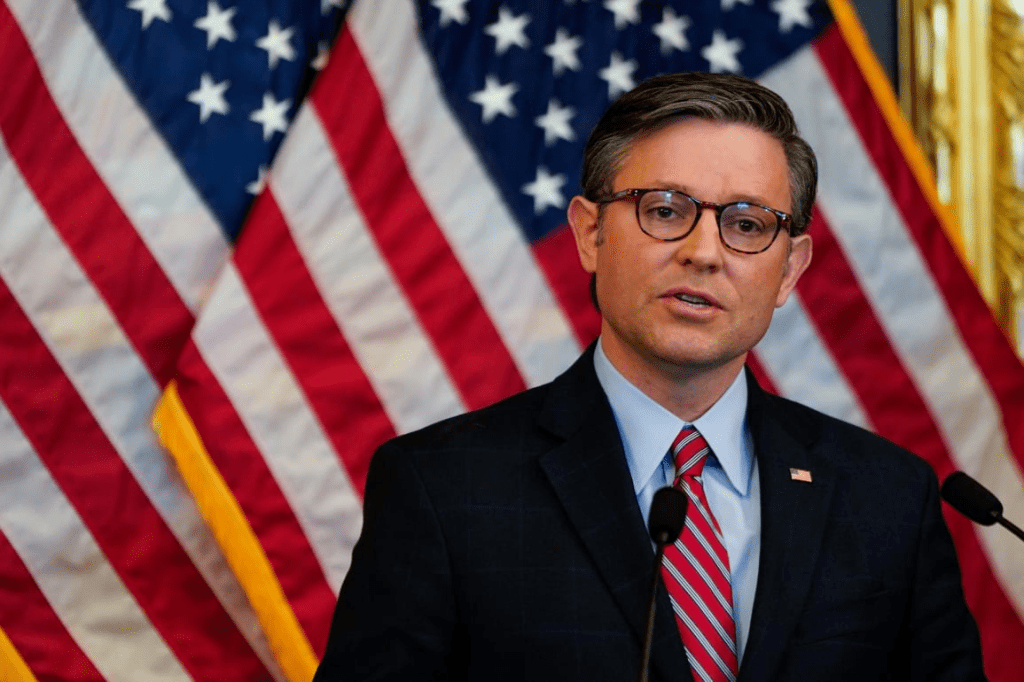
Speaker Mike Johnson has previously represented individuals with troubling views, including one who expressed support for killing gay people and another who advocated for the government to be a terror to the LGBTQ community.
Speaker Mike Johnson has downplayed his pre-Congress career, presenting himself as a modest constitutional lawyer advocating for conservative Christian causes.
“I’m deeply thankful for the ministry and your steadfastness,” Johnson expressed in August, responding to the commendations from evangelical figure Jim Garlow. “It provides tremendous encouragement for me and others laboring in these occasionally challenging areas of the Lord’s vineyard.”
While Johnson might have been expressing dissatisfaction with Congress, an examination of the new speaker’s past clients sheds light on the challenging nature of some of those corners in his legal career.
Johnson’s fervent religious convictions and Christian nationalist ideology led him to offer his legal services, frequently pro bono, to clients associated with some of the country’s most radical anti-abortion and anti-LGBTQ organizations, including individuals linked to militant movements with a tendency for violent expression.
A scrutiny by The Daily Beast uncovered one of Johnson’s past clients who advocated that the government “should be a terror” to abortion providers and the LGBTQ community. Another client opposed condemning domestic terrorist attacks on abortion clinics, while yet another client recorded himself endorsing the hanging of government officials during the January 6 attack on the U.S. Capitol.
The said former client currently heads a militant organization associated with a notorious incident in the anti-abortion movement, involving the 2009 murder of a Kansas abortion doctor. Moreover, this plaintiff’s father sought Johnson’s assistance in 2003 to obtain a permit for an anti-LGBTQ protest, which eventually resulted in the attempted stabbing of a gay man.
In that instance, Johnson’s client, Grant E. Storms, an anti-gay activist and former radical Christian preacher, gained national attention in 2012 when he admitted to engaging in inappropriate behavior in his van near a playground in Metairie, Louisiana. Storms faced charges of indecent exposure and received a three-year probation sentence.
While Johnson didn’t handle Storms’ criminal case, Storms revealed in an interview with The Daily Beast that Johnson had provided extensive legal services for him during the early to mid-2000s, and all of these services were offered pro bono. Storms considered Johnson a friend.
“We were comrades on the journey,” Storms said. “He consistently supported us.”
In all instances, Johnson indeed supported them. Though his fervent anti-abortion and anti-LGBTQ positions remained largely unnoticed nationally for years, they gained attention after he assumed the speaker’s position in October. Johnson has referred to abortion as “a holocaust,” expressed support for criminalizing gay sex, and openly emphasized his Christian nationalist affiliations, stating on Fox News that his beliefs on “any issue under the sun” are guided by the Bible.
The Daily Beast submitted a comprehensive comment request to Johnson’s office, seeking clarification on his perspectives regarding specific former clients and their actions or affiliations. In response, a spokesperson from the speaker’s office provided a statement underscoring a fundamental aspect of the attorney-client relationship.
“After practicing law for more than 20 years, Johnson has defended the First Amendment rights of numerous clients. It’s essential to recognize that representing a client in a First Amendment dispute doesn’t imply an endorsement of everything the client has said or done before or after a case,” stated the spokesperson in response to The Daily Beast’s inquiry.
“Attorneys are not held responsible for their clients’ actions or choices, especially after their legal relationship ends. However, Johnson consistently chose to represent clients and causes, often pro bono, that aligned with his ideological stance. While he could argue these cases on a First Amendment basis, Johnson frequently took on clients with anti-gay and anti-abortion positions, similar to his openly held views. His clients’ use of violent rhetoric didn’t seem to deter Johnson at the time, and he has not taken the opportunity to condemn their actions, words, or involvement in the insurrection,” responded the spokesperson.
The spokesperson did not respond to a follow-up inquiry about whether Johnson would provide comments on the specific details in this report.
This examination of Johnson’s legal career highlights the need for further exploration into his past and the extent of his involvement with some of the nation’s most militant religious movements.
Grant Storms informed The Daily Beast that his initial connection with Johnson occurred in the early 2000s through Alliance Defending Freedom, a prominent activist group striving to institutionalize conservative Christian principles in legislation.
ADF presents itself as a charitable organization committed to safeguarding religious freedom; however, it has embarked on a worldwide campaign to undermine LGBTQ and abortion rights. Following law school, Johnson joined ADF and served there for almost a decade as a lawyer and spokesperson.
Storms remembered reaching out to Johnson to seek assistance in removing what he deemed “indecent” imagery from an advertisement he saw at a bus station, claiming it depicted men engaging in sexual activity. At that time, Storms was a prominent figure in Louisiana, known for his fervent Christian activism. Johnson offered his pro bono support for various legal issues Storms faced, one of which gained national attention and resulted in a hate crime.
Storms claimed that Johnson played a key role in securing a permit for his 2003 protest against the Southern Decadence festival, an annual celebration of gay culture in New Orleans. Storms, known for influencing the passage of stricter decency laws in Louisiana, gained national attention for providing lawmakers with videos he personally recorded of men engaging in public sex. He asserted that both local officials and the Department of Homeland Security were initially opposed to his demonstration, but Johnson helped overcome these objections.
The Associated Press extensively reported on the protest, which unfortunately turned violent when an assailant, unrelated to Christian Conservatives for Reform, attempted to murder a man with a five-inch steak knife. Storms faced charges of battery in a separate incident that weekend, involving a pushing match with a nightclub security guard who denied him permission to record video inside the establishment.
In a recorded confession, the assailant confirmed his intent to attend Storms’ event with the purpose of killing a gay man, as stated by the police. However, it remained unclear whether the victim he targeted was actually gay. The assailant faced charges of attempted first-degree murder and a felony hate crime but passed away before the trial.
In an interview with The Daily Beast, Storms consistently condemned the attack and expressed opposition to any violence against LGBTQ and abortion rights communities. Reflecting on his past, Storms acknowledged that his passionate rhetoric at the time, often featured on his five-day-per-week radio show (which he believes included Johnson on several occasions), might have inadvertently contributed to an atmosphere that incited harmful actions by certain individuals.
“When things were at their peak, always in the news, and everyone talking about it—right in the midst of our protest, a gay person got stabbed,” he acknowledged, conceding that some of his rhetoric around the event “didn’t come out right.”
“Every public figure has to be careful with their rhetoric, and as you get older you have to be more and more careful,” Storms expressed, reiterating his view of the LGBTQ lifestyle as “a perversion.”
However, Johnson did not distance himself from Storms after the violence of the protest. In fact, he became more closely associated with the preacher. Eight months later, Johnson represented Storms in another legal case concerning permits, this time for anti-abortion rallies in Jefferson Parish.
In the interim, Storms made headlines again when he seemingly endorsed the mass killing of gay people at a religious fundamentalist conference in Wisconsin.
During the event, known as the “International Conference on Homo-Fascism,” hosted in Milwaukee by a group called Wisconsin Christians United, Storms delivered an hour-long address filled with fiery rhetoric. He extensively discussed his perceived “battle” against the Southern Decadence Festival, where a stabbing had occurred weeks earlier, claiming it was a “great breakthrough” from the Lord. Storms repeatedly used violent imagery, cautioning his Christian audience that gay individuals “want to kill you” and “have to eliminate us,” drawing parallels between his crusade and Jonathan’s biblical battle against the Philistine army.
Storms, according to a transcript of the speech, enthusiastically recounted the biblical story, stating, “That first slaughter which Jonathan and his armor bearer made was about 20 men. Wheeeww! Come on. Let’s go. God has delivered them all into our hands. Hallelujah!” He then accompanied his words with sounds imitating explosions: “boom, boom, boom, boom, boom.”
“There are 20. Whew. Ca-Ching. Yes. Glory. Glory to God. Let’s go through the drive-thru at McDonald’s and come back and get the rest,” Storms remarked, according to the transcript.
After the occasion, the LGBTQ rights organization Fair Wisconsin accused Storms of mimicking ‘sounds like gunfire as if he were shooting gay people’ and ‘seemingly endorsing the murder’ of gay individuals. Subsequently, Storms filed a defamation lawsuit against Fair Wisconsin. The Wisconsin Supreme Court later deemed the suit frivolous, affirming $87,000 in sanctions against his attorney—distinct from Johnson.
In a conversation with The Daily Beast, Storms initially characterized these incidents as ‘hilarious,’ emphasizing that they were symbolic gestures aimed at opposing the LGBTQ+ agenda rather than advocating literal harm to gay individuals. The means of opposition mentioned included legal avenues and protests.
When passages from his statements, such as ‘It’s us or them. There’s no in between. There’s no having this peaceful co-existence,’ were quoted by The Daily Beast, Storms acknowledged that he might have been ‘a little bit over-the-top.’ Over time, he expressed understanding as to why an external group could have ‘misinterpreted’ his remarks as endorsing mass murder.
“I must grapple with my words and how they’re perceived, but I remain committed to advocating for everyone’s right to life, liberty, and the pursuit of happiness.”
However extreme Storms’ language might have been, Johnson still chose to represent him.
Several months after Storms sued Action Wisconsin, Johnson assisted him in suing Jefferson Parish. Concurrently, he drew a parallel between another religious case he was involved in and “spiritual warfare.”
“The ultimate objective of the adversary is to stifle the gospel,” Johnson asserted in an interview with the Shreveport Times in April 2004. “This is a form of spiritual warfare.”
Storms informed The Daily Beast that the two individuals lost contact sometime after Hurricane Katrina in 2005, which was several years before the playground incident involving masturbation that thrust him back into the national spotlight.
Despite Storms’ confession, he attempted to contest the witness account of the exposure charge, which he again disputed in his interview with The Daily Beast. Nevertheless, the judge sentenced him to three years of probation, considering his admission that it was the third time he had engaged in the act in the park that week.
If Johnson did indeed lose contact with Storms in 2005, he somehow found a connection to Storms’ son, Jason Storms. Johnson and the ADF represented Jason Storms in another Milwaukee case in 2009.
In that case, Johnson contended that his plaintiffs, a group of anti-abortion extremists, had been hindered in the exercise of their free speech rights by a federal court injunction in the Eastern District of Wisconsin against protests at abortion clinics.
That ominous word—intimidation—is a concept Johnson’s clients may understand well.
Jason Storms is the leader of Operation Save America, formerly Operation Rescue, which has been called the nation’s largest militant anti-abortion group. Jason Storms also partook in the Jan. 6 insurrection at the U.S. Capitol, posting a social media video of himself on the building’s scaffolding shortly after the breach.
Jason Storms at an anti-abortion gathering.
Operation Rescue shot to infamy when it was tied to the slaying of a Kansas abortion provider in 2009—the same year Johnson filed the lawsuit. Today, OSA and its militant allies still believe women who get abortions should be charged with murder—a step up from more mainstream anti-abortionists who would only place that burden on the doctor.
This summer, Storms said abortion might only be ended in the U.S. through civil war. He routinely drawswidespreadmediacoverage for camping outside of abortion clinics and urging women against ending their pregnancies, frequently alongside his wife and their 10 children.
Earlier this year, a member of OSA was charged in connection with a bomb scare at a Milwaukee-area Pride event, the Milwaukee Journal Sentinel reported. In October, the Sixth Circuit of Federal Appeals upheld a 2022 restraining order against the group, after unruly demonstrations in Tennessee.
But in 2009, Johnson—on behalf of the ADF—represented Jason Storms alongside a group of virulent anti-abortion extremists when they sued the city of Milwaukee over a court injunction at abortion protests. That crew included anti-LGBTQ activist Robert Breaud and Jim Soderna, both of whom have their own storied past.
In 1999, Soderna entered his name in the public record as opposing a Milwaukee city council resolution “against domestic terrorism in the form of violence against health-care providers, especially those providing family planning services.” Meanwhile, Breaud—a self-described former “homosexual”—ran a 1999 failed campaign for the Louisiana state House as a Republican. Per an article from The Times-Picayune, which is not publicly available online but accessible through the Lexis Nexis publication database, Breaud said the government “should be a terror to the evildoer”—quoting the apostle Paul in the Bible—further specifying, as Paul did not, that the evildoers were gay men, lesbians, and abortion providers.
Breaud, a nurse and musician, spread his homophobic message via an original song called “It’s Not OK to be Gay.” A 2007 video of Breaud shows him strumming a guitar and singing, “It’s not OK to be gay. It’s not OK to be perverted. It’s not in your DNA. What you need is to be converted.” A spoken-word interlude describes Breaud’s former lifestyle as “unholy, unnatural, unsatisfying, unfulfilling.”
But in the 2009 abortion case, Johnson represented Breaud regarding a different piece: an anti-abortion composition called “Baby Song,” which Breaud had rendered at a “disturbing” volume outside of a clinic, drawing a police citation.
Breaud also went on to publicly boycott Starbucks over CEO Howard Schultz’ 2013 support of gay marriage, saying in a Christian News Network interview that he would tell Schultz, “You’re promoting sin. You’re helping destroy young people’s lives.”
Johnson’s Milwaukee lawsuit was bolstered by affidavits from Jason Storms’ father-in-law, militant anti-abortionist Rev. Matthew Trewhella. Trewhella—who two years prior was represented by ADF in a separate matter in Ohio—previously defended the murder of abortion doctors as “justifiable homicide.” And in 1994, Trewhella was recorded urging parents to give their children firearms training and advocating for religious congregations to launch militias, The New York Timesreported.
By 2009, Trewhella had served 14 months in prison for obstructing clinics. He ran an Operation Rescue splinter group, called Missionaries to the Pre-Born, which also featured Jason Storms. Missionaries to the Pre-Born has been described as “one of the most dangerous and violent of the direct action anti-abortion groups active in the United States.”
The city settled the Milwaukee suit. Johnson’s co-counsel, Fintan Dooley, told The Daily Beast that he was happy with the settlement at the time, though they didn’t win fees. Dooley, a Democrat, also pleaded ignorance about any ties to violent groups among the plaintiffs and Trewhella.
But the year of that lawsuit, Operation Rescue was tied to the murder of Kansas abortion provider Dr. George Tiller. The killer had been in touch with a group official about Tiller’s whereabouts, and claimed to be a member. While the group denounced the slaying and the attacker’s claims to membership, Tiller was a top target of Operation Rescue’s ire for years—in 2002, they relocated their headquarters to Wichita specifically to pressure his clinic—and its leader at the time had previously called the murder of abortion providers a “justifiable defensive action.”
Twelve years later, Jason Storms was part of another siege. On Jan. 6, 2021, Storms and two other OSA members “set up the Lord’s beachhead” at Trump’s rally in Washington, D.C., according to an OSA blog post two days after the attack. The post marveled that “many saints were encouraged by the bold and plain declarations of the Law/Word of God,” declaring that it was “a great and exhausting time.”
What the post did not mention, however, was that Storms participated in the sacking of the Capitol. He posted a social media video of himself on the scaffolding shortly after the building was breached, admiring the insurrection as “Revolution 2.0” and crowing, “Yeah, baby!” in reply to a bullhorned call to “Hang ’em high!”
Dooley, Johnson’s co-counsel, told The Daily Beast that he was “disappointed but not surprised” to learn about Jason Storms’ involvement in the attack.
Grant Storms told The Daily Beast that he “supported” his son attending the rally, but, like Dooley, he condemned Trump and the Republicans who still support him—specifically including Johnson.
“Trump went nuts,” Grant Storms told The Daily Beast. “Anyone can see he tried to overturn the election. He belongs in jail.”
Like Grant Storms, Dooley spoke admirably about Johnson, noting his intellect and the influence he had on his own legal work.
But asked what he would say to Johnson regarding the speaker’s own unrepentant efforts to overturn the 2020 election and his continued support of Trump, Dooley soured.
A Missouri school board, led by conservatives, has decided to eliminate elective courses on Black history and literature, following the rescinding of an anti-discrimination policy adopted five months earlier in the wake of George Floyd’s killing.
In a 5-2 vote on Thursday night, the Francis Howell School Board decided to discontinue offering Black History and Black Literature courses, which had been part of the curriculum at the district’s three high schools since 2021. Over 100 students enrolled in these courses this semester in the predominantly white suburban area of St. Louis.
In July, the board rescinded an anti-racism resolution and directed the removal of copies from school buildings. This resolution had been implemented in August 2020 during the nationwide unrest following the killing of George Floyd by a police officer in Minneapolis.
The resolution committed the Francis Howell community to “strongly oppose any racism, discrimination, and unjust violence against individuals, irrespective of their race, ethnicity, nationality, immigration status, religion, sexual orientation, gender identity, or ability.”
The resolution and the available courses became a focus for five recently elected board members, who gained control since last year’s election and in April, supported by the conservative political action committee Francis Howell Families. All seven members of the board are of Caucasian descent.
The PAC’s website vehemently opposes the courses, claiming they incorporate principles of critical race theory. However, numerous experts assert that the scholarly theory, which focuses on the idea that racism is systemic in the nation’s institutions, is not taught in K-12 schools.
The resolution and course offerings faced opposition from the five new board members who assumed control since their election last year, backed by the conservative political action committee Francis Howell Families. All seven board members are white. The PAC’s website strongly opposes the courses, claiming they involve principles of critical race theory, though many experts assert that the scholarly theory, centered on the idea that racism is systemic in the nation’s institutions, is not taught in K-12 schools.
“You’ve certainly taught me not to underestimate how low you will go to show your disdain toward the Black and brown communities’ experiences and existence,” remarked Harry Harris, a Black father, addressing the board.
Another speaker, Tom Ferri, urged the board to prioritize more significant issues, such as addressing the high turnover among teachers.
“Tapping into a diverse talent pipeline would be an excellent strategy to mitigate attrition, but who from a diverse background would want to work in a district embroiled in culture wars?”
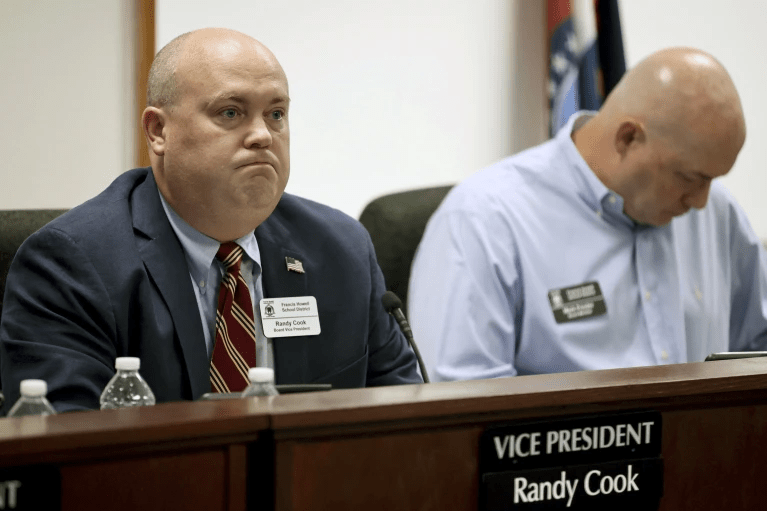
Board Vice President Randy Cook Jr., elected in 2022, stated that the Francis Howell courses, which he and others opposed, employed “Social Justice Standards” developed by the Southern Poverty Law Center with an inclination toward activism.
“I don’t oppose teaching Black history and Black literature, but I do object to teaching it through a social justice framework,” Cook expressed in an email on Friday. “I don’t believe it’s the public school’s responsibility to teach social justice and activism.”
In an email, district spokesperson Jennifer Jolls mentioned that new courses on Black history and literature “could be redeveloped and brought to the Board for approval in the future.”
During this semester, a total of 60 students across the three schools enrolled in the Black History course, while 42 students took Black Literature, as reported by the district.
Francis Howell is one of the largest school districts in Missouri, serving 16,647 students, with 7.7% of the student population identified as Black. The district is located on the far western edge of the St. Louis area, in St. Charles County.
The county’s substantial growth has aligned with the significant population decrease in St. Louis city. In 1960, St. Louis boasted 750,000 residents, while St. Charles County had 53,000. Presently, St. Louis is home to 293,000 residents, with a nearly equal distribution between Black and white residents. St. Charles County has experienced growth, reaching around 415,000 residents, with approximately 6% identifying as Black.
Racial tensions persist in the St. Louis area, heightened more than nine years ago when an 18-year-old named Michael Brown was fatally shot by a police officer in Ferguson, Missouri. The officer, Darren Wilson, faced no charges, triggering months of sometimes violent protests and serving as a catalyst for the nationwide Black Lives Matter movement.
In July, Cook defended the decision to revoke the anti-racism resolution, stating that the board “doesn’t need to be in the business of dividing the community.”
“We need to focus on educating students and steer clear of national politics,” he remarked.
The Black Literature course centers on contemporary and multi-genre literary works by Black authors, celebrating the dignity and identity of Black voices, as described by the district.
The Black History course delves into the roots of today’s world, providing a comprehensive understanding of the present through the history of Blacks. It spans from the ancient civilizations of Africa to the contemporary accomplishments and achievements of Black individuals today, according to the course description.
Since 2020, school board elections in the U.S. have evolved into highly charged political arenas, particularly in response to policies addressing the COVID-19 pandemic.
Political Action Committees (PACs) in numerous local districts have effectively supported candidates who pledged to combat teachings related to race and sexuality, eliminate books considered offensive, and oppose transgender-inclusive sports teams.
“We are not the parents whom they wish to grant rights.
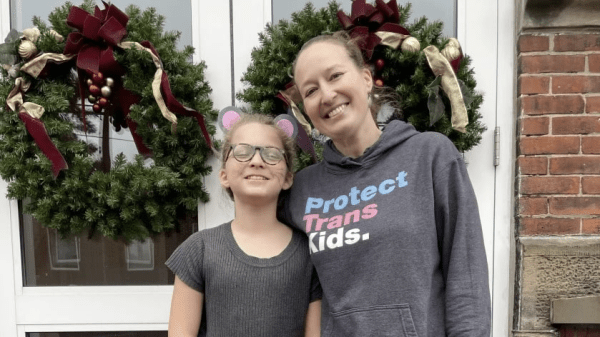
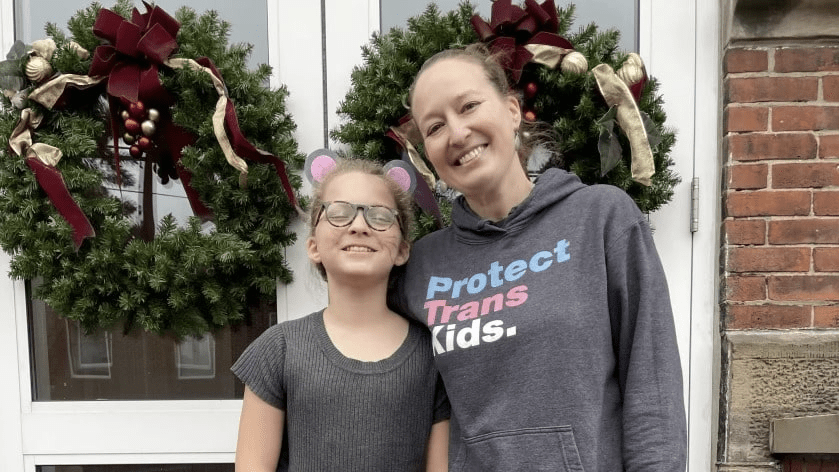
Blaze, a 12-year-old transgender girl, stands with her parent Dani Beale in front of the Unitarian Universalist Church in Kent. They relocated from Ohio to Western New York due to the state legislature’s decision to prohibit gender-affirming healthcare for transgender youth.
This month, legislators approved House Bill 68, prohibiting gender-affirming healthcare for transgender minors and restricting the participation of trans girls on girls’ and women’s scholastic sports teams.
Governor Mike DeWine has not yet signed the bill into law.
Dani Beale and her family, including 12-year-old transgender daughter Blaze, relocated from Ohio to Western New York due to what they perceive as the anti-trans measures taken by Ohio lawmakers.
Beale expressed that her family felt compelled to relocate when Republican lawmakers introduced the legislation that eventually became HB 68 earlier this year.
“We began to observe the language in the bills, and we realized that we wouldn’t have a choice if we were going to care for our child in the way we believe is necessary for her,” Beale explained.
“The moment that hit me was when Blaze said, ‘I don’t want to live in a state that doesn’t want me.’ That really struck me when she said those words out loud,” she expressed.
Blaze conveyed that she, along with other trans individuals, senses being singled out by lawmakers.
“This has been blown way out of proportion. It’s like 2% of people are trans,” she said. “It’s not affecting a lot of people, but the people that it is affecting, it’s affecting them so much.”
Medical care is the chief concern.
The Saving Adolescents from Experimentation Act (SAFE Act) prohibits gender-affirming healthcare, encompassing puberty blockers and hormone replacement therapies. Detractors argue that it essentially outlaws counseling for transgender youth. This act was consolidated into HB 68 along with the Save Women’s Sports Act, which prohibits transgender girls from participating in girls’ and women’s scholastic sports.
Ohio is currently contemplating a range of restrictions, including the “bathroom bill,” which would prevent students from using restrooms or locker rooms assigned to a sex other than that listed on their birth certificate.
According to Dani Beale, the various proposed bills in Ohio, especially those like the “bathroom bill,” are discriminatory towards her child. However, the primary concern for her family was the potential restriction of medical care. They felt the need to ensure their child could receive proper medical care without facing penalties or risks to their ability to parent, and the legislative environment in Ohio raised concerns in this regard.
Beale and other advocates reference support from institutions like the National Institutes of Health, the American Medical Association, and various other groups endorsing gender-affirming care. They argue that such care has been safely administered for decades.
Beale emphasized that gender-affirming care is the appropriate treatment for Blaze.
“What puberty blockers do is essentially hit pause, preventing puberty and allowing us a few more years to have conversations with her, for her to grow up and explore her identity, ensuring this is the path we want to take,” she explained.
“Individuals can form their opinions on our parenting choices, but when it comes to legislation dictating what I, as a parent, can decide for my child, that’s a significant concern. Particularly in a state where parental rights are highly valued by many, yet we, as parents, are not granted those rights,” Beale expressed.
The politics of gender
Blaze recognized her gender identity as a girl at an early age.
“I’ve known since I could remember that being a boy wasn’t really who I am,” she expressed.
However, she isn’t overly focused on gender.
She emphasized that her identity as a trans person or part of the LGBTQ community has never defined her personality. She’d rather be recognized for her interests and activities, such as playing the euphonium, being part of a basketball team, and her previous involvement in a jump rope team. For her, these are the aspects she wants people to associate with her, rather than her past gender identity, as it doesn’t hold significance in defining who she is.
She thinks that the legislature is overly fixated on the politics of gender, overlooking her humanity in the process.
“I wish they could see beyond my name and gender, delving deep to recognize that I’m not just a trans girl; I am simply a human.” 🔥
Bridget Ziegler, who supported the signing of Florida’s ‘don’t say gay’ law, implicated in another sex tape scandal.
Sarasota police acquire a second sex video involving Christian Ziegler, Chair of the Republican Party of Florida, featuring his wife Bridget Ziegler in an intimate encounter with another woman.
The Florida Center for Government Accountability, the organization that first reported on the investigation into rape allegations against Christian Ziegler, Chair of the Republican Party of Florida, has revealed that local law enforcement sources confirm the existence of a second sex tape involving Ziegler’s wife, Bridget Ziegler, with another woman. It remains unclear whether the woman in this video is the same individual who accused Christian Ziegler of rape, or if it involves a different person.
Police have acquired a video recorded by Christian Ziegler, Chair of the Republican Party of Florida, depicting a sexual encounter with the woman who has accused him of rape. Law enforcement sources, detailing the contents of the tape to the Florida Center for Government Accountability, suggest that the video introduces complicating factors into the case against Ziegler, as certain details appear to contradict the events as described by the woman in Sarasota who brought forward the accusations.
While investigating Christian Ziegler, police discovered another video, as reported by the Center for Government Accountability. The identity of the woman in this new video remains unclear at this point.
“There is uncertainty about whether the woman in the video is the same individual who accused Christian Ziegler of sexual assault. Requests for comments from both Christian and Bridget Ziegler have gone unanswered, as reported by the Trident.
Bridget Ziegler, known for co-founding the conservative Moms for Liberty organization, has been serving on the Sarasota County School Board in her recent capacity.
In the process of obtaining a search warrant, Bridget Ziegler acknowledged to law enforcement that over a year earlier, she had participated in a threesome with her husband and the woman. Speculation in Southwest Florida continues about the couple’s involvement in a non-traditional marriage for an extended period. This revelation is particularly noteworthy given that the political power couple had consistently advocated for social conservative values, with Bridget Ziegler notably standing alongside Governor Ron DeSantis during the signing of Florida’s controversial ‘don’t say gay’ law.
The disclosure of involvement in threesomes has sparked significant political turmoil for Bridget Ziegler. In response, the Sarasota County School Board, in a 4-1 vote earlier this month, called for her resignation. However, only Governor DeSantis possesses the authority to remove her from office.
“In a recent vote by the board, Nicholas Machuca, the deputy director of development at LGBTQ+ rights group Equality Florida, emphasized, ‘Now, let me be clear, participation in same-sex activities is not shameful. However, Bridget Ziegler has engaged in this while concurrently denigrating our community and actively working to implement policies that directly marginalize us. Such hypocrisy is unacceptable.”
All statewide officials, led by DeSantis, have urged Christian Ziegler to resign. The executive board of the Republican Party of Florida recently decreased his salary, censured him, and initiated a procedure to oust him in January. Reportedly, Christian Ziegler is seeking a $2 million settlement to step down.
The legislation poses a threat to gay-straight alliances and is leading to additional challenges for LGBTQ+ youth.
The enactment of Kentucky’s version of a “don’t say gay” law is causing numerous challenges for LGBTQ+ students, along with the parents and educators aiming to provide support.
In March, Kentucky’s Republican-majority legislature overrode Democratic Gov. Andy Beshear’s veto to pass one of the most expansive anti-LGBTQ+ laws in the nation. Senate Bill 150 includes a prohibition on all gender-affirming care for minors and restricts public school instruction on sexual orientation and gender identity across all grade levels. Additionally, it mandates that school districts, at the very least, prevent transgender students from using restrooms that align with their gender identity. The law also compels school personnel to disclose confidential discussions with students about sexual orientation or gender identity to parents, essentially forcing the disclosure of such information. Furthermore, it allows teachers to disregard students’ chosen pronouns.
“What initially began as a bill primarily addressing pronouns and restroom use has evolved into an extensive piece of legislation that prohibits conversations about gender and sexuality across all subjects and grades,” remarked Jason Glass, the former Kentucky commissioner of education, in a recent interview with the Kentucky Lantern. Glass stepped down from his position in September and accepted a role at Western Michigan University in the face of criticism from Republicans who opposed his backing of LGBTQ+ students, with some demanding his termination.
Numerous educators and administrators who offered support are discovering that Kentucky is no longer a conducive environment for them. Willie Carver, a gay individual honored as Kentucky’s Teacher of the Year in 2022, has exited the teaching profession due to the animosity directed at him—a plight that students continue to endure. “We’ve stripped away all of the school support from the students, so they’re consistently miserable and hopeless,” he lamented to the Lantern.
The recent law has made it more challenging for gay-straight alliances, often referred to as gender and sexuality alliances, to function in schools, despite their heightened necessity. In the small rural community of Owenton, the GSA, named PRISM (People Respecting Individuality and Sexuality Meeting), has ceased operations due to students’ apprehensions. While Owen County High School Principal Renee Boots mentioned that the club has adjusted its focus, parent Rachelle Ketron asserted that students were too frightened to persist with their meetings.
Ketron played a pivotal role in establishing the club after her transgender daughter, Meryl, tragically died by suicide in 2020. Initially meeting at the local public library, the club later gained approval as a school organization in 2022. Despite Ketron’s efforts to revive the group outside the school, students are hesitant, mainly because many of them haven’t disclosed their identities to their parents.
This year, Ketron experienced the devastating loss of another foster child, who was also part of the LGBTQ+ community, to suicide. Ketron and her wife, Marsha Newell, have been actively involved in fostering LGBTQ+ youth. Despite facing challenges and prejudice, Ketron emphasizes the importance of creating a supportive environment for queer youth in communities like Owenton. She has observed firsthand the bullying her children faced due to their LGBTQ+ identity and having two mothers.
Even in more progressive communities like Lexington, where the University of Kentucky is located, queer youth and Gender and Sexuality Alliances (GSAs) are encountering difficulties. In a local high school in Lexington, a GSA has opted for a lower profile, refraining from announcing its meetings over the school’s public address system due to concerns that administrators might take action to shut it down, according to a trans and nonbinary student interviewed by the publication.
“The school felt much safer with the knowledge that a GSA existed because there were students like you elsewhere,” expressed Anna, a student identified by that name. “You could enter and say, ‘Hey, I’m experimenting with this set of pronouns. I’m exploring more about myself. Can you all call me this for a couple of weeks?’ It provided a space where students like me could go.”
Across the nation, the count of GSAs is currently at its lowest in two decades, as per GLSEN. This decline could be attributed to students discovering alternative support systems and schools becoming more inclusive—or conversely, due to an anti-LGBTQ+ atmosphere making it challenging for them to function.
Ketron expressed her determination to persist in advocating for GSAs and is actively arranging a summit for LGBTQ+ youth. She emphasized that at its essence, a GSA serves as a protective element and is incredibly crucial, particularly in rural communities.
“I dislike the necessity of being present to demonstrate our existence…yet, I also appreciate witnessing so many individuals standing up for this community,” expressed one of the performers.
Approximately 300 individuals attended a “guerrilla drag show” held this week outside an event featuring anti-transgender speakers. The anti-trans event, organized by the conservative student group Turning Point USA, occurred on Cal Poly’s campus in San Luis Obispo, California. It included speeches by de-transition advocate Chloe Cole and Canadian anti-LGBTQ+ activist Chris Elston.
Cole and Elston are currently part of a speaking tour titled “A Dad & A Detransitioner’s Take on the Transgender Movement.” Promoted by Turning Point on Instagram, the event claimed that the speakers would “explain what the transgender movement really is, the truth about it, and the myths that surround it!”
Chloe Cole, a detransitioner with right-wing views, has emerged as a strong advocate for anti-trans laws and policies. Chris Elston, known for wearing sandwich-board signs with anti-trans slogans, gained attention in 2020 and 2021 by displaying a billboard and wearing a sign that declared “I (heart) J.K. Rowling.” He also engaged in confrontations with women whom he perceived as overly supportive of trans rights.
To counter the anti-trans event hosted by Turning Point USA, the Cal Poly Drag Club organized a drag show outside the venue.
“The Drag Club stands as a beacon for the queer community and our allies. We’re appalled by Turning Point USA’s anti-trans agenda on our campus. In protest, we’re hosting a guerrilla drag show to embrace the love and queer joy present here…”
“Unlike the 300 attendees at the drag show, only 100 were present inside to hear the anti-trans speakers, as reported by San Luis Obispo’s The Tribune.”
“Video footage of the drag show captures hundreds of students cheering and dancing joyfully as they witness the performances.”
“I dislike having to be present to affirm our existence and demonstrate our pride, success, and resilience as trans individuals. However, I appreciate the overwhelming support shown by so many people for our community,” expressed Vinny Torres, drag club vice president and performer known as Skinny Mocha. “It’s a mix of emotions, but the solidarity is heartening.”
A university spokesperson responded to upset students who accused the school of insufficient action against Turning Point’s event, asserting the institution’s position.
“We acknowledge the concerns about specific guest speakers at Cal Poly,” stated spokesperson Matt Lazier. “However, it is not the university’s responsibility to determine who can or cannot share their perspectives on campus.”
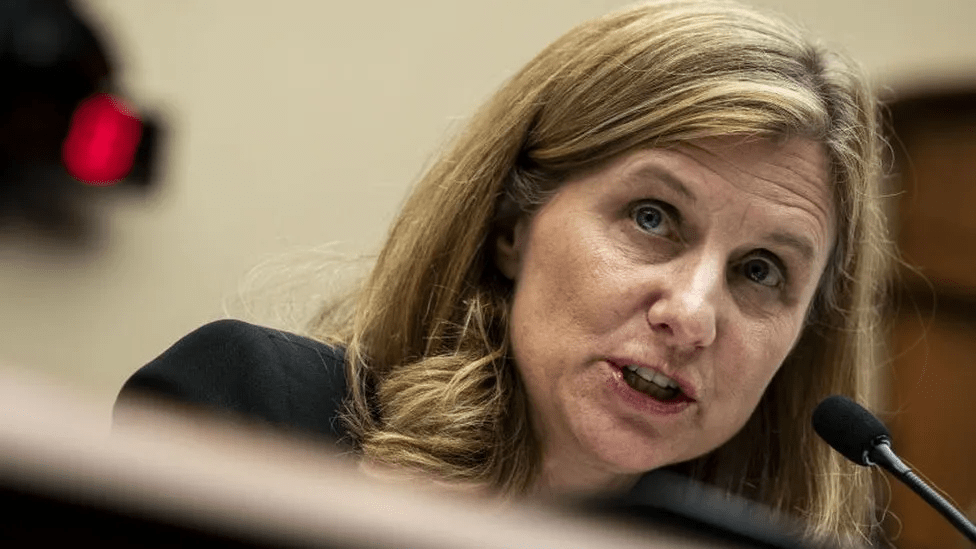
Elizabeth Magill resigns as UPenn president amid controversy over her comments on antisemitism during a Congressional hearing.
UPenn President Elizabeth Magill resigns following controversy over her Congressional testimony on antisemitism.
Elizabeth Magill, president of the University of Pennsylvania, faced criticism for declining to specify consequences for students advocating the genocide of Jews during Congressional testimony.
The university announced that Elizabeth Magill had “voluntarily tendered her resignation,” and she will continue in her role until a successor is appointed.
Ms. Magill had issued an apology for her testimony.
She made the controversial remarks during her appearance before a House of Representatives committee on December 5 alongside the presidents of Harvard and MIT, Claudine Gay and Sally Kornbluth.
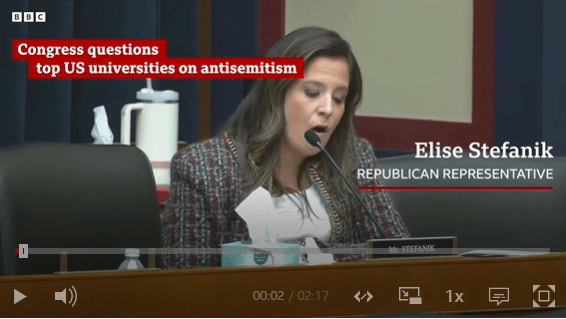
They were asked by Republican New York Congresswoman Elise Stefanik: “Does calling for the genocide of Jews violate [your university’s] code of conduct or rules regarding bullying and harassment? Yes or no?”
Ms Magill and her counterparts from MIT and Harvard repeatedly stated that it would depend on the “context” and have faced criticism for not unequivocally condemning any calls for the genocide of Jews.
American students navigate the complexities of free speech and concerns about antisemitism
The Congressional hearing occurred during campus protests triggered by the Israel-Gaza conflict and a surge in antisemitic incidents.
US University Heads Evade Question on Genocide
Statement: Ms. Magill apologized for her testimony, but calls for her resignation have continued.
Criticism from the White House and the withdrawal of a $100 million donation from a major donor, who expressed being “appalled” at Ms. Magill’s comments, have intensified calls for her resignation.
On Thursday, two Jewish students at the university filed a lawsuit, asserting that the campus has evolved into “an incubation lab for virulent anti-Jewish hatred, harassment, and discrimination.”
Ms. Magill’s resignation was confirmed by Scott L. Bok, chair of the Penn board of trustees. He stated that Ms. Magill would step down as president but “will remain a tenured faculty member at Penn Carey Law.”
Trustees were reportedly scheduled to meet on Sunday to discuss Ms. Magill’s position.
Ms. Magill released a statement via the university, expressing, “It has been my privilege to serve as President of this remarkable institution.”
“It has been a privilege collaborating with our faculty, students, staff, alumni, and community members to further Penn’s essential missions,” Ms. Magill stated.
The University of Pennsylvania, commonly referred to as UPenn, stands as one of the oldest and most esteemed universities in the United States, belonging to the prestigious Ivy League alongside institutions like Harvard and Yale.
Gov. Evers Makes Good on Promise to Stand With LGBTQ+ Youth, Fight for Equality
MADISON, WI — Today, the Human Rights Campaign (HRC), the nation’s largest LGBTQ+ civil rights organization, commended Wisconsin Gov. Tony Evers for vetoing AB465, legislation perceived as anti-LGBTQ+ and designed to limit healthcare options for transgender youth. Governor Evers’ veto aligns with his public pledge to uphold equality in the state and shield LGBTQ+ young individuals from discriminatory far-right policies.
Wendy Strout, HRC’s Wisconsin State Director, issued the subsequent statement:
“We appreciate Governor Evers, a crucial ally in Wisconsin’s equality struggle, for vetoing this divisive bill. It’s not a politician’s role to dictate medical decisions for constituents. That choice is exclusively between providers and families—end of story.”
In October, Governor Evers reaffirmed his support for LGBTQ+ youth on social media:
“I want LGBTQ folks, including our trans kids, to know they are welcome, wanted, and belong here in Wisconsin, and I will keep fighting every day to continue our work to build a state where they feel safe, supported, and loved being exactly who they are.”
AB465 would have compelled state medical boards to revoke the medical licenses of healthcare professionals offering life-saving, medically necessary healthcare to transgender youth. Despite transgender youth constituting a small percentage of the youth population, the care they receive is rooted in decades of clinical research and is endorsed by every major medical association in the US, representing over 1.3 million doctors.
Governor Evers’ rejection of the anti-LGBTQ+ legislation is the most recent instance of pro-equality leaders acting to safeguard LGBTQ+ individuals. In neighboring Michigan, the pro-equality majority in the state legislature extended current civil rights laws to ensure nondiscrimination protections for the LGBTQ+ community, signed into law by Governor Gretchen Whitmer. Similarly, in Arizona, Governor Katie Hobbs vetoed several anti-LGBTQ+ bills, including one targeting transgender individuals, pledging to veto any legislation aiming to harm children.
Non-medical politicians are overstepping by intruding on the rights of parents of transgender youth. No parent should face a situation where their chosen course of action, backed by their doctor and supported by the majority of medical experts, is forbidden by the government. This interference occurs when politicians attempt to prohibit best-practice healthcare.
THE FACTS: Gender-Affirming Care
Every reputable medical organization, representing over 1.3 million doctors in the United States, advocates for age-appropriate gender-affirming care for transgender and non-binary individuals.“Transition-related” or “gender-affirming” care varies for each transgender and non-binary individual. Decisions are collaboratively made by parents, their children, and doctors. No medical interventions with permanent consequences occur until a transgender person is old enough to provide fully informed consent.
This is the reason why majorities of Americans are against criminalizing or prohibiting gender-affirming care.Recent national surveys reveal that majorities of Americans, totaling 54% in the NPR/Marist survey conducted on 3/20-23, 2023, and 53% in the Grinnell College National Survey conducted on 3/14-19, 2023, oppose “criminalizing” or “banning” gender transition-related medical care for minors. The opposition is primarily driven by Democrats and Independents, indicating that support for such bans could pose risks in a general election context.
Gender transition is a personal journey encompassing changes such as wardrobe, names, and hairstyles to align with an individual’s gender identity. Individuals have the autonomy to decide whether to use medications or undergo surgeries as part of their gender transition. The process is a personal choice made in consultation with family and healthcare professionals. Therapists, parents, and healthcare providers collaborate to determine the most appropriate changes for a child’s well-being. For many young children, gender-affirming care is primarily social in nature.
New name
New hairstyle
New clothing
None of this care is irreversible.
Transgender identity is not a recent phenomenon. While the media may portray transgender issues more prominently nowadays, being transgender is not a recent development. Transgender individuals have always existed, and their experiences persist irrespective of legislative measures. It’s important to note that the vast majority of transgender individuals remain consistent in their identity over time.
All forms of gender-affirming care are tailored to the individual’s age, deemed medically necessary, endorsed by major medical associations, and determined collaboratively with medical, mental health experts, and parents. In numerous instances, this care proves to be life-saving. Recent research from the Trevor Project offers compelling data — transgender youth with access to gender-affirming hormone therapy experience reduced rates of depression and a lower risk of suicide.
For additional information, kindly visit hrc.org/transgender, along with these additional resources:
The Texas Supreme Court has denied a woman’s request for an abortion in the case of her high-risk pregnancy, following her attorneys’ announcement that she was leaving the state for the procedure.
Kate Cox, 31, had pursued an abortion due to a fatal fetal condition jeopardizing her fertility, as diagnosed by doctors.
A lower court had granted an exception, but this decision was overturned on Monday.
Texas enforces one of the most stringent abortion bans in the nation.
Texas’s comprehensive abortion bans restrict the procedure from the moment of conception, allowing exceptions only in limited circumstances where the life of the pregnant woman is in imminent danger. Critics of the law contend that the exception is overly ambiguous and jeopardizes women’s health.
In a concise seven-page ruling, the Texas Supreme Court determined that the doctor attending to Ms. Cox had not sufficiently demonstrated that her safety was imperiled by a “life-threatening physical condition,” a prerequisite mandated by the law.
“The justices emphasized that these laws reflect the policy choices made by the Legislature, and it is incumbent upon the courts to respect and uphold those choices,” they stated.
“This case marked the first instance of a woman seeking court permission for an abortion since the US Supreme Court overturned Roe v. Wade last year, granting individual states the authority to regulate abortion access,” legal experts noted.
Ms. Cox, a mother of two residing in the Dallas area, pursued an abortion due to her fetus being diagnosed with Trisomy 18, a chromosomal disorder often resulting in miscarriage, stillbirth, or infant mortality within the first year. Her physicians warned that proceeding with the pregnancy could pose a threat to her future fertility.
As per Ms. Cox’s legal documents, healthcare providers declined to conduct an abortion, citing restrictions tied to the presence of a fetal heartbeat.
She received a special dispensation from a Texas judge on Thursday. However, Texas Attorney General Ken Paxton promptly warned of potential criminal charges against any medical professionals who assisted her in obtaining the abortion.
He also petitioned the state’s Supreme Court, comprised entirely of Republicans, to step in. The court granted the request, temporarily preventing Ms. Cox from undergoing an abortion while it examined the case.
On Monday, attorneys representing Ms. Cox disclosed that she had departed Texas to seek an abortion beyond the state’s borders. No statewide law in Texas prohibits travel outside the state for an abortion.
“This week of legal uncertainty has been incredibly difficult for Kate,” stated Nancy Northup, president of the Center for Reproductive Rights, the pro-choice organization representing Ms. Cox. “Her health is in jeopardy, and after being in and out of the emergency room, she could not afford to wait any longer.”
Only a few hours after Ms. Cox’s legal team’s announcement, the state Supreme Court declared a verdict against her.
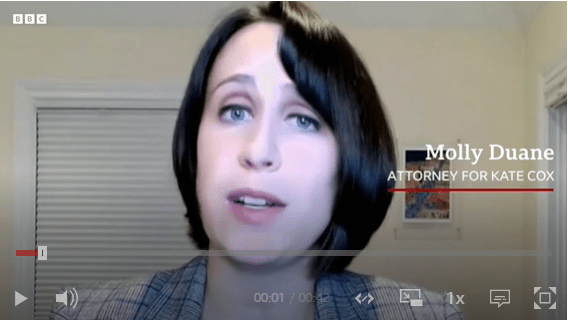
Watch: Lawyer for Kate Cox speaks on Texas abortion ruling
President Joe Biden remarked on Ms. Cox’s case on Tuesday, stating, “This should never happen in America.”
“Legal and medical chaos, as we are witnessing in states like Texas, Kentucky, and Arizona, is a direct result of Roe v. Wade being overturned, and as we predicted would happen, women’s health and lives now hang in the balance,” he added.
Speaking to the BBC on Monday, Molly Duane, a lawyer for the Center, called the Supreme Court’s ruling “stunning.”
“Politicians like to tout medical exceptions as being reasonable and available, as Kate’s experience shows they simply don’t exist in practice,” she said.
The Texas Supreme Court is currently considering another abortion case related to the state’s health exception, also led by Ms Duane and the Center for Reproductive Rights. Twenty-two plaintiffs, including doctors and women denied abortions in the state, have sued to clarify the existing state bans, stating that the medical exception is dangerously unclear.
The near-total bans have left physicians “terrified” to use their medical judgment over fear of harsh penalties, Ms Duane told the court last month. Doctors who perform abortions in Texas could risk life in prison, loss of their medical license, and hundreds of thousands of dollars in fines.
A lawyer representing the attorney general, Beth Klusmann, argued that existing standards permitted physicians to exercise “reasonable” medical judgment.












 fleeredstates.blog
You must be logged in to post a comment.