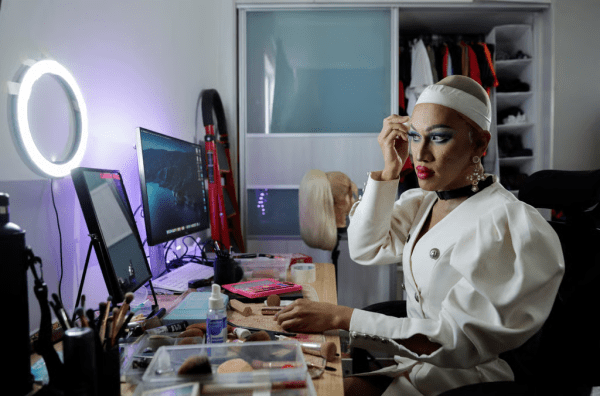
Tijuana is opening a facility that will help members of the LGBTQ+ community and women and children who are victims abuse, including those who are migrants deported from the U.S. or have just arrived in the city.
The center will be run by a group called Ayuda Acción México and will provide people with a home for up to three months as they remain in transition, said Tania Rodríguez Zafra, the agency’s director.
Those who live at the site will also receive job placement, basic health care, legal assistance and other resources.
She stated the site will especially cater to women and children who are victims of abuse.
“These are the most vulnerable members of the population,” Rodríguez Zafra.
The site opened its doors this week and it’s the third such facility in Mexico.
“We are very interested in giving opportunities to those who come here, including those who get deported,” she said. “We want to help as many people as we can.”
There will be room for up to 30 people at a time, but Rodríguez Zafra hopes to grow in the future and be able to accommodate 50 residents.
“Our utmost mission is to change the American dream for the Mexican dream,” she said. “Mexico needs to be more than a transit country, but a destination where people want to remain, we are not encouraging anyone to cross the border.”
The center will also help relocate residents to other areas in Mexico, especially if it means getting them jobs and more opportunities in cities such as Monterrey, Querétaro and Mexico City.
Private donations and contributions, along with some grants from the Mexican government will fund the site and its programs.
“We are affiliated with different firms who will help us accommodate and cater to whoever comes here seeking help, we will find them dignified jobs to meet their level of experience and education,” said Rodríguez Zafra.
A Moscow court Friday found an LGBTQ travel agent who had killed himself in custody a year ago guilty of extremism, as Russia increasingly targets individuals it says undermine “traditional” values.
The posthumous ruling came a year after 48-year-old Andrei Kotov was found dead in his cell in a Moscow pre-trial detention centre.
Russia has heavily targeted the LGBTQ community under President Vladimir Putin, and Friday’s ruling against somebody who had died a year earlier is seen as a particularly symbolic example of how zealous the crackdown is.
Kotov, who ran a travel company called Men Travel, had said he was beaten by 15 men when he was arrested in November 2024.
The Moscow Golovinsky court found him guilty of taking part in “extremist activity” as well as using underage people for pornography, the independent Mediazona website reported from inside the court.
His lawyer had said in December 2024 that Kotov’s body was found in his cell and that investigators told her he died by suicide.
Rights groups have accused authorities of using the case as a show trial — not dropping it after his death to scare LGBTQ people.
In November 2024, Kotov described his arrest in court: “Fifteen people came to me at night, beat me, were punching me in the face.”
Putin has for years denounced anything that goes against what he calls “traditional family values” as un-Russian and influenced by the West.
In 2023, Russia’s Supreme Court banned what it called the “international social LGBT movement” as an “extremist organisation”.
Human Rights Watch has said that the ruling “opened the floodgates for arbitrary prosecutions of individuals who are LGBT or perceived to be, along with anyone who defends their rights or expresses solidarity with them”.
Russia has never been a hospitable environment for LGBTQ people, but has become far more dangerous since Moscow’s Ukraine offensive, which massively accelerated the country’s hardline conservative turn.
In 1980, Cuban police detained Fidel Armando Toboso-Alfonso without charge, encouraged co-workers to publicly shame him, and warned he faced four years in prison unless he fled the country. His “crime” was being gay. Having previously faced 60 days in a labor camp, Toboso-Alfonso chose exile. When he reached the United States, an immigration judge made a historic ruling: He granted Toboso-Alfonso refuge. That decision became a lifeline for countless LGBTQ people.
The United States was once considered a place where LGBTQ people could claim asylum. Today, under a harsher immigration system shaped by Trump-era judges, this image is slipping away.
In June, U.S. Citizenship and Immigration Services issued an alert reminding officers that marriages must be legally valid where celebrated to qualify for immigration benefits. For queer couples from countries that criminalize or refuse to recognize same-sex marriage, that’s an impossible standard. They must present a marriage certificate that, in their home country, they could be jailed or killed for attempting to obtain.
This is just one part of the Trump Administration’s broader rollback of protections for immigrants and LGBTQ people.
Under Presidents Barack Obama and Joe Biden, the United States resettled tens of thousands of refugees annually, including LGBTQ people fleeing persecution, arrest, torture, or death. Today, that number has been slashed to just 7,500—a fraction of its former scale and overwhelmingly skewed toward white applicants from South Africa.
The Trump Administration has also ordered federal agencies to remove recognition of transgender and nonbinary identities from official documents. Because the asylum process demands consistency across forms, nonbinary refugees now face an impossible choice: misrepresent themselves on paper or risk rejection for “inconsistency.”
These bureaucratic changes to passports, marriage certificates, and federal forms carry devastating consequences. By narrowing who counts as married or whose gender “exists” on paper, the White House has effectively barred countless queer individuals from asylum protections. Bureaucracy has become a new border wall, keeping the most vulnerable people out.
The United States does not jail or execute people for being LGBTQ. But the government is asking queer people to erase themselves to remain here—a quieter, procedural form of violence. A nation cannot call itself a refuge while demanding that those seeking safety deny who they are.
Last week, the Supreme Court allowed the Trump Administration to require that U.S. passports list only the sex assigned at birth. The decision halts lower-court efforts to block the policy, meaning the State Department may now refuse to process passports reflecting a person’s self-identified gender. The change may seem technical, but it signals something larger: When combined with other anti-LGBTQ measures, it threatens not only the rights of citizens, but also the safety of queer immigrants and refugees.
Meanwhile, some lawmakers are pushing to overturn Obergefell v. Hodges, the 2015 Supreme Court decision that recognized same-sex marriage as a constitutional right. The Court recently declined to hear one such challenge, but its mere consideration shows how precarious equality has become.
For queer asylum seekers already in the United States, the situation remains perilous. Claims based on sexual orientation or gender identity are often met with skepticism, as adjudicators demand “proof” of identity—an impossible expectation when visibility itself can be a death sentence. Instead of offering protection, the system pressures applicants to conform to stereotypes of what being “gay enough” looks like.
Worse still, immigration judges may now deny asylum applications without hearings, silencing stories that could save lives. Bureaucracy, once again, has become a weapon.
The next generation must do more than defend LGBTQ people—they must reclaim the promise of this country. A true refuge is defined not by paperwork or policy, but by the belief that every person deserves to live in truth and safety.
State Representative David Borrero (HB 347) and Senator Clay Yarborough (SB 426) filed the first anti-LGBTQ bill of Florida’s 2026 legislative session — the Pride Flag Ban. The legislation seeks to prohibit state and local government buildings from displaying any flag representing “race, gender, or sexual orientation,” including the Pride flag. The bill also attempts to strip cities and counties of the power to design or adopt their own municipal flags, while carving out protections for “historical” flags — including Confederate symbols. This proposal follows a summer of state action to remove LGBTQ visibility, when Governor Ron DeSantis ordered the removal of rainbow crosswalks and street murals in cities across Florida. Now being introduced for the fourth year, the legislation has been widely rejected three years in a row.
Statement from Joe Saunders, Senior Political Director, Equality Florida:
“This bill is a direct attack on LGBTQ visibility and a textbook example of government overreach and censorship. The Pride flag is a symbol of safety, inclusion, and community for millions of Floridians. After DeSantis spent the summer ripping up rainbow crosswalks and street murals for his own political agenda, legislative extremists are now attempting to finish the job by banning Pride flags in public facilities. These bills prevent local cities and counties from using flags to recognize their own communities or make them welcoming to residents and tourists. Floridians deserve leaders focused on solving real problems, not weaponizing government to erase LGBTQ people from public life. We’ve defeated this bill before, and we will defeat it again.”
Dozens of local queer leaders, community members and allies gathered at the Oakland LGBTQ Community Center on a rainy Thursday afternoon to celebrate the unveiling of the city’s first permanent rainbow crosswalk and the second anniversary of the Lakeshore LGBTQ Cultural District.
The crosswalk was installed on Lakeshore Avenue, outside the LGBTQ center, symbolizing Oakland’s commitment to LGBTQ inclusion and visibility, the center said in a news release. Instead of paint, it is made from thermoplastic materials to ensure durability and safety.
“It tells every trans, queer and non-binary person who visits our LGBTQ district that they are welcome, seen, safe, and celebrated right here in Oakland,” said Jeff Myers, chair of the Lakeshore LGBTQ Cultural District Committee, which plans events and does community outreach in the neighborhood.
A two-hour indoor ceremony preceded the unveiling, hosted by center co-chairs Myers and Joe Hawkins and emcee MCYB. It featured music from flutist Piedpiper KJ, singer-songwriter Cadence Myles and the Oakland Gay Men’s Chorus, as well as remarks from elected officials and neighborhood business owners.
Speakers emphasized the importance of the Lakeshore District, which was established in 2023, and the new rainbow crosswalk as markers of queer visibility in Oakland during a time of fraught messaging from the federal government.
“The Lakeshore LGBTQ Cultural District is more than just geography,” said Kin Folkz, a visual artist, poet and founder of the neighborhood’s Queer Arts Center. “It is the way that we refuse to disappear.”
Mayor Barbara Lee presented Lakeshore District leaders with a placard proclaiming Nov. 13 as “Lakeshore LGBTQ Cultural District Day.”
“The rainbow crosswalk is a signal that you are part of the fabric of Oakland’s history and of Oakland’s future,” Lee said.
Hawkins thanked Lee for securing grant funding to support improvements at the center during her tenure in Congress. He also praised the Alameda County Supervisors for helping make up for the center’s recent loss of federal funding. The Supervisors approved $1.5 million for LGBTQ service providers, with the Oakland center getting some of that funding.
“Our city and county are helping,” Hawkins said. “I’m very confident this is more help than we’ve ever received.”
Bucking the trend
Councilmember Charlene Wang, who represents the Lakeshore District, applauded Oakland for installing the rainbow crosswalk, while lamenting the removal of such crosswalks in Florida and Texas cities. U.S. Transportation Secretary Sean Duffy launched a “roadway safety initiative” in July, urging governors to remove “political messaging and artwork” from intersections. Following that announcement, Orlando, Miami Beach, Gainesville, and Houston removed colorful crosswalks.
“While those cities caved, we are standing strong and we are adding crosswalks,” Wang said.
Megan Wier, an assistant director at the city’s Transportation Department, told Oakland North that the city worked with the LGBTQ center and Councilmember Rowena Brown’s office on a design that reflected diversity but also followed Americans with Disabilities Act requirements.
After the ceremony, everyone shuffled out of the building and into the rain for the crosswalk unveiling. Onlookers clustered under tents to watch Lee, Myers and Brown cut a ceremonial red ribbon, flanked by members of the Lakeshore District committee and the Transportation Department.
Oakland resident Darron Lewis said he was overjoyed to be there. Lewis, whose boyfriend works for the LGBTQ center, recently moved from Seattle and expressed his admiration for Oakland.
“It’s an adaptable place,” Lewis said. “There’s nothing more queer than a rainy day in Oakland.”
The Texas State Board of Education is reshaping how public schools will teach social studies for years to come, but its recent selection of the panelists who will advise members during the process is causing concern among educators, historians and both Democrats and Republicans, who say the panel’s composition is further indication that the state wants to prioritize hard-right conservative viewpoints.
The Republican-dominated education board earlier this year officially launched the process of redesigning Texas’ social studies standards, which outline in detail what students should know by the time of graduation. The group, which will meet again in mid-November, is aiming to finalize the standards by next summer, with classroom implementation expected in 2030.
The 15 members in September agreed on the instructional framework schools will use in each grade to teach social studies, already marking a drastic shift away from Texas’ current approach. The board settled on a plan with a heavy focus on Texas and U.S. history and less emphasis on world history, geography and cultures. Conservative groups like Texas Public Policy Foundation and the Heritage Foundation championed the framework, while educators largely opposed it.
In the weeks that followed, the board selected a panel of nine advisers who will offer feedback and recommendations during the process. The panel appears to include only one person currently working in a Texas public school district and has at least three people associated with far-right conservative activism. That includes individuals who have criticized diversity efforts, questioned school lessons highlighting the historical contributions of people of color, and promoted beliefs debunked by historians that America was founded as a Christian nation.
That group includes David Barton, a far-right conservative Christian activist who gained national prominence arguing against common interpretations of the First Amendment’s establishment clause, which prevents the government from endorsing or promoting a religion. Barton believes that America was founded as a Christian nation, which many historians have disproven.
Critics of Barton’s work have pointed to his lack of formal historical training and a book he authored over a decade ago, “The Jefferson Lies,” that was pulled from the shelves due to historical details “that were not adequately supported.” Brandon Hall, an Aledo Republican who co-appointed Barton, has defended the decision, saying it reflected the perspectives and priorities of his district.
Another panelist is Jordan Adams, a self-described independent education consultant who holds degrees from Hillsdale College, a Michigan-based campus known nationally for its hard-right political advocacy and efforts to shape classroom instruction in a conservative Christian vision. Adams’ desire to flip school boards and overhaul social studies instruction in other states has drawn community backlash over recommendations on books and curriculum that many felt reflected his political bias.
Adams has proclaimed that “there is no such thing” as expertise, describing it as a label to “shut down any type of dialogue and pretend that you can’t use your own brain to figure things out.” He has called on school boards to craft policies to eliminate student surveys, diversity efforts and what he considers “critical race theory,” a college-level academic and legal framework examining how racism is embedded in laws, policies and institutions. Critical race theory is not taught in K-12 public schools but has become a shorthand for conservative criticism of how schools teach children about race.
In an emailed response to questions from The Texas Tribune, Adams pointed to his earlier career experience as a teacher and said he understands “what constitutes quality teaching.” Adams also said he wants to ensure “Texan students are taught using the best history and civics standards in America” and that he views the purpose of social studies as forming “wise and virtuous citizens who know and love their country.”
“Every teacher in America falls somewhere along the political spectrum, and all are expected to set their personal views aside when teaching. The same goes for myself and my fellow content advisors,” Adams said. “Of course, given that this is public education, any efforts must support the U.S. Constitution and Texas Constitution, principles of the American founding, and the perpetuation of the American experiment in free self-government.”
Republicans Aaron Kinsey and LJ Francis, who co-appointed Adams, could not be reached for interviews.
David Randall, executive director of the Civics Alliance and research director of the National Association of Scholars, was also appointed a content adviser. He has criticized standards he felt were “animated by a radical identity-politics ideology” and hostile to America and “groups such as whites, men, and Christians.” Randall has written that vocabulary emphasizing “systemic racism, power, bias, and diversity” cannot coexist with “inquiry into truth — much less affection for America.” He has called the exclusion of the Bible and Christianity in social studies instruction “bizarre,” adding that no one “should find anything controversial” about teaching the role of “Judeo-Christian values” in colonial North America.
Randall told the Tribune in an email that his goal is to advise Texas “as best I can.” He did not respond to questions about his expertise and how he would work to ensure his personal beliefs do not bleed into the social studies revisions.
Randall was appointed by Republican board members Evelyn Brooks and Audrey Young, both of whom told the Tribune that they chose him not because of his political views but because of his national expertise in history and civics, which they think can help Texas improve social studies instruction.
“I really can’t sit here and say that I agree with everything he has said. I don’t even know everything that he has said.” Brooks said. “What I can say is that I can refer to his work. I can say that he emphasizes integrating civics.”
The advisory panel also consists of a social studies curriculum coordinator in the Prosper school district and university professors with expertise ranging from philosophy to military studies. The group notably includes Kate Rogers, former president of the Alamo Trust, who recently resigned from her San Antonio post after Lt. Gov. Dan Patrick criticized her over views she expressed in a doctoral dissertation suggesting she disagreed with state laws restricting classroom instruction on race and slavery.
Seven of the content advisers were selected by two State Board of Education members each, while Texas’ Commissioner of Higher Education Wynn Rosser chose the two other panelists. Board member Tiffany Clark, a Democrat, did not appoint an adviser, and she told the Tribune that she plans to hold a press conference during the board’s November meeting to address what happened.
Staci Childs, a Democrat from Houston serving on the State Board of Education, said she had anticipated that the content advisory group would include “extremely conservative people.” But her colleagues’ choices, she said, make her feel like “kids are not at the forefront right now.”
Pam Little, who is the board’s vice chair, is one of two members who appear to have chosen the only content adviser with active experience working in a Texas K-12 public school district. The Fairview Republican called the makeup of the advisory panel “disappointing.”
“I think it signals that we’re going in a direction where we teach students what we want them to know, rather than what really happened,” Little said.
The board’s recent decisions show that some members are more focused “on promoting political agendas rather than teaching the truth,” said Rocío Fierro-Pérez, political director of the Texas Freedom Network, a progressive advocacy organization that monitors the State Board of Education’s decisions.
“Whether your political beliefs are conservative, liberal, or middle of the road really shouldn’t disqualify you from participating in the process to overhaul these social studies standards,” Fierro-Pérez said. “But it’s wildly inappropriate to appoint unqualified political activists and professional advocates with their own agendas, in leading roles and guiding what millions of Texas kids are going to be learning in classrooms.”
Other board members and content advisers insist that it is too early in the process to make such judgments. They say those discussions should wait until the actual writing of the standards takes place, which is when the board can directly address concerns about the new framework.
They also note that while content advisers play an integral role in offering guidance, the process will include groups of educators who help write the standards. State Board of Education members will then make final decisions. Recent years have shown that even those within the board’s 10-member Republican majority often disagree with one another, making the final result of the social studies revisions difficult to predict.
Donald Frazier, a Texas historian at Schreiner University in Kerrville and chair of Texas’ 1836 Project advisory committee, who was also appointed a content adviser, said that based on the panelists’ conversations so far, “I think that there’s a lot more there than may meet the eye.”
“There’s people that have thought about things like pedagogy and how children learn and educational theory, all the way through this panel,” Frazier said. “There’s always going to be hand-wringing and pearl-clutching and double-guessing and second-guessing. We’ve got to keep our eye on the students of Texas and what we want these kids to be able to do when they graduate to become functioning members of our society.”
The makeup of the advisory panel and the Texas-heavy instructional framework approved in September is the latest sign of frustration among conservative Republicans who often criticize how public schools approach topics like race and gender. They have passed laws in recent years placing restrictions on how educators can discuss those topics and pushed for instruction to more heavily emphasize American patriotism and exceptionalism.
Under the new framework, kindergarteners through second graders will learn about the key people, places and events throughout Texas and U.S. history. The plan will weave together in chronological order lessons on the development of Western civilization, the U.S., and Texas during grades 3-8, with significant attention on Texas and the U.S. after fifth grade. Eighth-grade instruction will prioritize Texas, as opposed to the broader focus on national history that currently exists. The framework also eliminates the sixth-grade world cultures course.
When lessons across all grades are combined, Texas will by far receive the most attention, while world history will receive the least.
During a public comment period for the plan, educators criticized its lack of attention to geography and cultures outside of America. They opposed how it divides instruction on Texas, U.S. and world history into percentages every school year, as opposed to providing students an entire grade to fully grasp one or two social studies concepts at a time. They said the plan’s strict chronological structure could disrupt how kids identify historical trends and cause-and-effect relationships, which can happen moreeffectively through a thematic instructional approach.
But that criticism did not travel far with some Republicans, who argue that drastic changes in education will almost always prompt negative responses from educators accustomed to teaching a certain way. They point to standardized test results showing less than half of Texas students performing at grade level in social studies as evidence that the current instructional approach is not working. They also believe the politicization of education began long before the social studies overhaul, but in a way that prioritizes left-leaning perspectives.
“Unfortunately, I think it boils down to this: What’s the alternative?” said Matthew McCormick, education director of the conservative Texas Public Policy Foundation. “It always seems to come down to, if it’s not maximally left-wing, then it’s conservative indoctrination. That’s my perspective. What is the alternative to the political and policymaking process? Is it to let teachers do whatever they want? Is it to let the side that lost the elections do what they want? I’m not sure. There’s going to be judgments about these sorts of things.”
This is not the first time the board has garnered attention for its efforts to reshape social studies instruction. The group in 2022 delayed revisions to the standards after pressure from Republican lawmakers who complained that they downplayed Texan and American exceptionalism and amounted to far-left indoctrination. Texas was also in the national spotlight roughly a dozen years prior for the board’s approval of standards that reflected conservative viewpoints on topics like religion and economics.
Social studies teachers share the sentiment that Texas can do a better job equipping students with knowledge about history, geography, economics and civics, but many push back on the notion that they’re training children to adhere to a particular belief system. With challenges like budget shortfalls and increased class sizes, they say it is shortsighted to blame Texas’ academic shortcomings on educators or the current learning standards — not to mention that social studies instruction often takes a backseat to subjects like reading and math.
“I think we’re giving a lot more credit to this idea that we’re using some sort of political motivation to teach. We teach the standards. The standards are there. That’s what we teach,” said Courtney Williamson, an eighth-grade social studies teacher at a school district northwest of Austin.
When students graduate, some will compete for global jobs. Others may go to colleges across the U.S. or even internationally. That highlights the importance, educators say, of providing students with a broad understanding of the world around them and teaching them how to think critically.
But with the recent moves requiring a significant overhaul of current instruction — a process that will likely prove labor-intensive and costly — some educators suspect that Texas leaders’ end goal is to establish a public education system heavily reliant on state-developed curricula and training. That’s the only way some can make sense of the new teaching framework or the makeup of the content advisory panel.
“I’m really starting to notice an atmosphere of fear from a lot of people in education, both teachers and, I think, people higher up in districts,” said Amy Ceritelli-Plouff, a sixth-grade world cultures teacher in North Texas. “When you study history, you look at prior conflicts and times in our history when there has been extremism and maybe too much government control or involvement in things; it starts with censoring and controlling education.”
Liberty Counsel, the Christian hate group behind Kim Davis’s attempt to have the Supreme Court overturn its marriage equality decision, says their fight to end LGBTQ+ equality is far from over.
“I have no doubt that Davis’s resolve will serve as a catalyst to raise up many more challenges to the wrongly decided Obergefell opinion,” wrote Liberty Counsel President Mat Staver in a message on the group’s website. “Until then, we must pray, fight, and contend for when Obergefell is no longer the law of the land.”
The Supreme Court ruled in its 2015 Obergefell v. Hodges decision that people have a fundamental right to choose who to marry, regardless of their spouse’s gender. The decision legalized marriage equality in all 50 states.
A county clerk in Kentucky, Kim Davis, refused to issue marriage licenses to same-sex couples, which led to a lawsuit and ten years of legal fights.
This year, with help from the lawyers at Liberty Counsel, she filed an appeal to the Supreme Court to overturn a judgment against her that required her to pay $360,000 to a gay couple whom she had illegally denied a marriage license. In that petition, she asked the Supreme Court to end marriage equality, arguing that her case proved that LGBTQ+ equality was inherently a threat to the rights of Christians like herself.
Last week, the Supreme Court rejected her appeal, leaving its decision in favor of marriage rights in place for at least another year.
Anti-LGBTQ+ activists, though, aren’t going to give up.
“This time, Kim Davis is the victim of religious animus and is being deprived of her constitutional freedom of religion,” Staver wrote. “Tomorrow, it could be you.”
“This may mark the end of an era in litigating Davis’s case, but the fight to overturn Obergefell and protect religious liberty has just begun.”
Staver’s argument is similar to an argument that Justices Clarence Thomas and Samuel Alito made in 2020 that the mere existence of married same-sex couples is a violation of Christians’ religious freedom because seeing married same-sex couples encourages people to judge Christians “as bigots.” (That opinion was delivered in the context of a different appeal filed by Davis.)
“Since Obergefell, parties have continually attempted to label people of good will as bigots merely for refusing to alter their religious beliefs in the wake of prevailing orthodoxy,” Thomas wrote at the time.
Kazakhstan’s parliament on Wednesday passed a bill to ban the promotion of what it calls “non-traditional sexual orientation” in public spaces and the media, a copycat of Russia’s anti-LGBTQ laws.
Rights groups described the measure, which needs to be approved by the upper house, as discriminatory and said it would increase the vulnerability of LGBTQ people in the Central Asian Muslim-majority country, an ally of Russia.
The legislation would ban “information containing propaganda of pedophilia and/or non-traditional sexual orientation in public spaces, as well as in the media.”
Numerous rights groups urged MPs to reject the law, saying adopting it “would blatantly violate Kazakhstan’s international human rights commitments,” the International Partnership for Human Rights said in a statement.
Located between Russia and China, the vast former Soviet republic rich in natural resources, is trying to balance between its superpower neighbors and the West.
Kazakh President Kassym-Jomart Tokayev is currently on a state visit to Moscow, where he is expected to sign a strategic partnership agreement with Russian leader Vladimir Putin.
Earlier this year Tokayev slammed the rise of what he called LGBTQ values.
“For decades, so-called democratic moral values, including LGBT, were imposed on many countries,” he wrote on social media.
Echoing language used by Moscow, he added that various NGOs and foundations had used that as a facade for meddling in other countries’ internal affairs.
Russia adopted its own anti-LGBTQ law in 2013, initially banning what it called the “propaganda of non-traditional sexual relationships” among children. It expanded the measure to adults after it invaded Ukraine in 2022 and has ramped up a campaign targeting LGBTQ groups and people.
Several other countries, including EU members Hungary and Bulgaria, have also passed anti-LGBTQ “propaganda” laws that critics say are inspired by Russia’s.
A town in Maine voted Monday night to continue to comply with the state’s Human Rights Act, allowing a transgender grade-schooler to play on a girls’ recreational basketball team.
The 3–2 vote at the November 10 special meeting of the St. George, Maine, Select Board came after a group of parents submitted a letter at last week’s regular monthly meeting raising their “deep concern” about the St. George Parks & Recreation Department’s youth basketball program allowing a transgender girl to play on its third and fourth grade girls’ team.
“While we understand that Maine law allows children to participate [in sports] based on how they identify, we also believe that these policies have created a very uncomfortable situation for many families in our community,” local parent Emily Chadwick read from the group’s letter during the public comment portion of the November 4 meeting.
In video from the meeting, Chadwick and others who spoke initially seemed to go out of their way not to mention the trans child or indeed to even specify the reason for their “concerns” or to ask the board to take any specific action beyond considering “how these policies impact all the children involved, not just one.”
Noting that the group seemed to be referencing the Maine Human Rights Act (MHRA), which bars discrimination based on gender identity, Select Board Chair Jane Conrad told those in attendance that their proper course of action would be “to lobby your legislators” to change the law. The Select Board members, she explained, “are in charge of enforcing the law.”
The board ultimately decided to schedule the November 10 special meeting to discuss whether it would continue to comply with the law and to allow for the broader community to weigh in.
Monday night’s meeting opened with Colin Hurd, deputy counsel for the Maine Human Rights Commission, clarifying precisely what is covered by the state human rights law.
“Under the Maine Human Rights Act, it’s illegal to prevent a person from playing sports on the team of their gender identity solely because their sex assigned at birth is different from the people that they will be playing with or against,” Hurd explained. “Furthermore, under the same provision, it’s illegal to prevent a person from using the restroom or locker room that most closely corresponds with their gender identity. So, the law, the Human Rights Act, is pretty unequivocal on these matters.”
Following the meeting’s hour-long public comment period, Conrad once again reiterated that it is not the board’s role “to determine or debate the law,” adding that in recent years, the board has consistently voted to follow state law, even when individual members disagreed with it. While she encouraged board members to voice their objections to the law, she also expressed her hope that they would vote to follow it, as not doing so would likely invite a lawsuit that they would lose, “and the taxpayers of our town would have to foot the bill.”
While some speakers at both the November 4 and 10 meetings seemed to reference a February 5 executive order banning transgender women and girls from women’s and girls’ sports (which neither changed nor established any law) and his administration’s interpretation of Title IX, Conrad noted that no court has ruled so far that any federal law supersedes the Maine Human Rights Act. She also noted that attempts in the state’s most recent legislative session to restrict trans people’s participation in sports have all been rejected.
As Them notes, the dust-up in St. George follows Maine’s Democratic Gov. Janet Mills’s months-long feud with the president over her refusal to comply with his anti-trans executive order. Mills has argued that the state’s human rights law prevents her from banning trans athletes from women’s and girls’ sports. However, as Them notes, several school districts in the state have nonetheless opted to institute trans sports bans in compliance with the executive order. An anti-trans advocacy group recently launched a new effort to amend the MHRA via ballot referendum so that it is in compliance with the presidential administration’s anti-trans interpretation of Title IX.
A Virginia transportation security officer is accusing the U.S. Department of Homeland Security of sex discrimination over a policy that bars transgender officers from performing security screening pat-downs, according to a federal lawsuit.
The Transportation Security Administration, which operates under DHS, enacted the policy in February to comply with President Donald Trump’s executive order declaring two unchangeable sexes: male and female.
According to internal documents explaining the policy change that The Associated Press obtained from four independent sources, including two current and two former TSA workers, “transgender officers will no longer engage in pat-down duties, which are conducted based on both the traveler’s and officer’s biological sex. In addition, transgender officers will no longer serve as a TSA-required witness when a traveler elects to have a pat-down conducted in a private screening area.”
Until February, TSA assigned work consistent with officers’ gender identity under a 2021 management directive. The agency told the AP it rescinded that directive to comply with Trump’s Jan. 20 executive order.
Although transgender officers “shall continue to be eligible to perform all other security screening functions consistent with their certifications,” and must attend all required training, they will not be allowed to demonstrate how to conduct pat-downs as part of their training or while training others, according to the internal documents.
A transgender officer at Dulles International Airport, Danielle Mittereder, alleges in her lawsuit filed Friday that the new policy — which also bars her from using TSA facility restrooms that align with her gender identity — violates civil rights law.
“Solely because she is transgender, TSA now prohibits Plaintiff from conducting core functions of her job, impedes her advancement to higher-level positions and specialized certifications, excludes her from TSA-controlled facilities, and subjects her identity to unwanted and undue scrutiny each workday,” the complaint says.
Mittereder declined to speak with the AP but her lawyer, Jonathan Puth, called TSA’s policy “terribly demeaning and 100% illegal.”
TSA spokesperson Russell Read declined to comment, citing pending litigation. But he said the new policy directs that “Male Transportation Security Officers will conduct pat-down procedures on male passengers and female Transportation Security Officers will conduct pat-down procedures on female passengers, based on operational needs.”
Other transgender officers describe similar challenges to Mittereder.
Kai Regan worked for six years at Harry Reid International Airport in Las Vegas, but retired in July in large part because of the new policy. Regan, who is not involved in the Virginia case, transitioned from female to male in 2021 and said he had conducted pat-downs on men without issue until the policy change.
“It made me feel inadequate at my job, not because I can’t physically do it but because they put that on me,” said the 61-year-old, who worried that he would soon be fired for his gender identity, so he retired earlier than planned rather than “waiting for the bomb to drop.”
Skye Perryman, president and CEO of Democracy Forward — a legal organization that has repeatedly challenged the second Trump administration in court — called TSA’s policy “arbitrary and discriminatory,” adding: “There’s no evidence or data we’re aware of to suggest that a person can’t perform their duties satisfactorily as a TSA agent based on their gender identity.”
DHS pushed back on assertions by some legal experts that its policy is discriminatory.
“Does the AP want female travelers to be subjected to pat-downs by male TSA officers?” Homeland Security spokesperson Tricia McLaughlin asked in a written response to questions by the AP. “What a useless and fundamentally dangerous idea, to prioritize mental delusion over the comfort and safety of American travelers.”
Airport security expert and University of Illinois Urbana-Champaign professor Sheldon H. Jacobson, whose research contributed to the design of TSA PreCheck, said that the practice of matching the officer’s sex to the passenger’s is aimed at minimizing passenger discomfort during screening. Travelers can generally request another officer if they prefer, he added.
Deciding where transgender officers fit into this practice “creates a little bit of uncertainty,” Jacobson said. But because transgender officers likely make up a small percent of TSA’s workforce, he said the new policy is unlikely to cause major delays.
“It could be a bit of an inconvenience, but it would not inhibit the operation of the airport security checkpoint,” Jacobson said.
TSA’s policy for passengers is that they be screened based on physical appearance as judged by an officer, according to internal documents. If a passenger corrects an officer’s assumption, “the traveler should be patted down based on his/her declared sex.” For passengers who tell an officer “that they are neither a male nor female,” the policy says officers must advise “that pat-down screening must be conducted by an officer of the same sex,” and to contact a supervisor if concerns persist.
The documents also say that transgender officers “will not be adversely affected” in pay, promotions or awards, and that TSA “is committed to providing a work environment free from unlawful discrimination and retaliation.”
But the lawsuit argues otherwise, saying the policy impedes Mittereder’s career prospects because “all paths toward advancement require that she be able to perform pat-downs and train others to do so,” Puth said.
According to the lawsuit, Mittereder started in her role in June 2024 and never received complaints related to her job performance, including pat-down responsibilities. Supervisors awarded her the highest-available performance rating and “have praised her professionalism, skills, knowledge, and rapport with fellow officers and the public,” the lawsuit said.
“This is somebody who is really dedicated to her job and wants to make a career at TSA,” Puth said. “And while her gender identity was never an issue for her in the past, all of a sudden it’s something that has to be confronted every single day.”
Being unable to perform her full job duties has caused Mittereder to suffer fear, anxiety and depression, as well as embarrassment and humiliation by forcing her to disclose her gender identity to co-workers, the complaint says. It adds that the ban places additional burden on already-outnumbered female officers who have to pick up Mittereder’s pat-down duties.
American Federation of Government Employees National President Everett Kelley urged TSA leadership to reconsider the policy “for the good of its workforce and the flying public.”
“This policy does nothing to improve airport security,” Kelley said, “and in fact could lead to delays in the screening of airline passengers since it means there will be fewer officers available to perform pat-down searches.”
You must be logged in to post a comment.