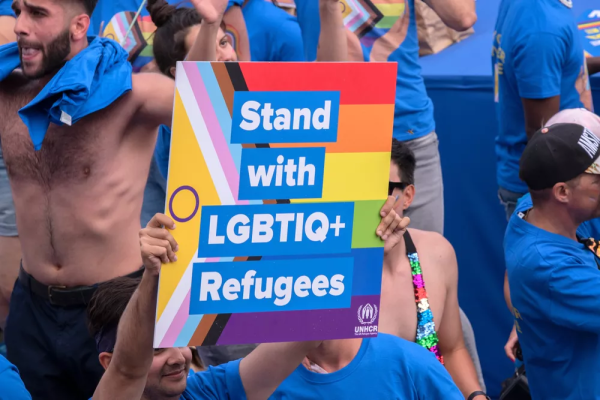
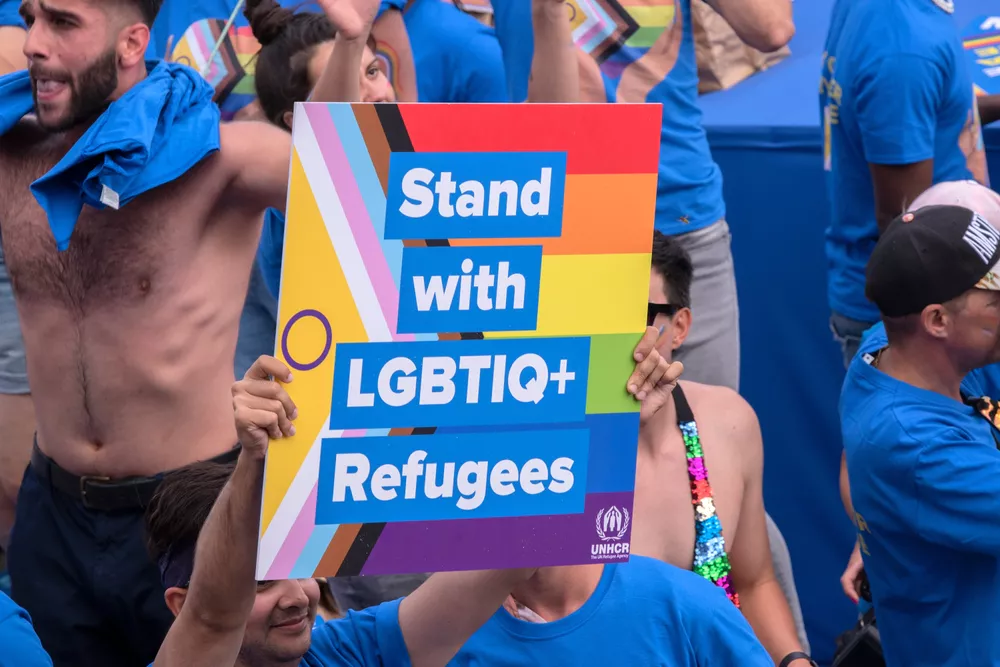
President Donald Trump’s second term has especially targeted two groups in particular: immigrants and LGBTQ people. On his first day in office, he ended the U.S. Refugee Admissions Program, which left thousands of refugees who had already been approved to live in the United States stranded. He also drastically lowered the cap on the number of refugees allowed to enter the U.S. from 125,000 to 7,500. Thankfully, Immigration Equality is here to help.
“For many decades, we’ve seen clients arrive with nothing but hope and fear, and walk out with safety and freedom,” Anto Chavez, Immigration Equality’s communications director, told LGBTQ Nation. “It’s just becoming harder to fight, but we’re still here with them. We still hold their hand every step of the way. We have more than 700 active legal cases, our legal staff trains thousands of lawyers nationwide to represent queer immigrants pro bono, and we fight in the courts and Congress to expand protections.”
Founded in 1994, Immigration Equality provides free legal help for immigrants and asylum seekers who are LGBTQ+ or HIV-positive. The group is fighting Trump’s seemingly arbitrary executive orders on immigration in courts — and winning.
Chavez spoke with LGBTQ Nation about how the sociocultural landscape around immigration has changed now that Trump is back in office and what average citizens can do to fight for the rights of queer immigrants in our community.
For forever, immigrant communities have learned how to take care of each other without relying on systems that have failed us. We have to continue to do that. We have to continue to fight. Anto Chavez, Immigration Equality communications director
LGBTQ Nation: What has changed under Trump’s second term for immigrants applying for asylum to escape anti-LGBTQ persecution in their home countries?
Anto Chavez: The anti-immigrant rhetoric has shaped the culture and the cultural shift in our country; this happened during Trump’s term as well. But it really changes how queer immigrants even envision themselves in the U.S.
At the beginning of this administration, some of our clients were refugees. We have an asylum program and a refugee program. Historically, we have worked with ICE (Immigration and Customs Enforcement), but we opened up our refugee program a few years ago. After we launched it, some folks were really scared to even just decide to come to the U.S. I think there was a lot of misinformation, [but] this is still a place that’s safer for many folks.
But when it comes to policy — I mean, if we talk about refugee work, every avenue has been blocked for us. The refugee resettlement program went from thousands a year to zero, and so we’ve had to really look into other options.
How has Donald Trump’s executive order drastically lowering the refugee cap affected refugees who were already approved?
Since January 20, after the executive order suspending the refugee resettlement program and halting the process for many folks, we had people who were ready to travel and had to cancel. So for queer and trans asylum seekers, this means just fewer pathways for relocation or protection from persecution.
The U.S. has historically been a place where queer immigrants have been able to come and live freely. It’s scary to think it’s starting to change.
There are increased barriers for asylum seekers who are already here as well. Policies like what was called “Remain in Mexico,” were reinstated. The CBP (Customs and Border Patrol) One app, which allowed those migrating for humanitarian reasons to schedule asylum interviews at ports of entry, was ended, and existing appointments were canceled.
There has been increased deportation, including of multiple LGBTQ asylum seekers. There’s also the abuse that happens in detention, particularly to queer and trans immigrants. It’s just out of this world. We have some reports that queer immigrants are more likely to be assaulted and abused in ICE detention and put into solitary confinement.
Trump’s Department of Health and Human Services (HHS) seeks to end all Medicaid and Medicare funding for young people’s gender-affirming care (GAC), according to newly proposed rules shared by NPR. A trans activist said the rules would amount to a “de facto national ban” on GAC.
The proposed rules would prohibit all federal Medicaid and Medicare funding — as well as funding through the federal Children’s Health Insurance Program (CHIP) — for any services at hospitals that provide GAC for trans youth.
“These would be proposals that would go out for public comment, it would take months for the Trump administration to issue a final rule, and then, if past is prologue, we would see litigation over whatever the final rules are,” Katie Keith, director of the Center for Health Policy and the Law at Georgetown University, told NPR.
Terry Schilling, president of the American Principles Project, a right-wing think tank that has pushed national transphobia as an effective Republican political strategy, said of the proposed rules, “I think these restrictions are very good. It’s going to change the entire transgender industry, and it’s going to take away a lot of their funding streams.”
“This would be a de facto national ban,” wrote trans activist and civil rights attorney Alejandra Caraballo via Bluesky. “There would still be providers in blue states that don’t take federal funding but the large interdisciplinary teams of just a few years ago would be nearly impossible to maintain. The result is that the care that remains would largely be underground with worse support and likely outcomes.”
“They’ll never be able to fully ban this care,” Caraballo added. “There will always be providers willing to provide it like abortion. Even without access to providers, many trans youth will simply go DIY [do-it-yourself] like trans folks have done for decades. They’re not actually banning this care, they’re making it less safe.”
The administration’s “toxic” war on gender-affirming care
Though there is no federal law banning gender-affirming care, the current presidential administration has sought to eradicate the practice through a January executive order (that has since been blocked by several courts). The order instructed the DOJ to extend the time that patients and parents can sue gender-affirming doctors and to use laws against false advertising to prosecute any entity that may be misleading the public about the long-term effects of gender-affirming care (GAC).
In April, Bondi issued a memo to DOJ employees, telling them to investigate and prosecute cases of minors accessing gender-affirming care as female genital mutilation (FGM), even though hospitals don’t conduct such female genital surgeries. The memo threatened to jail doctors for 10 years if they provide gender-affirming care to young trans people.
The following June, the DOJ sent subpoenas to 20 medical providers who offer GAC to trans youth, demanding patients’ Social Security numbers, emails, home addresses, and information on the care they received, as well as other sensitive information dating back to January 2020. A federal judge blocked the subpoena in one instance and accused the DOJ of going on a “bad faith” “fishing expedition” to interfere with states’ rights to protect GAC within its borders, to harass and intimidate providers from offering such care, and to dissuade patients from seeking such care.
Fewer than 3,000 teens nationwide receive puberty blockers or hormone replacement therapy, according to a 2025 JAMA analysis of private insurance data. Gender-affirming care is supported by all major medical associations in the U.S., including the American Medical Association, the Endocrine Society, and the American Academy of Pediatrics, as safe and life-saving for young people with gender dysphoria.
One doctor interviewed by The Washington Post called the federal government’s crusade against gender-affirming care a “toxic plan” that will force some patients to detransition, potentially forcing them into adverse psychological and physical effects, including increased anxiety, depression, and the development of unwanted physical changes.
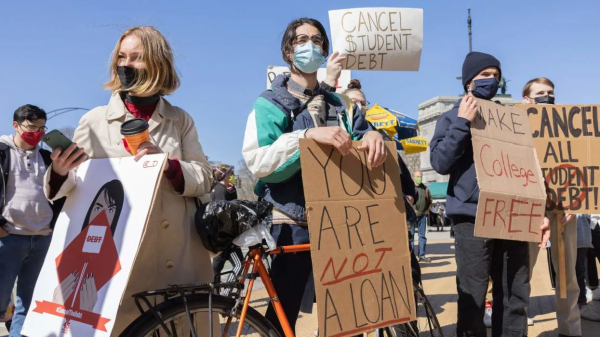
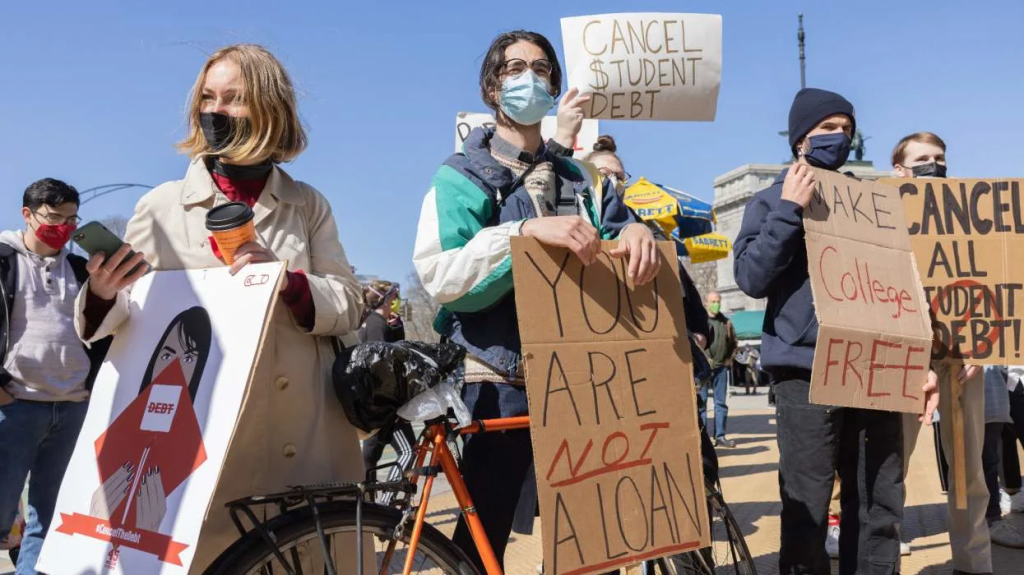
Donald Trump‘s Department of Education has unveiled a new policy that will make workers of LGBTQ+ nonprofits ineligible for student loan forgiveness.
The department will publish a rule tomorrow in the Federal Register that would allow the Secretary of Education, Linda McMahon, to disqualify government and nonprofit employers that do not align the Trump administration’s agenda from participating in the Public Service Loan Forgiveness (PSLF) program.
While no specific organizations have yet been named publicly as ineligible for PSLF under the rule, LGBTQ+ organizations operating as 501(c)(3) nonprofits are likely to be targeted. Even large legal groups like the American Civil Liberties Union or Lambda Legal working to legally protect gender-affirming care could be misconstrued as the “subsidization of illegal activities.”
“This is a direct and unlawful attack on nurses, teachers, first responders, and public service workers across the country,” Democracy Forward and Protect Borrowers said in a joint statement. “Congress created the Public Service Loan Forgiveness (PSLF) program because it is important for our democracy that we support the people who do the hard work to serve our communities.”
“This new rule is a craven attempt to usurp the legislature’s authority in an unconstitutional power grab aimed at punishing people with political views different than the administration’s,” it continued. “In our democracy, the president does not have the authority to overrule Congress. That’s why we will soon see the Trump-Vance administration in court.”
The Public Service Loan Forgiveness (PSLF) program forgives the student loans of those who work for federal, state, tribal, or local government, or for non-profit organizations, after they’ve made payments for ten years (120 payments). The program was created as part of the 2007 College Cost Reduction and Access Act and signed into law by President George W. Bush as a way to encourage students to pursue careers in public service.
Trump signed an executive order in March that drastically limits who qualifies for PSLF, preventing forgiveness for people who work at organizations that engage in the supposed “subsidization of illegal activities, including illegal immigration, human smuggling, child trafficking, pervasive damage to public property, and disruption of the public order.”
The order directly singled out organizations that assist trans people, including with gender-affirming care, which it falsely refers to as “child abuse, including the chemical and surgical castration or mutilation of children.”
More than one-third (35 percent) of LGBTQ+ adults ages 18 to 40 — an estimated 2.9 million — held more than $93.2 billion in federal student loans at the beginning of the Biden Administration, according to a March report from the Williams Institute and the Point Foundation, including over half (51 percent) of trans adults, 36 percent of cisgender LBQ women, and 28 percent of cisgender GBQ men.
Luis Vasquez, Senior Legal Writer for the Human Rights Campaign, told The Advocate that “this rule is simply about bullying LGBTQ+ people and nonprofits and other progressive groups and making life more difficult for those who Donald Trump dislikes.”
“The result is that it would keep talented people from pursuing careers in public service, fearing that they may suddenly lose eligibility for this program on a whim,” Vasquez said. “The administration is once again going beyond what Congress has authorized, pursuing a discriminatory policy without legal basis. This hurts innocent people and should be rescinded immediately.”
The Texas Supreme Court on Friday gave judges in the state a pass if they don’t want to marry same-sex couples, unilaterally granting public officials the right to discriminate against queer couples.
In an end run around equal protection concerns, the high court amended the Texas Code of Judicial Conduct to read, “It is not a violation of these canons for a judge to publicly refrain from performing a wedding ceremony based upon a sincerely held religious belief.”
The change follows years of litigation that inspired a lawsuit by a county judge in Texas asking federal courts to declare that Texas law does not and cannot punish him for his practice of officiating opposite-sex, but not same-sex, marriages in the state.
Jack County Judge Brian Umphress, who sued in 2020 because he only wanted to perform weddings for opposite-sex couples, argued that his conduct would run afoul of the Texas State Commission on Judicial Conduct, despite protections he believed he enjoyed consistent with his religious freedom rights under the First and Fourteenth Amendments, Houston Public Media reports.
In response, the U.S. Court of Appeals for the Fifth Circuit put the lower federal-court proceedings on hold and asked the Texas Supreme Court to answer the question, “Does Canon 4A(1) of the Texas Code of Judicial Conduct prohibit judges from publicly refusing, for moral or religious reasons, to perform same-sex weddings while continuing to perform opposite-sex weddings?” That part of the code requires judges to refrain from behavior that would “cast reasonable doubt on the judge’s capacity to act impartially as a judge.”
The high court’s answer came with the amended code of conduct, bypassing public argument.
Judge Umphress’ fear of sanction for his discriminatory conduct was based on the case of McLennan County Justice of the Peace Dianne Hensley in Waco, who spent years in court arguing she had a right to refuse to marry gay couples.
Hensley replied to requests from gay couples with a statement that read, “I’m sorry, but Judge Hensley has a sincerely held religious belief as a Christian, and will not be able to perform any same-sex weddings.”
That conduct earned a public warning from the Judicial Conduct Commission, which said Hensley was violating a requirement that justices of the peace be impartial, even in extrajudicial duties like officiating weddings.
Her refusal to treat LGBTQ+ people equally cast “doubt on her capacity to act impartially to persons appearing before her as a judge due to the person’s sexual orientation,” the commission wrote.
Hensley claimed that no one’s rights were denied since a same-sex couple could have found another judge to marry them, despite the fact that she was the only justice of the peace performing marriages in Waco at the time.
Hensley filed a lawsuit against the commission with help from the First Liberty Institute, a Texas-based anti-LGBTQ+ legal organization, arguing for protections under the Texas Religious Freedom Restoration Act. The commission eventually dismissed its sanction a few months after the Texas Supreme Court allowed Hensley’s case to proceed.
That decision from the Texas high court earned Hensley a supportive concurring opinion from the chief justice, who publicly supported the Waco judge before his appointment.
“Judge Hensley treated them respectfully,” Chief Justice Jimmy Blacklock wrote of the couples she refused to marry. “They got married nearby. They went about their lives. Judge Hensley went back to work, her Christian conscience clean, her knees bent only to her God. Sounds like a win-win.”
Jason Mazzone, a law professor at the University of Illinois at Urbana-Champaign who’s familiar with both cases, said the Texas Supreme Court’s code of conduct workaround still leaves open the possibility for a gay couple with standing to challenge a judge’s decision not to marry them on constitutional equal protection grounds.
“One of the claims that I think will be made in response to litigation that is likely is that, ‘Well, there are other people who can perform the wedding ceremony, so you can’t insist that a particular judge do it,’” Mazzone said. “But that, of course, is not how equal protection works, and it’s not how we expect government officials to operate.”
A Dallas pediatrician who became the first doctor to be sued under a Texas law banning gender-affirming care for minors has given up her license to practice in the state.
According to TownFlex, the Texas Medical Board confirmed that Dr. May Lau voluntarily surrendered her medical license. In a statement, Lau’s attorney, Craig Smyser, said that she has decided to move her practice to Oregon and sees no reason to maintain her license to practice in Texas.
Last year, Texas Attorney General Ken Paxton (R) filed a first-of-its-kind lawsuit against Lau for allegedly providing gender-affirming care to minors in violation of S.B. 14. The state law, which went into effect in September 2023, bans doctors from prescribing hormone replacement therapy and puberty blockers to minors, and from performing gender-affirming surgery on minors.
Paxton’s suit accused Lau of prescribing hormone replacement therapy to at least 21 minors between October 2023 and August 2024. It further alleged that Lau “used false diagnoses and billing codes to mask these unlawful prescriptions.”
Notably, Paxton’s suit falsely referred to gender-affirming care as “dangerous and experimental” and a press release from his office claimed that there is “no scientific evidence” to support the benefits of gender-affirming medication.
In fact, puberty blockers and hormone replacement drugs have for decades been used safely for the purposes of gender transition in trans minors and to treat other medical issues in cisgender children. Gender-affirming care, which encompasses a range of both surgical and nonsurgical treatments, has been endorsed by every major American medical association and leading world health authority as evidence-based, safe, and in some cases lifesaving for transgender minors. Gender-affirming surgical intervention is rarely performed on minors.
In his statement, Smyser said that Lau “continues to deny the Texas Attorney General’s politically- and ideologically-driven allegations,” according to TownFlex.
Paxton, meanwhile, said that Lau’s surrender of her medical license was “a major victory for our state.”
“Doctors who permanently hurt kids by giving them experimental drugs are nothing more than disturbed left-wing activists who have no business being in the medical field. We will not relent in holding anyone who tries to ‘transition’ kids accountable,” he said in a statement, according to TownFlex.
As the outlet notes, Paxton has filed similar lawsuits against two other Texas doctors. Last month, the Texas AG withdrew the state’s suit against Hector Granados after finding no evidence that he violated S.B. 14. However, a lawsuit brought against M. Brett Cooper is ongoing and expected to go to trial in May.
Equality Texas noted that the enforcement of S.B. 14 has led many doctors who provide gender-affirming care to leave the state — making it harder for trans adults to access care.
LGBTQ Nation spoke with Rainbow Railroad, an international not-for-profit organization that helps LGBTQ+ people escape state-sponsored violence, and two refugees that the group has helped to better understand the plight of queer asylum seekers looking to settle in the United States amid the president’s xenophobic attacks on immigrants.
It was a bracingly cold night a year ago last December when Javi (not his real name) found himself exiting the jetway at O’Hare International Airport in Chicago. After a five-hour flight from the Salvadoran capital of San Salvador, he literally had no idea where he was going.
Described by those who know him as a good-looking guy — about 5’9″, with dark hair and a beautiful smile — Javi, 30, grew up in a small town in El Salvador among a religious and “very conservative” family, including an uncle who had a problem with him.
“He said, ‘I’m gonna kill you, because in my family, it’s not allowed to have a fa**ot,’” Javi recounted well enough in English, his second language.
His uncle was a cop assigned to El Salvador’s Supreme Court.
“The police in El Salvador are very, very corrupt,” Javi explained. But when Javi shared the threat with his family, they did nothing to support him. They already suspected Javi’s uncle of shooting his brother in an incident the year before, and were powerless to help, even if they wanted to.
“My family never supported me because I’m gay,” Javi said.
There had been other threats when he was growing up, but this time was different, more overt.
Javi decided to leave. It was the first of several moves that took Javi around the country as terror gripped El Salvador under the authoritarian regime of President Nayib Bukele.
The charismatic leader, first elected in 2019 at the age of 38, unleashed police and the army across the country to address gang crime, sent troops into the legislature to force votes, and enabled his own indefinite reelection after ending a historic ban on consecutive presidential terms.
Despite aligning with the LGBTQ+ community early in his political career, Bukele broke a pledge supporting marriage equality and vowed to remove “all traces” of “gender ideologies in schools and colleges.” He purged workers from the government, promoting policies that were “incompatible” with his “patriotic and family values” agenda.
LGBTQ+ people were now officially under threat in El Salvador, in a terror campaign sanctioned by the government and carried out by foot soldiers like Javi’s uncle.
Paranoia ran rampant in the community. Javi saw suspicious men surveilling one building he lived in, “Secret Service agents or something like that.” Police and military officers appeared in the building’s hallways, taking photographs.
“That was not normal, having somebody in a mask for surveillance in your building,” he said.
People are forcibly displaced from their home, whether it’s for climate disaster reasons, or geopolitical crises, or in the case of LGBTQ+ people, it’s because of their identity or because of who they love, or because of who they are.Jamaican queer refugee, Latoya Nugent
Javi was detained on the way to lunch from work one day by a dozen police officers who accused him of stealing a phone. They asked, “‘Why are you shaking?’ Because I was very nervous. Why did they choose me to detain and not somebody else?”
When they saw his identification, “the narrative changed,” Javi said.
They said the town on his ID was a “dangerous place” and “then they accused me of being a gangster, not stealing the phone.”
“I was detained for like 45 minutes on the street while they were doing the investigation, and it was a horrible experience, because they hit me, and they threatened me, saying, ‘You are going to the jail,’ and this kind of stuff.”
They didn’t discover he was gay, Javi said. Whether or not they had, Javi could have been detained indefinitely under legislation passed by Bukele’s government, suspending due process in service of his anti-gang crusade.
“All of your constitutional rights are cut off, because that is the law now,” Javi said.
It’s one reason the Trump administration accepted Bukele’s offer earlier this year to house U.S. detainees in El Salvador’s notorious CECOT prison.
Other incidents followed, Javi said: more masked officers sighted, neighbors screaming then suddenly silenced, cars and apartments inspected and photographed.
None of it “was normal,” Javi said.
Javi’s detention on the street two years ago ended with his release and a warning — and his own determination that life in El Salvador was no longer tenable for him.
Refugees may need a helping hand and support in the beginning, because they’re often relocating with limited or no resources. But the minute they get that support, they start to integrate, and they go on to live very self-sufficient lives and make significant contributions to their communities.Jamaican queer refugee, Latoya Nugent
Latoya Nugent came to the same conclusion in Jamaica three years ago.
“People do not become refugees by choice,” said the engagement director for Rainbow Railroad, a non-governmental organization (NGO) that helps relocate and resettle LGBTQ+ refugees in the United States and Canada.
Nugent spoke with the lilting accent she brought to Toronto in 2022.
“People are forcibly displaced from their home, whether it’s for climate disaster reasons, or geopolitical crises, or in the case of LGBTQ+ people, it’s because of their identity or because of who they love, or because of who they are, right?”
Nugent has watched with dismay as the second Trump administration shuts down refugee admissions to the United States.
Trump issued an executive order on his very first day in office suspending all refugee admissions to the U.S., and a presidential determination on September 30 lowered the ceiling on refugees from a cap of 125,000 set by the Biden administration last year to just 7,500 in 2025.
The downsized and refocused U.S. program will almost entirely benefit just one group of asylum seekers: white South Africans.
It’s a mindset “steeped in anti-immigrant sentiment and xenophobia,” Nugent said of Trump’s nativist immigration goals.
The idea that refugees are criminals waiting to prey on American “suckers”, to use a favored Trump description, or “just looking for handouts” in Nugent’s words, misses the point of refugee relocation and assistance, she says.
“Yes, I appreciate and I accept that refugees may need a helping hand and support in the beginning, because they’re often relocating with limited or no resources. But the minute they get that support, they start to integrate, and they go on to live very self-sufficient lives and make significant contributions to their communities,” she said.
Supporting refugees to the U.S. is an investment in communities, she says, not an invitation to do crime in them.
“I tell people — I mean, I’m very open about this, like, this has been my own experience, too. Yes, I live in Canada, but when I was forced to flee my home country, I needed support in the first few months to help me to restart and to rebuild. And this is what happens to a lot of LGBTQ+ refugees.”
It’s also the kind of assistance Rainbow Railroad is expanding after nearly 20 years helping them.
Named for the Underground Railroad of secret routes and safe houses that led fugitive slaves to freedom in the United States in the late 18th and 19th centuries, the NGO was founded in 2006 with a similar purpose: to help relocate LGBTQ+ people experiencing violence in their home countries to more affirming nations free from the same kinds of persecution.
The group has assisted nearly 40,000 individuals since their founding, including over 2200 refugees supported through emergency relocation assistance in crisis situations like the anti-gay purges in Chechnya in 2017 and 2018 and the fall of Kabul to the Taliban in 2021.
In 2024 alone, Rainbow Railroad received 13,402 requests for help, supported 5,886 people, and relocated 302 LGBTQ+ individuals from 36 countries.
While dislocation due to war, famine and persecution of all kinds roils the planet in ever-greater numbers — 1 in every 69 people globally is forcibly displaced, or about 115 million people — only about 5% of those in need of resettlement received it last year.
Integrating refugees has become a key element in an expanded remit for Rainbow Railroad, as they look to both broaden their mission and grapple with the U.S government slamming the door on new LGBTQ+ arrivals.
Rainbow Railroad’s Nugent says the initial support that refugees may need has been “weaponized against them” and “used in a lot of spaces to demonize refugees.”
The same executive order that halted refugee admissions in January slashed a State Department program designed specifically to help integrate refugees into U.S. communities.
It was called Welcome Corps.
“What the Welcome Corps program did was it allowed groups of volunteers of five-plus people to sponsor a refugee from overseas, and they would work with the refugee when they arrived for a three-month period to help to connect them with resources,” Nugent said.
The Biden administration initiative went live in 2023, and Rainbow Railroad became a partner, sponsoring travel to the U.S. and welcoming LGBTQ+ refugees to the country.
One of the first Welcome Corps arrivals: Javi from El Salvador.
“I never knew I was traveling from El Salvador to Chicago,” he said. “When I was in the airport was the moment when I realized I was traveling here.”
Javi spent close to a year speaking with different organizations about how to escape El Salvador, and came to the attention of the International Organization for Migration (IOM), a United Nations-affiliated group. They brought Javi together with Welcome Corps and Rainbow Railroad.
“For security reasons, they only told me, basically, just the important information, but nothing about the place, nothing about who will be your sponsors, or who or where to go,” Javi says with a note of incredulity.
You can hear in his voice a kind of astonishment that he was now entrusting his life and future to a group of people he didn’t know in a place he’d never been, wherever that turned out to be.
At least life in El Salvador was the devil he knew.
“And it was very cold here,” Javi adds with a laugh.
He didn’t look happy, says one of his sponsors.
Bruce Koff, a longtime board member for Rainbow Railroad, organized what the org called a Community of Care group for Javi as part of their Welcome Corps partnership.
A therapist by trade, Koff brought together four gay men, including a Colombian social worker, two emigres from Uzbekistan and Kyrgyzstan, and his own husband. They were tasked with settling Javi into his new community.
“We didn’t want to all go out to the airport at once and kind of overwhelm him,” Koff recounted. “We had no idea what that might be, what his state was.”
Mauricio, the Spanish speaker in the group, and David, one of the emigres, welcomed Javi at the airport.
“Two people were waiting for me, and in that moment I realized, these are from Rainbow Railroad,” Javi said, recalling a sense of relief.
“There are so many different opportunities to do good in the world…. But to actually have the experience of seeing one individual life transformed from one of fear and desperation to one of hope and stability is magical.Bruce Koff, a longtime board member for Rainbow Railroad
Still, it was an awkward first few hours for the refugee as he took in his new surroundings and literally acclimated to Chicago in December.
David and Mauricio took Javi to a restaurant to meet the other members of the group before heading to the apartment he’d be sharing with a friend of Bruce and his husband Mitchell.
“He spoke maybe about three or four words of English at the time, but we made sure he had a good, warm meal, and that he met us and knew who we were and what we were there to do,” Koff said.
“Mauricio spoke fluent Spanish, so there was that comfort, as well, that we could communicate with Javi from the very beginning.”
But it was a big meal and Javi wasn’t eating that much, Koff recalled.
“So I turned to him, and I said in my just okay Spanish, ‘You have to finish your meal, because you now have five mothers’ — cinco madres.” And he understood that, and he laughed. And it was such a relief to see him laugh, you know, in that first hour or two with us. And he’s been amazing ever since.”
Javi’s sponsors settled him in over their allotted three months with a small stipend from Rainbow Railroad and a GoFundMe campaign that raised enough to cover his expenses and bank a little more. The group helped with his work authorization, obtaining a Social Security number, applying for a green card, opening a bank account, and finding healthcare. His roommate plastered their apartment with Post-It notes that showed the English word for practically every object in it.
Javi found two food service jobs to get on his feet — “He’s very good with a budget,” Koff says — and now he’s working at a nonprofit doing community outreach with the Latin community. He already has a degree in social work earned in El Salvador; now he wants to pursue his master’s.
It’s just the kind of refugee success story Rainbow Railroad’s Nugent described.
“Honestly, he’s everything you want in someone coming to this country,” Koff said. “I mean, without exaggeration, he is such a fine person with a good mind who wants to contribute to the common good, and just make a good life for himself.”
“The only caveat to that,” Koff adds, “is the times that we live in, right? And the concerns that even though his status is completely legal, we have no idea what sort of risk he may still be facing.”
With Welcome Corps eliminated and refugee admissions now slashed, Rainbow Railroad is focused on resettlement efforts for refugees and asylum seekers already in the U.S.
They’re recruiting volunteers for a revived sponsor program with the same responsibilities, and launched a Community Access Fund to distribute money to service providers, community activists, and grassroots organizations supporting LGBTQ+ asylum seekers and other displaced migrants. A new Rainbow Housing Drive connects volunteer hosts with LGBTQ+ newcomers.
Contributing to the common good is a common theme among the refugees Nugent and Koff have worked with.
There was the very first person Rainbow Railroad relocated with Welcome Corps — to Washington DC — wide-eyed at his married sponsors walking hand-in-hand on the street and vowing to start his own support team to pay the support he was given forward.
There was the refugee relocated to San Francisco whose volunteer group helped land him a job. After he got his first paycheck, he asked, “Which organization in my community works with LGBTQI youth, because I want to donate to that organization.”
And there’s Javi, who’s shared his refugee experience with others contemplating an escape from persecution. He recently spoke with a young man in Uganda.
“It’s great to share the experience with other people about how they can change their life,” he said. “In those kinds of countries, it’s illegal to be gay. For gay people it’s very complicated even to have a good conversation with somebody, because all the time they are afraid to share their experience. I can help with that.”
It’s a virtuous cycle for refugees and volunteers alike.
“There are so many different opportunities to do good in the world,” says Koff. “This was just one, but to actually have the experience of seeing one individual life transformed from one of fear and desperation to one of hope and stability is magical. And it just helped me to realize that I don’t have to spend the day worrying about what’s the best way to respond to adversity in this world. There’s always a way to help.”
“They build community so quickly,” Nugent says of refugees. “They finally find that sense of home, and it makes them feel human. That’s it. It makes them feel human. And they show up in the world differently.”
Nearly three dozen men were arrested in Indonesia this week for allegedly organizing and attending a gay sex party.
Police in Surabaya reportedly raided a private gathering at the Midtown Hotel in the city’s Wonokromo district sometime between 11 p.m. local time on October 18 and the early hours of October 19. According to both the Daily Mailand News Ghana, police were responding to reports of unusual activity on one of the hotel’s floors.
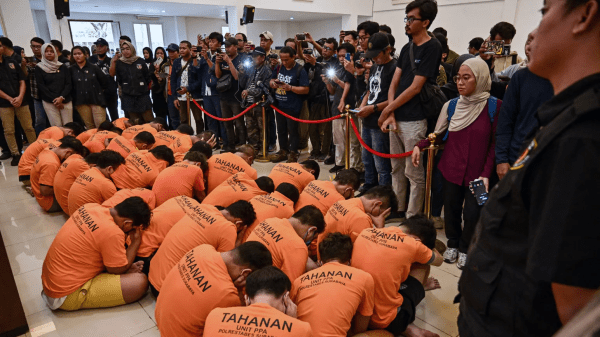
Police arrested 34 men and collected evidence from the scene, including contraceptives, cell phones, and other electronic devices. The men were taken to Surabaya Police Headquarters for questioning, and on Tuesday afternoon, AKBP Edy Herwiyanto, head of the Surabaya Police Criminal Investigation Unit, identified all 34 men as suspects, with some accused of organizing and financing the alleged sex party.
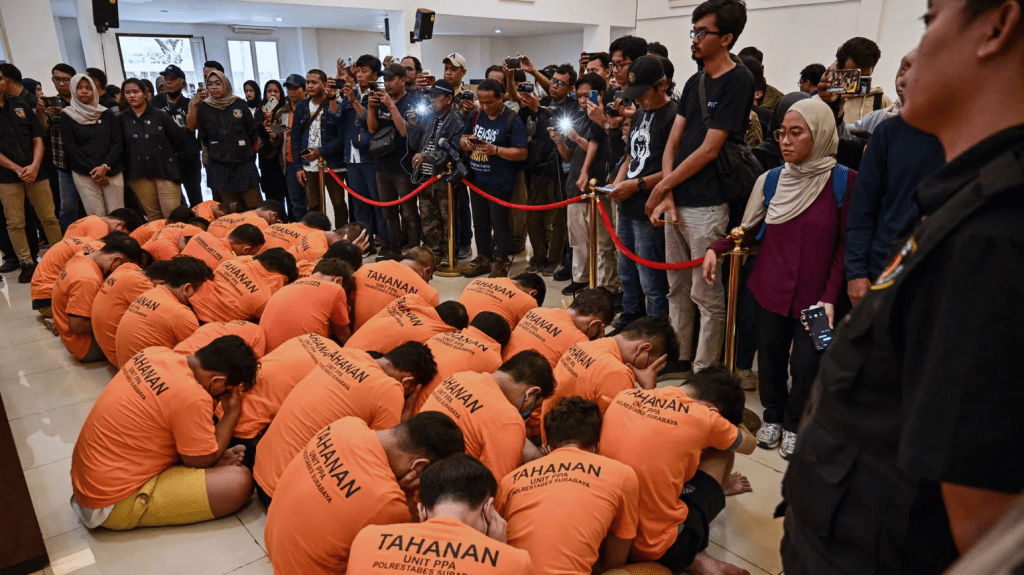
Photos show the suspects barefoot and bound together at the wrists by zip ties being paraded in front of a press scrum on October 22.
The hotel’s management reportedly told local media that they were unaware of the alleged event at the time, describing the hotel’s rooms as private areas, according to the Daily Mail.
While formal charges have not been announced yet, News Ghana notes that the case is similar to several others in which suspects have been prosecuted under Indonesia’s controversial anti-pornography law. The 2008 law defines pornography broadly as encompassing material that contravenes “norms of community morality.” The law bans activities as well as explicit material, specifically “deviant sexual intercourse,” which includes, News Ghana notes, consensual same-sex activity between adults.
In 2022, Indonesia’s government also revised its criminal code to ban sex outside of marriage. Unmarried couples caught having sex can be jailed for up to a year. While same-sex relationships are not explicitly criminalized under Indonesia’s national criminal code, same-sex marriage is illegal in the country, meaning that all same-sex sexual acts fall outside the law.
As News Ghana notes, Indonesian police have increasingly used the country’s anti-pornography law as a pretext for raids on LGBTQ+ gatherings. In June, police arrested 74 men and one woman in Jakarta who they accused of attending a “gay party.” Police detained nine people following a raid on a “gay sex party” at a hotel in South Jakarta in late May, and in February, 56 individuals were detained for participating in “a gay party” at a different hotel in South Jakarta.
Following the June raid in Jakarta, Amnesty International called on Indonesian authorities to end “these hate-based and humiliating raids” and to release those who have been arrested.
Human Rights Watch senior LGBT rights researcher Kyle Knight said Indonesia’s pornography law has been used as “a weapon to target LGBT people,” according to News Ghana.
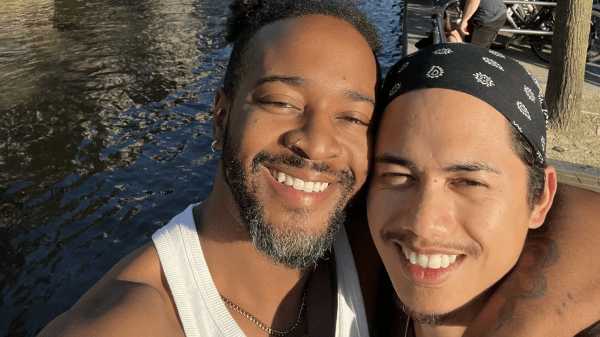
Austin Willingham, 30, grew up in Decatur, Alabama, and knew from a very early age that he wanted to leave home as soon as he turned 18.
While studying abroad in Sweden during his junior year at Troy University, he visited the Netherlands for the first time. Now almost 10 years later, Willingham and his partner are living in Rotterdam with the hope that they can obtain permanent residency or EU citizenship.
It was a move that Willingham admits had been in the works since he returned from his semester abroad in Sweden.
“Once I came back from Sweden, I was just determined to move back to Europe and had reverse culture shock. I was asking my parents if I could transfer to a different university and complete my degree abroad,” he tells CNBC Make It.
“Me being the first-generation college student in my immediate family, my parents were really adamant about me just going ahead and finishing my degree.”
Prior to moving to Rotterdam, Willingham lived in Ireland, traveled through Southeast Asia and was in and out of Australia for five years.
“We thought that it would be a good break. It would be a good change and transition from life in Australia. We also thought it would not be as difficult a change because Rotterdam is still the second-largest city in the country. We’re definitely city people, so we thought that this would just be the best space for us,” he says. “As soon as we got here, the people were so warm and they immediately welcomed us in.”
An estimated 5.5 million Americans live abroad, according to the Association of Americans Resident Overseas (AARO). That number continues to rise with an estimated 1,285 U.S. citizens expatriated in the first quarter of 2025 alone — a 102% increase compared to the same period a year ago, according to a report from CS Global Partners, which analyzed statistics from the U.S. Federal Register.
Life in the Netherlands
Willingham made the official move to Rotterdam in June of this year, on a DAFT (Dutch-American Friendship Treaty) visa. That visa stipulates that he be self-employed or work as a freelancer only.
To satisfy the visa requirements, Willingham works as an event planner and does commercial modeling, but his ultimate goal is to grow his relocation services business, Willing World.
Willingham and his partner live in a two-bedroom apartment with a roommate. The couple splits 430 euros or USD $498 a month for rent — paying 215 euros or USD $249 each — according to documents reviewed by CNBC Make It.
Including rent, Willingham’s monthly expenses in Rotterdam total approximately $680, covering utilities, transportation, health insurance, groceries, and his mobile phone bill.
“I like the freedom. This is coming from a privileged place, but I truly feel like anywhere outside the United States, it’s about being able to breathe and have a work-life balance. That’s what I love most about living abroad, even though I’m working for myself, there is still this balance and there’s not this societal pressure of needing to prove myself all the time.”
Willingham started sharing his journey abroad on TikTok and says that since moving to Rotterdam, he’s enjoyed building a community both online and in real life. He’s excited to see what the future holds, he says, but moving back to the United States is just not in the cards for him right now.
“I would love to live. I would love to own. I would love to say yes at some point, but not in the current situation that we have. It would be way down the line when the United States finally gets some change,” he says.
“I want to be able to be there for my parents, so maybe I wouldn’t move back permanently, but I would spend an extended amount of time.”
Willingham says that leaving the U.S. has taught him that he is capable of anything.
“I’ve learned that I can do it even when I’m scared because it still has to get done,” he says. “When living abroad, especially on your own, you don’t have anybody to depend on, so you learn to depend on yourself and trust yourself with it.”
Conversions from euros to USD were done using the OANDA conversion rate of 1 euro to $1.16 USD on October 14, 2025. All amounts are rounded to the nearest dollar.
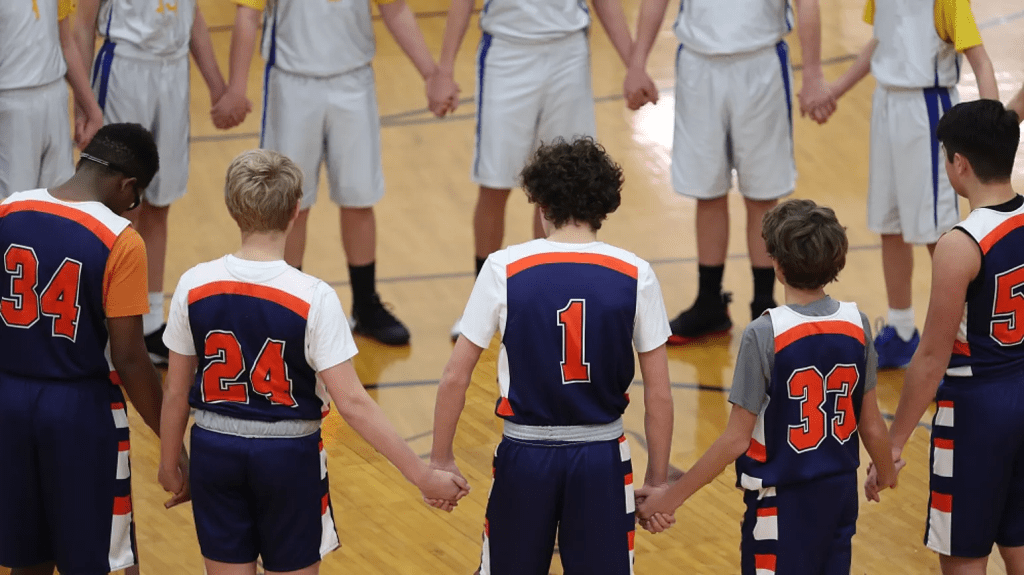
In Arizona last week, a cisgender male 8th grader was “physically removed” from tryouts for his school’s boys’ basketball team because an error on his original birth certificate incorrectly identified him as being born female.
It’s the latest episode in a “gender ideology”-inspired nightmare for the teenager, Laker Jackson, and his family.
“I’m sad for everybody that it’s come down to this,” mom Becky Jackson told KNXV News in Phoenix.
The Kafkaesque drama was inspired by a clerical mistake 14 years ago, when hospital staff mistakenly identified Becky Jackson’s newborn son as a girl. It was an error Laker’s parents never noticed.
“I give him the birth certificate and they’re like, ‘Did you know this says female?’” Becky Jackson recalled about handing over enrollment paperwork to a school administrator last year.
“I was like, ‘What?’” Becky Jackson said. “I was like, ‘Oh man, that’s so funny.’ So we come home, everyone’s laughing.”
The busy mom of six said correcting the document wasn’t a priority.
“So we just put it in the drawer and moved on,” she said.
The mix-up didn’t cause issues until recently, she told AZ Family.
Last spring, school staff began treating Jackson as female, Becky Jackson said.
The district removed Laker Jackson from an all-boys gym class and mandated he use a separate restroom, despite the family’s assertion that their son is a cisgender boy, assigned male at birth.
Becky’s mom had already started work on changing Laker Jackson’s birth certificate, but “it’s not something that you can fix quickly. You have to have an affidavit signed,” she said.
In the meantime, the 14-year-old continued training to make the boys’ basketball team at his Mesa high school, a 7th to 12th-grade school in the Queen Creek Unified School District.
Becky Jackson said she received the corrected birth certificate over the summer and provided the district with the revised document, along with a doctor’s note confirming Laker’s sex.
But Queen Creek administrators said it wasn’t enough, standing by a rule stating that the school’s determination of a student’s sex would rely solely on an original birth certificate.
“They sent the athletic director of Eastmark High to physically remove Laker from the basketball tryouts in front of all of his friends, in front of the coach,” Becky Jackson said.
“I am a biological boy. I was born a boy,” said Laker Jackson, who heard from friends on the basketball team that “they were talking about it for the entire tryout and even the next day’s tryouts because they were really confused.”
After the family continued to raise objections to Laker Jackson’s treatment, a letter from an administrator said genetic testing to confirm their claim that the child is a boy “could be considered.”
“They may consider changing it if we get chromosomal testing. They didn’t say they would,” Laker’s mom said. She estimated the cost at $1500.
“So who’s going to pay that?” she asked.
In a statement, the district said it was “committed to ongoing dialogue.”
Becky Jackson also said her son will try out for a girls’ team if that’s what it comes to.
The ordeal is a prime example of what activists have long warned: that anti-trans policies are bad for everyone. It’s also quite ironic, considering the very people who want to stop anyone assigned male at birth from playing on girls’ sports teams may wind up forcing a cisgender boy to do just that.
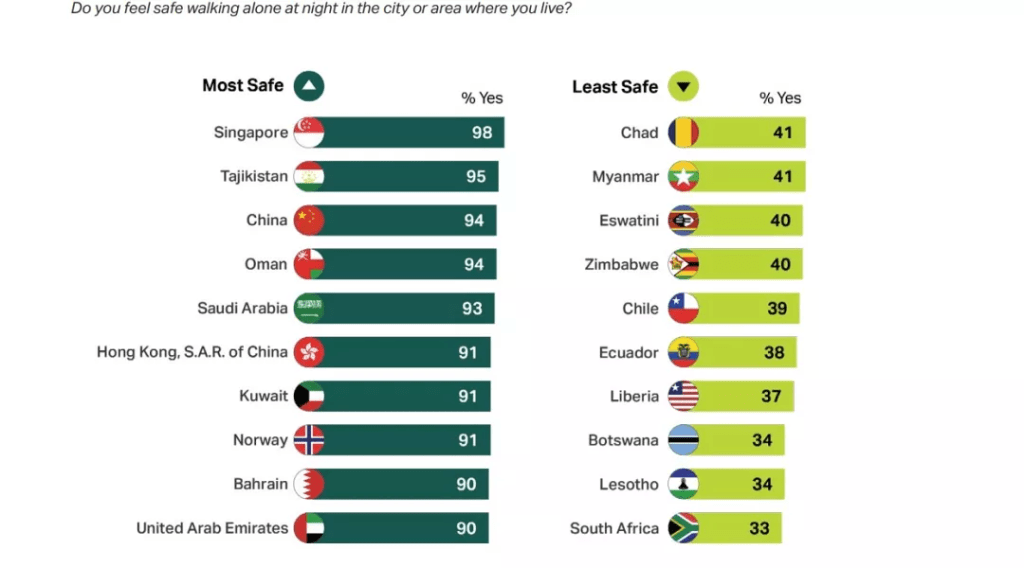
Is France less safe than Rwanda and Bangladesh? The new World Safety Index has raised questions on security across Europe.
People feel less safe walking alone at night in Italy and France than in dozens of other countries, including Iraq, Rwanda, and Bangladesh, according to a new report.
In fact, the 2025 edition of The Global Safety Report features only one European nation in the top 10 countries with the highest sense of security: Norway (91%).
Denmark and Kosovo, both with 89%, are the second-highest ranking European countries, respectively 11th and 12th worldwide.
Italians feel least safe in Europe, France 56th worldwide
With 60%, the perception of security among Italians is the lowest in Europe, and the 95th in the world, behind war-torn Ukraine (62%), Nicaragua (63%), Mauritania (64%) and Niger (67%).
France, ranked in 56th place with 73%, fared higher than Italy but placed behind similar European economies such as Spain (81%), Germany (78%) and the UK (76%), as well as non-European nations like Egypt (82%), Bangladesh (74%) and Belize (74%).
The Gallup report surveyed 145,170 adults aged 15 and older across 144 countries and territories.
How does Europe compare to the rest of the world?
Globally, 73% of adults worldwide said they feel safe walking alone at night in the city or area where they live.
It’s the highest level on Gallup’s record (which began in 2006) and a 13% increase over the past decade.
“The paradox is striking,” the researchers said in the report. “We are living through more armed conflicts than at any time since the Second World War. And yet, Gallup finds that more people than ever say they feel safe in their communities.”
The world region with the highest sense of security is Asia-Pacific (79%).
Western Europe follows in second place (77%), ahead of the Middle East and North Africa (74%).
Security perception: Post-Soviet Europe nearly overtakes America
With a 34-point jump over the past two decades, the former Soviet bloc has experienced the greatest growth in safety perceptions across all macroregions, reaching 71%.
If the trend continues, the former USSR countries — Russia excluded — could surpass North America, which now stands at 72%.
Along with sub-Saharan Africa, North America has been the only world region to see a decline in security perception since 2006 (-4%).
Overall, the region where people feel the least safe globally is Latin America and the Caribbean (50%).
Gender gap: Many more women feel unsafe than men
The Gallup report also highlights a stark gender gap: 32% of women, globally, claim they don’t feel safe compared to 21% of men.
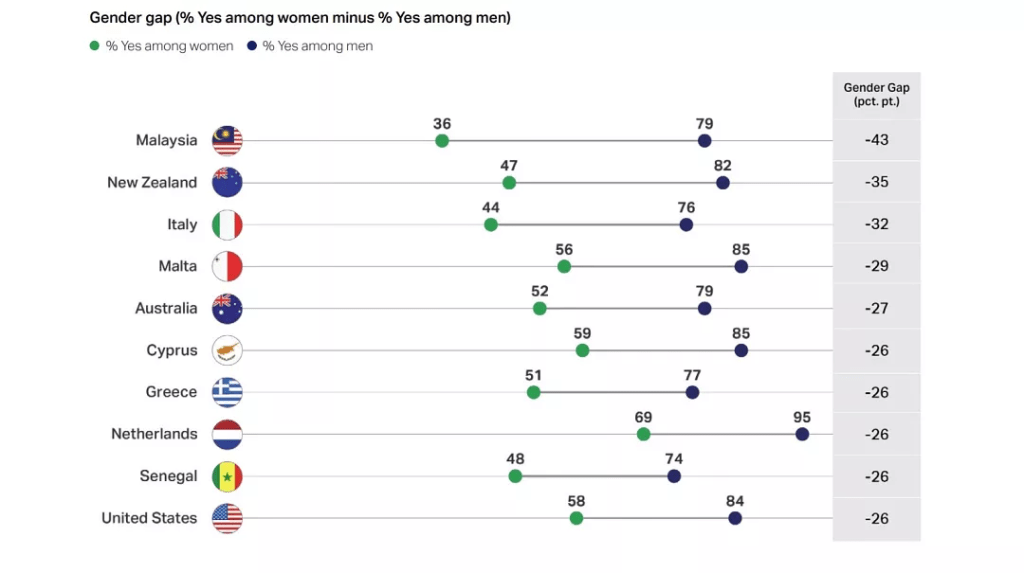
Five of the world’s 10 countries with the highest gender gap in this sense are EU member states.
Again, Italy’s performance here is the worst in Europe, with a 32-point gap between the security perception of Italian men versus that of Italian women — 76% of men feel safe walking alone at night versus 44% of women.
The report says that “56% of intentional homicides where the victim is a woman or girl are perpetrated by an intimate partner or family member, compared to 11% when the victim is male.”
“While men are more likely to be victims of lethal violence in public, rates of reported non-lethal violence are much closer between genders,” it adds.
Perception vs reality: Which countrie see themselves better — or worse — than they really are?
A low sense of safety doesn’t always mean a country is actually unsafe and vice versa.
TheGlobal Peace Index — which factors in Gallup’s safety perception along with other, more pragmatic data like homicide rates, violent crime, access to firearms, terrorism and political instability — often paints a more nuanced picture.
Across Europe, many nations turn out to be safer than they think.
Germany, for instance, ranks 20th worldwide in the Global Peace Index, yet only 34th when it comes to their citizens’ perception.
Italians and Brits also seem to underestimate their safety levels, with a gap of 62 and 15 positions, respectively, between perception and estimated reality.
France, on the other hand, tends to perceive itself as more secure than it might be — ranking 56th by its own perception but 74th in the Global Peace Index.
Still, it remains more secure than several non-European nations, including the aforementioned Rwanda (91st) and Bangladesh (123rd).
Spain seems to have a more grounded perception of reality. The country placed 25th in the Global Peace Index and 29th in Gallup’s safety perception table.





 fleeredstates.blog
You must be logged in to post a comment.