LGBTQ+ Americans have always been here, but as sector of society has largely been ignored until recently. LGBTQ+ seniors are continuing to increase in number, with the need for services that make them comfortable in their golden years becoming a growing issue.
According to surveys by SAGE and the Williams Institute, there are an estimated 2.7 million LGBTQ+ adults aged 50 and older in the United States, including 1.1 million who are 65 and older. By 2030, this number is projected to grow to around 7 million. Baby Boomers and Gen X, no longer plagued by the near certain early death sentence of AIDS, and contributing to growing numbers of elderly LGBTQ people.
There are a few projects across the country that have started to look at retirement community living for this sector of the population. We recently shared reporting of places in Boston MA and Austin TX. An alternative to apartment style living are single story units of housing, such as in Durham NC at the Village Hearth.
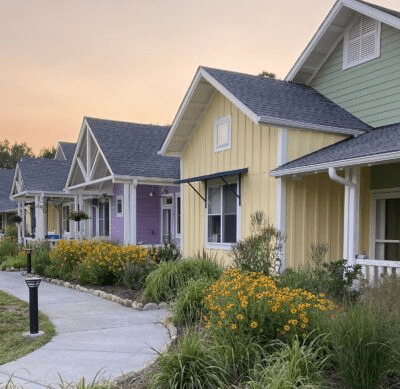
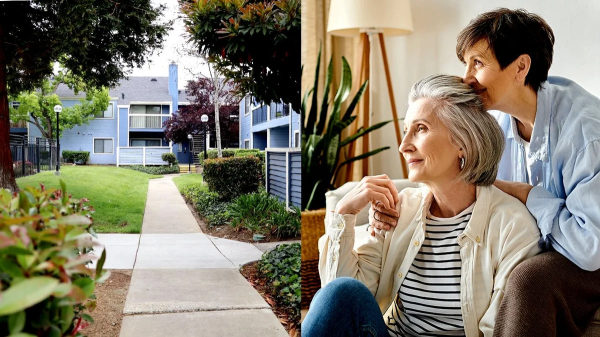
Village Hearth is located just 15 minutes from downtown Durham NC, one of NC’s major cities part of the Research Triangle. 28 homes surround a village green. For those willing to purchase their own home and be part of an HOA, this type of housing is an option.
CBS News recently profiled the village. Check out their report below.
On Wednesday, an Austin-based group broke ground on a new affordable housing development geared toward LGBTQ+ senior citizens.
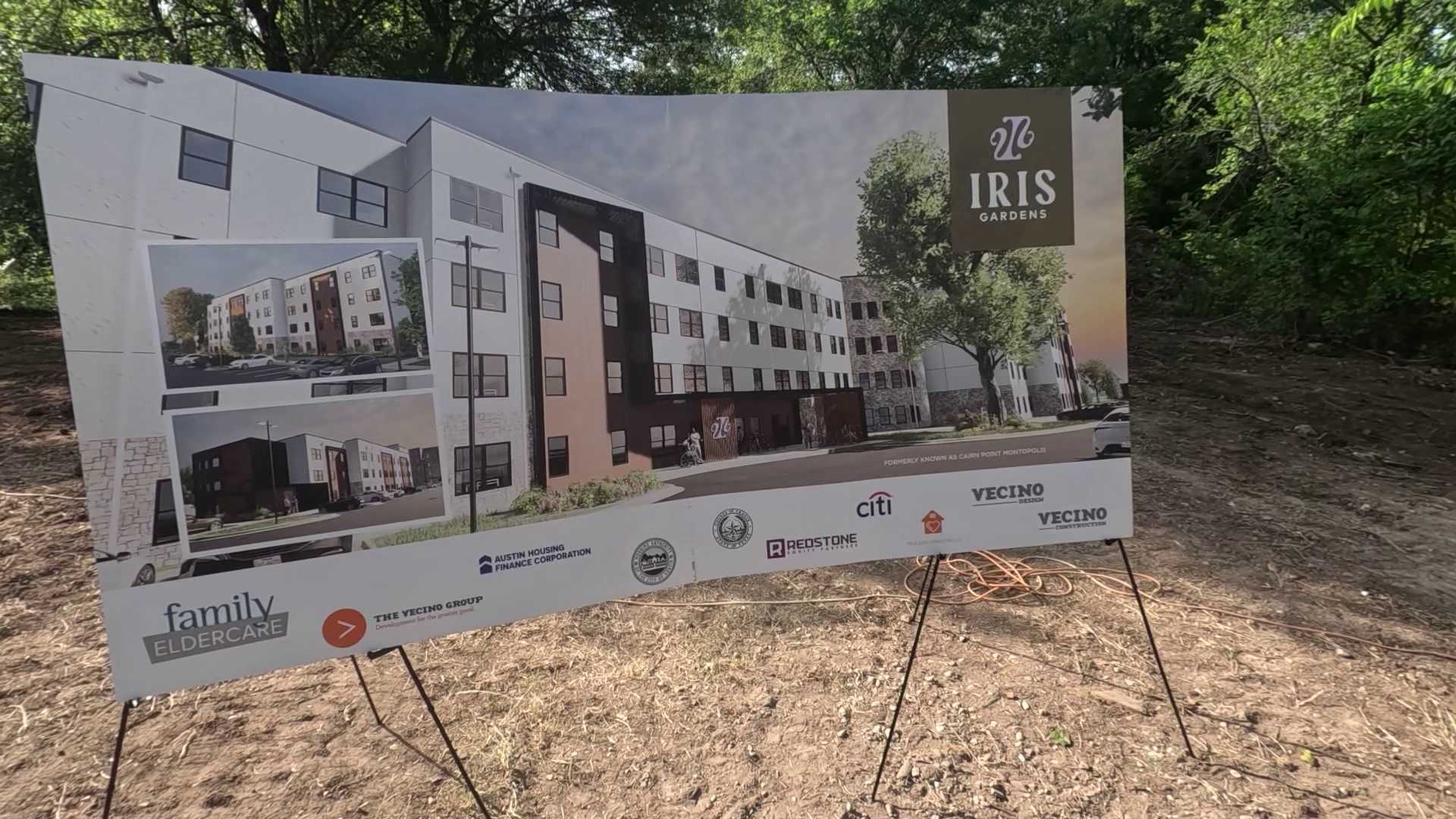
The development, which will be known as Iris Gardens, is located at 1013 Montopolis Drive in southeast Austin. It will consist of 150 units for people aged 55 and older and will be considered a first of its kind for Austin through a partnership with Family Eldercare and the national housing developer, Vecino Group.
It will also offer on-site services, including mental wellness and social connection programs.
“This project just felt like it was the right thing to do,” Family Eldercare CEO Dr. Aaron Alarcon said.
Alarcon said people who are at or below the 30% to 60% area median income will be accepted. The goal is to give people who live at the complex a safe and affordable space.
At the moment, there’s an uptick of elderly people experiencing homelessness, according to Austin’s Homeless Strategy Officer David Gray.
“Oftentimes, what happens is seniors are on a fixed income, but the cost of living in our city and in our county is going up,” Gray said.
Gray said his office plans to lend a helping hand to reduce barriers and will have a list of people set to move in. Those barriers include moving expenses, helping get identification and clearing old debt.
When it comes to adding more affordable housing in Austin, Gray noted that the city is on track to to add 1,200 units by 2026 as part of its homeless response system.
Other barriers people face as they try to gain access to affordable housing are criminal backgrounds and evictions. Gray said that one tool with landlords is to reduce screening criteria by looking past criminal history and past evictions.
However, when it comes to Iris Gardens, Gray said the city wanted to focus on a community that was not being properly served.
“While this is the groundbreaking for this development, this is not the first [and] this is not going to be the last. And we’re really excited to have more of these celebrations in the future,” Gray said.
Other organizations, like Rainbow Connections ATX, will also help with outreach.
“I feel that this is necessary; it’s a long time coming,” said Annie Saldivar, project manager for Rainbow Connections ATX.
The four-story building has a price tag of $51 million, with money coming from the Austin Housing Finance Corporation, Travis County, CITI Bank and Redstone Equity.
AUSTIN, Texas — On Wednesday, an Austin-based group broke ground on a new affordable housing development geared toward LGBTQ+ senior citizens.
The development, which will be known as Iris Gardens, is located at 1013 Montopolis Drive in southeast Austin. It will consist of 150 units for people aged 55 and older and will be considered a first of its kind for Austin through a partnership with Family Eldercare and the national housing developer, Vecino Group.
It will also offer on-site services, including mental wellness and social connection programs.
“This project just felt like it was the right thing to do,” Family Eldercare CEO Dr. Aaron Alarcon said.
Alarcon said people who are at or below the 30% to 60% area median income will be accepted. The goal is to give people who live at the complex a safe and affordable space.
At the moment, there’s an uptick of elderly people experiencing homelessness, according to Austin’s Homeless Strategy Officer David Gray.
“Oftentimes, what happens is seniors are on a fixed income, but the cost of living in our city and in our county is going up,” Gray said.
Gray said his office plans to lend a helping hand to reduce barriers and will have a list of people set to move in. Those barriers include moving expenses, helping get identification and clearing old debt.
When it comes to adding more affordable housing in Austin, Gray noted that the city is on track to to add 1,200 units by 2026 as part of its homeless response system.
Other barriers people face as they try to gain access to affordable housing are criminal backgrounds and evictions. Gray said that one tool with landlords is to reduce screening criteria by looking past criminal history and past evictions.
However, when it comes to Iris Gardens, Gray said the city wanted to focus on a community that was not being properly served.
“While this is the groundbreaking for this development, this is not the first [and] this is not going to be the last. And we’re really excited to have more of these celebrations in the future,” Gray said.
Other organizations, like Rainbow Connections ATX, will also help with outreach.
“I feel that this is necessary; it’s a long time coming,” said Annie Saldivar, project manager for Rainbow Connections ATX.
The four-story building has a price tag of $51 million, with money coming from the Austin Housing Finance Corporation, Travis County, CITI Bank and Redstone Equity.
The development is set to be completed by spring 2027.
The Texas House agreed late Thursday to let the governor determine the countries whose residents, governments and other entities could be banned from buying property here.
Members granted the governor such power when they amended Senate Bill 17, whose real estate sales restrictions were limited to countries that the U.S. national director of intelligence has designated as national security threats. Currently, that list includes only China, Iran, North Korea and Russia.
After giving the governor the ability to expand the list of restricted countries, the House then gave SB 17 preliminary approval in a 85-60 vote. The bill now heads back to the Senate.
State Rep. Nate Schatzline, the Republican from Fort Worth who introduced the amendment, said the goal was to make sure that any threats to Texas could quickly be addressed.
“Our governor can act swiftly rather than waiting for a year for that to be added into the [director of national intelligence’s] designated country list,” he said.
That amendment drew rebuke from Democrats.
“This gives the governor unfettered power to add whatever county he wants to in this bill,” said state Rep. Gene Wu, chair of House Democratic Caucus. “It’s kind of dangerous to say one person can decide whatever country he or she wants to add to this without any oversight, without any controls — this is the definition of overreach.”
Schatzline’s amendment also allows the governor to bar people “transnational criminal organizations” to the list of entities barred from buying Texas property. Schatzline pointed to the Venezuelan gang Tren de Aragua as an example.
State Rep. Cole Hefner, the Mt. Pleasant Republican carrying SB 17 in the lower chamber, described the bill during Thursday’s hourslong debate as “securing Texas land and natural resources and making sure that this precious resource does not fall prey to adversarial nations and oppressive regimes that wish to do us harm.”
The bill’s advancement came over opposition from Democrats who are concerned that it could be used to potentially discriminate against Asian Americans.
The bill will need one more House vote before it goes back to the Senate. The upper chamber previously approved a version of the bill, but House members amended several key portions of it Thursday.
The Senate’s previous version would have exempted anyone or any entity that leased the property to someone else for under 100 years. The House limited that exemption to property leased to someone else for one year or less. Rep. Mitch Little called the 100-year lease exemption “a loophole that you could drive a Mack truck through.”
The House also previously amended the bill to exempt lawful permanent residents.
But Democrats failed to make changes to the bill several times Thursday. Their failed amendments included provisions that would have exempted visa holders such as medical students and researchers, performers and athletes. They also raised concerns that the law could hurt the Texas economy.
SB 17 is Brenham Republican Sen. Lois Kolkhorst’s second attempt at limiting who can buy property in Texas. Similar legislation she authored in 2023 died in the House. In committee hearings this year, she described the legislation as protecting Texas’ assets from “hostile nations.”
“This is a matter of national security,” she said in March. “Texas must act now to protect our land, food sources, water, and natural resources.”
A batch of new, more conservative lawmakers were elected to the House last year, giving new life to legislation that struggled in previous sessions. Chief among those measures are the creation of school vouchers.
If passed, the bill goes into effect Sept. 1 and would only apply to purchases or acquisitions after that date.
It would require the attorney general’s office to create a process to investigate possible violations and refer the matter to a district court. If the court finds a violation, it would be authorized to order the purchaser to divest from the property either by selling it or terminating the lease, according to the House Research Organization’s most recent analysis of the bill. The court also would be required to refer the matter for potential criminal offenses.
The amount of Texas property owned by entities from outside the U.S. is not tracked in detail, aside from agricultural land. But Joshua Blackman, a constitutional law professor at South Texas College of Law, said it is likely a very small fraction. In the U.S. overall, Chinese investors own less than 1% of total foreign-held acreage, according to 2021 data from the U.S. Department of Agriculture. Investors from Russia, Iran and North Korea collectively own less than 3,000 acres.
But to Abraham George, chair of the Texas Republican Party, 1% is too much — which is why the bill was a party priority.
Rep. Angie Chen Button, who was only the second Asian American woman to serve in the Legislature and whose parents fled from China, also spoke in support of the bill Thursday night, saying the bill aims to “protect our freedom, liberty and national security.” She introduced a similar bill last session.
Some Asian Texans are concerned the bill would create animosity and “state-sanctioned racial profiling,” said Lily Trieu, executive director of the civic engagement group Asian Texans for Justice.
The bill doesn’t prohibit purchases of land based on national origin, which would violate federal civil rights laws. Instead, it prohibits people based on their permanent residence.
Wu, who immigrated to the United States from China as a child, said the bill could impact not just Chinese people in Texas, but members of all Asian communities in the state.
“Nobody knows the difference between Chinese, Japanese, Vietnamese and Korean, right? Nobody knows what your immigration status is,” he said in an interview. “When they discriminate against you … when they look for people to assault, they don’t really care what you are. They care that you have Asian face.”
Trieu said the group’s No. 1 concern is that individuals shouldn’t be conflated with governments.
“Just like how no one here would want to travel to another country and be held individually accountable for what Governor Abbott does or what President Donald Trump does,” she said.
“These individuals should not be held accountable for what the government of their national origin does, or what their ideology is, or what, you know, the government does as an entity.”
Trieu said the group was formed to engage Asian Texans in civic participation such as voting, but this bill galvanized people into getting involved in legislation.
Wu expects the bill is just the start of that. And even with its passage, he sees it as a loss for the Republican Party because it could push Asian American voters to shift to the Democratic Party in the 2026 midterm elections.
“I think the Republicans are heading into gale force winds in 2026 if they want to alienate and make enemies of an entire community who for a large part has stayed out of politics,” he said in an interview.
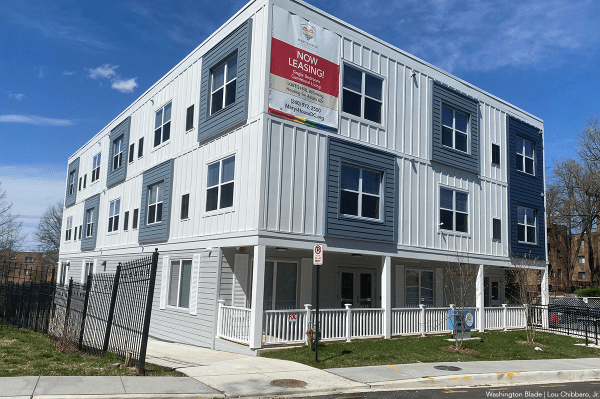
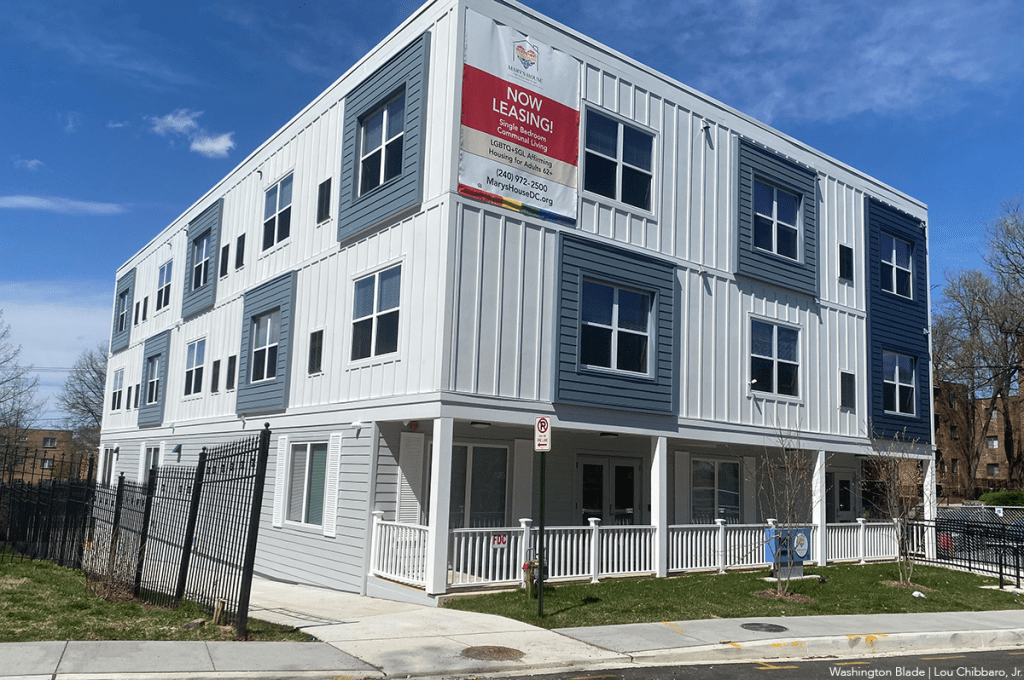
The first nine residents of Mary’s House For Older Adults, D.C.’s first LGBTQ home for seniors, are expected to move into the newly built group home within the next week or two, according to Mary’s House founder and CEO Imani Woody.
Located at 401 Anacostia Rd., S.E. in the city’s Fort Dupont neighborhood, a write-up on its website says the house includes 15 single-occupancy residential units and more than 5,000 square feet of shared communal living space.
Woody said construction of the three-story house was completed in January and leases have been obtained by the first nine of the 15 residents, with the remaining six still available for interested seniors. She points out that Mary’s House, which is a nonprofit operation, is not an assisted living facility.
A large sign hanging near the top of the front wall of the Mary’s House building says, “Now Leasing! Single Bedroom Communal Living—LGBTQ+ Affirming Housing for Adults 62+”
The sign also includes the Mary’s House phone number and website address that Woody said interested seniors or those who may know a senior who would be interested should use to contact the LGBTQ supportive seniors residence.
Woody said each of the individual units or suites includes a sleeping area, living room, bathroom, and kitchenette with a sink, microwave, and refrigerator but no stove. According to the Mary’s House website, the shared communal areas of the house include a “fully equipped kitchen, separate dining area and living room.”
It says the communal area also includes a computer room, arts and crafts room, an exercise room, laundry facilities, community meeting space for gatherings, a “tranquil quiet room for relaxation,” and an outdoor terrace with seating.
Woody said the monthly rent for Mary’s House residents, depending on their income, is currently set at $812 or $886.
“Our mission extends beyond providing housing,” a statement on the Mary’s House website says. “We strive to build welcoming communities that address affordability, accessibility, and the unique needs of LGBTQ/SGL [Same Gender Loving] older adults.”
The statement adds, “Through health and wellness programs, connections to community services, and advocacy efforts, Mary’s House for Older Adults endeavors to ensure that all elders, regardless of identity, can enjoy fulfilling and secure lives in their golden years.”
Woody said a ribbon-cutting ceremony to celebrate the opening, to be led by D.C. Mayor Muriel Bowser is planned for early May, with a specific date to be announced soon.
Further information about Mary’s House, including a lease application, can be obtained at MarysHouseDC.org or at 240-972-2500.
Ground has been broken in Pittsburgh for what will be the first LGBTQ-focused senior housing complex in western Pennsylvania and the second in the state overall.
Groundbreaking took place Thursday for the Mosaic Apartments in the city’s Oakland neighborhood, which is home to the University of Pittsburgh and Carnegie Mellon University, along with museums, health care providers, and an eclectic mix of shops and restaurants. The 48-unit complex will open in the fall of 2025, according to local media.
The affordable housing development is a project of Presbyterian SeniorCare Network, which was approached about seven years ago by the Persad Center, a provider of LGBTQ-affirming mental health services.
“One of their staff members said, ‘Can you build us an apartment building?’ It was a beautiful opportunity for us to enhance our mission and help a greatly underserved and often discriminated-against population,” Jim Pieffer, president and CEO of Presbyterian SeniorCare, told TV station WTAE.
Presbyterian SeniorCare raised $30 million for the complex but was able to acquire the land for free thanks to the University of Pittsburgh and its medical center, Pieffer told another station, KDKA.
Persad Center CEO Martin Healey told KDKA that LGBTQ+ people sometimes encounter problems in senior housing. “It’s scary — you sometimes have to go back into the closet,” he said. “There’s not necessarily a safe space all the time. … We’ve seen situations where they have fear and have isolation and loneliness that hopefully this type of place will break.”
“My hope is that this is the start of something far bigger and far greater for our community, not just here in Pittsburgh, but more across the country,” he added.
By 2030, there will be 7 million LGBTQ+ seniors in the U.S., SAGE National Resource Center on LGBTQ+ Aging estimates.
Prospective Mosaic Apartments residents can begin applying next March.
The U.S. has always been a difficult country to “age in place”—seniors who can’t find lodging with a loved one are often relegated to nursing homes, if they can afford the fees. The situation gets even more precarious for LGBTQIA+ seniors, who commonly see bias in the rental application process, and get turned down for apartments at high rates.
Things are especially dire in Texas, where state law doesn’t protect individuals from housing discrimination based on their sexual orientation, although LGBTQIA+ individuals are still protected under the federal Fair Housing Act. This exacerbates the problem and puts even more people at risk of poverty and social isolation.
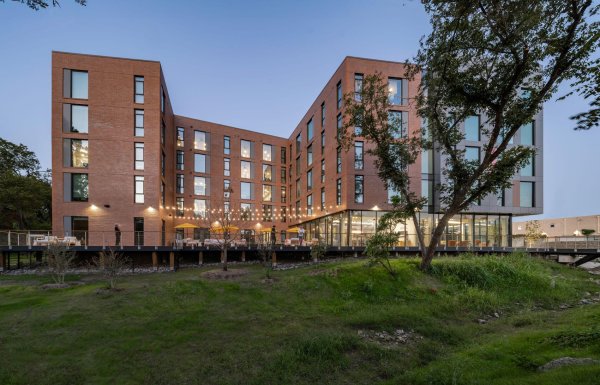
Perkins&Will’s Dallas studio recently completed a new affordable housing project to help combat this public health crisis. Today, Oak Lawn Place in Dallas represents north Texas’s first affordable housing development of its kind, the architects shared. It offers 100 percent affordable housing for LGBTQIA+ seniors, 55 years of age and older.
Karen Chen of Sunshine Studios created a bespoke mural on every floor of the building. (James Steinkamp)
The Dallas neighborhood of Oak Lawn has been the beating heart of north Texas’s LGBTQIA+ community for decades. Oak Lawn Place was built with the developer Matthews Southwest, Volunteers of America, and Resource Center, one of the largest LGBTQIA+ community centers in the country and a key north Texas HIV/AIDS service organization.
“I’m seeing Oak Lawn Place transform people’s lives,” Resource Center CEO Cece Cox said in a press statement. “A project like this elevates everyone and makes Dallas a better place.”
In plan, Oak Lawn Place is shaped like a C. This was meant to increase natural light exposure within every unit; this feature also provides a protective wing that surrounds an outdoor deck, hidden from public view. The deck has great views of the site’s sloping topography and a nearby creek.
Mural by Karen Chen of Sunshine Studios (James Steinkamp)
Karen Chen of Sunshine Studios created a bespoke mural on every floor of the building, which helps with wayfinding. Oak Lawn Place was designed with maximum accessibility in mind—everything from the hallway seatings, elevator lobbies, to wheelchair-friendly doorways are meant to provide a positive user experience.
The design of Oak Lawn Place is economical and efficient, yet still manages to have splashes of color here and there; the facade has a rainbow flag to signify all are welcome. The 80,000-square-foot building has a total 84 units. It’s within walking distance of public transit options and Resource Center’s Community Center.
The building has a shared kitchen and other community-building amenities. (James Steinkamp)
“Oak Lawn Place helps make Dallas a more inclusive, inviting city—for those considering moving here and for those wondering, as a queer person, ‘Will I truly feel welcome? Are there spaces in Dallas for me?’ We are honored and proud to bring this project to life,’” Cox continued.
A new healthcare facility, Resource Center Health, will open across the street from Oak Lawn Place later this year.







 fleeredstates.blog
You must be logged in to post a comment.