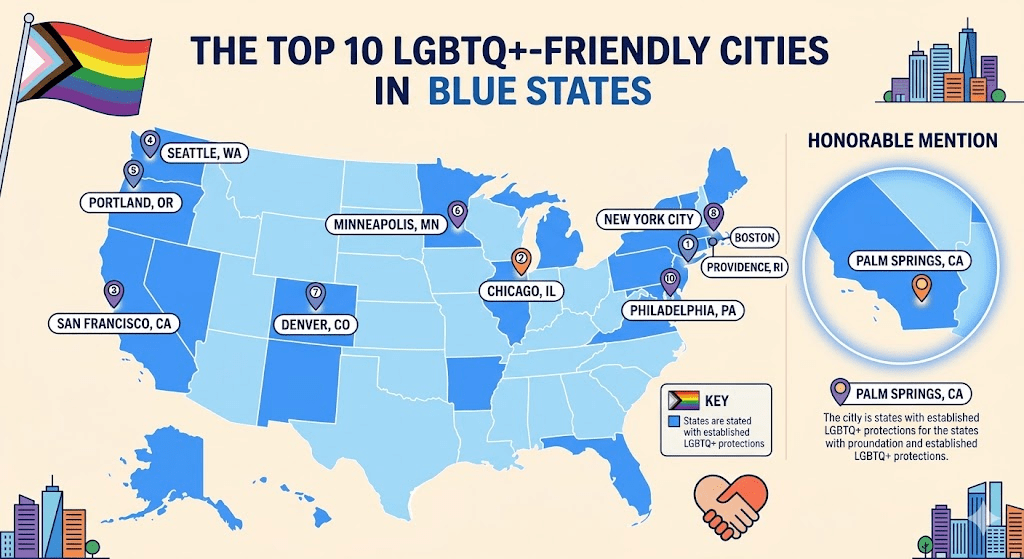
In states where equality is codified into law, these cities don’t just protect the queer community—they let it shape their cultural DNA. From coast to coast, these ten metropolitan hubs represent the absolute gold standard for LGBTQ+ visibility, safety, and community joy.
1. New York City, New York
You can’t talk about LGBTQ+ history without starting in New York City. As the birthplace of the modern gay rights movement at the Stonewall Inn, NYC is a global queer capital. From the historic streets of Greenwich Village to the bustling nightlife of Hell’s Kitchen, the city offers unmatched diversity, visibility, and endless community spaces.
2. Chicago, Illinois
Chicago holds a legendary spot on this list, boasting Northalsted (historically known as Boystown), the oldest officially recognized gayborhood in the United States. Beyond its incredible legal protections, the city radiates Midwestern warmth. For a slightly more relaxed, artsy, and family-friendly vibe, neighborhoods like Andersonville make Chicago one of the most livable, inclusive mega-cities in the world.
3. San Francisco, California
Historically, structurally, and culturally, San Francisco remains a global sanctuary of queer history.The Castro District is one of the world’s most famous gay neighborhoods, acting as a living monument to decades of activism. Roughly 6% of the city’s population identifies as LGBTQ+, and the sheer baseline of acceptance makes living here feel effortlessly normal.
4. Seattle, Washington
Earning top marks for its progressive oasis environment, Seattle combines a relaxed Pacific Northwest atmosphere with fierce community support. The Capitol Hill neighborhood is the historic epicenter of the city’s queer culture, packed with rainbow crosswalks, queer-owned bookstores, bars, and community centers. Seattle features exceptional legal protections and stands as a major leader in welcoming non-binary and trans residents.
5. Portland, Oregon
Portland takes pride in its eccentric, progressive spirit. It consistently scores a perfect 100 on municipal equality indices, reflecting decades of top-tier non-discrimination protections. The city is exceptionally welcoming to trans, non-binary, and queer artists, with neighborhoods like Alberta Arts District and the Pearl District serving as creative, inclusive safe havens.
6. Minneapolis, Minnesota
As a vital progressive anchor in the upper Midwest, Minneapolis consistently punches above its weight. The city pairs rock-solid statewide protections with a deeply rooted local arts scene. Neighborhoods like Loring Park (the historic home of Twin Cities Pride) and the Northeast Arts District offer a remarkably resilient, community-oriented lifestyle.
7. Denver, Colorado
Denver offers high-altitude harmony with a booming, stable progressive political climate and a massive outdoor culture. The city’s historic Capitol Hill and Five Points areas host an incredibly active queer population. Denver serves as a mountain sanctuary, offering excellent healthcare access and a highly visible, year-round LGBTQ+ community.
8. Boston, Massachusetts
Massachusetts was a historical pioneer as the first state to legalize same-sex marriage back in 2004, and Boston remains a brilliant hub for the community. Thanks to a massive academic presence, it’s a prime destination for young queer professionals and singles. The South End and Jamaica Plain (JP) neighborhoods are highly inclusive, offering an eclectic mix of historic charm, progressive values, and local queer activism.
9. Providence, Rhode Island
Rhode Island may be small, but Providence is a true hidden gem for the creative queer community. Driven by a massive artistic population from local design schools, the city is intensely artistic and highly secure. The city features a high density of LGBTQ+ adults, a lower cost of living than nearby Boston or New York, and a wonderfully tight-knit, welcoming vibe.
10. Philadelphia, Pennsylvania
While Pennsylvania can lean purple statewide, its biggest city is fiercely blue. Philadelphia is famous for its centrally located, historic “Gayborhood” right in Center City. Marked by rainbow street signs, this district is a culturally rich, highly walkable, and safe anchor for local businesses, nightlife, and community health centers.
Honorable Mention: Palm Springs, California
While technically a smaller resort city rather than a massive urban metropolis, Palm Springs deserves a legendary honorable mention. It features one of the highest concentrations of LGBTQ+ residents and city officials in the entire country. Effectively operating as a mid-century modern queer paradise, Palm Springs offers specialized local hospitality, sunny pool parties, and an entire city infrastructure built explicitly on LGBTQ+ joy and safety.
The Takeaway: In states where progressive values pave the way, these cities serve as blueprints for what happens when a community is allowed to truly thrive, create culture, and lead with unconditional inclusivity.
When you think of the premier LGBTQ+ destinations in America, coastal giants like San Francisco and New York usually dominate the conversation. But a massive shift has been happening. Attracted by a lower cost of living, growing tech hubs, and a desire to build grassroots communities, LGBTQ+ Americans have been moving to traditionally conservative states in record numbers.
Living in a red state doesn’t mean you have to sacrifice a vibrant, welcoming queer community. In fact, some of the most resilient, tight-knit, and celebratory LGBTQ+ scenes in the country exist right in the heart of the American South, Midwest, and Mountain West.
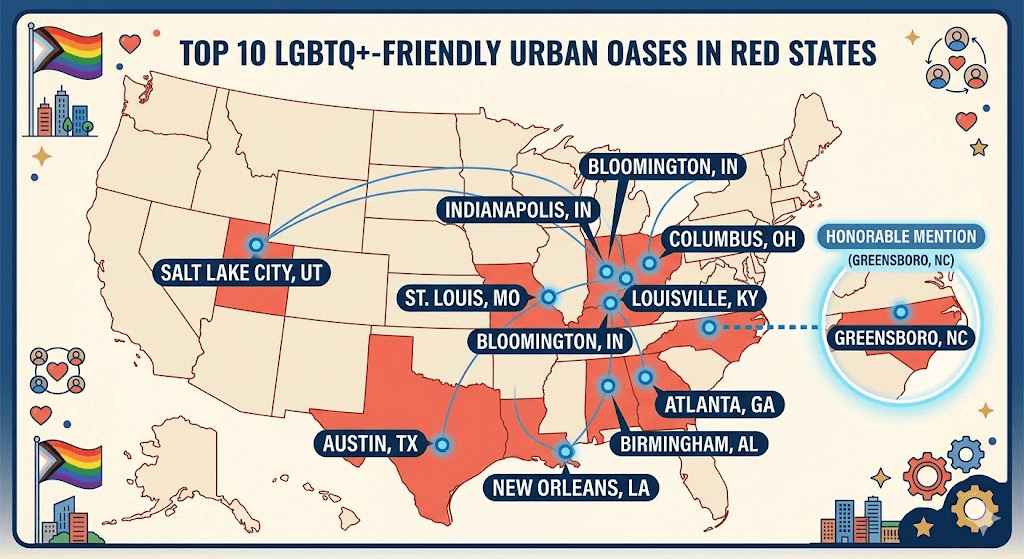
Here is a look at the top 10 LGBTQ+-friendly urban oases located in firmly red states.
1. Austin, Texas
Texas is a massive force in conservative politics, but its capital city operates on its own wavelength. Driven by the proud moniker “Keep Austin Weird,” Austin is a deeply progressive, diverse oasis. Nearly 6% of Austin’s population identifies as LGBTQ+, one of the highest concentrations in the country. The city features a dedicated LGBTQ Quality of Life Advisory Commission to advise local government, and the bars lining Fourth Street make the community highly visible and deeply woven into the city’s famous live-music fabric.
2. Salt Lake City, Utah
Perhaps the biggest surprise to outsiders is Salt Lake City. Despite being the global headquarters of the deeply conservative LDS (Mormon) Church, SLC has undergone a massive cultural transformation. It routinely ranks among the top ten cities in the nation for its percentage of LGBTQ+ residents, elected its first openly lesbian mayor back in 2015, and features the vibrant, inclusive Marmalade District as the historic epicenter of its queer culture.
3. St. Louis, Missouri
Missouri’s statewide political landscape tilts heavily conservative, but St. Louis stands out as a massive beacon for the LGBTQ+ community—especially for those looking for affordability. The city consistently scores a perfect 100 on the Human Rights Campaign’s Municipal Equality Index. Neighborhoods like The Grove feature miles of rainbow-painted crosswalks, queer-owned boutiques, lively nightlife, and active community centers.
4. Atlanta, Georgia
While Georgia has leaned “purple” in recent federal elections, its state legislature and rural areas remain firmly conservative. Atlanta, however, is frequently crowned the “LGBTQ+ Capital of the South.” It features an incredibly diverse, politically active queer population, anchored by a historic and massive Black queer community. The neighborhood of Midtown is the heart of the action, where rainbow flags fly year-round from restaurants, bars, and high-rises.
5. Louisville, Kentucky
Kentucky may be famous for coal and bluegrass, but Louisville is widely celebrated for its progressive, welcoming charm. Louisville has maintained a perfect 100 score on the Municipal Equality Index for years, thanks to local ordinances that protect LGBTQ+ residents in housing, employment, and public accommodations. The Highlands neighborhood is the city’s cultural heart, known for its eclectic, artsy vibe.
6. Columbus, Ohio
Ohio has solidified its status as a reliable red state in recent election cycles, but Columbus remains a booming, progressive powerhouse. Home to Ohio State University and a massive corporate tech presence, Columbus boasts one of the largest LGBTQ+ populations in the Midwest. The Short North Arts District is the epicenter of the community, packed with queer-owned galleries, bars, and businesses that make the city incredibly welcoming.
7. Indianapolis, Indiana
Indiana has a reputation for deeply conservative state politics, but its capital city is a distinct blue hub. Indianapolis has long held a perfect 100 on the Municipal Equality Index. The historic Mass Ave Arts District serves as the city’s progressive heartbeat, featuring a high concentration of inclusive theaters, bars, and restaurants. The city’s corporate pillars (like Eli Lilly and Salesforce) also actively champion local diversity initiatives.
8. New Orleans, Louisiana
Louisiana is culturally conservative, but New Orleans is a law unto itself. Long heralded as one of the most bohemian and accepting cities in the world, NOLA’s queer history runs deep. While the Faubourg Marigny neighborhood and the edge of the French Quarter host famous gay establishments, the entire city embraces an open, “live and let live” ethos. Events like Southern Decadence bring hundreds of thousands of queer travelers to the city every Labor Day weekend.
9. Bloomington, Indiana
While Indianapolis handles the big-city energy, Bloomington represents the classic, ultra-progressive college town oasis. Home to Indiana University, Bloomington punches way above its weight class for inclusivity. It features comprehensive local non-discrimination ordinances and a highly visible queer academic and local population. It consistently ranks as one of the most affordable and welcoming small cities for LGBTQ+ singles and families alike.
10. Birmingham, Alabama
Often a surprise addition for those unfamiliar with the modern deep South, Birmingham has built an incredibly resilient and active LGBTQ+ infrastructure despite a heavily conservative state environment. The city boasts a perfect 100 on the Municipal Equality Index and supports vital resources like the Magic City Acceptance Center, a sanctuary for queer and trans youth. The city’s progressive core ensures a vibrant local nightlife scene where community protection and grassroots activism go hand in hand.
The Takeaway: While statewide laws in red states can present hurdles, the local leadership, municipal protections, and fiercely supportive grassroots networks in these ten cities prove that you can find a safe, joyful, and thriving community just about anywhere in America.
Honorable Mention: Greensboro, North Carolina
While North Carolina frequently finds itself at the center of heated national political debates, Greensboro quietly serves as a masterclass in local progressivism and community building.
Greensboro has scored a perfect 100 on the Human Rights Campaign’s Municipal Equality Index for five consecutive years, consistently ranking as a top city for inclusivity in the state. Driven by a massive student population from local universities and an active grassroots network, the city boasts a thriving queer culture. Year-round events like Green Queen Bingo pack local venues, and institutions like Chemistry Nightclub and Twist Lounge anchor a welcoming nightlife scene. It’s a prime example of a mid-sized Southern city proving that inclusivity isn’t just a big-city trait.
Only one U.S. state has a majority that opposes marriage equality, another has the highest concentration of LGBTQ+-identified people, and a majority of Republicans agree that transgender people deserve the same rights and protections as other Americans, according to a newly released 50-state survey conducted by the Public Religion Research Institute (PRRI).
PRRI interviewed more than 22,000 adults nationwide throughout the last year as part of its American Values Atlas. The findings provide a snapshot of how individual states and demographic groups view same-sex marriage, anti-discrimination protections, and trans rights at a time when all of those are under attack from Christian nationalist forces.
The survey revealed the two U.S. states with the lowest levels of support for same-sex marriage: Only 47% of respondents from Mississippi support same-sex marriage with Arkansas close behind at 50%. Conversely, the highest levels of support for same-sex marriage were expressed by 85% of respondents from Massachusetts and the same amount Rhode Island, with the 81% of respondents from Vermont close behind.
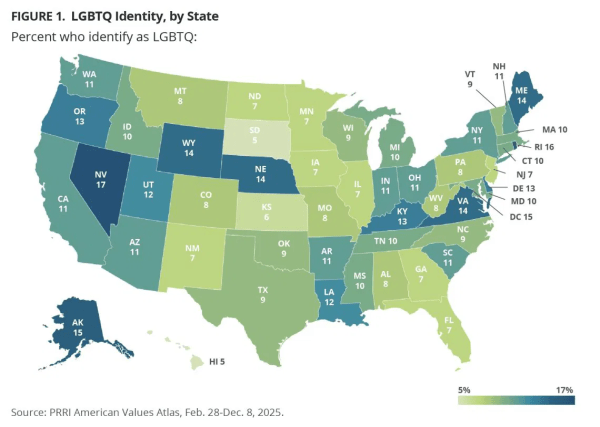
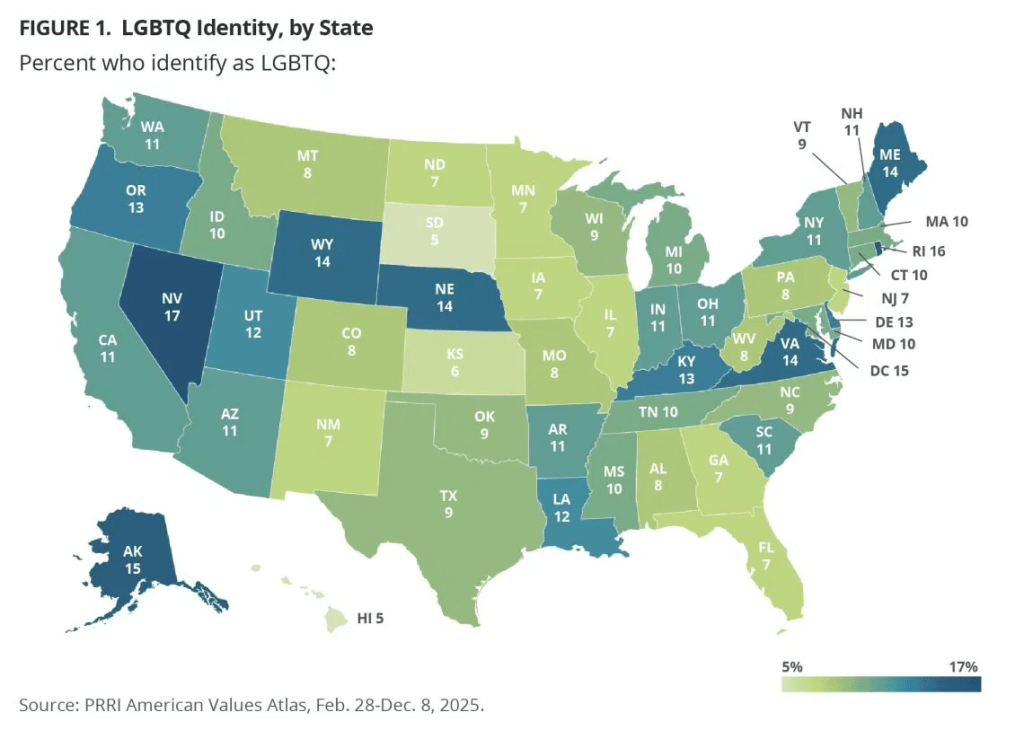
The survey asked respondents whether they self-identified as LGBTQ. It found that 17% of respondents in Nevada self-identified as LGBTQ — the highest percentage of all U.S. states, followed by 14% of respondents in Maine, Nebraska, and Wyoming.
The states with the lowest percentage of self-identified LGBTQ respondents were Hawaii and South Dakota, with just 5% each. Kansas was the state with the second-lowest number of self-identified LGBT respondents, with just 6%.
Among states whose respondents voiced the highest level of support for nondiscrimination protections for LGBTQ+ people were Massachusetts (85%), Maryland (82%), and Alaska (81%). However, Mississippi (60%), Wyoming (57%), and Arkansas (53%) showed the lowest support for such protections.
States with the most respondents opposed to religiously based ant-LGBTQ+ service refusals were Massachusetts (72%), Hawaii (71%), Vermont (71%), and Connecticut (70%). Conversely, only 44% of West Virginia respondents voiced opposition to such refusals — the lowest percentage among all U.S. states.
Interestingly, the poll found that seven in 10 Americans (71%) agreed that “transgender people deserve the same rights and protections as other Americans,” including most Democrats (88%), independents (77%), and Republicans (57%). This is especially surprising, seeing as the Republican Party and its president have spent the last decade vilifying trans people as mentally ill and a danger to the privacy and safety of women, girls, and children.
PRRI’s survey also looked at LGBTQ+ attitudes in relation to Christian nationalism. It found that Christian nationalism rejecters (91%) were the most likely to support LGBTQ+ nondiscrimination protections, followed by 77% of skeptics, 61% of sympathizers, and 42% of adherents of Christian nationalism.
Unsurprisingly, adherents and sympathizers of Christian nationalism were less likely to support same-sex marriage and less likely to oppose religiously based refusals for LGBTQ+ people, compared to respondents who either reject or are skeptical of Christian nationalism.
The American Medical Association (AMA) reaffirmed its support for gender-affirming care and said media outlets that reported a change in its policy (including LGBTQ Nation) misinterpreted a recent statement from the organization.
AMA’s March 2026 newsletter devoted a section to the debacle and explained that it all started in February when Dr. Mehmet Oz, the head of the Centers for Medicare and Medicaid Services, held a meeting for the leaders of the nation’s major medical organizations to discuss why they all endorsed medical interventions for trans teenagers.
Sources told the Times that Dr. Oz’s tone was measured, rather than hostile, but that it was clear he hoped to sway the organizations away from supporting gender-affirming care for young trans people. At the meeting, the American Society of Plastic Surgeons (ASPS) reportedly shocked everyone by announcing it was indeed changing its stance on gender-affirming care.
The ASPS announced the change in its stance publicly on February 3, releasing a statement advising against conducting “gender-related breast/chest, genital, and facial surgery” on people under the age of 19. The ASPS based its statement on two recent reports from the U.K. and the U.S. that were widely criticized by transgender healthcare advocates as being biased.
Surgical interventions, however, are already almost never performed on minors. Trans minors don’t receive bottom surgery, though some teenagers who meet certain rigid requirements get top surgery or facial procedures.
The AMA newsletter explained that once ASPS released its statement, the AMA’s Executive Committee of the Board met to craft a statement to provide to probing media outlets.
“During our Board discussion, we were clear that we were not changing AMA policy,” the newsletter said, emphasizing that the statement was exclusively to be used if media outlets contacted the organization, rather than preemptively.
“While some media coverage characterized this as agreement with the ASPS statement, that phrasing did not come from the AMA,” the newsletter continued. “Unfortunately, how reporters frame their stories is beyond our control.”
The newsletter emphasized that the statement did not reflect a policy change or an endorsement of ASPS’s policy change: “AMA policy on gender-affirming care is unchanged. Our recent response to questions about ASPS’s position statement was intended to preserve—not diminish—access to gender-affirming care, and to clarify and reinforce what our policy has long reflected and standards of care. The AMA supports gender-affirming care as medically necessary per our policy.”
The language in AMA’s initial statement sowed chaos because it does state: “In the absence of clear evidence, the AMA agrees with ASPS that surgical interventions in minors should be generally deferred to adulthood.”
But because gender-affirming surgery is already rare for minors, it seems AMA is trying to say it was merely reaffirming the position it has always held, which is that it supports non-surgical interventions for minors and, in rare cases, surgical ones.
At the time the ASPS walked back support for gender-affirming care, and many at least believed AMA did, too, the American Academy of Pediatrics (AAP) released its own statement emphasizing it still fully endorses gender-affirming care. “The AAP continues to hold to the principle that patients, their families and their physicians — not politicians — should be the ones to make decisions together about what care is best for them,” the statement read, according to the New York Times.
The World Professional Association for Transgender Health (WPATH) also spoke out: “There is no definitive age or one-size-fits-all approach for every patient, which is why they are built on case-by-case assessments, involve experts on adolescent development, and are designed to support thoughtful and ethical shared decision-making in a multidisciplinary field.”
Recent studies have shown that trans youth tend to be consistent in their identities, even after a decade. The findings mirror what has overwhelmingly been found in studies on trans adults, that very few people detransition. A 2024 study found that 97% of trans youth don’t regret transitioning, and another study from the same year showed that fewer than 1% of patients who undergo gender-affirming surgical procedures end up regretting it. In fact, rates of regret are higher for people who get tattoos, elective plastic surgeries, bariatric weight loss surgeries, or have children, the study found.
Senate Republicans have unveiled a comprehensive amendment package to the SAVE America Act that combines new federal voting restrictions with policies targeting transgender people. It comes after President Donald Trump has insisted that the provisions be added and the bill passed.
Offered as a substitute amendment, the proposal, obtained by Punchbowl News on Tuesday evening, reorganizes the legislation into three sections: elections, sports, and what it calls protections for children.
The election provisions would require Americans to present documentary proof of U.S. citizenship in order to register to vote in federal elections, a change to current law. Voting by noncitizens is already illegal under federal law, and documented cases are rare. The proposal would also require photo identification to vote and limit mail voting, requiring most ballots to be cast in person and restricting absentee voting to specific circumstances such as illness, disability, or verified travel.
The amendment would also direct states to compare voter rolls with federal immigration databases and remove people identified as noncitizens, while requiring federal agencies to share data to support those checks.
Other sections of the package include unrelated culture war issues that focus on transgender people. One provision would bar transgender women and girls from participating in schoolsports aligned with their gender identity, stating that it would be a violation of federal law to allow “a person whose sex is male to participate in an athletic program or activity that is designated for women or girls,” and defining sex “based solely on a person’s reproductive biology and genetics at birth.”
Another section would create federal criminal penalties for gender-affirming care, or what the bill falsely describes as “genital and bodily mutilation of a minor” and “chemical castration of a minor.”
“It’s no surprise that Trump and his MAGA enablers in Congress are combining voting restrictions with attacks on the transgender community in this Frankenstein of a bill,” David Stacy, vice president of government affairs at the Human Rights Campaign, said in a statement to The Advocate. “They are part of the same autocratic mission to suppress the vote, throw folks back in the closet, and undermine the will of the people.”
Stacy added that the amendment draws from earlier Republican legislation targeting gender-affirming care.
“If that wasn’t enough, the amendment copies and pastes language from a Marjorie Taylor Greene bill that would throw doctors in jail and even risk putting parents in handcuffs, simply for providing best practice care to their children,” he said. “This bill is a sad and dangerous attempt to cover up for the fact that Trump and Congressional Republicans have no plans to tackle rising costs or any of the priorities of the American people.”
Missouri Republican Sen. Eric Schmitt said he “worked closely” with the president “to introduce a substitute amendment that will save our elections, save women’s sports, and save our children from gender mutilation surgeries. It’s time to get this done.”
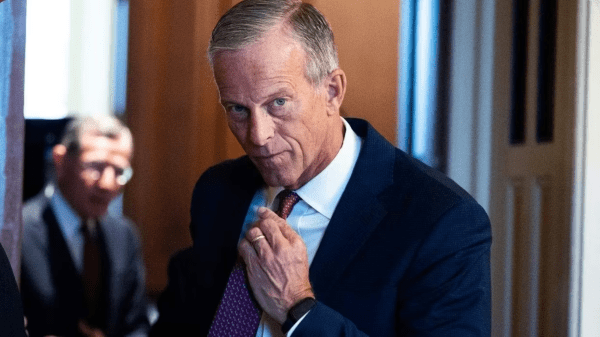
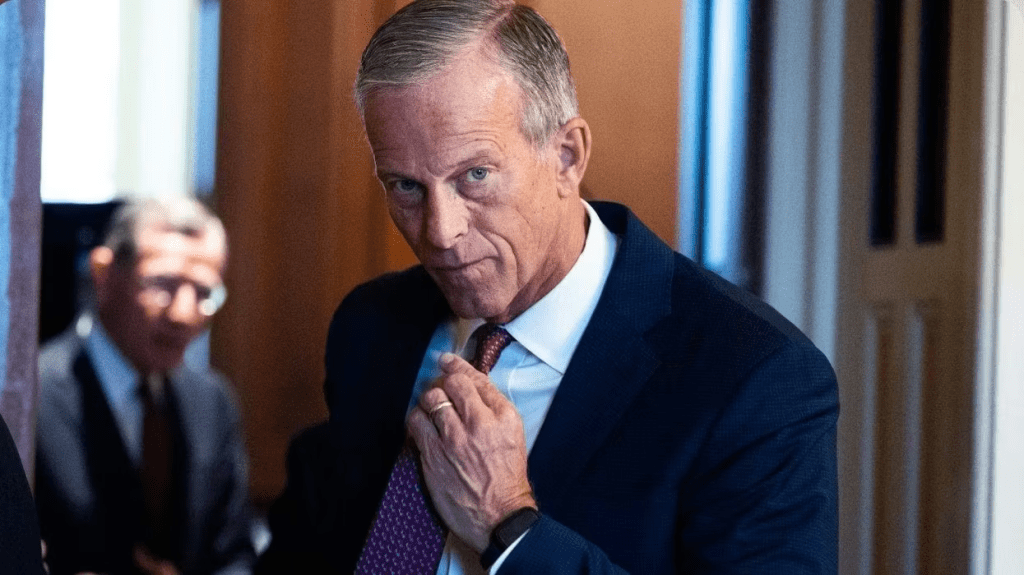
The amendment comes as Senate Republicans move forward with debate on the SAVE Act despite lacking the votes needed to pass it. Senate Majority Leader John Thune has acknowledged the bill is unlikely to reach the 60 votes required to overcome a filibuster, but has continued with floor consideration.
Voting rights groups have warned that proof-of-citizenship requirements could make it harder for some eligible voters to register, particularly those whose documents do not match their current legal names, like married people, especially women, and transgender Americans. The amendment includes a process for name discrepancies but requires additional documentation or affidavits.
The legislation faces an uncertain path in the Senate. The House already passed a version of the bill that did not include the anti-trans provisions, and it would have to return to the House if the Senate passes it before Trump could sign the legislation into law. He has vowed not to sign any other bills into law until the measure receives a vote and passes.
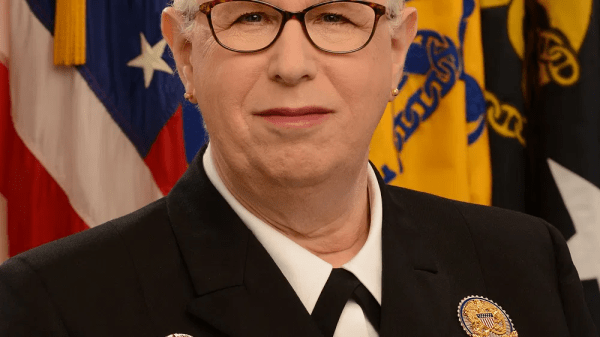
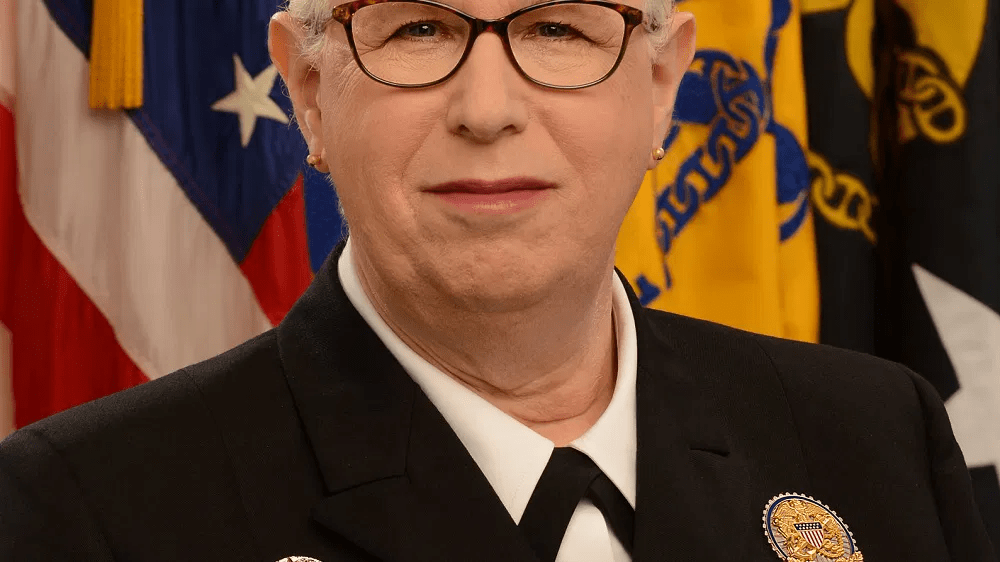
The Department of Health and Human Services (HHS) has altered the official portrait of Adm. Rachel Levine, the out transgender former assistant secretary for health under President Joe Biden, to display Levine’s deadname — a needless act of transphobia that Levine has called “petty.” Her portrait hangs in the HHS office alongside those of other federal officials who have led the U.S. Public Health Corps.
“During the federal shutdown, the current leadership of the Office of the Assistant Secretary for Health changed Admiral Levine’s photo to remove her current legal name and use a prior name,” Levine’s spokesperson Adrian Shanker, former deputy assistant secretary for health policy under Biden, told NPR. Shanker called the move an “unprecedented” act “of bigotry against her.” Though Levine said, “I’m not going to comment on this type of petty action.”
When asked about the alteration, HHS spokesperson Andrew Nixon told the aforementioned news outlet, “Our priority is ensuring that the information presented internally and externally by HHS reflects gold standard science. We remain committed to reversing harmful policies enacted by Levine and ensuring that biological reality guides our approach to public health.”
An anonymous HHS staffer told NPR that they considered the change “disrespectful,” adding that it exemplifies “the erasure of transgender individuals by this administration.” Upon taking office, the president issued numerous executive orders denying all federal recognition of trans people and kicking trans people out of the military for being selfish, dishonorable, deceitful, and undisciplined.
Levine was the first out trans person to receive Senate confirmation. On October 19, 2021, became the first out trans four-star officer in the U.S. Public Health Service Commissioned Corps, a noncombatant service of the nation’s eight uniformed services which promotes public health and safety. She resigned on the current president’s first day in office.
The current assistant secretary for health is Adm. Brian Christine, MD, who was appointed in November.
Aubrey and her wife are preparing to leave the United States for Costa Rica in January – a decision they haven’t taken lightly, after building a life as homeowners in upstate New York.
She says months of unease about the political climate in the United States – from debates over LGBT rights to concerns about basic safety – finally tipped them into making a plan to leave.
Her story is far from unique, according to a recent survey by US analytics firm Gallup which suggests 40% of American women aged 15 to 44 would move abroad if they had the opportunity.
These figures reflect aspirations rather than intentions, but they appear to highlight a trend that Gallup says began more than a decade ago – a growing number of younger American women reassessing where they see their futures.
The rise has also created the largest gender gap in migration aspirations that Gallup has ever recorded, with only 19% of younger men saying they want to leave the US.
Although Aubrey’s decision crystallised in the last few months, under the Trump presidency, the trend has been apparent for many years – starting at the end of the Obama administration, according to Gallup.
Pressures have been building on women from the left and the right, says Nadia E Brown, professor of government and chair of the women’s and gender studies at Georgetown University.
“It’s not just partisan politics,” says Professor Brown. “Women feel caught between expectations from both sides – traditional roles promoted by conservatives, and the pressures of progressive working life. Neither path guarantees autonomy or dignity, and that leaves women considering alternatives like moving abroad.”
Economic reasons like student loans, the rising cost of healthcare and the cost of home ownership are also factors in shaping young women’s decisions to forge a life in another country, she adds.
A recent survey from the Harris Poll – a US market research firm – suggested 40% of Americans have considered moving abroad, with many citing lower living costs as their main reason. The largest demographic groups thinking of moving were Gen Z and Millennials.
‘No strong work-life balance in US’
Kaitlin, 31, who moved from the US to Portugal four years ago, says there wasn’t one big reason why she decided to move abroad but she felt compelled to ditch her day job to explore a new life somewhere else.
“I was working a 9-to-5 in Los Angeles, and every day felt exactly the same. There’s not a strong work-life balance in the US. I wanted to live somewhere with a different pace, different cultures, and learn a new language.”
She now lives in Lisbon, works remotely as a freelancer, and says the lower cost of living and strong social culture have made her feel “more like a whole person again”.
“I can’t imagine ever going back to the US”, she says.
Despite the non-political nature of decisions made by people like Kaitlin, a clear political divide emerged in 2017, with those who disapproved of the Trump presidency far more likely to want to leave, according to the Gallup data, which was based on 1,000 interviews.
The number of young women expressing an interest in leaving actually fell this year compared with Biden’s final year in office but the gender gap has now reached its widest level.
Interest in moving abroad is also rising among Americans using platforms that help plan relocations and explore new countries. Expatsi, which offers scouting trips, expert consultations, and relocation services, has reported a spike in younger women’s interest in recent years.
“Expatsi data shows a clear gender trend,” says its co-founder Jen Barnett. “Our clientele has always been two-thirds or more women, but our first big bump in traffic came after Roe v Wade was overturned.”
‘Women’s rights were being stripped away in real time’
For Alyssa, a 34-year-old mother who moved from the US to Uruguay earlier this year, the decision to leave wasn’t just about lifestyle – it was a response to political and social pressures that felt immediate and personal.
She first began seriously thinking about leaving three years ago, after the US Supreme Court overturned the Roe v Wade ruling – ending the constitutional right to abortion in the US – but didn’t make the move until early 2025.
“I have children and I don’t plan on having more, but the increasing governance of women’s bodies terrified me. I felt like women’s rights were being stripped away in real time,” she explains.
As a Latina, she felt unsafe because of rhetoric around immigration in the US, even as a US citizen. “I genuinely feared being detained in front of my kids,” she says.
Confidence in major US institutions drops
Another related issue on which a gender divide appears to have widened is the matter of Americans’ trust in institutions, including the Supreme Court.
This has also sunk to historic lows, according to data from Gallup. Just 26% of Americans say they trust the presidency, 14% trust Congress and fewer than half express confidence in the court.
But the decline has been especially precipitous among young women.
Their scores have fallen by 17 points since 2015 – the sharpest decline of any demographic. Confidence dropped during both the Trump and Biden administrations.
Some women are also weighing practical concerns like healthcare, and climate – factors that can tip the balance when considering a move abroad.
Marina plans to leave the US for Portugal next May with her boyfriend. “Healthcare not being a human right in this country is a huge part of why we’re leaving.”
“We also want to live somewhere where gun violence is unlikely,” she added, citing a decades-old issue in America. “In Portugal it’s much harder to get a gun – that alone makes life feel safer.”
For Marina and her boyfriend, the challenges at home have made the decision to leave the US more urgent – including the nightmare of his house flooding during increasingly extreme weather, another issue that has intensified in recent decades.
“We’re tired of the climate here – it’s become unbearably hot, and it feels like there’s a natural disaster every year now.”
Her concerns reflect a broader mix of economic, environmental and safety pressures drawing younger women towards Europe and elsewhere.
A global trend
Younger American women were previously less likely than those in other advanced economies to see their futures abroad, Gallup has documented, a trend that has reversed since the late 2000s and early 2010s.
But Professor Brown says this “isn’t just a US problem”.
“Women in many countries are navigating similar challenges. The US just happens to be one where these pressures are particularly visible and acute,” she says.
Access to subsidies for childcare and healthcare, which are more common in Europe, can impact an American woman’s decision to move abroad.
“People don’t realise how far behind the US is on maternal care, parental leave, and healthcare,” Alyssa says, “until they leave the country.”
Across the country, LGBTQ+ Americans, people of color, women, religious minorities, and others who feel newly vulnerable under the second Trump administration are quietly constructing “Plan B” escape strategies: securing second residencies, lining up alternate passports, moving assets offshore, scouting communities abroad, or mapping literal escape routes to sanctuary states or neighboring countries.
Some are wealthy enough to buy investment visas in Europe. Others are applying for digital nomad permits that require little more than proof of remote income. Still others are assembling go-bags, stockpiling medication, or rehearsing how they would reach the Canadian border if federal restrictions tightened.
But the phenomenon, a blend of dread, pragmatism, and resignation, is unmistakably rising. None of the people interviewed for this story wants to leave their country. All emphasized that they hope their Plan B remains unused.
They are preparing anyway, because, they say, preparation now feels like survival.
A business built on American anxiety
Eric Major, CEO of the London-based global migration firm Latitude, says his American business has undergone a transformation.
“What used to be a 90 percent, ‘I’m not moving, but I want an insurance policy,’ is now turning into, ‘No, I am moving,’” Major said. “People are saying, ‘I don’t like what I’m hearing or what I’m living or what I’m experiencing.’”
Major, whose company operates across Europe and the Americas, says the shift began in late 2023 and accelerated after Trump’s second inauguration in January, when the administration moved quickly to reinstate the transgendermilitary ban, strip LGBTQ+ recognition from federal websites, and target health care and civil rights protections.
For LGBTQ+ clients, timelines are now one of the first concerns.
The timeline: from 30 days to two years
Major stressed that processing times vary dramatically depending on the country, the type of visa, and how overwhelmed that nation is by American demand.
He says some countries operate at almost lightning speed: Costa Rica, Panama, and other smaller jurisdictions can process residency in as little as 30 to 60 days, depending on background checks and documentation. Malta, too, can process a residency application in approximately three months, making it one of the faster European programs, Major said.
Meanwhile, he noted, countries like Portugal offer popular pathways but now struggle under the sheer volume of applicants. Major said that Portugal’s processing time ranges from six months on the low end to nearly two years on the high end, describing it as a country “victim of its own success.”
Canada, from where Major is originally from, he added, has become similarly stretched; in his experience, no one should expect to receive anything there in under 18 months.
He also emphasized the importance of timing and planning in the application process. Suppose clients know they cannot move until a certain date. In that case, he says the firm essentially reverse-engineers the application, starting preparations early but holding submission to align with a client’s planned departure. Some countries require newly approved residents to arrive almost immediately after approval, he said, which means planning a move is as important as qualifying for one.
‘America is not a safe place in my mind right now’
For “Mark,” not his real name, a gay New Yorker who works as both a physician and a consultant, the ability to pursue multiple residencies is directly tied to his financial circumstances, something he is quick to acknowledge.
He describes himself as “speaking from a very affluent gay perspective,” noting that he has the freedom to work remotely, the savings to invest abroad, and the professional flexibility to relocate. “I have the ability to do such things,” he said. “For me, it was a very no-brainer decision.”
He said the speed at which he could leave mattered as much as the destination.
“When Trump was in office first, I saw the writing on the wall,” Mark told The Advocate in an interview. “I decided one needed an escape mechanism from the United States.”
Mark obtained residency in Portugal, formed a company to gain residency in Panama, and secured status in a Caribbean country. These routes required financial resources, but he stressed that even many of his patients, including those with modest means, are pursuing lower-cost options such as digital nomad visas or temporary residency permits.
Mark said that a significant portion of his own patient population is preparing similar contingency plans. “At least 40 percent of my patients, and 100 percent of my gay patients, all have other residencies now.”
He pointed to Spain’s digital nomad visa, noting that one only needs to show roughly $3,000 in monthly income to qualify. In that program, he said, people can obtain residency and health care after a few years, then become eligible for citizenship after that.
The process brought him a profound sense of security.
“America is not a safe place in my mind right now,” he said. “I’m not going to allow my rights to be taken away from me by some insane lunatic.”
For trans Americans, the calculus is existential
For transgender Americans, the stakes feel even sharper.
Robert, a transgender man in his 60s living in a blue coastal state, began planning immediately after Trump’s inauguration, when the administration reimposed the transgender military ban and targeted trans people’s access to accurate passports and federal recognition.
“I thought we were headed down an authoritarian path — maybe even fascist,” Robert said. “The probability wasn’t zero.”
He initially researched so-called golden passports in the Caribbean, but quickly realized two issues: several of the countries selling them were not LGBTQ+ friendly, and the programs often required investments of $200,000 to $300,000 without guaranteeing a safe environment.
He instead turned to residency programs in Europe and selected Malta, which he identified as one of the most LGBTQ-protective countries in the world. Robert is now deep into the process: he has submitted all documentation, paid the first government fee, and is awaiting final approval before traveling for a required biometric appointment.
But immigration paperwork is only part of his Plan B. Robert has also stockpiled testosterone, a controlled substance, in case access becomes restricted. He has consulted attorneys to secure his real estate holdings, mapped out strategies for exiting the country if his passport is invalidated, and established protocols with his financial institution so that, with a single trigger phrase, his liquid assets can be moved or protected. He said the financial professionals he spoke to did not consider him paranoid; instead, they viewed these preparations as reasonable under the circumstances.
He also acknowledged that his preparation is not something every trans person can do. “My situation is privileged and unique,” he said. “The only thing I tell other trans folks is to at least make a Plan B, even if it’s just knowing how to get to a sanctuary state or across the border.”
For Robert, the red line that would prompt immediate departure is if the government starts signaling that transgender people’s passports could be restricted or invalidated. He said that any move toward requiring trans people to carry identifying markers or any early signs of authoritarian control would also trigger his exit. “Anything akin to the initial steps taken by a fascist regime,” he said.
A new American story
Beyond the logistics and financial planning, the emotional weight of this new reality is heavy.
“People don’t think of what their choices do to people like me,” Robert said. “There’s this level of apathy.”
Mark expressed a similar warning. “Don’t be too late,” he said. “When they start taking passports away and closing borders, it’s too late.”
Major sees this shift reflected in nearly every conversation he has with American clients today. While the process begins with lifestyle questions, financial disclosures, and paperwork, he says the deeper shift is psychological. “Americans are asking: If it gets really bad, where do I go?”
Everyone interviewed emphasized the same hope: that they will never need to use their Plan B.
But preparation itself has become a form of survival.
“I feel it’s a good feeling to be prepared,” Robert said. “I hope I never have to use it. But I’m not willing to gamble my future.”
Mark echoed him, reflecting on how drastically the national mood has shifted. “People usually moved to the United States for better lives. Now people are leaving the United States for better lives.”
The summer of 1985, I turned 16. In Belgium. While I lived primarily in rural, red Florida, summers sometimes had me staying with Dad’s family. At the time, my Army father was assigned to the American embassy in Brussels. With $100 in American Express “travelers’ cheques,” our go-to global currency of the time, it was a thrilling summer.
In Florida, I would’ve spent those months mopping floors or working the grill at a mall job. Instead, I had urban mass transit and could drink in bars. Granted, my Euro ’80s summer was more Depeche Mode than anything as explicit as Call Me By Your Name. Though virginal, at least I passed for something seedier one afternoon.
On a gray August Sunday, I was to meet my pal, Alex. Forget texting, as we didn’t even have email yet. Phone tag was possible, but nobody wanted to leave a message with somebody’s parents. We’d usually just make a vague plan in person. Probably, the previous Friday, it was, “Let’s meet by Rainbow Sunday round 4.” Ironic that a bar in 1985 could be called “Rainbow,” yet have no LGBTQ connection whatsoever. It was, loosely, an American-themed bar, popular with the small cohort of American teens in the city.
As I stood outside in whatever place of Brussels was near Rainbow, I did not know I was to be stood up. In what I thought was my coolest new piece of clothing, a plaid blue-and-white sport coat I’d bought in a cheap-chic bin in Italy, I waited. I checked my Swatch as the minutes passed. At least an hour went by before two Brussels police officers approached me. They wanted to see my “papers.” This was a new experience. The two suspicious policemen were asking me questions in French, which I did my best to translate. Was I meeting someone? Where did I live? How long had I been waiting? It seemed rather invasive, but they were cops, and I was 16.
Back home, my dad told me bluntly that the cops obviously thought I was a sex worker. I knew that new coat looked hot! Then again, the only attention I got was from the police. Ouch.
A few weeks later, I told this story to my mom. Her own upbringing took her from Baltimore to Switzerland to Brazil. With that background, she rather patriotically told me that being asked for your “papers” was relatively common outside of the U.S. We Americans, she opined, were used to a degree of anti-authoritarian freedom not found elsewhere. So, “land of the free” was more than jingoistic marketing? Great!
While I’d never been asked for my papers in my home country, I’m not sure I’d ever perceived it as free as my mother had. Sure, there were plenty of scary Soviet stories during the Cold War, the nightmare of the Khmer Rouge my father had seen firsthand…. But I was familiar with Reagan’s arguably racist drug war, kid-glove approach to Apartheid, and support for dictators like Augusto Pinochet and Ferdinand Marcos. At 16, I was definitely more cynical than my mother.
Sadly, today I have more reason than ever to be. Though I guess it’s not cynicism so much as disgust, anger, and resistance to our government’s new police state. A few years ago, I interviewed a man, Butch Merritt, who told tales of working clandestinely for Nixon’s citizen-surveillance machine. I was shocked when he recalled scooping up protest petitions and sign-up sheets from shops and venues around Dupont Circle, which he’d turn over to his FBI or police handlers.
The tools the federal government — along with several other governments around the world — is setting on America makes stealing a petition from Community Bookshop on P Street seem quaint. Hello, Facial-Recognition Technology.
Sure, so many of us use facial recognition to get into our phones and think nothing of it. It did not seem so innocent, however, when Hungary’s authoritarian government passed a law in March allowing it to use the tech to identify anyone who dared to show their face, literally, at Budapest Pride this year. At least Pride-goers threw that threat back in the horrible government’s face, with attendance hitting more than 100,000.
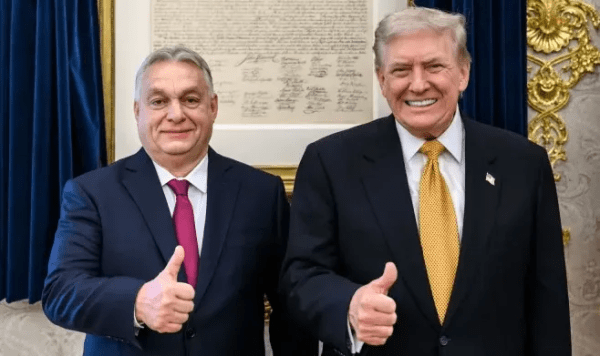
It is a very short line from Budapest to the “Ballroom,” considering the current regime of Viktor Orbán is celebrated in Trump World. The administration’s attacks on universities, media, and law firms reek of Orbán.
So, while I’m shocked to learn that ICE and its adjacent goons have rolled out handheld facial recognition tech across the country, to what is likely an unprecedented level, I’d be embarrassingly naive to be surprised.
Rep. Bennie Thompson (D-Miss.), a veteran of the civil rights movement and ranking member of the House Homeland Security Committee, last month told 404 Media, as reported by Common Dreams, “ICE using a mobile biometrics app in ways its developers at CBP never intended or tested is a frightening, repugnant, and unconstitutional attack on Americans’ rights and freedoms.” Amen.
Now that Trump has issued National Security Presidential Memorandum 7, we are all suspects. “There are common recurrent motivations and indicia uniting this pattern of violent and terroristic activities under the umbrella of self-described ‘anti-fascism,’” reads NSPM-7, in part. “Common threads animating this violent conduct include anti-Americanism, anti-capitalism, and anti-Christianity; support for the overthrow of the United States Government; extremism on migration, race, and gender; and hostility towards those who hold traditional American views on family, religion, and morality.”
Are my views on gender “extreme”? Am I “hostile” toward systems that have long been used to oppress me? Are you? Who knows? Who defines these vague, subjective terms? I’m guessing it’s the folks who have decided to throw facial-recognition tech into the surveillance mix, with little, if any, legal restraint. The use of this technology is apparently new enough, that no one has bothered to set down laws to restrain it. Instead, we have protocols and suggestions as the only limits on an administration that delights in destroying whatever stands in its way.
COVID has waned, but this new Big Brother era may soon have us all masking up again for our personal safety, whether for Pride or protests.
In 1980, Cuban police detained Fidel Armando Toboso-Alfonso without charge, encouraged co-workers to publicly shame him, and warned he faced four years in prison unless he fled the country. His “crime” was being gay. Having previously faced 60 days in a labor camp, Toboso-Alfonso chose exile. When he reached the United States, an immigration judge made a historic ruling: He granted Toboso-Alfonso refuge. That decision became a lifeline for countless LGBTQ people.
The United States was once considered a place where LGBTQ people could claim asylum. Today, under a harsher immigration system shaped by Trump-era judges, this image is slipping away.
In June, U.S. Citizenship and Immigration Services issued an alert reminding officers that marriages must be legally valid where celebrated to qualify for immigration benefits. For queer couples from countries that criminalize or refuse to recognize same-sex marriage, that’s an impossible standard. They must present a marriage certificate that, in their home country, they could be jailed or killed for attempting to obtain.
This is just one part of the Trump Administration’s broader rollback of protections for immigrants and LGBTQ people.
Under Presidents Barack Obama and Joe Biden, the United States resettled tens of thousands of refugees annually, including LGBTQ people fleeing persecution, arrest, torture, or death. Today, that number has been slashed to just 7,500—a fraction of its former scale and overwhelmingly skewed toward white applicants from South Africa.
The Trump Administration has also ordered federal agencies to remove recognition of transgender and nonbinary identities from official documents. Because the asylum process demands consistency across forms, nonbinary refugees now face an impossible choice: misrepresent themselves on paper or risk rejection for “inconsistency.”
These bureaucratic changes to passports, marriage certificates, and federal forms carry devastating consequences. By narrowing who counts as married or whose gender “exists” on paper, the White House has effectively barred countless queer individuals from asylum protections. Bureaucracy has become a new border wall, keeping the most vulnerable people out.
The United States does not jail or execute people for being LGBTQ. But the government is asking queer people to erase themselves to remain here—a quieter, procedural form of violence. A nation cannot call itself a refuge while demanding that those seeking safety deny who they are.
Last week, the Supreme Court allowed the Trump Administration to require that U.S. passports list only the sex assigned at birth. The decision halts lower-court efforts to block the policy, meaning the State Department may now refuse to process passports reflecting a person’s self-identified gender. The change may seem technical, but it signals something larger: When combined with other anti-LGBTQ measures, it threatens not only the rights of citizens, but also the safety of queer immigrants and refugees.
Meanwhile, some lawmakers are pushing to overturn Obergefell v. Hodges, the 2015 Supreme Court decision that recognized same-sex marriage as a constitutional right. The Court recently declined to hear one such challenge, but its mere consideration shows how precarious equality has become.
For queer asylum seekers already in the United States, the situation remains perilous. Claims based on sexual orientation or gender identity are often met with skepticism, as adjudicators demand “proof” of identity—an impossible expectation when visibility itself can be a death sentence. Instead of offering protection, the system pressures applicants to conform to stereotypes of what being “gay enough” looks like.
Worse still, immigration judges may now deny asylum applications without hearings, silencing stories that could save lives. Bureaucracy, once again, has become a weapon.
The next generation must do more than defend LGBTQ people—they must reclaim the promise of this country. A true refuge is defined not by paperwork or policy, but by the belief that every person deserves to live in truth and safety.











You must be logged in to post a comment.