

Read more at Erasing 76 Crimes.
North Africa
Morocco: Morocco has been under a long-term project to revise its legal system, and this year published reforms to the code of criminal procedure that ought to at least make the justice system more fair and limit pre-trial detention. Then again, we’ve also heard reports this year of continued crackdowns on queer people for pro-LGBT expression on the internet. [See “Coalition demands release of Morocco LGBT activist after 100 days in prison” (November 2025)]
Morocco also intends to revise its penal code, and some campaigners have been pushing to delete its sodomy and extramarital sex provisions when that happens, but no progress was made this year. I think the likelihood Morocco actually deletes its sodomy law is very slim.
Meanwhile, in October, the UN Security Council backed Morocco’s plan to resolve the dispute over the Western Sahara/Sahrawi Arab Democratic Republic, which would make it autonomous under Moroccan rule. The UN called on both sides to negotiate an actual settlement, but this seems like a big step toward eliminating an entire country from the map (which would decrease by one the number of states that criminalize homosexuality).
Tunisia: Multiple mass arrests of queer people were reported this year. [For example, “Tunisia steps up anti-LGBTI crackdown with wave of arrests” (February 2025), “Queer people suffer double punishment in Tunisian prisons” (June 2025), “Tunisia and Malaysia arrest dozens of queer people in escalating crackdowns” (July 2025), and “More than 70 arrested in Tunisia’s anti-LGBT crackdown” (November 2025).]
Chad: The government launched a commission on reinstating the death penalty, which was abolished in 2020.
West Africa
Burkina Faso, Mali and Niger: These three states run by military juntas following coups over the past half-decade took steps to deepen their integration into the Alliance of Sahel States (yes, the ASS), which is something between a supranational organization and a proto-state in its own right. They all withdrew from the Economic Community of West African States (ECOWAS), and they announced their intention to withdraw from the International Criminal Court. The states are motivated in part by antipathy to France and the West, Islamic faith, and support for and from Russia, all of which is exemplified in their pursuit of anti-LGBT policies.
Mali criminalized gay sex and promoting homosexuality in 2024, and Burkina Faso followed up in 2025. Niger has promised to enact a similar law but has not done so yet. Notably, as former French colonies, none previously had a sodomy law on the books.
Burkina Faso is also considering reinstating the death penalty as it overhauls its penal code, which ought to be a worrying sign. The new code also includes a crime of “promotion of homosexual practices and similar acts.”
Niger held a national conference that voted to extend the junta’s rule by five years and also to oppose any effort to legalize same-sex marriage.
Worryingly, some other neighbors, Chad and Togo (which both criminalize gay sex) have publicly mused about joined the ASS and have even taken some steps to integrate with them.
Of course, if the ASS ever does replace these three to five states, it would at least reduce the number of criminalizing states on the chart.
Ghana: A draconian anti-LGBTQ bill modelled after Uganda’s Anti-Homosexuality Act was reintroduced to parliament after a previous version lapsed without the president’s signature before the end of the term. This one is sponsored by a group of opposition MPs, but the government has said it intends to introduce its own version at some point. The current president has strongly suggested he will sign it.
Ghana also ratified the Treaty on the Prohibition of Nuclear Weapons.
The Trump administration used Ghana and Togo as places to deport asylum seekers, including at least one who was seeking asylum due to his sexual orientation.
The constitution review committee proposed an amendment to specifically bar the use of the death penalty. Ghana abolished the penalty in 2023 for ordinary crimes only, and the repeal was not retroactive, so those on death row still face execution.
Liberia: The government undertook a review of its laws for gender discriminatory effects – particularly around marriage, citizenship, rape, and children’s rights – but the review did not take sexual orientation or gender identity into account. I haven’t heard of further action being taken on this file.
The government intervened in the United Methodist Church over its support of same-sex marriage, including a senate investigation and even police detention. The local church has made clear its opposition to same-sex marriage.
A lawmaker was removed from a session of parliament after he disruptively attempted to introduce an anti-LGBT bill that would have imposed criminal penalties on same-sex marriage. Watch out for this to come back.
Nigeria: In a climate of regular violence against queer people, the governor of Kano state submitted a bill to the legislature to criminalize same-sex marriage. It’s already criminalized federally.
The senate was also considering a bill to expand the use of the death penalty.
Senegal: The government forced the UN and the Dutch embassy to cancel a planned film screening and discussion of LGBT issues. [Dozens of LGBTI Senegalese were arrested in police crackdowns as 2025 drew to a close.]
Cameroon: Erasing 76 Crimes reported on numerous cases of men being jailed for homosexuality. The government also accused the country’s most prominent human rights lawyer of money laundering and terrorism.
Gabon: A constitutional ban on same-sex marriage, passed in 2024, took effect in 2025.
Eastern Africa
Kenya: In August, the high court directed the government to protect transgender peoples’ rights, including recognition of their chosen gender and dignified treatment in government custody. The court ordered the government enact a specific Transgender Protection Rights Act or add amendments to that effect to the Intersex Persons Act.
Meanwhile, an MP vowed to bring forward a bill to criminalize LGBTQ advocacy, but he hasn’t done so yet. Parliament was also considering a bill to abolish the death penalty.
Uganda: The World Bank has ended its suspension of lending to Uganda, which was imposed in 2023 after the passage of the Anti-Homosexuality Act. The Bank now claims it has put in place mitigation measures to ensure its funds won’t be used to discriminate, which, frankly doesn’t make a lot of sense.
Tanzania: The government has announced it is moving forward with toughening existing criminal laws banning same-sex intercourse to further ban same-sex relationships and marriages, but I haven’t actually seen legislation come forward yet.
Rwanda: Parliament passed a new health care law that specifically excludes same-sex couples from accessing surrogacy and assisted reproduction.
Mauritius: The UK and Mauritius finalized and published a treaty on the handover of the British Indian Ocean Territory, with the UK maintaining sovereignty over the military base on Diego Garcia. While the treaty hasn’t yet been ratified, once it does the BIOT will cease to exist as a separate jurisdiction where same-sex marriage is legal – unless the UK recreates it in some form to cover Diego Garcia only.
Comoros: Joined the Biological Weapons Convention.
Eritrea: Ratified the Convention on the Rights of Persons with Disabilities.
Southern Africa
Botswana: A lesbian couple filed a constitutional challenge seeking the right to marry, saying the current ban violates various sections of the constitution guaranteeing the right to equality. The high court struck down Botswana’s sodomy law in 2019, in part after finding that the constitutional prohibition on sex discrimination included sexual orientation discrimination, a decision that was upheld by the court of appeal in 2021.
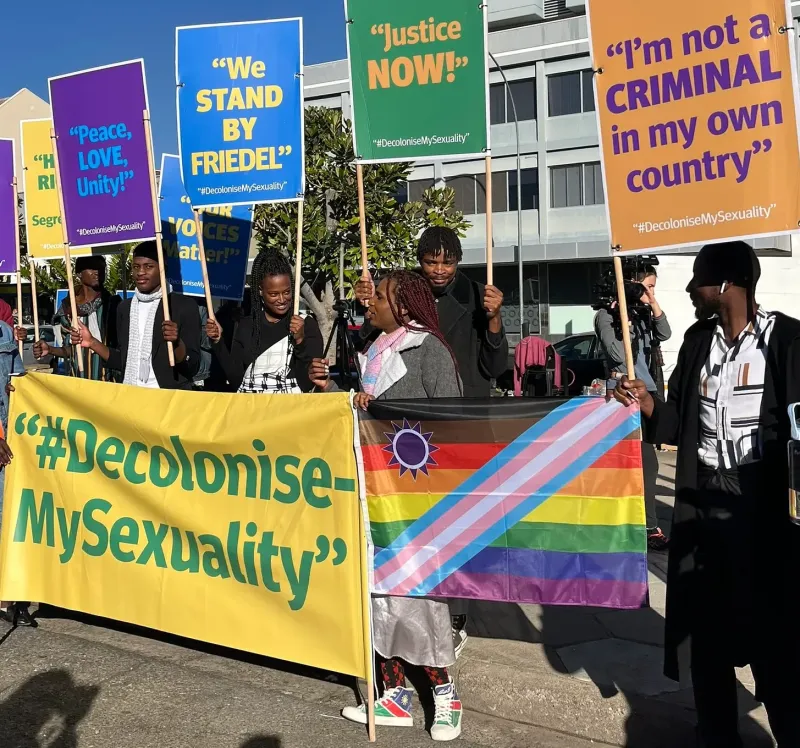
Namibia: We’re still waiting on a ruling from the supreme court on the government’s appeal of 2024’s lower court decision decriminalizing sodomy.
The former president officially vetoed a bill that aimed to criminalize same-sex marriage and LGBT advocacy before leaving office (he signed a different bill late in 2024 that banned same-sex marriage, however). His successor – the country’s first female president – says she’ll fight for equality for everyone but has avoided saying anything about LGBT people. Meanwhile, Equal Namibia was seeking couples who want to challenge the country’s ban on same-sex marriage.
South Africa: The government continued to work on a unified marriage act which will combine several marriage laws for different religious communities and the same-sex Civil Union Act into a single law. It has not yet cleared parliament.
Eswatini: The leading LGBT advocacy group Eswatini Sexual and Gender Minorities went back to court to challenge the government’s decision to deny them a company registration. The supreme court had ordered the government to reconsider their application back in 2023, but the minister’s decision remained the same.
Malawi: The Minister of Justice said the country is committed to abolishing the death penalty, having already completed public consultations, but no bill has been brought forward yet.
Zambia: The constitutional court dismissed a challenge to the country’s sodomy laws, ruling that the court lacked jurisdiction as the challenge needed to be filed before the country’s high court first. The Zambia Civil Liberties Union says they will refile the case.
Zimbabwe: In July, the government launched a legal reform process to recognize the rights of intersex people. We’ll see what comes of this.
The ruling party’s national conference also vowed to intensify and enforce laws banning homosexuality in late 2024, though no new legislation has been put forward.
 fleeredstates.blog
You must be logged in to post a comment.