As the Trump administration continues to curtail federal education protections – with particular cruelty aimed at LGBTQ+ students – lawmakers in Maryland have advanced a sweeping bill to protect marginalized students against discrimination in virtually all educational institutions in the state.
H.B. 649, named the Advancing Equal Educational Opportunities for All Students in Maryland Act, creates stronger enforcement mechanisms against “discrimination and retaliation” based on “race, color, national origin, ethnicity, ancestry, religion, sex, pregnancy, sexual orientation, gender identity, disability, age, or marital status.”
The legislation allows students and families to report discrimination to either the state superintendent or the Maryland Commission on Civil Rights to investigate. It also gives students and families the right to sue an educational institution directly. It broadly defines an educational institution as any pre-K program, elementary school, secondary school, institution of postsecondary education, institution of higher education, or any other program that culminates in a certificate, diploma, or degree.
The bill also says that the state may withhold funding from a school in violation of the anti-discrimination protections and may also withhold funding if a school does not remedy the problem once it’s found.
Cleveland Horton II, the executive director of the Maryland Commission on Civil Rights, told Fox Baltimorethat the bill is “about making sure that when Maryland students experience discrimination, there is a clear, reliable, and timely place to turn at the state level.”
“This bill addresses a state-level enforcement gap in education discrimination, particularly in higher education. This bill is not intended to replace the Office of Civil Rights, but again, to provide a state-level parallel safeguard, and to reduce the over-reliance on the federal capacity.”
In written testimony in favor of the bill, the ACLU of Maryland emphasized that passage is “urgent.”
“When the current president was inaugurated in January 2026, there were over 270 pending complaints from Maryland residents through OCR [The federal Office for Civil Rights]. Many or perhaps most of these cases have already been dismissed without an investigation. With the dismantling of USDE and OCR, Maryland must fill the gap to ensure that the civil rights of all Maryland students are protected and upheld.”
The ACLU also pointed out that current Maryland anti-discrimination law does not cover students in higher education: “These students must rely on federal anti-discrimination laws. And with the aforementioned changes at the federal level, Maryland families have fewer practical options for filing complaints with the OCR.”
Religious institutions, on the other hand, have expressed concern.
“We are deeply concerned that H.B. 649 proposes that religious and faith-based schools would have their decisions judged by a State commission that will not respect or consider the sincerely held religious beliefs of the school or, accordingly, their constitutional rights,” the Maryland Catholic Conference said in written testimony, according to Fox Baltimore. “Allowing a commission that is unrelated to educational practices and procedures to literally police faith-based schools regarding broad terms of discrimination, potentially resulting in a cause of action which could result in compensatory or punitive monetary damages, is clearly unconstitutional and an overreach.”
Nevertheless, the bill passed the state House of Delegates 100-35 and is now being considered in the state Senate.
On March 19, the University of North Texas (UNT) in Denton announced it would cut over 70 courses, including its LGBTQ Studies course, as part of broader budget reductions.
President Harrison Keller and Provost Michael A. McPherson sent a statement detailing the upcoming budget cuts for the fall 2026 semester.
The university plans to eliminate over 70 programs, including courses, minors, and certificates. The cuts are expected to save $45 million.
The university cited declining enrollment, particularly among international students, as the reason for its significant budget cuts.
The enrollment decline contributed to a $32 million budget deficit for the upcoming fiscal year.
The university will allow currently enrolled students to complete their degree programs. New students will not be able to register for these majors or courses.
The cuts include three master’s programs, one undergraduate major, 25 undergraduate minors, 21 graduate programs, and 21 undergraduate certificates.
UNT ordered a review of its courses last fall as part of the budget planning process.
Some courses, including LGBTQ Studies and Women’s and Gender Studies, were eliminated as part of the budget cuts.
Texas university systems reviewed courses in response to federal directives issued during the Trump administration.
The review was conducted in response to H.B. 229, which recognizes only two genders, male and female.
UNT has not confirmed whether the law influenced its decision to cut certain programs.
The university also plans to eliminate the Department of Linguistics, citing a “consistent decline.”
UNT said it continues to monitor its strategic budgeting model, which began in fall 2024, amid declining enrollment and sponsored research.
Monitoring the strategic budgeting model has helped identify budgeting issues for the upcoming school year.
University officials emphasized the importance of the budget plan in maintaining program quality and financial stability.
Harrison Keller said, “We will continue to make strategic investments for the health of the university. Most importantly, we remain steadfast in our commitment to the long-term success of our students.”
UNT stated it aims to support staff and faculty as part of its long-term planning.
Keller and McPherson added at the end of their letter on March 19 that, “By making these difficult but necessary decisions, we will be able to strengthen the quality and impact of our current academic programs while investing in new areas that help us build momentum for the future.”
Campus Reform has reached out to the university for further comment.
The Supreme Court yesterday blocked a law in California that bans teachers from outing trans kids to their parents from going into effect. The decision was 6-3, with the six Republican appointees opposing trans rights and the three Democratic appointees taking the side of trans kids.
The case involves teachers from Escondido Union School District who claim that their Christian faith requires them to out trans kids to their parents. They argue that their “right to exercise [their] own religious beliefs” is being violated by the district policy, which was established in response to 2016 legal guidance from the California Department of Education advising districts not to out students.
Trans and nonbinary youth can be put at risk of parental rejection and homelessness if outed to their parents.
In early January, a panel of judges on the Ninth Circuit U.S. Court of Appeals issued a stay to Benitez’s injunction, allowing California to enforce its trans youth protections as appeals work their way through the legal system.
But the teachers appealed to the Supreme Court, which sided with them and granted their emergency request for a stay.
The Court issued an 18-page unsigned ruling that said they believe that the parents are “likely to succeed on the merits” of their religious freedom claim, which was that there is a “right of parents to guide the religious development of their children” that also implies a right to know how their children are presenting their gender at school. The Court said that not outing kids to their parents is an even “greater… intrusion on the parents’ free exercise rights” than schools letting kids read books with LGBTQ+ characters, which the Court also ruled schools couldn’t do in its Mahmoud v. Taylor ruling last year.
In her dissent, Justice Elena Kagan wrote that this case shows how the “emergency docket can malfunction” because the case involved “novel legal questions” that the Court is ruling on with “inadequate briefing.”
“The Court is impatient: It already knows what it thinks, and insists on getting everything over quickly,” she wrote, noting that the federal appeals court hasn’t even ruled on the appeals in the case yet.
On the more substantive issues, Kagan wrote that the Constitution makes no mention of parental rights and that the conservatives on the Court relied on the Due Process Clause, which they usually read narrowly. She pointed out that the idea that women have a right to control their own bodies elicits “outright hostility” from her conservative colleagues when it’s suggested to be part of the Constitution’s due process protections. But now the same conservatives found that that clause gives parents the right to know how their children are presenting their genders at school.
She added that parents’ rights have to be balanced against the “critical interests in the care and education of children” that the state has, and that they needed to follow “ordinary processes” to address that balance.
Outing trans youth to their parents puts them at increased risk of homelessness, according to the Williams Institute. Not only that, they might still be exploring their identities and need to exercise control over their coming-out process.
“Transition isn’t a flick of a switch; it’s a complex, gradual, weaving journey of identity,” Connie Walden, a trans woman, wrote to the New York Times in 2023.
“My own transition started in high school. At what stage between my experimenting with makeup now and then to asking specific friends to call me Connie would I have officially, suddenly, socially transitioned? When should I have been robbed of the right to come out to my own family, to decide when to include them in my own process?”
“I recognize the pain of well-meaning parents who feel that their child kept such a large ‘secret’ from them. Yet with transition being a gradual process of experimentation, there is no big secret. There’s only kids slowly figuring out who they are, like all other kids.”
Iowa’s public K-12 schools would be barred from teaching students about topics related to gender identity and sexual orientation at all grade levels under a bill expanding what critics have dubbed the state’s “Don’t Say Gay” law.
It would subject all of Iowa’s K-12 students to a law Gov. Kim Reynolds signed in 2023 that bans instruction on gender identity and sexual orientation through sixth grade. The wide-ranging education legislation also ordered schools to remove books that depict sex acts.
A Senate subcommittee voted 2-1 Wednesday, Jan. 21, to advance Senate Study Bill 2003, which would extend the prohibition on LGBTQ-related teaching through high school.
“I think just as not all parents want others to teach their children about sex education because it involves family religious beliefs about sexuality, so not all parents want others to teach children about sexual orientation and gender identity because it too involves family religious beliefs about sexuality and sexual ethics,” Sen. Sandy Salmon, R-Janesville, said.
She and Sen. Jesse Green, R-Boone, who introduced the bill, voted to advance it.
Iowa’s 2023 law, Senate File 496, is being challenged as unconstitutional in a federal lawsuit. A federal judge initially granted an injunction blocking parts of the law, including the ban on teaching about gender orientation and sexual identity, while the lawsuit is decided.
But the U.S. Eighth Circuit Court of Appeals reversed his decision, allowing the law to take effect. Attorneys argued the law’s constitutionality in federal court last week.
Sen. Molly Donahue, D-Marion, voted against moving the bill forward, calling it a “distraction” from other issues facing the state.
“Iowans are definitely tired of this type of legislation, and we’re seeing that with the voting records, not just in Iowa but across the United States,” Donahue said. “We should be focused on prioritizing public schools, funding affordability for our people in this state and making sure that we’re balancing a budget in this state that is currently over $1 billion in deficit. We are focusing on the wrong things when we bring bills like this.”
Iowa is one of several Republican-led states, including Florida, with similar prohibitions on classroom teaching about gender identity and sexual orientation.
The bill says that Iowa’s public school districts and charter schools cannot provide “any program, curriculum, test, survey, questionnaire, promotion or instruction relating to gender theory or sexual orientation” to K-12 students.
Similar legislation has not advanced in past years, including in 2025 after a House proposal stalled once it passed out of subcommittee.
Opponents of the bill say ‘LGBTQ people exist’ regardless of classroom instruction
Opponents outnumbered supporters of the bill at the hearing Wednesday at the Capitol, as LGBTQ Iowans and LGBTQ rights groups shared opposition with lawmakers, while religious and conservative groups spoke in favor of the measure.
Kaylara Hoadley, of Mason City, cried as she showed lawmakers a photograph of her 15-year-old nonbinary child, saying the bill does not keep students safe.
As a caseworker for families in crisis, Hoadley said she supports youth who are homeless or facing other crises whose only safe space is their school.
“When the law silences teachers, counselors and staff, vulnerable youth suffer and suicide rates increase. … When does a child’s suicide matter to you?” she asked the Republican senators as her voice wavered.
Melissa Peterson, representing the Iowa State Education Association, said questions remain as to whether the current law is discriminatory toward LGBTQ students as it remains tied up in court and urged lawmakers to oppose expanding the law.
“We want to get back to basics and provide a safe learning environment for every single one of our students as closely to as free from discrimination as possible,” Peterson said.
Damian Thompson, external affairs director for Iowa Safe Schools, said the bill would amplify the existing law’s constitutional problems by applying it to older students who have well-established constitutional rights.
“High school students can vote soon, they can serve in the military and they’re expected to understand complex and social and health issues as they enter adulthood,” Thompson said. “Federal courts have been consistently clear that students do not shed their First Amendment rights when they enter a public school.”
Bethany Snyder, of Urbandale, who has a trans partner and is a lesbian mother to a freshman at Valley High School, said silence isolates children and does not protect them.
“My partner and I grew up in that silence,” Snyder said. “We didn’t see ourselves reflected in school. We learned very early what shame sounds like in the absence of words. High school should prepare students for the real world and the real world. LGBTQ people exist as parents, coworkers, legislators, historical figures and leaders and families like mine and families like hers.”
Her daughter Evelynn Snyder-Maul said she has never received instruction on gender identity in school beyond sharing that she has a trans father and queer mother.
“If I’m telling someone about my family, could I get reported?” Snyder-Maul said. “However, that is the least of my concerns. Lawmakers who want to pass this bill are snowflakes. You think that love is inappropriate and you think that it is forcing kids to believe they like the same gender. If your kid is gay, whether they are taught that gay exists or not, they are still going to be gay.”
Supporters say schools should teach ‘fundamentals,’ not discuss LGBTQ topics
Danny Carroll, a senior policy adviser with The Family Leader and a former state lawmaker, said the bill would “remove unnecessary distraction” from Iowa classrooms.
“I think Iowans have grown a little bit weary of the distraction — and sometimes very loud and profane distraction — that gender theory has brought on, and I think they’re inclined to think perhaps we should return our schools to some of the fundamentals of learning and put this aside,” Carroll said. “I can see no way that this would interfere with teaching goodwill, friendship, respect for each other.”
Patty Alexander, a retired educator from Indianola, said discussing sexual identity is not an educator’s job.
“We do not believe in labeling students or grouping them by sexual preferences,” Alexander said. “We are here to meet their learning needs. We are not mental health counselors, and forcing us to group and label students only divides and causes rifts. Forcing us to discuss sexuality furthers the mistrust of educators between parents and their children.”
Jeff Pitts, representing the Iowa Faith and Freedom Coalition, said the group supports expanding the existing law through high school.
“Our schools are not the place to promote political ideology,” Pitts said.
A federal judge in California has struck down a state policy that prevented teachers from informing parents when their child identified as a different gender at school, calling the rule unconstitutional and a violation of parental and teachers’ rights.
U.S. District Judge Roger Benitez, sitting in San Diego, ruled Monday that California’s policy—meant to protect LGBTQ students’ privacy—improperly restricted communication between parents and educators. The decision delivers a major setback to state officials and LGBTQ advocacy groups that had defended the policy as essential to student safety.
Why It Matters
The ruling stems from a 2023 lawsuit filed by Escondido Unified School District teachers Elizabeth Mirabelli and Lori Ann West, who challenged a district policy requiring staff to keep a student’s gender identity confidential from parents. The pair, represented by the Thomas More Society, a religious liberty law firm, argued that the rule forced them to violate their faith and the trust of parents.
The ruling directly conflicts with California’s Safety Act (AB 1955), signed by Governor Gavin Newsom in 2024, which banned schools from disclosing students’ gender identity or pronouns to parents without the students’ consent.
What To Know
In a 40-page opinion, Benitez said the rules “place a communication barrier between parents and teachers” and “harm the child who needs parental guidance.” He added that such policies deprive parents of their 14th Amendment right to direct the care and upbringing of their children and infringe upon teachers’ First Amendment rights.
“Parental involvement is essential to the healthy maturation of schoolchildren,” Benitez wrote, according to Courthouse News Service. “California’s public school system parental exclusion policies place a communication barrier between parents and teachers… That, this court will not do.”
Benitez’s ruling also issued a permanent injunction, blocking school districts from reinstating similar “gender secrecy” policies. He acknowledged the state’s intent to protect LGBTQ youth from possible abuse or rejection at home but concluded that the policy was overly broad and not narrowly tailored to that goal.
“When the state drops an elephant in the middle of its classrooms,” he wrote, “it is not a defense to say that the elephants are too heavy to move.”
In his order, Benitez framed the issue as a constitutional matter rather than a cultural one.
“Historically, school teachers informed parents of physical injuries or questions about a student’s health and well-being,” he wrote. “But for something as significant as a student’s expressed change of gender, California public school parents end up left in the dark.”
The decision intensifies a legal and political struggle over how schools handle issues of gender identity. Supporters of the Safety Act cited Centers for Disease Control and Prevention data showing that about 25 percent of transgender youth attempted suicide in 2023, underscoring the risks of forced disclosure. LGBTQ groups, including the American Civil Liberties Union and Equality California, have argued that involuntary outing can lead to family rejection, homelessness or self-harm.
Conservative lawmakers and parental rights groups have opposed such secrecy policies. Tech executive Elon Musk also criticized California’s gender identity disclosure law, saying it was among the reasons he decided to move the headquarters of SpaceX and X (formerly Twitter) from California to Texas.
What People Are Saying
Elizabeth Mirabelli and Lori West, in a joint statement shared on Monday: “We are profoundly grateful for today’s ruling. This has been a long and difficult journey, and we are humbled by the support we’ve received along the way. We want to extend our deepest thanks to Thomas More Society and to everyone who stood by us, prayed for us, and encouraged us from the very beginning.”
California State Senator Scott Wiener, on X days before the ruling: “I’ve passed some of the strongest protections for trans people in the country—from safeguarding gender-affirming care to protecting youth and families fleeing hostile states. As the federal government ramps up its attacks, I will always stand between trans people and harm.”
What Happens Next
The California Attorney General’s Office has not said whether it will appeal the ruling to the Ninth Circuit. For now, the court’s decision halts enforcement of policies that restrict teachers from sharing students’ gender information with parents across California’s public schools.
The University of Oklahoma (OU) recently dismissed a professor for telling students that they wouldn’t be counted absent from her class if they attended an on-campus protest in support of a transgender teaching assistant (TA) who was placed on administrative leave after she failed a student’s essay that referred to trans people as “demonic.” The newly dismissed professor reportedly didn’t give the same option to students who wanted to protest against the trans TA’s reinstatement, OU said.
OU composition professor Kelli Alvarez was accused of viewpoint discrimination for her alleged actions, OU said in an official statement cited by KFOR. OU’s director of first-year composition emailed Alvarez’s students, calling Alvarez’s actions “inappropriate and wrong,” adding, “The university classroom exists to teach students how to think, not what to think.”
The director informed students that they could miss the Friday class to attend either the protest or the counterprotest. The director also noted that Alvarez has been replaced for the remainder of the term, which ends on December 19. OU said it agrees with the director’s actions.
“Classroom instructors have a special obligation to ensure that the classroom is never used to grant preferential treatment based on personal political beliefs, nor to pressure students to adopt particular political or ideological views,” OU wrote in its statement.
At the Friday protest, hundreds of students rallied in support of Mel Curth, a trans TA who OU placed on administrative leave after she gave a student a grade of zero on an essay about a study on gender roles in which the student called trans people “demonic.” The student, Samantha Fulnecky, filed a religious discrimination complaint with OU in November, and the university put Curth on administrative leave.
Students at the protest chanted, “OU shame on you,” “Protect our professors,” and “Justice for Mel,” KOKH-TV reported. Even students who didn’t agree with Curth’s failing grade for the student agreed that Fulnecky’s essay was poorly written and that Curth didn’t need to be put on leave.
At one point in the protest, a Turning Point USA (TPUSA) supporter got in front of the crowd and began counterprotesting.
The OU Chapter of the right-wing young conservatives group published a transphobic tweet saying, “We should not be letting mentally ill professors around students. Clearly this professor lacks the intellectual maturity to set her own bias aside and take grading seriously. Professors like this are the very reason conservatives can’t voice their beliefs in the classroom.”
In her paper, Fulnecky wrote that people aren’t “pressured to be more masculine or feminine,” that she doesn’t see it as a problem when peers use teasing to enforce gender norms, and that “eliminating gender in our society… pulls us farther from God’s original plan.” She also said trans identities are “demonic and severely [harm] American youth.”
In her response, Curth — to whom the OU Department of Psychology recently gave its Outstanding Graduate Teaching Award — wrote that her grade wasn’t because Fulnecky had “certain beliefs,” but rather because the paper “does not answer the questions for this assigment, contradicts itself, heavily uses personal ideology over empirical evidence in a scientific class, and is at times offensive.”
In a statement, OU wrote that it takes First Amendment rights and religious freedoms seriously and began a “full review” of the situation to “swiftly” address the matter, including a “formal grade appeals process” and a review of the student’s claim of “illegal discrimination based on religious beliefs.”
The university also said that Curth had been placed on administrative leave during the finalization of the discrimination review, leaving “a full-time professor” to serve as the course’s instructor for the rest of the semester.
Missouri State Sen. Joe Nicola (R) introduced a bill that would ban “social transition” in schools and forcibly out any transgender and nonbinary students to their potentially unsupportive parents if the students ask a school staff member to address them by a name or gender identity different from the sex assigned to them at birth.
The bill would also allow teachers to be fired and banned from teaching, as well as schools to be sued for affirming trans and nonbinary students’ gender identities, even if a parent approves of their child socially transitioning.
S.B. 1085, one of 21 anti-LGBTQ+ bills recently introduced by Missouri State Republicans, requires school staff members to inform the principal or a designee within 24 hours if any student asks them to “participate in or support” their social transition by having them address them by a name or gender identity that differs from those they were assigned at birth. The principal or designee would then have 72 hours to inform the student’s parents.
The bill would forbid school staffers and counselors from affirming a student’s trans or nonbinary gender identity or teaching about such identities. School districts would also be forced to fire teachers who violate the law and begin proceedings to revoke those teachers’ teaching licenses. Parents and the state attorney general may also pursue a civil lawsuit against any school or school district that violates the law.
The bill has no exception for parents who approve of their child’s social transition. This essentially forces educators to continue misgendering trans students and invalidating their identities even if they personally support trans and nonbinary students. Studies have shown that social transitioning improves the overall health and well-being of trans children.
Trans journalist Erin Reed wrote that the bill “underscores a shift in how anti-trans legislation is being sold to the public.”
“For years, supporters of bathroom bans, sports bans, and ‘don’t say gay’ policies framed their efforts as battles for ‘parental rights.’ Increasingly, though, that language has fallen away as lawmakers move to strip supportive parents of any authority at all, mirroring the approach in medical transition bans that override parental consent entirely.”
Nicola’s bill is just one of numerous anti-LGBTQ+ bills introduced in the state legislature. The other proposed bills would require the state to deny all legal recognition of non-cisgender identities; roll back nondiscrimination protections for transgender people; ban trans students from accessing school facilities or sports teams matching their gender identities; ban schools from displaying Pride flags; and allow anyone working with schools to misgender other employees’ trans/nonbinary gender identities.
The other proposed bills would also forbid state agencies from allowing gender changes on government-issued identity documents; ban trans people from using public facilities matching their gender identities; ban teachers from being a member of any sports organizations that allow trans participation; ban all “obscene” content from schools (including LGBTQ+ educational materials); forbid all gender-affirming care for minors; and designate all drag performances as “adult cabaret” performances (whose viewing by children can be criminally charged).
In April, Nicola voiced support for a state bill that would ban trans and nonbinary people from using “bathrooms, locker rooms, sports facilities, various crisis centers, prisons,” and other sex-segregated spaces that match their gender identity.
When a doctor testified against the bill, noting that such bans negatively affect trans people’s well-being, Nicola replied, “I’m not going to listen to doctors that say one thing that disagrees with a God of creation. You want to kind of berate me a little bit by saying we should listen to what doctors have to say, what your schooling has to say, over what the scripture has to say — it’s not happening with me.”
Nicola may not realize that the Bible has several scriptures that theologians interpret as being supportive of trans people and their identities.
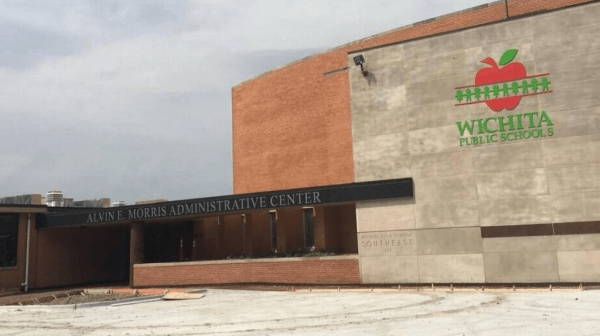
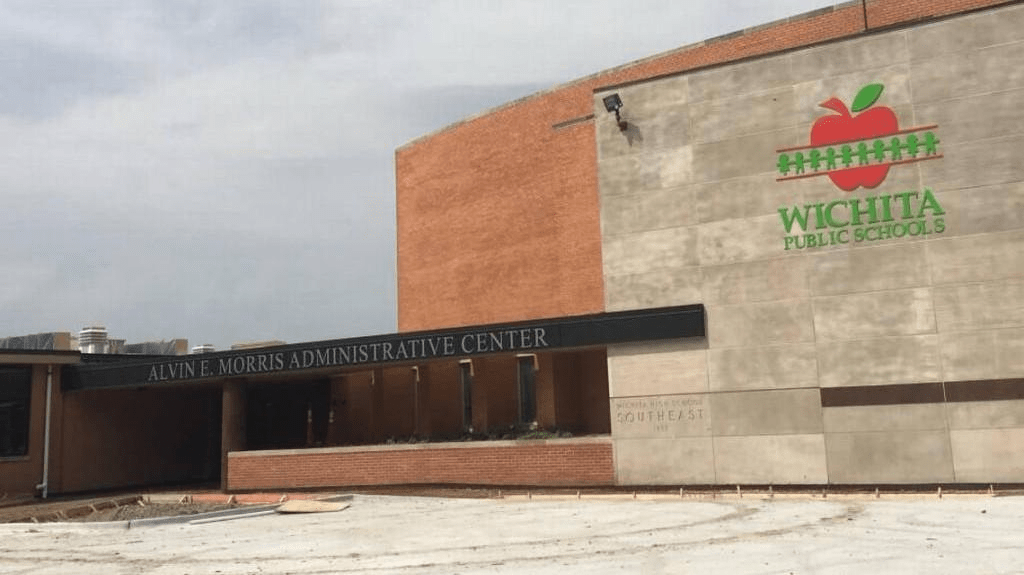
The Kansas Attorney General’s Office has sent letters to more Kansas school districts, including Wichita’s, warning of possible legal action over LGBTQ policies. Along with Wichita Public Schools, the letters were also sent to the Lawrence Public School District, the Cherryvale School District in southeast Kansas, and the State Board of Education.
The letters alleged that the school districts were not following state and federal laws regarding school policies for LGBTQ students and libraries. “I am writing to warn you that these policies make you vulnerable to lawsuits and the loss of federal funding, endanger your students, and violate the constitutional and legal rights of parents, students and your employees,” the letter to USD 259 read. The letters are similar to those sent by Attorney General Kris Kobach to some northeast Kansas school districts, which are now under federal investigation. A letter addressed to Wichita Public Schools alleges that East High and “possibly other schools” were engaging “in gender transitioning of minors without parental knowledge or consent.” Without going into specifics, it also alleges that the district “may have additional transgender policies” that don’t align with state and federal law.
Earlier this year, the district quietly removed language regarding diversity from its website and online policy handbook after the Trump administration published a letter to public schools threatening federal funding if they continued diversity, equity and inclusion programs. In a statement to the Eagle, Wichita Public Schools said the district follows Kansas and federal law. The largest school district in Kansas also said it wasn’t aware of what allegations were made to the AG’s office to prompt the letter. The attorney general’s office has not responded to an Eagle inquiry about why it sent the letters to those school districts and the State Board of Education. “The letter made several broad recommendations – from policies to student support to parental review of instructional materials – which the Board of Education has not had the opportunity to fully discuss,” the statement read. The letter gives the district a Jan. 2 deadline to revise its policies and to identify books and other materials in schools that are “religiously objectionable.” Letters sent to the other school districts and the state board make similar statements and recommendations, but the letter sent to Lawrence Public Schools makes more pointed recommendations. The attorney general’s letter to the Lawrence School District specifically called on it to take down its “LGBTQ Advisory Guide” from the district’s website.
That guide was still available on its site as of Thanksgiving week. It also wants the district to ensure students use locker rooms for the gender they’re assigned at birth, as well as allowing only “biological females” to play in girls sports. The state legislature recently passed a law banning transgender student athletes from girls sports. Cherryvale and Lawrence Public Schools have yet to respond to a request for comment – but both of the school districts’ calendars show that they’re closed for Thanksgiving break. A letter addressed to the State Board of Education makes similar allegations about several other school districts in the state, but doesn’t name them. “As of today, the State Board has not issued any comment,” the board’s spokesperson said in a statement to the Eagle.
The grim consequences for transgender students in Texas are coming into focus three months after the state’s sweeping new Don’t Say Gay legislation went into effect in September.
Texas Gov. Greg Abbott (R) signed the so-called “Bill of Parental Rights” in June, a draconian right-wing wishlist of MAGA priorities banning discussion of LGBTQ+ identity and race in classrooms, shutting down gay-straight student alliances (GSAs) on school campuses, and explicitly prohibiting school staff from supporting trans students, alongside other restrictive measures.
The prohibitions around social transition mean kids known to their classmates and teachers by their preferred name and identity for years are now being deadnamed and forced to assume an identity they’d abandoned long ago.
Ethan Brignac, a trans student at Wylie East High School northeast of Dallas, has been known by his chosen name since seventh grade. With the new legislation in effect, the high school senior lobbied teachers to continue using it.
“In the first week of school, when I was kind of trying to convince my teachers to call me Ethan, I was like, ‘Hey, look, it’s still on my ID.’”
“Then one of my teachers this year said, ‘Okay, they’re gonna fix that soon.’”
Three weeks later, school administrators called him to the library and gave him a new ID. Ethan was now officially identified by his deadname.
He says some teachers seem to make a point of working his legal name into every interaction, he told the Texas Tribune, outing him to peers and rekindling the dread he felt in his time before Ethan.
“It was definitely a big change having my deadname kind of sprawled everywhere,” he said, “It was like, wow, okay, that wasn’t just a social media post I saw, this is real life.”
A school spokesperson confirmed the change was “to ensure full compliance with state law, including Senate Bill 12.”
In the Leander school district north of Austin, faculty may continue to call students by their preferred name, if it was done prior to SB 12’s implementation. But for new students, the use of their chosen names and pronouns is banned. Parents can request a name change, but those updates are only allowed if they’re unrelated to social transitioning, said Conner Carlow, a classroom support specialist in the district.
Carlow grappled with his own sexuality as a middle schooler and recalled how hard it was.
“I wasn’t telling my parents what was going on, so I imagine these kids aren’t either,” Carlow said. “The fact they’re willing to tell us before even the parents is a big deal, and now the fact that we have to just not accept them, I mean, it’s awful.”
The school board in Conroe, Texas, north of Houston, was among the first in Texas to bar teachers from using gender-affirming names and pronouns.
At Woodlands High School in the district, junior Cassie Hilborn had planned to come out as trans, but the onslaught of anti-LGBTQ+ legislation stripped her of her confidence, she says.
“It feels like every day I look at the news and then the headline just reads, ‘Sorry, more things you’ve lost.’”
Cassie takes refuge at the school’s Dungeons & Dragons club, where classmates and a faculty adviser call her by her chosen name. She lodges a small protest against SB 12 by hiding the deadname on her school ID under blue masking tape.
But Cassie remains discouraged, she said.
“Now, even teachers that might have respected my identity have been told that they unequivocally are not allowed to do so,” Cassie said.
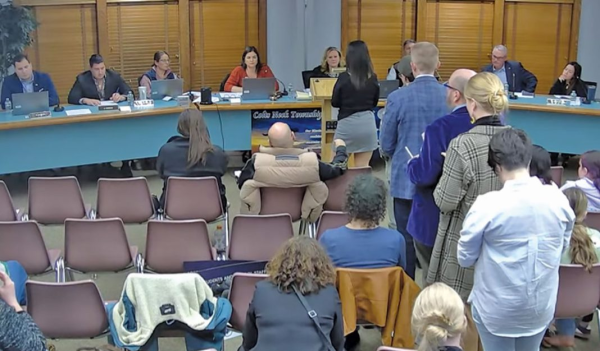
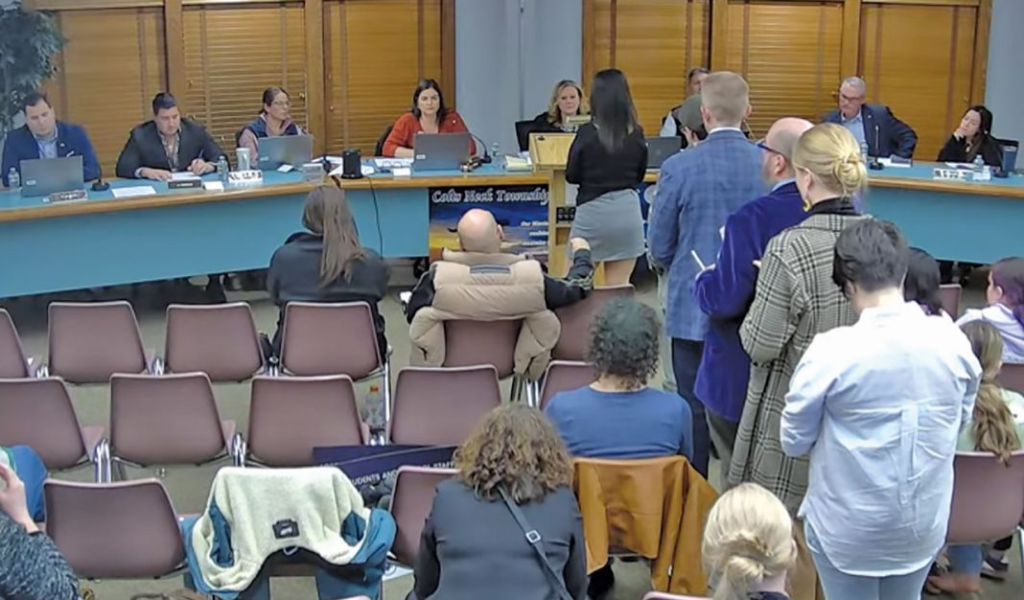
The Colts Neck Township Schools Board of Education on Nov. 19 unanimously passed a “Parental Bill of Rights,” which among other things allows parents to obtain information surrounding their child’s gender identity and allows them to opt their child out of lessons they find morally objectionable.
The adoption of the policy for the preschool through eighth-grade school district was seen as a victory for parents who believe they should have a say in what their child is learning, but drew criticism from LGBTQ advocates who believe the policy is discriminatory and will hurt students who are sexual or gender minorities.
Lucas Manrique, a mental health professional who spoke during the public comment portion of the meeting before the vote took place, said the BOE’s policy would “operate in direct opposition” to New Jersey Department of Education Policy 5756, which provides guidance to schools on how to treat transgender and gender nonconforming students.
“It is my ethical responsibility as a therapist to provide testimony where I see the potential for harm,” said Manrique, who identified himself as a licensed associate counselor and a nationally certified counselor from Middlesex County.
“5756 was created to protect young people by preventing forced outing. Outing students without their consent is psychologically damaging, is discrimination, and is illegal in New Jersey. I implore you to recognize that as a body, it is your responsibility to protect every student and reinforce the rights protected by law,” he said.
However, Val Mendez of Marlboro said she strongly supports the policy. She said that she cares deeply about transparency and that schools should not be a replacement for parents.
“What I appreciate most about this … is that it’s not about politics; it’s about restoring trust, strengthening communication, and ensuring that parents and schools work together,” said Mendez, who emphasized she was speaking as a parent and not as a member of any board to which she belongs.
The policy contains eight articles and outlines parents’ and legal guardians’ rights in the school district. The parts of the policy that sparked the most controversy deal with sexuality and gender, including resources and curricula containing LGBTQ content.
Article 3.3 of the policy addresses the issue of gender identity. It says that the BOE affirms the rights of a child’s parents or legal guardians to ask staff members and receive from them “truthful and to the extent known information” about their child, including changes to their child’s gender identity, pronouns, and name. A child’s legal caretakers, according to the policy, are also entitled to know the sports teams and activities “organized by sex” in which their child is participating and what “sex-specific” facility, such as a bathroom or locker room, their child is using.
Article 4.1 of the policy entitles parents or legal guardians to excuse their child from any “instructions in health, family life education or sex education” that conflict with their “conscience, or sincerely held moral or religious beliefs.”
Article 4.2 of the policy allows a child’s legal caretakers to prevent their child from exposure to a resource or curriculum content that they believe “substantially interferes” with their child’s religious development.
And Article 4.3 allows parents or legal guardians to prevent their child from participating in surveys, questionnaires, or research projects involving personal family information, beliefs, sexual behavior, mental health, or other “sensitive areas.”
Other school districts in the state have written similar policies that have been met with legal challenges. New Jersey Attorney General Matthew J. Platkin filed lawsuits alleging the policies violate the state’s Law Against Discrimination against at least three school districts. The attorney general’s office declined to comment on the matter in Colts Neck. A spokesperson for the LGBTQ civil rights organization Garden State Equality said the organization is “carefully considering any and all possibilities.” A spokesperson for the American Civil Liberties Union of New Jersey said the organization is looking into the policy.
Shawn Hyland, director of advocacy at the New Jersey Family Policy Center, which describes itself on its website as a “Christ-centered organization” and has offices in Trenton and Warren, thanked the board for considering what he called a “common-sense policy.”
“Thank you for recognizing that the parents in Colts Neck genuinely want what’s best for their children and that school policies should reflect that reality. Parents are not only taxpayers; they’re the primary stakeholder in public education. They nurture, protect, and guide their children every day, and they deserve transparency. Let me be clear: Parents are not the problem,” he said.
However, that is not always the case, according to Manrique, who said The Trevor Project, a national nonprofit organization focused on suicide prevention and crisis intervention for LGBTQ youth, found that in 2024, 40 percent of unhoused LGBTQ youth reported that they were kicked out of their parents’ home or were abandoned because of their LGBTQ identity. Also, 35 percent of homeless youth reported attempting suicide, Manrique said.
Still, Hyland said it is “deeply offensive” to suggest moms and dads should have no right to know what curriculum is being taught, to access student records, to be notified of health-related decisions, and to opt out of “intrusive surveys.”
“It is both unethical and dangerous to advocate for that extreme position, yet sadly some do.” Hyland said, adding that the BOE’s policy does not create rights; it simply recognizes the rights already protected under existing federal law. He added that “keeping secrets from parents” violates the federal Family Educational Rights and Privacy Act and the Protection of Pupil Rights Amendment.
Hyland said 77 percent of New Jersey adults believe parents should be fully informed about what’s happening in school. “This is not a fringe position; it’s a mainstream conviction,” he said.
However, Dr. Brian Kaufman, a psychologist with expertise in adolescent development and human sexuality from Asbury Park, told the board that outing students before they are prepared “could lead to the indelible stain of blood on your hands. You can always choose to introduce additional conversations and lessons, but you cannot undo the physical and emotional trauma that results from ignorance.”
Kaufman directs a nonprofit organization called “Rainbow Quest.” Its mission, stated on its website, is to distribute “affirming and educational resources to promote social and intercultural skills.” The organization offers training workshops for educators and therapists and “community-building” events that are intended to “reduce bullying, discrimination, and intolerance and help build and maintain healthy, safe communities, homes, schools, and workplaces.”
He said the organization also aims to educate about “historical and cross-cultural heroes who advanced humankind, LGBTQ role models.
“We rarely learn about these heroes’ sexual orientation or gender identities in school, but every election cycle, we can’t avoid being bombarded with angry, ignorant rhetoric that portrays LGBTQ+ community members as inferior, deviant, and less deserving of respect and love than their gender-conforming peers.”
The exclusion of positive content about LGBTQ people and their contributions to society “leaves the public with a one-sided, negative perception of our gender-diverse youth,” Kaufman said, adding that much more is known now about human sexuality and gender than in the past.
Larissa Garcia, community organizer for GSE, who also identified herself as a Middlesex County resident, read a statement to the board from GSE Senior Director of Advocacy and Organizing Lauren Albrecht.
In it, Albrecht criticized the BOE and its policy committee chairman, Robert Scales, saying she is “keenly aware” of the board’s “disingenuously named ‘Parental Bill of Rights.’” Albrecht said Scales previously told her when she contacted the district months ago about the policy to register a complaint about it that it was dishonest of her to do so without reading it.
“I knew what it would say due to my professional experience and knowledge, and that coupled with the fact that I field regularly occurring calls from families in your district who are concerned by your board’s actions, which is an unusual occurrence for community members from a specific school district to regularly reach out to us about your board’s words, your board’s votes, and what your board members post on social media, about the tone and the climate that has been created for LGBTQ students in your schools by these words and actions,” Albrecht’s statement said.
She continued by saying she has since seen the policy and said it was “verbatim” the same as other policies introduced around the country by “right-wing extremists.”
Albrecht said the policy begs the question: “‘What is the end game here?’ What is the message that Colts Neck is trying to send to LGBTQ students and the school staff who serve them? Parents have always had rights. That has not changed nor been altered. And LGBTQ students have the right to be safe and supported at school so that they can focus on learning and just being kids. Just because you can introduce a policy like this, and you can, because the law still stands, absolutely does not mean that you should.”
Before the vote was taken, BOE President Angelique Volpe read a statement that said the policy’s adoption makes the board’s position “unmistakably clear” that the rights of parents will stay at the forefront of every decision the board makes.
“Parents are the primary authority in their children’s education, and this district will never sideline that role,” Volpe said. “Every child in Colts Neck will be protected, respected, and treated equally without exception, and we will not permit any sexual content, ideology, or identity to take priority over the rights of our families or the educational mission of our schools. No group’s sexuality will override the values or rights of others. Period.
“This board stands firm, united and unwavering. Our commitment to academic excellence, child safety, and parental authority is absolute, and we will defend these principles without hesitation.”







 fleeredstates.blog
You must be logged in to post a comment.