Florida’s Republican Party introduces a set of anti-LGBTQ bills, including measures involving sex affidavits and bans on activities deemed as ‘grooming.’

This blog originally appeared at NBC News.

In the state, Republican legislators have already submitted a minimum of twelve bills that LGBTQ advocates argue could adversely impact the community.
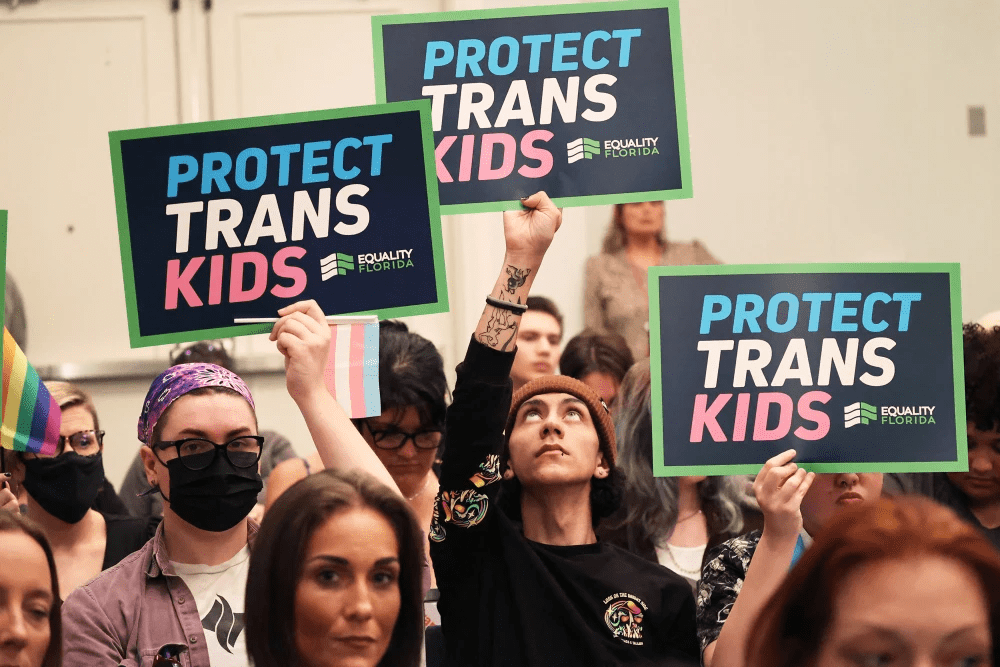
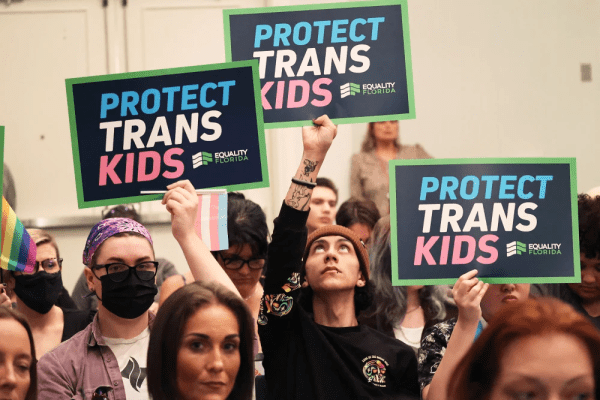
Individuals display signs during a collaborative board meeting of the Florida Board of Medicine and the Florida Board of Osteopathic Medicine in Lake Buena Vista in the year 2022.

The legislative session in Florida commenced just this week, and within the first few days of the new year, Republican lawmakers have already presented more bills aimed at the LGBTQ community than there are days elapsed.

Certain bills, such as one seeking to alter the state’s definition of sex and another intending to criminalize “lewd or lascivious grooming,” stand out as some of the most extreme among the hundreds introduced in state Legislatures this year. Additionally, there’s a proposal to prevent government employees from being compelled to use their colleagues’ requested pronouns, and another bill aims to shield children from “harmful material” online. However, the ambiguous nature of what constitutes harmful material raises concerns among advocates, as it could potentially encompass LGBTQ content.


Moreover, a proposal put forth by Republican state Senator Jason Brodeur aims to classify almost all public allegations of anti-LGBTQ bias as “defamation per se.” This legislation would prohibit journalists from defending such claims by referencing the subject’s “constitutionally protected religious expression or beliefs” or scientific beliefs. Those found liable in successful lawsuits would face damages of no less than $35,000.

“Florida has consistently led in introducing new challenges to freedom and equality, and this year’s array of bills continues the trend,” remarked Brandon Wolf, a representative for the Human Rights Campaign, an LGBTQ advocacy group, and a survivor of the Pulse nightclub mass shooting in Orlando, Florida. “During this session, we anticipate heightened assaults on education, medical freedom, and the basic right of transgender individuals to live authentically.”

One of the most far-reaching bills comes from Republican Representative Dean Black, introducing a comprehensive measure that mandates Floridians to submit an affidavit confirming that their driver’s license or other state ID aligns with the sex indicated on their original birth certificate. Consequently, transgender individuals in Florida would be compelled to surrender any existing ID reflecting their gender identity and would be barred from obtaining such identification in the future.

Additionally, Black’s proposal mandates that any health insurance policy in the state covering transition-related “prescriptions or procedures” must also include coverage for “treatment to detransition” from such procedures. The bill further necessitates the inclusion of so-called conversion therapy in health insurance policies, compelling coverage for mental health services that aim to address a person’s perception that their gender is inconsistent with their sex assigned at birth, thereby affirming their birth sex.

Furthermore, the legislation would compel any school district or state agency engaged in collecting vital statistics for anti-discrimination compliance or accurate data on public health, crime, economics, or other purposes to include the identification of individuals’ birth sex in the dataset. This provision has the potential to impose limitations on the comprehensive collection of data concerning transgender individuals.

Black stated that the purpose of the bill is to address the “defining question of this decade: ‘What constitutes a woman?'”

“In truth, this legislation merely seeks to formalize what is already universally accepted but has unfortunately been manipulated by an extremist political movement determined to alter the laws of nature to suit their distorted agenda,” Black declared in a press statement.


Gillian Branstetter, a communications strategist with the American Civil Liberties Union, noted that Florida is not the inaugural state to contemplate a measure restricting transgender individuals from obtaining driver’s licenses reflecting their gender identity. Montana, North Dakota, Kansas, and Tennessee have already implemented comparable laws, with the ACLU presently involved in legal action against Kansas’ restriction. Additionally, Nebraska and Oklahoma have instituted executive orders that similarly define sex within state law.

Branstetter asserted that the bills represent a “clear attempt” to counter the Supreme Court’s decision in Bostock v. Clayton County, which established that federal employment law safeguards LGBTQ individuals from discrimination. Justice Neil Gorsuch’s opinion explicitly clarified that discrimination grounded in sex encompasses both sexual orientation and gender identity.

“In essence, these bills are designed to provide extensive authority to the state to erase the existence of ‘transgender,'” Branstetter stated.

A new proposal introduced by Republican Representative Taylor Yarkosky criminalizes “lewd or lascivious grooming,” categorizing it as an offense. The bill defines this as an individual “preparing or encouraging a child to participate in sexual activity through overtly sexually themed communication with the child or engaging in conduct with or in the presence of the child without permission from the child’s parent or legal guardian.”

While the bill doesn’t explicitly mention LGBTQ individuals, one of its Republican sponsors has publicly voiced criticism of all-ages drag performances. Additionally, the term “grooming” has been recently employed by some conservative officials to characterize LGBTQ

Florida’s series of legislative measures extends a trend that has persisted for several years. In the previous year, state Republican legislators presented 10 bills specifically addressing LGBTQ individuals, and four of them were enacted into law. Among these was a measure that extended the reach of Florida’s Parental Rights in Education Act, commonly criticized as the “Don’t Say Gay” law.

“Florida might serve as a testing ground for anti-LGBTQ+ hostility, but it is not isolated,” remarked Wolf, the advocate from the Human Rights Campaign. “The bills originating from the state are indicative of a broader agenda orchestrated by a national extremist network seeking to enforce these measures nationwide.”

Last year, conservative legislators introduced an unprecedented number of bills aimed at LGBTQ individuals, surpassing 500 filings nationwide, as reported by the ACLU. An analysis by NBC News revealed that seventy-five of these bills were enacted into law.


As of last month, Branstetter mentioned that the ACLU has documented 212 bills of such nature for the year 2024.
Alabama has been granted the ability to enforce a ban on gender-affirming care for transgender youth.

Alabama has been granted the ability to enforce its felony ban on gender-affirming health care for minors, as per a federal court ruling on Thursday.

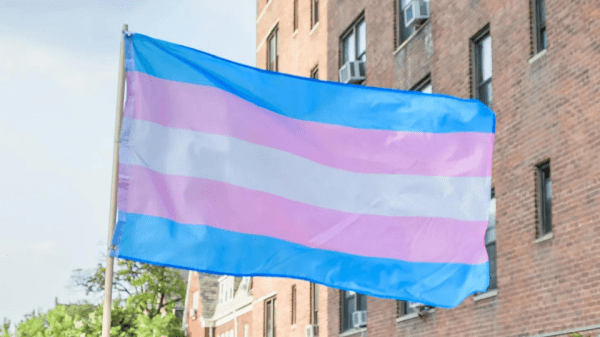
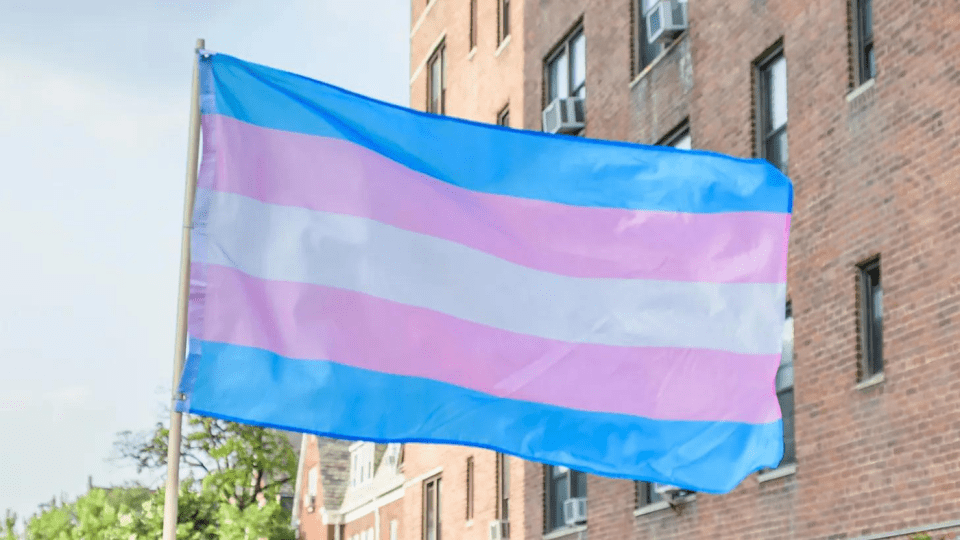
A transgender pride flag is displayed.


The decision allows the state to proceed with the ban, lifting a preliminary injunction that had prevented officials from enforcing it for over a year.


On Thursday, the U.S. 11th Circuit Court of Appeals lifted the injunction against Alabama’s 2022 law, turning it into a felony for physicians to prescribe puberty blockers or hormones to transgender individuals under 19. Convictions could lead to sentences of up to a decade in prison.

When the injunction was issued in 2022, U.S. District Judge Liles C. Burke stated that Alabama failed to provide credible evidence demonstrating that gender-affirming treatments are “experimental.”


In August, a federal appeals court reversed this decision, stating, “The use of these medications in general—let alone for children—almost certainly is not ‘deeply rooted’ in our nation’s history and tradition,” referencing the Supreme Court’s decision overturning Roe v. Wade.


In November, Alabama’s attorneys requested the 11th Circuit stay the enforcement of the district court’s preliminary injunction, which was granted Thursday in a brief unsigned order.


A September request for a rehearing made by the Alabama families challenging the law is still pending, and a full trial on the constitutionality of the ban is slated for August.


Alabama Attorney General Steve Marshall praised Thursday’s decision as “a significant victory for our country, for children, and for common sense.”


In a joint statement, lawyers representing the families challenging the law said the ruling will cause significant harm to children and parents in Alabama.


“Alabama’s transgender healthcare ban will harm thousands of transgender adolescents across the state and will put parents in the excruciating position of not being able to get the medical care their children need to thrive,” according to the statement, issued Thursday by the National Center for Lesbian Rights, GLBTQ Legal Advocates & Defenders, the Southern Poverty Law Center, and the Human Rights Campaign.


Including Alabama, 23 states have enacted laws or policies that heavily restrict or ban gender-affirming health care for transgender minors. Laws passed in five states — Alabama, Florida, Oklahoma, North Dakota, and Idaho — include provisions that make it a felony crime to provide treatment to trans youth under 18.

Legislation on Personal Pronouns Submitted in Florida Senate

This blog originally appeared at CBS News.

In alignment with a House bill introduced in November, a Senate Republican presented a proposal on Thursday that aims to impose limitations on the use of personal pronouns by government agencies.


Senator Jonathan Martin, representing Fort Myers and a member of the Republican party, submitted the proposal (SB 1382) for deliberation in the upcoming 2024 legislative session, commencing this Tuesday. The identical House bill (HB 599) has been filed by Representative Ryan Chamberlin, a Republican from Belleview.


The introduction of these bills may contribute to ongoing legislative debates on matters concerning gender identity. The bills assert, in essence, that the state policy recognizes a person’s sex as an unchangeable biological characteristic. It further states that assigning a pronoun not corresponding to the person’s sex is considered inaccurate.


These bills would prohibit state and local government agencies from mandating employees and contractors to use a person’s preferred personal title or pronouns if they don’t align with the sex assigned to that person at birth.


Furthermore, these bills would bar employees of government agencies and contractors from presenting preferred pronouns to their employers that “do not correspond to his or her sex.” Additionally, employers would be prohibited from requesting workers to provide personal pronouns.

DeSantis disseminated misinformation while advocating for a ban and restrictions on trans health care, according to a judge’s statement.

This blog originally appeared at AP News.

In a federal court on Wednesday, December 13, 2023, a transgender girl’s mother broke down in tears as she considered the possibility of relocating away from her Navy officer husband to access healthcare for her 12-year-old.

A federal judge presiding over a case challenging a ban on transgender health care for minors and restrictions for adults observed on Thursday that Republican Florida Governor Ron DeSantis has consistently disseminated misinformation about doctors mutilating children’s genitals, despite no documented cases supporting such claims.


Judge Robert Hinkle remarked to Mohammad Jazil, a lawyer for the state, that the law was presented as a measure to protect children from mutilation, whereas, in reality, it is aimed at obstructing transgender children from accessing healthcare.

Judge Hinkle inquired, “When I’m examining the governor’s motivation, how should I interpret these statements? This appears to go beyond mere exaggeration.”


Hinkle stated that he will issue a ruling in the coming year regarding whether the Legislature, the Department of Health, and presidential candidate DeSantis intentionally singled out transgender individuals with the new law. Expressing some doubt about the state’s motives, he did so as lawyers presented their concluding arguments.

The trial revolves around contesting Florida’s prohibition on medical interventions for transgender children, encompassing treatments like hormone therapy or puberty blockers—legislation championed by DeSantis in his presidential bid. The law also imposes limitations on transgender healthcare for adults.


Jazil argued that the intent behind the law was primarily to ensure public safety in an area that requires greater oversight and can have lasting consequences.


“It’s about addressing a medical condition; it’s not about singling out transgender individuals,” Jazil stated.


Jazil argued that if the state intended to target transgender people, it could have prohibited all treatments for both adults and children. Hinkle promptly countered that defending such a law would pose challenges.


Hinkle, appointed by former President Bill Clinton, has temporarily halted the enforcement of the law concerning minors until the trial concludes. The legal challenge also questions restrictions on adult transgender care, which have been permitted to be in effect during the trial.


Laws limiting or prohibiting gender-affirming medical care for transgender minors have been enacted in at least 22 states. Several of these states are confronting legal challenges, and court decisions have been varied. The initial law in Arkansas, the first of its kind, was invalidated by a federal judge who asserted that the prohibition on care violated the due process rights of transgender youth and their families.


The enforcement of similar laws has been blocked in two states aside from Florida. In seven other states, enforcement is either currently allowed or set to go into effect soon.


Thomas Redburn, representing trans adults and families of trans children, argued that Governor DeSantis and the Legislature have consistently targeted transgender people. He pointed to recent laws affecting the community, such as restrictions on pronoun use and the teaching of gender identification in schools, regulations on public bathrooms, and the prohibition of trans girls from participating in girls’ sports.

Court Exposes the Deceptive Intentions of Ron DeSantis’ Law Prohibiting Medical Care for Trans Youth


A federal judge has determined that Ron DeSantis was disseminating falsehoods when he referred to gender-affirming care as “mutilation.”


This year has been a series of setbacks for Florida Gov. Ron DeSantis. His presidential ambitions are dwindling due to his lack of charisma and campaign missteps. His conflict with Disney is draining millions from Florida taxpayers. Additionally, a federal court has strongly suggested that DeSantis was dishonest in justifying his prohibition on medical care for transgender youth.


DeSantis consistently argued that the law was essential to prevent the “mutilation” of young individuals. For instance, he criticized a reporter who challenged him on this when he signed the bill in May.

“And when you talk to people—I know people in your industry will dress it up with a euphemism—and they’ll say it’s health care to cut off the private parts of a 14 or 15-year-old,” DeSantis stated. “That is not health care. That is mutilation.”

Inform that to U.S. District Judge Robert Hinkle.

“When assessing the governor’s motives, how should I interpret these statements? It appears to be more than mere exaggeration.”


Hinkle is overseeing a legal challenge to the law brought by three Florida families with transgender children. He has implemented a stay against the measure from being enforced during the legal proceedings and has consistently shown skepticism toward the state’s arguments. In a ruling that invalidated Florida’s ban on Medicaid coverage for gender-affirming care, Hinkle emphasized, “Gender identity is real.”


Hinkle conceded that he cannot completely discern DeSantis’ intentions. He raised the question of whether the plaintiffs could demonstrate that DeSantis endorsed the law “because he hates transgender people.” The families’ attorney argued that the law is inherently unconstitutional, making DeSantis’ motivations less pivotal to the case.


Hinkle indicated his belief that the law’s purpose isn’t truly to prevent mutilation but rather to obstruct transgender youth from accessing healthcare. This strongly suggests that DeSantis might face an unfavorable ruling from the court.


This development also signals that DeSantis might have based his campaign on an unsuccessful concept. Relying heavily on anti-trans stances to perform well in the Iowa presidential caucus, he finds himself facing challenges with Nikki Haley gaining popularity and his campaign in disarray. The outlook for him in Iowa appears uncertain, making the end of 2023 potentially regrettable for DeSantis, with the prospect of 2024 being even more challenging.

Co-Founder of Moms for Liberty, Bridget Ziegler, Allegedly Featured in Another Sex Tape with Another Woman: Report

This blog originally appeared at Advocate.


Bridget Ziegler, who supported the signing of Florida’s ‘don’t say gay’ law, implicated in another sex tape scandal.

Sarasota police acquire a second sex video involving Christian Ziegler, Chair of the Republican Party of Florida, featuring his wife Bridget Ziegler in an intimate encounter with another woman.

The Florida Center for Government Accountability, the organization that first reported on the investigation into rape allegations against Christian Ziegler, Chair of the Republican Party of Florida, has revealed that local law enforcement sources confirm the existence of a second sex tape involving Ziegler’s wife, Bridget Ziegler, with another woman. It remains unclear whether the woman in this video is the same individual who accused Christian Ziegler of rape, or if it involves a different person.

Police have acquired a video recorded by Christian Ziegler, Chair of the Republican Party of Florida, depicting a sexual encounter with the woman who has accused him of rape. Law enforcement sources, detailing the contents of the tape to the Florida Center for Government Accountability, suggest that the video introduces complicating factors into the case against Ziegler, as certain details appear to contradict the events as described by the woman in Sarasota who brought forward the accusations.

While investigating Christian Ziegler, police discovered another video, as reported by the Center for Government Accountability. The identity of the woman in this new video remains unclear at this point.


“There is uncertainty about whether the woman in the video is the same individual who accused Christian Ziegler of sexual assault. Requests for comments from both Christian and Bridget Ziegler have gone unanswered, as reported by the Trident.

Bridget Ziegler, known for co-founding the conservative Moms for Liberty organization, has been serving on the Sarasota County School Board in her recent capacity.

In the process of obtaining a search warrant, Bridget Ziegler acknowledged to law enforcement that over a year earlier, she had participated in a threesome with her husband and the woman. Speculation in Southwest Florida continues about the couple’s involvement in a non-traditional marriage for an extended period. This revelation is particularly noteworthy given that the political power couple had consistently advocated for social conservative values, with Bridget Ziegler notably standing alongside Governor Ron DeSantis during the signing of Florida’s controversial ‘don’t say gay’ law.

The disclosure of involvement in threesomes has sparked significant political turmoil for Bridget Ziegler. In response, the Sarasota County School Board, in a 4-1 vote earlier this month, called for her resignation. However, only Governor DeSantis possesses the authority to remove her from office.


“In a recent vote by the board, Nicholas Machuca, the deputy director of development at LGBTQ+ rights group Equality Florida, emphasized, ‘Now, let me be clear, participation in same-sex activities is not shameful. However, Bridget Ziegler has engaged in this while concurrently denigrating our community and actively working to implement policies that directly marginalize us. Such hypocrisy is unacceptable.”

All statewide officials, led by DeSantis, have urged Christian Ziegler to resign. The executive board of the Republican Party of Florida recently decreased his salary, censured him, and initiated a procedure to oust him in January. Reportedly, Christian Ziegler is seeking a $2 million settlement to step down.

The scheduled board meeting of the Central Florida Tourism Oversight District for December 13th has been called off.

This blog originally appeared at WDW Magic.

The Central Florida Tourism Oversight District (CFTOD) has not provided a reason for the cancellation of the December 13th meeting. This decision coincides with a tumultuous period for the board of supervisors, appointed by Ron DeSantis.

Supervisor Bridget Ziegler’s standing on the board is uncertain due to abuse allegations against her husband, Christian Ziegler. Bridget Ziegler, known for her association with Florida Governor Ron DeSantis’ “Don’t Say Gay” bill, has faced criticism for her anti-LGBTQ+ stance despite alleged personal involvement with a woman alongside her husband. Calls for the Zieglers to exit Florida politics are increasing, raising questions about Bridget Ziegler’s status at CFTOD. As of now, the CFTOD website indicates her position on the board is in place until 2/26/25.

This week initiates court hearings in Disney’s legal action against Florida Governor Ron DeSantis and the Central Florida Tourism Oversight District board.

Disney contends in its federal lawsuit that there is a “deliberate government-backed campaign of retaliation, orchestrated at every level by Governor DeSantis as reprisal for Disney’s protected speech. This campaign poses a threat to Disney’s business operations, imperils its economic prospects in the area, and infringes upon its constitutional rights.”

Ron DeSantis and the CFTOD submitted a motion to dismiss the case, scheduled for a hearing on December 12, a day before the recently canceled December 13 board meeting.

A Florida mother expresses concern that her family may face severe consequences as the trial on the ban on trans health care commences.

This blog originally appeared at AP News.


The mother of a transgender girl broke into tears in federal court on Wednesday, fearing she might have to relocate away from her Navy officer husband to access healthcare for her 12-year-old if Florida’s ban on gender dysphoria treatments for minors is implemented.

Republican presidential candidate and Florida Gov. Ron DeSantis speaks at an annual Basque Fry at the Corley Ranch in Gardnerville, Nev., Saturday, June 17, 2023. The mother of a transgender girl sobbed in federal court Wednesday, Dec. 13, 2023, as she contemplated having to move away from her Navy officer husband to get health care for her 12-year-old if Florida’s ban on gender dysphoria treatments for minors is allowed to take affect.

The woman, identified as Jane Doe to safeguard her child’s identity, shared in court that her daughter’s life transformed from anxiety and distress to that of a thriving, happy straight-A student about eight years ago. This transformation occurred after making the decision, along with her husband, to allow their child to live as a girl—a choice influenced by numerous consultations with their family doctor.

As the girl approaches puberty, the mother expressed concern that her daughter may undergo unwanted changes without treatment, potentially causing devastation for her and the entire family.

“I am willing to go to the ends of the Earth to get the help my daughter needs,” the woman testified tearfully, contemplating the possibility of her family being torn apart and having to live somewhere else away from her husband.

The testimony unfolded as a trial commenced to challenge Florida’s prohibition on medical interventions for transgender minors, including hormone therapy or puberty blockers. This law, advocated by Republican Governor Ron DeSantis as part of his presidential campaign, also imposes limitations on transgender care for adults.


“This originated with the governor,” stated Thomas Redburn, an attorney representing transgender adults and families with transgender children.


He highlighted additional laws advocated by DeSantis, demonstrating that the governor and Republican legislators have targeted transgender rights. This includes regulations limiting the use of pronouns in schools to those that align with individuals’ sex at birth.

However, Mohammad Jazil, the state’s attorney, argued that the law is about protecting individuals. He cited instances where individuals were prescribed hormones after a brief 30-minute telehealth session. He also mentioned cases where people decided to detransition, experiencing permanent damage from their treatments.

“This case isn’t about overregulation, it’s about under-regulation,” Jazil stated.

Judge Robert Hinkle has temporarily halted the enforcement of the law until the trial concludes. The lawsuit also contests restrictions on adult transgender care, which are currently permitted to be enforced during the trial.

As of now, 22 states have implemented laws limiting or prohibiting gender-affirming medical procedures for transgender minors. Legal challenges have been raised in numerous states with varying outcomes. In Arkansas, the first such law was invalidated by a federal judge who ruled that the ban on care violated the due process rights of transgender youth and their families.


Enforcement of similar laws is currently blocked in two states apart from Florida, while in seven other states, enforcement is either currently allowed or set to go into effect soon.


Redburn argued in the opening statements that the Florida law is unconstitutional as it singles out an entire group of people. He highlighted that non-transgender adults can receive the same treatments, such as estrogen and testosterone, without facing similar restrictions.

“The state of Florida has determined that individuals should not be transgender,” Redburn asserted. “The fewer transgender people, the better.”

The mother of the girl testified that their family’s pediatrician diagnosed her daughter with gender dysphoria when she started showing a preference for girls’ toys and clothes at the age of 3. She recounted instances of her daughter screaming and removing her clothes in the car seat during trips to preschool. To access specialized care, the family has undertaken four-hour round trips to the University of Florida.

Regarding risks such as infertility mentioned by Jazil in the opening statements, the woman emphasized, “The benefits for my daughter far outweigh the potential risks. Her greatest fear is what she refers to as turning into a boy. I’ve reassured her that won’t happen.”

Jazil briefly questioned the girl’s mother, highlighting that the University of Florida health records did not include a height and weight for Jane Doe’s daughter.


Redburn emphasized that gender dysphoria is a genuine condition, not a choice influenced by social media or the internet, contrary to policymakers’ arguments. He highlighted how Republican lawmakers, advocates of the law, portrayed transgender individuals as evil and part of a cult. Additionally, he pointed out that the bill’s sponsor argued that God doesn’t make mistakes.

On a different note, three educators filed a lawsuit challenging the law restricting pronoun use in schools. They argue that the legislation prohibits transgender and nonbinary teachers from expressing their authentic selves.

Ironically, Jazil consistently used “her” and “she” when referring to Jane Doe’s daughter, despite the state’s mandate for others to use pronouns based on birth sex in schools.

The trial concerning transgender health care is anticipated to span five days.

Florida judge strikes down DeSantis-backed voting map as unconstitutional

This blog originally appeared at The Guardian.

Circuit court judge rules proposal ‘results in the diminishment of Black voters’ ability to elect their candidate of choice’

A judge in Florida has delivered a verdict in favor of voting rights groups that had filed a lawsuit against a congressional redistricting map endorsed by Ron DeSantis in 2022. The map had faced criticism from voting rights advocates for undermining political influence in Black communities.

In the ruling, Leon County Circuit Judge J. Lee Marsh has ordered the map to be returned to the Florida legislature for a redraw that aligns with the state’s constitution.

In his ruling, Marsh stated, “Under the stipulated facts (in the lawsuit), plaintiffs have shown that the enacted plan results in the diminishment of Black voters’ ability to elect their candidate of choice in violation of the Florida constitution.”

The recent ruling is expected to be appealed by the state of Florida, which could ultimately bring the case before the Florida Supreme Court.

The lawsuit specifically centered on a congressional district in north Florida that was previously represented by Democrat Al Lawson, who is Black. Lawson’s district was redrawn into districts represented by white Republicans.

In 2022, Governor Ron DeSantis vetoed a map that initially preserved Lawson’s district and submitted his own map, calling for a special legislative session to enforce its acceptance. Judge Marsh rejected arguments from Florida Republicans who claimed that the state’s provision against weakening or eliminating minority-dominant districts violated the U.S. Constitution.

Olivia Mendoza, the director of litigation and policy for the National Redistricting Foundation, an affiliate of the National Democratic Redistricting Committee, hailed the ruling as a significant victory for fair representation for Black Floridians. She emphasized the need to replace the current discriminatory map with one that restores the fifth congressional district in a way that empowers Black voters to elect their preferred candidate.

In 2022, the Florida Legislative Black Caucus labeled the congressional map approved by DeSantis as voter suppression. The map resulted in Florida Republicans gaining four congressional seats, increasing their representation from 16 to 20 out of 28 seats and securing a narrow majority in the House in 2022.

Before the court decision, the state of Florida and the voting rights groups involved in the lawsuit had reached an agreement that narrowed the focus of the lawsuit to Lawson’s congressional seat. However, a separate lawsuit over the state’s congressional maps is still pending in federal court.

This court decision adds to a series of rulings in the South against Republican-drawn congressional maps due to concerns that redistricting had diminished Black voting power. In June, the U.S. Supreme Court overturned a Republican-drawn map in Alabama and later lifted a hold on a case involving redistricting in Louisiana, returning the case to a lower court. This increases the likelihood that Louisiana will be required to create a second congressional district that empowers Black voters.

Florida school district orders removal of all books with gay characters before slightly backing off

This blog originally appeared at NBC News.

The Charlotte County school district will now allow certain exceptions for high school libraries.

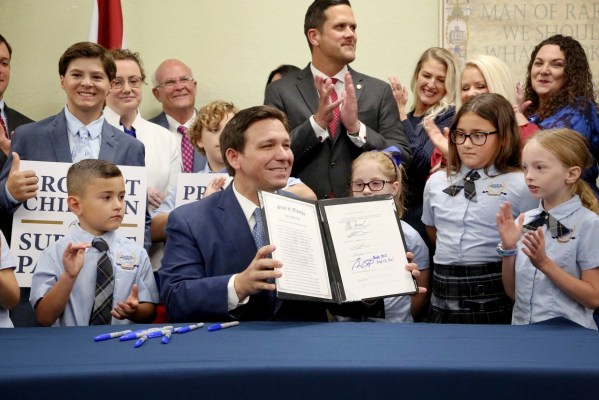
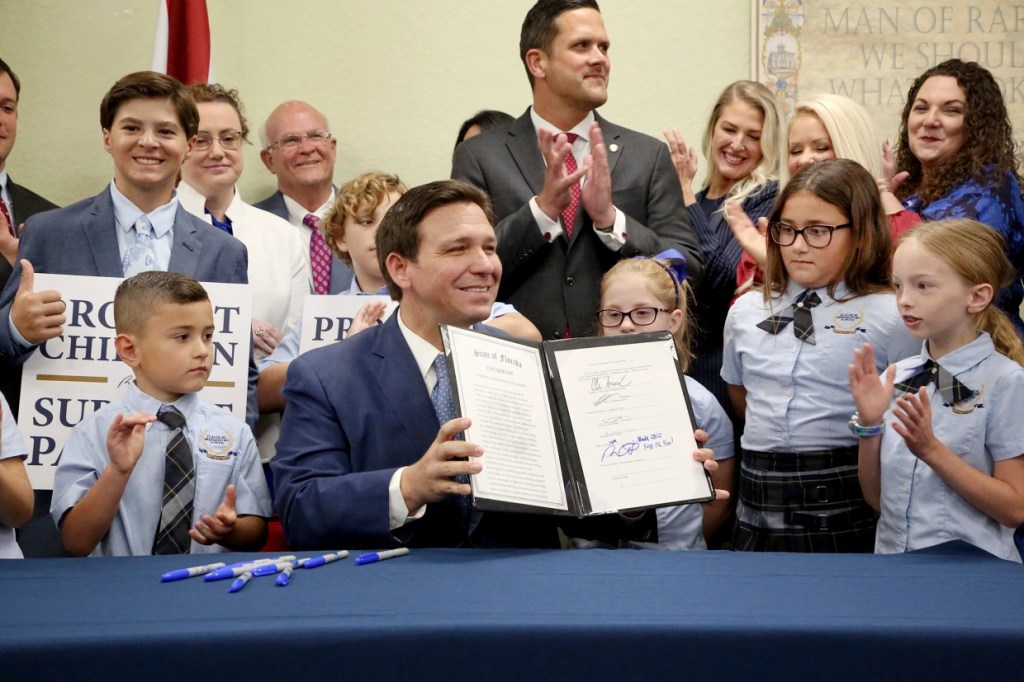
Florida Gov. Ron DeSantis holds the Florida Parental Rights in Education bill after having signed it at Classical Preparatory School in Spring Hill on March 28, 2022.

In Fort Lauderdale, Florida, high-ranking officials in a school district have mandated the removal of all books and materials featuring LGBTQ characters and themes from both classrooms and campus libraries. This decision was made in accordance with a state law supported by Governor Ron DeSantis, which opponents have nicknamed “Don’t Say Gay.”

At a July meeting, Charlotte County Schools Superintendent Mark Vianello and the school board’s attorney, Michael McKinley, addressed queries from the district’s librarians. They inquired if the legislation, officially known as the Florida Parental Rights in Education Act, mandated the removal of books featuring gay characters but devoid of explicit sexual content.

According to a district memo obtained through a public information request by the Florida Freedom to Read Project, the pair replied, “Books with LBGTQ+ characters are not to be included in classroom libraries or school library media centers.” The nonprofit organization, which opposes the law, shared the memo with The Associated Press on Wednesday.

Subsequently, the district made some concessions, permitting a few exceptions in high school libraries. Nevertheless, Charlotte County’s policy remains among the most stringent measures enforced among the state’s 67 countywide school districts to comply with the legislation.

The legislation was initially approved by the Legislature and ratified by Governor DeSantis in 2022, with further enhancements made in the spring. Charlotte County, located in southwest Florida between Fort Myers and Sarasota, has approximately 17,000 students attending its public schools. During the 2022 elections, Governor DeSantis, a Republican presidential nominee contender, secured 70% of the vote in the county as he comfortably won re-election.

The school district did not provide a response to calls made by the AP on Wednesday. The district informed the news website Popular Information, which initially disclosed the memo, that while the document is not an exact transcript of the meeting, it does accurately capture the essence of the discussion.

DeSantis and fellow Republicans have consistently argued that the legislation is sensible, emphasizing that discussions related to sexual orientation and gender identity should be initiated by parents, not teachers, in their interactions with their children. The governor has underscored cultural matters as a central aspect of his presidential campaign, notably confronting the Walt Disney Co. following its public stance against the legislation.

Florida Freedom to Read said Charlotte’s policy is “evidence that fear over thoughtful decision making is winning the day.” But the group says Florida Department of Education officials are to blame for any district confusion or overreach.

“Their failure to lead and use their power to benefit the future of Florida is a disservice to all Floridians, no matter their political leanings,” the group said in a statement. “Parents want politics out of education. We want all students to feel safe and included, so they can focus on their education while in school. Removing all representation of LGBTQ+ people in literature goes against our very principles of living in a free and just, pluralistic society.”

The department did not provide any response to a call and email made on Wednesday requesting comment.

At the meeting in July, librarians were informed by Vianello and McKinley that any reference to sexual orientation or gender identity is forbidden from prekindergarten through middle school and even in high school, “unless supported by the state academic standards.”

The librarians inquired whether this implied the removal of a book, even if it featured a secondary character who is gay, a main character with two moms, or a gay best friend. Vianello and McKinley affirmed with a “Yes,” and further clarified that this prohibition extended to books brought to school by children, even if the content was non-pornographic or not explicit.

“These characters and themes cannot exist,” they responded, according to the memo.

The school district released a statement to Popular Information this week, providing clarification on certain statements made by the superintendent and attorney. According to the statement, some materials featuring LGBTQ themes or characters will remain accessible in high school libraries.

“Books featuring LGBTQ characters are accessible in the media center for grades 9-12. While they may not be utilized for classroom instruction, these books are available for individual study and can be borrowed by students,” the statement said.

Blog at WordPress.com.

Up ↑