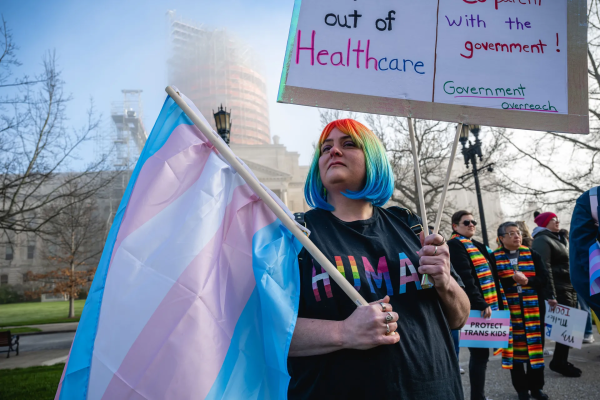
*The below is part of a larger report from Ohio’s NBC4.
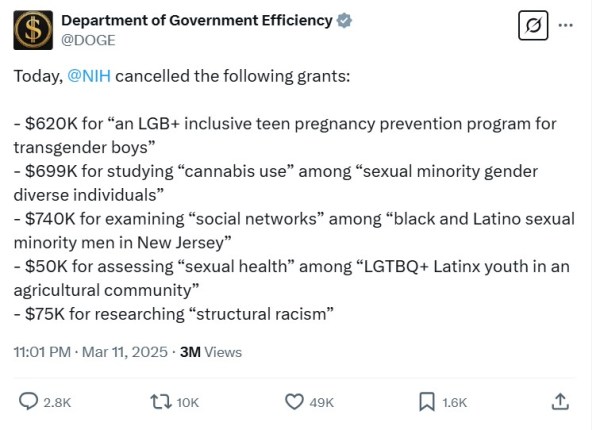
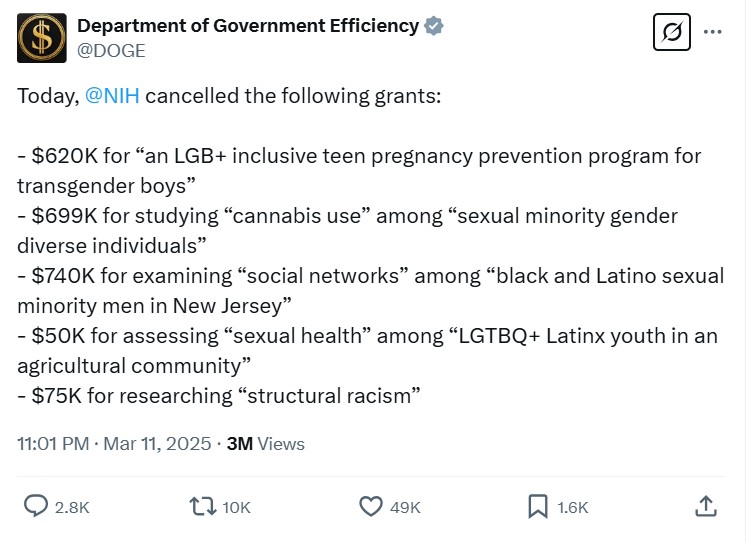
Nearly $2.2 million worth of grant funding for university research was cancelled earlier this month by the NIH at the behest of DOGE. The majority of the funding dealt with the LGBTQ community. The remainder was specific to structural racism.
The report of course stems from a post on X by DOGE “itself”. The news article does confirm the cancellation of the cannabis use study funding. Others have not been independently verified as having been cancelled.
The well-being of LGBTQ+ young people suffers not because of who they are but due to mistreatment and stigmatization, a leading suicide-prevention organization contends.
The Trevor Project has released a state-by-state analysis of the mental health of LGBTQ+ teens and young adults. The survey of 18,000 LGBTQ+ young people ages 13 to 24 examines suicide risk, access to care, discrimination, bullying and the impact of anti-LGBTQ+ policies, among other factors.
The Trump administration has impacted support and awareness for LGBTQ+ students across colleges and universities. A recent Dear Colleague letter has demanded institutions to dismantle diversity, equity and inclusion programs, which usually house support for LGBTQ students. GOP lawmakers across Florida, Texas and Iowa have also targeted academic programs related to gender studies.
Young people made the following statements about where they live:
I live in a community that is accepting of LGBTQ+ young people.
Arkansas: 36%
Hawaii: 88%
Idaho: 31%
Puerto Rico: 60%
Washington, D.C.: 97%
I or my family have considered leaving for another state because of LGBTQ-related topics politics and laws.
Connecticut: 19%
Kentucky: 56%
Montana: 53%
Texas: 58%
West Virginia: 46%
Percentage of LGBTQ+ youth who have seriously considered suicide in the past year:
Arizona: 39%
Colorado: 41%
Louisiana: 32%
Michigan: 37%
Vermont: 44%
LGBTQ+ young people were physically threatened or harmed:
Alaska: 16%
New York: 22%
Rhode Island: 17%
South Carolina: 25%
Wyoming: 29%
LGBTQ+ youth who reported experiencing symptoms of depression:
Alabama: 56%
Kansas: 49%
Maryland: 48%
Tennessee: 57%
Utah: 53%
LGBTQ+ young people who wanted and received mental health care:
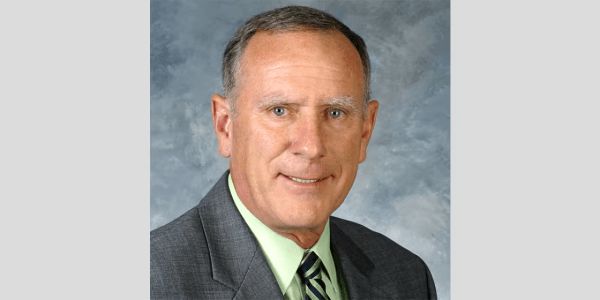
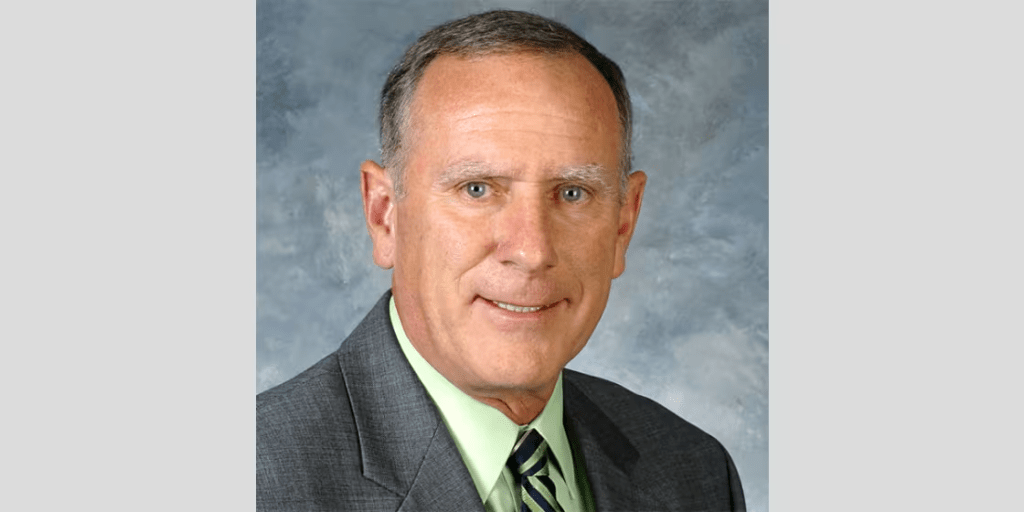
Kentucky state Representative David Hale, a Republican, has introduced legislation aimed at overturning a 2024 executive order issued by Democratic Governor Andy Beshear that bans conversion therapy. This controversial practice, which attempts to change a person’s sexual orientation or gender identity, has been widely discredited by medical and psychological experts. Despite numerous opponents testifying against Hale’s bill, the lawmaker insists that his research supports the need for the legislation, although he declined to disclose the organizations that helped him draft the bill.
Governor Beshear’s Executive Order and Its Impact
In September 2024, Governor Beshear signed an executive order that outlaws conversion therapy for minors in Kentucky. The executive order not only prohibits state-funded programs from supporting the practice, but it also calls for licensing boards for counselors to consider disciplinary action against those who engage in conversion therapy. Beshear’s order aims to protect minors from a practice that has been shown to have detrimental effects on mental health.
At the time of signing the order, Beshear emphasized that conversion therapy “has no basis in medicine or science” and cited research linking the practice to increased rates of suicide and depression. “This is about doing what is right and protecting our children,” Beshear said in a statement. “Hate is not who we are as Kentuckians.”
Hale’s Proposed Bill and its Justifications
On February 15, 2025, Hale introduced House Bill 495, a measure designed to reverse Beshear’s executive order. Hale, who is known for his conservative stances, argues that his bill would protect counselors, therapists, and pastors who offer conversion therapy from government interference. He insists that parents should have the right to seek therapy that aligns with their beliefs and the needs of their children.
During a committee meeting, Hale claimed that his bill would protect mental health providers offering “therapy to relieve discomfort or distress caused by an individual’s sex or romantic or sexual attraction.” He further added that the bill would also safeguard practitioners who offer other forms of therapy, including pro-LGBTQ or gender-affirming care. Despite the claims, Hale did not specify which organizations assisted in drafting the bill’s language.
The bill, which was approved in a 15-4 party-line vote by the committee’s Republican members, is now one step closer to being debated by the full Kentucky legislature. Some Republicans on the committee argued that the bill would ensure mental health professionals could offer care that respects both LGBTQ+ individuals and those seeking therapy to change their sexual orientation.
Opposition Voices and Concerns
Numerous witnesses spoke out against Hale’s bill, citing the harm caused by conversion therapy and the damage it can do to vulnerable individuals. Eric Russ, a licensed clinical psychologist and executive director of the Kentucky Psychological Association, testified that the bill “directly threatens the trust between a mental health provider and our clients” by legitimizing practices that are widely considered harmful.
Rev. Brandon Long, an ordained minister and former victim of conversion therapy, shared his personal experience of being subjected to the practice after coming out as gay. He described how conversion therapy had attempted to alter his sexual orientation by blaming it on childhood trauma and demonic influence. “Conversion therapy weaponized sacred pastoral practices,” Long said, adding that it was “spiritual and psychological abuse.”
Chris Hartman, executive director of the Fairness Campaign, an LGBTQ+ rights group, questioned why the committee responsible for overseeing state government functions was involved in passing legislation related to mental health care.
Hale, who said he had found “no evidence” supporting the personal testimonies of those who spoke against his bill, went on to shake hands with several of the witnesses who had opposed it. Rev. Long refused to shake his hand, accusing Hale of dismissing their lived experiences and framing their testimony as lies.
Political Landscape and Future of the Bill
Hale’s bill is part of a broader culture war in Kentucky, where conservative lawmakers have made several attempts to restrict LGBTQ+ rights. In 2023, Kentucky Republicans successfully passed a ban on gender-affirming medical care, though it is currently on hold due to ongoing court challenges. While this ban focuses on medical care, it does not address gender-affirming psychological counseling.
Conversion therapy has been banned in 23 states, and the practice has faced widespread condemnation from major U.S. medical and psychological associations. Research has consistently shown that conversion therapy leads to increased emotional distress, including depression and suicidal thoughts, particularly among LGBTQ+ youth. According to the Trevor Project, nearly 21% of LGBTQ+ youth in Kentucky have reported being subjected to conversion therapy, with 83% of those experiences occurring before the age of 18.
A Divisive Issue for Kentucky’s Future
Hale’s bill comes at a time when Republicans hold supermajorities in both chambers of Kentucky’s legislature, which could threaten the future of Beshear’s executive order. If passed, the bill would reverse the protections set forth by Beshear, allowing the practice of conversion therapy to continue in the state.
As the bill moves through the legislative process, it is clear that the debate over conversion therapy is far from settled. Advocates for LGBTQ+ rights are committed to fighting the bill, while opponents argue that parents should have the freedom to choose therapeutic options that align with their values. With the state’s political climate increasingly polarized, Kentucky’s legislature is set to remain at the center of a larger national conversation about the rights of LGBTQ+ individuals and the role of government in regulating mental health practices.
For those struggling with issues related to conversion therapy, several resources are available, including the Trevor Project (1-866-488-7386) and the Trans Lifeline (1-877-565-8860). These organizations provide safe, confidential support for LGBTQ+ youth and adults.
The Supreme Court announced Monday it will hear a case regarding whether state bans on “conversion therapy” trying to change minors’ sexual orientation or gender identity are legal—a case that could carry billions of dollars in repercussions, as a 2022 study found conversion therapy carries an economic burden of approximately $9 billion annually for patients and their families.
Key Facts
The Supreme Court took up Chiles v. Salazar, a case challenging Colorado’s ban on LGBTQ “conversion therapy” for minors, which asks the justices to more broadly decide whether laws that “[censor] certain conversations between counselors and their clients based on the viewpoints expressed” are constitutional.
LGBTQ “conversion therapy,” as it’s commonly known, refers to any practices—including both emotional efforts, like talk therapy, or physical efforts, like electroconvulsive therapy—that aim to influence a patient’s sexual orientation or gender identity, which are typically framed as efforts to “cure” homosexuality or being transgender.
Repeated studies have shown such efforts are ineffective at changing people’s sexual orientation or gender identity and carry a variety of harmful effects—such as elevated risks for suicide, drug abuse and mental health issues—which has led to bans on conversion therapy for minors being enacted in more than 20 states.
Conversion therapy and its negative effects also have an economic impact, as a 2022 study published in JAMA Pediatrics found conversion therapy and its “associated harms” result in an economic burden of approximately $9.23 billion per year.
Conversion therapy alone costs approximately $650 million for participants annually in the U.S., with individuals who undergo it paying an extra $97,985 for treatment as compared with people who don’t undergo any counseling, according to the study, which was based on data from LGBTQ youth ages 13-24.
There are also significant costs associated with knock-on effects from conversion therapy and the study estimates each conversion therapy patient pays an extra $83,366 on average to treat the “downstream consequences” associated with the procedure, which combined raise the total economic burden of conversion therapy to $9.2 billion.
What To Watch For
The Supreme Court will hear the case on conversion therapy at some point during its next term, which begins in October, so any ruling in the case is likely more than a year away.
What Did The Study Conclude?
The study, which was conducted by pro-LGBTQ rights organization The Trevor Project and research group Cytel, concluded there is a “high economic burden and high societal costs” that come along with conversion therapy, which the study refers to as sexual orientation and gender identity change efforts (SOGICE). Researchers analyzed the difference in costs between patients who underwent conversion therapy, LGBTQ youth who received no therapy and those who received therapy that affirmed their sexual orientation or gender identity. The study found conversion therapy carried the highest economic burden: In addition to the $650 million per year in total attributed to the therapy itself, there are also total annual costs of $190 million related to anxiety or “severe psychological distress” among those that underwent conversion therapy, $1.36 billion related to depression, $2.42 billion from suicide attempts, $1.17 billion from fatal suicides, $1.26 billion from alcohol use disorder and $2.18 billion from substance abuse. The likelihood of those negative outcomes was largely markedly higher among those who underwent conversion therapy as compared with other LGBTQ populations—except alcohol use disorder, where those without any therapy registered the highest number by one percentage point (42.26% among those with no intervention versus 41.26% among conversion therapy patients). As a result, the total costs incurred by conversion therapy patients were higher than the $4.85 billion in total annual costs among those who hadn’t received any treatment, and $3.04 billion among those who received affirmative therapy.
Contra
Researchers noted there were some limitations with the study’s methodology that may affect its results, such as being based on studies in which patients self-reported their experiences. That means it might not be fully representative of all LGBTQ patients, as many people may be unwilling to discuss their experiences. It also assumes the risks are the same across the LGBTQ population and for various types of conversion therapy, which may not be the case. Researchers argued they took a “conservative approach” with their findings, however, and noted the $9 billion figure is likely an underestimate of the total economic impact. The study only looked at adverse impacts from conversion therapy for three years after the treatment, for instance—though such effects could likely extend for much longer—and did not examine some other potential impacts, like post-traumatic stress disorder or medical consequences from various medications or electroconvulsive therapy.
Big Number
13%. That’s the share of LGBTQ youth who have either been subjected to or threatened with conversion therapy, according to a 2024 survey conducted by The Trevor Project among more than 50,000 Americans ages 13-24. That includes 5% who have been subjected to the therapy and 8% who were threatened with it. The 5% share is down from 10% who said in 2020 they were subjected to the therapy, though that number could rise again should the Supreme Court outlaw state bans.
Key Background
The Supreme Court case was brought by Kaley Chiles, a licensed counselor in Colorado who said in a court filing “she believes that people flourish when they live consistently with God’s design, including their biological sex.” Chiles objects to Colorado restricting her from counseling clients to change their sexual orientation or gender identity, claiming it violates her First Amendment rights and classifying state bans on conversion therapy as “silenc[ing] counselors’ ability to express views their clients seek on a topic of ‘fierce public debate.’” Chiles asked the Supreme Court to take up the case after a federal appeals court upheld Colorado’s policy restricting conversion therapy, ruling that it was regulating counselors’ professional conduct, rather than chilling First Amendment-protected speech. The case is the latest in a string of major cases related to LGBTQ rights the 6-3 conservative-leaning court has decided in recent years—such as cases over businesses being allowed to discriminate against same-sex couples or discriminate on the basis of sexual orientation and gender identity—and the court is deliberating on a case this term over gender-affirming care for minors.
Staff and patients at the Department of Veterans Affairs say impacts of Trump administration changes to the agency go beyond erasing diversity programs and affect care for LGBTQ patients.
A MARTÍNEZ, HOST:
The Department of Veterans Affairs is planning to cut as many as 80,000 employees, which it says won’t affect healthcare or benefits. Still, VA staff and patients are concerned that a policy ending diversity programs will affect care for LGBTQ veterans. Here’s Steve Walsh with WHRO in Norfolk, Virginia.
STEVE WALSH, BYLINE: Mary Brinkmeyer put in her resignation after receiving emails from management in the wake of President Trump signing executive orders targeting DEI.
MARY BRINKMEYER: It was just a really upsetting and shocking change for me from feeling as if the program was supported to suddenly having people being told they have to take every Pride magnet out of their office. And it felt like that happened just overnight and without a lot of thought.
WALSH: Until recently, the psychologist was the LGBTQ+ veteran care coordinator for the Hampton VA. A few days after the inauguration, employees at her VA were told to take down any outward signs referencing LGBTQ veterans, including flyers printed by the VA.
BRINKMEYER: Less than 24 hours after everything had been taken out of the main hospital, I was speaking to a gay veteran who said, oh, I heard about how y’all took everything down. I guess that shows what they think of us.
WALSH: Rainbow-colored Pride lanyards, which say the VA serves all who serve, had been a strategy to make veterans feel safe. They were banned from the building, she says.
BRINKMEYER: A lot of LGBTQ veterans don’t feel safe coming to the VA because their experiences in the military were so unsafe.
WALSH: Brinkmeyer says she decided to resign when she said she was told to stop attending employee orientation. A large part of her job had been training other providers in ways to ask the right questions. A transformation is underway at the VA, but it’s unclear how large the change will be. VA Secretary Doug Collins announced the change to the VA’s flag policy.
(SOUNDBITE OF ARCHIVED RECORDING)
DOUG COLLINS: For all of us who served in uniform, that American flag is on our uniform. It’s what unites us. So we’ve changed the policy. At the VA, you’re only going to see the American flag and the POW flag. That’s what’s going to be flying in front of our facilities.
WALSH: John Rogers with the Hampton VA says they are working to execute the executive order, and there will be no changes to services and benefits for veterans and VA beneficiaries until a formal order is issued. Banners and posters advertising the VA’s outreach for LGBTQ+ veterans came down very quickly at the Hampton VA in Virginia. Amanda Volk is a patient at the Hampton VA. She served under Don’t Ask, Don’t Tell in 1995 and got out 18 months later after a sexual assault.
AMANDA VOLK: For those of us that lived through Don’t Ask, Don’t Tell, we were there. We saw it. We marched. We fought. We thought we had our rights. And now it’s – you know, we’re back to the ’80s with people being scared.
WALSH: In New York state, one mental health practitioner says posters remain up at his VA, but he’s still seeing a chilling effect among veterans. NPR agreed to withhold his name as he fears retaliation.
UNIDENTIFIED HEALTH PRACTITIONER: I think, you know, veterans are kind of hesitant, and some veterans I know have decided they’re not willing to come in person. It’s more on the veteran side of things that there’s this uncertainty of kind of what care actually is going to look like.
WALSH: Adding to the tension, in late January, a transgender veteran killed themselves in the parking garage of the Syracuse VA Medical Center, wrapped in the transgender flag – an indication, he says, that this shift has a high potential to impact patient care at the VA.
For NPR News, I’m Steve Walsh.
MARTÍNEZ: If you or someone you know is in crisis, call or text 988 to reach the Suicide & Crisis Lifeline.
First year freshman Texas state house representative Brent Money (R-Greenville) filed House Bill 3399 on Wednesday which would ultimately ban all gender transitioning procedures in the state of Texas, regardless of age of the patient.
The section of the bill that would prohibit doctors from providing this care to adults is written in this section:
Sec. 161.702. PROHIBITED PROVISION OF GENDER TRANSITIONING OR GENDER REASSIGNMENT PROCEDURES AND TREATMENTS [TO CERTAIN CHILDREN]. For the purpose of transitioning a person’s [child’s] biological sex as determined by the sex organs, chromosomes, and endogenous profiles of the person [child] or affirming the person’s [child’s] perception of the person’s [child’s] sex if that perception is inconsistent with the person’s [child’s] biological sex, a physician or health care provider may not knowingly: (1) perform a surgery that sterilizes the person [child], including: (A) castration; (B) vasectomy; (C) hysterectomy; (D) oophorectomy; (E) metoidioplasty; (F) orchiectomy; (G) penectomy; (H) phalloplasty; and (I) vaginoplasty; (2) perform a mastectomy; (3) provide, prescribe, administer, or dispense any of the following prescription drugs that induce transient or permanent infertility: (A) puberty suppression or blocking prescription drugs to stop or delay normal puberty; (B) supraphysiologic doses of testosterone to females; or (C) supraphysiologic doses of estrogen to males; or (4) remove any otherwise healthy or non-diseased body part or tissue.
Did you think this was all about protecting the children? Of course not. They are coming for you, regardless of whether you are a grown adult or not.
The one glimmer of hope in this situation is that bills filed by freshman state reps in Texas typically do not making anywhere close to the floor for a vote. It would be a rare case if it did, and at this time there are also no co-authors to the bill. This meant he’s out on a limb on his own with this legislation. It may be a red meat attention getter for his constituents and the GOP at large.
The Republican-controlled Kansas Legislature on Tuesday overrode the Democratic governor’s veto of a bill that bans gender-transition treatments for minors, fulfilling a longtime goal of conservative lawmakers and joining about half of the country’s states in enacting bans or sharp limits on those procedures.
The Kansas bill had broad Republican support, but its status had been uncertain because of the opposition of Gov. Laura Kelly, who said it was “disappointing that the Legislature continues to push for government interference in Kansans’ private medical decisions.” Ms. Kelly vetoed similar bills in each of the last two years, and lawmakers had previously failed to override her.
This time, Republicans in both chambers mustered the two-thirds margin necessary to override her and celebrated the decision as following President Trump’s lead on the issue. Kansas had been among the only states where Republicans hold significant legislative power without such a law.
“Today, a supermajority of the Kansas Senate declared that Kansas is no longer a sanctuary state” for those procedures, Senator Ty Masterson, the chamber’s president, said in a statement.
Republican supporters of the measure, which bans hormone treatments, puberty blockers and transition surgeries for transgender patients younger than 18, described it as guarding young people from life-altering choices that they could later regret. Under the new law, doctors who provide those treatments to minors could lose their licenses and be sued by patients or their parents.
The shift in Kansas comes as President Trump and his administration crack down on gender transitions for minors nationally, seeking to end funding for hospitals that provide those treatments. The Trump administration has also moved to ban trans women and girls from competing in women’s sports, to bar trans people from serving openly in the military, to house trans women who are federal prisoners with men, and to no longer reflect the gender identities of trans people on passports.
Democrats and L.G.B.T.Q. advocates called the Kansas legislation an invasion of privacy that would have devastating health consequences. In her veto message, Ms. Kelly said “infringing on parental rights is not appropriate, nor is it a Kansas value,” and warned that enacting the measure could have economic consequences.
“This legislation will also drive families, businesses, and health care workers out of our state, stifling our economy and exacerbating our workforce shortage issue,” the governor wrote.
The new law comes as part of a broader push by Republicans in Kansas, a state that Mr. Trump carried last year by 16 percentage points, to place limits on transgender people. Kansas stopped changing birth certificates to reflect gender identity in 2023 after lawmakers overrode another veto by Ms. Kelly and passed a law defining male and female as a person’s sex at birth.
But as Republicans across the country have moved in recent years to restrict transition treatments for minors, Kansas had remained an outlier on the Great Plains. Bans or severe limits are already in place in three of its four bordering states — Colorado is the exception — and across much of the rest of the Midwest.
Bans elsewhere have been challenged in state and federal courts with a range of preliminary outcomes. Many expect the U.S. Supreme Court to ultimately decide whether there is a national right to access such treatments.
Kansas Gov. Laura Kelly has vetoed Senate Bill 63, which would have restricted gender-affirming care for transgender youth.
“Right now, the legislature should be focused on ways to help Kansans cope with rising prices,” Kelly said in a statement emailed late Tuesday. “That is the most important issue for Kansans. That is where my focus is.”
The bill would bar health care providers from administering gender-affirming medical care – including puberty suppressants and hormone therapies – for someone under the age of 18, only for the purposes of gender transitioning. The ban would also apply to gender-affirming surgeries.
“Infringing on parental rights is not appropriate, nor is it a Kansas value,” said Kelly in her veto message. “As I’ve said before, it is not the job of politicians to stand between a parent and a child who needs medical care of any kind. This legislation will also drive families, businesses, and health care workers out of our state, stifling our economy and exacerbating our workforce shortage issue.”
This is the third time Kelly has vetoed similar transgender youth care bills, but the bill may now have the support to pass.
The bill passed the state legislature with flying colors – passing the House 83-35 and the Senate 32-8.
In 2023, the attempt to override a past trans care ban veto lost in the House 82-43.
State Republicans quickly denounced Kelly’s veto.
“The governor’s devotion to extreme left-wing ideology knows no bounds, vetoing a bipartisan bill that prevents the mutilation of minors,” said State Sen. Ty Masterson in an online statement. “The Senate stands firmly on the side of protecting Kansas children and will swiftly override her veto before the ink from her pen is dry.”
Top national medical associations such as the American Medical Association, American Academy of Child and Adolescent Psychiatry, and American Academy of Pediatrics and more than 20 others argue that gender-affirming care is safe, effective, beneficial, and medically necessary for transgender populations.
Kelly joins governors past and present in Ohio and Arkansas in vetoing bills that targeted gender-affirming youth care. However, both of their vetoes were overridden.
Across the country, trans youth care restrictions have faced legal hurdles in their enforcement.
The battle and debate has most recently made its way to the national stage, with the Supreme Court considering U.S. v. Skrmetti, which will decide if Tennessee’s law banning some gender-affirming care for transgender minors violates the Equal Protection Clause of the U.S. Constitution.
The U.S. State Department has issued a memo stating that the President’s Emergency Plan for AIDS Relief (PEPFAR), a program to prevent HIV in low- and middle-income foreign countries, can only offer HIV-preventing pre-exposure prophylaxis (PrEP) medications to pregnant and breastfeeding women (PBFW) rather than to LGBTQ+ people, sex workers and other groups at high-risk for contracting HIV.
The memo circulated by the State Department’s Global Health Security and Diplomacy program states, “People other than PBFW who may be at high risk of HIV infection or were previously initiated on a PrEP option cannot be offered PEPFAR-funded PrEP during this pause of U.S. Foreign Assistance or until further notice.”
The “pause” mentioned in the memo refers to a 90-day hold on all foreign aid issued by President Donald Trump’s executive order on “reevaluatig and realigning” U.S. foreign aid. The State Department added that Trump’s order is “rooting out waste” and “blocking woke programs” to ensure that funding only benefits efforts “fully aligned” with Trump’s foreign policy.
“We are outraged by the Trump Administration’s puritanical distribution of life-saving medication that brazenly discriminates against anyone not having sex exclusively for procreation,” said Wayne Besen, executive director of the LGBTQ+ advocacy organization Truth Wins Out. “This… could cruelly lead to the infection, and eventual death, of hundreds of thousands of people worldwide.
“There is no other explanation for these guidelines other than cruel, vindictive behavior meant to cause pain and suffering to vulnerable communities disfavored by President Trump’s right-wing base,” Besen continued, adding, “Aren’t conservatives supposed to be pro-life, or do they only care about ‘life’ for those who are just like them?”
Secretary of State Marco Rubio issued a waiver for lifesaving medicines and medical services affected by the pause, but his memo explained that PEPFAR funds will be restricted in various ways. In addition to denying PrEP medications to all but PBFW, Rubio’s restrictions also prohibit surveys and systems tracking the spread of HIV and child abuse in regional populations, as well as any projects scheduled beyond December 31 of this year.
As a result, the program’s HIV-prevention drugs are reportedly still not reaching their intended recipients, many clinics have ceased offering services, and healthcare workers haven’t been paid, the Kaiser Family Foundation (KFF) reported. These all increase the likelihood of rising HIV rates, outbreaks, and HIV-related deaths abroad, KFF and Besen said.
The freeze and restrictions on PEPFAR funding have coincided with the dismantling of USAID – the independent U.S. international development agency that implements most U.S. global health programs – by Trump’s unofficial Department of Government Efficiency (DOGE). DOGE, which is not an official federal department created through required congressional approval, is headed by the world’s richest man, Elon Musk.
Musk has made the elimination of the agency a top DOGE priority, stating, “USAID is a criminal organization. Time for it to die,” without citing any evidence. Although USAID is the primary source of funding for HIV/AIDS relief for over 25 million people in 54 countries, the agency’s website has since been disabled.
A large portion of USAID’s personnel have been furloughed or fired; PEPFAR recipients have been left with no way to reach longtime contacts or access guidance. The Trump administration announced its intention to remove almost all USAID workers from their jobs and out of the field worldwide. Rubio said recipient organizations would have to apply for waivers to restart the funding.
Opponents have called Trump and Musk’s actions against PEPFAR and USAID illegal and unconstitutional. Lawsuits against the dismantling of the agency have been filed by USAID contractors – who say that the Trump administration owes them millions in unpaid bills that had been pledged in the last congressional budget – and also by a pair of nonprofit organizations, including the AIDS Vaccine Advocacy Coalition (AVAC), an HIV-prevention nonprofit.
*This commentary by Matt Keeley was originally published by LGBTNation.
Some cisgender people think the recent Republican fad of banning of transgender people from sports and bathrooms won’t affect them, and that if people just conform closely to gender stereotypes, they won’t have trouble. But these don’t realize that random nuts have confronted cis women in the ladies’ room just for wearing pants and having short hair.
Gender policing goes from controlling how we look to controlling how we behave. And cis people who have never been misgendered may not realize just how much it can hurt… but as a cis man who has been misgendered, I do.
As a kid, I had gynecomastia, a condition where prominent breasts develop on a boy or man. And my breasts were indeed prominent — probably a C- or D-cup in bra size. It started around when I was 10 or so. While we never figured out the reason, it doesn’t really matter when you’re in middle school and kids confront you in the bathroom, calling you “titty boy.”
Even friends would make the occasional crack to my chagrin. I remember once talking about how my uncle’s internal organs were backwards; one of my friends immediately joked, “And you’ve got two hearts: here and here,” gesturing at each breast. It didn’t feel great!
I hated my breasts. I often fantasized about chopping them off. It was never gory or gross in my mind — it usually was more like picking off a scab — a little bit of pain at first, but then perfectly fine with a normal chest just like every other boy.
The teasing changed my relationship with my body. My nipples usually inverted into my areolas by nature. But whenever they weren’t, I’d push them back in because, in my weird kid mind, women’s breasts had outward-facing nipples for babies to feed. If mine pointed inward, then that meant they weren’t breasts like what women had, and were…. something different.
I didn’t know the word “dysmorphia” at the time, but looking back, it seems like a manifestation of that. Most of all, I wanted to ignore that my breasts even existed. I hated even using the word “breast” in any context. While taking swimming lessons, I’d refer to the breaststroke as the “whip-kick stroke” based on the leg movements. When I wore collared shirts, they had chest pockets — men had chests, women had breasts.
While the teasing and bullying was bad, unintentional cruelty was somehow even worse. One expects bullies to be mean and to focus on one’s flaws. But if someone unintentionally misgendered me, it felt like they couldn’t help but hurt me, based solely on my appearance, infringing on my misguided attempts to ignore and feel indifferent to my own body.
One moment that’s seared in my brain (and will be for the rest of my life) happened around age 11 one afternoon at an office supply store. I needed a new graphing calculator for math class. I approached a worker kneeling on the floor, re-stocking the bottom shelf.
“Pardon me, do you know where the graphing calculators are?” I asked.
“Oh, sure, sir,” he said, turning and seeing my shoes.
His eyes raised to my chest and said, “…ma’am…”
His eyes then hit my face and he quickly went back to “sir,” before telling me where they were located.
I could tell he wasn’t being mean, he was just processing the visual stimuli in the order presented. I could tell he was embarrassed and neither of us wanted to call attention to his error, so I thanked him, and went to pick up the TI-85 calculator I needed.
I have no idea if he remembers that day at all. Probably not. But it’s a moment I relive over and over. I was wearing my standard uniform of jeans and a loose-fitting green/yellow Hypercolor T-shirt — it was the early ‘90s after all.
It’s hard to explain why it hurt so much to be mistaken for a woman. It wasn’t merely that it proved I was “different” from other boys. It wasn’t shame at being seen as a woman or less than “manly” — in fact, I don’t think real-or-perceived misogyny played a part in what happened or how I felt. I’ve always had various “feminine”-coded interests even as a kid: In first grade, I loved The Baby-Sitter’s Club book series (which features mostly girl characters) and I’d often pretend to be the magical Mrs. Piggle-Wiggle from the classic children’s novels.
The misgendering bothered me more so because it just wasn’t me — I wasn’t being perceived correctly. I couldn’t put it into words; I wasn’t necessarily “manly” and had no real desire to be seen as such, but I was a man (or at least, I would be one day when I grew up).
I was lucky; I was able to get a breast reduction — top surgery in trans masc parlance — the summer I turned 13. My surgeon, Dr. Kropp — whose name somewhat matched his surgical specialty — was excellent, and confirmed that I had excess breast tissue, not just fat.
That fall, I came into a new school as a high school freshman, and no one ever commented on my chest again; I was thankfully average. Friends even seemingly forgot about it, and no one asked about the change.
It took me a very long time to get over it — my chest was the one thing I was sensitive about. I’m pushing 45 now; it’s been 30 years, and the wounds have finally scabbed over. (The figurative ones, I mean. As for the actual surgical scars, those healed very nicely and relatively quickly after the procedure.)
But it took decades for me to get over the misgendering. And I immediately “passed as male” otherwise, if you wanted to call it that. It was just: one day boobs, one day none. So I can only imagine the pain that accumulates over when a trans person gets misidentified for so long, sometimes even after transitioning.
Misgendering can lead to depression and psychological distress. (It certainly did for me.) It can also create a sense of emotional exhaustion. I know that when I came home from a particularly bad day at school, I just wanted to shove everything out of my mind, and just veg in front of the TV. But the teasing made me think about self-obliteration. I never attempted suicide — but the idea of just not existing for a while definitely appealed to me.
Truthfully, these days, when I start feeling very anxious, stressed, or depressed, the idea of not existing for a while still appeals to me. And I can’t help but think that this desire to disappear first began when people mocked and mistook me for having “female” body parts.
I have just a glimpse of how cruel Trump and his transphobic followers have been in their constant crusade to demonize and misgender trans people. I can’t imagine feeling the full force from a lifetime of this meanness — the years I endured it was enough for me.
You must be logged in to post a comment.