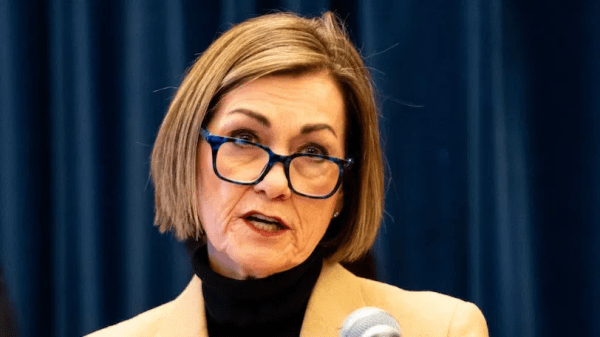
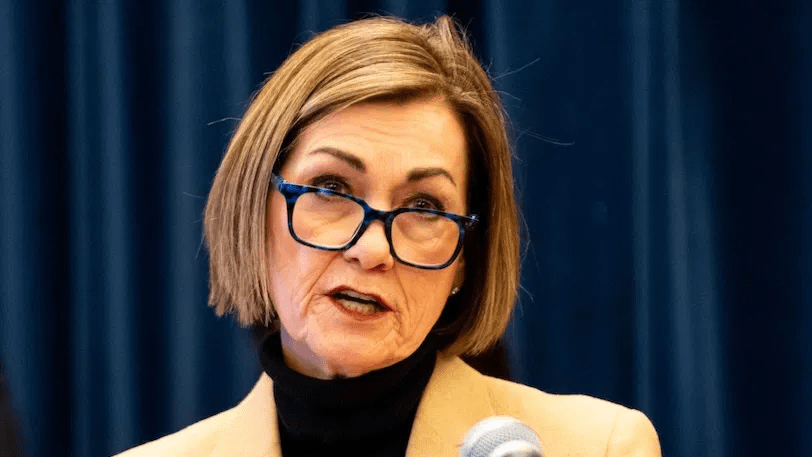
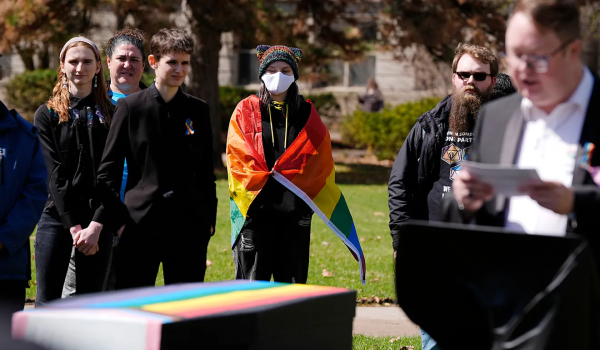
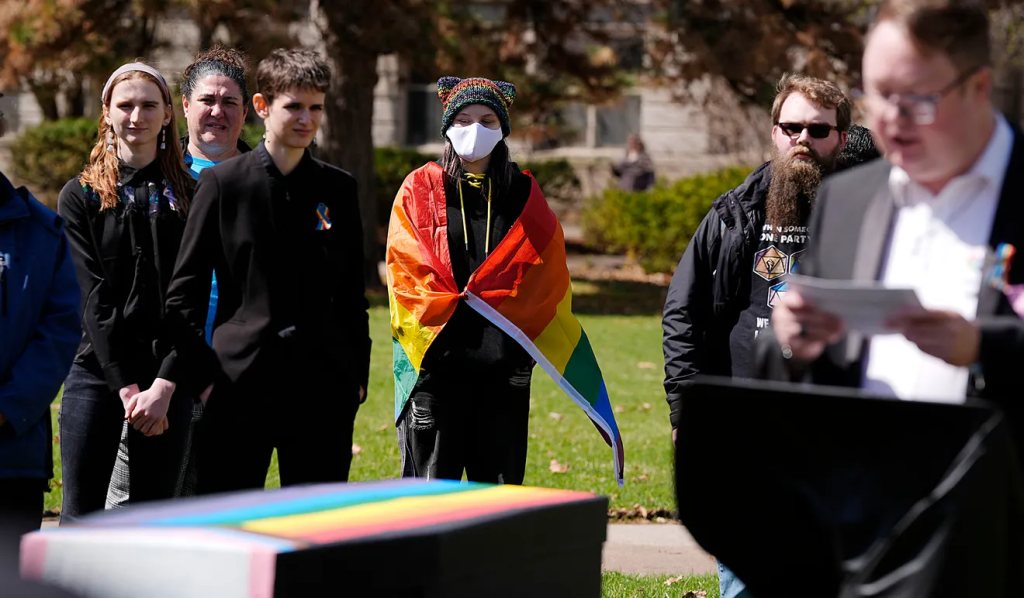
Iowa’s Republican Governor just signed a new law banning protections for trans people at the city and county level.
Gov. Kim Reynolds signed Senate File 579 earlier this week, the Des Moines Register reports. The bill, passed by Iowa’s House of Delegates on March 5 in a party-line vote, prevents local governments throughout the state from adding categories of civil rights violations that are not included in the Iowa Civil Rights Act.
“A city or local government shall not enact any ordinance or other law which is broader or has different categories of unfair or discriminatory practices than those provided,” in the state civil rights code, the bill states.
As the Register notes, the law also bans nearly 20 local governments with existing trans protections in their civil rights laws from enforcing them.
Reynolds told reporters Wednesday that signing the bill “was the right thing to do.”
“We just believe that the locals should follow the state laws, especially when it comes to civil rights, otherwise we have a mismatch of rights out there,” she said, according to the Register.
State Republican lawmakers made it clear that the point of the 2025 repeal was to ensure that Iowa’s anti-trans bathroom and sports bans and a law banning gender-affirming care for minors could survive potential court challenges, according to the Register.
“It does have an impact on protecting girls’ sports and making sure that we’re protecting girls in safe spaces, in restrooms and in lockers,” Reynolds said Wednesday of Senate File 579. “And so that was at jeopardy if we have a hodgepodge of mixed laws within our state.”
LGBTQ+ rights group One Iowa’s executive director, Max Mowitz, blasted Reynolds’ decision to ban trans protections at the local level, noting that the bill is one of only two pieces of legislation the governor has signed this year.
“Republicans acted as quickly as possible to remove any semblance of rights remaining for transgender Iowans, and took local civil rights commissions down with them,” Mowitz said in a statement, according to the Register.
“With all the issues facing Iowans at this moment, from cancer rates to water quality, Iowa Republicans can’t seem to agree on anything other than taking away civil rights,” he said. “Gov. Kim Reynolds’ legacy will be having removed more civil rights protections from her constituents than any other governor in history.”
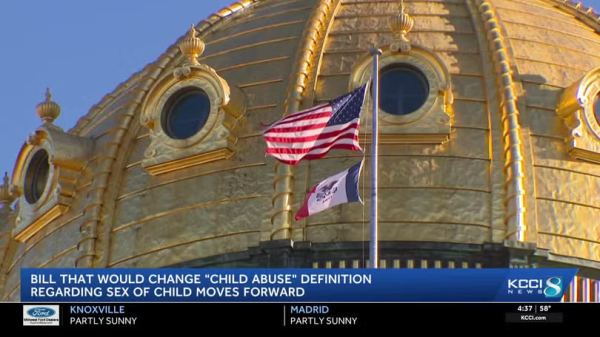
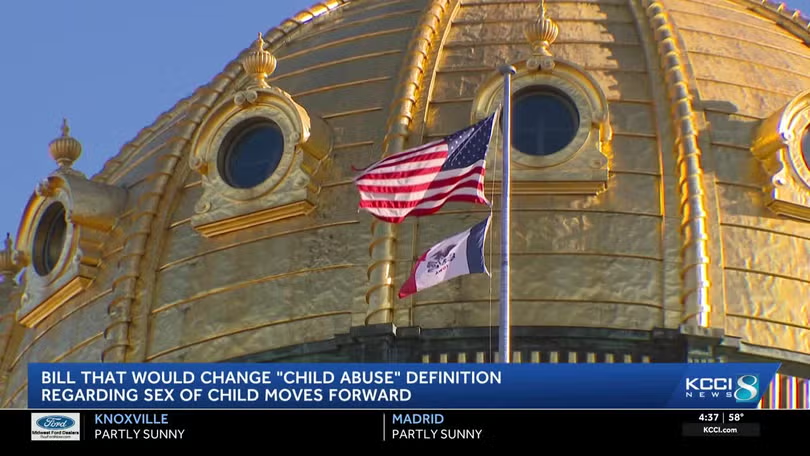
A bill moving through the Iowa Legislature is sparking a heated debate over parental rights and LGBTQ protections, as House lawmakers voted 65 to 31 to pass it.
The bill states it would not be considered child abuse for parents to seek therapy aimed at helping a child live according to their biological sex and would allow parents to use pronouns that match the child’s sex or decline gender-affirming medical care.
Supporters say the bill protects parents’ ability to raise their kids. LGBTQ advocates warn the language could protect conversion therapy and expose kids to harmful treatment. Democratic Rep. Angel Ramirez expressed concern, saying, “I urge a no vote because we will have the blood of LGBTQ+ kids on our hands.”
The bill now goes to the Senate Judiciary Committee, where it has to be approved in the next two weeks to stay eligible for the rest of the session.
Iowa’s public K-12 schools would be barred from teaching students about topics related to gender identity and sexual orientation at all grade levels under a bill expanding what critics have dubbed the state’s “Don’t Say Gay” law.
It would subject all of Iowa’s K-12 students to a law Gov. Kim Reynolds signed in 2023 that bans instruction on gender identity and sexual orientation through sixth grade. The wide-ranging education legislation also ordered schools to remove books that depict sex acts.
A Senate subcommittee voted 2-1 Wednesday, Jan. 21, to advance Senate Study Bill 2003, which would extend the prohibition on LGBTQ-related teaching through high school.
“I think just as not all parents want others to teach their children about sex education because it involves family religious beliefs about sexuality, so not all parents want others to teach children about sexual orientation and gender identity because it too involves family religious beliefs about sexuality and sexual ethics,” Sen. Sandy Salmon, R-Janesville, said.
She and Sen. Jesse Green, R-Boone, who introduced the bill, voted to advance it.
Iowa’s 2023 law, Senate File 496, is being challenged as unconstitutional in a federal lawsuit. A federal judge initially granted an injunction blocking parts of the law, including the ban on teaching about gender orientation and sexual identity, while the lawsuit is decided.
But the U.S. Eighth Circuit Court of Appeals reversed his decision, allowing the law to take effect. Attorneys argued the law’s constitutionality in federal court last week.
Sen. Molly Donahue, D-Marion, voted against moving the bill forward, calling it a “distraction” from other issues facing the state.
“Iowans are definitely tired of this type of legislation, and we’re seeing that with the voting records, not just in Iowa but across the United States,” Donahue said. “We should be focused on prioritizing public schools, funding affordability for our people in this state and making sure that we’re balancing a budget in this state that is currently over $1 billion in deficit. We are focusing on the wrong things when we bring bills like this.”
Iowa is one of several Republican-led states, including Florida, with similar prohibitions on classroom teaching about gender identity and sexual orientation.
The bill says that Iowa’s public school districts and charter schools cannot provide “any program, curriculum, test, survey, questionnaire, promotion or instruction relating to gender theory or sexual orientation” to K-12 students.
Similar legislation has not advanced in past years, including in 2025 after a House proposal stalled once it passed out of subcommittee.
Opponents of the bill say ‘LGBTQ people exist’ regardless of classroom instruction
Opponents outnumbered supporters of the bill at the hearing Wednesday at the Capitol, as LGBTQ Iowans and LGBTQ rights groups shared opposition with lawmakers, while religious and conservative groups spoke in favor of the measure.
Kaylara Hoadley, of Mason City, cried as she showed lawmakers a photograph of her 15-year-old nonbinary child, saying the bill does not keep students safe.
As a caseworker for families in crisis, Hoadley said she supports youth who are homeless or facing other crises whose only safe space is their school.
“When the law silences teachers, counselors and staff, vulnerable youth suffer and suicide rates increase. … When does a child’s suicide matter to you?” she asked the Republican senators as her voice wavered.
Melissa Peterson, representing the Iowa State Education Association, said questions remain as to whether the current law is discriminatory toward LGBTQ students as it remains tied up in court and urged lawmakers to oppose expanding the law.
“We want to get back to basics and provide a safe learning environment for every single one of our students as closely to as free from discrimination as possible,” Peterson said.
Damian Thompson, external affairs director for Iowa Safe Schools, said the bill would amplify the existing law’s constitutional problems by applying it to older students who have well-established constitutional rights.
“High school students can vote soon, they can serve in the military and they’re expected to understand complex and social and health issues as they enter adulthood,” Thompson said. “Federal courts have been consistently clear that students do not shed their First Amendment rights when they enter a public school.”
Bethany Snyder, of Urbandale, who has a trans partner and is a lesbian mother to a freshman at Valley High School, said silence isolates children and does not protect them.
“My partner and I grew up in that silence,” Snyder said. “We didn’t see ourselves reflected in school. We learned very early what shame sounds like in the absence of words. High school should prepare students for the real world and the real world. LGBTQ people exist as parents, coworkers, legislators, historical figures and leaders and families like mine and families like hers.”
Her daughter Evelynn Snyder-Maul said she has never received instruction on gender identity in school beyond sharing that she has a trans father and queer mother.
“If I’m telling someone about my family, could I get reported?” Snyder-Maul said. “However, that is the least of my concerns. Lawmakers who want to pass this bill are snowflakes. You think that love is inappropriate and you think that it is forcing kids to believe they like the same gender. If your kid is gay, whether they are taught that gay exists or not, they are still going to be gay.”
Supporters say schools should teach ‘fundamentals,’ not discuss LGBTQ topics
Danny Carroll, a senior policy adviser with The Family Leader and a former state lawmaker, said the bill would “remove unnecessary distraction” from Iowa classrooms.
“I think Iowans have grown a little bit weary of the distraction — and sometimes very loud and profane distraction — that gender theory has brought on, and I think they’re inclined to think perhaps we should return our schools to some of the fundamentals of learning and put this aside,” Carroll said. “I can see no way that this would interfere with teaching goodwill, friendship, respect for each other.”
Patty Alexander, a retired educator from Indianola, said discussing sexual identity is not an educator’s job.
“We do not believe in labeling students or grouping them by sexual preferences,” Alexander said. “We are here to meet their learning needs. We are not mental health counselors, and forcing us to group and label students only divides and causes rifts. Forcing us to discuss sexuality furthers the mistrust of educators between parents and their children.”
Jeff Pitts, representing the Iowa Faith and Freedom Coalition, said the group supports expanding the existing law through high school.
“Our schools are not the place to promote political ideology,” Pitts said.
Six months after Iowa removed gender identity as a protected class from its civil rights laws, the state now must pay $85,000 to LGBTQ+ students ejected from the Iowa Capitol in 2020, among them trans students who were denied access to the building’s bathrooms.
Iowa Safe Schools, an LGBTQ+ youth advocacy group, sponsored the visit of about 150 Iowa students and chaperones to the Capitol to meet with legislators in 2020. The group’s then-executive director, Nate Monson, told the Iowa Register that, at the time, Iowa State Patrol troopers told several transgender students they couldn’t use one of the bathrooms and had to use a gender-neutral restroom instead.
When Monson intervened, arguing that the troopers’ directions were inconsistent with state law, the entire group was ordered to leave.
“I went up to the trooper and said, ‘No, that’s not what the law says,’” Monson said. “The civil rights code includes gender identity. He told me it did not. Then I told him yes, it did. And he said, ‘Well it doesn’t include bathrooms.’”
The students were then told to leave the Capitol altogether, that they had been banned from the Capitol grounds, and they would be arrested if they returned.
The students and several Iowa Safe Schools leaders filed suit in 2022, alleging sex-based discrimination, harassment, and unlawful retaliation.
Under terms of a settlement agreement — filed in July and approved by the Iowa State Board of Appeals on Tuesday — the state will pay the students and group leaders to settle the case without admitting any wrongdoing.
“These individuals were exercising their constitutional and civil rights when they were singled out and removed from the Iowa Capitol solely because of their identity and their affiliation with an LGBTQ+ organization,” said Devin C. Kelly, an attorney for the plaintiffs, following the Board of Appeals approval.
“At a time when LGBTQ+ Iowans and their families continue to face growing challenges, this settlement reaffirms a simple truth: all Iowans are equal under the law,” Kelly added.
In a letter to the Board of Appeals, state attorney Jeffrey Peterzalek made it a point to say that the plaintiffs’ legal claims “would now not be allowed” under the updated Civil Rights Act.
With Republican Gov. Kim Reynolds’ signature in February, Iowa became the first state in the nation to remove a previously protected class from its civil rights laws. The change took effect July 1.
The law, which will take effect on July 1, 2025, prohibits state universities like Iowa State from starting, maintaining or funding DEI offices or positions unless required by law or for accreditation. The Iowa Board of Regents imposed directives and a Dec. 31 deadline to eliminate functions like the Center.
Holding a ‘funeral’ for a community resource
ISU Students Against SF 2435 Coalition published a mock obituary and shared it with the Ames Tribune prior to Wednesday’s event. The obituary said the Center was “killed” on Dec. 31, “with the assistance of Iowa State University.”
“This marks a great loss for the community, and we encourage those impacted to join us and find community in these trying times,” the mock obituary reads.
Several students addressed the crowd on Wednesday, noting how the Center provided them with a safe space to connect with their community. They said they are frustrated that it’s closing. Several said the presence of the Center was a key factor in attending the university.
The Center is a place where LGBTQIA+ students could go for safety and support, Iowa State student Silvera Dudenhoefer said on Wednesday.
“It was a space that celebrated queer joy and accomplishment, academically and personally,” Dudenhoefer said. “Above all, it was a clear mark that LGBTQIA+ students mattered to this school.”
By removing the LGBTQIA+ from the Center, Dudenhoefer said the Board of Regents has “shown who they’re willing to push aside in an effort to comply.”
The Center, according to Iowa State’s website, is still open from 8 a.m. to 5 p.m., Monday through Friday, on the fourth floor of the Iowa State Memorial Union. Iowa State now lists The Center under the umbrella of multicultural student affairs.
‘The Center’ has been a LGBTQIA+ student resource for more than 30 years
Iowa State University’s Lesbian Gay Bisexual and Transgender Student Services (LGBTSS) opened on Nov. 8, 1992, and was housed above Student Services. It was initially staffed by student volunteers until 1997, when four full-time staff members were brought on.
The LGBTSS was rebranded as The Center for LGBTQIA+ Student Success in 2019 and relocated to the Memorial Union.
The Center is “a space for you to be yourself, find and build community, get involved, and explore lesbian, gay, bisexual, transgender, queer, intersex, asexual, and ally life at Iowa State University,” according to the school’s website.
Senator Quirmbach voices support for ‘encouraging’ campus environment
Senator Herman Quirmbach of Ames attended Wednesday’s gathering and addressed the crowd. He said Iowa State has a responsibility to provide a supportive and encouraging environment for every student, regardless of their background.
“This university is failing in its moral responsibility,” Quirmbach said. “The members of the Board of Regents are failing. And the legislature? Don’t get me started.”
Iowa State graduate student Amanda Thomas assured the gathered students that they have allies willing to support them.
“When attacks like this hurt my friends, my family, my coworkers and my peers, it hurts me and that’s not okay,” Thomas said. “Allies are here, even if you can’t see them.”
Reverand Kelli Clement from the Unitarian Universalist Fellowship of Ames said students are learning to take the “stone in their shoe” that came with Senate File 2435 being passed.
“When you find your people, it is a holy moment,” Clement said. “And the loss of this center does not mean that your people go away.”
DES MOINES, Iowa (AP) — Iowa moved to remove gender identity protections from the state’s civil rights code Thursday despite massive protests by opponents who say it could expose transgender people to discrimination in numerous areas of life.
The Iowa House approved the bill that would strip the state civil rights code of protections based on gender identity, less than an hour after the state Senate backed the legislation. First introduced last week, the measure raced through the legislative process.
Hundreds of LGBTQ+ advocates streamed into the Capitol rotunda on Thursday waving signs reading “Trans rights are human rights” and chanting slogans including “No hate in our state!” There was a heavy police presence, with state troopers stationed around the rotunda. Of the 167 people who signed up to testify at the public hearing before a House committee, all but 24 were opposed to the bill.
Protesters that watched the vote from the House gallery loudly booed and shouted “Shame!” as the House adjourned. Many admonished Iowa state Rep. Steven Holt, who floor managed the bill and delivered a fierce defense of it before it passed.
The bill would remove gender identity as a protected class from the state’s civil rights law and explicitly define female and male, as well as gender, which would be considered a synonym for sex and “shall not be considered a synonym or shorthand expression for gender identity, experienced gender, gender expression, or gender role.”
The measure would be the first legislative action removing nondiscrimination protections based on gender identity, said Logan Casey, director of policy research at the Movement Advancement Project, an LGBTQ+ rights think tank.
Supporters of the change say the current law incorrectly codified the idea that people can transition to another gender and granted transgender women access to spaces such as bathrooms, locker rooms and sports teams that should be protected for people who were assigned female at birth.
The legislation now goes to Republican Gov. Kim Reynolds, who has been supportive of efforts to limit gender identity protections.
The Iowa lawmakers’ actions came on the same day the Georgia House backed away from removing gender protections from the state’s hate crimes law, which was passed in 2020 after the death of Ahmaud Arbery.
Iowa’s current civil rights law protects against discrimination based on race, color, creed, gender identity, sex, sexual orientation, religion, national origin or disability status.
Sexual orientation and gender identity were not originally included in the state’s Civil Rights Act of 1965. They were added by the Democratic-controlled Legislature in 2007, also with the support of about a dozen Republicans across the two chambers.
Iowa Republicans say their changes are intended to reinforce the state’s ban on sports participation and public bathroom access for transgender students. If approved, the bill would go to Republican Gov. Kim Reynolds, who signed those policies into law. A spokesperson for Reynolds declined to comment on whether she would sign the bill.
V Fixmer-Oraiz, a county supervisor in eastern Johnson County, was the first to testify against the bill at the public hearing. A trans Iowan, they said they have faced their “fair share of discrimination” already and worried that the bill will expose trans Iowans to even more.
“Is it not the role of government to affirm rather than to deny law-abiding citizens their inalienable rights?” Fixmer-Oraiz said. “The people of Iowa deserve better.”
Among those speaking in support of the bill was Shellie Flockhart of Dallas Center, who said she is in favor as a woman and a mother, a “defender of women’s rights” and someone “who believes in the truth of God’s creation.”
“Identity does not change biology,” Flockhart said.
About half of U.S. states include gender identity in their civil rights code to protect against discrimination in housing and public places, such as stores or restaurants, according to the Movement Advancement Project. Some additional states do not explicitly protect against such discrimination but it is included in legal interpretations of statutes.
Iowa’s Supreme Court has expressly rejected the argument that discrimination based on sex includes discrimination based on gender identity.
Several Republican-led legislatures are also pushing to enact more laws this year creating legal definitions of male and female based on the reproductive organs at birth following an executive order from President Donald Trump.
Exposing minors to an “obscene performance” would be a crime under a bill winding through the Iowa Senate that critics fear could discourage drag shows and spur lawsuits against venues offering LGBTQ pride programming.
The legislation, Senate File 116, would make knowingly exposing anyone younger than 18 to such a performance an aggravated misdemeanor, as well as knowingly selling a ticket or admitting a minor to a venue where such a performance is held.
Similar to legislation that was introduced but did not pass last year, the bill that advanced out of subcommittee Wednesday defines “obscene performance” as one that exposes genitals, invokes sexual acts or “appeals to the prurient interest and is patently offensive.”
“I brought this bill forward because I had constituents complain to me about performances that, if not meeting the definition of obscenity in our law, at least approach that definition, and concerned about this in our communities and the exposure of minors to it,” said Sen. Sandy Salmon, R-Janesville, who was part of a group of GOP lawmakers who introduced the legislation.
Critics argue the bill would encourage frivolous lawsuits
Keenan Crow, policy and advocacy director for One Iowa, a statewide LGBTQ advocacy organization, raised concerns with a provision establishing a private civil cause of action allowing parents of minor children to sue to determine whether something is obscene.
The bill states “a cause of action may be brought against any person that has knowingly disseminated or exhibited obscene material to the minor or who engaged in or caused or allowed a person to knowingly engage in an obscene performance in the presence of the minor.” It sets the minimum award of damages at $10,000.
While drag shows are not explicitly labeled in the bill as obscene performances, those opposed to the legislation fear it would target drag performances.
“What we are doing is we are allowing parents to target these venues for SLAPP suits, Strategic Lawsuits Against Public Participation, which are not designed to actually win the suit,” Crow said. “They are designed to make venues spend money and to reconsider hosting drag events entirely, lest they be sued on the off chance that it meets the obscenity definition, which obviously Drag Story Time does not.”
Drag Story Time events are sometimes held at libraries or other venues where drag performers read stories to children. In recent years, the events have increasingly been at the center of a larger GOP-led effort to restrict public drag events as conservative critics suggest they “sexualize” children.
Sen. Janice Weiner, D-Iowa City, said she worried the provision would incentivize frivolous lawsuits.
“This bill, as written, could encourage potential frivolous or bad actors to shake down local governments and private businesses, and that’s the taxpayer on the hook,” said Weiner, who opposed the bill.
Elizabeth Hall, a local trans woman, said bills targeting the LGBTQ population create “an aura of fear” among trans people that has pushed those she knows into psychiatric care.
“We fear for our communities,” Hall said. “We fear for our lives, and even if the particulars of how this bill would come into effect aren’t necessarily like that extreme, that fear still has a tangible effect on our lives and has caused so many people that I know to reach ends that I fear have continued to lead to detrimental effects.”
Supporters say the bill ensures performances shown to minors are ‘age appropriate’
Ryan Benn, a lobbyist for the conservative religious group The Family Leader, said the group supported the law because obscene materials that may be illegal to show children in movies or other material are not illegal to perform.
“I think it fixes that loophole,” Benn said.
Sen. Jeff Taylor, R-Sioux Center, said he would like to see a more clear definition of a “performance,” but overall obscenity is rarely prosecuted.
“In general, obscenity does not have constitutional protection in terms of freedom of speech,” Taylor said. “Something that’s obscene is, by definition, not protected by the First Amendment, and that’s regardless whether you’re sharing that with adults or with children. But to me, especially in the case of children, I feel like this is appropriate.”
Sen. Cherielynn Westrich, R-Ottumwa, said she supported the bill to protect children from obscenities.
“I think that what the one thing that we all in this room have agreed on is that we need to protect children from those sort of obscene or performances that are sexual in nature,” Westrich said.
Bill would repeal exemptions for public institutions
Melissa Peterson, with the Iowa State Education Association, said the group opposed the bill, especially a proposal to repeal an Iowa code section that allows minors to access appropriate material for educational purposes, at art exhibitions or in public libraries.
She said Senate File 496, the 2023 state law that requires school staff to remove books depicting sex acts, already sought to establish what content was age appropriate by existing obscenity standards.
“We worked closely together in a compromised fashion to come with what we thought would be considered age appropriate, and we would really like to see that exemption maintained for public institutions that are public spaces,” Peterson said.
Weiner also opposed repealing the exemption for public institutions.
“To repeal it is in some ways to admit that this bill really isn’t about obscenity,” Weiner said.
Exercise, a balanced diet, and safe habits play crucial roles in determining both the quality of life and life expectancy. However, did you know that your location also significantly impacts these metrics? U.S. News and World Report reveals that health outcomes are often shaped by factors such as a community’s economic performance, educational strength, housing availability, and affordability, among others.
In its latest “Healthiest Communities” report, U.S. News assessed nearly 3,000 counties across 92 metrics within 10 health categories—ranging from food and nutrition to housing, population health, education, and the economy—to identify the 500 healthiest counties in the nation. The analysis included factors such as housing affordability, food accessibility, and crime rates. Additionally, U.S. News ranked counties based on mental health, life expectancy, safety, and healthcare access.
Three southern Wisconsin counties secured top-25 positions in U.S. News’ rankings—Ozaukee and Waukesha counties were recognized as the 7th and 23rd healthiest counties overall, while Iowa County was ranked 17th for mental health.
Let’s take a closer look at how these Wisconsin communities achieved their impressive rankings.
Ozaukee County ranks among the healthiest in the U.S.
Home to Cedarburg, Mequon, and Port Washington, this northern neighbor of Milwaukee County was named the seventh-healthiest community in the nation by U.S. News.
Ozaukee County excelled in several categories, particularly in food and nutrition, population health, and infrastructure. The county boasts a food insecurity rate of just 4.4%, significantly lower than the national average of 11.5%. Moreover, its residents have lower rates of diabetes and obesity compared to state and national averages.
In terms of population health, Ozaukee County shines with a life expectancy of 81.3 years, which is 5.5 years longer than the national average of 75.8. Additionally, only about 4% of residents are uninsured, compared to 11.5% of Americans nationwide. Smoking rates are also lower, with only 11% of residents smoking compared to 19% nationally. The county also has a significantly lower rate of deaths of despair (suicide or drug/alcohol-related deaths), occurring at about half the national average. Residents here are more likely to engage in regular physical activity than both state and national averages.
Ozaukee County also surpasses national standards in infrastructure. Over 98% of residents have reliable internet access, compared to about 83% nationwide. The county is more walkable than average, and only 3.6% of residents have a commute longer than an hour, which is less than half the national average of 8.3%. Additionally, nearly three-quarters of Ozaukee residents live within walking distance of a library, museum, or park, compared to about 47% of Americans.
It’s important to note that Ozaukee County is one of Wisconsin’s wealthiest counties in terms of both per capita and median family income, according to U.S. Census data. U.S. News reports that the county’s median household income is just over $97,000, compared to the national median of just under $65,000. Clearly, wealth and privilege can significantly influence access to the resources and opportunities that contribute to a long and healthy life.
Waukesha County ranks among the top 25 healthiest counties in the U.S.
Continuing the trend, Wisconsin’s other wealthiest county secured the 25th spot on U.S. News’ list of the nation’s Healthiest Counties. Waukesha County excelled in the population health, economy, and infrastructure categories.
With a life expectancy of 80.7 years, Waukesha residents live nearly five years longer than the national average. Only 4.1% of residents are uninsured, compared to 11.5% nationwide. The county also boasts lower-than-average rates of smoking and heart disease, and its teen birth rate is just 3.3 per 1,000, significantly lower than the national rate of 21.7 per 1,000.
In terms of the economy, Waukesha County boasts an unemployment rate of just 2.6%, one percentage point lower than the national average. The median household income in the county is over $107,000, nearly $38,000 higher than the national average, and the poverty rate is a low 5%, compared to over 14% nationwide.
Similar to its neighbor Ozaukee, Waukesha County excels in infrastructure. Almost all residents have reliable internet access, while only about 83% of Americans can say the same. The rate of residents commuting over an hour to work is less than half the national average. The county is also rated as more walkable than average, with approximately 72% of residents living within walking distance of a library, museum, or park.
Iowa County is recognized as one of the best counties for mental health in the U.S.
Located in southwestern Wisconsin, Iowa County ranked 79th among the nation’s overall healthiest counties and 17th on U.S. News’ list of the Best Counties for Mental Health.
Home to Dodgeville, Mineral Point, and several major state parks, Iowa County scored 90 out of 100 points in U.S. News’ mental health category. In the county, 14.4% of adult residents report experiencing “frequent mental distress,” compared to just over 17% of U.S. adults. The county has a rate of 28.6 deaths of despair (suicide or drug/alcohol-related deaths) per 100,000 residents, significantly lower than the national rate of 63.5 per 100,000 and Wisconsin’s rate of 53.5 per 100,000.
Additionally, U.S. News found that 13% of Medicare beneficiaries in Iowa County have depression, compared to nearly 18% of beneficiaries nationwide and in Wisconsin.
What are the healthiest counties in Wisconsin?
These 10 Wisconsin counties ranked highest on U.S. News’s Healthiest Communities list:
The outcome of the Iowa caucuses solidifies the top echelon, or more precisely, the top two tiers: Donald Trump secured the win, and following a notable gap, Ron DeSantis and Nikki Haley essentially ended up in a tie for the second position.
On January 15, former President Donald Trump emerged victorious in the Iowa Republican presidential caucuses, marking his triumph in the initial election contest of 2024. (Video: Blair Guild/The Washington Post, Photo: Jabin Botsford/The Washington Post)
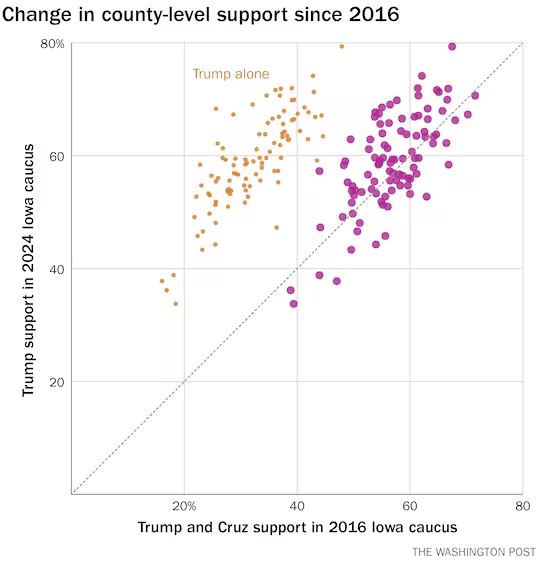
During the evening, we have been juxtaposing Trump’s 2024 performance with the combined performance of Trump and Sen. Ted Cruz (R-Tex.) eight years prior. This comparison remained consistent, as Trump’s county-level performance deviated by an average of merely 2 percentage points from the combined performance in 2016.
He improved by two points. In 59 out of Iowa’s 99 counties, he surpassed the Trump-Cruz support from 2016. Currently, he is on track to secure victory in all three counties where he performed least favorably in 2016.
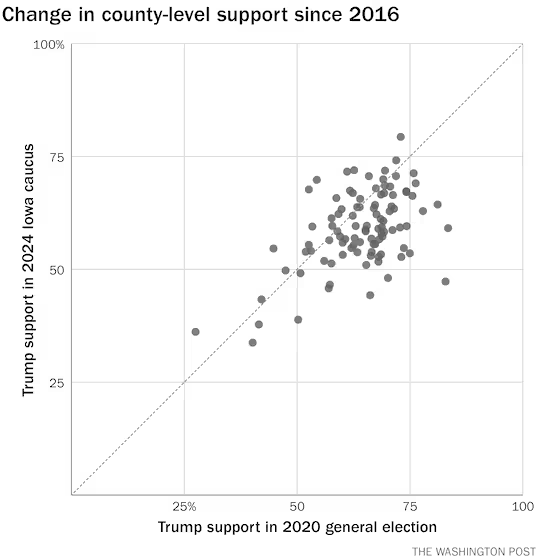
Despite facing competition from several other Republicans, Trump garnered greater support in 27 counties compared to his performance in the 2020 general election.
On average, his performance in Iowa’s counties tonight was only about 5 points lower than it was in November 2020.
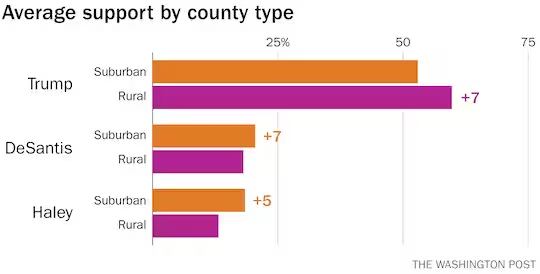
The average remained consistent in both suburban and rural counties. Similar to his performance in 2016, Trump exhibited stronger results in rural counties. However, in a notable shift, he also garnered over half the vote on average in suburban counties this time. As anticipated, both Haley and DeSantis performed better in suburban counties compared to rural ones.
It’s a matter of fine distinctions, really. Trump is anticipated to secure victory in every county except one: Johnson County, where, due to its high percentage of college-educated residents, Trump faced notable challenges in 2016.
Nikki Haley is currently ahead by a single vote in that area.
Iowa Meteorologist Started Talking About Climate Change On Newscasts. Then Came The Harassment
“I started just connecting the dots between extreme weather and climate change, and then the volume of pushback started to increase quite dramatically.”
DES MOINES, Iowa (AP) — The harassment started to intensify as TV meteorologist Chris Gloninger did more reporting on climate change during local newscasts — outraged emails and even a threat to show up at his house.
Gloninger said he had been recruited, in part, to “shake things up” at the Iowa station where he worked, but backlash was building. The man who sent him a series of threatening emails was charged with third-degree harassment. The Des Moines station asked him to dial back his coverage, facing what he called an understandable pressure to maintain ratings.
“I started just connecting the dots between extreme weather and climate change, and then the volume of pushback started to increase quite dramatically,” he said in an interview with The Associated Press.
So, on June 21, the 38-year-old announced that he was leaving KCCI-TV — and his 18-year career in broadcast journalism altogether.
Gloninger’s experience is all too common among meteorologists across the country who are encountering reactions from viewers as they tie climate change to extreme temperatures, blizzards, tornadoes and floods in their local weather reports. For on-air meteorologists, the anti-science trend that has emerged in recent years compounds a deepening skepticism of the news media.














 fleeredstates.blog
You must be logged in to post a comment.