More Kansas schools receive warning letters about LGBTQ policies, including Wichita

Read more at the Wichita Eagle.

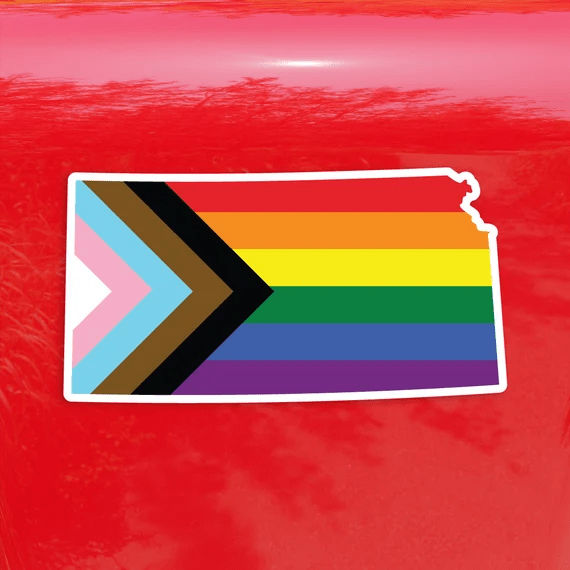
The Kansas Attorney General’s Office has sent letters to more Kansas school districts, including Wichita’s, warning of possible legal action over LGBTQ policies. Along with Wichita Public Schools, the letters were also sent to the Lawrence Public School District, the Cherryvale School District in southeast Kansas, and the State Board of Education.

The letters alleged that the school districts were not following state and federal laws regarding school policies for LGBTQ students and libraries. “I am writing to warn you that these policies make you vulnerable to lawsuits and the loss of federal funding, endanger your students, and violate the constitutional and legal rights of parents, students and your employees,” the letter to USD 259 read. The letters are similar to those sent by Attorney General Kris Kobach to some northeast Kansas school districts, which are now under federal investigation. A letter addressed to Wichita Public Schools alleges that East High and “possibly other schools” were engaging “in gender transitioning of minors without parental knowledge or consent.” Without going into specifics, it also alleges that the district “may have additional transgender policies” that don’t align with state and federal law.

Earlier this year, the district quietly removed language regarding diversity from its website and online policy handbook after the Trump administration published a letter to public schools threatening federal funding if they continued diversity, equity and inclusion programs. In a statement to the Eagle, Wichita Public Schools said the district follows Kansas and federal law. The largest school district in Kansas also said it wasn’t aware of what allegations were made to the AG’s office to prompt the letter. The attorney general’s office has not responded to an Eagle inquiry about why it sent the letters to those school districts and the State Board of Education. “The letter made several broad recommendations – from policies to student support to parental review of instructional materials – which the Board of Education has not had the opportunity to fully discuss,” the statement read. The letter gives the district a Jan. 2 deadline to revise its policies and to identify books and other materials in schools that are “religiously objectionable.” Letters sent to the other school districts and the state board make similar statements and recommendations, but the letter sent to Lawrence Public Schools makes more pointed recommendations. The attorney general’s letter to the Lawrence School District specifically called on it to take down its “LGBTQ Advisory Guide” from the district’s website.

That guide was still available on its site as of Thanksgiving week. It also wants the district to ensure students use locker rooms for the gender they’re assigned at birth, as well as allowing only “biological females” to play in girls sports. The state legislature recently passed a law banning transgender student athletes from girls sports. Cherryvale and Lawrence Public Schools have yet to respond to a request for comment – but both of the school districts’ calendars show that they’re closed for Thanksgiving break. A letter addressed to the State Board of Education makes similar allegations about several other school districts in the state, but doesn’t name them. “As of today, the State Board has not issued any comment,” the board’s spokesperson said in a statement to the Eagle.

Kansas Supreme Court Delivers Big Win For Driver’s License Gender Markers

Read more at Erin in the Morning.

After a grueling two-year fight, starting on Tuesday, the Kansas Department of Revenue (KDOR) will resume issuing accurate driver’s licenses to transgender Kansans, a spokesperson for the ACLU of Kansas told Erin in the Morning.

Last week, the Kansas Supreme Court declined to hear Attorney General Kris Kobach’s request to uphold a district court order preventing the state from updating IDs for trans residents. And while there is still a fight ahead, it marks a notable victory for trans people in a state that has been holding their driver’s licenses hostage for years.

“I want every transgender Kansan to be able to live their lives authentically,” said Kathryn Redman, a 65-year-old resident and a plaintiff in the case, Kansas v. Harper, brought on by the ACLU and Stinson LLP.

AG Kobach asserted that the courts needed to put a stop to the license updates indefinitely, claiming it would interfere with law enforcement’s ability to identify and apprehend criminal suspects. The Court of Appeals called this “mere speculation.”

“There is no hidden agenda,” Redman told Erin in the Morning. “All I tried to accomplish and what I have accomplished by my transition is, I now live my life at peace with myself.”

In theory, the case should now be returned to a new trial court for final resolution. But the conservative Kobach doesn’t want to let that happen. He and other Republican officials have sought to call a special legislative session on the matter—a process they were already undertaking in a transparent attempt at gerrymandering, and it has seen renewed fanfare in light of the court events this past week.

The fight to strip trans Kansans of their rights, state Senate President Ty Masterson wrote in an Oct. 1 letter, is considered “even more important than redistricting.” He called on the Kansas State Republican Caucus to simply “add a few words” to state law to stop Kansans from updating their gender markers.

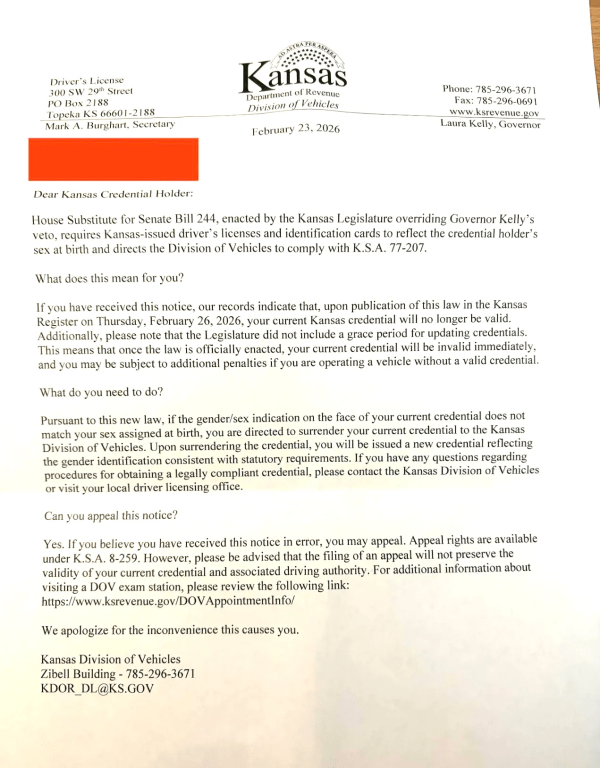
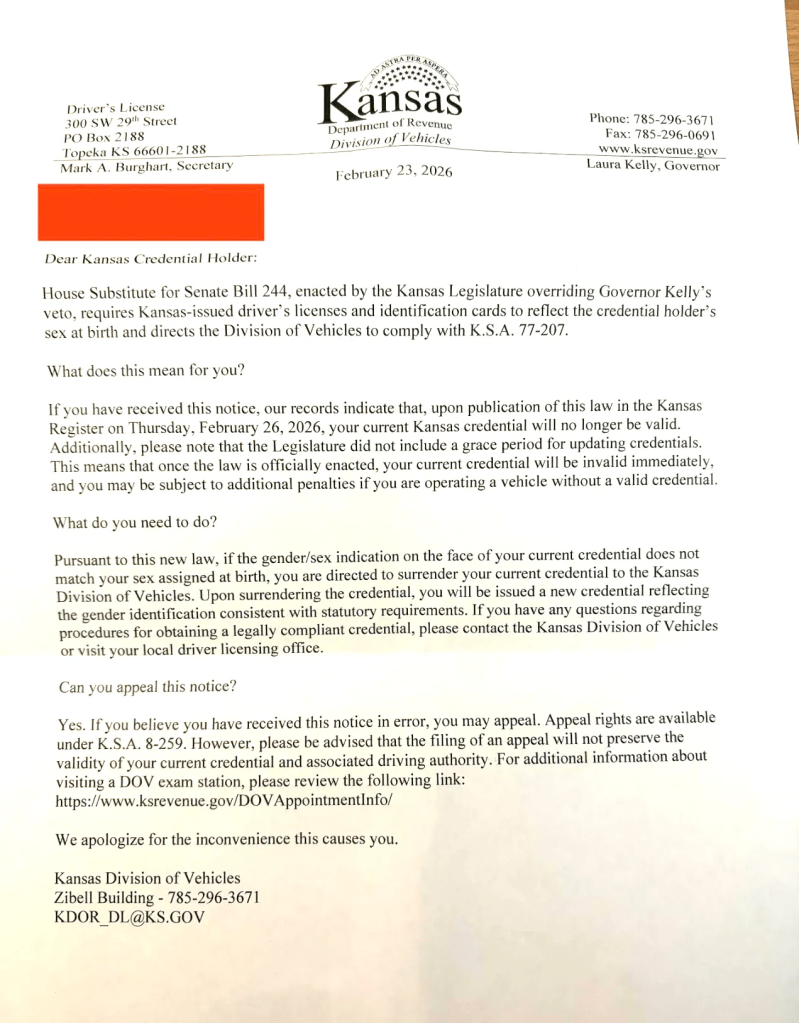
The legal proceedings have ricocheted from court to court since July 2023, when legislators overrode Democratic Governor Laura Kelly’s veto on Senate Bill 180. The anti-trans law takes after legislation proposed by right-wing, anti-trans organizations, misleadingly dubbed the “Women’s Bill of Rights.” In practice, the only thing the bill does is codify sex segregation and target the equal rights of transgender people. It makes no mention of forcing Kansans to carry a driver’s license with an inaccurate gender marker.

“Rather than accepting the decisions of the two highest courts in our state, Mr. Kobach is resorting to backroom attempts to change the law and shut the courts out of our government so he can have full, unchecked power,” Micah Kubic, executive director of the ACLU of Kansas, said in a statement. “This is, simply put, a power grab by the attorney general that goes beyond his baseline of cheap political theater and wasteful litigation.”

Kubic denounced Kobach’s “extremist and discriminatory agenda,” adding that it “threatens not just the privacy and agency of all Kansans but also the very checks and balances of our state government.”

Kansas Lawmakers Override Veto of Ban on Transition Care for Minors

*This was reported by the NY Times

The Republican-controlled Kansas Legislature on Tuesday overrode the Democratic governor’s veto of a bill that bans gender-transition treatments for minors, fulfilling a longtime goal of conservative lawmakers and joining about half of the country’s states in enacting bans or sharp limits on those procedures.

The Kansas bill had broad Republican support, but its status had been uncertain because of the opposition of Gov. Laura Kelly, who said it was “disappointing that the Legislature continues to push for government interference in Kansans’ private medical decisions.” Ms. Kelly vetoed similar bills in each of the last two years, and lawmakers had previously failed to override her.

This time, Republicans in both chambers mustered the two-thirds margin necessary to override her and celebrated the decision as following President Trump’s lead on the issue. Kansas had been among the only states where Republicans hold significant legislative power without such a law.

“Today, a supermajority of the Kansas Senate declared that Kansas is no longer a sanctuary state” for those procedures, Senator Ty Masterson, the chamber’s president, said in a statement.

Republican supporters of the measure, which bans hormone treatments, puberty blockers and transition surgeries for transgender patients younger than 18, described it as guarding young people from life-altering choices that they could later regret. Under the new law, doctors who provide those treatments to minors could lose their licenses and be sued by patients or their parents.

The shift in Kansas comes as President Trump and his administration crack down on gender transitions for minors nationally, seeking to end funding for hospitals that provide those treatments. The Trump administration has also moved to ban trans women and girls from competing in women’s sports, to bar trans people from serving openly in the military, to house trans women who are federal prisoners with men, and to no longer reflect the gender identities of trans people on passports.

Democrats and L.G.B.T.Q. advocates called the Kansas legislation an invasion of privacy that would have devastating health consequences. In her veto message, Ms. Kelly said “infringing on parental rights is not appropriate, nor is it a Kansas value,” and warned that enacting the measure could have economic consequences.

“This legislation will also drive families, businesses, and health care workers out of our state, stifling our economy and exacerbating our workforce shortage issue,” the governor wrote.

The new law comes as part of a broader push by Republicans in Kansas, a state that Mr. Trump carried last year by 16 percentage points, to place limits on transgender people. Kansas stopped changing birth certificates to reflect gender identity in 2023 after lawmakers overrode another veto by Ms. Kelly and passed a law defining male and female as a person’s sex at birth.

But as Republicans across the country have moved in recent years to restrict transition treatments for minors, Kansas had remained an outlier on the Great Plains. Bans or severe limits are already in place in three of its four bordering states — Colorado is the exception — and across much of the rest of the Midwest.

Bans elsewhere have been challenged in state and federal courts with a range of preliminary outcomes. Many expect the U.S. Supreme Court to ultimately decide whether there is a national right to access such treatments.

Trans youth care ban vetoed by Kansas governor again

*This was published by ABC News.

Kansas Gov. Laura Kelly has vetoed Senate Bill 63, which would have restricted gender-affirming care for transgender youth.

“Right now, the legislature should be focused on ways to help Kansans cope with rising prices,” Kelly said in a statement emailed late Tuesday. “That is the most important issue for Kansans. That is where my focus is.”

The bill would bar health care providers from administering gender-affirming medical care – including puberty suppressants and hormone therapies – for someone under the age of 18, only for the purposes of gender transitioning. The ban would also apply to gender-affirming surgeries.

“Infringing on parental rights is not appropriate, nor is it a Kansas value,” said Kelly in her veto message. “As I’ve said before, it is not the job of politicians to stand between a parent and a child who needs medical care of any kind. This legislation will also drive families, businesses, and health care workers out of our state, stifling our economy and exacerbating our workforce shortage issue.”

This is the third time Kelly has vetoed similar transgender youth care bills, but the bill may now have the support to pass.

The bill passed the state legislature with flying colors – passing the House 83-35 and the Senate 32-8.

In 2023, the attempt to override a past trans care ban veto lost in the House 82-43.

State Republicans quickly denounced Kelly’s veto.

“The governor’s devotion to extreme left-wing ideology knows no bounds, vetoing a bipartisan bill that prevents the mutilation of minors,” said State Sen. Ty Masterson in an online statement. “The Senate stands firmly on the side of protecting Kansas children and will swiftly override her veto before the ink from her pen is dry.”

Top national medical associations such as the American Medical Association, American Academy of Child and Adolescent Psychiatry, and American Academy of Pediatrics and more than 20 others argue that gender-affirming care is safe, effective, beneficial, and medically necessary for transgender populations.

Kelly joins governors past and present in Ohio and Arkansas in vetoing bills that targeted gender-affirming youth care. However, both of their vetoes were overridden.

Across the country, trans youth care restrictions have faced legal hurdles in their enforcement.

The battle and debate has most recently made its way to the national stage, with the Supreme Court considering U.S. v. Skrmetti, which will decide if Tennessee’s law banning some gender-affirming care for transgender minors violates the Equal Protection Clause of the U.S. Constitution.

Texas and Kansas are at the forefront of legal challenges against a recent firearm regulation introduced by the ATF.

Texas and Kansas are spearheading separate multi-state lawsuits contesting a recent ATF regulation aimed at criminalizing private firearm sales. They argue that the rule is unlawful, unconstitutional, and runs counter to congressional intent, Second Amendment rights, and principles of due process.

On Wednesday, Texas Attorney General Ken Paxton and Kansas Attorney General Kris Kobach revealed that they are spearheading two distinct multi-state lawsuits against a recent regulation issued by the Bureau of Alcohol, Tobacco, Firearms and Explosives. This rule aims to criminalize private firearm sales.

The attorneys general contend that the rule, released on April 19, is both illegal and unconstitutional. They assert that it significantly broadens the definition of a firearm dealer and has the potential to unjustly cast hundreds of thousands of law-abiding gun owners as presumed guilty for engaging in private sales and trades of firearms.

Paxton declared at a press conference held at a Frisco, Texas gun range, “Joe Biden is attempting to alter this through regulatory redefinition, executive directives, and loopholes crafted to circumvent our Constitution. He has shown utter disrespect and disregard for the democratic process.”

In the Northern District of Texas, Texas is filing its lawsuit, while Kansas is spearheading a legal action in the Eastern District of Arkansas. Both lawsuits contend that the ATF rule breaches the statutory definition of a firearms dealer as established by Congress, encroaches upon Second Amendment rights, and is sufficiently ambiguous to contravene due process.

He’s The Trans Son Of An Anti-Trans Influencer. It’s His Turn To Speak.

This blog originally appeared at The Texas Tribune.

Renton Sinclair’s mother is a former Miss Illinois who wants to force trans people out of public life. That’s exactly what makes her a rising star in MAGA World.

KANSAS CITY, Mo. — When Renton Sinclair texted his mom to say that he was transgender, she summoned a curse on the testosterone he was taking.

“I actually went after the medicine, and I cursed it in the name of Jesus, and I said, ‘No, you’re not going to work. I don’t know if you’re going to make her sick or whatever, but she’s going to have to go off that medicine,’” Tania Joy Gibson recounted recently during an episode of her podcast, repeatedly misgendering her child.

Renton doesn’t talk to Tania anymore. But Tania is always talking about Renton these days, on podcasts and livestreams and stages across the country, from California to South Dakota to Pennsylvania. She often tells the story of how God appeared to her in a dream before her first child was born, telling her what to name her child, a name with Biblical origins.

Renton is not that name. Tania refuses to call her son that name. In fact, she refuses to call her son her son. “It’s demonic,” Tania said about the existence of transgender people. “My daughter is in there, my daughter who was born and prophesied over and given the name from God is in there, but the Devil has taken and twisted her mind…”

In Tania’s telling, she is a victim, a mother who lost her child to the woke cult of “gender ideology.” She once told a crowd of 4,000 people that the gender-affirming care Renton and other trans people receive is the work of the literal devil, a scheme of mass sterilization to steal the “seed” of humanity.

She then broke into a rendition of “America The Beautiful,” a sea of middle-aged white people rising to their feet and placing red MAGA hats over their hearts.

Renton knows his mom has always loved the spotlight. She was, after all, a Miss America contestant, having been crowned Miss Illinois in 1996. Renton is horrified that, in a way, Tania has a new, albeit crueler, pageant. It’s a pageant similarly obsessed with gender. For Tania, it has higher stakes than a sash and crown: She believes it’s her divine destiny and duty to take part in the current conservative crusade to force trans people out of public life, a necessary step in paving the path for Christ’s return. As outlandish and self-aggrandizing as that may seem, Tania has allies in high places to help her on this holy mission.

Renton has watched as his mom has started to speak from the same stages as famous right-wing figures — Eric Trump, Roger Stone, Michael Flynn and others — calling for laws that would force him to be everything he’s not.

He has watched his mom get on these stages and call him a “prodigal daughter” — a reference to the biblical story of the Prodigal Son, a wayward child destined to one day repent and return to God, return home, return to her.

But Renton is neither a prodigal nor a daughter. He’d like you to know he’s never going home to Tania because that home was hell — the type of hell he’s horrified that Republican legislators are trying to recreate for every trans kid in America.

He has forged a new home for himself. A new family, too. And if Tania Joy Gibson is going to keep giving speeches about him, then maybe it’s time for Renton Sinclair to speak up about her.

Renton Sinclair’s old diary in Kansas City. Renton kept the diary in a hole in his bed to keep it out of his parent’s detection.

Renton Sinclair reads through his old diary on his porch.

Renton was around 6 years old when his mom put him in a beauty pageant. He didn’t take to it. “I just stole a crown off the table,” he recalls, laughing. “We left, and I was in the back seat, and they were like, ‘Where did you get that?’ And I just said, ‘I took it.’”

The crown is somewhere in his place now, a two-story house with a front porch in a working-class part of Kansas City, Missouri, that Renton, 23, shares with his partner Greg Hyatt, their three dogs, and a large orange cat.

He has other artifacts from his childhood stuffed into a Home Depot moving box — old family photos, Christmas cards, and a beat-up blue journal, the first page inscribed with an urgent, all-caps message: “MOM, GO AWAY.” (Tania did not respond to a list of detailed questions for this story. “It would be inappropriate for me to discuss my daughter’s health issues or her experiences as an adolescent,” she wrote in an email where she deadnamed and repeatedly misgendered her child. “My only request is that you respect my daughter’s fragile condition and consider the harm the Huffington Post can bring her by making her problems known worldwide.”)

click here to see full blog: https://www.texastribune.org/2023/05/28/texas-legislature-drag-show-bill/?utm_source=articleshare&utm_medium=social

This cis woman and her disabled child were ousted from a Kansas library bathroom due to anti-trans ban

This blog originally appeared at Reckon.

In a concerning incident in Kansas, a cisgender woman and her disabled child were reportedly forced to leave a library bathroom due to the implementation of an anti-transgender bathroom ban. The incident highlights the impact that such discriminatory policies can have on individuals who do not fit the narrow definitions imposed by these bans.

Karen Wild and her son Ellis Dunville. Photo courtesy of The Wichita Eagle (Michelle Zenarosa)

On May 20, a woman in Kansas was instructed to leave the restroom for helping her disabled son.

Karen Wild is the mother to her son Ellis Dunville, who is on the autism spectrum, has a seizure disorder and is nonverbal. Part of her weekly routine is visiting the Wichita Public Library to meet up with Dunville’s grandmother, who helps Wild take care of him.

This incident comes weeks after the state signed SB180, which is informally known as the “Women’s Bill of Rights”. The law is intended to “ensure current protections for women’s spaces are not eroded,” said Republican Rep. Brenda Landwehr during the House Committee hearing on Mar. 31.

click here to see full blog: https://www.reckon.news/lgbtq/2023/06/this-cis-woman-and-her-disabled-child-were-ousted-from-a-kansas-library-bathroom-due-to-anti-trans-ban.html?fbclid=IwAR3O01yCO1cAjKxjLWFWcbq3LBQNV_bofvnD8feA8srrPyh9StenclFBTgI

Kansas City declares itself a sanctuary city for LGBTQ+ people

This blog originally appeared at WFAA.

Kansas City’s new sanctuary status sets it apart as a Democratic-leaning city in a state with a Republican governor and GOP-controlled Legislature.

In a bold move, officials in Kansas City, Missouri, have passed a resolution declaring the city a sanctuary for individuals seeking or providing gender-affirming care, despite a recent state-level ban on such care for minors. The 12 to 1 vote demonstrates the city’s commitment to being an inclusive and safe haven for the transgender and LGBTQ+ community, setting it apart from the state’s Republican-led government.

Similar actions have been taken in other cities across the country where there is opposition to state-level restrictions on transgender rights. This sanctuary status aligns Kansas City with places like Austin, Texas, that have taken a stand against legislation limiting transgender healthcare options.

Governor Mike Parson, a Republican, is expected to sign the ban on gender-affirming care into law, making Missouri one of over 16 states to enact similar restrictions or bans for minors. Meanwhile, a judge is currently reviewing a proposed emergency rule from the state’s Attorney General, which would impose additional requirements and a lengthy therapy process before individuals can access gender-affirming treatments.

Credit: AP

Supporters of a resolution that would make Kansas City, Mo, a sanctuary city for transgender people celebrate outside of city council chambers.

The recently passed resolution ensures that Kansas City will not prosecute or penalize anyone seeking, providing, or receiving gender-affirming care, including puberty blockers, hormones, or surgeries. Moreover, if the state enacts laws or resolutions imposing punishments or fines, city personnel have committed to making enforcement of such requirements their lowest priority.

Opponents of gender-affirming care, typically Republican lawmakers, argue that they are safeguarding children from decisions they may later regret. However, gender-affirming care for minors has been available in the United States for more than a decade and is supported by major medical associations.

Kansas City’s sanctuary status represents a significant step forward in protecting the rights and healthcare options of transgender individuals. By openly defying state legislation and providing a safe haven for gender-affirming care, the city is sending a powerful message of inclusivity and support for the LGBTQ+ community. The outcome of this resolution and ongoing legal battles will have broader implications for the rights and well-being of transgender individuals across the state of Missouri and potentially influence the national conversation on transgender healthcare rights.

“This is an important first step in Kansas City’s commitment to trans and nonbinary people,” Merrique Jenson, founder of Transformations KC, said in a written statement after the vote. “I look forward to trans leaders and Kansas City working together to address the health disparities in our communities and ways we can have sustainable funding & programming reaching all trans people.”

CLICK HERE TO READ MORE

Blog at WordPress.com.

Up ↑