Texas and Kansas are spearheading separate multi-state lawsuits contesting a recent ATF regulation aimed at criminalizing private firearm sales. They argue that the rule is unlawful, unconstitutional, and runs counter to congressional intent, Second Amendment rights, and principles of due process.
On Wednesday, Texas Attorney General Ken Paxton and Kansas Attorney General Kris Kobach revealed that they are spearheading two distinct multi-state lawsuits against a recent regulation issued by the Bureau of Alcohol, Tobacco, Firearms and Explosives. This rule aims to criminalize private firearm sales.
The attorneys general contend that the rule, released on April 19, is both illegal and unconstitutional. They assert that it significantly broadens the definition of a firearm dealer and has the potential to unjustly cast hundreds of thousands of law-abiding gun owners as presumed guilty for engaging in private sales and trades of firearms.
Paxton declared at a press conference held at a Frisco, Texas gun range, “Joe Biden is attempting to alter this through regulatory redefinition, executive directives, and loopholes crafted to circumvent our Constitution. He has shown utter disrespect and disregard for the democratic process.”
In the Northern District of Texas, Texas is filing its lawsuit, while Kansas is spearheading a legal action in the Eastern District of Arkansas. Both lawsuits contend that the ATF rule breaches the statutory definition of a firearms dealer as established by Congress, encroaches upon Second Amendment rights, and is sufficiently ambiguous to contravene due process.
Renton Sinclair’s mother is a former Miss Illinois who wants to force trans people out of public life. That’s exactly what makes her a rising star in MAGA World.
KANSAS CITY, Mo. — When Renton Sinclair texted his mom to say that he was transgender, she summoned a curse on the testosterone he was taking.
“I actually went after the medicine, and I cursed it in the name of Jesus, and I said, ‘No, you’re not going to work. I don’t know if you’re going to make her sick or whatever, but she’s going to have to go off that medicine,’” Tania Joy Gibson recounted recently during an episode of her podcast, repeatedly misgendering her child.
Renton doesn’t talk to Tania anymore. But Tania is always talking about Renton these days, on podcasts and livestreams and stages across the country, from California to South Dakota to Pennsylvania. She often tells the story of how God appeared to her in a dream before her first child was born, telling her what to name her child, a name with Biblical origins.
Renton is not that name. Tania refuses to call her son that name. In fact, she refuses to call her son her son. “It’s demonic,” Tania said about the existence of transgender people. “My daughter is in there, my daughter who was born and prophesied over and given the name from God is in there, but the Devil has taken and twisted her mind…”
In Tania’s telling, she is a victim, a mother who lost her child to the woke cult of “gender ideology.” She once told a crowd of 4,000 people that the gender-affirming care Renton and other trans people receive is the work of the literal devil, a scheme of mass sterilization to steal the “seed” of humanity.
She then broke into a rendition of “America The Beautiful,” a sea of middle-aged white people rising to their feet and placing red MAGA hats over their hearts.
Renton knows his mom has always loved the spotlight. She was, after all, a Miss America contestant, having been crowned Miss Illinois in 1996. Renton is horrified that, in a way, Tania has a new, albeit crueler, pageant. It’s a pageant similarly obsessed with gender. For Tania, it has higher stakes than a sash and crown: She believes it’s her divine destiny and duty to take part in the current conservative crusade to force trans people out of public life, a necessary step in paving the path for Christ’s return. As outlandish and self-aggrandizing as that may seem, Tania has allies in high places to help her on this holy mission.
Renton has watched as his mom has started to speak from the same stages as famous right-wing figures — Eric Trump, Roger Stone, Michael Flynn and others — calling for laws that would force him to be everything he’s not.
He has watched his mom get on these stages and call him a “prodigal daughter” — a reference to the biblical story of the Prodigal Son, a wayward child destined to one day repent and return to God, return home, return to her.
But Renton is neither a prodigal nor a daughter. He’d like you to know he’s never going home to Tania because that home was hell — the type of hell he’s horrified that Republican legislators are trying to recreate for every trans kid in America.
He has forged a new home for himself. A new family, too. And if Tania Joy Gibson is going to keep giving speeches about him, then maybe it’s time for Renton Sinclair to speak up about her.
Renton Sinclair’s old diary in Kansas City. Renton kept the diary in a hole in his bed to keep it out of his parent’s detection.
Renton Sinclair reads through his old diary on his porch.
Renton was around 6 years old when his mom put him in a beauty pageant. He didn’t take to it. “I just stole a crown off the table,” he recalls, laughing. “We left, and I was in the back seat, and they were like, ‘Where did you get that?’ And I just said, ‘I took it.’”
The crown is somewhere in his place now, a two-story house with a front porch in a working-class part of Kansas City, Missouri, that Renton, 23, shares with his partner Greg Hyatt, their three dogs, and a large orange cat.
He has other artifacts from his childhood stuffed into a Home Depot moving box — old family photos, Christmas cards, and a beat-up blue journal, the first page inscribed with an urgent, all-caps message: “MOM, GO AWAY.” (Tania did not respond to a list of detailed questions for this story. “It would be inappropriate for me to discuss my daughter’s health issues or her experiences as an adolescent,” she wrote in an email where she deadnamed and repeatedly misgendered her child. “My only request is that you respect my daughter’s fragile condition and consider the harm the Huffington Post can bring her by making her problems known worldwide.”)
In a concerning incident in Kansas, a cisgender woman and her disabled child were reportedly forced to leave a library bathroom due to the implementation of an anti-transgender bathroom ban. The incident highlights the impact that such discriminatory policies can have on individuals who do not fit the narrow definitions imposed by these bans.
Karen Wild and her son Ellis Dunville. Photo courtesy of The Wichita Eagle (Michelle Zenarosa)
On May 20, a woman in Kansas was instructed to leave the restroom for helping her disabled son.
Karen Wild is the mother to her son Ellis Dunville, who is on the autism spectrum, has a seizure disorder and is nonverbal. Part of her weekly routine is visiting the Wichita Public Library to meet up with Dunville’s grandmother, who helps Wild take care of him.
This incident comes weeks after the state signed SB180, which is informally known as the “Women’s Bill of Rights”. The law is intended to “ensure current protections for women’s spaces are not eroded,” said Republican Rep. Brenda Landwehr during the House Committee hearing on Mar. 31.
Kansas City’s new sanctuary status sets it apart as a Democratic-leaning city in a state with a Republican governor and GOP-controlled Legislature.
In a bold move, officials in Kansas City, Missouri, have passed a resolution declaring the city a sanctuary for individuals seeking or providing gender-affirming care, despite a recent state-level ban on such care for minors. The 12 to 1 vote demonstrates the city’s commitment to being an inclusive and safe haven for the transgender and LGBTQ+ community, setting it apart from the state’s Republican-led government.
Similar actions have been taken in other cities across the country where there is opposition to state-level restrictions on transgender rights. This sanctuary status aligns Kansas City with places like Austin, Texas, that have taken a stand against legislation limiting transgender healthcare options.
Governor Mike Parson, a Republican, is expected to sign the ban on gender-affirming care into law, making Missouri one of over 16 states to enact similar restrictions or bans for minors. Meanwhile, a judge is currently reviewing a proposed emergency rule from the state’s Attorney General, which would impose additional requirements and a lengthy therapy process before individuals can access gender-affirming treatments.
Credit: AP
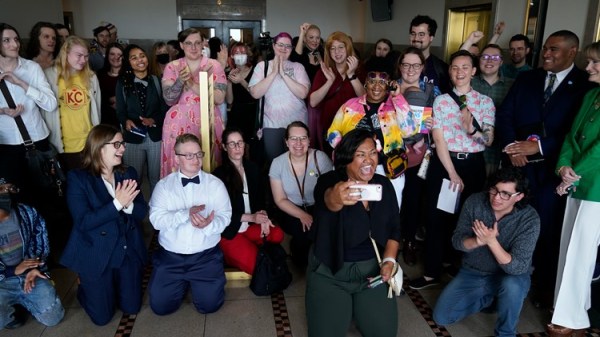
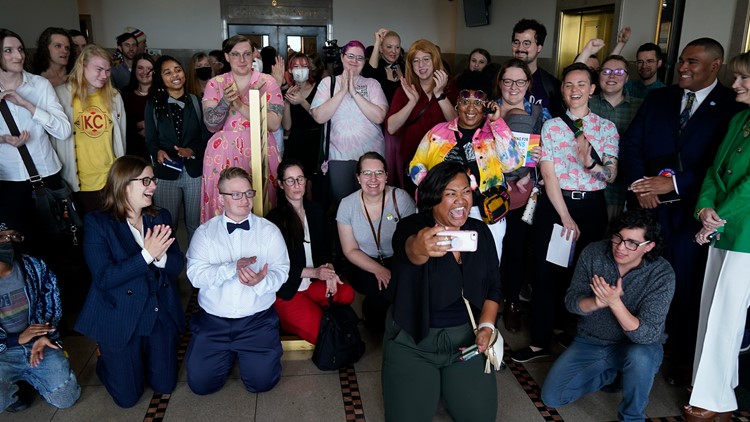
Supporters of a resolution that would make Kansas City, Mo, a sanctuary city for transgender people celebrate outside of city council chambers.
The recently passed resolution ensures that Kansas City will not prosecute or penalize anyone seeking, providing, or receiving gender-affirming care, including puberty blockers, hormones, or surgeries. Moreover, if the state enacts laws or resolutions imposing punishments or fines, city personnel have committed to making enforcement of such requirements their lowest priority.
Opponents of gender-affirming care, typically Republican lawmakers, argue that they are safeguarding children from decisions they may later regret. However, gender-affirming care for minors has been available in the United States for more than a decade and is supported by major medical associations.
Kansas City’s sanctuary status represents a significant step forward in protecting the rights and healthcare options of transgender individuals. By openly defying state legislation and providing a safe haven for gender-affirming care, the city is sending a powerful message of inclusivity and support for the LGBTQ+ community. The outcome of this resolution and ongoing legal battles will have broader implications for the rights and well-being of transgender individuals across the state of Missouri and potentially influence the national conversation on transgender healthcare rights.
“This is an important first step in Kansas City’s commitment to trans and nonbinary people,” Merrique Jenson, founder of Transformations KC, said in a written statement after the vote. “I look forward to trans leaders and Kansas City working together to address the health disparities in our communities and ways we can have sustainable funding & programming reaching all trans people.”







 fleeredstates.blog
You must be logged in to post a comment.