Although Rep. Jerry Schillinger’s measure didn’t explicitly name Zephyr, she is the only legislator to whom the rule would apply.
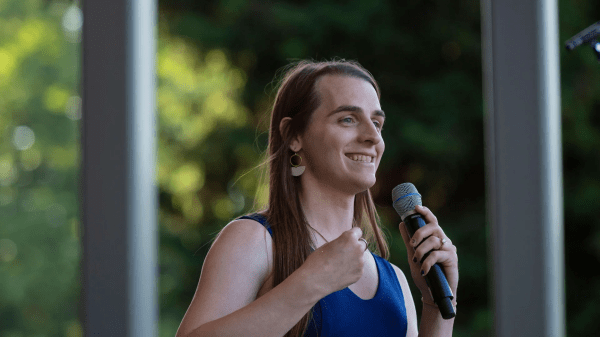
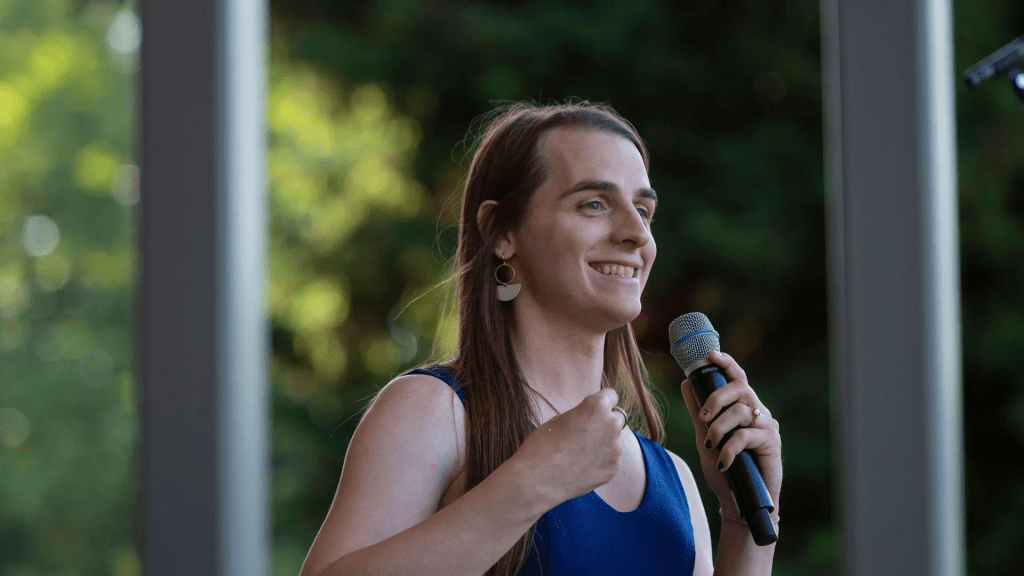
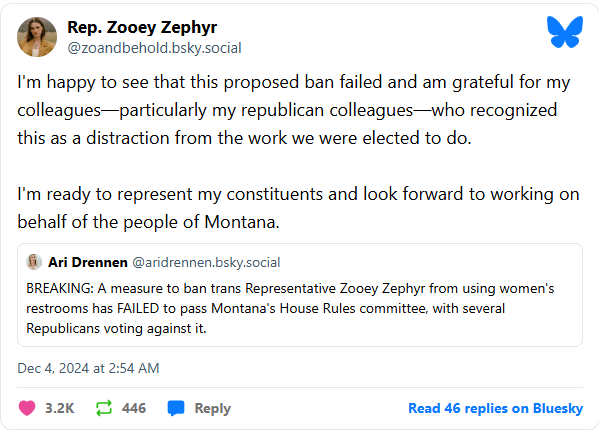
An attempt to bar Montana lawmaker Zooey Zephyr and other transgender women from using the women’s restroom in the State Capitol has failed, with several Republicans voting against the measure.
The Montana legislature’s joint rules committee voted down the proposal on Tuesday, according to the New York Times. The measure, introduced by Republican Rep. Jerry Schillinger, was unanimously opposed by Democrats, and some Republican lawmakers also joined in rejecting it. Although Zephyr was not specifically named in the measure, she is the only legislator to whom it would apply, as the rule would have required lawmakers to use restrooms corresponding to their sex assigned at birth, per CNN. Zephyr is also Montana’s first openly transgender woman to serve in the state legislature.
In a post on Bluesky Tuesday, Zephyr expressed relief, writing, “I’m happy to see that this proposed ban failed and am grateful for my colleagues, particularly my Republican colleagues, who recognized this as a distraction from the work we were elected to do.” She also told the New York Times via email that she plans to focus on issues like “housing and health care” in her legislative work moving forward.
According to the Times, Republican Rep. David Bedey argued during the committee meeting that such a rule would “have the effect of making people famous in the national news, and will not contribute to the effective conduct of our business.” Previous efforts to remove Zephyr from the legislature have indeed attracted significant national attention. In April 2023, Montana Republicans voted to censure Zephyr after she delivered an impassioned speech opposing a bill that would ban gender-affirming care for youth. As a result, she was barred from speaking in the legislature for the remainder of the session, although she retained her right to vote. Zephyr subsequently filed a lawsuit against the state, seeking to overturn the censure ruling, but a judge denied her petition, ruling that he lacked the authority to reverse the vote.Despite Republican efforts to censor her, Zephyr was re-elected to the legislature in November, securing 80% of the vote in her district. When she returns to the Capitol in 2025, Zephyr will finally be allowed to speak during floor debates for the first time in nearly two years.
Ugandan officials have expressed support for the incoming U.S. president.
As the results of the U.S. presidential election were revealed on November 5, showing that former President Donald Trump had secured a second term, homophobic political leaders in Uganda celebrated 7,000 miles away, in the capital city of Kampala.
“The sanctions are gone,” said Anita Among, Uganda’s parliamentary speaker, addressing members of parliament. She was referring to her previous U.S. travel ban imposed by the Biden administration on June 16, 2023, after Uganda passed the controversial “Kill The Gays” law on May 28, 2023.
The law, officially named the Anti-Homosexuality Act, was signed into effect by President Yoweri Museveni on May 28, 2023. The legislation imposes life imprisonment for same-sex acts, up to 20 years in prison for “recruitment, promotion, and funding” of same-sex “activities,” and the death penalty for those convicted of “attempted aggravated homosexuality.”
As the results of the U.S. presidential election were revealed on November 5, showing that former President Donald Trump had won a second term, homophobic political leaders celebrated 7,000 miles away in Uganda’s capital, Kampala.
“The sanctions are gone,” said Anita Among, Uganda’s parliamentary speaker, referring to the fact that she had been barred from entering the U.S. by the Biden administration on June 16, 2023, following Uganda’s passage of the “Kill The Gays” law on May 28, 2023.
The law, officially called the Anti-Homosexuality Act, was signed into law by President Yoweri Museveni on May 28, 2023. It mandates life imprisonment for same-sex acts, up to 20 years in prison for the “recruitment, promotion, and funding” of same-sex “activities,” and the death penalty for those convicted of “attempted aggravated homosexuality.”
On May 8, Among declared that the law’s enactment proved “the Western world will not come and rule Uganda.” The following day, she tweeted: “The president … has assented to the Anti-Homosexuality Act. As the parliament of Uganda, we have answered the cries of our people. We have legislated to protect the sanctity of [the] family. We have stood strong to defend our culture and [the] aspirations of our people,” thanking Museveni for his “steadfast action in the interest of Uganda.”
Among further stated that Ugandan MPs had resisted pressure from “bullies and doomsday conspiracy theorists” and urged the country’s courts to enforce the new law. The passage of this bill, along with Among’s and other African homophobes’ celebrations of Trump’s re-election, indicates the likely direction for Africa’s LGBTQ+ community over the next four years.
For years, political and religious leaders across Africa, including both Christian and Muslim zealots, have exploited homophobia to consolidate political and religious power. They claim that same-sex relations and gay rights are foreign imports from the West and use homophobia to position themselves as defenders of African values. By stoking fear and division, they galvanize popular support and votes.
However, as others have pointed out, homophobia itself is a Western import, rooted in colonial history. From sodomy laws inherited from colonial rule to the parliaments passing these laws today, the tools used by homophobes in Uganda and elsewhere in Africa are themselves colonial legacies.
And homophobia in Africa is intensifying.
In mid-March 2023, Museveni told the Monitor newspaper that “Western countries should stop wasting the time of humanity by imposing their social practices on us.” Kenyan President William Ruto echoed these sentiments in the same month, declaring that “our culture and religion does not allow same-sex marriages.”
On April 2, 2023, Museveni called on African leaders to reject “the promotion of homosexuality,” claiming that homosexuality posed a “big threat and danger to the procreation of the human race.” He further asserted that “Africa should provide the lead to save the world from this degeneration and decadence, which is really very dangerous for humanity.”
On December 29, 2023, Burundian President Evariste Ndayishimiye, speaking in Cankuzo province, made a defiant statement that powerful nations “should keep” their aid if it came with an obligation to extend rights to LGBTQ+ people. He added, “If we find these people in Burundi, they should be taken to stadiums and stoned, and doing so would not be a crime.”
In Ghana, lawmakers have been debating the Proper Human Sexual Rights and Ghanaian Family Values Bill, which was introduced in August 2021. Under current law, same-sex relations are punishable by up to three years in prison. However, the new bill criminalizes even identifying as LGBTQ+, outlaws being transgender, and introduces jail sentences of up to 10 years for advocating for LGBTQ+ rights. It also mandates that all citizens report perceived LGBTQ+ individuals or activities to the authorities.
The bill passed in the Ghanaian parliament on February 28, though President Nana Addo Dankwa Akufo-Addo has not yet announced whether he will sign it, pending the outcome of two Supreme Court cases challenging its constitutionality. On July 17, the Supreme Court postponed a ruling on the bill until all legal challenges are resolved.
Former Ghanaian President John Dramani Mahama, a leading candidate in the upcoming elections, expressed his opposition to same-sex marriage and transgender rights. He stated during a meeting with clergy in eastern Ghana, “The faith I have will not allow me to accept a man marrying a man, and a woman marrying a woman.” He also rejected the notion of someone changing their gender, stating, “I don’t believe that anyone can get up and say I feel like a man although I was born a woman and so I will change and become a man.”
In Kenya, opposition parliamentarian Peter Kaluma introduced the Family Protection Bill in February 2023. The bill, which mirrors aspects of Uganda’s law, would impose prison sentences of up to 10 years or even the death penalty for same-sex relations. The bill is currently being reviewed by a parliamentary committee, with a full vote expected soon. President William Ruto, an evangelical Christian, has endorsed this legal crackdown on LGBTQI+ rights.
In Mali, the National Transitional Council, effectively the country’s legislature after a military coup in 2020, approved a new penal code on October 31 that criminalizes same-sex relations by 132 votes to one. The exact penalties for same-sex acts remain unclear, but the Justice and Human Rights Minister, Mamadou Kasogue, confirmed that “anyone who indulges in this practice, or promotes or condones it, will be prosecuted.”
Trump’s foreign policy advisors are already preparing an explicitly anti-LGBTQ+ rights agenda for his second term. The Project 2025 report, crafted under the guidance of the Heritage Foundation, proposes that the U.S. “stop promoting policies birthed in the American culture wars” and cease pressuring African governments to respect human rights, including LGBTQ+ rights, women’s rights, and abortion rights.
The report claims that “African nations are particularly (and reasonably) non-receptive to the US social policies such as abortion and pro-LGBT initiatives,” and suggests that the U.S. should focus on “core security, economic, and human rights engagement” without promoting “divisive policies that hurt shared goals.”
The implementation of this policy shift on LGBTQ+ rights in Africa will be overseen by Trump’s nominee for Secretary of State, Marco Rubio, and his selection for Assistant Secretary of State for African Affairs. They will be tasked with promoting and funding homophobic groups across the continent, a strategy that is expected to be pursued with enthusiasm.
While African leaders claim they are defending the continent from Western influences, they are in fact advancing their own agendas, often in partnership with right-wing Christian nationalists in the West. However, LGBTQ+ communities in both Africa and the West share a common interest in resisting these attacks, and civil society groups, along with human rights advocates, are increasingly active. As LGBTQ+ activist Eric Gilari from Kenya stated, “One day we shall defeat these assaults on our human rights and triumph in equality and inclusion for LGBTQ persons within African countries. This ideal must be our guiding light in this moment of darkness and tears.”
“I want everyone to be treated fairly,” Trump told TIME, apparently without irony.
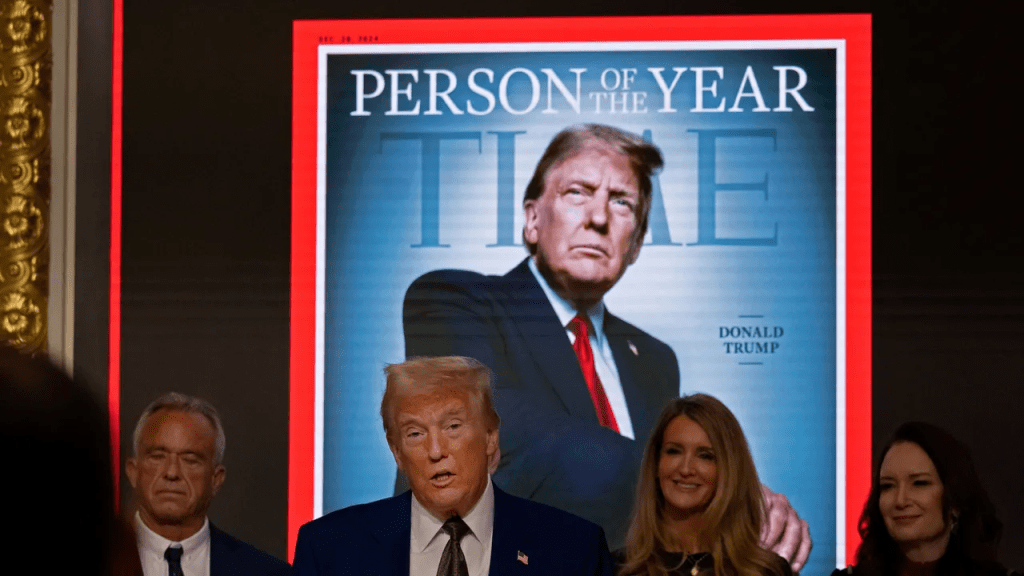
In an interview with TIME magazine this week, President-elect Donald Trump expressed confusion over the growing attention to transgender issues, stating that he didn’t understand where all the fuss was coming from, but that “we’re all trying to find the guy who did this.”
In a surreal “Person of the Year” interview published Thursday, Trump made a series of false and misleading statements on various topics, including vaccines, immigration, and military policy. When asked about his views on transgender rights and his campaign’s aggressive anti-trans ad campaigns, Trump offered vague responses, emphasizing his desire for “all people [to be] treated fairly.” When the TIME staff reminded him of his 2016 comments supporting equal public bathroom access for trans individuals, Trump avoided the issue, stating he would not “get into the bathroom issue.” He then, somewhat ironically, claimed that the debate had “ripped apart our country.”
“I am a big believer in the Supreme Court, and I’m going to go by their rulings… but we’re talking about a very small number of people, and it gets massive coverage, and it’s not a lot of people,” Trump told TIME.
When asked about his “Kamala is for They/Them” ad campaign, which flooded the U.S. with over $200 million worth of anti-trans attack ads this year, Trump once again sidestepped a direct response. Instead, he portrayed himself as a champion of fairness. “I mean, Trump is definitely for us, okay? And ‘us’ is the vast, vast majority of people in this country. And also, I want to have all people treated fairly. You know, forget about majority or not majority. I want people to be treated well and fairly,” he said.
Trump’s remarks, however, gloss over his prominent role in stoking transphobia for political gain. Both the Republican Party and Trump himself have spent years pushing an increasingly anti-trans agenda, which some experts see as a strategic move to solidify support among evangelical voters. On the campaign trail, Trump decried what he called “transgender insanity” and promised to effectively ban gender-affirming care for trans youth. When asked if he would repeal President Biden’s trans-inclusive changes to Title IX—something he has vowed to do—Trump said he would “look at it very closely.”
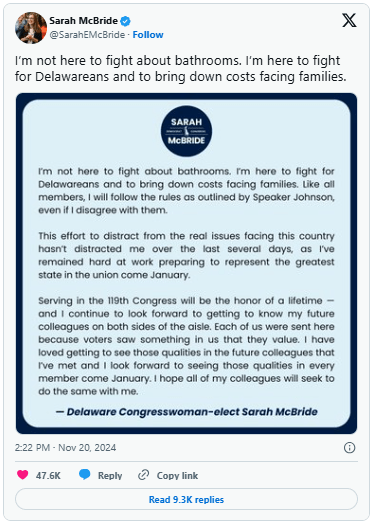
Trump also expressed agreement with Delaware Representative-elect Sarah McBride’s statement that Congress should be “focused on more important issues,” as TIME phrased it in their question to the President-elect. McBride, who recently won her election, has reportedly told fellow Democrats that Republican attacks against her—particularly the push by Reps. Nancy Mace and Mike Johnson to restrict Capitol bathrooms based on sex, following her November victory—are mere distractions. She has since stated in a press release that she is “not here to fight about bathrooms.” Reactions from the trans community to McBride’s stance have been mixed, with some telling The Advocate this week that they believe she should be more vocal in opposing such restrictions. The bathroom proposals, if enacted, would primarily affect trans staffers and visitors to the Capitol, as each member of Congress has a private bathroom in their office. Mace has since expanded her proposal to include public parks, government offices outside Capitol Hill, and other public spaces. Them reached out to McBride for comment but did not receive a reply by the time of writing.
Later in the interview, Trump misgendered and spread misinformation about trans athletes, claiming that Americans “don’t want to see a girl get beat up in a boxing ring by a man”—likely referencing boxer Imane Khelif, who is not transgender but was the subject of an anti-trans backlash at this year’s Olympics. Khelif also appeared in an early-November Trump ad. “People don’t want to see, you know, men playing in women’s sports… They don’t want to see all of this transgender [stuff], which is—it’s just taken over,” Trump added.
At various points in the interview, Trump reiterated false claims, including tying vaccines to autism—a debunked conspiracy theory that has nevertheless been endorsed by Robert F. Kennedy Jr., whom Trump has selected as his pick for Secretary of Health and Human Services. He also distanced himself from Project 2025, the Heritage Foundation’s manifesto for his presidency, despite already nominating at least five of its contributors for government positions. Trump told TIME that he disagreed with parts of Project 2025, calling it “inappropriate” that it was published before the election. His own “Agenda47” platform largely mirrors Project 2025, though it notably excludes some of the more controversial elements of the Heritage document, such as a universal ban on pornography.
As with many of Trump’s interviews, it’s unclear whether he truly believes or will act on any of the statements he made to TIME. A 2021 tally by The Washington Post found that Trump made roughly 30,573 false or misleading claims during his first term. Among those, his assertion that he was a “real friend” to LGBTQ+ people might stand out as one of the biggest exaggerations.
Ohio Governor Approves Ban on Transgender Students Using Preferred Bathrooms
Texas Transgender Community Fights Back After Capitol Bathroom Ban
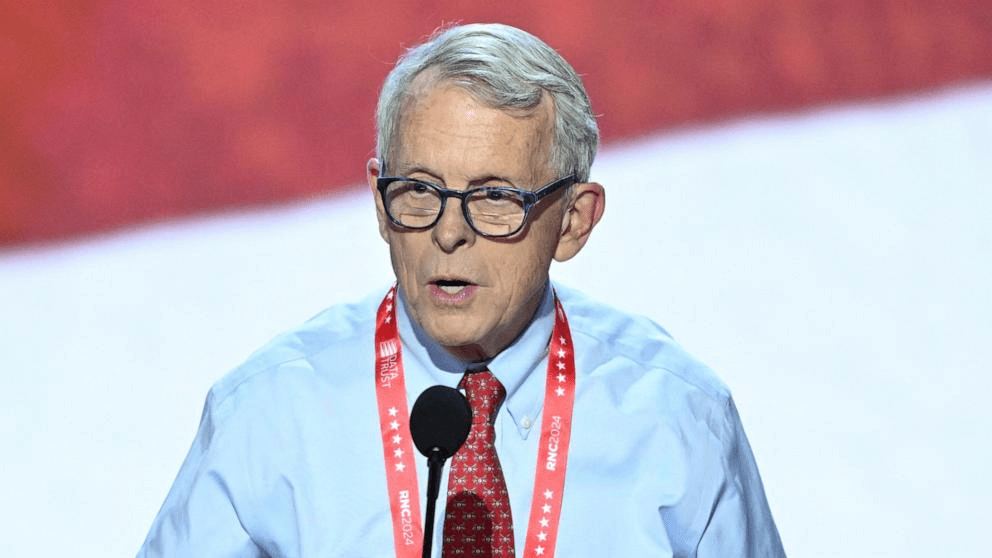
Residents of Odessa, Texas, are speaking out after the city council amended a local ordinance to ban transgender individuals from using public restrooms that align with their gender identity. Meanwhile, in Ohio, Republican Governor Mike DeWine has signed a law banning transgender students from using bathrooms that correspond to their gender identity. The new legislation mandates that students in K-12 schools, as well as colleges and universities, must use the restroom or facility designated for their sex assigned at birth.
The law clarifies that it does not prohibit schools from constructing single-occupancy restrooms and allows individuals of the opposite gender to enter a bathroom to assist someone else, if necessary.
MORE: Congressional Bathroom Ban Adds to Growing Transgender Policy Debate
Ohio now joins at least 14 other states in restricting transgender individuals from using bathrooms that match their gender identity, according to the Human Rights Campaign.
Supporters argue that the ban addresses concerns about student privacy and safety, while critics contend that it fuels baseless fears about transgender students and could put them at greater risk of discrimination or harm.
Governor DeWine’s office did not respond to ABC News’ request for comment prior to the bill’s signing. However, in the summer, he told reporters that he was reviewing the “specific language” of the legislation.
“I’m supportive of kids being able to use bathrooms that align with their gender assigned at birth for their protection, but I’ll need to review the specific language of the bill,” DeWine told reporters.
Transgender healthcare, bathroom access, sports participation, and other related issues have become central to the Republican legislative agenda across the country in recent years. This trend has led to a surge in anti-LGBTQ bills, with hundreds introduced during the 2024 legislative session alone, according to the American Civil Liberties Union.
DeWine has occasionally bucked the state’s Republican leadership on transgender matters. In December 2023, he vetoed a bill that would have banned gender-affirming care for transgender youth, including restrictions on puberty blockers, hormone therapy, and surgeries.
He claimed that his experience delivering babies proves that transgender people don’t actually exist, though his argument remains unclear.
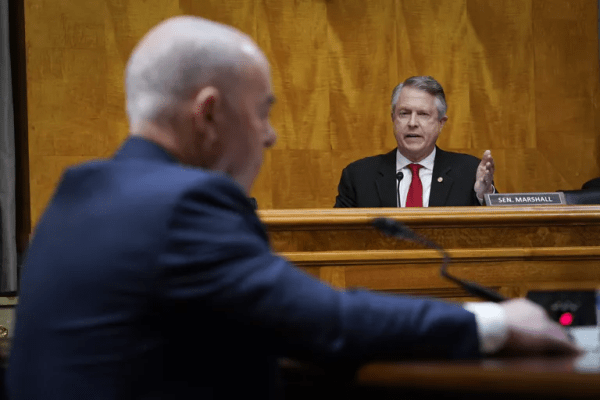
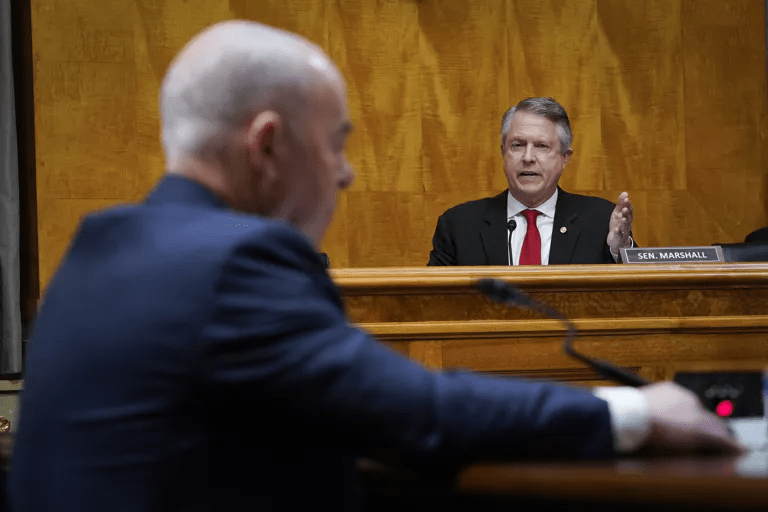
Washington, D.C. — Senator Roger Marshall (R-Kansas) questioned Secretary of Homeland Security Alejandro Mayorkas at a Senate Homeland Security and Governmental Affairs Committee hearing focused on the President’s proposed budget request for the Department of Homeland Security for fiscal year 2025. The hearing examined resources and authorities requested to protect the homeland.
This week, Sen. Marshall introduced the “Defining Male and Female Act of 2024,” a bill aimed at legally erasing the recognition of transgender individuals. Marshall argued that the bill is a response to what he describes as the Biden administration’s effort to “replace biological sex with dangerous radical gender ideology.”
The proposed legislation consists largely of definitions, with terms like “father” and “girl” now explicitly tied to the words “male” and “female.” Under the bill, “male” and “female” are defined as individuals who “naturally have, had, will have, or would have, but for a congenital anomaly or intentional or unintentional disruption, the reproductive system that at some point produces, transports and utilizes sperm or eggs for fertilization.”
Marshall claims the bill would prevent transgender individuals from participating in school sports and ensure “sex separation” in spaces like restrooms, locker rooms, dorms, prisons, and shelters for victims of sexual assault.
“As a physician who has delivered over 5,000 babies, I can confidently say that politicizing children’s gender and using them as pawns in a radical woke agenda is not only wrong, it is extremely dangerous,” Marshall said. However, his experience as a former OB/GYN does not make him an expert on transgender issues. “We must codify the legal definition of sex based on science, not feelings. With this legislation, we can fight back against the Biden-Harris Administration’s assault on our children.”
Marshall’s assertion that the Biden administration is behind the existence of transgender people is inaccurate; transgender individuals have existed long before Biden’s presidency and will continue to exist long after it. Transgender people are not an “ideology”; they are human beings.
A similar bill was introduced in July in the House of Representatives by Rep. Mary Miller (R-IL), who also claimed her bill would prevent Title IX protections from applying to transgender people. However, the argument that transgender individuals are not protected by Title IX hinges on the notion that discrimination based on gender identity is discrimination based on sex assigned at birth. In other words, if a school allows cisgender girls to compete on a sports team but excludes transgender girls, this constitutes discrimination based on sex, as the only difference between the two groups is their sex assigned at birth. Title IX bans sex-based discrimination in education.
While Marshall’s bill is unlikely to pass in the current Senate controlled by Democrats, its introduction could signal plans to reintroduce it next session when Republicans are projected to regain control of the chamber.
The nine-day trial featured witnesses with varying levels of credibility.
A Missouri county judge has upheld the state’s ban on gender-affirming care for minors.
In a 74-page ruling issued on Monday, Wright County Circuit Court Judge Craig Carter stated, “If we don’t let a 16-year-old buy a six-pack of beer and a pack of cigarettes, or allow an adult to purchase them for the teen, should we permit the same child and parent to decide to permanently alter the teenager’s sex?”
The restrictions on gender-affirming care, passed by Missouri lawmakers in 2023, prohibit minors from using hormones, puberty blockers, and undergoing gender-affirming surgeries. The law also blocks state funding for gender-affirming care for adults through Medicaid and for incarcerated individuals in state prisons.
The ACLU of Missouri and Lambda Legal have promised to appeal the ruling.
Judge Craig Carter acknowledged the “ethical minefield” of the case, writing that “the medical profession stands in the middle” with “scant evidence to lead it out.”
The nine-day trial featured witnesses of varying credibility, with the state’s Solicitor General Joshua Divine introducing partisan politics into the proceedings. Some experts presented research that had been retracted, which the plaintiffs argued was problematic. Divine maintained that the scientific community had dismissed the research due to “cancel culture.”
Carter’s ruling was partly based on testimony from Jamie Reed, a whistleblower who previously worked at the Washington University Transgender Center at St. Louis Children’s Hospital. Reed’s affidavit helped inspire the gender-affirming care ban. She testified that the hospital treated many patients with mental health issues without comprehensive psychological evaluations. There was disagreement at trial over whether a licensed therapist’s evaluation was sufficient for gender-affirming care, or if a psychologist or psychiatrist was required.
The judge found Reed’s testimony credible, noting, “Her testimony does not arise from any ideological or other bias.” He also pointed out that Reed is married to a transgender individual.
Reed is now the executive director of the LGBT Courage Coalition, an advocacy group that opposes gender-affirming care for minors. The day before she testified, her partner announced he was discontinuing testosterone treatments and “detransitioning.”
While Carter accepted Reed’s credibility, he was less convinced by some of the plaintiffs’ witnesses. He expressed concerns about deferring to organizations like WPATH, which the plaintiffs relied on. WPATH, the World Professional Association for Transgender Health, is a professional group that sets standards for gender-affirming care, but Carter noted that it self-describes as being “committed to advocacy.”
Ultimately, Carter’s ruling emphasized U.S. Supreme Court precedent that grants lawmakers broad discretion in areas “fraught with medical and scientific uncertainty.” He concluded that there is “an almost total lack of consensus as to the medical ethics of adolescent gender dysphoria treatment,” and therefore, the state legislature has the authority to ban the care.
She had to slog through deep snow to remove them herself.
Hateful flyers circulated in Billings, Montana, falsely accusing local trans activist Adria Jawort of “grooming children,” according to local news outlet KTVQ. The flyers, which perpetuate the false narrative from the anti-trans right that all trans people are pedophiles, were posted near schools in Jawort’s neighborhood just days before Thanksgiving.
Jawort had to travel across town in heavy snow to remove the flyers herself.
“I was annoyed about it,” she told KTVQ, describing how the flyers misgendered her and made hateful claims about her life and sexuality. “I was just thinking, why am I doing this? Why do I have to do this? Why do people think this is okay?”
“The thing the flyer said, calling me a groomer and stuff, and basically labeling me as a danger to the community,” Jawort added. “It’s like one of the most awful things you can say. How does that become normalized?”
Billings police are currently investigating the incident. Lt. Matthew Lennick spoke on what constitutes hate speech: “Once someone transitions from making a general statement about their beliefs or another group to a targeted attack on an individual… a victim could take civil action against someone attempting to defame them.”
Possible criminal charges could include disorderly conduct, stalking, intimidation, or harassment, among others.
While Jawort knows the group responsible, she says she’s more frustrated by the ongoing attacks on state Rep. Zooey Zephyr (D-MT). Recently, Republicans unsuccessfully attempted to ban her from women’s bathrooms.
Jawort has been targeted before. Last year, a lecture she was set to give at a library was canceled after a drag ban, with staff citing concerns that hosting a transgender person posed “too much of a legal risk.” This led her to file a lawsuit against the state.
With Trump potentially returning to office, I’m concerned that more transgender people will be denied the right that had such a profound impact on my life.
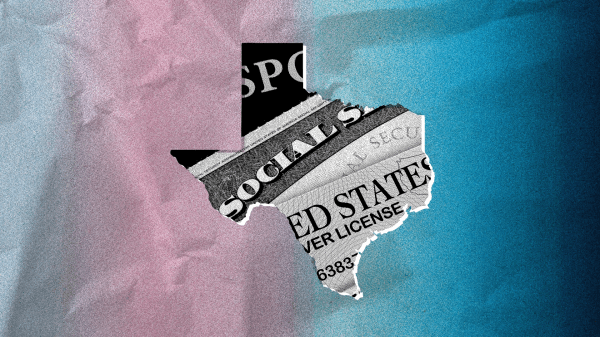
When I learned on August 21st that the Texas Department of Public Safety had quietly revoked the ability to change your gender on driver’s licenses and birth certificates, I was stunned. Devastated. The already daunting process of officially changing one’s name and gender marker had just been taken away. Trans Texans are now stripped of a right that once allowed me to live with less fear. And as Donald Trump nears a potential return to office, many are fearful that trans Americans nationwide could face the same loss.
On a random Tuesday in December 2020, I made the decision to start hormone replacement therapy (HRT). By then, I had been using they/them pronouns for two years and had undergone top surgery eight months earlier. For years, I had thought about beginning HRT, hoping it would help me escape a life where people assumed I was a woman based solely on my appearance. That day, I finally felt ready to silence the voices in my head telling me I’d be letting others down by embracing who I truly was. I was ready to step out of the shadows—out of the expectations others placed on me—and into my own light. I went to an LGBTQ+ clinic, got a prescription for testosterone, and, in that moment, I felt like my life was finally beginning.
And then everything changed.
By April 2021, my voice had deepened, stubble began appearing on my face, and I no longer had a period—physical changes I embraced with open arms. Strangers began noticing too, and suddenly, I was being treated differently. The looks I once got as a perceived butch lesbian shifted to confused stares, discomfort, and sometimes, outright disdain.
‘Dropping off flowers for your wife?’ a receptionist at a gynecologist’s office asked me that same April. ‘Not quite,’ I replied with a nervous laugh. ‘I’m here for an appointment.’ As is customary, I handed over my ID. She glanced at it—name: [something I no longer go by], sex: F—then looked back at me, clearly unsure how to reconcile the mismatch. She called over a coworker, whispering about what to do in this ‘situation.’ I stared at my phone, trying to stay calm as the coworker muttered, ‘Just check her in.’ And she did. I sat down, feeling that familiar discomfort of my presence unsettling others.
Throughout that entire doctor’s appointment, I was treated as though my body was something entirely unique—as if I were the only person who had ever transitioned. In moments like these, I try to chalk it up to ignorance, reminding myself that 71% of Americans say they’ve never met a trans person. But at what point does ‘ignorance’ become too generous?
This same scenario unfolded at the club when bouncers checked my ID, when people hesitated to call me ‘sir’ or ‘ma’am’ as they guided me to a table at restaurants, or when customer service reps asked me twice as many security questions as they did for others. And every time I needed to use the bathroom, I had to make the decision: men’s or women’s? At best, I was made uncomfortable for a few seconds. At worst, I was subjected to slurs or threats of violence. In all those moments, I told myself, ‘It’s no big deal’—as though it were no big deal for my mere existence to constantly puzzle or disturb people. The very fact of my body made others treat me as if I were a problem. I came to expect discomfort every time I stepped outside my door.
Every time I grabbed my keys, phone, and wallet, I weighed the emotional and physical risks of venturing out into the world. This constant calculation is why some trans people delay medical care or feel disconnected from the world around them. It’s also why, after two years on HRT, I finally decided to change the name and gender marker on my ID. But this was not a decision I made lightly.
Until August, changing your name and gender marker in Texas cost $350 (plus lawyer fees, unless you could prove you couldn’t afford it). You also needed a doctor’s note stating that you were ‘receiving clinically appropriate treatment related to your gender identity.’ (The pathologizing of transness is its own burden.) Once you had those documents and filled out a ‘Petition to Change the Name and Sex/Gender Identifier of an Adult’ form, you had to appear before a county judge. That judge could deny your petition for any reason—or no reason at all. It was a request, not a guarantee. In Texas, trans people often seek advice from other trans folks about which counties to target, because not all judges are inclusive. Many travel from across the state to Austin, the third-queerest city in the U.S., in hopes of a more supportive judge. Even then, judges can demand more ‘proof’ than the law requires. In a state where anyone can change their last name after marriage with minimal hurdles, trans people are forced to jump through countless hoops just to have their gender recognized.
It took a month for me to get a letter from a doctor. Another month passed before I could find time to go to the courthouse, which was only open during regular work hours—a schedule that most people can’t easily accommodate. When I finally arrived at the Travis County office, I sat for two hours waiting to be helped. A county clerk, who had warmly greeted other patrons, glanced at my petition and abruptly told me, ‘If you aren’t finished with your papers, we can’t help you.’ Despite the cold reception, I was determined to get this done—to untangle the mess of living as a visibly trans person. I handed in my request, and six weeks later, I received an email with a PDF confirming that my petition had been approved.
Afterward, I spent months updating my name and gender marker on my driver’s license, social security card, passport, and a slew of other official documents. One might ask, ‘Why would anyone willingly sign up for such a cumbersome and clearly prejudiced process?’ The answer is simple: I needed it. My body not matching the letters on my ID had become a life-threatening issue. Without the change, I’d still be trapped in the daily hell of being put in emotional and physical danger. Not all trans people feel the need to change their name and gender marker, but for me, it was crucial. Because this option was available, I’ve been able to build a new life.
The difference between my life from April 2021 to September 2022—when I didn’t ‘look like a girl’ but still had a feminine name and sex on my ID—and now is like night and day. I can hand over my ID and no longer feel like I’m putting myself in harm’s way. It says ‘Kaybee,’ Sex: M (though that still doesn’t feel right, since Texas hasn’t offered an X gender marker yet). Now, when I pass over a piece of plastic, I no longer feel like I’m outing myself or offering my life up for judgment.
In the same month that Texas reversed the right to change your name and gender marker, Trump announced he would sign an executive order banning gender-affirming care for trans youth on his first day back in office. As if it isn’t enough that Governor Greg Abbott, Lieutenant Governor Dan Patrick, Texas Attorney General Ken Paxton, and a whole host of other Texas politicians have pushed so much misinformation about the trans community that people now feel emboldened to mistreat us. As if it’s not enough that Texas attempts to pass transphobic laws every year.
Everything about this group of people—who could never understand what it’s like to hand over an ID that doesn’t match how the world sees you—fills me with disgust. They don’t know even a fraction of what people like me go through, just to live authentically.
Yes, I still have to explain to medical providers that my legal sex and my sex assigned at birth are not the same. Yes, I still out myself every time I take off my shirt, revealing the two beautiful top surgery scars that are part of my journey. My goal was never to ‘pass’ as cis, or to meet the ridiculous expectations that transphobes project onto us. My goal has always been to be myself. Safely.
Trump’s inauguration is on January 20th, and the next Texas legislative session—the period when most anti-trans laws will be debated—starts just a week earlier, on January 14th. In preparation, Texas lawmakers have already prefiled 34 anti-trans bills for the 2025 session. Now is the time to act, to support and defend the psychological and physical safety of trans people. I will be contributing both money and volunteer hours to the Transgender Education Network of Texas. This BIPOC-led organization fights anti-LGBTQ+ laws daily, and they offer a wealth of resources on their website, including guidance on how to file discrimination complaints with the U.S. Department of Health and Human Services.
Despite the wishes of those who seek to erase us, trans people like me will be part of the future of Texas—and beyond.
I long for a Texas where trans people don’t just survive, but thrive. We deserve safety here, in the Lone Star State, and anywhere else we choose to be. I spent too much time living under an identity that wasn’t mine, but I was able to change it. Everyone else deserves the same right to do so.
Why Allies Must Act: Defending Trans Rights Protects Everyone’s Freedoms
As the election dust settles, the focus shifts to practical realities. For transgender people like me, a pressing question looms: What actions will this new Trump administration take?
It’s tempting to jump to extreme conclusions—like the idea of being rounded up and placed in camps. But it likely won’t look like that. There won’t be “camps,” nor will there be overt “rounding up.” Instead, the approach will be more subtle, and that subtlety is precisely what makes it so dangerous.
The quiet nature of these changes will make them easier for cisgender people to overlook. However, their awareness is vital—not only for our survival but for their own protection, as the erosion of trans rights often signals broader attacks on freedoms that could ultimately affect everyone.
The groundwork for trans oppression is already being laid. In recent years, Republicans have pursued anti-trans legislation with alarming intensity, proposing over 1,000 laws targeting everything from medical care and bathroom usage to IDs, sports, and even how we dress. Trump has vowed to push similar policies at the federal level, and Project 2025 outlines an even more expansive agenda.
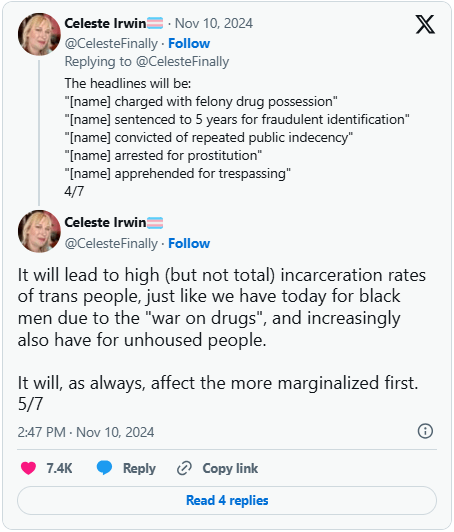
To understand what trans oppression under Trump might look like, we can look to other marginalized groups. For instance, the mass incarceration of Black men wasn’t achieved through blatant decrees like “round them up” but through systemic oppression: harsh laws with disproportionate penalties, over-policing, and economic barriers that strip away basic human needs. Trans people have already faced similar tactics, such as laws criminalizing “cross-dressing” to police our existence.
Under another Trump administration, this oppression might escalate. It could involve banning hormone replacement therapy and criminalizing those who seek it out. Policies might mandate that gender markers on IDs match sex assigned at birth, penalizing those of us who continue to live authentically with fraud or perjury charges. Involuntary commitment to mental institutions could even be a reality.
These measures, even if sporadically enforced, create an ever-present climate of fear—a psychological toll that leaves us constantly bracing for the next law, the next crackdown, the next violation of our humanity. And in this hostile environment, the silence or complacency of cisgender allies would make it all the easier for these oppressive systems to thrive.
The coming years will likely see escalating attacks on trans people, particularly the most marginalized among us—trans women of color, disabled trans people, and others who already face significant barriers. These policies will make it harder for them to access stable employment and lead precarious lives, amplifying systemic inequities.
We cannot wait for something as blatant as a “lock up all the trans people” decree. The oppression will come in quieter, more insidious forms: laws and policies that restrict our rights to healthcare, employment, and basic expression. Even if trans people comply with these laws, the result will still be a kind of prison—a life stripped of autonomy and dignity.
If you are cisgender, we need your help. Not just because it’s the right thing to do, but because these attacks on trans rights will eventually pave the way for attacks on your rights. Consider abortion access: for decades, conservatives framed their arguments around “protecting life” to avoid addressing bodily autonomy directly. But the fight against gender-affirming care removes that pretense altogether. By banning medically supported, evidence-based care simply because they don’t like it, lawmakers set a dangerous precedent that could extend to other healthcare decisions.
Your body could be next.
Employment and education are also at risk. Imagine a national “Don’t Say Gay/Trans” policy that bars teachers like me—who are openly transgender—from the profession. Policies like these won’t stop at targeting trans people. Deadnaming and misgendering trans students could morph into strict gendered dress codes for everyone, eroding freedom of expression for all students. What starts as an attack on trans rights often metastasizes into broader assaults on personal liberties.
As we approach January 20th, now is the time to act:
Get involved: Connect with your local LGBTQ+ center and see how you can support their efforts.
Stay informed: Follow trans journalists and activists to keep up with the latest developments.
Advocate: Write to your representatives in both parties, showing them that you stand with trans people.
Speak out: Use your voice, wear supportive messages, and engage your cisgender friends to build awareness.
Support trans people directly: Check in with your trans friends, especially now, as they navigate a political climate fueled by over $200 million of anti-trans rhetoric during the election. Let them know you’re there for them.
This isn’t just about protecting trans people—it’s about preserving freedom and dignity for everyone. Together, we can resist these threats and build a future where everyone has the right to live authentically.
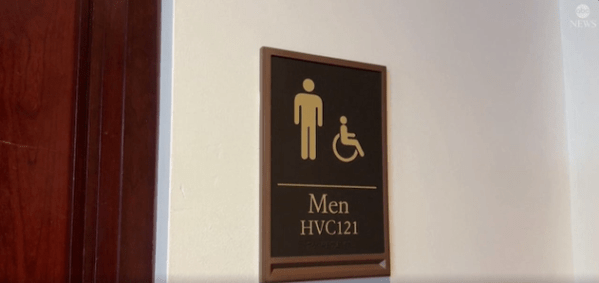
New Policy by Speaker Johnson Mandates Capitol Facilities Be “Reserved for Individuals of That Biological Sex”
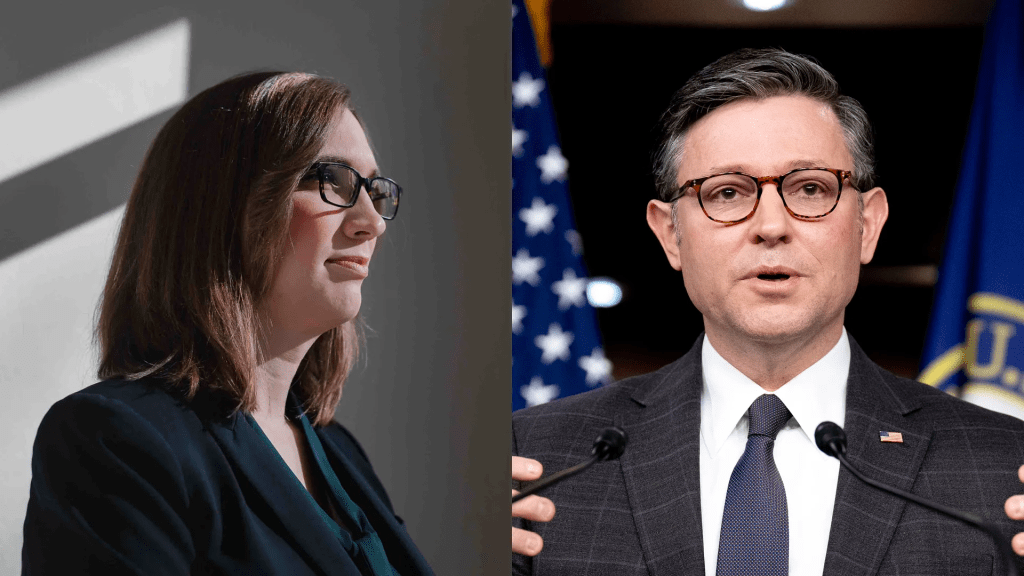
Speaker Mike Johnson Announces Policy Banning Transgender Women from Women’s Restrooms and Changing Facilities on Capitol Hill, Likely Targeting Rep. Sarah McBride
Speaker Mike Johnson Declares Capitol and House Office Building Single-Sex Facilities Reserved for Individuals of Biological Sex in Statement Released on Trans Day of Remembrance.
Speaker Mike Johnson Defends New Bathroom Policy, Targeting Rep. McBride, as GOP Figures Push for Bathroom Ban
Speaker Mike Johnson’s new policy, which reserves single-sex facilities in Capitol Hill for individuals of their biological sex, has sparked controversy, especially as it coincides with Trans Day of Remembrance. Johnson emphasized that each member of Congress has access to a private bathroom but insisted, “women deserve women’s only spaces.” In previous remarks, Johnson reiterated his belief that “a man cannot become a woman,” further fueling criticism of his long history of anti-LGBTQ+ statements.
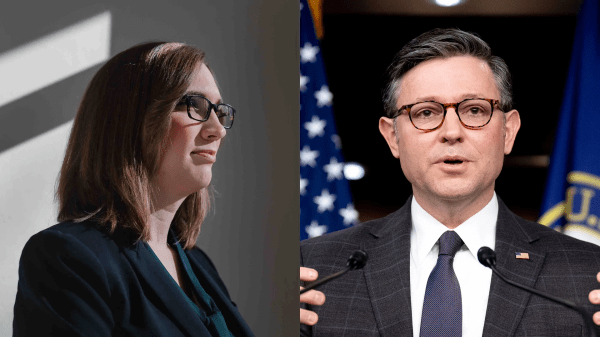
The policy appears to specifically target Delaware Rep. Sarah McBride, the first out transgender woman elected to Congress. McBride has become a focal point of the debate as South Carolina Rep. Nancy Mace introduced a resolution for a formal bathroom ban in the House, directly aimed at McBride. Mace referred to herself as “[a] Full TERF” and dismissed McBride’s right to access women’s private spaces.
In response, McBride urged Democrats to disregard these anti-trans actions, framing them as a distraction from more pressing issues. “This is a blatant attempt from far right-wing extremists to distract from the fact that they have no real solutions to what Americans are facing. We should be focused on bringing down the cost of housing, health care, and child care, not manufacturing culture wars,” she said in a statement. McBride later posted on social media, emphasizing her focus on fighting for Delawareans rather than engaging in debates over bathrooms.
LGBTQ+ Advocates Warn Against Dismissing GOP Anti-Trans Policies as Distractions
While Rep. Sarah McBride has urged her fellow Democrats to focus on issues like healthcare and housing instead of engaging in culture wars, some LGBTQ+ advocates argue that the GOP’s anti-trans policies should not be ignored or treated solely as distractions. Jeff Main, cofounder of the trans-led nonprofit Point of Pride, emphasized that these proposals are real threats.
“In addition to being a distraction, these proposals are direct threats,” Main told CBS News Philadelphia. “It’s more than just access to a bathroom or healthcare. It’s about existing. It’s about our right to live authentically, safely, and with pride.” Main expressed concern over the broader implications of these policies for the trans community, stressing the importance of defending basic rights and safety.





 fleeredstates.blog
You must be logged in to post a comment.