TALLAHASSEE, Fla. — A federal judge has determined that Florida’s ban on transgender health care discriminates against state employees and breaches their civil rights.
Chief U.S. District Judge Mark Walker ruled on Thursday that the state’s ban contravenes Title VII of the Civil Rights Act of 1964, which safeguards employees and job applicants from discrimination based on race, color, religion, sex, and national origin.
The lawsuit, filed in 2020, was brought by three current and former state employees against the Florida Department of Management Services. They challenged the state’s exclusion of coverage for “gender reassignment or modification services or supplies,” arguing it denied them medically necessary treatment for gender dysphoria.
Represented by Southern Legal Counsel, the ACLU of Florida, and Legal Services of Greater Miami, the plaintiffs argued that the state’s policy unfairly targets transgender employees.
Southern Legal Counsel attorney Simone Chriss expressed gratitude for the ruling, stating, “We are thankful the court is holding the state accountable for its discriminatory policy that treats transgender employees unequally. There is no valid reason to deny coverage for necessary treatment for gender dysphoria while covering other medical conditions.”
Judge Walker highlighted that health and pension benefits are integral to employee compensation, and denying these benefits based on sex effectively denies employment opportunities based on sex. He emphasized that medical treatment should be tailored to individual needs rather than imposed through blanket exclusions.
A trial will be scheduled to determine the damages owed to the plaintiffs.
The Florida Department of Management Services and the governor’s office have not yet responded to requests for comment from The Associated Press.
In a significant ruling, the Nebraska Supreme Court voted 6-1 to uphold a ban on gender-affirming care and abortion restrictions beyond 12 weeks of pregnancy.
The case, Planned Parenthood of the Heartland v. Hilgers, challenged Legislative Bill 574, which restricts abortions after 12 weeks and limits gender-affirming care for minors. The Nebraska legislature passed the bill in 2023, and it was signed into law by the governor in May. In response, the ACLU of Nebraska, representing Planned Parenthood of the Heartland, filed a lawsuit against Attorney General Michael Hilgers.
The ACLU contended that the bill violated the Nebraska Constitution’s single-subject rule, which mandates that a bill should focus on only one subject. However, the court found that both abortion and gender-affirming care are medical procedures, making it acceptable for the bill to address both issues.
The court stated, “We disagree with Planned Parenthood’s contention that it is not possible to identify a single purpose of L.B. 574 that withstands single subject scrutiny. L.B. 574 does regulate both abortion and gender-altering care, but both abortion and gender-altering care are medical procedures, and L.B. 574 prescribes rules that define if and when such procedures can be performed.”
Justice Lindsey Miller-Lerman was the sole dissenter, offering a partial dissent. She argued that the bill’s unrelated provisions did not adequately meet the single-subject requirement, stating, “Unrelated provisions that happen to do similar things at some level of generality do not dispel the criticism that the bill contains more than one subject.”
Mindy Rush Chipman, executive director of ACLU of Nebraska, expressed disappointment with the ruling. “We respectfully disagree with the court majority’s determination, and we had hoped for a different outcome. However, it is crucial that Nebraskans remain aware of the impact these restrictions will have. Nebraskans have been affected every week since the governor signed LB 574 into law. Despite this setback, we will continue to fight for the rights of Nebraskans to make their own private decisions about their lives, families, and futures.”
A similar case, United States v. Skrmetti, involving a Tennessee ban on gender-affirming care for minors, will be heard by the U.S. Supreme Court later this year.
LGBTQ Nation reached out to the ACLU of Nebraska and Planned Parenthood for comment but did not receive a response before publication. This article will be updated if they provide a statement.
In Austin, Texas, Joshua Ybarra, a gay man, was attacked by a group of men late at night while walking to his Uber. The assailants hurled an anti-gay slur at him during the assault. Ybarra, who was wearing a purse and black-heeled boots, expressed his frustration to KXAN, saying, “I believe they should all face charges. It started with one person, but they all joined in, especially as I was being beaten and the slurs were being shouted.”
Ybarra was repeatedly punched and beaten while being called a “gay f*g” until he lost consciousness and collapsed on the ground.
One of Ybarra’s friends tried to protect him during the assault, but she ended up being attacked herself. “She threw her body over me, and I just remember seeing them punch the back of her head,” Ybarra recounted. “I was just screaming at her, saying, ‘You need to move.’”
The Austin Police Department considers this incident a hate crime. Three University of Texas Delta Sigma Phi fraternity members—Alex Saenz, Bhavya Kaushik, and Sergio Martinez, the vice president of the Eta Chapter—were arrested after turning themselves in. An additional woman, believed to have been involved, has a warrant out for her arrest.
The defendants’ attorneys claim that a friend of Ybarra instigated the attack and assert there is evidence that will exonerate their clients, including security footage supporting their claims. Saenz, the only one charged with a hate crime, maintains that he did not use the slur.
Prosecuting hate crimes in Texas is notoriously difficult. Out of over 6,000 reported hate crimes since 2001, only 41 have been charged as such, with most not making it to court due to rare prosecutions.
Activists and lawmakers are pushing back against this lack of enforcement. “Where you live determines whether you’re going to get the help that you need. For many rural and suburban LGBTQ Texans, there is often no local recourse for having these crimes taken seriously,” Equality Texas Executive Director Ricardo Martinez told KXAN. “We need lawmakers to stand up and protect our community because violence, like what happened to Josh, falls squarely on their shoulders.”
Ybarra has yet to be cleared to return to work after the attack. Despite the trauma, he finds solace in a framed drawing from his niece, which quotes Ralph Waldo Emerson: “To be yourself in a world constantly trying to make you something else is the greatest accomplishment.” Ybarra reflected, “It’s funny because I always look at that, and I’m trying to remind myself to be my true, authentic self regardless of everything that has happened.”
The former Rowan County clerk, who was jailed for refusing to issue marriage licenses to same-sex couples, is now represented by Liberty Counsel. This legal team is using the case to challenge and potentially overturn the federal legalization of same-sex marriage.
On Monday, Liberty Counsel filed a brief arguing that Davis should have been granted a religious accommodation for her refusal. Over the past year, Davis has been ordered to pay over $360,000 to a couple she denied a marriage license. Liberty Counsel aims to appeal this decision and ultimately overturn Obergefell v. Hodges, which legalized same-sex marriage across the United States.
In their brief, Liberty Counsel references the Supreme Court’s 2022 Dobbs decision, which overturned Roe v. Wade, as a precedent for challenging marriage equality.
Liberty Counsel is classified as a hate group by the Southern Poverty Law Center.
The law exposes libraries to liability if they fail to restrict access to books that receive complaints from the public, keeping them away from children.
Parents, students, and private schools and libraries are suing the state of Idaho over a law they argue infringes on their First Amendment free speech rights and Fourteenth Amendment due process rights.
H.B. 710, which took effect in early July, permits citizens and government officials to file lawsuits against schools and libraries that fail to relocate books with “adult content” to “adults only” sections within 60 days of receiving a complaint.
H.B. 710 does not provide concrete guidelines, stating that “obscene content” will be “judged by the average person, applying contemporary community standards.”
The law has forced some libraries to go “adults only.” A library in rural Idaho, which lacks the square footage to comply with state standards separating children’s and adults’ books, has decided to prohibit children entirely. The library fears that a lawsuit could bankrupt it and end all programming.
“H.B. 710 is the product of a social climate in Idaho (and elsewhere) in which schools and libraries have been inaccurately and unfairly castigated and villainized for using and making available constitutionally protected materials with content that the state and some Idahoans disapprove of,” the plaintiffs state in the 57-page complaint.
Sun Valley Community School and Foothills School of Arts and Sciences, two private schools, along with the privately funded public library Community Library Association and Collister United Methodist Church, a lending library, have brought the suit forward.
Two high school students are also plaintiffs in the lawsuit. They argue that the law hinders their education by restricting access to books they deem essential for learning.
“The Act encompasses works of significant cultural, historical, literary, and scientific import that are central to an informed education,” the high school plaintiffs assert.
“Indeed, the broad language of the Act subjects the Private Entity Plaintiffs to suit for providing minors with health education textbooks, images of canonical works of art like Michelangelo’s David, significant works of literature like Toni Morrison’s The Bluest Eye, and even the Bible, if a Defendant or citizen complainant subjectively believes members of their community would find them offensive,” the complaint states.
“The Constitution does not permit the State to engage in content-based censorship to mollify a community’s most sensitive and censorious members.”
“The Act’s vague and overbroad definition of ‘harmful to minors’ conflicts with decades of settled constitutional law and extends well beyond the state’s limited authority to restrict the materials that private parties, like the private entity plaintiffs, may provide to minors,” the lawsuit concludes.
She has been falsely accused of supporting pedophilia due to her efforts to protect LGBTQ+ individuals from such harmful accusations.
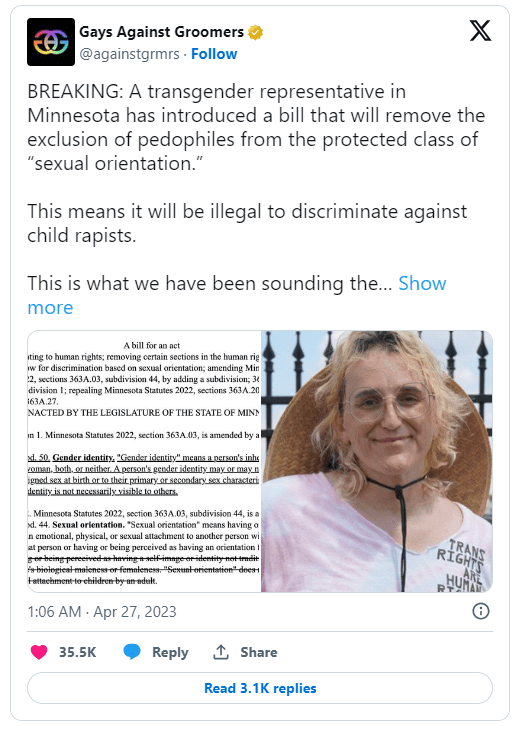
Minnesota State Rep. Leigh Finke (D) describes the relentless right-wing campaign against her, including attacks from within the House and a national hate group, Gays Against Groomers. “There were attacks from inside the House, with some members using their time on the floor to target me. Gays Against Groomers also joined in, fueling a nationwide campaign against me that has never really slowed down,” Finke tells LGBTQ Nation.
Finke has been falsely accused of supporting pedophilia, a claim with no evidence to back it up. She reports receiving death threats and having to increase her security measures, including regular meetings with the Sergeant at Arms and state troopers, as well as changes to her email and voicemail protocols.
Since her election to the Minnesota House of Representatives in 2022, Finke has been in the spotlight. Representing District 66A in northern St. Paul, an area with a vibrant queer community, she stands as the first openly trans state legislator in Minnesota. Finke has made history by serving as a representative who authentically connects with and represents her constituency.
Finke’s distinct presence in the Minnesota House of Representatives is evident in both her policies and personal style. Known for her dyed pink or purple hair, tattooed arms, and black leather jackets over skirts and dresses, she consciously stands out to ensure queer individuals see themselves represented in a legislator capable of enacting meaningful change.
With a background in activism, including work with the state’s ACLU chapter and as a documentarian, Finke has made significant strides in office. Her achievements include passing the landmark trans refuge bill, which ensures safe passage for those seeking gender-affirming care from other states, codifying trans rights under the Minnesota Human Rights Act, securing millions in HIV care funding, and advocating for more inclusive shelters for homeless LGBTQ+ individuals.
While her political prominence has garnered her accolades, such as being named one of USA Today’s Women of the Year in 2023, it has also attracted considerable backlash. Finke faces intense vitriol, particularly from a segment of the Republican party in Minnesota that exploits her advocacy for trans protections as a liability against supporters. This mirrors national attacks, including dehumanizing language, misgendering, and targeted harassment.
One of her most controversial actions involved revising the outdated wording in the 1993 Human Rights Act, which previously stated, “sexual orientation does not include a physical or sexual attachment to children by an adult.” While this wording aimed to exclude pedophilia, Finke and LGBTQ+ rights advocates were concerned it could be used to unjustly label queer individuals as pedophiles. Her attempt to remove this language drew fierce criticism from right-wing groups, including Gays Against Groomers and figures like Rep. Marjorie Taylor Greene (R-GA), despite a PolitiFact fact check debunking the false claims that she was trying to “make pedophilia a protected class.”
The right-wing Daily Caller and Fox News intensified their attacks on Finke, contributing to a surge in online harassment directed at her from right-wing circles.
LGBTQ Nation has confirmed that Finke indeed received death threats, a fact supported by public documentation from civil rights attorney Alejandra Caraballo on X.
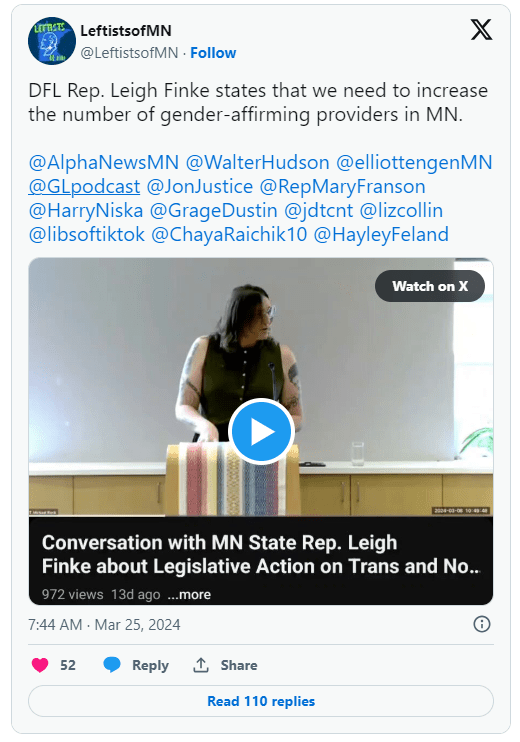
Minnesota conservatives often spotlight Finke, especially when she speaks positively about gender-affirming care. Both large and small accounts launch attacks against her. LGBTQ Nation has identified several of these accounts, including “@LeftistsofMN,” a prominent right-wing account that monitors notable left-wing figures in the state, and “Action 4 Liberty,” a right-wing activist organization.
The attacks on Finke weren’t confined to the right-wing outrage machine; they also came from within the state House.
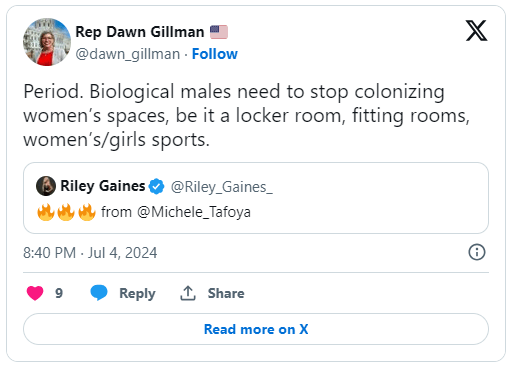
Finke has pointed to social media attacks from Minnesota right-wing lawmakers, describing them as just a fraction of the vitriol she endures from some of her colleagues. One notable example came from state Rep. Dawn Gillman (R), who remarked, “Period. Biological males need to stop colonizing women’s spaces, be it a locker room, fitting rooms, women’s/girls sports,” which Finke interpreted as a direct attack on her.
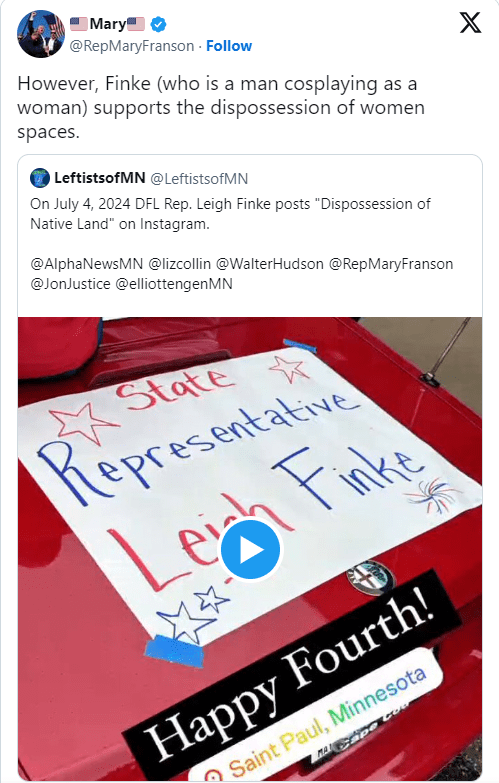
Another instance came from state Rep. Mary Franson (R), who publicly stated, “However, Finke (who is a man cosplaying as a woman) supports the dispossession of women [sic] spaces.”
Finke’s colleagues have not faced the same level of attacks. While some allies experience a degree of criticism, the majority of the focus has been on her.
These relentless attacks have taken a toll on Finke’s health, but she remains committed to serving the people of Minnesota despite the challenges. “I continue to do the work I was brought to do. It has become a very heavy toll [on me] personally. It’s obviously hard to be attacked, but I have good support from my community, my family, and my colleagues at the House. There’s a faction of the Minnesota GOP that is not hesitant to use me as a political weapon, and that’s likely to continue,” she says.
Finke acknowledges the impact of these attacks but is determined not to let them deter her. “I’m getting a bit better at not letting it affect me personally, but you never know what’s next,” she notes. Her resolve is unwavering; she plans to push back by continuing her work and winning elections. “I will do what I’ve always done—ignore the specific attacks and advocate for what I believe is right. Trans people have always existed and deserve basic dignities, human rights, freedom, safety, and security. That will remain my message.”
Finke’s strategy includes focusing on legislative achievements and building a strong connection with her constituents. She engages directly with her community through door-to-door outreach, supporting fundraisers, and helping colleagues with their campaigns. Her goal is to maintain the Democratic trifecta in Minnesota, which facilitates the passage of progressive legislation and addresses constituents’ needs effectively.
In addition to her work on queer rights, Finke is interested in expanding her focus to issues of incarceration and justice. “The needs of the trans community are urgent, and I’ll concentrate on that until we reach a place where I don’t need to. When the time comes, I’d like to broaden my efforts to include other areas.”
Her actionable steps include advancing the Equal Rights Amendment to enshrine LGBTQ+ rights in the state constitution and improving support for queer youth in schools. Finke’s overarching aim is to strengthen her role as an advocate for both the LGBTQ+ community and marginalized groups more broadly. “I’ve been an activist for many years, involved in LGBTQ rights, the Black Lives Matter movement, and reproductive justice. My commitment to advocating for full human and civil rights will continue, whether it’s for incarcerated individuals, Black and brown communities, those with disabilities, or any group impacted by white supremacy and patriarchy.”
The Nebraska Supreme Court has upheld a law that restricts access to both medical care for transgender youth and abortion.
OMAHA, Neb. — The Nebraska Supreme Court has ruled that a state law combining abortion restrictions with measures limiting gender-affirming health care for minors does not breach a state constitutional amendment requiring bills to address only one subject.
The court acknowledged that abortion and gender-affirming care are distinct types of medical care but concluded that the law falls under the broad category of medical care, thus complying with Nebraska’s single-subject rule. Chief Justice Mike Heavican, writing for the majority, referred to an 1895 ruling, emphasizing that a bill with a general object and a title that fairly expresses the subject does not violate the single-subject rule.
The ruling came in response to a lawsuit filed by the American Civil Liberties Union (ACLU) on behalf of Planned Parenthood of the Heartland. The lawsuit challenged the law, which restricts abortion to 12 weeks of pregnancy, bans gender-confirming surgery, and limits hormone treatments for transgender minors. The ACLU’s arguments that the hybrid law violated Nebraska’s single-subject rule were rejected by the high court.
Originally, Nebraska lawmakers proposed separate bills: one banning abortion at around six weeks of pregnancy and another restricting gender-affirming treatments for minors. The Legislature combined these measures into a single bill after the six-week abortion ban faced a filibuster. This combination was one of the most controversial pieces of legislation in the 2023 session, leading to an extended filibuster by some lawmakers.
A district judge had previously dismissed the lawsuit, prompting the ACLU to appeal. During the high court arguments, state attorneys argued that combining the measures under health care did not breach the single-subject rule, while Planned Parenthood contended that the Legislature had recognized abortion and transgender care as separate issues by introducing them as distinct bills.
Justice Lindsey Miller-Lerman’s dissent criticized the majority for applying inconsistent standards, accusing the court of giving undue leeway to the Legislature. She argued that the bill should have adhered strictly to the constitutional requirement for a single subject.
Opponents of the ruling expressed disappointment. ACLU Nebraska Executive Director Mindy Rush Chipman and Planned Parenthood North Central States President and CEO Ruth Richardson criticized the decision, emphasizing its potential negative impacts on Nebraskans, particularly in rural areas and among marginalized communities.
Nebraska Governor Jim Pillen and the state’s attorney general praised the ruling. Pillen highlighted his role in advocating for the bill’s passage.
Since the U.S. Supreme Court overturned Roe v. Wade in 2022, many Republican-controlled states have enacted abortion bans. Currently, 14 states have bans at all pregnancy stages, while Nebraska and North Carolina have implemented 12-week bans. Similarly, many GOP-controlled states have restricted gender-affirming care for minors, with 22 states enforcing such measures.
In contrast, several Democratic-controlled states have adopted policies to protect abortion and gender-affirming care access, including efforts to shield healthcare providers from out-of-state investigations.
Nebraska voters may have the final say on abortion access with two potential ballot questions in November: one proposing to add a right to abortion to the state constitution and another to enshrine the 12-week ban in the state constitution.
Republicans contend that the policy is a ploy to permit transgender girls to join girls’ athletic teams.
A federal appeals court on Wednesday refused to lift a judge’s order temporarily blocking the Biden administration’s new Title IX rule aimed at expanding protections for LGBTQ students.
The ruling from the 6th U.S. Circuit Court of Appeals upheld a preliminary injunction issued last month by a federal district judge in Kentucky. This order blocked the new rule in six states — Kentucky, Indiana, Ohio, Tennessee, Virginia, and West Virginia — though similar legal battles are ongoing in Republican-led states nationwide.
“In our view, the district court likely correctly concluded that the Rule’s definition of sex discrimination exceeds the (U.S. Education) Department’s authority,” the 6th Circuit’s three-judge panel stated in its majority ruling.
The Education Department did not immediately respond to requests for comment via email and phone.
Kentucky Attorney General Russell Coleman praised the ruling as “a victory for common sense.”
“For 50 years, Title IX has created equal opportunities for women and young girls in the classroom and on the field,” said Coleman, a Republican. “Today, the 6th Circuit becomes the first appellate court in the nation to halt President Biden’s blatant assault on these fundamental protections.”
Chris Hartman, executive director of the Fairness Campaign, a Kentucky-based LGBTQ advocacy group, warned that the ruling would endanger transgender children.
“We believe Kentucky schools have an obligation to protect all students, including transgender students, and that they should implement the new Title IX Rule regardless of the 6th Circuit’s opinion,” Hartman said in a statement Wednesday evening.
The rule aims to expand Title IX civil rights protections to LGBTQ students, broaden the definition of sexual harassment in schools and colleges, and introduce additional safeguards for victims. While civil rights advocates have praised the new protections, opponents argue that they undermine the spirit of Title IX, a 1972 law that prohibits sex discrimination in education.
Most Republican state attorneys general have taken legal action to challenge the new rule.
The regulation is set to take effect on Aug. 1, but judges have temporarily blocked its enforcement while legal cases proceed in 15 states: Alaska, Indiana, Idaho, Kansas, Kentucky, Louisiana, Mississippi, Montana, Ohio, Tennessee, Texas, Utah, Virginia, West Virginia, and Wyoming.
The regulation faces legal challenges from 12 other states where enforcement has not been paused: Alabama, Arkansas, Florida, Georgia, Iowa, Missouri, Nebraska, North Dakota, Oklahoma, Oregon, South Dakota, and South Carolina.
Republicans argue the policy is a ploy to allow transgender girls to participate in girls’ athletic teams. The Biden administration clarified that the rule does not apply to athletics.
In its ruling on Wednesday, the 6th Circuit panel noted that critics of the rule warned that implementing it just before the start of the new school year would impose an “onerous burden” on the states.
The 6th Circuit panel also expedited a full hearing of the case for this fall.
In granting the preliminary injunction last month, U.S. District Judge Danny C. Reeves in Kentucky noted that Title IX was intended to “level the playing field” between men and women in education, but said the department was seeking to “derail deeply rooted law” with the new policy.
“At bottom, the department would turn Title IX on its head by redefining ‘sex’ to include ‘gender identity,’” he said in his ruling. “But ‘sex’ and ‘gender identity’ do not mean the same thing. The department’s interpretation conflicts with the plain language of Title IX and therefore exceeds its authority to promulgate regulations under that statute.”
Responding at the time to Reeves’ action, the Education Department stated: “Title IX guarantees that no person experiences sex discrimination in a federally funded educational environment. The department crafted the final Title IX regulations following a rigorous process.”
The appeals court ruling included a partial dissent from one member of the three-judge panel.
“All three members of the panel, it bears emphasis, agree that these central provisions of the Rule should not be allowed to go into effect on August 1,” the majority ruling said. “Our modest disagreement turns on the question, in this emergency setting, of whether the other parts of the Rule can be separated from these central provisions.”
Gay and transgender “panic” defenses are now prohibited in Michigan courtrooms, following legislation signed on Tuesday by Democratic Gov. Gretchen Whitmer.
Michigan becomes the 20th state to ban these defenses, which permit individuals accused of violent crimes to seek reduced sentences by claiming that the victim’s sexual orientation or gender identity caused them to panic. Although these defenses, collectively known as the LGBTQ “panic” defense, are not standalone defenses, they are often employed alongside other legal strategies to mitigate charges or sentencing.
Michigan’s new law significantly enhances legal protections for LGBTQ individuals against discrimination, prejudice, and hate crimes by ensuring that a defendant cannot use a person’s actual or perceived identity to claim “reasonable provocation” or to argue they acted in the heat of passion.
Democratic state Rep. Laurie Pohutsky, the bill’s primary sponsor, praised Whitmer’s signature as “a huge step toward securing a safe and inclusive state for all Michiganders.”
Tracking “panic” defenses in American courtrooms is notoriously difficult, with no exact figures available. As recently as 2018, the LGBTQ “panic” defense was used to mitigate a murder charge, according to the LGBTQ+ Bar Association.
In a 2013 resolution, the American Bar Association urged federal, tribal, state, and local governments to “take legislative action to curtail the availability and effectiveness” of gay and transgender “panic” defenses in court. “Successful gay and trans panic defenses constitute a miscarriage of justice,” the group stated.
Shortly after announcing that his company, X, would be moving out of California due to the state’s newly enacted law that protects trans students, Elon Musk went on a demeaning rant about his own transgender daughter on a right-wing podcast, repeatedly misgendering her and saying that she had been “killed by the woke mind virus.”
The billionaire was a guest on Monday’s episode of The Jordan B. Peterson Podcast, which found the titular conservative influencer interviewing Musk at Gigafactory Texas, where Tesla is headquartered. Toward the end of the podcast, Peterson asked Musk about “one of things that [he’s] been relatively vocal about,” namely gender-affirming care. Peterson referred to trans minors’ access to medical care “the worst medical and psychological malpractice I’ve ever seen anywhere,” adding, “At least the bloody Nazis knew it was wrong and tried to hide it.”
(Peterson was likely referring to the Institute for Sexual Research in Berlin, which performed the world’s first gender-affirming surgeries, and which was a noted target of one of the first and largest of the Nazi book burnings.)
Although trans advocates have been sounding the alarm about Musk since he bought the platform formerly known as Twitter in 2022, the CEO has tilted even further into more full-throated endorsement of transphobic talking points in recent years. In his interview with Peterson, he agreed with the psychologist, calling the term gender-affirming care “a terrible euphemism” and referring to it as “child mutilation and sterilization,” per The Daily Beast.
“You’re taking kids who are obviously often far below the age of consent — almost every child goes through some kind of identity crisis, it’s just part of growing up — so it’s very possible for adults to manipulate children who have are having a natural identity crisis into believing that they are the wrong gender and that they need to be the other gender,” Musk said. Though it is a common right-wing talking point that transness naturally desists in most young people, studies have found that trans youth are actually extremely unlikely to detransition.
But the issue is personal for Musk, as he explained to Peterson, claiming that he was “essentially tricked into signing documents for one of my older [children]… before I had really any understanding of what was going on” — a reference to his daughter Vivian Jenna Wilson, who in 2022 filed a petition to change her name in part because, as she stated, “I no longer live with or wish to be related to my biological father in any way, shape or form.”




















 fleeredstates.blog
You must be logged in to post a comment.