A new California social media law could harm LGBTQ+ youth, according to an internet civil liberties group. The group, the Electronic Frontier Foundation (EFF), has advised California Attorney General Rob Bonta (D) not to approve the proposed law for an upcoming voter referendum.
Two advocates have called it “a misguided and unconstitutional proposal.”
The law, entitled “The Common Sense Initiative to Protect California Kids Online,” seeks to protect minors from specific online “injuries” by allowing people to sue social media companies for $5,000 per violation, up to $1 million per child, according to The Sacramento Bee.
“It would be up to the courts to decide the merits of a parent’s claim,” explains James Steyer, the CEO and founder of Common Sense Media, a nonprofit that provides information on the suitability of tech platforms for children. “Tech companies have avoided any accountability for their profit-driven actions and it is time to change that, either through the Legislature or through the ballot.”
But the proposal currently doesn’t specifically list which “injuries” are covered or how social media companies could avoid inflicting them. That non-specificity concerns the EFF because they worry that the law could be used to censor LGBTQ+ content as “harmful.”
In a letter to Bonta, the EFF policy analyst Joe Mullin and senior staff attorney Aaron Mackey wrote that the proposed law violates social media companies’ constitutionally protected free speech rights and would result in the censoring of LGBTQ+ content.
“For example, elected officials in both California and other states have said that access to LGBTQ+ content harms children,” Mullin and Mackey wrote. “Lawsuits would likely push online services to restrict access to medical, health, and sexual information that many LGBTQ+ children need.”
Mullin and Mackey’s concern isn’t unprecedented. In fact, groups like the American Civil Liberties Union ACLU and the parents of transgender youth worry that a similar proposed federal law, the Kids Online Safety Act (KOSA), could compel social media companies to censor LGBTQ+ content to avoid possible lawsuits.
Specifically, the ACLU and parents of trans youth worry that state attorneys general who consider queerness a social fad or a form of mental illness that causes kids to harm themselves, participate in risky sexual behavior, and increase their risks for depression, suicide, or drug use would use KOSA to sue social media platforms companies.
“[The proposed state law] is a misguided and unconstitutional proposal that will restrict all Californians’ access to online information,” Mullin and Mackey added.
Firefighters in Decatur, Georgia have determined that an October fire at a local gender-affirming care clinic was intentionally set in a move one activist has labeled “terrorism.”
The fire in the city’s historic Blair Building was “contained to one office, and no injuries were reported,” according to a recent statement from the City of Decatur Fire Rescue Department.
The statement expressed that an investigation has determined the fire “to be incendiary in nature, indicating the fire was intentionally set.” No suspects have been identified.
The Blair building houses several medical providers, but a police report confirms that the target of the fire was QMed, which focuses on gender-affirming care, Decaturish reported.
“We won’t be intimidated,” QMed owner Dr. Izzy Lowell told Atlanta News First. “We will not stop providing life-saving care to our patients.” While the office is “completely destroyed,” Lowell said the clinic is seeing patients remotely. She also confirmed the FBI is investigating the arson attack as a hate crime.
Georgia passed a hate crime law in 2020. H.B. 426 became the first law in the state to specifically protect LGBTQ+ residents and give stronger punishments to those whose crimes target victims due to their LGBTQ+ identity, or due to other factors such as their race, religion, or national origin.
Trans activist Alejandra Caraballo wrote on X that the attack “is following the antiabortion playbook of destroying clinics to get them shut down.”
“This is terrorism,” she concluded.
The Movement Advancement Project gave Georgia 1 point out of a possible 44.5 for its LGBTQ+ policies, leaving it with an overall rating of “low.”
In March 2023, Gov. Brian Kemp (R) signed a ban on trans youth receiving gender-affirming health care. The law revokes the licenses of medical professionals who administer surgeries or hormone replacement therapy for transgender people under the age of 18. The law creates an exemption for cisgender youth; they are allowed gender-affirming care to conform to their sex assigned at birth.
Puberty blockers, however, are not banned under the legislation.
The American Medical Association, the American Psychiatric Association, and the American Academy of Pediatrics have all rejected claims that gender-affirming care harms transgender children or adults. Additionally, gender-affirming surgery is almost never performed on youth.
In a recent incident, an anonymous complaint regarding a frequently banned LGBTQ+ book prompted local police to conduct a search in a Massachusetts classroom, citing concerns about “obscene” and “pornographic” material. The American Civil Liberties Union (ACLU) has strongly criticized this incident.
“Police going into schools and searching for books is the sort of thing you hear about in communist China and Russia,” Ruth A. Bourquin, senior and managing attorney for the ACLU of Massachusetts, told The Berkshire Eagle this week. “What are we doing?”
The Great Barrington Police Department and the Berkshire District Attorney’s Office initiated an investigation to determine if Maia Kobabe’s “Gender Queer” contains pornographic material. The inquiry was prompted by a complaint received on December 8, asserting that the book was present in an eighth-grade classroom at W.E.B. Du Bois Regional Middle School.
Upon receiving notification of the investigation, Superintendent Peter Dillon was informed by the police. Principal Miles Wheat, accompanied by a plainclothes officer, conducted a search for the book in the classroom after school on December 8. The English teacher, reportedly unaware of the impending search, was present during the search. Despite the use of a body camera by the officer, the book was not found.
District Attorney Timothy Shugrue announced that Great Barrington Police had concluded their investigation, stating that the complaint did not involve criminal activity. Consequently, the matter was closed, and any further action was referred back to the Berkshire Hills Regional School District. The superintendent assured the District Attorney’s Office that the issue would be reviewed according to the school district’s policies, treating it as a school department matter.
Teachers, parents, and students in the community expressed outrage over the incident. More than 100 students at Monument Mountain Regional High School staged a walkout in protest. Massachusetts Gov. Maura Healey (D) released a statement supporting the walkout, asserting that “book banning has no place” in the state.
In a Facebook post, the teacher whose classroom was searched wrote, “How on earth is a cop more qualified to decide what books are OK to be in an educational setting for teens?”
According to The Berkshire Eagle, the police argued they had a duty to investigate the complaint about Gender Queer. However, the ACLU of Massachusetts expressed deep concern about this notion.
“They say anytime someone could call they have an obligation to go marching into places wearing a body cam, and you know, interrogating people,” Bourquin said, adding that state laws are “pretty clear about police not having roles in this situation.” Obscenity laws, she explained, have been “carefully crafted to ensure not tromping on constitutional free speech rights.”
Bourquin informed the paper that the ACLU has requested the officer’s body camera footage and other records related to the investigation.
Justin Silverman, executive director of the New England First Amendment Coalition, explained that obscenity laws test whether a book has value beyond sexual arousal. This “very specific” requirement is not necessarily something the average person or police officer might understand.
Silverman said that he’s concerned about the precedent the Great Barrington Police may have set amid the national rise in book bans primarily targeting books by Black and LGBTQ+ authors. “While it might be rare now, it doesn’t mean that it will be rare in the future,” Silverman said. “I think the school and the police department have to come forth with a policy to make sure that this doesn’t happen again.”
In a statement, the Berkshire Hills Regional School Committee and Superintendent Peter Dillon apologized for the incident.
“The recent incident at the middle school has challenged and impacted our community,” the statement read. “Faced with an unprecedented police investigation of what should be a purely educational issue, we tried our best to serve the interests of students, families, teachers, and staff. In hindsight, we would have approached that moment differently. We are sorry. We can do better to refine and support our existing policies. We are committed to supporting all our students, particularly vulnerable populations.”
The recent fire at a clinic providing gender-affirming care is being examined within the context of recently enacted hate crime legislation.
Officials in Georgia are probing a fire from the previous year as an anti-LGBTQ+ hate crime, suspecting arson.
The Decatur Fire Department has officially labeled the fire at a gender clinic in the historic Blair Building on October 30 as a deliberate act of arson and is currently treating it as a possible hate crime.
The Decatur Fire Department efficiently controlled the fire, which, as reported by Atlanta TV station WANF, was confined to a single office and resulted in no injuries. Despite the contained nature of the incident, the investigation has concluded that the fire was deliberately set.
This unsettling incident specifically targeted QMed, a clinic renowned for providing gender-affirming care to transgender and nonbinary individuals. Dr. Izzy Lowell, the proprietor of QMed, informed WANF that the fire resulted in the destruction of their office.
The event is being investigated as first-degree arson, a grave felony. This classification is in accordance with Georgia’s hate crimes law, which was implemented in 2020, extending protections to LGBTQ+ individuals. Convictions under this law carry heightened penalties.
Built in 1939, the Blair Building stands as an impressive specimen of Streamline Moderne architecture and holds a place on the National Register of Historic Places. Serving the Decatur community for over eight decades, it has accommodated a diverse range of businesses and offices.
Following the incident, the city has joined forces with federal and state agencies to probe the crime. Despite the ongoing investigation and no arrests made thus far, the Decatur Fire Department has been circumspect in divulging specific details. The case garnered public attention after an anonymous tip about the incident reached Decaturish.
The arson attack has amplified concerns about the safety of facilities catering to specialized services for marginalized groups. The ongoing investigation aims to determine whether this was a hate-motivated crime.
Audio from a Twitter Space, initially intended for a small audience, featured Republican legislators from Ohio and Michigan.
In audio released Friday evening, senators and representatives from Ohio and Michigan revealed the “endgame” is to ban transgender care “for everyone.”
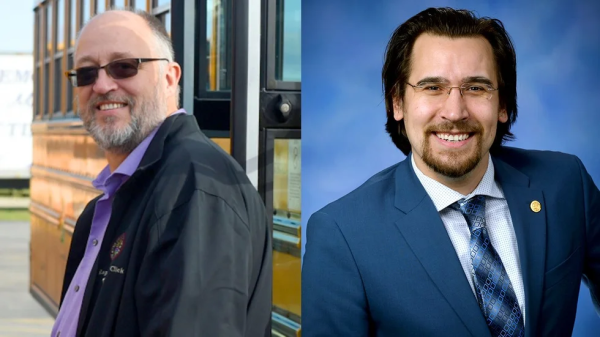
The recording was inadvertently made public, capturing discussions where legislators revealed the ultimate goal of their anti-trans legislation – to ban transgender care “for everyone.” The Space, which had measures to remove uninvited participants, hosted several Michigan senators and representatives, along with Ohio Representative Gary Click, who sponsored the contentious gender-affirming care ban in the state. Throughout the conversation, the legislators openly discussed their plans and strategies for targeting transgender care. Towards the conclusion of the Space, the dialogue shifted to a plan for the “endgame,” involving discussions among Republican legislators and anti-trans activist Prisha Mosley about various strategies aimed at “banning this for everyone,” specifically referring to gender-affirming care.
Representative Brad Paquette of Michigan hosted the Space, providing a platform for an unstructured conversation about potential developments in Michigan and the ongoing strategy for anti-trans legislation in Ohio. Notable participants included Representative Gary Click, along with Michigan Representatives Josh Schriver and Tom Kunse, as well as Senators Lana Theis and Jonathan Lindsey.
Although the initial part of the Space predominantly addressed transgender care for youth, around the 49-minute mark, the conversation shifted to focus on transgender adults. Representative Shriver posed a question, stating, “In terms of endgame, why are we allowing these practices for anyone? If we are going to stop this for anyone under 18, why not apply it for anyone over 18? It’s harmful across the board, and that’s something we need to take into consideration in terms of the endgame.”
Representative Click subsequently replied, “That’s a very astute observation. I think legislatively, we have to take incremental steps.”
He then shifted to Governor DeWine’s efforts to address transgender adult care clinics, remarking, “The other thing is Planned Parenthoods; they pass out hormones like candy, he’s put a stop to that. That’s one of the places a lot of adults go. There’s also Euphoria and Plume.”
Governor DeWine’s regulations extend beyond typical transgender bans in the United States and have the potential to lead to the widespread closure of gender-affirming care clinics for transgender adults. Similar regulations were implemented in Florida, resulting in the elimination of 80% of all transgender care through burdensome requirements imposed on clinics, including the mandate for in-person care and restrictions on nurse practitioners providing it. In Missouri, there were attempts to impose targeted restrictions on gender-affirming care providers, leading to the closure of many clinics. Notably, the regulations concerning transgender adults in Missouri were halted by a court ruling.
Following this discussion, Representative Shriver persisted in asserting that adults consenting to gender-affirming care should be prohibited. He went to the extent of drawing comparisons to consent for “self-mutilation” and “euthanasia.” He reiterated, stating, “we have to be looking at the endgame simultaneously, maybe even using that to move the window to say that this isn’t just wrong 0-18, it’s wrong for everyone and we shouldn’t be allowing that to happen.”
Representative Click affirmed the strategy, stating, “We have to take one step at a time, do it incrementally.”
The dialogue extended further as Prisha Mosley, an anti-trans detransitioner and right-wing political figure, commended the discussion, expressing, “I did want to say that I’ve kind of been waiting for a state or a representative or anyone to be brave enough to address that… you cannot consent to a lie. Most of these doctors are straight up lying about the effects and saying it’ll magically cure every bad feeling you’ve ever had and that you can magically change sex.”
Towards the conclusion of the conversation, Representative Shriver suggests they should “prohibit this for all individuals,” prompting Representative Paquette to reply, “We’ll chat offline about all this good stuff.”
More and more, anti-trans groups and politicians are directing their efforts towards transgender adults. In a recent critique of the World Health Organization panel on trans care, the anti-trans group Society for Evidence in Gender Medicine (SEGM) did not advocate for access to trans care for those aged 18-25. Leor Sapir, affiliated with the Manhattan Institute, a right-wing think tank, argued that permitting “adults to do what they want” regarding gender-affirming care no longer aligns with “the libertarian position.” Additionally, bills and laws targeting transgender adults are becoming increasingly prevalent, including bathroom bans in Utah and Florida, medical care restrictions for incarcerated trans adults, and numerous bills aiming to ban gender-affirming care for various age groups, including adults.
Never before have elected representatives explicitly outlined the strategy of banning care for transgender adults as clearly as in these recordings. Representative Gary Click is affiliated with the Heritage Foundation and the Center for Christian Virtue, both well-known for their involvement in the formulation and drafting of anti-trans legislation. These newly revealed recordings offer a significant glimpse into the endgame of anti-trans legislation: the complete exclusion of transgender people from public life by prohibiting care at any age.
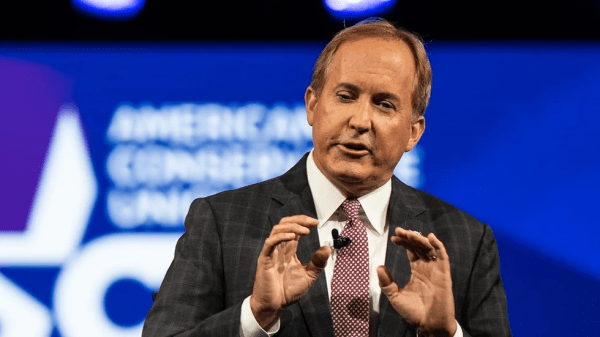
Texas Attorney General Ken Paxton has once more sought medical records from a transgender healthcare provider in another state, even though he lacks legal jurisdiction.
Without legal jurisdiction, Texas Attorney General Ken Paxton has once more sought medical records from a transgender healthcare provider in another state.
The recent request was directed to QueerMed, a telehealth clinic in Georgia that caters to patients nationwide. Dr. Izzy Lowell, the founder of the organization, verified Paxton’s inquiry to the Houston Chronicle but refrained from providing details about the subsequent actions the group plans to take in response.
“I’m not breaking any laws,” she told the outlet. “We are doing everything by the book according to state law.”
This marks the second identified inquiry from Paxton, who previously demanded in November that the Seattle Children’s Hospital furnish information related to the count of Texas minors undergoing gender-affirming care at the clinic, their diagnoses, prescribed medications, and even guidance on gradually discontinuing such treatments.
In December, a judge in Washington prevented the hospital from disclosing the records, citing the state’s recently enacted shield laws that protect patients from civil or criminal legal actions for procedures prohibited in other states, such as gender-affirming care or abortions. Following this, Seattle Children’s Hospital filed a lawsuit against Paxton, urging him to halt the investigation.
Paxton has refrained from making public comments on the Seattle case or the inquiry in Georgia. His office has opted not to disclose details about other ongoing inquiries involving transgender health providers.
Texas is among 23 states that have implemented prohibitions on gender-affirming care for minors, contrary to abundant medical evidence. Organizations such as the American Medical Association, the American Psychiatric Association, the American Academy of Pediatrics, the American Academy of Child & Adolescent Psychiatry, the World Medical Association, and the World Health Organization collectively endorse the evidence-based and medically necessary nature of gender-affirming care for both adults and minors.
In his capacity as the attorney general of Texas, Paxton lacks jurisdiction over healthcare provided in other states, regardless of the patients’ place of residence. Despite Paxton’s request, Lowell affirmed that she is “not going to stop or be intimidated.”
“The unfairness and blatant discrimination and harassment and persecution of trans people in this country right now is outrageous, and I’m only becoming more and more passionate about it as things have gotten worse,” she continued.
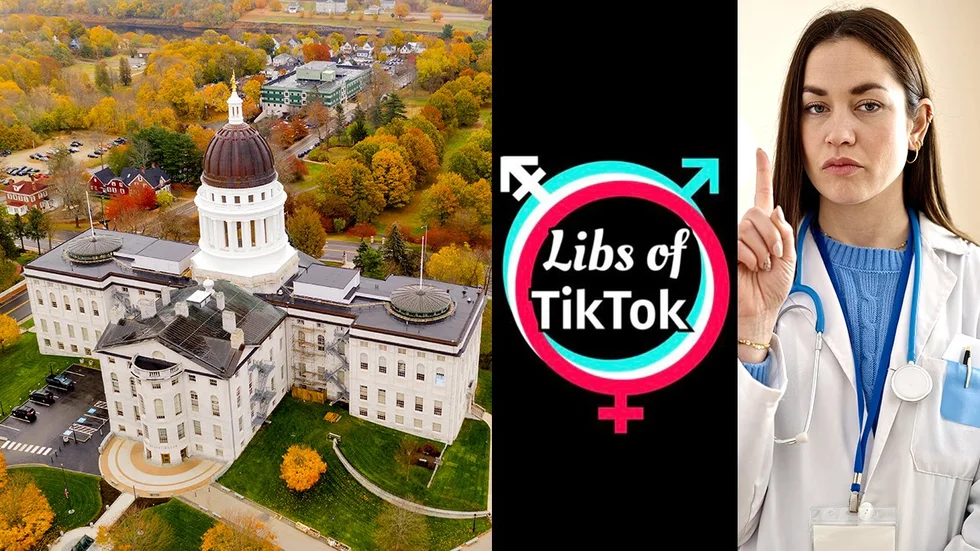
Seemingly influenced by a significant online campaign led by Libs of TikTok’s Chaya Raichik, Maine legislators voted against a bill addressing gender-affirming care for minors.
In Maine, a bill aimed at ensuring security for individuals seeking gender-affirming care sparked significant controversy online, leading lawmakers from both sides of the aisle to abandon the measure.
The Maine Legislature’s Judiciary Committee rejected a proposal following online backlash from right-wing extremists who discovered the bill. Far-right influencers, including Libs of TikTok, singled out lawmakers involved in the legislation, contributing to the decision against it.
LD 1735, a proposed measure designed to protect gender-affirming care for transgender individuals, including minors, faced a pivotal moment on Thursday as the decision reflects a significant shift in the state’s stance on transgender rights and healthcare.
Initially championed by Democratic Rep. Laurie Osher of Orono, LD 1735 enjoyed support from various advocacy groups, including the Maine Nurse Practitioner Association, the Maine Psychological Association, the National Association of Social Workers, as reported by the Maine Beacon. The bill’s primary aim was to shield Maine from collaboration with law enforcement in states where gender-affirming care is prohibited. Specifically, in instances where individuals sought such treatment in Maine and authorities from other states attempted to intervene, the bill sought to relieve Maine from any obligation to assist them.
This legislation held significant importance for advocates of transgender rights during this session. It was perceived as an extension of the legislative advancements made last year, which granted 16- and 17-year-olds in Maine access to gender-affirming care without requiring parental consent or notification, aligning with the state’s laws on abortion and contraception for minors.
Related: Maine’s bill on transgender healthcare triggers a right-wing uproar, fueled by unfounded concerns about phantom kidnappings.
Nevertheless, notable opposition arose, particularly from Republican lawmakers, as reported.
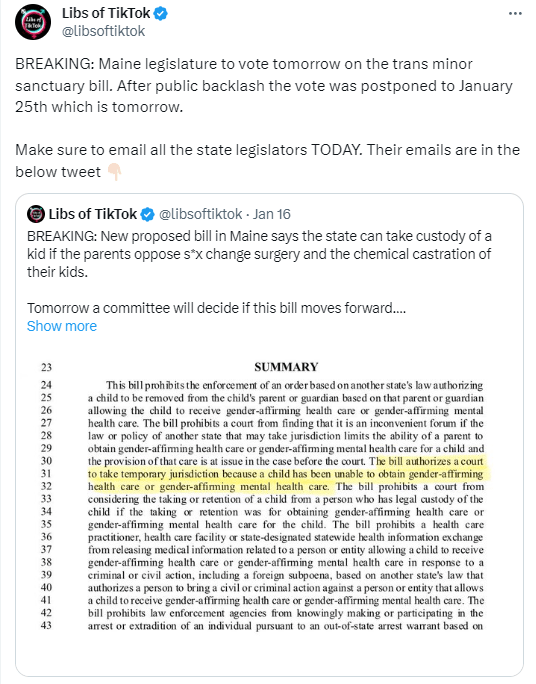
The discourse surrounding the bill appeared to be shaped by a social media campaign spearheaded by Chaya Raichik, the operator of the Libs of TikTok account. On January 16, Raichik mobilized her 2.8 million followers to actively oppose the proposed legislation. Subsequently, on Wednesday, she issued another plea.
“BREAKING: The Maine legislature is set to vote tomorrow on the trans minor sanctuary bill. Following public backlash, the vote has been rescheduled for January 25th, which is tomorrow. Ensure to send emails to all state legislators TODAY. Find their email addresses in the tweet below,” urged Libs of TikTok, providing a list of lawmaker email addresses.
In response to this rallying cry, the Judiciary Committee voted unanimously with a 12-0 decision (one member was absent), putting a halt to the bill’s advancement after a brief period of deliberation.
Led by Democrats Sen. Anne Carney and Rep. Matt Moonen, the Judiciary Committee, in an unusual display of unity cutting across party lines, unanimously rejected the bill. Democrats, who had previously endorsed the legislation, pointed to the inclusion of unnecessary language as a primary factor influencing their shift in stance.
Republicans contended that in its current state, LD 1735 could potentially encourage child trafficking—an assertion stemming from online conspiracy theories propagated by conservative influencers—and undermine parental rights. Within its provisions, the bill sought to prevent the enforcement of orders from other states that might sanction the separation of a child from their parent or guardian based on the receipt of gender-affirming health care or mental health care.
The Advocate reached out to Osher for comment but did not receive a response.
The committee’s unanimous dismissal of LD 1735 represents a substantial setback for providers of gender-affirming care and advocates for transgender rights in Maine.
Over the weekend in Seattle, a task force conducted raids on two gay bars, ostensibly in search of “lewd conduct” by both patrons and staff.
“You’re allowed to be who you are in Seattle as long as you don’t go into a gay bar.”
Over the weekend in Seattle, two gay bars were raided by a task force allegedly searching for “lewd conduct” among both patrons and staff.
During the raids in Seattle, investigators reported finding a bartender with an exposed nipple at one venue, and patrons wearing jock straps at another.
The raids in Seattle were carried out by the Joint Enforcement Team (JET), a coalition involving the Police and Fire departments, the state Liquor and Cannabis Board (LCB), and others. Around 12:30 a.m. on Saturday, ten task force members entered The Cuff brandishing flashlights, as reported by owner Joey Burgess. Some patrons left the bar, particularly where the exposed nipple incident occurred, during the raid.
On the following night, two members of the Joint Enforcement Team (JET) entered the Eagle at approximately 11:30 p.m., according to owner Keith Christensen. The inspection at this venue revealed patrons wearing jock straps.
Seattle established the JET task force a few years ago to address nuisance businesses and criminal activity. Neither The Cuff nor The Eagle has a history of alcohol or violence-related offenses.
In Washington, venues where alcohol is served are prohibited from allowing nudity.
The owners, along with a coalition of LGBTQ+ advocates, including writer Dan Savage, released a joint statement condemning the raids.
“The absence of violence or liquor-related issues in the citations indicates a concerning focus on targeting queer individuals in queer spaces,” the statement read.
“The community recalls the generational trauma and the homophobia-driven policies of the not-so-distant past, making the recent actions particularly distressing.”
Cuff owner Burgess mentioned that he has been facing the same issue since Pride celebrations in 2022 when the Liquor and Cannabis Board cited his bar for a customer wearing a jockstrap.
Since then, Cuff staff have been compelled to act as “hall monitors” for patrons’ fashion choices; jock straps are prohibited at the venue, and exposed cracks are not allowed.
Burgess attributes a decline in business to the outdated regulations and points to nearby Cal Anderson Park, where individuals are allowed to play kickball in their jockstraps.
“You’re allowed to be who you are in Seattle as long as you don’t go into a gay bar,” Burgess said. “They’re not going into the other bars the same way as this.”
It’s discrimination, according to Burgess. “There is no other answer.”
Eagle owner Keith Christensen is still awaiting a response from JET regarding a potential citation. He mentioned losing 70% of his business due to citations in February 2008.
“These regulations that are so paternalistic, that control people’s bodies and sexualities, pretty much only affect marginalized communities and non-conforming people,” said Madison Zack-Wu, who directs the worker-led group Strippers Are Workers (SAW).
“I do see the thread here of queer venues being raided and strip clubs being prevented from having a sustainable business model as ultimately authoritarian judgment on how queer people and sex workers are trying to move through the world… Both of our communities should have the right to speak up against this.”
Following an incident where a Utah dad became belligerent at his high school-aged daughter’s recent junior varsity basketball game, alleging that a player on the opposing team was transgender, he has been banned from attending future games.
“I wasn’t born yesterday, I know that’s a boy!” the dad shouted at the principal.
Jeff Haney, spokesperson for Canyons School District, informed The Salt Lake Tribune that during a game on January 19, the dad in question was actively challenging the eligibility of a player, vocally expressing concerns based on his perception of the student-athlete’s gender.
The man, whose identity remains undisclosed, allegedly confronted the principals of both his daughter’s school and the opposing school after the incident. Both principals reassured him that every player on the court, including the 17-year-old girl in question, had met the eligibility requirements outlined by the Utah High School Athletics Association (UHSAA). UHSAA mandates that student-athletes provide a birth certificate to verify their gender, and for transgender students, proof of undergoing at least one year of hormone therapy is required.
“I wasn’t born yesterday, I know that’s a boy and you better be able to prove yourself because I am going to the top,” the man insisted after the game, according to one principal.
Haney said the man became so belligerent that he was asked to leave, and the principal of his daughter’s school banned him from future games. “We do not tolerate people coming into our community and our schools and harassing our student-athletes,” Haney said.
The incident on January 19 is the most recent case of parents challenging a student athlete’s gender in Utah since the passage of H.B. 11 in 2022. This law prohibits transgender girls in grades K–12 from participating in girls’ sports. However, the law is currently on hold due to a legal challenge initiated by the families of three transgender students. The legal proceedings are ongoing in court.
In 2022, the parents of two girls who secured second and third place in a Utah track event lodged complaints urging the Utah High School Athletics Association (UHSAA) to investigate the gender of the girl who claimed first place. David Spatafore, a spokesperson for UHSAA, disclosed that additional complaints had been received, asserting that the student did not “look feminine enough.” However, Spatafore clarified that upon investigation, it was found that the student had consistently identified as female since kindergarten.
According to The Salt Lake Tribune, there have been additional similar incidents in Utah, but the Utah High School Athletics Association (UHSAA) has not disclosed the frequency or the specific number of such occurrences.
Marina Lowe, policy director at Equality Utah, commented that these incidents offer a glimpse into what might become more common, especially with the enactment of legislation that allows the public to pass judgment on individuals’ physical characteristics, determining whether they are deemed feminine or masculine enough to participate in certain spaces.
Advocates for the LGBTQ+ community have cautioned that transgender sports bans and bathroom bills may lead to policing people’s gender presentation. In some states, such as Idaho, sports bans have included requirements for genital examinations. This stipulation could subject students under investigation to unnecessary and invasive examinations.
“This doesn’t just harm the trans community. It really harms us all,” Lowe said. “Because once we get in the business of policing someone’s appearance… all of us are going to be subject to this sort of inquiry potentially.”
In the realm of real estate, achievement isn’t spontaneous; it’s carefully crafted, strategically executed, and firmly grounded in meticulous planning.
Envision 2024 as an expansive terrain of possibilities, where you, as the mastermind of your success, wield the ability to mold outcomes. This monumental webinar isn’t merely an occasion; it serves as your guiding tool for navigating the intricacies of the upcoming year.
Participate alongside me and an exceptional lineup of real estate specialists in this Mega Webinar on Launching BIG in 2024! 🔥 We’ll be unveiling established marketing strategies, techniques to draw in more listings, methods for boosting mental resilience, and practices to keep you ahead with the most current industry insights.













 fleeredstates.blog
You must be logged in to post a comment.