Contradictory information on a driver’s license results in heartbreak for the victim’s family and friends.
The killing of a transgender man in August has transformed into a learning opportunity in the progressive Wayne County, Michigan. Bereaved friends and family found themselves compelled to advocate for his gender identity posthumously.
The tragic slaying of 26-year-old Jean Butchart, who was shot in the head by a stranger on a warm August evening in Belleville, deeply disturbed his close ones. However, their grief was compounded by a series of misinformation fueled by conflicting reports about his gender.
During the search for Butchart’s murderer, inconsistent details on the victim’s driver’s license resulted in both law enforcement and the media misidentifying his gender as female.
“It was an inadvertent error,” Julisa Abad, a transgender woman and the director of transgender outreach for the advocacy group Fair Michigan, shared with the news outlet MLive.
On the day of his tragic death, Butchart had just commenced a new job in landscape maintenance at a mobile home park. Responders discovered him lifeless on the ground, with no pulse and a gunshot wound to the head. He was pronounced dead at the scene.
Although Butchart’s driver’s license indicated male, his name had not yet been updated on the document, resulting in his deadname being reflected. While Michigan has streamlined the process of changing gender on identity documents, altering a name is more intricate, time-consuming, and, for some, financially challenging.
Eyewitnesses at the crime scene identified Butchart as Jean, utilizing the French pronunciation common in the Great Lakes region near Quebec. Consequently, the police were informed about the victim’s male gender identity.
“He was referred to as Jean,” stated Van Buren Township Police Chief Jason Wright. “That’s how we were informed.”
In the subsequent days, as the incident was reported both internally and to the public, the contradictory details on his driver’s license became a cause of sorrow.
Initially, the Van Buren Township Police Department issued a news release regarding Butchart’s death in connection with the apprehension of Matthew Torrey Tiggs Jr., 22. Tiggs faced charges related to Butchart’s murder, as well as attempted murder and assault in two other incidents spanning ten days in August.
The release specified the victim as “26-year-old Jean Butchart” without any mention of gender.
Subsequently, when the prosecutor’s office released a statement, Butchart was identified by their deadname, with “Jean” included in quotes, following the convention for nicknames.
“Due to the use of female names without clarification of the victim’s gender identity, the entry ‘male’ [for Butchart] was mistakenly assumed to be an error,” clarified Maria Miller, the director of communications for the prosecutor’s office.
The dissemination of this misinformation was magnified in news coverage and across social media platforms, causing frustration and anger among Butchart’s friends and family. They inundated officials with an email campaign, urging a correction and a formal apology.
“We extend our apologies to his family, friends, and the transgender community,” stated Miller in an email. “We promptly rectified this error upon confirming Mr. Butchart’s gender identity. There was never any intention to misgender Mr. Butchart.”
Although the error was distressing for Butchart’s friends and family, Miller described the case as “beneficial” in prompting cultural competence training for officials in Wayne County.
Presently, 18 local police departments have participated in a dedicated training session, and additional sessions are scheduled for other Wayne County police departments and the sheriff’s office.
“We need to recognize that not everything originates from a malicious intent,” remarked Julisa Abad of Fair Michigan. “We’re all continually learning about the complexities of the LGBTQ+ umbrella—I don’t even know all of it.”
Examine the data-backed rationale for emphasizing content at the bottom of the marketing funnel, optimizing return on investment, and leveraging SEO resources effectively.
Ring in the holiday season by revisiting some of the standout articles from SEJ in 2023.
The Festive Flashback series, spanning from December 21 to January 5, offers a daily revisit to noteworthy events, foundational principles, practical strategies, and insights from thought leaders.
The year 2023 has been marked by significant developments in the SEO industry, and our contributors have crafted exceptional articles to capture and elucidate these transformative shifts.
Dive into the top articles of 2023, providing ample food for thought as you navigate your way into the new year, 2024.
The SEO landscape firmly recognizes the importance of search intent, advising marketers to closely align their strategies with this concept, especially when targeting organic keywords.
However, while many SEO articles delve into explaining search intent (as seen in these insightful SEJ pieces on crafting content that meets search intent and comprehending user search patterns), most don’t explicitly outline how companies should strategically prioritize keywords.
In particular, the majority of discussions on search intent acknowledge the spectrum of search queries, spanning from informational (individuals seeking to acquire knowledge about a topic) to comparative (individuals comparing solutions to their problem) to transactional (individuals intending to make a purchase).
This is commonly represented as a marketing funnel.
But when it comes to advising on how to leverage search intent for SEO success, the prevailing suggestion is to ensure you possess a range of content that addresses the entire spectrum of search intent—encompassing informational, mid-funnel, and transactional content.
We hold a different perspective.
In our experience collaborating with numerous brands over several years to develop SEO-focused content, we’ve discovered that most companies benefit from prioritizing bottom-of-the-funnel content. It’s often more effective to concentrate efforts on content aimed at users closer to making a transaction and then gradually extend the focus to upper-funnel content.
Why?
As SEO resources are limited, prioritizing bottom-of-funnel content (such as search queries with “transactional” search intent) becomes crucial due to its significantly higher return on investment (ROI) for SEO expenditure.
In this article, we will elucidate our rationale and present data substantiating this thesis.
SEO Resources Are Limited: Not All Keywords Can Be Effectively Targeted
The common advice to “ensure you create content for every stage of the funnel” would be feasible if businesses had unlimited SEO resources—such as an abundance of writers for content creation, a surplus of SEO strategists for keyword selection and SERP analysis, and an extensive budget for link building.
However, no brand possesses such unlimited resources.
Furthermore, the notion that AI-assisted writing simplifies the production of vast amounts of content doesn’t change this reality.
Certainly, while AI tools can generate thousands of pieces much faster than humans, it doesn’t guarantee that all of them will rank well or meet the quality standards necessary to engage potential customers and drive conversions.
Certainly, if multiple websites are creating similar AI-assisted content to target the same keywords, Google will likely rely on factors such as content quality and backlinks to differentiate and determine which sites to rank higher.
When it comes to content quality, the articles that stand out for a particular keyword are likely those with the highest degree of originality and specific personal expertise. Google has explicitly expressed a preference for such traits, requiring human input.
Backlinks have long been recognized as a key ranking factor in SEO. In a landscape where numerous sites generate similar AI-generated content for the same keywords, it’s reasonable to assume that backlinks will remain, if not become more, crucial.
Irrespective of the content production method, SEO resources are limited. There’s a finite amount of employee hours, a capped writing budget (even with AI use), and a constrained link-building budget for everyone.
This necessitates prioritizing the keywords you intend to target.
The most logical approach to prioritization is directing SEO efforts toward activities that yield the highest return on investment, specifically in terms of leads and sales.
In our experience, prioritizing bottom-of-funnel and transactional keywords has proven to be the most effective strategy.
Keywords at the bottom of the funnel consistently demonstrate significantly higher conversion rates compared to other search intents.
In conclusion, to affirm that bottom-of-the-funnel content converts substantially more than any other type, the initial step involves measuring and diligently tracking SEO-driven conversions.
This might seem evident, but in reality, many SEO and content teams neglect this; they often presume that more traffic is better, and their entire strategy revolves around traffic growth.
You can assess SEO conversion using various analytics tools, but generally, the process involves the following steps:
Clearly outline what constitutes a conversion. For SaaS or sales-oriented enterprises, this might involve actions like completing a lead form or initiating a trial. For e-commerce businesses, an actual transaction would be considered a conversion.
Establish a goal within your analytics platform to track this conversion event.
Generate reports indicating the number of conversions associated with various landing pages on your site. This can be achieved through different attribution models, such as first or last click, depending on your analytics platform. Nonetheless, having any data in this regard is better than having none.
By doing this, you will inevitably discover what we’ve learned through over 5 years, working with dozens of brands and creating hundreds of SEO pieces.
Pages on your site that rank for bottom-of-funnel keywords typically convert at multiple single-digit percentages (1% – 5%), while pages ranking for top-of-funnel, informational keywords usually convert at a fraction of a percent (0.01% – 0.5%).
In essence, the disparity in conversion rates between bottom-of-funnel and top-of-funnel keywords isn’t just a marginal 10%, 20%, or 50% — it’s several times over.
This is highlighted by data from over 60 content pieces for a software client. On average, pages targeting bottom-of-funnel queries converted at a rate 25 times higher than articles focusing on mid to top-of-funnel queries.
Bottom-of-funnel posts demonstrated a 4.78% conversion rate, in stark contrast to the 0.19% conversion rate observed for top-of-funnel posts. This analysis is derived from over 60 posts created for a client.
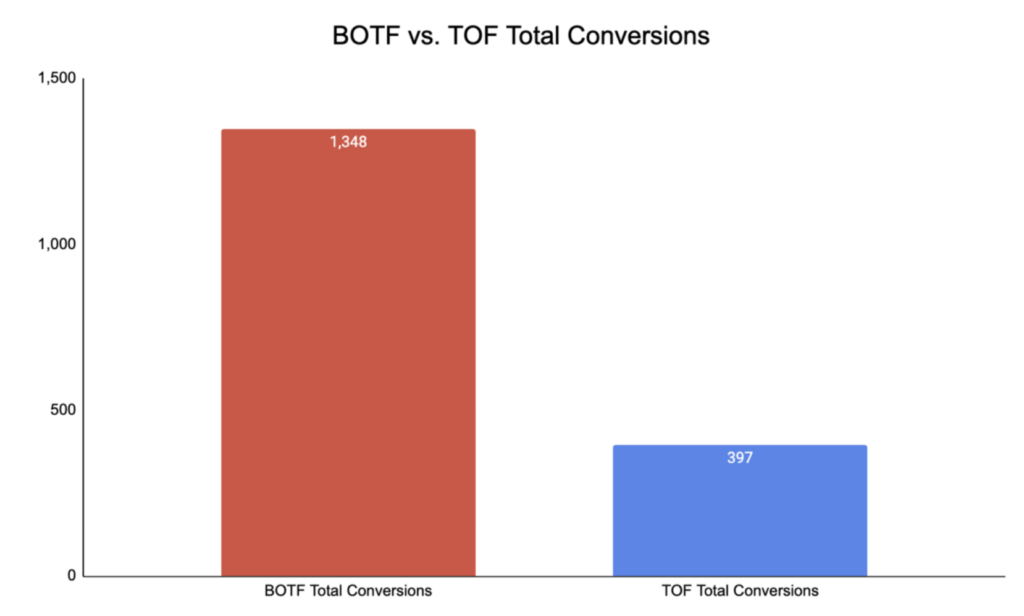
Even when factoring in the higher traffic volume for top-of-funnel pieces, the absolute number of conversions from only 20 bottom-of-funnel pieces exceeded that of 40 top-of-funnel pieces by threefold:
Twenty bottom-of-funnel posts yielded 1,348 conversions, surpassing the 397 conversions generated by 40 top-of-funnel posts.
To underscore, the 1,350 conversions from bottom-of-funnel content were derived from only 22 pieces, whereas the 400 conversions from top-of-funnel content were from 42 articles.
Moreover, it’s worth noting that the articles categorized as “top of funnel” in this study still retained some purchase intent. We pursued them only after exploring most bottom-of-funnel keywords and selected the keywords strategically to guarantee they still held some potential for conversion.
Hence, it’s reasonable to consider them more as “mid-funnel” rather than strictly “top of funnel.” Many companies focus the majority of their content and SEO efforts solely on top-of-funnel keywords that convert to leads or sales at or below the conversion rates mentioned earlier.
It’s a regrettable misallocation of SEO efforts, in our view.
Why Do Top-of-Funnel, Informational Keywords Have Such Low Conversion Rates?
The rationale for pursuing top-of-funnel keywords often centers on their high search volumes.
Therefore, the idea is that by targeting top-of-funnel keywords, you can expose your brand to a large audience that may eventually require a product or service similar to yours.
However, as indicated by the data and supported by our extensive experience, the number of steps needed to convert top-of-funnel traffic into actual conversions is so substantial that the conversion rates are extremely low.
More precisely, the path from an individual searching for an informational top-of-funnel query on Google to becoming a customer involves:
They initiate a search on Google for the query.
They click on your search result.
They read the article.
Some fraction of these users either return to your site on pure memory or give their email to download a white paper or gated resource.
Some fraction of those users open subsequent drip emails.
Then at some point, some fraction of those users will need your product or service and reach out.
Each of these steps has a small conversion rate, so in combination, the entire journey has an absolutely minuscule conversion rate.
To the extent that the data above indicates a potentially greater search volume for these top-of-funnel queries compared to transactional queries, the minuscule conversion rates fail to compensate.
There exist a greater number of bottom-of-funnel keywords than one might realize.
If you subscribe to the idea that focusing on bottom-of-the-funnel keywords is a more effective utilization of limited SEO resources than dispersing content evenly across the entire range of search intent, the crucial next step is to address the question: “Which keywords in my domain indicate bottom-of-the-funnel intent and boast high conversion rates, and how abundant are they?”
We’ve observed that a significant number of SEO professionals and marketers possess a narrow perspective on which keywords indicate bottom-of-the-funnel intent, meaning they exhibit some degree of transaction or buying intent.
From our experience, bottom-of-the-funnel keywords can be categorized into three common buckets, with only the first one being widely recognized as indicative of a bottom-of-the-funnel intent.
1. Keywords Reflecting Product Categories If we consider a hypothetical business that’s widely known, such as SEO software, the evident transactional keywords include phrases like “SEO software” or “best SEO tools.”
Certainly, these are highly effective keywords at the bottom of the sales funnel, and they are crucial for any SEO software brand to target.
In our approach to Bottom of the Funnel (BOTF) SEO, which we refer to as Pain Point SEO, these are termed “category keywords.” This designation stems from users directly searching for the name of the product or service category on Google.
The majority of SEO and marketing teams are cognizant of these keywords and typically direct their efforts toward them, often optimizing the homepage or a couple of landing pages.
However, what we’ve discovered is that numerous teams perceive this as covering the entirety of bottom-of-funnel or transactional keywords. They concentrate on a handful of category keywords and allocate the remaining effort to producing blog content aimed at ranking for top-of-funnel search terms.
Yet, there exist numerous other high-converting search terms that we’ve observed many brands tend to overlook. Instead, they prioritize creating content to target top-of-funnel keywords with lower conversion rates.
2. Keywords for Comparisons
More precisely, another category of keywords that yields exceptionally high conversion rates is what we term as comparison keywords.
These keywords indicate that the searcher is evaluating various options, like “salesforce vs pipedrive” or “adidas vs nike women’s running shoes.”
In various discussions about search intent, this is often classified as a mid-funnel query. According to this perspective, the searcher might not be ready for a transaction but is engaged in product research.
In discussions about search intent, this is frequently labeled as a mid-funnel query. The rationale is that the searcher, at this point, might not be prepared for a transaction but is primarily conducting product research.
However, based on our analysis of the conversion rates of numerous pages ranking for comparison keywords, they frequently exhibit conversion rates just as high as the category keywords mentioned earlier.
Consequently, from my perspective, companies aiming to optimize ROI from SEO should actively pursue comparison keywords.
They ought to pinpoint every comparison keyword associated with their top competitors, with any noticeable search volume, and guarantee the existence of a dedicated page on their site to rank for each one.
3. Keywords Associated with Jobs To Be Done
The last category among the three that we’ve identified as capable of generating conversions through SEO is keywords related to Jobs To Be Done.
This is the most extensive among these three categories of high-buying-intent keywords, implying that there are typically a significantly larger number of jobs to be done keywords than category or comparison.
Brands often overlook or don’t prioritize this category as conversion-generating. This is because these queries don’t overtly express a user’s search for or comparison of product options but indicate that the user has a problem your product happens to solve.
In the context of our SEO software example, these would encompass queries such as “how to conduct competitor keyword research,” “how to determine the search volume of keywords,” or “how to track the keywords a site ranks for.”
If your SEO software product includes features that enable users to perform these tasks, our experience suggests that achieving a ranking for keywords like these will result in conversions.
Usually, the conversion rate of these keywords is slightly lower than that of category or comparison keywords.
Nevertheless, they still outperform top-of-funnel queries like “SEO strategy,” “best SEO tips,” or even “digital marketing strategies.” These are the common top-of-funnel keywords that companies pursue, but they often lack significant buying intent.
Economic Ramifications of Roe v. Wade on Various Sectors
The author argues that the challenges faced by universities and companies are wrongly attributed to a lack of available talent due to Roe v. Wade. In my view, this perspective is flawed. The declining birth rate is more likely a consequence of inadequate support for parents from both our society and the government.
Childcare and healthcare expenses are exorbitant, placing the majority of the burden on women. Young couples and women are apprehensive about residing in locations where complications during pregnancy could lead to severe health consequences. Personally, I’m aware of several individuals of childbearing age who are relocating from Missouri for work or education due to these concerns.
Physicians are departing from conservative states due to concerns about potential lawsuits. Military families are reluctant to be stationed in states governed by Republicans. I’m aware of a business owner losing a prospective employee precisely for this reason.
The assertion in the letter that Catholic Church institutions are not experiencing a decline in membership due to the Church’s stance on abortion is absurd. Many students at Catholic universities are not Catholic, and churches along with their affiliated grade schools are shuttering throughout the region.
One of the numerous reasons the Church struggles to retain or draw in members is its outdated perspective. If individuals disagree with abortion, they can choose not to undergo one. For men who hold a different view, the solution is to avoid impregnating a woman. However, imposing restrictive laws to control women’s reproductive choices should cease.
In a federal court on Wednesday, December 13, 2023, a transgender girl’s mother broke down in tears as she considered the possibility of relocating away from her Navy officer husband to access healthcare for her 12-year-old.
A federal judge presiding over a case challenging a ban on transgender health care for minors and restrictions for adults observed on Thursday that Republican Florida Governor Ron DeSantis has consistently disseminated misinformation about doctors mutilating children’s genitals, despite no documented cases supporting such claims.
Judge Robert Hinkle remarked to Mohammad Jazil, a lawyer for the state, that the law was presented as a measure to protect children from mutilation, whereas, in reality, it is aimed at obstructing transgender children from accessing healthcare.
Judge Hinkle inquired, “When I’m examining the governor’s motivation, how should I interpret these statements? This appears to go beyond mere exaggeration.”
Hinkle stated that he will issue a ruling in the coming year regarding whether the Legislature, the Department of Health, and presidential candidate DeSantis intentionally singled out transgender individuals with the new law. Expressing some doubt about the state’s motives, he did so as lawyers presented their concluding arguments.
The trial revolves around contesting Florida’s prohibition on medical interventions for transgender children, encompassing treatments like hormone therapy or puberty blockers—legislation championed by DeSantis in his presidential bid. The law also imposes limitations on transgender healthcare for adults.
Jazil argued that the intent behind the law was primarily to ensure public safety in an area that requires greater oversight and can have lasting consequences.
“It’s about addressing a medical condition; it’s not about singling out transgender individuals,” Jazil stated.
Jazil argued that if the state intended to target transgender people, it could have prohibited all treatments for both adults and children. Hinkle promptly countered that defending such a law would pose challenges.
Hinkle, appointed by former President Bill Clinton, has temporarily halted the enforcement of the law concerning minors until the trial concludes. The legal challenge also questions restrictions on adult transgender care, which have been permitted to be in effect during the trial.
Laws limiting or prohibiting gender-affirming medical care for transgender minors have been enacted in at least 22 states. Several of these states are confronting legal challenges, and court decisions have been varied. The initial law in Arkansas, the first of its kind, was invalidated by a federal judge who asserted that the prohibition on care violated the due process rights of transgender youth and their families.
The enforcement of similar laws has been blocked in two states aside from Florida. In seven other states, enforcement is either currently allowed or set to go into effect soon.
Thomas Redburn, representing trans adults and families of trans children, argued that Governor DeSantis and the Legislature have consistently targeted transgender people. He pointed to recent laws affecting the community, such as restrictions on pronoun use and the teaching of gender identification in schools, regulations on public bathrooms, and the prohibition of trans girls from participating in girls’ sports.
If you’re considering a move beyond U.S. borders, this country across the pond might be your ideal destination for a cup of (afternoon) tea.
HireAHelper, an online marketplace facilitating the search and hiring of professional movers, recently conducted a study unveiling the locations where Americans have been relocating the most since the onset of the pandemic. The findings were derived from an analysis of monthly Google searches incorporating keywords such as “moving to Mexico,” “moving to Canada,” and “moving abroad.”
The leading destination, according to these findings? The United Kingdom.
As indicated by the study, although searches for relocating abroad have decreased by 30% compared to last year, the count of U.S. citizens moving to the primary destination countries has risen. For example, more than 11,500 Americans relocated to the United Kingdom in the initial half of the year, marking a 30% increase from the corresponding period in 2022.
An article from The Evening Standard outlines several reasons why numerous Americans are opting to move to London, including the increasing cost of living, soaring house prices, a strengthened dollar, and domestic political uncertainties. If you’re among those who searched “moving to the U.K.” on Google, discover the necessary steps for relocating across the pond.
On a different note, the second most favored destination is Mexico, where 19,620 U.S. citizens have chosen to relocate.
North of the border, Canada garnered more searches than any other nation, despite a 53% decrease compared to last year. Furthermore, Canada witnessed a 10% increase in the number of Americans moving there in the first six months of 2023 compared to the same period in 2022. If you’re considering such a move, explore the steps for moving to Canada as an American.
Additional countries that attract American emigrants include various European nations, Japan, South Korea, Australia, New Zealand, Brazil, Costa Rica, and Israel. In total, more than 821,000 U.S. citizens have moved to 40 different countries since 2017, driven by factors such as lower taxation, improved quality of life, and the growing trend of digital nomadism, among other reasons.
A federal judge has determined that Ron DeSantis was disseminating falsehoods when he referred to gender-affirming care as “mutilation.”
This year has been a series of setbacks for Florida Gov. Ron DeSantis. His presidential ambitions are dwindling due to his lack of charisma and campaign missteps. His conflict with Disney is draining millions from Florida taxpayers. Additionally, a federal court has strongly suggested that DeSantis was dishonest in justifying his prohibition on medical care for transgender youth.
DeSantis consistently argued that the law was essential to prevent the “mutilation” of young individuals. For instance, he criticized a reporter who challenged him on this when he signed the bill in May.
“And when you talk to people—I know people in your industry will dress it up with a euphemism—and they’ll say it’s health care to cut off the private parts of a 14 or 15-year-old,” DeSantis stated. “That is not health care. That is mutilation.”
Inform that to U.S. District Judge Robert Hinkle.
“When assessing the governor’s motives, how should I interpret these statements? It appears to be more than mere exaggeration.”
Hinkle is overseeing a legal challenge to the law brought by three Florida families with transgender children. He has implemented a stay against the measure from being enforced during the legal proceedings and has consistently shown skepticism toward the state’s arguments. In a ruling that invalidated Florida’s ban on Medicaid coverage for gender-affirming care, Hinkle emphasized, “Gender identity is real.”
Hinkle conceded that he cannot completely discern DeSantis’ intentions. He raised the question of whether the plaintiffs could demonstrate that DeSantis endorsed the law “because he hates transgender people.” The families’ attorney argued that the law is inherently unconstitutional, making DeSantis’ motivations less pivotal to the case.
Hinkle indicated his belief that the law’s purpose isn’t truly to prevent mutilation but rather to obstruct transgender youth from accessing healthcare. This strongly suggests that DeSantis might face an unfavorable ruling from the court.
This development also signals that DeSantis might have based his campaign on an unsuccessful concept. Relying heavily on anti-trans stances to perform well in the Iowa presidential caucus, he finds himself facing challenges with Nikki Haley gaining popularity and his campaign in disarray. The outlook for him in Iowa appears uncertain, making the end of 2023 potentially regrettable for DeSantis, with the prospect of 2024 being even more challenging.
A federal judge has issued a preliminary injunction against an Idaho law that would have banned gender-affirming healthcare treatments for transgender individuals under 18 years old. The law, which was scheduled to take effect on January 1, 2024, aimed to make it a felony to provide gender-affirming care for transgender youth.
On Wednesday, District Court Judge Lynn Winmill ruled that the restrictions imposed by the law violate the Due Process Clause and the Equal Protection Clause under the Fourteenth Amendment of the U.S. Constitution.
Winmill stated in his decision, “Transgender children should receive equal treatment under the law. Parents should have the right to make the most fundamental decisions about how to care for their children.”
Continuing, he emphasized, “Time and again, these cases illustrate that the Fourteenth Amendment’s primary role is to protect disfavored minorities and preserve our fundamental rights from legislative overreach… and it is no less true for transgender children and their parents in the 21st Century.”
HB 71, signed into law by Governor Brad Little in April, prohibits puberty blockers, which enable children to explore their gender identity and temporarily halt the development of permanent sex characteristics. The law also bans hormone therapies and surgeries. Physicians, as reported by ABC News, have emphasized that surgeries on adolescents are infrequent and are only considered after careful evaluation on a case-by-case basis.
The law includes an exception for children with a “medically verifiable genetic disorder of sex development,” commonly referred to as intersex.
The law stipulates that any medical professional found guilty of providing gender-affirming care to transgender individuals under 18 could face a felony conviction and imprisonment in a state prison for a maximum of 10 years.
In the United States, approximately 20 states have enacted limitations on the accessibility of gender-affirming care, and several of these measures have encountered legal opposition. Arkansas, the initial state to pass such legislation, also had its law declared unconstitutional by a federal judge.
Proponents of these restrictions contend that they safeguard children from “medically unnecessary interventions that result in irreparable infertility, chronic health problems, and mutilated reproductive organs,” as expressed in a press release by the conservative Christian lobbying group Idaho Family Policy Center after the bill was signed into law.
The adolescent plaintiffs central to this legal action, directly affected by the legislation, emphasize that gender-affirming care has been crucial for their mental well-being. This sentiment aligns with findings from various studies.
The CDC reports that transgender youth frequently face anxiety, depressive moods, and thoughts or attempts of suicide, often stemming from gender-related discrimination and dysphoria. A recent study in the New England Journal of Medicine affirms that gender-affirming hormone therapy is effective in enhancing the mental well-being of transgender adolescents and teenagers.
One of the plaintiffs emphasized the swift and positive impact of puberty blockers on her well-being. The decision by Judge Winmill notes that by temporarily halting the physical changes contributing to her depression and anxiety, her mental health significantly improved.
The second plaintiff initiated puberty blockers following extensive therapy, additional consultations with her doctor, and laboratory assessments. After a few months, she commenced low-dose hormone therapy, as outlined in the legal filing.
The filing, which uses a pseudonym for the plaintiff, stated, “Since receiving gender-affirming medical care, Jane’s mental health has significantly improved, but the debate over HB 71 and other anti-transgender bills has affected her mental health and her grades.” It further mentions that when the bill passed, Jane wept in the school hallway, requiring her parents to take her home. The passage of the bill has prompted the Doe family to contemplate leaving Idaho so that Jane can maintain access to the medical care that has proven significantly beneficial to her.
Prominent national medical associations, including the American Academy of Pediatrics, the American Medical Association, the American Academy of Child and Adolescent Psychiatry, and more than 20 others, concur that gender-affirming care is both safe and medically necessary, offering effective and beneficial outcomes.
During the traffic stop, an officer documented that Republican state Rep. Nico Rios became “verbally abusive, displaying homophobic, racially discriminatory behavior.
Recently, North Dakota state Rep. Nico Rios, a member of the Republican party, was arrested for DUI, and during the arrest, he reportedly made homophobic and xenophobic comments to the police.
On December 15, authorities arrested Nico Rios and issued citations for DUI, DUI refusal, and an open container, according to a Williston Police Department report.
The representative was pulled over around 11:30 p.m. after reportedly swerving between lanes, as stated in the report.
The police officers who initiated the stop then administered a Horizontal Gaze Nystagmus test, Walk and Turn test, and One-Leg-Stand test. During these tests, Rios allegedly exhibited “slurred speech and difficulty constructing sentences,” as outlined in the report.
In the report, one of the police officers noted that during the testing, Rios became.
An officer reported that Rios became “verbally abusive, homophobic, racially abusive, and discriminatory” during the tests, leading to his arrest when he refused to undergo a screening test.
“Irrespective of my state of inebriation, my conduct and words toward law enforcement that night were entirely unacceptable,” Rios stated in a comment to CNN. “Just two officers doing their job to keep the community safe when they encountered me on a night when I chose to act foolishly. They did nothing to warrant any form of disrespect. I owe it to myself, my district, and everyone, and I vow to ensure this never happens again.”
In the body camera footage released of the incident, Rios can be seen making the remarks while being transported to jail.
At the traffic stop, Rios can be heard using a homophobic slur and asking the officer about his accent. The officer responds that he is originally from England.
“You’re arresting me for driving home while people come into your country and rape your women? And I’m the bad guy?” Rios says after mentioning that the U.K. is being “taken over” by migrants.
Rios stated to the Associated Press that he was leaving a Christmas party before he was stopped and has “only received support from my colleagues, although a few have yelled at me, for sure I deserved it.”
The legislator was elected last year and currently serves on the House Judiciary Committee, a panel overseeing legislation related to law enforcement.
“Moving forward after this incident, I want to emphasize my complete and total commitment to supporting law enforcement,” Rios stated. “I messed up big time, and I am truly sorry.”
Republican House Majority Leader Mike Lefor stated to the AP that he hadn’t watched the video but had heard sufficient details about it.
He mentioned that he is assessing the available options and plans to have a discussion with Rios before providing further comments on the incident. Lefor didn’t disclose whether he had already requested Rios’s resignation.
“We are profoundly concerned about Rep. Rios’ reckless choice to drive under the influence and his comments to law enforcement officers,” stated North Dakota Republican Party Chairwoman Sandi Sanford in a text message to the news wire. “His actions do not reflect the values of the NDGOP.”
Rios is scheduled for a pretrial conference in municipal court on February 5th.
The police department has been altering its rationale for the cause of the crash involving the officer and the SUV into a gay bar.
A St. Louis police official has disclosed that the police officer involved in crashing his SUV into a Missouri LGBTQ+ bar, resulting in the arrest of the bar’s co-owner, was not tested for intoxication at the time of the incident. Surveillance footage depicts the vehicle running a red light before the crash, conflicting with the police department’s changing explanations for the crash’s cause.
Following the incident, the state’s governor has urged the police department to make public the bodycam footage from the arresting officers. The co-owner of the bar alleges that he was given a black eye by the police, and his legal representative is advocating for the dismissal of all criminal charges against him.
St. Louis Metropolitan Police Lieutenant Colonel Renee Kriesmann informed the media that the officer involved in the crash wasn’t tested for alcohol or drugs as there was no “reasonable suspicion” of intoxication, according to The Riverfront Times.
Kriesmann stated that the driver was “distracted while attempting to change his in-car radio” during the crash. However, there have been inconsistent explanations from officers. Initially, the bar’s co-owner, James Pence, reported that the officer said he swerved to avoid hitting a dog on the street.
Yet, according to an official incident report from the police department, the officer stated that he “believed he was traveling too close to a parked car” and overcorrected, resulting in the crash into the bar, as reported by KTVI.
Javad Khazaeli, the attorney representing Chad Morris, co-owner of Bar:PM, shared surveillance footage on X (formerly Twitter) demonstrating that neither a dog nor a parked car was in close proximity to the police vehicle. Additionally, he posted a video revealing that the police vehicle ran a red light shortly before the collision.
Chad Morris asserted that he was beaten by an arresting officer. When released from jail, he displayed a black eye, facial bruises, and scratches. Prosecutors have reduced his assault charge to a misdemeanor, but his attorney contends that all charges against him must be dismissed.
Khazaeli communicated on X, stating, “The same officer who assaulted my client decided that the driver had no impairment and didn’t need a breathalyzer. There’s no dash cam on the car, and they won’t release the body cam. There’s no investigation of the crash, no crash scene photos. If I crashed into a building while speeding, after midnight, after running a stoplight, there’s no way I could have a co-worker decide that I should not get a breathalyzer.”
Khazaeli presented VICE News with footage of the arrest, undermining police assertions that Morris pushed an officer following the crash. In the video, moments before his arrest, Morris exclaims, “This person in the black beanie punched me in the face,” referring to the officer who detained him and wasn’t involved in driving.
After the crash, the arresting officer instructs Pence to “stop yelling,” claiming it causes a disturbance, and warns the person recording that continued interference will result in handcuffs, adding “clown.” Recording the police is legal under state law as long as it doesn’t obstruct law enforcement. The video also captures someone asking the officers about their relationship before the crash.
The St. Louis Circuit Attorney’s Office initially filed felony charges against Morris, accusing him of third-degree assault on a special victim. However, these charges were later reduced to misdemeanors, specifically fourth-degree assault and resisting arrest. Khazaeli advocates for the dismissal of all charges against Morris.
The officer involved in Morris’s arrest was previously accused of causing injuries to a man in 2019 who had verbally confronted him with “F**k the police.” However, it’s important to note that verbal harassment does not legally justify physical assault by law enforcement.
Governor Mike Parson (R) has urged the department to release the body camera footage of the officers involved in the incident. He emphasized the importance of transparency, stating, “If you’ve got body cam footage, I don’t know why you wouldn’t release it. In the old days, it will help you as much as it will ever hurt you… Be transparent and get it over with.”
On Thursday, a resolution was reached in the contentious lawsuit concerning diversity and inclusion within the Forest Hills School District, involving four student families.
Since June 2022, there has been a legal dispute between the school board and four families over a resolution aiming to prohibit race-based and gender-identity training for staff and curriculum in schools. The resolution was named the “Culture of Kindness and Equal Opportunity for All Students” Resolution.
After 18 months of legal battles, Forest Hills has agreed to a settlement that mandates the district to pay $100,000 to the attorneys of the parents and revoke their resolution, as outlined in the settlement document.
While I’m pleased that the resolution has been revoked, I see it as a temporary solution to a broader national issue. The idea that we can simply “agree to disagree” becomes problematic when some believe that certain voices should be silenced, specific experiences dismissed, and accepting LGBTQ children equated to grooming. While they may argue they act in the best interests of children, their limited perspective, excluding experiences of discrimination based on race, orientation, disability, or socioeconomics, demonstrates a willful ignorance. This approach, choosing not to listen to the diverse experiences of all children, can only be detrimental.
Despite reaching a settlement, the Forest Hills School District maintains that this doesn’t imply an acknowledgment of any wrongdoing or liability regarding the resolution.
The $100,000 payment is being covered by the district’s liability insurance.
The Resolution aimed to create a safe and supportive learning environment for all students. The Board is confident that existing policies and guidelines will adequately fulfill the district’s obligations to students, parents, and the community. The Forest Hills School District Board of Education remains committed to supporting a high-quality educational experience that enables each student to attain personal success.
The “Culture of Kindness” resolution was adopted by the district in June 2022 but was not implemented as the district faced an ongoing lawsuit filed in the U.S. District Court for the Southern District of Ohio.
With the conclusion of the case, Janielle Davis, a parent of a student at Forest Hills, expressed relief, stating that they can now “breathe a little easier.”
“This victory goes beyond our immediate community; it is for anyone who has felt unseen and unheard over the past year,” elaborated Janielle Davis.
Natalie Hastings, a parent of two students, sees this as a pivotal moment for the Forest Hills community. However, she remains skeptical about the Board’s future actions.
“Now, as we enter 2024, we have an opportunity for a new beginning for our board and district, moving past the division and confusion caused by the Resolution. However, we will remain vigilant in monitoring the board’s activities to ensure every student receives a quality, honest education in a safe environment that promotes belonging and inclusion,” expressed Hastings.




















 fleeredstates.blog
You must be logged in to post a comment.