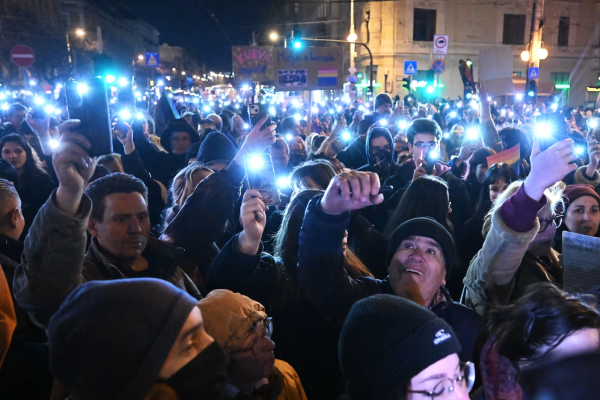
Thousands take to the streets after Hungary passes anti-LGBTQ law banning Pride events

*This is being reported by NBC.

A new anti-LGBTQ law banning Pride events and allowing authorities to use facial recognition software to identify those attending the festivities was passed in Hungary on Tuesday, leading to a large demonstration on the streets of Budapest.

Several thousand protesters chanting anti-government slogans gathered after the vote outside Hungary’s parliament. They later staged a blockade of the Margaret Bridge over the Danube, blocking traffic and disregarding police instructions to leave the area.

The move by Hungarian lawmakers is part of a crackdown on the country’s LGBTQ+ community by the nationalist-populist party of Prime Minister Viktor Orbán, who is an ally of Russian President Vladimir Putin and U.S. President Donald Trump.

The measure, which is reminiscent of similar restrictions against sexual minorities in Russia, was passed in a 136-27 vote. The law, supported by Orbán’s Fidesz party and their minority coalition partner the Christian Democrats, was pushed through parliament in an accelerated procedure after being submitted on Monday.

Opposing legislators led a vivid protest in the legislature involving rainbow-colored smoke bombs.

At the protest outside parliament, Evgeny Belyakov, a Russian citizen who immigrated to Hungary after facing repression in Russia, said the legislation went at the heart of people’s rights to peacefully assemble.

“It’s quite terrifying to be honest, because we had the same in Russia. It was building up step by step, and I feel like this is what is going on here,” he said. “I just only hope that there will be more resistance like this in Hungary, because in Russia we didn’t resist on time and now it’s too late.”

The bill amends Hungary’s law on assembly to make it an offense to hold or attend events that violate Hungary’s contentious “child protection” legislation, which prohibits the “depiction or promotion” of homosexuality to minors under 18.

Attending a prohibited event will carry fines up to 200,000 Hungarian forints ($546), which the state must forward to “child protection,” according to the text of the law. Authorities may use facial recognition tools to identify individuals attending a prohibited event.

In a statement on Monday after lawmakers first submitted the bill, Budapest Pride organizers said the aim of the law was to “scapegoat” the LGBTQ+ community in order to silence voices critical of Orbán’s government.

“This is not child protection, this is fascism,” wrote the organizers of the event, which attracts thousands each year and celebrates the history of the LGBTQ+ movement while asserting the equal rights of the gay, lesbian, bisexual and transgender community.

Following the law’s passage Tuesday, Budapest Pride spokesperson Jojó Majercsik told The Associated Press that despite Orbán’s yearslong effort to stigmatize LGBTQ+ people, the organization had received an outpouring of support since the Hungarian leader hinted in February that his government would take steps to ban the event.

“Many, many people have been mobilized,” Majercsik said. “It’s a new thing, compared to the attacks of the last years, that we’ve received many messages and comments from people saying, ‘Until now I haven’t gone to Pride, I didn’t care about it, but this year I’ll be there and I’ll bring my family.’”

Government crackdown

The new legislation is the latest step against LGBTQ+ people taken by Orbán, whose government has passed other laws that rights groups and other European politicians have decried as repressive against sexual minorities.

In 2022, the European Union’s executive commission filed a case with the E.U.’s highest court against Hungary’s 2021 child protection law. The European Commission argued that the law “discriminates against people on the basis of their sexual orientation and gender identity.”

Hungary’s “child protection” law — aside from banning the “depiction or promotion” of homosexuality in content available to minors, including in television, films, advertisements and literature — also prohibits the mention of LGBTQ+ issues in school education programs, and forbids the public depiction of “gender deviating from sex at birth.”

Booksellers in Hungary have faced hefty fines for failing to wrap books that contain LGBTQ+ themes in closed packaging. Critics have argued Orbán’s campaign amounts to an attempt to cut LGBTQ+ visibility, and that by tying it to child protection, it falsely conflates homosexuality with pedophilia.

Hungary’s government argues that its policies are designed to protect children from “sexual propaganda.”

Is Orbán trying to distract the electorate?

Hungary’s methods resemble tactics by Putin, who in December 2022 expanded Russia’s ban on “propaganda of nontraditional sexual relations” from minors to adults, effectively outlawing any public endorsement of LGBTQ+ activities.

Orbán, in power since 2010, faces an unprecedented challenge from a rising opposition party as Hungary’s economy struggles to emerge from an inflation and cost of living crisis and an election approaches in 2026.

Tamás Dombos, a project coordinator at Hungarian LGBTQ+ rights group Háttér Society, said that Orbán’s assault on minorities was a tactic to distract voters from more important issues facing the country. He said allowing the use of facial recognition software at prohibited demonstrations could be used against other protests the government chooses to deem unlawful.

“It’s a very common strategy of authoritarian governments not to talk about the real issues that people are affected by: the inflation, the economy, the terrible condition of education and health care,” Dombos said.

Orbán, he continued, “has been here with us for 15 years lying into people’s faces, letting the country rot basically, and then coming up with these hate campaigns.”

GOP bill could ban hairdressers from giving gender-nonconforming haircuts to minors

*This is being reported by LGBTQNation.

A bill introduced by Republican lawmakers in Arkansas aims to intimidate anyone who supports or affirms young people’s social transition.

Earlier this month, Arkansas state Rep. Mary Bentley (R) introduced H.B. 1668, the “Vulnerable Youth Protection Act,” and Republican state Sen. Alan Clark introduced the Senate version. As the American Civil Liberties Union of Arkansas and local advocacy group Intransitive note, the anti-trans bill does not actually criminalize anything. Arkansas law banning gender-affirming care for minors was already struck down by a federal judge in 2023.

Instead, H.B. 1668 “weaponizes civil enforcement by permitting lawsuits against any person who supports trans young people by providing or helping to receive gender-affirming care or by affirming young people in their transition,” according to the ACLU of Arkansas. Minors or their parents can sue for minimum damages of $10,000 and up to $10 million in punitive damages for certain forms of medical care. The bill also allows Arkansas parents to sue people or medical providers outside of the state who help Arkansas youth access gender-affirming care.

Sadly, in 2025, state laws aimed at preventing minors from receiving gender-affirming healthcare — which every major American medical association has long been endorsed as evidence-based, safe, and in some cases lifesaving for trans and gender-nonconforming youth — are nothing new. But Arkansas’s proposed law goes an alarming step further in targeting anyone who might support or affirm a young person’s social transition.

The bill defines social transitioning as “any act by which a minor adopts or espouses a gender identity that differs from the minor’s biological sex … including without limitation changes in clothing, pronouns, hairstyle, and name.”

As the ACLU of Arkansas notes, if enacted, H.B. 1668 could lead to frivolous lawsuits against “hairdressers who cut a trans teen’s hair, teachers who use a student’s chosen name, and nonprofits that offer support.” Such lawsuits, the organization says, would be unlikely to hold up in court, as the First Amendment guarantees the right to free speech and free expression.

However, the law is clearly meant to chill support for trans and gender-nonconforming young people with the threat of costly lawsuits. Describing the bill as “state-mandated bullying,” the ACLU of Arkansas writes that “H.B. 1668 fosters a climate of fear, where doctors, teachers, and even parents risk financial ruin simply for supporting transgender youth. It is a blatant overreach of government power, attempting to control private decisions and to circumvent our constitutional rights, including free speech, religious exercise, due process, and equal protection.”

During a Tuesday, March 18, hearing before the Arkansas House Judiciary Committee, a representative from the state attorney general’s office expressed concern that, as written, H.B. 1668 could not be legally defended, citing the First Amendment’s free speech protections.

“Particularly as it comes to the conduct that other individuals are allowed to have towards minors that can be deemed to be aiding in their social transitioning — things like a haircut, even clothing, or even the use of pronouns,” he said, “That’s all speech. And so our concern there is that when you are criminalizing or, in this case, providing a civil cause of action for certain forms of speech, that has to pass a very, very high constitutional bar, and we have to be able to defend that in court. And we think of this bill as it currently is, we can’t do that.”

Texas collected information on transgender drivers. It won’t say why.

*This is being reported by Houston Public Media.

The state of Texas collected information on transgender residents who have changed the sex listed on their identification documents.

According to internal agency documents provided to The Texas Newsroom, employees with the Department of Public Safety recorded each time a driver requested to change the sex listed on their license. The employee scanned and saved the driver’s information, the records show, and sent it to an internal email account created for collecting these data.

At least 42 such attempts, including instances where people asked for guidance about state policies during calls or in-person appointments, have been reported in the last five months, the records show.

It’s unclear why the state is gathering this information, with whom it is sharing it and whether the effort is ongoing.

The data collection occurred as state officials and lawmakers continue to erode LGBTQ rights, bolstered by the Trump administration’s policy rejecting the existence of transgender people.

On Friday, Paxton said it is unlawful for transgender Texans to change the sex listed on their state IDs. In an opinion that does not hold the force of law, he added that any documents that have been updated must be changed back.

Paxton’s agency and the Department of Public Safety did not respond to requests for comment for this story.

The Texas Newsroom spoke with one driver who was flagged by the agency. A transgender man who asked not to be named out of privacy concerns for himself and his child, he said he would not have asked the agency for help updating his license if he knew his information would be reported to the internal agency email account.

“Absolutely not,” he said. “I would not have emailed because now that’s further putting me and my business at risk. …It makes me uneasy.”

Policy change, data collection

For years, transgender people in Texas could update their state IDs to match their gender identity by obtaining a court order and then submitting this document to the state agencies that issue driver’s licenses and birth certificates.

Last fall, the Department of Public Safety said it would no longer let Texans change the sex on their licenses unless it is to fix a clerical error. In announcing the policy change, agency officials also directed employees to record anytime such a change was requested and send the information to an internal email address with the subject line “Sex Change Court Order.”

A similar policy change was made soon after for changes to birth certificates.

At first, LGBTQ activists spammed the email address with subscriptions to gay pornography blogs and adult toy companies, copies of the “Bee Movie” script and personal pleas to leave transgender Texans alone.

But The Texas Newsroom has learned that after the outcry died down, the department continued to use the email for its original purpose — to collect information from drivers who tried to change the sex listed on their driver’s license.

According to more than 100 pages of records obtained through an open records request, driver’s license division employees reported dozens of cases of drivers attempting to change the sex on their licenses in the last six months.

How people were treated and what information was collected varied by location and who dealt with their file, the records showed.

Some employees allowed the drivers to change the name listed on their licenses, but rejected their requests to update their sex. Others were declined on both fronts. Some new residents presented out-of-state or federal documents that matched their gender identity but were still denied a matching Texas license.

The records showed that some state employees also reported people who called the department or walked into a driver’s license office with questions about how to make these changes — even if they did not file a formal request to change their ID.

The Texas Newsroom reached out to the agency, as well as state leaders including Paxton and Gov. Greg Abbott, about the data collection. None answered questions about how the information was being used or how long the effort would last.

This isn’t the first time that state officials have expressed interest in tracking transgender Texans. In 2022, Paxton asked the Department of Public Safety to send his office data about drivers who may be transgender, according to the Washington Post.

At the time, the department said it did not track this exact information and no records were provided to Paxton.

This year, state lawmakers have proposed dozens of bills to whittle away at the rights of lesbian, gay, bisexual and transgender Texans. One proposes jailing anyone whose sex on state documents does not match that assigned to them at birth.

Transgender driver flagged

Most of the drivers’ names were redacted from the records released to The Texas Newsroom.

The aforementioned driver was identified using other information in the documents. In an interview, he said he was not aware that the state was no longer allowing people to change the sex on their IDs when he reached out to the department for help updating his license in October.

He had already updated his passport to match his gender identity, he said, and then went to update his license. But an employee at a local driver’s license office said he needed to contact the state directly and provide more documentation, the driver told The Texas Newsroom.

That’s when he sent a copy of his passport to the Department of Public Safety, he said.

“Hello, I’ve attached my passport in case you need it,” he wrote in an email, which was included in the records released to The Texas Newsroom. “Thanks in advance for your help.”

His email was then forwarded to the special address collecting information about transgender drivers, the records showed.

The driver said the request to change his license was then rejected. He is relieved that he has a passport and social security card that do match this gender identity. In February, the Trump administration stopped allowing transgender people to change the sex on their federal document; the policy change is being challenged in court.

“I feel at peace, honestly, just because I was able to get it done. But that doesn’t mean I don’t sympathize or empathize with the people that were unable to get the change,” he said. “I should be OK to live a normal life without being bothered or harassed.”

A 50-state look at the well-being of LGBTQ+ young people

*This is being reported by University Business.

The well-being of LGBTQ+ young people suffers not because of who they are but due to mistreatment and stigmatization, a leading suicide-prevention organization contends.

The Trevor Project has released a state-by-state analysis of the mental health of LGBTQ+ teens and young adults. The survey of 18,000 LGBTQ+ young people ages 13 to 24 examines suicide risk, access to care, discrimination, bullying and the impact of anti-LGBTQ+ policies, among other factors.

The Trump administration has impacted support and awareness for LGBTQ+ students across colleges and universities. A recent Dear Colleague letter has demanded institutions to dismantle diversity, equity and inclusion programs, which usually house support for LGBTQ students. GOP lawmakers across Florida, Texas and Iowa have also targeted academic programs related to gender studies.

Young people made the following statements about where they live:

I live in a community that is accepting of LGBTQ+ young people.

  • Arkansas: 36%
  • Hawaii: 88%
  • Idaho: 31%
  • Puerto Rico: 60%
  • Washington, D.C.: 97%

I or my family have considered leaving for another state because of LGBTQ-related topics politics and laws.

  • Connecticut: 19%
  • Kentucky: 56%
  • Montana: 53%
  • Texas: 58%
  • West Virginia: 46%

Percentage of LGBTQ+ youth who have seriously considered suicide in the past year:

  • Arizona: 39%
  • Colorado: 41%
  • Louisiana: 32%
  • Michigan: 37%
  • Vermont: 44%

LGBTQ+ young people were physically threatened or harmed:

  • Alaska: 16%
  • New York: 22%
  • Rhode Island: 17%
  • South Carolina: 25%
  • Wyoming: 29%


LGBTQ+ youth who reported experiencing symptoms of depression:

  • Alabama: 56%
  • Kansas: 49%
  • Maryland: 48%
  • Tennessee: 57%
  • Utah: 53%

LGBTQ+ young people who wanted and received mental health care:

  • Florida: 44%
  • Massachusetts: 58%
  • Mississippi: 41%
  • New Jersey: 55%
  • Wisconsin: 53%

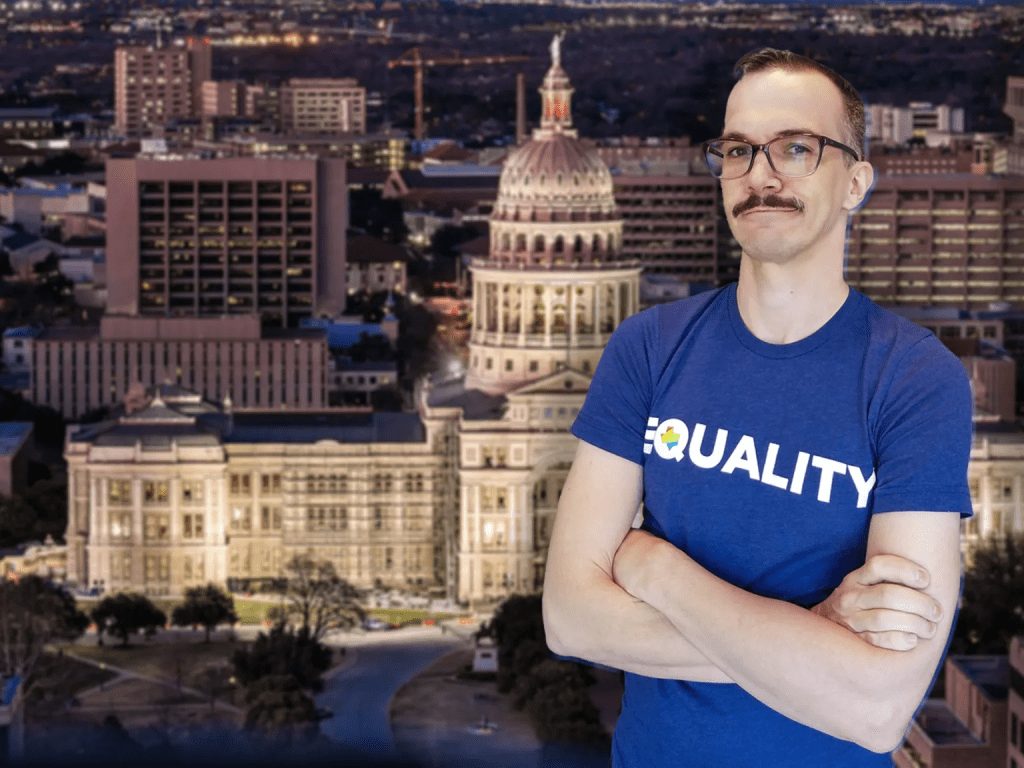
Equality Texas notes record number of anti-LGBTQ bills introduced in 2025 Legislature

*This is being reported by the Dallas Voice.

Friday was the bill filing deadline for Texas’ 2025 legislative session, and Equality Texas’ Interim Executive Director Brad Pritchett today issued a fundraising message warning the state’s LGBTQ community that “we have reached a grim milestone:”

As of Monday, March 15, 205 anti-LGBTQIA+ bills have been filed in the Texas legislature, Pritchett noted. That is, he said, the highest number ever recorded in Texas, surpassing the previous record of 141 bills filed in 2023.

“This is a distinction no Texan should be proud of,” Pritchett wrote. “These bills target our community’s basic rights and freedoms, from healthcare access to education to simply being able to live our lives with dignity. They aim to marginalize LGBTQIA+ Texans and erase our existence from public life.”

Pritchett pointed to Equality Texas’ efforts so far in 2025 which include hosting 30 advocacy training sessions across the state and training more than 1,000 advocates to mobilize at the Capitol, launching the largest pro-transgender TV ad campaign in Texas history, conducting more than 30 issue briefings on LGBTQ rights with legislators and stakeholders and organizing the “largest LGBTQIA+ advocacy day in Texas history.”

Pritchett said that while Equality Texas knows such strategies work, “we need your support to implement them, effectively … . The sheer volume of anti-LGBTQIA+ legislation means we must redouble our efforts.”

Help fund Equality Texas’ efforts in the fight for LGBTQ equality in the Lone Star State at this link.

Ohio appeals court tosses out ban on gender-affirming care for transgender minors

*This is being reported by The Columbus Dispatch.

Ohio’s ban on gender-affirming care for transgender minors is unconstitutional and should be tossed out, an appeals court ruled Tuesday.

The three-judge panel on the Tenth District Court of Appeals overturned a decision by a Franklin County judge that allowed the law to take effect last year. The GOP-controlled Legislature voted in early 2024 to override Gov. Mike DeWine’s veto of House Bill 68, but advocates quickly sued on behalf of two transgender girls and their families.

“It is difficult to understand why our legislature believes adults are equipped to make decisions about gender-affirming medical care for themselves but not for their minor children,” Judge Carly Edelstein wrote in the decision.

House Bill 68 prevents doctors from prescribing hormones, puberty blockers or gender reassignment surgery before patients turn 18. It also bans transgender girls and women from playing on female school sports teams, although the lawsuit didn’t target that piece of it.

The law allows Ohioans younger than 18 who already receive hormones or puberty blockers to continue, as long as doctors determine stopping the prescription would cause harm. It does not ban talk therapy, but mental health providers must get permission from at least one parent or guardian to diagnose and treat gender dysphoria.

The American Civil Liberties Union argued the law violates the right of transgender Ohioans to choose their health care under the Ohio Constitution.

“The state’s ban is discriminatory, baseless and a danger to the well-being of the same Ohioan youth lawmakers claim to want to protect,” said Harper Seldin, an attorney for the ACLU. “It’s also part of a sweeping effort to drive trans people out of public life altogether by controlling our health care, our families and our lives.”

Republican Attorney General Dave Yost, who is running for governor in 2026, pledged to appeal the decision.

Judge blocks implementation of Trump’s transgender military ban

*This is being reported by The Hill.

A federal judge on Tuesday indefinitely blocked implementation of President Trump’s executive order effectively barring transgender people from serving openly in the military, a stark blow to the administration’s efforts to curb transgender rights. 

U.S. District Judge Ana Reyes, an appointee of former President Biden, barred Defense Secretary Pete Hegseth and other military officials from implementing Trump’s order or otherwise putting new policy into place effectuating it. She also said the plaintiffs’ military statuses must remain unchanged until further order of the court.  

The judge said her order intends to “maintain the status quo” of military policy regarding transgender service that existed before Trump signed the order titled “Prioritizing Military Excellence and Readiness.” She stayed her order until Friday to give the administration time to appeal.  

“The Court knows that this opinion will lead to heated public debate and appeals,” Reyes wrote in her opinion. “In a healthy democracy, both are positive outcomes.”

Six active service members and two individuals seeking to enlist in the military sued the Trump administration soon after the Jan. 27 order was signed, asserting it violates their constitutional rights. Two similar lawsuits are moving through the courts. 

Trump’s order suggests that transgender people cannot “satisfy the rigorous standards necessary for military service” because they threaten the lethality of the armed forces and undermine unit cohesion, an argument long used to keep marginalized communities from serving.

“A man’s assertion that he is a woman, and his requirement that others honor this falsehood, is not consistent with the humility and selflessness required of a service member,” the executive order states. 

Reyes wrote in her opinion that the president has both the power and obligation to ensure military readiness but noted that leaders of the armed forces have long used that justification to “deny marginalized persons the privilege of serving.” 

“‘[Fill in the blank] is not fully capable and will hinder combat effectiveness; [fill in the blank] will disrupt unit cohesion and so diminish military effectiveness; allowing [fill in the blank] to serve will undermine training, make it impossible to recruit successfully, and disrupt military order,’” Reyes wrote.  

“First minorities, then women in combat, then gays filled in that blank,” she continued. “Today, however, our military is stronger and our Nation is safer for the millions of such blanks (and all other persons) who serve.” 

A 2016 RAND Corp. study commissioned by the Pentagon found that allowing trans individuals to serve in the military had no negative impact on unit cohesion, operational effectiveness or readiness. 

During several hearings across multiple weeks, Reyes tore into Justice Department lawyers over Trump’s order and Hegseth’s policy effectuating it, which was set to go into effect on March 26. 

A Department of Defense memo dated Feb. 26 said individuals with a “current diagnosis or history of, or exhibit symptoms consistent with, gender dysphoria” are not fit for military service. It added that the Pentagon recognizes only two sexes, male and female, in compliance with another Trump executive order, and requires service members to “only serve in accordance with their sex.” 

Reyes noted that symptoms of gender dysphoria could “mean anything,” from “cross-dressing” to mental health conditions like depression, which are also common among members of the military who do not identify as transgender. 

“How can I say that a policy is limited, when on its own terms, it could include almost any transgender person?” the judge asked Justice Department lawyers during a March 13 hearing. 

Department of Justice (DOJ) lawyer Jason Manion argued that judges must accede to the “current” military, not those under the leadership of past administrations. 

“You defer to the military,” he said. “You do not reassess the evidence they are doing.” 

Nonetheless, the judge questioned the Defense Department’s use of “cherry-picked” studies to back up its new policy, which she said were “totally, grossly” misrepresented by Hegseth. 

In her ruling Tuesday, Reyes pointed to that lack of evidence as reason to take a different course.

“Yes, the Court must defer,” the judge wrote. “But not blindly.” 

At an earlier hearing last month before Hegseth’s policy was announced, Reyes sparred with DOJ lawyer Jason Lynch over the breadth of Trump’s order, suggesting it amounted to “unadulterated animus” backed up by little evidence. 

She directed Lynch to sit down and purported she would ban all graduates of the University of Virginia School of Law — his alma mater — from appearing before her because they’re “liars” and “lack integrity,” terms mimicking Trump’s executive order. 

“Is that animus?” she asked, calling Lynch back to the podium. 

Following that hearing, the Justice Department filed a complaint against Reyes accusing her of misconduct. Attorney General Pam Bondi’s chief of staff, Chad Mizelle, claimed the judge sought to “embarrass” Lynch with her hypothetical scenario. 

Another seven transgender service members, backed by two LGBTQ civil rights organizations, are challenging Trump’s order on transgender troops in a separate lawsuit filed earlier this month in Washington state. Two more active-duty members challenged the order in a suit filed Monday in New Jersey.

In a statement, Jennifer Levi, senior director of transgender and queer rights at GLBTQ Legal Advocates & Defenders, one of the groups representing the plaintiffs at the center of Reyes’s ruling, said Tuesday’s decision “speaks volumes.”

“The Court’s unambiguous factual findings lay bare how this ban specifically targets and undermines our courageous service members who have committed themselves to defending our nation. Given the Court’s clear-eyed assessment, we are confident this ruling will stand strong on appeal,” Levi said.

These lawmakers’ speeches were so powerful that 29 Republicans abandoned their anti-trans bill

*This is being reported by LGBTQNation.

In a shocking turn of events, Republican House representatives in Montana decided to cross the aisle and vote against two anti-transgender bills, following powerful speeches delivered by transgender Reps. Zooey Zephyr and SJ Howell.

President Donald Trump has made his opposition to LGBTQ+ rights very clear, and as a result, Republicans and even some Democrats have felt emboldened to push anti-LGBTQ+ sentiment. Republican legislators in numerous states have proposed bills targeting trans people, and GOP-dominated states like Montana are no exception.

On March 6, day 47 in Montana’s 69th Legislature, lawmakers debated nearly 250 bills, including ones targeting the trans population, which Republican representatives largely supported, with some notable exceptions.

House Bill 675, sponsored by Rep. Caleb Hinkle (R), would ban drag performances and Pride parades in Montana. Hinkle proposed it in response to a previous drag ban he sponsored being struck down by the courts after it was used against a trans woman who was not a drag artist to prevent her from speaking at a library event.

To circumvent this ruling, Rep. Hinkle proposed granting individuals the private right to sue drag performers rather than relying on state enforcement. Hinkle called being transgender “a fetish” during committee hearings.

Rep. Zooey Zephyr (D) took to the floor and gave an impassioned speech in response.

“At its very core, drag is art. It is very beautiful art. It has a deep history in this country, and it is important to my community. You know, if you are a woman in this body wearing a suit today, you are in some way challenging gender norms that existed long ago,” she said.

“There were three-article-of-clothing laws 50 years ago that said if you wore three articles of clothing that were indicative of the opposite gender, they could stop you, arrest you,” she continued. “It was those laws that led to the police raiding an LGBTQ+ bar that led to the Stonewall riots, one of the most important civil rights moments in my community’s history.”

She added, “The sponsor … said this bill is needed… and I quote his words… ‘because transgenderism is a fetish based on crossdressing.’ And I am here to stand before the body and say that my life is not a fetish. My existence is not a fetish. I was proud a month ago to have my son up in the gallery here. Many of you on the other side met him. When I go to walk him to school, that’s not a lascivious display. That is not a fetish. That is my family. This is what these bills are trying to come after… not obscene shows in front of children; we have the Miller test for that, we have laws for that. This is a way to target the trans community, and that is in my opinion, and in the speaker’s own words.”

In a surprising turn of events, Rep. Sherry Essmann (R) rose to Rep. Zephyr’s defense, chastising the bill’s sponsor for using parental rights as his argument for bringing this bill into law, pointing out that such a bill would impede on the rights of parents such as Rep. Zephyr, and that representatives who support parents’ rights should vote against this bill.

In Rep. Essmann’s own words, “I’m speaking as a parent and a grandmother. And I’m very emotional because I know the representative in seat 20 is also a parent. No matter what you think of that, she is doing her best to raise a child. I did my best to raise my children as I saw fit, and I’m taking it for granted that my children are going to raise my grandchildren as they see fit,”

Following these two speeches, 13 Republican representatives voted against the bill.

This turn of events would’ve been remarkable in its own right, but this wasn’t the only occurrence of aisle-crossing on trans issues this session.

House Bill 754, if passed, would’ve had even more devastating consequences. The measure would’ve allowed the state to remove transgender children from their parents.

Rep. SJ Howell (D) took the floor to argue against the passing of the bill. Rep. Howell, who is non-binary, pointed out the vagueness of what the bill defines as a transgender child as it could mean a child who does anything that defies conventional gender norms, such as having a certain haircut or trying out a new nickname.

“Transitioning gender is not defined in this bill… so what does that mean? Maybe it means, as the sponsor said, surgery or medical treatment. Maybe it means therapy, mental healthcare. Maybe it means a kid who gets a haircut and a new set of clothes. Maybe a name change… a legal name change, or someone who wants to try out a different name… a strict reading of this bill could include all of that,” Howell said.

Rep. Howell further drove their point that the decision for the state to intervene in the removal of a child is a serious matter that holds a great deal of weight. They urged lawmakers to keep that in mind and consider the real consequences.

“Put yourself in the shoes of a [Child Protective Services] worker who is confronted with a young person, 15 years old maybe, who is happy… healthy… living in a stable home with loving parents, who is supported and has their needs met? And they are supposed to remove that child from their home and put them in the care of the state? We should absolutely not be doing that,” they said.

The bill went to a vote; this time, the Montana Republican party was fully fractured on the matter with 29 Republican representatives voting nay, killing the bill with a majority vote from all representatives. 

When discussing the results of these two decisions, Rep. Zephyr took to Bluesky, where in a post she typed, “These kind of votes are born out of trans representation in government.”

Equality Florida Resistance Report- Bad Bills Are Moving

*This is being reported by Equality Florida.

We’re heading into week #3 of the legislative session — and there’s a LOT happening. But reinforcements are on the way! Soon, we’ll be welcoming hundreds of volunteers to Tallahassee for our Pride At The Capitol kick-off campaign on Tuesday and Wednesday — and we have a packed schedule! Multiple bad bills are moving through the legislative process, and it’s all hands on deck to fight back against them.

But that’s not all. Earlier this week, Jennifer Solomon — Equality Florida’s Parents and Families Support Manager and the President of Kaleidoscope PTA, which advocates for safe, supportive, and respectful learning environments for ALL students — joined parents from across the state in the Capitol for the Florida PTA’s Legislative Convention. The message from Kaleidoscope PTA was clear: we want policies that protect every student and respect every family.

Our ongoing Pride At The Capitol program is a crucial element of our goal to combat and minimize the impact of bad bills and prepare for legal challenges against any that are passed into law.

But this effort relies heavily on pro-equality supporters like YOU taking action. Your presence in Tallahassee, your stories, and your participation in committee hearings are crucial. We have a phenomenal group joining us in the Capitol next week, but we’re still signing folks up for the weeks beyond to stand with us on the front lines. Whether you can join us for a day or the entire week, find a time that works for you!

If you can’t join us in person, please consider a donation to help us get as many people to Tallahassee as possible. Every dollar counts!

Now, we’re going to take you through exactly what happened in Week #2, what’s still coming, and how you can take action.

🚨OPPOSE: End Citizen-Led Amendments (HB 1205/SB 7016)🚨
Sponsors:
 Rep. Jenna Persons-Mulicka

  • What it does: These bills attempt to effectively End Citizen-Led Amendments that allow we the people to change the state constitution via statewide referendum. Florida already has some of the strictest requirements in the nation for citizen-led amendments, but this legislation imposes new and insurmountable barriers that put constitutional amendments even further out of reach and consolidate power toward politicians and away from the voters.
  • What happened: SB 7016 PASSED out of its first committee by a 6-3 vote this week. Next, it heads to the Senate Fiscal Policy Committee — its final committee in the Senate before it reaches the floor for a full vote.
    How you can help: We need you to contact members of the Senate Fiscal Policy Committee right away and urge them to vote NO on SB 7016.

  • 🚨Anti-Diversity In Local Government (HB 1571/SB 420)🚨
  • Sponsors: Sen. Clay Yarborough and Rep. Dean Black
  • What it does: These bills prohibit local governments from enacting DEI-related policies, ordinances, or resolutions, and can subject local officials who previously voted for them to removal from office. This outrageous state overreach censors local governments and restricts their ability to respond to community needs and priorities.
  • What’s coming: SB 420 has been scheduled for a vote in its first Senate Committee, Community Affairs, on Monday, March 17th at 4:00pm ET.
  • How you can help: We need you to contact members of the Senate Community Affairs Committee right away and urge them to vote NO on SB 420.

  • 🚨Don’t Say Gay or Trans at Work 2.0 (HB 1495/SB 440)🚨
  • Sponsors: Sen. Stan McClain and Rep. Rachel Plakon
  • What it does: This bill enacts state regulations on pronoun use in public and certain private workplaces. It shields employees from accountability for anti-trans harassment and intentional misgendering, and prohibits the inclusion of a transgender or nonbinary gender option on any job application or related employment form. The bill also prohibits LGBTQ-related cultural competency training requirements for government workers.
  • What’s coming: SB 440 has been scheduled for a vote in its first Senate Committee, Governmental Oversight and Accountability, on Tuesday, March 18th at 3:30pm ET.
  • How you can help: We need you to contact members of the Governmental Oversight and Accountability Committee right away and urge them to vote NO on SB 440.

  • 🏆 THE GOOD BILLS 🏆
  • We’re keeping up the pressure on lawmakers to support and co-sponsor these bills, and we need your help.
  • 🏆 The Health Care Freedom Act (HB 823/SB 932) 🏆
  • Sponsors: Rep. Anna V. Eskamani and Sen. Shevrin Jones
  • Restores Reproductive Rights: Repeals Governor DeSantis’ 6-Week Abortion Ban, reinstating abortion access up until the start of the third trimester, in line with broader medical and legal standards.
  • Protects Medical Care For Transgender People: Eliminates restrictions on essential medical care for transgender individuals, ensuring access to treatments supported by leading medical authorities like the American Academy of Pediatrics and the American Medical Association.

  • 🏆 Freedom to Learn Act (HB 811/SB 930) 🏆
  • Sponsors: Rep. Angie Nixon and Sen. Tracie Davis
  • Safeguards Academic Freedom: Repeals provisions of the Stop WOKE Act and the “Don’t Say LGBTQ” law, protecting the right to teach honest history, discuss systemic injustices, and fully address LGBTQ topics in educational settings.
  • Promotes Inclusive Education: Allows higher education institutions to fund DEI programs and activities on campus, and requires the inclusion of LGBTQ history in public education, alongside Holocaust education, African American history, and women’s contributions, and restricts book-banning practices by limiting who can raise objections to school materials to only parents of public school students.
  • Send a message to lawmakers urging them to support the two Freedom bills.

Our public policy team has been reviewing hundreds of bills filed this legislative session. View our full legislative slate of priority bills Equality Florida supports and opposes.

Florida has been setting the example for bad policy that’s now being taken up at the federal level. Earlier this week, we held a virtual briefing with national partners to discuss ways we’re resisting attacks from the Trump Administration in the courts.

Green card holder from New Hampshire ‘interrogated’ at Logan Airport, detained

*This is being reported by NHPR.

A New Hampshire man with a green card was detained by immigration officers at Logan Airport and is being held by U.S. Immigration and Customs Enforcement at the Donald W. Wyatt detention facility in Central Falls, Rhode Island.

Fabian Schmidt’s family said they are unsure of why he is being held. They said he has a recently renewed green card, and no active issues in court.

Schmidt had been visiting Luxembourg and flew back to the U.S. on Friday. His partner had gone to pick him up at Logan Airport, and waited four hours before calling authorities.

“It was just said that his green card was flagged,” said Astrid Senior, his mother. She said she didn’t hear from her son directly until Tuesday, when she learned he’d been hospitalized.

Senior described Schmidt being “violently interrogated” at Logan Airport for hours, and being stripped naked, put in a cold shower by two officials, and being put back onto a chair.

She said Schmidt told her immigration agents pressured him to give up his green card. She said he was placed on a mat in a bright room with other people at the airport, with little food or water, suffered sleep deprivation, and was denied access to his medication for anxiety and depression.

“He hardly got anything to drink. And then he wasn’t feeling very well and he collapsed,” said Senior.

He was transported by ambulance to Mass General Hospital. He didn’t know it at the time, but he also had influenza.

On Tuesday, Schmidt was transported to the regional headquarters for ICE in Burlington, Massachusetts, and then transferred to the Wyatt facility. The family, including his partner, who is a cardiologist in Nashua, have acquired attorneys and been working with the German consulate in hopes to have him released on bail.

Schmidt and his mother moved to the U.S. in 2007, and received green cards in 2008. He moved from California to New Hampshire in 2022.

Senior described her son as a hardworking electrical engineer with a partner and 8-year-old daughter who are both U.S. citizens.

“Fabian said to me that he feels he’s very fearful and is frightened,” said Senior.

Schmidt had a misdemeanor charge for having marijuana in his car in 2015, which his mother said was dismissed after laws changed in California around marijuana possession. He missed a hearing about the case in 2022 since a notice was never forwarded to his new address. Senior mentioned that Schmidt is successfully recovering from alcoholism, and had a DUI that he’s completely worked through and paid off from around ten years ago.


Can a green card holder be deported?

It’s a complicated question, but some protections exist.

Green cards grant foreign nationals the right to live and work in the U.S. as permanent residents. They’re valid for ten years and have to new renewed.

“Only the immigration judge can take away that green card. The Trump administration thinks that they can expand that and do some crazy things,” said Curtis Morrison, an immigration attorney in California with experience litigating against the Trump administration. “But the law as it is now — he needs to be able to appear before an immigration judge.”

The government has to initiate removal proceedings in immigration court, and an individual has the right to go before a judge to defend themselves and understand the government reasoning for the potential deportation.

“[It’s the] Immigration and Nationality Act — which describes different kinds of conduct or crimes that could trigger somebody with a green card being deported and put into court proceedings to have them deported,” said Gregory Chen, senior director of government relations for the American Immigration Lawyers Association.

The law doesn’t always require convictions for green card holders to be deported.

“There is a long list of behaviors, conduct and also crimes. If somebody’s been convicted of something that could make somebody deportable if they have a green card,” he said.

Chen hadn’t heard of other green card cases like Schmidt’s other than that of Palestinian and Syrian student activist Mahmoud Khalid in New York City, a green card holder who is currently detained due to his protest activity at Columbia University. In that case, attorneys are relying partially on First Amendment right of protest.

“We have seen a disturbing trend from the federal government to target people who have legal immigration status,” said Chen, including not just those who have green cards, but people with visas and varying legal statuses.

“Denying a green card holder admission on such a minor charge would be an extreme case, but it is possible under the law,” said Jaclyn Kelley-Widmer, immigration law professor at Cornell Law School of the pot possession charge and deportation.

The reasons a green card holder can be deported include many kinds of criminal convictions, even if those convictions are from a long time ago and even some very minor convictions. For marijuana convictions, a person is deportable unless the conviction is for possession of 30 grams or less of marijuana for one’s own use, she said. Otherwise, any controlled substances offense makes a green card holder deportable.

Blog at WordPress.com.

Up ↑