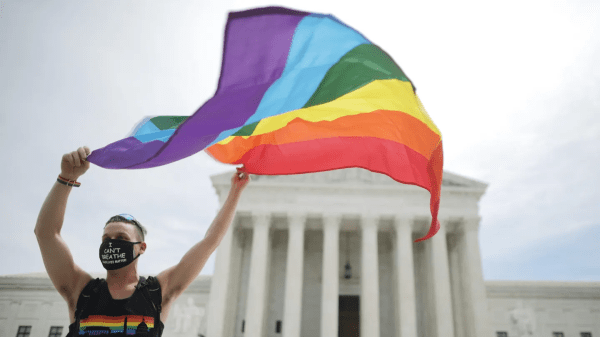
Supreme Court Could Legalize LGBTQ Conversion Therapy—The Consequences Could Cost Billions

*This is being reported by Forbes

The Supreme Court announced Monday it will hear a case regarding whether state bans on “conversion therapy” trying to change minors’ sexual orientation or gender identity are legal—a case that could carry billions of dollars in repercussions, as a 2022 study found conversion therapy carries an economic burden of approximately $9 billion annually for patients and their families.

Key Facts

The Supreme Court took up Chiles v. Salazar, a case challenging Colorado’s ban on LGBTQ “conversion therapy” for minors, which asks the justices to more broadly decide whether laws that “[censor] certain conversations between counselors and their clients based on the viewpoints expressed” are constitutional.

LGBTQ “conversion therapy,” as it’s commonly known, refers to any practices—including both emotional efforts, like talk therapy, or physical efforts, like electroconvulsive therapy—that aim to influence a patient’s sexual orientation or gender identity, which are typically framed as efforts to “cure” homosexuality or being transgender.

Repeated studies have shown such efforts are ineffective at changing people’s sexual orientation or gender identity and carry a variety of harmful effects—such as elevated risks for suicide, drug abuse and mental health issues—which has led to bans on conversion therapy for minors being enacted in more than 20 states.

Conversion therapy and its negative effects also have an economic impact, as a 2022 study published in JAMA Pediatrics found conversion therapy and its “associated harms” result in an economic burden of approximately $9.23 billion per year.

Conversion therapy alone costs approximately $650 million for participants annually in the U.S., with individuals who undergo it paying an extra $97,985 for treatment as compared with people who don’t undergo any counseling, according to the study, which was based on data from LGBTQ youth ages 13-24.

There are also significant costs associated with knock-on effects from conversion therapy and the study estimates each conversion therapy patient pays an extra $83,366 on average to treat the “downstream consequences” associated with the procedure, which combined raise the total economic burden of conversion therapy to $9.2 billion.

What To Watch For

The Supreme Court will hear the case on conversion therapy at some point during its next term, which begins in October, so any ruling in the case is likely more than a year away.

What Did The Study Conclude?

The study, which was conducted by pro-LGBTQ rights organization The Trevor Project and research group Cytel, concluded there is a “high economic burden and high societal costs” that come along with conversion therapy, which the study refers to as sexual orientation and gender identity change efforts (SOGICE). Researchers analyzed the difference in costs between patients who underwent conversion therapy, LGBTQ youth who received no therapy and those who received therapy that affirmed their sexual orientation or gender identity. The study found conversion therapy carried the highest economic burden: In addition to the $650 million per year in total attributed to the therapy itself, there are also total annual costs of $190 million related to anxiety or “severe psychological distress” among those that underwent conversion therapy, $1.36 billion related to depression, $2.42 billion from suicide attempts, $1.17 billion from fatal suicides, $1.26 billion from alcohol use disorder and $2.18 billion from substance abuse. The likelihood of those negative outcomes was largely markedly higher among those who underwent conversion therapy as compared with other LGBTQ populations—except alcohol use disorder, where those without any therapy registered the highest number by one percentage point (42.26% among those with no intervention versus 41.26% among conversion therapy patients). As a result, the total costs incurred by conversion therapy patients were higher than the $4.85 billion in total annual costs among those who hadn’t received any treatment, and $3.04 billion among those who received affirmative therapy.

Contra

Researchers noted there were some limitations with the study’s methodology that may affect its results, such as being based on studies in which patients self-reported their experiences. That means it might not be fully representative of all LGBTQ patients, as many people may be unwilling to discuss their experiences. It also assumes the risks are the same across the LGBTQ population and for various types of conversion therapy, which may not be the case. Researchers argued they took a “conservative approach” with their findings, however, and noted the $9 billion figure is likely an underestimate of the total economic impact. The study only looked at adverse impacts from conversion therapy for three years after the treatment, for instance—though such effects could likely extend for much longer—and did not examine some other potential impacts, like post-traumatic stress disorder or medical consequences from various medications or electroconvulsive therapy.

Big Number

13%. That’s the share of LGBTQ youth who have either been subjected to or threatened with conversion therapy, according to a 2024 survey conducted by The Trevor Project among more than 50,000 Americans ages 13-24. That includes 5% who have been subjected to the therapy and 8% who were threatened with it. The 5% share is down from 10% who said in 2020 they were subjected to the therapy, though that number could rise again should the Supreme Court outlaw state bans.

Key Background

The Supreme Court case was brought by Kaley Chiles, a licensed counselor in Colorado who said in a court filing “she believes that people flourish when they live consistently with God’s design, including their biological sex.” Chiles objects to Colorado restricting her from counseling clients to change their sexual orientation or gender identity, claiming it violates her First Amendment rights and classifying state bans on conversion therapy as “silenc[ing] counselors’ ability to express views their clients seek on a topic of ‘fierce public debate.’” Chiles asked the Supreme Court to take up the case after a federal appeals court upheld Colorado’s policy restricting conversion therapy, ruling that it was regulating counselors’ professional conduct, rather than chilling First Amendment-protected speech. The case is the latest in a string of major cases related to LGBTQ rights the 6-3 conservative-leaning court has decided in recent years—such as cases over businesses being allowed to discriminate against same-sex couples or discriminate on the basis of sexual orientation and gender identity—and the court is deliberating on a case this term over gender-affirming care for minors.

Further Reading

Humanistic and Economic Burden of Conversion Therapy Among LGBTQ Youths in the United States (JAMA Pediatrics)
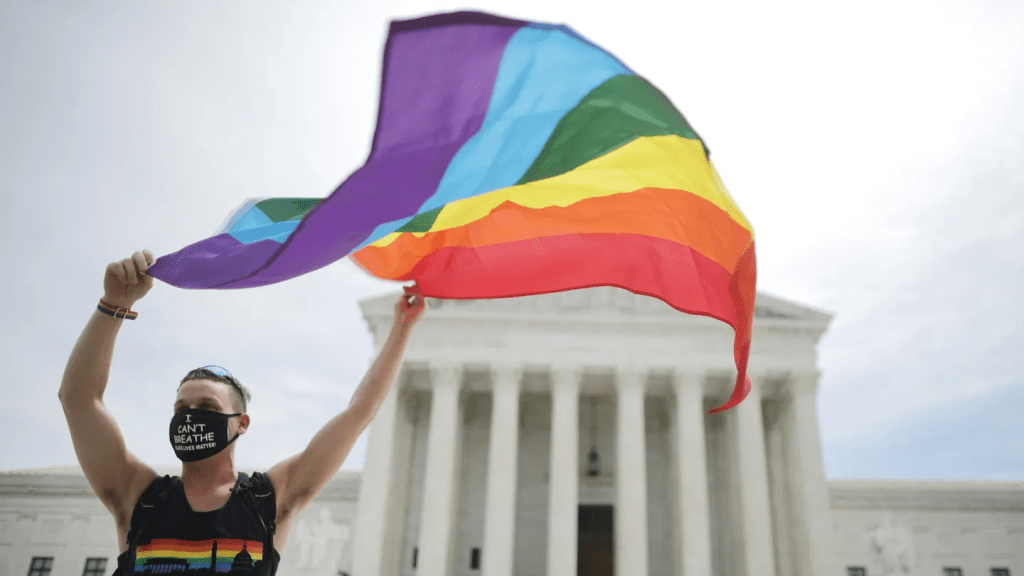
Survey: Over two-thirds of LGBTQ youth in Florida want to move out of state

*This was reported by the Tallahassee Democrat.

Less than half of young LGBTQ Floridians feel accepted in their communities, according to a new report released by The Trevor Project.

The Trevor Project, a nonprofit that provides crisis support for LGBTQ young people, surveyed almost 1,000 young LGBTQ Floridians about their mental health, and 48% felt the community they live in was accepting of their gender identity or sexual orientation.

But more than two-thirds, or 69%, say they or their family members have considered moving out of Florida because of LGBTQ-related politics and laws. It wasn’t clear where they considered moving.

“Florida might be free, but Florida is not welcoming,” said Sen. Shevrin Jones, D-Miami Gardens.

Since 2022, the Republican-led Legislature and Gov. Ron DeSantis have pushed multiple anti-LGBTQ laws in what they call the “Free State of Florida,” including banning “gender ideology” from K-12 schools, criminalizing trans people for using the bathroom that corresponds with their gender identity and restricting health care for trans people.

Florida’s Log Cabin Republicans, an organization of LGBTQ+ conservatives and allies within the Republican Party, did not respond to the USA TODAY Network-Florida’s request for comment in time for publication.

The Trevor Project also reported the following data about Florida’s LGBTQ youth. In the past year:

  • 37% contemplated suicide
  • 11% attempted suicide
  • 67% reported experiencing symptoms of anxiety
  • 54% reported experiencing symptoms of depression
  • 24% were physically threatened or harmed because of their sexual orientation or gender identity
  • 63% experiences discrimination because of their sexual orientation or gender identity

Jones said the passage of the Parental Rights in Education Act, called “Don’t Say Gay” by critics, and the “Stop WOKE Act” created a hostile environment for minorities in Florida. “Don’t Say Gay” prohibits the teaching of classroom instruction on gender identity and sexual orientation, and the “Stop WOKE Act” restricts how race is discussed in schools, colleges and workplaces.

The legislation also prohibits any teaching that could make students feel they bear personal responsibility for historic wrongs because of their race, color, sex or national origin.

DeSantis inveighed against ‘oppressive ideologies’

“We believe an important component of freedom in the state of Florida is the freedom from having oppressive ideologies imposed upon you without your consent,” DeSantis said when he signed the bill in 2022. “Whether it be in the classroom or in the workplace. And we decided to do something about it.”

On Tuesday in DeSantis’ State of the State speech, he made fun of Canada’s travel boycott of the U.S. and of Canadians who say they are canceling their vacations over President Trump’s tariffs and policies.

“We continue to set tourism records; 2024 saw more than 142 million visitors come to the state of Florida. This includes 3.3 million visitors from Canada,” DeSantis said. “That’s not much of a boycott in my book.”

Trump administration changes at the VA affecting care for LGBTQ veterans

*Reported by NPR’s Morning Edition.

Staff and patients at the Department of Veterans Affairs say impacts of Trump administration changes to the agency go beyond erasing diversity programs and affect care for LGBTQ patients.

A MARTÍNEZ, HOST:

The Department of Veterans Affairs is planning to cut as many as 80,000 employees, which it says won’t affect healthcare or benefits. Still, VA staff and patients are concerned that a policy ending diversity programs will affect care for LGBTQ veterans. Here’s Steve Walsh with WHRO in Norfolk, Virginia.

STEVE WALSH, BYLINE: Mary Brinkmeyer put in her resignation after receiving emails from management in the wake of President Trump signing executive orders targeting DEI.

MARY BRINKMEYER: It was just a really upsetting and shocking change for me from feeling as if the program was supported to suddenly having people being told they have to take every Pride magnet out of their office. And it felt like that happened just overnight and without a lot of thought.

WALSH: Until recently, the psychologist was the LGBTQ+ veteran care coordinator for the Hampton VA. A few days after the inauguration, employees at her VA were told to take down any outward signs referencing LGBTQ veterans, including flyers printed by the VA.

BRINKMEYER: Less than 24 hours after everything had been taken out of the main hospital, I was speaking to a gay veteran who said, oh, I heard about how y’all took everything down. I guess that shows what they think of us.

WALSH: Rainbow-colored Pride lanyards, which say the VA serves all who serve, had been a strategy to make veterans feel safe. They were banned from the building, she says.

BRINKMEYER: A lot of LGBTQ veterans don’t feel safe coming to the VA because their experiences in the military were so unsafe.

WALSH: Brinkmeyer says she decided to resign when she said she was told to stop attending employee orientation. A large part of her job had been training other providers in ways to ask the right questions. A transformation is underway at the VA, but it’s unclear how large the change will be. VA Secretary Doug Collins announced the change to the VA’s flag policy.

(SOUNDBITE OF ARCHIVED RECORDING)

DOUG COLLINS: For all of us who served in uniform, that American flag is on our uniform. It’s what unites us. So we’ve changed the policy. At the VA, you’re only going to see the American flag and the POW flag. That’s what’s going to be flying in front of our facilities.

WALSH: John Rogers with the Hampton VA says they are working to execute the executive order, and there will be no changes to services and benefits for veterans and VA beneficiaries until a formal order is issued. Banners and posters advertising the VA’s outreach for LGBTQ+ veterans came down very quickly at the Hampton VA in Virginia. Amanda Volk is a patient at the Hampton VA. She served under Don’t Ask, Don’t Tell in 1995 and got out 18 months later after a sexual assault.

AMANDA VOLK: For those of us that lived through Don’t Ask, Don’t Tell, we were there. We saw it. We marched. We fought. We thought we had our rights. And now it’s – you know, we’re back to the ’80s with people being scared.

WALSH: In New York state, one mental health practitioner says posters remain up at his VA, but he’s still seeing a chilling effect among veterans. NPR agreed to withhold his name as he fears retaliation.

UNIDENTIFIED HEALTH PRACTITIONER: I think, you know, veterans are kind of hesitant, and some veterans I know have decided they’re not willing to come in person. It’s more on the veteran side of things that there’s this uncertainty of kind of what care actually is going to look like.

WALSH: Adding to the tension, in late January, a transgender veteran killed themselves in the parking garage of the Syracuse VA Medical Center, wrapped in the transgender flag – an indication, he says, that this shift has a high potential to impact patient care at the VA.

For NPR News, I’m Steve Walsh.

MARTÍNEZ: If you or someone you know is in crisis, call or text 988 to reach the Suicide & Crisis Lifeline.

Lawsuit aims to strike down LGBTQ anti-discrimination protections in Pennsylvania

*This is being reported by the AP and NBC.

 Two public school districts and several parents have sued the state in a bid to undo anti-discrimination protections for gay and transgender people in Pennsylvania, saying that the two-year-old regulation is illegal because it goes beyond what lawmakers intended or allowed.

The lawsuit, filed in the statewide Commonwealth Court late Thursday, comes amid a debate in Pennsylvania and nationally over the rights of transgender high school athletes to compete in women’s sports.

If the lawsuit is successful, the Pennsylvania Human Relations Commission would no longer be able to investigate complaints about discrimination involving sexual orientation, gender identity and gender expression. The plaintiffs’ lawyers also say a favorable ruling in court would bar transgender student athletes from competing in women’s high school sports in Pennsylvania.

The plaintiffs include two districts — South Side Area and Knoch, both in western Pennsylvania — and two Republican state lawmakers, Reps. Aaron Bernstine and Barbara Gleim, as well as three parents and seven students.

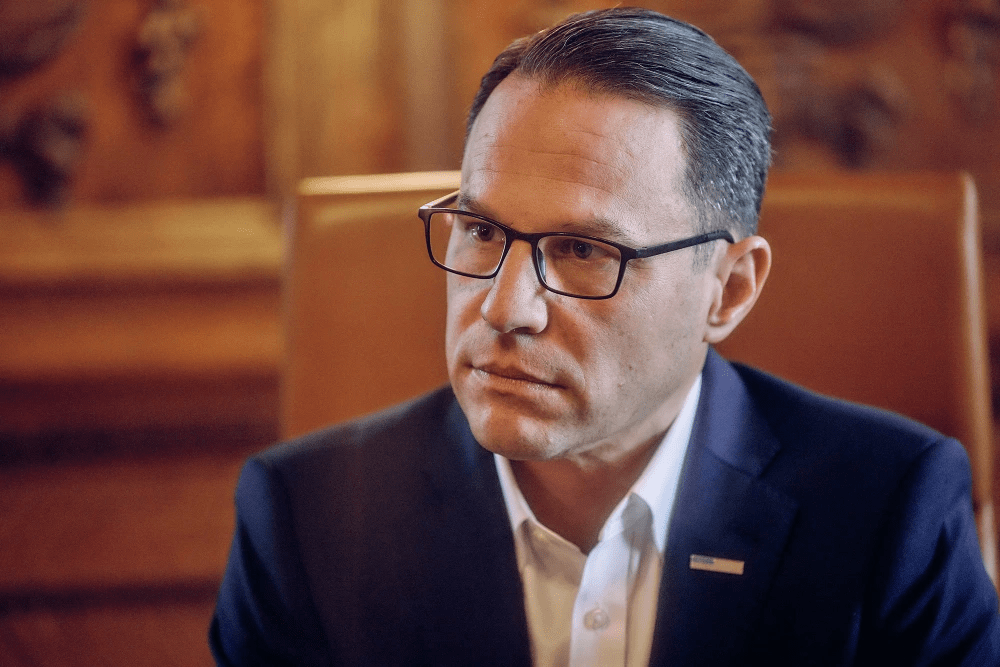
The lawsuit names Gov. Josh Shapiro, a Democrat, and the Pennsylvania Human Relations Commission, which investigates complaints about discrimination because of someone’s race, sex, religion, age or disability in housing, employment and public accommodations.

Shapiro’s office said it had no immediate comment Friday and the commission did not immediately respond to an inquiry about the lawsuit Friday.

The lawsuit is aimed at the definition of sex discrimination that the commission expanded by regulation to include sexual orientation, gender identity and gender expression.

The regulation was approved in late 2022 by a separate regulatory gatekeeper agency, and it took effect in 2023.

The plaintiffs contend that the state Supreme Court has interpreted the term “sex” as used in the Pennsylvania Constitution to mean either male or female.

They also contend that the state Legislature never gave permission to the Human Relations Commission to write regulations expanding the legal definition of sex discrimination, making the regulation a violation of the Legislature’s constitutional authority over lawmaking.

The commission has justified the expanded definition by saying that state courts have held that Pennsylvania’s anti-discrimination laws are to be interpreted consistently with federal anti-discrimination law. The commission can negotiate settlements between parties or impose civil penalties, such as back pay or damages.

For years, Democratic lawmakers tried to change the law to add the terms sexual orientation, gender identity and gender expression to the portfolio of complaints that the Human Relations Commission could investigate. Every time, Republican lawmakers blocked the effort.

Texas House Representative Attempts to Criminalize Being Transgender

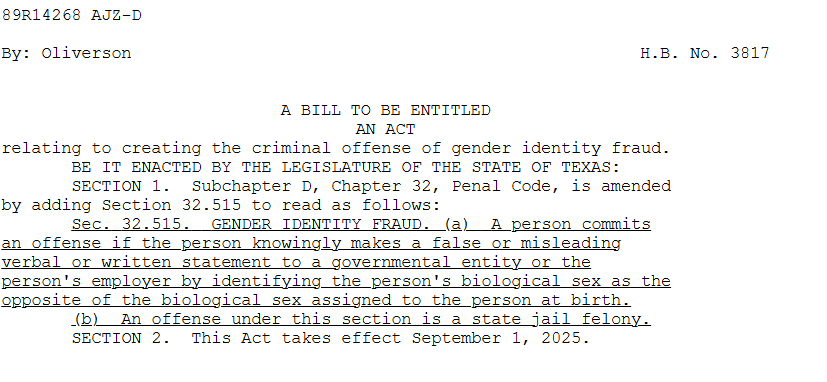
Not to be outdone by Rep. Money, who earlier filed an attempted ban on gender transition, Texas State House Representative Tom Oliverson (R-Cypress) filed House Bill 3817 on March 5 that would make simply being transgender a state felony. Below is the entirety of the bill text:

Oliverson is the Vice Chair of the House Republican Caucus. He had previously filed a bill in January to establish a “Religious Freedom Commission”.

LGBTQ Refugees May Apply for Asylum in Sweden

The Swedish Migration Board has posted the following information for LGBTQ asylum seekers.

If you have a well-founded fear of being persecuted because of your sexual orientation, gender, gender expression, gender identity or other membership in a certain social group, you may be a refugee and have the right to protection in Sweden. This is stated in the Refugee Convention, Swedish law and EU rules.

Asylum application and rules

Persecution can be threats or violence against your life or health. It can also be about laws and regulations or people’s views that mean that you are subjected to serious violations because of your sexual orientation. It can be, for example, punishment or extensive discrimination such as not being able to go to school, choose a job or receive healthcare.

The right to express yourself and engage politically without fear of persecution regardless of ethnicity, religion, gender or sexual orientation are also examples of what can give you the right to stay in Sweden.

It does not matter whether the persecution comes from the authorities of your home country or if your family or other people threaten you. The Swedish Migration Board will then investigate what could happen to you if you return to your home country in the future and whether the authorities there are unable or unwilling to protect you against the persecution that you say you are at risk of.

The Swedish Migration Board will register you as an asylum seeker with the name, date of birth and legal gender that appears on your identity documents. Swedish law does not allow us to register you with a different name, but if you wish to use a different address or pronoun, you should tell us so that we can make a note of this.

Investigation

When the Swedish Migration Board decides whether you need protection and can therefore be granted a residence permit in Sweden, an investigation will be carried out with you to understand what your life has been like and why you are afraid of returning to your home country. If the reason is your sexual orientation, gender expression or gender identity, it is important that you tell us as early as possible.

Read more about how to apply for asylum

The Swedish Migration Board knows that it can be difficult to tell someone you have never met about such things. It may even be the first time you have talked about it with someone and the boundaries of what feels personal and private are different for everyone. It is important that you still tell us as much as possible about all your reasons for asylum. The more details you can talk about, the better basis the Swedish Migration Board has for its decision. The investigator will also ask questions about your sexual orientation, your gender expression or gender identity, the thoughts and feelings you have had about it and your relationships with family, friends and the society you have lived in. We are bound by confidentiality and do not tell people who are not working on your case about what you tell us.

If you feel that the officer conducting your investigation does not understand what you are saying, or if you have information that the officer does not ask for, you must tell them as soon as possible. Do not wait until you have received a decision on your case.

You have the opportunity to express your gender preferences for the interpreter, caseworker and assistant so that you feel safe during the asylum process, and the Swedish Migration Board will then try to help you with your preferences. If you are over 18 years of age, you will meet your assistant and your caseworker alone without other co-applicants. You can request an assistant with special knowledge of the situation of LGBTQ people if you know of, or receive help in finding, such an assistant.

If you are under 18 years old

The Swedish Migration Board must listen to all children seeking asylum and find out whether the children need protection here. It is therefore important that you tell the Swedish Migration Board about your life in your home country and what you think would happen to you if you went back there. If you are under 18 and have guardians with you in Sweden, the Swedish Migration Board must ask them if we can talk to you without them being in the room. If you do not have your parents with you in Sweden, it is your guardian who decides whether we can talk to you alone. If you want to talk to your case officer without your parents or guardian, it is important that you say so.

The interpreter

Words and concepts in Swedish and your own language can mean different things. The most important thing is that you describe your own feelings and experiences and explain how they relate to why you are afraid.

If you do not understand the interpreter or if you think the interpreter may not be translating everything you say impartially, you should speak up. Also, keep in mind that the interpreter may not always know the specific words used to talk about sexual orientation, gender identity or gender expression. It may therefore be a good idea to also explain to the interpreter what the words you are using mean to you.

Accommodation

In most of the Swedish Migration Board’s accommodation, two or more people of the same gender share a room. The wait during the asylum process can make the accommodation situation stressful and conflicts can arise in the accommodation.

It is important that you tell us as soon as possible about what you need or if you feel unsafe where you live. If there are problems in the accommodation that you need help solving, you must tell us. Speak to the caseworker at the reception unit or the staff at the accommodation where you are registered.

Health

In some cities there are clinics for, for example, sexual health and counselling for specific target groups. Examples of target groups could be women, young people or LGBTQ people. Ask your caseworker for more information.

Voluntary organizations

You always have the right to contact voluntary organisations during the asylum process for advice and support. The more information you have about your rights and possible options, the better prepared you are for the different stages of the asylum process. RFSL is one such voluntary organisation that works for LGBTQ rights, providing special support and social meeting places for LGBTQ asylum seekers.

RFSL NewcomersLink to another website, opens in a new window.

RFSL Youth, Newcomers youth

City of Richmond stands in solidarity with LGBTQ+ organizations amid political climate

*This is being reported by WRIC News.

The City of Richmond has issued a joint statement standing in solidarity with a number of LGBTQ+ organizations. The statement, posted to the City’s official Instagram on Tuesday, is in response to a political climate that has challenged the protections of members of these communities.

Richmond has had a longstanding history of LGBTQ+ support. Events like Virginia Pridefest and the raising of the Progress Pride Flag at Richmond’s City Hall have signaled an inclusive environment.

This safe haven has since been disrupted by measures targeting the LGBTQ+ community, prompting the city to amplify their voices.

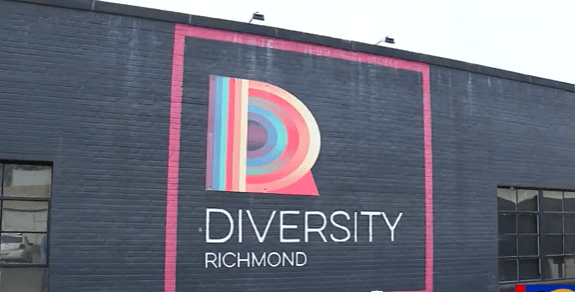
“They [the city] actually reached out to us and said, ‘How can we help?’” said James Millner, Pride Director of Diversity Richmond — the organization featured in the shared Instagram post. “We invited them to participate in the work that we’re doing to send a strong message to the community that Richmond is a welcoming and inclusive space for LGBTQ people, and it will remain so regardless of what is happening at other levels.”

While the statement does not name any specific legislation, it acknowledges that a coalition of LGBTQ+ organizations is working alongside the City of Richmond to advocate against “harmful policies.”

Recently, sweeping legislation has targeted LGBTQ+ protections — from an executive order banning transgender people from serving in the military to the suspension of certain gender affirming care.

“It’s no secret that the LGBTQ community is under attack,” said Millner.

The statement sets expectations for policymakers and highlights organizations that are taking action. Millner says the city’s bold stance and support are a step in the right direction. 

“We are incredibly fortunate that we have a city government that recognizes us, sees the LGBTQ community, celebrates the LGBTQ community — that, in this particular environment, is an anomaly right now,” Millner said.

The statement did not mention any specific action, but Millner said there is a lot of work being done behind the scenes and that this is just the first step of their efforts.

The post ends with a call to action, encouraging people to stay engaged by advocating for LGBTQ+ protections and donating or volunteering with local LGBTQ+ organizations.

Tennessee drag ban will stay as SCOTUS refuses to hear case, but artists ‘refuse to be silenced’

*This was reported by The Advocate.

The U.S. Supreme Court has refused to hear a lawsuit challenging Tennessee‘s drag ban, leaving in place an appeals court ruling upholding the law.

The state’s controversial Adult Entertainment Act, passed in 2023, prohibits “adult cabaret entertainment” on public property or in any location where minors could view it. Thelaw defines such entertainment as performances that are “adult-oriented” and “harmful to minors,” including acts by topless dancers, go-go dancers, exotic dancers, strippers, and “male or female impersonators.”

Friends of George’s Inc., a Memphis-based theater group known for its drag performances, filed a lawsuit against the AEA, arguing that the ban is overly broad and vague, and effectively criminalizes their performances.The Sixth Circuit Court of Appeals dismissed the legal challenge in Julyy, claiming that the plaintiffs did not have standing to sue. The decision reversed a lower court’s ruling that had declared the law unconstitutional.

separate lawsuit against the ban is still ongoing, brought by the American Civil Liberties Union on behalf of Blount County Pride. Organizers filed the suit after District Attorney General Ryan Desmond threatened to prosecute anyone violating the law during a 2023 Pride festival.

Friends of George’s denounced the Supreme Court’s ruling in a statement, maintaining that “this ruling does not define us — we do. And we refuse to be silenced.”

“Friends of George’s Theatre Company will continue exercising our First Amendment right — bringing inclusive, joyful art to our community while raising thousands for charities that uphold dignity and respect for all,” the group said. “Oppression is nothing new to the LGBTQ+ community. Every attempt to silence us has only made us louder, stronger, and more relentless. This moment is no different.”

“To our trans siblings who have led this fight from the start — you are not alone. Your courage fuels us. Your struggle is our struggle. We stand with you,” they continued. “To every performer, artist, and activist — keep using your voice, your craft, your presence. Every soapbox is sacred, and we will not step off it. To our supporters, friends, and allies — this fight is bigger than us. It’s about life, liberty, and the pursuit of happiness — for everyone. We will resist with joy, art, and the unshakable belief that laughter is defiance.”

Senate Democrats block GOP-led bill to ban transgender athletes from women’s sports

*This is being reported by CNN.


Senate Democrats on Monday blocked a GOP-led bill that would ban transgender athletes from women’s and girls’ sports at federally funded schools and educational institutions.

The bill’s failure to advance highlights the limits of Republicans’ narrow margins in Congress, despite control of both chambers. The party still needs support from Democrats in the Senate for most legislation to clear a 60-vote threshold. The party line vote was 51-45.

The Senate vote comes as GOP-led states across the country continue to put forward anti-trans measures, including bills intended to keep transgender students from playing on sports teams consistent with their gender identity.

Republicans put attacks over transgender issues front and center in competitive races during the last election cycle, including at the top of the ticket in the presidential race. In the aftermath of President Donald Trump’s White House win, some Democrats have said their party must do more to address potential voter concerns.

The GOP-led House passed their own version of the legislation in January by a vote 218-206 with two Democrats voting in favor and one Democrat voting “present.”

The bill seeks to amend federal law to require that “sex shall be recognized based solely on a person’s reproductive biology and genetics at birth,” for the purpose of determining compliance with Title IX in athletics, according to the legislative text.

Title IX prohibits discrimination on the basis of sex in education programs or activities that receive funding from the federal government, and applies to schools and other educational institutions.

Republicans have argued that transgender women hold a physical advantage over cisgender women in sports and thus their participation could consequentially limit opportunities for others.

Democrats have said that policies to restrict transgender athletes’ participation in team sports adds to the discrimination that trans people face, particularly trans youth. And they argue that Republicans are seeking to undermine the rights of LGBTQ students by advancing the bill.

Senate Republicans have 53 seats. Typically, that would mean that at least seven Democrats would need to vote with Republicans to hit the 60-vote threshold to advance a bill subject to a filibuster.

Ghana lawmakers reintroduce anti-LGBTQ legislation

*This was reported by Reuters.

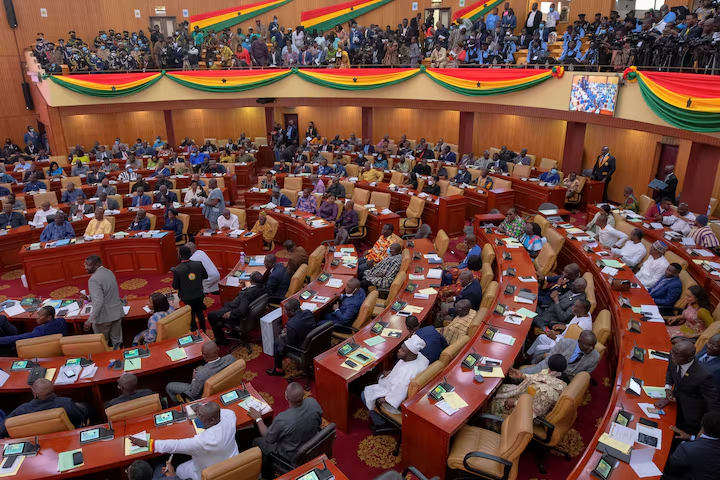
ACCRA, March 3 (Reuters) – Ghanaian lawmakers have reintroduced a bill that would become one of Africa’s most restrictive pieces of anti-LGBTQ legislation, three sponsors told Reuters, after an earlier attempt to enact it fell short because of legal challenges.

Same-sex sexual acts are currently punishable by up to three years in prison in Ghana. The bill would increase the maximum penalty to five years and also impose jail time for the “willful promotion, sponsorship, or support of LGBTQ+ activities”.

Ghana’s parliament approved the bill in February 2024 but then-President Nana Akufo-Addo did not sign it before his term ended and John Dramani Mahama took office in January.

Any bill passed by parliament must go to the president to be signed into law.

Ruling party lawmakers Samuel Nartey George and Emmanuel Kwasi Bedzrah and opposition lawmaker John Ntim Fordjour told Reuters the same bill had been reintroduced in parliament on February 25, sponsored by 10 lawmakers in total.

The bill intensifies a crackdown on the rights of LGBTQ people and those accused of “promotion” of sexual and gender minority rights.

Va-Bene Elikem Fiatsi, a Ghanaian trans woman and LGBTQ activist, told Reuters the bill’s reintroduction was “disheartening and hard to process” but that pro-LGBTQ activism would continue.

The fate of the legislation is unclear. Mahama has said he’d prefer a government-sponsored law rather than one sponsored by parliamentarians.

Last year Ghana’s finance ministry warned that the bill, if signed into law, could jeopardise $3.8 billion in World Bank financing and derail a $3 billion loan package from the International Monetary Fund.

Past polling has shown a lack of tolerance for LGBTQ people in Ghana and Fordjour said the country no longer needed to fear economic sanctions.

“The global political climate is favorable for conservative values as demonstrated in the bold conservative pronouncements of (U.S.) President Donald Trump,” he said.

Blog at WordPress.com.

Up ↑