She had to slog through deep snow to remove them herself.
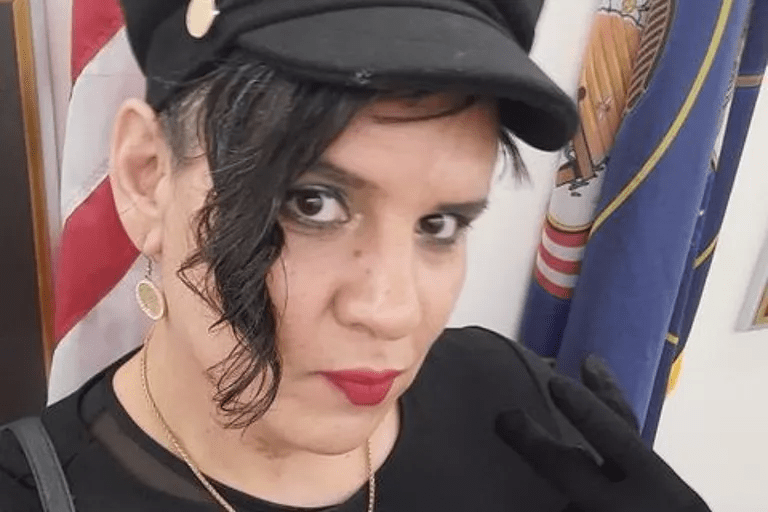
Hateful flyers circulated in Billings, Montana, falsely accusing local trans activist Adria Jawort of “grooming children,” according to local news outlet KTVQ. The flyers, which perpetuate the false narrative from the anti-trans right that all trans people are pedophiles, were posted near schools in Jawort’s neighborhood just days before Thanksgiving.
Jawort had to travel across town in heavy snow to remove the flyers herself.
“I was annoyed about it,” she told KTVQ, describing how the flyers misgendered her and made hateful claims about her life and sexuality. “I was just thinking, why am I doing this? Why do I have to do this? Why do people think this is okay?”
“The thing the flyer said, calling me a groomer and stuff, and basically labeling me as a danger to the community,” Jawort added. “It’s like one of the most awful things you can say. How does that become normalized?”
Billings police are currently investigating the incident. Lt. Matthew Lennick spoke on what constitutes hate speech: “Once someone transitions from making a general statement about their beliefs or another group to a targeted attack on an individual… a victim could take civil action against someone attempting to defame them.”
Possible criminal charges could include disorderly conduct, stalking, intimidation, or harassment, among others.
While Jawort knows the group responsible, she says she’s more frustrated by the ongoing attacks on state Rep. Zooey Zephyr (D-MT). Recently, Republicans unsuccessfully attempted to ban her from women’s bathrooms.
Jawort has been targeted before. Last year, a lecture she was set to give at a library was canceled after a drag ban, with staff citing concerns that hosting a transgender person posed “too much of a legal risk.” This led her to file a lawsuit against the state.
With Trump potentially returning to office, I’m concerned that more transgender people will be denied the right that had such a profound impact on my life.
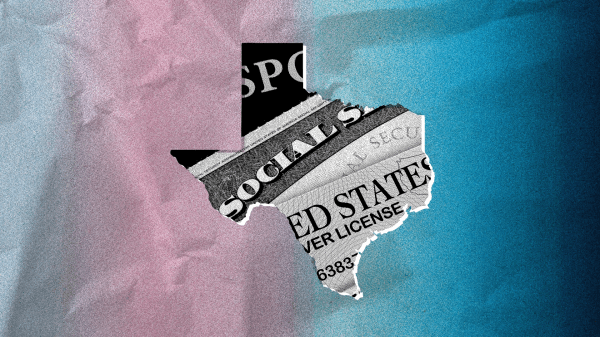
When I learned on August 21st that the Texas Department of Public Safety had quietly revoked the ability to change your gender on driver’s licenses and birth certificates, I was stunned. Devastated. The already daunting process of officially changing one’s name and gender marker had just been taken away. Trans Texans are now stripped of a right that once allowed me to live with less fear. And as Donald Trump nears a potential return to office, many are fearful that trans Americans nationwide could face the same loss.
On a random Tuesday in December 2020, I made the decision to start hormone replacement therapy (HRT). By then, I had been using they/them pronouns for two years and had undergone top surgery eight months earlier. For years, I had thought about beginning HRT, hoping it would help me escape a life where people assumed I was a woman based solely on my appearance. That day, I finally felt ready to silence the voices in my head telling me I’d be letting others down by embracing who I truly was. I was ready to step out of the shadows—out of the expectations others placed on me—and into my own light. I went to an LGBTQ+ clinic, got a prescription for testosterone, and, in that moment, I felt like my life was finally beginning.
And then everything changed.
By April 2021, my voice had deepened, stubble began appearing on my face, and I no longer had a period—physical changes I embraced with open arms. Strangers began noticing too, and suddenly, I was being treated differently. The looks I once got as a perceived butch lesbian shifted to confused stares, discomfort, and sometimes, outright disdain.
‘Dropping off flowers for your wife?’ a receptionist at a gynecologist’s office asked me that same April. ‘Not quite,’ I replied with a nervous laugh. ‘I’m here for an appointment.’ As is customary, I handed over my ID. She glanced at it—name: [something I no longer go by], sex: F—then looked back at me, clearly unsure how to reconcile the mismatch. She called over a coworker, whispering about what to do in this ‘situation.’ I stared at my phone, trying to stay calm as the coworker muttered, ‘Just check her in.’ And she did. I sat down, feeling that familiar discomfort of my presence unsettling others.
Throughout that entire doctor’s appointment, I was treated as though my body was something entirely unique—as if I were the only person who had ever transitioned. In moments like these, I try to chalk it up to ignorance, reminding myself that 71% of Americans say they’ve never met a trans person. But at what point does ‘ignorance’ become too generous?
This same scenario unfolded at the club when bouncers checked my ID, when people hesitated to call me ‘sir’ or ‘ma’am’ as they guided me to a table at restaurants, or when customer service reps asked me twice as many security questions as they did for others. And every time I needed to use the bathroom, I had to make the decision: men’s or women’s? At best, I was made uncomfortable for a few seconds. At worst, I was subjected to slurs or threats of violence. In all those moments, I told myself, ‘It’s no big deal’—as though it were no big deal for my mere existence to constantly puzzle or disturb people. The very fact of my body made others treat me as if I were a problem. I came to expect discomfort every time I stepped outside my door.
Every time I grabbed my keys, phone, and wallet, I weighed the emotional and physical risks of venturing out into the world. This constant calculation is why some trans people delay medical care or feel disconnected from the world around them. It’s also why, after two years on HRT, I finally decided to change the name and gender marker on my ID. But this was not a decision I made lightly.
Until August, changing your name and gender marker in Texas cost $350 (plus lawyer fees, unless you could prove you couldn’t afford it). You also needed a doctor’s note stating that you were ‘receiving clinically appropriate treatment related to your gender identity.’ (The pathologizing of transness is its own burden.) Once you had those documents and filled out a ‘Petition to Change the Name and Sex/Gender Identifier of an Adult’ form, you had to appear before a county judge. That judge could deny your petition for any reason—or no reason at all. It was a request, not a guarantee. In Texas, trans people often seek advice from other trans folks about which counties to target, because not all judges are inclusive. Many travel from across the state to Austin, the third-queerest city in the U.S., in hopes of a more supportive judge. Even then, judges can demand more ‘proof’ than the law requires. In a state where anyone can change their last name after marriage with minimal hurdles, trans people are forced to jump through countless hoops just to have their gender recognized.
It took a month for me to get a letter from a doctor. Another month passed before I could find time to go to the courthouse, which was only open during regular work hours—a schedule that most people can’t easily accommodate. When I finally arrived at the Travis County office, I sat for two hours waiting to be helped. A county clerk, who had warmly greeted other patrons, glanced at my petition and abruptly told me, ‘If you aren’t finished with your papers, we can’t help you.’ Despite the cold reception, I was determined to get this done—to untangle the mess of living as a visibly trans person. I handed in my request, and six weeks later, I received an email with a PDF confirming that my petition had been approved.
Afterward, I spent months updating my name and gender marker on my driver’s license, social security card, passport, and a slew of other official documents. One might ask, ‘Why would anyone willingly sign up for such a cumbersome and clearly prejudiced process?’ The answer is simple: I needed it. My body not matching the letters on my ID had become a life-threatening issue. Without the change, I’d still be trapped in the daily hell of being put in emotional and physical danger. Not all trans people feel the need to change their name and gender marker, but for me, it was crucial. Because this option was available, I’ve been able to build a new life.
The difference between my life from April 2021 to September 2022—when I didn’t ‘look like a girl’ but still had a feminine name and sex on my ID—and now is like night and day. I can hand over my ID and no longer feel like I’m putting myself in harm’s way. It says ‘Kaybee,’ Sex: M (though that still doesn’t feel right, since Texas hasn’t offered an X gender marker yet). Now, when I pass over a piece of plastic, I no longer feel like I’m outing myself or offering my life up for judgment.
In the same month that Texas reversed the right to change your name and gender marker, Trump announced he would sign an executive order banning gender-affirming care for trans youth on his first day back in office. As if it isn’t enough that Governor Greg Abbott, Lieutenant Governor Dan Patrick, Texas Attorney General Ken Paxton, and a whole host of other Texas politicians have pushed so much misinformation about the trans community that people now feel emboldened to mistreat us. As if it’s not enough that Texas attempts to pass transphobic laws every year.
Everything about this group of people—who could never understand what it’s like to hand over an ID that doesn’t match how the world sees you—fills me with disgust. They don’t know even a fraction of what people like me go through, just to live authentically.
Yes, I still have to explain to medical providers that my legal sex and my sex assigned at birth are not the same. Yes, I still out myself every time I take off my shirt, revealing the two beautiful top surgery scars that are part of my journey. My goal was never to ‘pass’ as cis, or to meet the ridiculous expectations that transphobes project onto us. My goal has always been to be myself. Safely.
Trump’s inauguration is on January 20th, and the next Texas legislative session—the period when most anti-trans laws will be debated—starts just a week earlier, on January 14th. In preparation, Texas lawmakers have already prefiled 34 anti-trans bills for the 2025 session. Now is the time to act, to support and defend the psychological and physical safety of trans people. I will be contributing both money and volunteer hours to the Transgender Education Network of Texas. This BIPOC-led organization fights anti-LGBTQ+ laws daily, and they offer a wealth of resources on their website, including guidance on how to file discrimination complaints with the U.S. Department of Health and Human Services.
Despite the wishes of those who seek to erase us, trans people like me will be part of the future of Texas—and beyond.
I long for a Texas where trans people don’t just survive, but thrive. We deserve safety here, in the Lone Star State, and anywhere else we choose to be. I spent too much time living under an identity that wasn’t mine, but I was able to change it. Everyone else deserves the same right to do so.
Why Allies Must Act: Defending Trans Rights Protects Everyone’s Freedoms
As the election dust settles, the focus shifts to practical realities. For transgender people like me, a pressing question looms: What actions will this new Trump administration take?
It’s tempting to jump to extreme conclusions—like the idea of being rounded up and placed in camps. But it likely won’t look like that. There won’t be “camps,” nor will there be overt “rounding up.” Instead, the approach will be more subtle, and that subtlety is precisely what makes it so dangerous.
The quiet nature of these changes will make them easier for cisgender people to overlook. However, their awareness is vital—not only for our survival but for their own protection, as the erosion of trans rights often signals broader attacks on freedoms that could ultimately affect everyone.
The groundwork for trans oppression is already being laid. In recent years, Republicans have pursued anti-trans legislation with alarming intensity, proposing over 1,000 laws targeting everything from medical care and bathroom usage to IDs, sports, and even how we dress. Trump has vowed to push similar policies at the federal level, and Project 2025 outlines an even more expansive agenda.
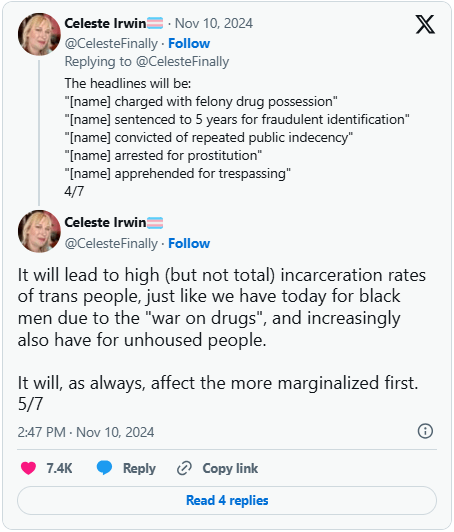
To understand what trans oppression under Trump might look like, we can look to other marginalized groups. For instance, the mass incarceration of Black men wasn’t achieved through blatant decrees like “round them up” but through systemic oppression: harsh laws with disproportionate penalties, over-policing, and economic barriers that strip away basic human needs. Trans people have already faced similar tactics, such as laws criminalizing “cross-dressing” to police our existence.
Under another Trump administration, this oppression might escalate. It could involve banning hormone replacement therapy and criminalizing those who seek it out. Policies might mandate that gender markers on IDs match sex assigned at birth, penalizing those of us who continue to live authentically with fraud or perjury charges. Involuntary commitment to mental institutions could even be a reality.
These measures, even if sporadically enforced, create an ever-present climate of fear—a psychological toll that leaves us constantly bracing for the next law, the next crackdown, the next violation of our humanity. And in this hostile environment, the silence or complacency of cisgender allies would make it all the easier for these oppressive systems to thrive.
The coming years will likely see escalating attacks on trans people, particularly the most marginalized among us—trans women of color, disabled trans people, and others who already face significant barriers. These policies will make it harder for them to access stable employment and lead precarious lives, amplifying systemic inequities.
We cannot wait for something as blatant as a “lock up all the trans people” decree. The oppression will come in quieter, more insidious forms: laws and policies that restrict our rights to healthcare, employment, and basic expression. Even if trans people comply with these laws, the result will still be a kind of prison—a life stripped of autonomy and dignity.
If you are cisgender, we need your help. Not just because it’s the right thing to do, but because these attacks on trans rights will eventually pave the way for attacks on your rights. Consider abortion access: for decades, conservatives framed their arguments around “protecting life” to avoid addressing bodily autonomy directly. But the fight against gender-affirming care removes that pretense altogether. By banning medically supported, evidence-based care simply because they don’t like it, lawmakers set a dangerous precedent that could extend to other healthcare decisions.
Your body could be next.
Employment and education are also at risk. Imagine a national “Don’t Say Gay/Trans” policy that bars teachers like me—who are openly transgender—from the profession. Policies like these won’t stop at targeting trans people. Deadnaming and misgendering trans students could morph into strict gendered dress codes for everyone, eroding freedom of expression for all students. What starts as an attack on trans rights often metastasizes into broader assaults on personal liberties.
As we approach January 20th, now is the time to act:
Get involved: Connect with your local LGBTQ+ center and see how you can support their efforts.
Stay informed: Follow trans journalists and activists to keep up with the latest developments.
Advocate: Write to your representatives in both parties, showing them that you stand with trans people.
Speak out: Use your voice, wear supportive messages, and engage your cisgender friends to build awareness.
Support trans people directly: Check in with your trans friends, especially now, as they navigate a political climate fueled by over $200 million of anti-trans rhetoric during the election. Let them know you’re there for them.
This isn’t just about protecting trans people—it’s about preserving freedom and dignity for everyone. Together, we can resist these threats and build a future where everyone has the right to live authentically.
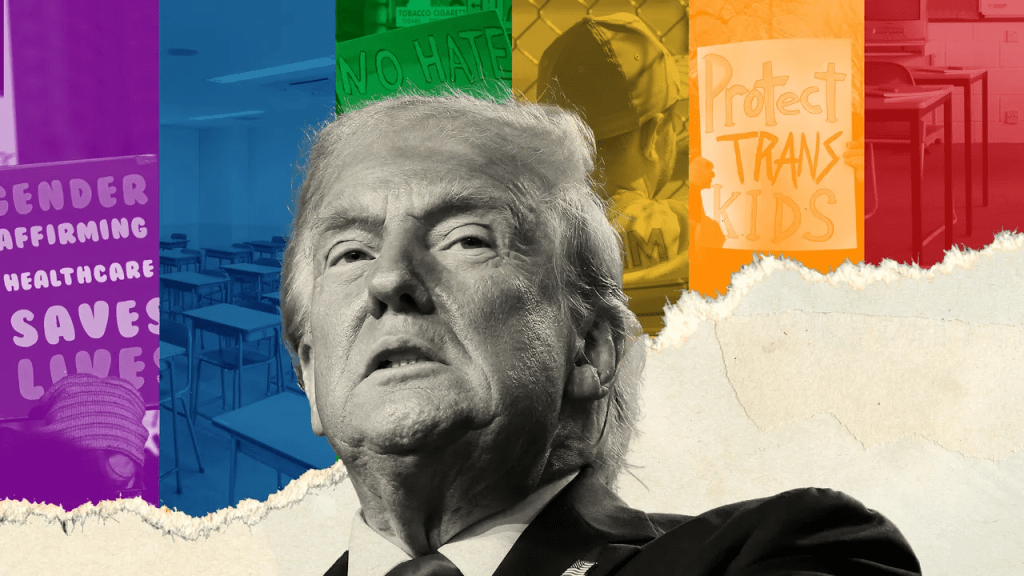
Trump has pledged to eliminate gender-affirming care for trans youth, ban trans kids from participating in sports, and erase trans people from public life. Is he actually able to carry out these promises?
As the second Trump administration starts to take form, civil rights advocates are bracing for a new wave of attacks on the LGBTQ+ community. During his first term, Trump’s White House enacted over 200 policies that harmed LGBTQ+ equality, including the ban on openly trans individuals serving in the military, cuts to HIV/AIDS funding, and the repeal of protections for trans patients seeking healthcare and trans individuals in need of emergency shelter.
Trump has made it clear that he intends to continue reversing LGBTQ+ rights once he returns to the White House in January. On his 2024 campaign website, the president-elect outlined an aggressive agenda targeting fundamental rights and protections for LGBTQ+ people. This includes a ban on gender-affirming medical care for trans youth, federal “Don’t Say Gay” policies restricting LGBTQ+ discussions in schools, a nationwide ban on trans student-athletes competing according to their gender identity, and a federal law defining gender as binary and assigned at birth—measures that would have far-reaching consequences for trans, nonbinary, and intersex Americans.
Civil rights groups say they are already bracing for the upcoming battle as Trump assembles a diverse group of anti-LGBTQ+ nominees for his Cabinet. What will bolster his administration’s power to push its far-right agenda is the GOP’s control over all three branches of government: six of the nine Supreme Court justices were appointed by Republican presidents, and conservatives will hold majorities in both houses of Congress for the first time since 2016.
Them spoke with legal experts to assess how feasible Trump’s anti-LGBTQ+ threats are and what strategies advocates might use to fight back. Despite the challenges ahead, Ezra Cukor, co-interim legal director of Advocates for Trans Equality, remains hopeful, believing this is merely “one chapter in a story of trans folks being a part of civil society in the United States.”
“There have been moments of joy, and there have been moments of challenge,” he tells Them. “In this moment, I’m just grateful to be part of a broader civil rights fabric, knowing that there’s a long history of trans folks insisting on our basic rights and working for our liberation and that there are many of us in this together.”
Ending Gender-Affirming Care for Trans Youth
In a January 2023 video posted on his Truth Social platform, Trump vowed to launch an all-out assault on gender-affirming healthcare for trans youth. He called on Congress to pass a law banning “child sexual mutilation” in all 50 states and pledged to cut Medicaid and Medicare funding to any hospital providing gender-affirming care to minors. Trump also promised to instruct the Department of Justice to investigate whether medical providers had “deliberately covered up horrific long-term side effects” of transition care for youth, and he vowed to support a “private right of action” for patients who might later regret the transition treatments they received as children. (This, despite the fact that rates of transition regret are notably low.)
Civil rights groups are already preparing for the fight ahead as Trump selects a range of anti-LGBTQ+ nominees for his Cabinet. What will strengthen his administration’s ability to push its far-right agenda is the GOP’s control over all three branches of government: six of the nine Supreme Court justices were appointed by Republican presidents, and conservatives will hold majorities in both houses of Congress for the first time since 2016.
Them spoke with legal experts to gauge how feasible Trump’s anti-LGBTQ+ threats truly are and what actions advocates might take to resist them. Despite the significant challenges, Ezra Cukor, co-interim legal director of Advocates for Trans Equality, remains hopeful, viewing this moment as “one chapter in a story of trans folks being a part of civil society in the United States.”
“There have been moments of joy, and there have been moments of challenge,” Cukor tells Them. “In this moment, I’m just grateful to be part of a broader civil rights fabric, knowing that there’s a long history of trans folks insisting on our basic rights and working for our liberation, and that there are many of us in this together.”
Ending Gender-Affirming Care for Trans Youth
In a January 2023 video posted on his Truth Social platform, Trump promised to launch a full-scale assault on gender-affirming healthcare for trans youth. He called on Congress to pass a law banning “child sexual mutilation” across all 50 states and vowed to eliminate Medicaid and Medicare funding for hospitals providing gender-affirming care to minors. Trump also pledged to direct the Department of Justice to investigate whether medical providers had “deliberately covered up horrific long-term side effects” of transition care for youth, and he expressed support for a “private right of action” for patients who might later regret their transition treatments. (This, despite the fact that regret rates for transition treatments are extremely low.)
Sasha Buchert, a senior attorney with Lambda Legal, argues that the push for a national trans sports ban exposes the hypocrisy of Republicans’ long-standing stance that LGBTQ+ educational policies should be decided at the state and local level. “Once the far right gets in power, suddenly they feel like they should be imposing their beliefs on the rest of the country,” Buchert tells Them, pointing to the 26 state attorneys general who opposed the Biden administration’s interpretation that Title IX protects trans students from discrimination. “These issues aren’t in isolation. They’re part of a widespread onslaught of attacks targeting the trans community and specifically trans youth.”
Given the potential for a filibuster, Buchert predicts Trump will not wait for Congress to act, instead seeking “immediate gratification” to appease his base. She expects him to issue an executive order that would bar trans students from protection under Title IX, echoing the early days of his first term, when his Department of Education repealed Obama-era guidance that required schools to treat trans students in accordance with their gender identity.
Buchert vowed that Lambda Legal would challenge such an order in court, pointing out that courts have consistently ruled against targeted sports bans, which they view as discriminatory toward trans athletes. Anti-trans sports laws in Arizona and Idaho have been blocked by the courts for now, while the Fourth Circuit Court of Appeals blocked West Virginia from preventing a trans student, Becky Pepper-Jackson, a 14-year-old middle school runner, from competing. (West Virginia intends to appeal that ruling to the Supreme Court.)
“The federal courts have agreed that it really does deprive [trans student athletes] and harm them by not allowing them to participate,” Buchert says. “The argument that they can still play on a boys’ team or intramural team doesn’t hold any water. The courts have seen right through that. It’s like saying before marriage equality: ‘You can still get married. You just can’t get married to somebody of the same gender.’”
Enacting National “Don’t Say Gay” Policies
Trump has also pledged to implement broader policies targeting LGBTQ+ students in schools, including “Don’t Say Gay”-style restrictions in the classroom and regulations that would force teachers to out trans students to their parents. His 2024 platform promises to “protect the rights of parents from being forced to allow their minor child to assume a gender” without their consent, frequently repeating false claims that schools are transitioning children without their families’ knowledge. “Can you imagine you’re a parent and your son leaves the house and you say, ‘Jimmy, I love you so much. Go have a good day in school,’ and your son comes back with a brutal operation?” Trump asked at a Wisconsin rally. “Can you even imagine this? What the hell is wrong with our country?”
Should Trump push his proposed policies through Department of Education regulations or an executive order, Chris Erchull, a staff attorney with the LGBTQ+ advocacy group GLAD, believes the legal system will stand with queer students. He points out that courts have long held that all students are “entitled to a full education.” “You go all the way back to the promise of Brown v. Board of Education, which said that separate education is not equal education,” he tells Them, referencing the landmark 1954 Supreme Court ruling that desegregated schools by race. “Those principles apply when we’re talking about the rights of LGBTQ+ students today. For students to get a complete education, they need to see themselves represented. You can’t suppress their identities in the classroom, or you’ll be depriving them of that.”
Erchull also notes that in the past year, advocates have won several key victories in the fight against anti-LGBTQ+ restrictions in schools. In March, Florida settled a lawsuit that rolled back parts of its “Don’t Say Gay” law, narrowing the scope of the state’s regulations. The law was so broadly worded that school districts, fearing lawsuits for noncompliance, had applied it to nearly all aspects of campus life, including student clubs like Gender-Sexuality Alliances. Just two months later, a New Hampshire district court ruled that an anti-LGBTQ+ law restricting classroom discussions in the state was “unconstitutionally vague.”
“Those are really powerful examples of how the courts can step up and be a voice of reason amidst attempts to undermine public education,” Erchull says. “There’s this zero-sum thinking where, if LGBTQ+ students are represented and seen, that’s depriving other people of something, and that’s not true at all. What research shows is that inclusive and supportive school environments benefit all students.”
Federal Law Erasing Trans People
Trump’s campaign website promises that, if re-elected, he will push Congress to pass a law defining gender as strictly male and female, assigned at birth. This pledge echoes a policy from his first presidency, when the Department of Health and Human Services (HHS) attempted to narrow the federal definition of gender to “immutable biological traits identifiable by or before birth.” A 2018 memo reportedly circulated within HHS stated that “the sex listed on a person’s birth certificate, as originally issued, shall constitute definitive proof of a person’s sex unless rebutted by reliable genetic evidence.”
Passing a federal bill through Congress to define trans people out of existence would be unprecedented, requiring support from both houses to succeed. Sarah Warbelow, legal director at the Human Rights Campaign, notes that LGBTQ+ advocates have already seen the potential impact of such policies through laws enacted at the state level. In May 2023, Montana Gov. Greg Gianforte (R) signed a law redefining sex as strictly male or female in portions of the state code. While that statute was struck down by a district court earlier this year, Kansas and Tennessee still have similar mandates in place.
Warbelow emphasizes that these types of restrictions have far-reaching consequences on trans people’s daily lives, impacting their ability to obtain identity documents and access spaces that align with their identities. However, she also points out that the full implications of such laws are unclear. After Kansas passed its 2023 law redefining gender, Attorney General Kris Kobach (R) claimed that schools were required to out trans students to their parents, even though the law did not explicitly state this. Warbelow notes that “there are huge unknowns” about how a federal law erasing trans identities would be interpreted or applied, whether by the courts, individual states, or schools.
“It becomes unclear how it would be operationalized,” she tells Them. “To the extent that it is interpreted broadly, it could have ramifications for non-discrimination laws. In Bostock, the Supreme Court interpreted the term ‘sex’ to be broadly understood as including LGBTQ+ people in the context of non-discrimination laws, so it could potentially eliminate those legal protections for LGBTQ+ people in the future.”
That’s why Warbelow says that the Human Rights Campaign, as the nation’s largest LGBTQ+ organization, is exploring “every option” to counter Trump’s anti-trans agenda. She adds that if litigation becomes necessary, the organization will likely invoke constitutional protections related to free speech, equal protection under the law, and due process to challenge a federal redefinition of gender. “We know it’s going to be incredibly tough work, but we have no choice but to fight,” she asserts. “We’ve got to throw our all at preserving democracy and the rights of LGBTQ+ people.”
The Oklahoma Superintendent of Schools recently spent $25,000 in state funds on Trump Bibles.
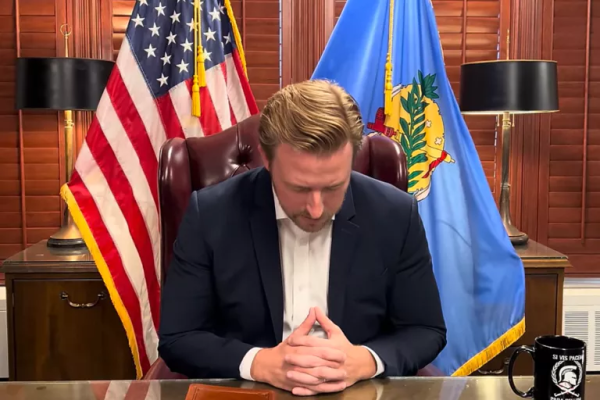
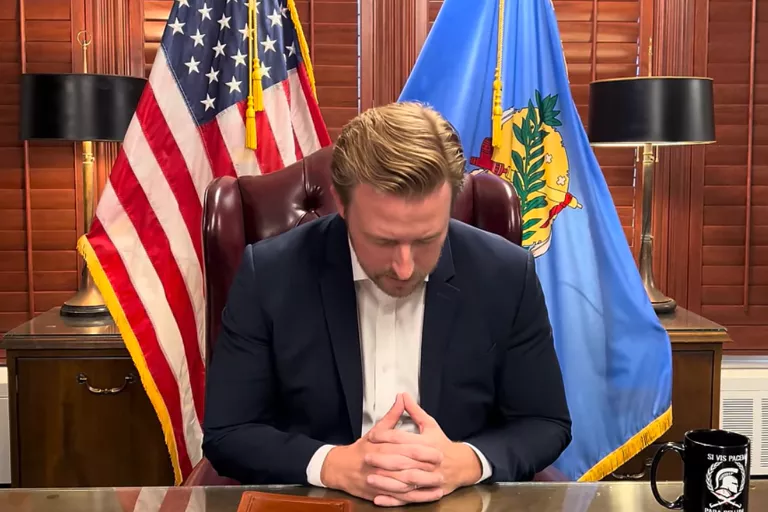
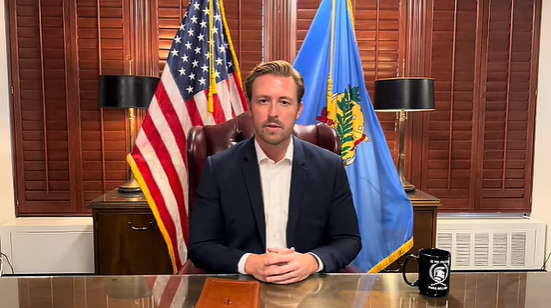
Ryan Walters, the controversial Oklahoma Superintendent of Schools, has directed school districts statewide to show a video of him praying for President-elect Donald Trump. This unusual and politically charged directive, issued amidst a recall effort against Walters, has sparked strong opposition from local school administrators. The video and accompanying order were sent out to schools on Thursday.
At least seven major Oklahoma school districts announced Friday that they will not show a video in which Superintendent Ryan Walters discusses the objectives of his newly established Office of Religious Liberty and Patriotism, concluding with a prayer for former and future President Donald Trump.
The video, which carries a highly partisan tone, criticizes the “radical left” for attacking religious freedom in schools and accuses teacher unions of undermining patriotism.
“We will not tolerate that in any school in Oklahoma,” Walters declares in the video. “We want our students to be patriotic. We want our students to love this country, and we want all students’ religious liberty to be protected.”
The video wraps up with a prayer in which Walters asks for divine guidance for the nation’s leaders and specifically prays for Trump and his team.
“Dear God, thank you for all the blessings you’ve given our country. I pray for our leaders to make the right decisions. I pray in particular for Donald Trump and his team as they continue to bring about change to the country,” Walters says.
Edmond Public Schools Superintendent Angela Grunewald informed parents on Friday that her district will not disrupt its locally approved curriculum to show Walters’ video.
Grunewald emphasized that her district will continue to teach the Oklahoma state standards and the curriculum set by the local school board. “Any changes to that would be based on local decisions,” she said, citing a recent ruling by the Oklahoma Supreme Court that upheld the authority of local school districts to make such decisions.
Similarly, Midwest City-Del City Public Schools Superintendent Rick Cobb told the Oklahoma Voice that his district will not show the video. “We do not believe he has the statutory authority to require us to share this content,” Cobb said.
The Oklahoma Attorney General’s Office supported this stance, declaring the mandate unenforceable. “Not only is this edict unenforceable, it is contrary to parents’ rights, local control, and individual free-exercise rights,” said Attorney General spokesperson Phil Bacharach.
Newly sworn-in Democratic state Sen. Mark Mann, a former member of the Oklahoma City Board of Education, also urged other districts to resist the mandate. “When Oklahoma needs to make gains in reading and math scores, the last thing we need to be doing is pushing the superintendent’s blatant, self-serving political agenda,” Mann remarked.
Walters’ controversial order, which is seen as unenforceable, accompanies his ongoing effort to distribute 55,000 Bibles to Oklahoma schools. On the same day his prayer video was released, Walters posted another video celebrating the arrival of the first 500 Bibles in AP Government classrooms.
Walters’ budget request was specifically aimed at purchasing a version of the Bible known as the “Trump Bible,” which combines the Declaration of Independence, the U.S. Constitution, and the Old and New Testaments into a single Christian nationalist text. The initial purchase of these Bibles amounted to $25,000.
Walters has been mentioned as a potential candidate for Secretary of Education in Trump’s second-term Cabinet. Both Walters and Trump have advocated for the abolition of the U.S. Department of Education.
There is no conclusive evidence to support the claim that transgender girls possess a substantial biological advantage in sports.
Alabama Attorney General Steve Marshall, along with attorneys general from 23 other states, filed an amicus brief advocating for the prohibition of transgender girls participating in sports.
The brief specifically requests the Supreme Court to review and overturn an injunction issued by the 9th U.S. Circuit Court of Appeals, which had blocked Arizona’s ban on transgender athletes.
Alabama Attorney General Steve Marshall collaborated with Arkansas Attorney General Tim Griffin to draft the amicus brief, with support from attorneys general in 22 other states, including Alaska, Florida, Georgia, Indiana, Iowa, Kansas, Kentucky, Louisiana, Mississippi, Missouri, Montana, Nebraska, New Hampshire, North Dakota, Oklahoma, South Carolina, South Dakota, Tennessee, Texas, Utah, Virginia, and Wyoming.
The injunction being challenged was issued in September by the 9th U.S. Circuit Court of Appeals in a unanimous 3-0 decision. This injunction blocked Arizona’s Save Women’s Sports Act, a law imposing a blanket ban on transgender girls participating in girls’ sports, regardless of their transition timeline or use of puberty blockers. The lawsuit challenging the law was filed by two transgender girls and their parents seeking to overturn the ban.
In the court’s decision, Judge Morgan Christen wrote, “[The law] permits all students other than transgender women and girls to play on teams consistent with their gender identities. Transgender women and girls alone are barred from doing so. This is the essence of discrimination.”
The amicus brief presented several arguments in favor of the ban. One claim was that implementing policies allowing transgender girls to join girls’ sports teams would be costly and logistically difficult for schools—despite evidence showing that many schools nationwide have successfully adopted trans-inclusive policies without significant challenges.
The brief also asserted that sex and gender identity are not equivalent under the Equal Protection Clause of the Constitution, a stance that contradicts legal precedent established in Bostock v. Clayton County. In that case, the Supreme Court ruled that protections against sex-based discrimination include transgender individuals due to their gender identity.
Additionally, the attorneys general argued that the Circuit Court’s ruling was legally flawed. They suggested that the decision could be interpreted in ways more favorable to their case and called for a rational-basis review. This review would evaluate whether the plaintiffs’ claims were consistent with constitutional equal protection principles or whether they failed to meet that standard.
It remains uncertain whether these arguments will prevail. The Supreme Court has not announced whether it will hear this case. However, the Court has already agreed to consider United States v. Skrmetti, which will address the legality of state bans on gender-affirming care for minors.
Evidence does not support claims that transgender girls have a significant biological advantage in sports. In fact, studies indicate that transitioning, including the use of puberty blockers, can mitigate differences and create a fairer playing field.
Despite this, anti-trans rhetoric continues to shape these legal battles. “Our coalition is determined to preserve the 50 years of work that expanded opportunities and leveled the playing field for girls and women in sports,” Attorney General Marshall stated in a press release.
He added, “But the left continues to pander to a small minority of their base… Parents of daughters are rightfully outraged at the loss of positions on teams and college scholarships. As our multiple briefs to the Supreme Court show, it’s time to return to fairness in opportunity for sports.”
The bill affects all students across the state and will limit the rights of thousands of transgender individuals if signed into law by the governor.
On Wednesday, the Ohio State Senate approved Senate Bill 104, a transgender bathroom ban for all students in the state, including those in higher education.
Titled the “Protect All Students Act,” the bill passed with a 24-7 vote, strictly along party lines.
The bill states, “A school shall designate each student restroom, locker room, changing room, or shower room that is accessible by multiple students at the same time, whether located in a school building or in a facility used by the school for a school-sponsored activity, for the exclusive use by students of the male biological sex only or by students of the female biological sex only.”
The bill will soon be sent to Governor Mike DeWine (R) for either approval or veto. While he is expected to sign it, the Associated Press reports that he will first conduct a legal review.
The ban exempts school faculty, children under 10 who require family assistance, and individuals with disabilities.
Rather than defining gender, the bill relies on the concept of biological sex, which it defines as “the biological indication of male and female, including sex chromosomes, naturally occurring sex hormones, gonads, and nonambiguous internal and external genitalia present at birth, without regard to an individual’s psychological, chosen, or subjective experience of gender.”
The bill does not address or provide exceptions for intersex individuals, who do not fit neatly into traditional biological sex categories.
The Ohio Center for Christian Virtue strongly supports the bill. “Today is a huge victory for children and families in Ohio,” said David Mahan, the group’s policy director, calling it “common-sense legislation.”
However, Jocelyn Rosnick, Policy Director for the American Civil Liberties Union of Ohio, expressed strong opposition. “We are incredibly disheartened by the Ohio General Assembly’s continuous attacks against transgender and gender non-conforming individuals across Ohio. Senate Bill 104 is a cruel invasion of students’ rights to privacy, which could result in unwarranted governmental disclosures of private, personal information.”
She added, “If allowed to go into effect, SB 104 will create unsafe environments for trans and gender non-conforming individuals of all ages. This bill ignores the material reality that transgender people endure higher rates of sexual violence and assaults, particularly while using public restrooms, than people who are not transgender. All Ohioans deserve to access the facilities they need, in alignment with their gender identity, without fear of harassment or bullying. The ACLU of Ohio remains steadfast in our commitment to standing with trans Ohioans and is closely considering next steps.”
“‘I will always stand with trans people and the entire LGBTQ+ community. This Congresswoman sees you and loves you,’ said Rep. Ayanna Pressley.”
It’s clear that a potential second term for Donald Trump would have devastating consequences for queer and trans Americans.
The accused rapist and his party have been outspoken in their opposition to trans rights. According to data from Ad Impact, reported by Washington Post’s Casey Parks on November 5, Republicans spent nearly $215 million on anti-trans ads during the 2024 election cycle. On Trump’s 2024 campaign website, he pledged to redefine gender at the federal level, recognizing only male and female as assigned at birth, and to push for a nationwide ban on gender-affirming care for minors.
To make matters worse, Democrats like New York Rep. Tom Suozzi and Massachusetts Rep. Seth Moulton chose to scapegoat trans people for their party’s failure to win the presidency, House, or Senate.
Despite the troubling implications of the 2024 elections, many Democratic politicians have made it clear that supporting the trans community is a top priority, regardless of what the next four years bring.
From calling out transphobia within their own party to working to enshrine LGBTQ+ protections at the state level, these leaders are standing up for trans rights.
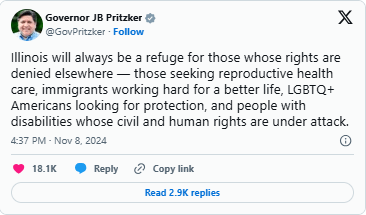
Gov. JB Pritzker and State Rep. Kelly Cassidy (Illinois) Illinois Gov. JB Pritzker reaffirmed his commitment to LGBTQ+ Americans in a tweet, declaring that Illinois would remain “a refuge for those whose rights are denied elsewhere.”
Pritzker went on to specifically highlight the communities he’s standing with, including “those seeking reproductive healthcare, immigrants working hard for a better life, LGBTQ+ Americans looking for protection, and people with disabilities whose civil and human rights are under attack.
Meanwhile, Illinois State Rep. Kelly Cassidy recently told the Chicago Sun-Times that a coalition of state lawmakers has been working to protect access to trans and reproductive healthcare since the Supreme Court’s decision to overturn Roe v. Wade in 2022. Now, this coalition is examining Project 2025 to assess what additional protections they can put in place in the near future.
Cassidy mentioned that one key issue the coalition hopes to address before the fall legislative session concludes is the use of geolocators to track individuals who access healthcare facilities.
Gov. Gavin Newsom (California)
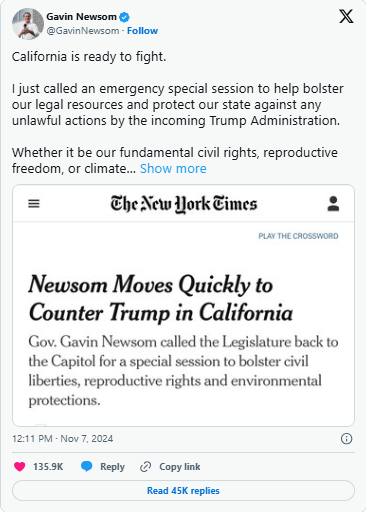
On November 7, California Gov. Gavin Newsom announced a special session of the California Legislature, set to begin on December 2. This session will focus on strengthening California’s legal resources to safeguard climate action, civil rights, immigrant families, and reproductive freedom in response to Trump’s reelection.
According to a release from Newsom’s office, this special session is a direct response to the public statements and proposals made by President-elect Trump and his advisors, as well as actions taken during his first term. These efforts, Newsom’s office warns, could threaten essential freedoms and individual rights, including women’s rights and LGBTQ+ rights.
In 2023, Gov. Gavin Newsom signed nine LGBTQ+ rights bills into law in just a few days, despite vetoing a bill that would have provided stronger protections for trans children in custody and visitation cases. Earlier this year, he also signed the Support Academic Future and Educators for Today’s Youth Act (SAFETY Act), which prohibits schools from implementing policies that require staff to out students to their parents. The law also mandates the California Department of Education to create resources for LGBTQ+ students and their families.
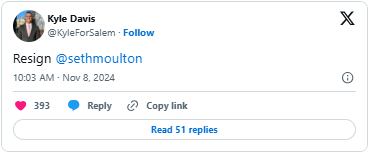
Salem City Councilor Kyle Davis (Massachusetts) Salem, Massachusetts City Councilor Kyle Davis called out Massachusetts Rep. Seth Moulton in a series of X posts after Moulton made transphobic remarks to the New York Times.
In an interview with the Times on November 7, Moulton stated, “I have two little girls, I don’t want them getting run over on a playing field by a male or formerly male athlete. But as a Democrat, I’m supposed to be afraid to say that.”
The following day, Davis responded strongly on X, not holding back in his critique.
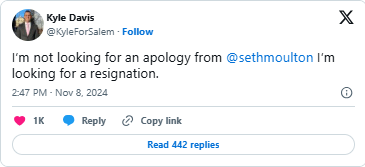
‘Resign @sethmoulton,’” he tweeted on November 8. Shortly after, he followed up with a second post, stating, “I’m not looking for an apology from @sethmoulton, I’m looking for a resignation.
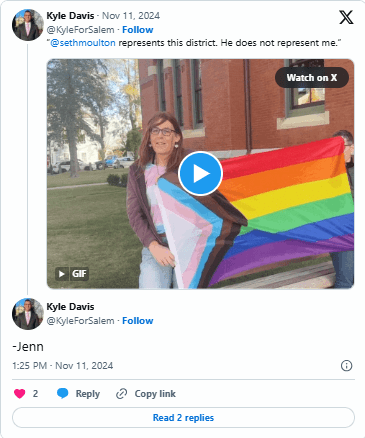
On November 11, Davis posted a gif of a woman named Jenn holding the progress Pride flag, with the caption, ‘@Sethmoulton represents this district. He does not represent me.’
The city councilor went on to question the timing of Moulton’s remarks in an interview with the Boston Globe last week.
“With all the things Trump has said about trans people, this is a time when the trans community is feeling a lot of fear,” Davis said.
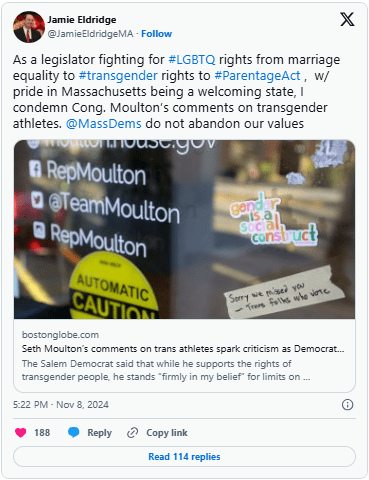
State Senator Jamie Eldridge (Massachusetts) Massachusetts Senator Jamie Eldridge also spoke out against Moulton’s transphobic comments. On November 8, Eldridge took to X to share a link to a Boston Globe article highlighting local Democrats who were condemning Moulton’s remarks.
As a legislator fighting for #LGBTQ rights—from marriage equality to #transgender rights to the #ParentageAct—and with pride in Massachusetts being a welcoming state, I condemn Cong. Moulton’s comments on transgender athletes,” Eldridge wrote. “@MassDems do not abandon our values.”
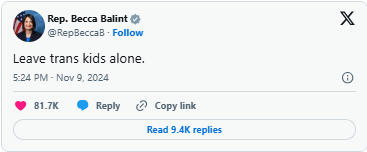
Rep. Becca Balint (Vermont) Vermont Rep. Becca Balint succinctly summed up the sentiment in a November 9 X post, writing, “Leave trans kids alone.
When Balint was elected in 2022, she made history as the first openly LGBTQ+ person and the first woman elected to Congress from Vermont.
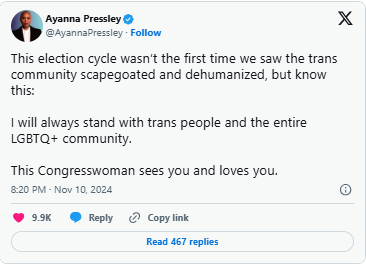
Rep. Ayanna Pressley (Massachusetts) Massachusetts Rep. Ayanna Pressley reinforced her commitment to the trans and LGBTQ+ communities in a November 10 X post, reaffirming her unwavering support.
This election wasn’t the first time we’ve seen the trans community scapegoated and dehumanized, but know this: I will always stand with trans people and the entire LGBTQ+ community,” she wrote. “This Congresswoman sees you and loves you.
Attorney General Rob Bonta (California) On November 5, California Attorney General Rob Bonta—who, last year, sued a school district in his state to block a policy requiring teachers to out trans students to their parents—told Cal Matters that his office is already preparing legal challenges to the incoming Trump administration. Bonta’s team has preemptively drafted briefs and tested arguments to counter policies they anticipate Trump will push during his second term, including those that could undermine civil rights for trans youth.
“Unfortunately, it’s a long list [of issues],” the attorney general said. “We are and have been for months developing strategies for all of those things.”
A new report sheds light on the “epidemic of violence” targeting transgender and gender non-conforming individuals.
This article addresses violence against transgender individuals and includes references to graphic content.
The epidemic of fatal violence against transgender individuals in the United States shows no signs of slowing down, with the Human Rights Campaign (HRC) documenting at least 36 killings over the past year. Half of these victims, including Honee Daniels, Kassim Omar, Redd, Vanity Williams, and others, were Black trans women.
The Human Rights Campaign (HRC), which has been tracking the murders of transgender individuals since 2013, released its 2024 report on the “Epidemic of Violence Against the Transgender & Gender-Expansive Community in the U.S.” on Tuesday. The report covers deaths between the day after Trans Day of Remembrance 2023 (November 21, 2023) and November 20, 2024. HRC highlighted that a disproportionate number of victims in the past year were young people of color—75% of all victims were people of color, and 54.3% were under the age of 35. Among the youngest victims was 14-year-old Pauly Likens, a trans girl who was tragically killed and dismembered in her Pennsylvania hometown in June, marking the youngest recorded death. Other young trans victims included 18-year-old Jazzlyn Johnson and 17-year-old Tayy Dior Thomas.
Tori Cooper, Director of Community Engagement for the Transgender Justice Initiative at HRC, stated that transphobia is fueled by disinformation, rhetoric, and ideologies that treat the transgender community as political tools, ignoring their right to live free from fear of harm or death. She pointed out the “disturbing reality” that half of the victims were Black trans women, a reflection of the ways in which racism, misogynoir, sexism, transphobia, and other societal issues disproportionately affect the trans community.
Cooper concluded, “In spite of these tragedies, I choose to remember the beauty brought to the world by those victims who left this earth far too soon and will celebrate their memories by continuing to fight for them through the Trans Justice Initiative’s advocacy and our leadership development work.”
While the statistics in the report are bleak, there was one slightly positive development. According to the report, 41.7% of victims were initially misgendered by the media or law enforcement. While still a significant number, this is the lowest percentage the Human Rights Campaign (HRC) has recorded since it began tracking this data in 2013. However, the report also highlights some alarming “firsts.” For the first time since 2013, transgender individuals were killed in Minnesota, Utah, and Nevada.
The HRC notes that the report is released at a critical moment for the transgender community in the U.S. Last June, for the first time in its history, the organization declared a state of emergency for LGBTQ+ Americans, citing the unprecedented number of anti-LGBTQ+ bills introduced in state legislatures across the country that year. The report also reflects the broader political climate, with former President Donald Trump, who ran on a platform that scapegoated trans people and pledged to ban gender-affirming care for trans youth, recently re-elected. His administration has appointed numerous anti-trans figures, such as Elon Musk, JD Vance, and Matt Gaetz, to key positions in the White House.
In recent years, an increasing number of LGBTQ+ individuals have been relocating from red states to blue states, and even abroad. This video examines the factors driving this migration, the challenges faced by those making the move, and the effects on both the places they leave and the communities they join. We’ll explore the political and social forces behind this trend, its economic implications, and the potential long-term consequences for both the LGBTQ+ community and society at large. Join us as we share the stories of those who’ve made this tough decision and the communities they’ve left behind.











 fleeredstates.blog
You must be logged in to post a comment.