The Pennsylvania House passed House Bill 1800, focusing on marriage equality, on a 127-72 vote, moving to change the state’s definition of marriage from a contract between a man and a woman to a contract between two individuals.
HB 1800 passes state House
The bill is sponsored by Democrat Rep. Malcolm Kenyatta of Philadelphia. The vote mostly followed party lines, with some Democrats voting against and some Republicans voting for the bill.
Opponents argued marriage should stay out of government, while supporters said the change would keep government out of marriage.
The bill would change the definition of marriage in the state to be between two consenting adults and remove a section stating that if a same-sex marriage happens in another state, it would be void in Pennsylvania.
Lawmaker comments on floor and response
“I don’t believe that we need government to put a stamp of approval on marriage. And I’ve been in the minority for that position for some time,” said Rep. Bryan Cutler, R-Pa. Dist. 100. “We need to recognize the foundation of marriage is actually for the stability of children, whether it’s history or whether it’s consistent with beliefs.”
“It is about a covenant that is deep and meaningful, and the one that I share, and thousands of Pennsylvanians share is deep and meaningful,” said Rep. Kenyatta. “So, marriage is not symbolic. They are legal, they are practical. There are financial things connected to the institution of marriage.”
“Marriage equality has been something I’ve been advocating for my entire career. It’s about time that we update Pennsylvania’s laws to reflect modern society,” said Rep. Dave Madsen, D-Pa. Dist. 104.
What’s next
The bill now heads to the Republican-controlled Senate, where it is unclear whether lawmakers will take up the proposal and vote on it.
Only one U.S. state has a majority that opposes marriage equality, another has the highest concentration of LGBTQ+-identified people, and a majority of Republicans agree that transgender people deserve the same rights and protections as other Americans, according to a newly released 50-state survey conducted by the Public Religion Research Institute (PRRI).
PRRI interviewed more than 22,000 adults nationwide throughout the last year as part of its American Values Atlas. The findings provide a snapshot of how individual states and demographic groups view same-sex marriage, anti-discrimination protections, and trans rights at a time when all of those are under attack from Christian nationalist forces.
The survey revealed the two U.S. states with the lowest levels of support for same-sex marriage: Only 47% of respondents from Mississippi support same-sex marriage with Arkansas close behind at 50%. Conversely, the highest levels of support for same-sex marriage were expressed by 85% of respondents from Massachusetts and the same amount Rhode Island, with the 81% of respondents from Vermont close behind.
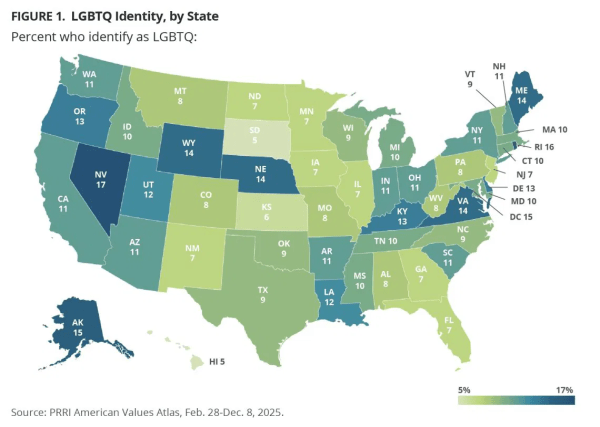
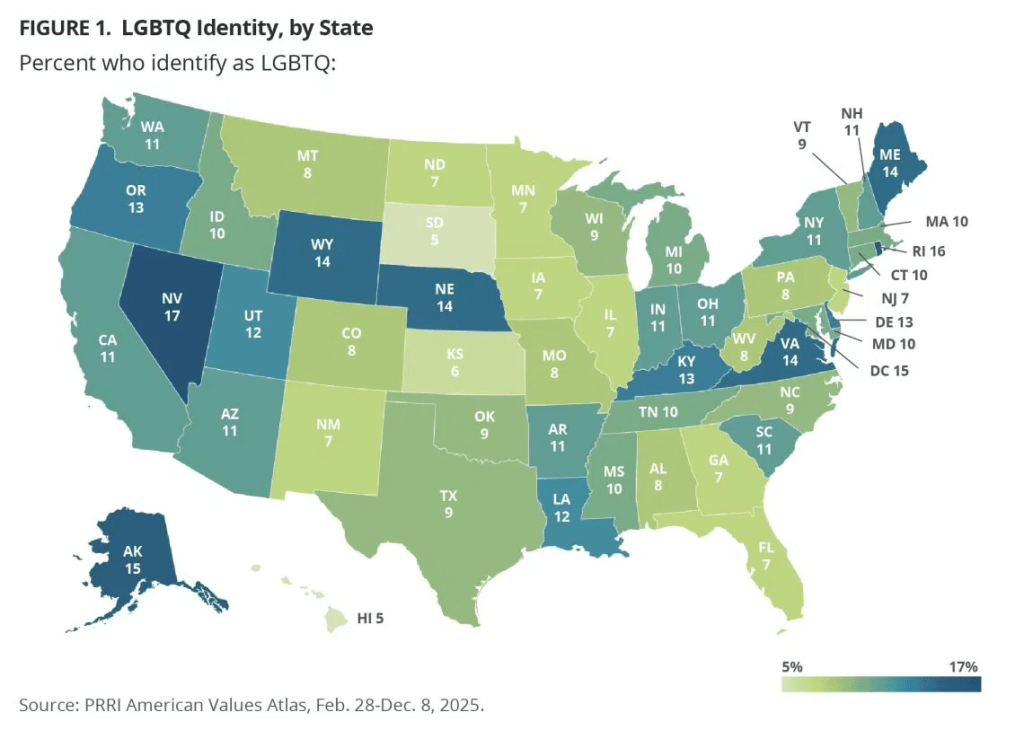
The survey asked respondents whether they self-identified as LGBTQ. It found that 17% of respondents in Nevada self-identified as LGBTQ — the highest percentage of all U.S. states, followed by 14% of respondents in Maine, Nebraska, and Wyoming.
The states with the lowest percentage of self-identified LGBTQ respondents were Hawaii and South Dakota, with just 5% each. Kansas was the state with the second-lowest number of self-identified LGBT respondents, with just 6%.
Among states whose respondents voiced the highest level of support for nondiscrimination protections for LGBTQ+ people were Massachusetts (85%), Maryland (82%), and Alaska (81%). However, Mississippi (60%), Wyoming (57%), and Arkansas (53%) showed the lowest support for such protections.
States with the most respondents opposed to religiously based ant-LGBTQ+ service refusals were Massachusetts (72%), Hawaii (71%), Vermont (71%), and Connecticut (70%). Conversely, only 44% of West Virginia respondents voiced opposition to such refusals — the lowest percentage among all U.S. states.
Interestingly, the poll found that seven in 10 Americans (71%) agreed that “transgender people deserve the same rights and protections as other Americans,” including most Democrats (88%), independents (77%), and Republicans (57%). This is especially surprising, seeing as the Republican Party and its president have spent the last decade vilifying trans people as mentally ill and a danger to the privacy and safety of women, girls, and children.
PRRI’s survey also looked at LGBTQ+ attitudes in relation to Christian nationalism. It found that Christian nationalism rejecters (91%) were the most likely to support LGBTQ+ nondiscrimination protections, followed by 77% of skeptics, 61% of sympathizers, and 42% of adherents of Christian nationalism.
Unsurprisingly, adherents and sympathizers of Christian nationalism were less likely to support same-sex marriage and less likely to oppose religiously based refusals for LGBTQ+ people, compared to respondents who either reject or are skeptical of Christian nationalism.
The Idaho House of Representatives passed a measure this week asking the Supreme Court to overturn its landmark 2015 decision legalizing same-sex marriage across the U.S. But the legislation lost three Republican votes compared to a similar measure that passed in the state House last year.
As the Idaho Statesmanreports, House Joint Memorial 17 passed in a 44–26 vote Tuesday. The measure, introduced by State Rep. Tony Wisniewski (R), is a formal legislative request for the Supreme Court to overturn its 2015 decision in Overgefell v. Hodges. The measure argues that the decision establishing the constitutional right of same-sex couple to legally marry is “at odds with the Constitution of the United States and the principles upon which the United States is established.” In its Obergefell ruling, the measure argues, the Court applied a definition of liberty that would not have been recognized by the country’s founders. The decision, it says, “relies on the dangerous fiction of treating the Due Process Clause of the Fourteenth Amendment to the Constitution as a font of substantive rights” which “strays from the full meaning of the Constitution.”
House Joint Memorial 17 is identical to House Joint Memorial 1, which the Idaho House passed last year.
This time around, however, 17 Republican lawmakers joined House Democrats to vote against the measure, with three more Republican no votes than in 2025.
According to the Statesman, Republican Reps. Dori Healey and Mike Pohanka, who both voted for House Joint Memorial 1 last year, both voted against the 2026 measure. Grayson Stone, who is serving as a long-term substitute for Rep. Don Hall (R) and recently announced that he is running for Hall’s seat, also voted against the measure. Late last year, Hall replaced former Republican Rep. Lance Clow, who voted for House Joint Memorial 1. Hall resigned due to health issues earlier this year.
Stone reportedly acknowledged that his no vote might amount to “political suicide,” but cited the Bible as the reason for his vote.
“This entire argument is rooted in the Bible,” Stone said, according to the Statesman, noting that the Bible includes instructions on how to shave. “I just don’t understand why we have to apply the Bible to specific aspects of our life, but not all of it. So, I will be voting against this bill.”
Pohanka, meanwhile, noted that his own religious beliefs on same-sex marriage have not changed since he voted for the 2025 measure. However, he told the Statesman that he represents all his constituents and wants to get back to actually legislating.
“I thought we advanced [House Joint Memorial 1] last year,” he said. “This year, to me, it’s just going to cause hurt and pain and I don’t want to do that.”
Healey declined to comment on his vote, according to the Statesman.
House Joint Memorial 17 now advances to the Idaho Senate, which declined to vote on the 2025 measure. Even if the state senate approves House Joint Memorial 17, it would not compel the Supreme Court to act.
Tennessee lawmakers have advanced a host of anti-LGBTQ bills that would run counter to U.S. Supreme Court precedent.
Two measures, both proposed by Rep. Gino Bulso, R-Franklin, would challenge landmark cases that legalized same-sex marriage and established protections for discrimination based on sexual orientation or gender identity.
Rep. Gloria Johnson, D-Knoxville, questioned the legality to going against Bostock v. Clayton County, which established that LGBTQ people are protected from discrimination under the Civil Rights Act of 1964.
“We’re talking about federal law that supersedes state law,” Johnson said. “You can’t just ignore the federal law. So, therein is the problem for those of us who believe in our U.S. Constitution.”
Bulso answered, arguing that, “The Civil Rights Act of 1964 does not govern all employers. It only governs employers with more than 15 employees.”
The legislation, Bulso said, would only apply to small businesses — but could jeopardize federal funding by putting the state at odds with federal law.
There’s a similar fiscal note on another of Bulso’s bills that would challenge Obergefell v. Hodges. Bulso argued that the opinion only dictates that public actors must recognize same-sex marriages, not private citizens.
Tom Lee, member of the Board of Directors of the Tennessee Pride Chamber, spoke against the bill, arguing that it could allow discrimination against LGBTQ couples.
“Imagine if under this bill a private employer said, ‘Well, you can’t take family leave because I, as a private citizen, don’t recognize — using the language of the bill — your purported marriage,’” Lee said. “Or a bank says, ‘You’ll pay the higher rate (for unmarried couples). We’re not bound by the 14th Amendment. You’re not married in our eyes.’”
Both measures advanced Wednesday along party lines.
Other measures proposed this year would expand previous bills aimed at LGBTQ Tennesseans. State law that allows teachers to ignore a student’s preferred pronouns would expand to include honorifics like “Mr.” or “Mrs,” and the state’s drag ban would expand the type of businesses that could be penalized under the law.
Marcus Ellsworth with the Tennessee Equality Project said that the legislature wants to consider queer people obscene at a time when all people, regardless of gender or sexuality, are struggling.
“What is actually obscene is that every year we have to watch our state prioritize wasting time, money, and resources, fabricating ways to hurt us,” Ellsworth said.
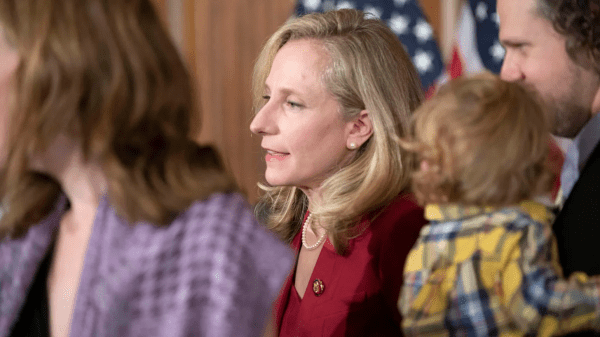
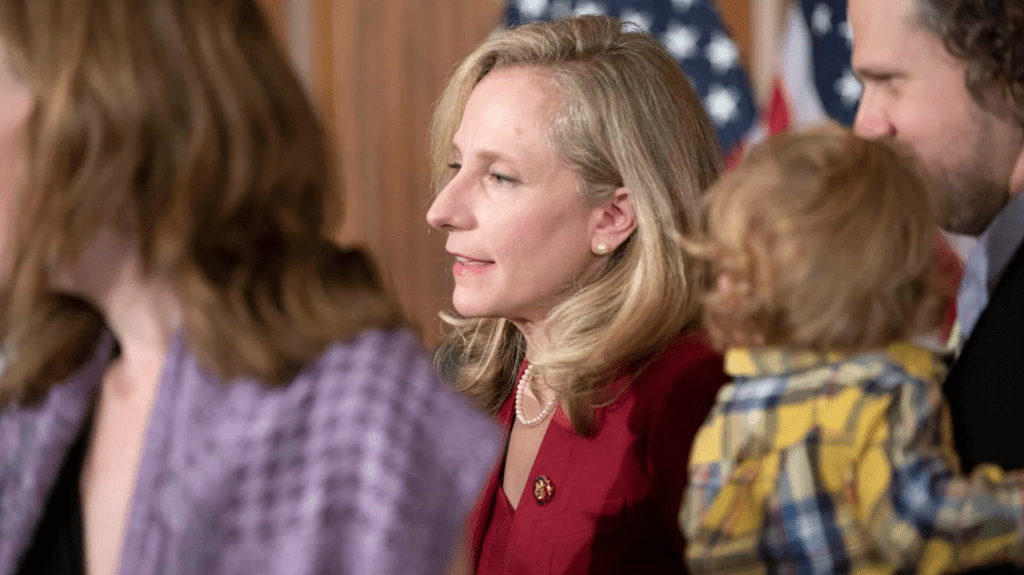
Virginia Gov. Abigail Spanberger (D) signed legislation that sent several potential state constitutional amendments to voters this past Friday, including a measure that would remove the state’s ban on same-sex marriage from the state constitution, which was originally passed in 2006.
While the state’s ban on marriage equality has not been enforced since the 2015 Obergefell v. Hodges Supreme Court decision, which legalized marriage equality in all 50 states, advocates for its removal say that it is discriminatory and could be enforced if Obergefell were ever overturned.
“We want to make sure that Virginia families know that here in Virginia, it is not just a Supreme Court decision that protects them, but it is also our state constitution,” Spanberger said in comments during the signing ceremony. “It’ll be a big step for Virginia to ensure that every family knows that Virginia is a place that welcomes them, appreciates them, and sees them for the wonderful family and Virginians that they are.”
“So before I get too emotional on that one, I will start signing.”
LGBTQ+ issues played a large role in the 2025 Virginia gubernatorial campaign, with Republican candidate Winsome Earle-Sears running ads throughout the election season that accused Spanberger of wanting “boys to play sports and share locker rooms with little girls” and letting “children change genders without telling their parents.”
At a debate later in the year, Spanberger pointed out Earle-Sears’ opposition to anti-discrimination laws and her opposition to marriage equality. Earle-Sears blurted out, “That’s not discrimination!” when Spanberger brought up how Earle-Sears believes “it’s OK for someone to be fired from their job for being gay.”
LGBTQ+ advocates hailed the marriage ballot initiative measure.
“Twenty years after banning marriage equality, it’s time for our commonwealth to fully complete our evolution – and finish the job on protecting marriage equality for all,” said Equality Virginia Executive Director Narissa Rahaman in a statement. “It’s up to all of us to vote on November 3, 2026 to safeguard marriage for all Virginians and remove the stain that exists in our constitution. We have come too far over the past 20 years to have any doubt that Virginia voters will support love and dignity for all couples this November.”
Spanberger also signed a bill that will send a reproductive rights amendment to voters in the fall. The proposed amendment would give Virginians a right to reproductive health care and include IVF, contraception, and abortion.
“This amendment protects families’ entire scope of reproductive needs,” said state Sen. Jennifer Boysko (D), who introduced it in the Virginia Senate.
“I look forward to spending ample time in advance of the 2026 elections campaigning to make sure that people understand the importance of this constitutional amendment,” Gov. Spanberger said last year, according to the Virginia Mercury.
Spanberger sent two other constitutional amendments to voters on Friday. One would automatically restore voting rights for convicted felons who finished their prison sentences (they currently have to appeal to the governer after their sentences are over to get their voting rights back), and the other would allow the state’s General Assembly to change the state’s congressional district map in the middle of decades in order to respond to other states doing the same, according to WOBC.
The Virginia Senate voted this past Friday in favor of repealing an amendment to the state constitution that defines marriage as only between a man and a woman.
Senate Joint Resolution 3, introduced by state Sen. Adam Ebbin (D), passed the chamber in a 26-13 vote and would ban the state “from denying the issuance of a marriage license to two adult persons seeking a lawful marriage on the basis of the sex, gender, or race of such persons.” It also requires Virginia to “recognize any lawful marriage between two adult persons and to treat such marriages equally under the law, regardless of the sex, gender, or race of such persons.”
A proposed Constitutional amendment must be voted on by two successive state legislatures before heading to the ballot, where voters ultimately decide its fate. Both chambers voted in favor of the resolution in 2025, and the House of Delegates already approved it again earlier this month. As such, the resolution will go to voters during the November 2026 elections.
Virginia’s 2006 constitutional ban on same-sex marriage has been unenforceable since the 2015 Supreme Court Obergefell v. Hodges decision that legalized marriage equality nationwide. In 2024, amid increasing threats that the Court may reexamine the decision, then-Gov. Glenn Youngkin (R) (who is generally anti-LGBTQ+) signed a bill codifying same-sex marriage in the Commonwealth.
The law now ensures same-sex marriage remains legal in Virginia regardless of any change in federal protections, but those championing the constitutional amendment say it’s still not enough.
“It’s time for the Virginia constitution to accurately reflect the law of the land. Full stop,” Ebbin said in a statement. “20 years ago, the Virginia Bill of Rights was unnecessarily stained in an overreaction. It’s past time to fix that and see that loving Virginia couples are not mistreated or discriminated against. I am confident that the voters will ratify this marriage equality amendment in November.”
“It’s about time Virginia gets this done,” added state Rep. Mark Sickles (D), who introduced the resolution in the House of Delegates. “All Virginia couples deserve the freedom to marry without fear that their rights could be rolled back. By advancing this amendment, we’re ensuring that the freedom to marry is protected by the people. It’s up to the voters now and I’m confident they’ll do the right thing in November.”
Virginia’s resolution comes after a new trend last year in which several Republican-led states introduced resolutions calling for the Supreme Court to overturn Obergefell. Two justices on the Supreme Court have openly stated that they want to overturn Obergefell, which has stirred fears in the LGBTQ+ community as the court has moved increasingly to the right.
In a victory for LGBTQ+ people, the Supreme Court opted in November not to hear an appeal from former Kentucky county clerk Kim Davis asking the court to reconsider its marriage equality decision.
Even if the Supreme Court had taken the case, Chris Geidner, the gay publisher and author of Law Dork, told LGBTQ Nation last year that he didn’t think a case like Davis’ would provide sufficient legal reasoning to overturn same-sex marriage entirely.
Rather, he said that a successful religious freedom or free speech challenge to Obergefell would do other “bad things,” like hollow out civil protections or public accommodations for same-sex couples, essentially inconveniencing or endangering them, but not outright denying them the right to a marriage license.
Texas judges can decline to perform same-sex weddings because of their “sincerely held religious belief” and not be in violation of the rules on judicial impartiality, according to the Texas Supreme Court.
A lawsuit is being brought by Judge Brian Keith Umphress in Jack County, Texas, against the Texas State Commission on Judicial Conduct. In November 2019, the commission issued a “public warning” to Dianne Hensley, a justice of the peace who recused herself from officiating at same-sex weddings, according to coverage by Legal Newsline.
Umphress later sued the commission’s members, citing that a judge’s refusal to officiate only same-sex unions could result in sanctions by the commission and violate his federal constitutional rights.
He is seeking declaratory and injunctive relief to restrain the commission from punishing judges for not performing same-sex marriage ceremonies, for either religious or secular reasons.
Costa Rica: The constitutional court recognized the right of same-sex couples to share maternity leave, just like heterosexual couples can.
The government has proposed a gender recognition bill, but the state Social Security Fund rejected a part of it that would require it to cover sex reassignment surgery. It’s still being debated.
The ministry of education announced it was eliminating sex education and policies around homophobic bullying in schools, and also eliminating the position of LGBTI commissioner.
Honduras: The country emerged as another locus of far-right drift after US President Trump intervened in the presidential election to declare his preferred candidate. The close election still hasn’t declared a winner nearly a month later. Whoever is ultimately declared winner will be further to the right of outgoing president Xiomara Castro, who had vocally supported LGBTQ rights (though didn’t accomplish much in the face of a hostile congress).
El Salvador: The country’s dictator has gotten cozy with Trump, hosting the CECOT detention and torture center where America is deporting its undesirable migrants.
Caribbean
St. Lucia: The biggest positive development in the region was the court ruling that decriminalized gay sex in Saint Lucia. This court case was part of a coordinated strategy by Caribbean LGBTQ activists who filed simultaneous cases in five states challenging their sodomy laws, and this was the fourth positive ruling. Unlike other rulings in this series, the court did not find that the constitution specifically bars sexual orientation discrimination. We’re still waiting on a ruling from Grenada, which could come any day now. Or a year from now. Look, the court operates on Caribbean time.
An unrelated sodomy case in St. Vincent and the Grenadines failed in 2024, and I have not heard anything about an appeal. And another unrelated case…
Trinidad & Tobago: And the shock negative development of 2025. In March, the court of appeal overturned a 2018 ruling that decriminalized sodomy in the country. Caribbean time is Caribbean time, but overturning a seven-year-old decision is crazy. The case is now headed to the Judicial Committee of the Privy Council in London for a final ruling, and it’s really unclear how it’ll rule.
The case turns on the “savings clause” in the constitution, which insulates pre-independence laws from court scrutiny, and whether it applies. The plaintiff said it didn’t apply, since the legislature had repealed the pre-independence sodomy law with a stronger one in 1986 and 2000. The court found that the savings clause applied, but reverted the law to the pre-independence version, which sounds like pure legislating from the bench to me!
The Privy Council has been pretty strongly in favor of upholding savings clauses in the recent past, but this one is quite a pretzel. They ought to also be bound by international treaty obligations (of both the UK and Trinidad) to decriminalize sodomy. In all likelihood, we won’t see a ruling until 2027 or later, fully a decade after the original case was filed.
Cuba: The National Assembly passed a law allowing gender change by self-identification, and also recognized common-law marriage for the first time.
Dominican Republic: The biggest news was that the Constitutional Court struck down laws that criminalized police officers and military personnel who have gay sex. The ruling also clearly established for the first time that the Dominican constitution bans discrimination based on sexual orientation, both in government services and in employment. It’s likely that over time this will become a foundational ruling to assert further LGBTQ rights in the country.
This is also fortunate, because congress also passed a new penal code this year over the objections of civil society groups, because it failed to include prohibitions on discrimination and hate crimes, and didn’t decriminalize abortion.
The court ruling also prompted me to do a bit of a Wikipedia dive updating entries on LGBTQ rights in numerous Caribbean countries, to clarify or update that they no longer bar gay servicemembers in their laws.
Dutch Territories: Sint Maarten is the last Netherlands territory where same-sex marriage is not yet legal, after the constitutional court made it legal in Aruba and Curacao last year. It seems like all it will take is a court challenge to bring equal marriage to Sint Maarten, but I don’t believe one has been filed yet.
UK Territories: Gays scored a surprise win in Turks and Caicos Islands, where a binational couple won a court of appeal ruling that the government must recognize overseas same-sex marriages for the purposes of immigration. The court explicitly did not rule on whether same-sex marriage must be legalized or recognized – the constitution specifically restricts it.
In the Cayman Islands, the UK Privy Council upheld the territory’s civil partnership law, which was imposed by the governor in 2020 after a similar bill failed in the legislature by one vote.
A long-threatened referendum on banning same-sex marriage in the UK Virgin Islands’ constitution failed to materialize. The territory is in the process of overhauling its constitution, and it may eventually emerge as part of a reform package.
None of Britain’s Caribbean territories recognize same-sex marriage.
South America
Argentina: The country’s far-right drift continued with the encouragement of the US President. In February, President Javier Milei banned gender care for minors by decree, but the federal court overturned the ban two months later. Legislators have since proposed an omnibus anti-trans bill, which we should watch out for in 2026.
Earlier this month, the government introduced a bill that would stiffen penalties for anti-LGBT hate crimes as part of a broader crime reform bill.
Brazil: The superior court of justice ruled in favor of a nonbinary person who wished to have their gender recorded as such in the civil registry. The decision was limited to the individual plaintiff, but ought to form a precedent for future cases. Brazil already allows a X marker on passports.
The supreme court also invalidated local laws that banned discussion of sexual orientation or gender identity in schools, and ruled that a domestic violence law that was originally drafted to only apply to women in heterosexual couples also applies to same-sex couples and trans women.
Meanwhile, the federal council of medicine issued a regulation banning gender-affirming care for minors, but simultaneously lowering the minimum age for genital surgery from 25 to 21. The regulation is being appealed.
Congress is also very slowly debating a bill that would finally codify same-sex marriage and adoption into federal law, following the supreme court ruling on the issue way back in 2013. Look for this to come to a vote in late 2026/27.
Chile: Another country that’s fallen to the extreme right-wing regional drift following presidential elections last month.
But before that happened, outgoing President Boric signed a new adoption law that finally ends discrimination against same-sex couples and couples in civil unions in adoptions. Previously, married heterosexual couples were given priority in adoptions.
Congress defunded the Gender Identity Support Program over the objections of the President Boric. It’ll continue for now under the Ministry of Health, but is a likely target of incoming President Kast, whose objections to LGBTQ rights are well documented. The constitutional court ruled in favor of the mother of a 10-year-old trans girl who wanted to update her daughter’s legal identity, although the law only allows that after age 14. The ruling was limited to the specific case.
Colombia: Congress failed again to pass a conversion therapy ban, though a new bill is pending.
Guyana: LGBTQ issues became a surprise issue in national elections this year, with nearly all parties pledging to repeal the country’s sodomy law. Reelected President Ali pledged to work with the local queer advocacy group on repealing the law and improving laws for the community, though same-sex marriage appears off the table for now. One to watch in 2026.
Guyana has become an incredibly rich nation basically overnight due to the new exploitation of off-shore oil fields, which has led to an influx of visitors, investors, and tourism, which may be helping drive some of this – not to mention the string of successful court challenges to sodomy laws in the near Caribbean. But that attention also came with a threat of annexation by neighboring Venezuela earlier in the year, though that appears to have subsided amidst ongoing threats of a US invasion of that country.
Peru: Bills seeking civil unions or same-sex marriage failed to advance in congress in 2025, but an administrative court for the first time recognized a same-sex marriage for the purposes of dividing property. About eleven cases are pending in courts across the country seeking same-sex marriage or recognition of foreign marriages.
Congress passed a bill that eliminates the concept of “gender” from law and replaces it with biological sex only. The law also eliminates the goal of “gender equality” and replaces it with “equity” and “equality of opportunity.” The law has been roundly condemned by the international community as retrograde and endangering the rights of women and girls.
Congress was also working on a bill to ban trans women from public bathrooms.
Suriname: In February, a review panel overturned a 2023 ruling by the constitutional court and ordered the government to record two same-sex couples who’d married overseas into the civil registry, essentially requiring recognition of same-sex marriage. The ruling also ordered the government to amend legislation to allow it, although a new civil code that came into effect in May specifically bans same-sex marriage. For now, the ruling only applies to the two couples, but others can sue for the right to be registered as well. The decision can still be appealed, but I haven’t seen any news on it since.
A court found Japan’s refusal to legalize same-sex marriage was constitutional Friday in the last of six cases that are expected to be brought to the Supreme Court for a final and definitive ruling, possibly next year.
The Tokyo High Court said marriage under the law is largely expected to be a union between men and women in a decision that reversed a lower court ruling last year and was the first loss at high courts in the six cases brought by those seeking equal marriage rights.
Judge Ayumi Higashi said a legal definition of a family as a unit between a couple and their children is rational and that exclusion of same-sex marriage is valid. The court also dismissed damages of 1 million yen ($6,400) each sought by eight sexual minorities seeking equal marital rights.
Plaintiffs and their lawyers said the decision was unjust but they were determined to keep fighting through the Supreme Court.
“I’m so disappointed,” plaintiff Hiromi Hatogai told reporters outside the court. “Rather than sorrow, I’m outraged and appalled by the decision. Were the judges listening to us?”
“We only want to be able to marry and be happy, just like anyone else,” said another plaintiff, Rie Fukuda. “I believe the society is changing. We won’t give up.”
With all six high court cases done, the Supreme Court is expected to handle all appeals and make a decision.
Though discrimination still exists at school, work and elsewhere, public backing for legalizing same-sex marriage and support in the business community have rapidly increased in recent years.
Japan is the only member of the Group of Seven industrialized countries that does not recognize same-sex marriage or provide any other form of legally binding protection for LGBTQ+ couples.
Prime Minister Sanae Takaichi ‘s conservative ruling Liberal Democratic Party is the main opponent of same-sex marital rights in Japan. The government has argued that marriage under civil law does not cover same-sex couples and places importance on natural reproduction.
More than 30 plaintiffs have joined the lawsuits on marriage equality filed across Japan since 2019. They argue that civil law provisions barring same-sex marriage violate the Constitutional right to equality and freedom of marriage.
Friday’s ruling was only the second that found the current government policy constitutional after the 2022 Osaka District Court decision.
The European Court of Justice has issued a ruling that all nations in the European Union (EU) must recognize lawful same-sex marriages that were performed in other EU countries. Previously, a country could refuse to recognize a marriage if it had taken place in another country and did not align with its own laws.
The court declared that EU citizens have a right to “a normal family life” regardless of borders. “When they create a family life in a host member state,” they said, “in particular by virtue of marriage, they must have the certainty to be able to pursue that family life upon returning to their member state of origin.”
Citizens of the European Union have the right to freedom of movement between the different nations within the union. The court suggested that this right, as well as the right to “respect for private and family life,” would be breached if one country could refuse to acknowledge a lawful marriage from another country.
The court added in a press release, “Member States are therefore required to recognize, for the purpose of the exercise of the rights conferred by EU law, the marital status lawfully acquired in another Member State.”
The case was brought to the Luxembourg-based court on behalf of a Polish couple who had been married in Berlin, Germany, where same-sex marriage is recognized. When, years later, they returned to their home country, they submitted their marriage certificate, which was in German, to the Polish government to be transcribed and recognized in the Polish civil register.
The Polish government denied their request, as the country does not recognize same-sex marriages. With this new ruling, they will no longer be able to refuse legally.
Of the 27 EU member states, only 18 have legalized same-sex marriage.
LGBTQ+ rights have taken some big hits in Poland in recent years. The far-right Law and Justice Party held power from 2015 to 2023 and enacted a range of anti-LGBTQ+ policies during that time. It was only in April of this year that the last “LGBT-free” zone created by the party was finally repealed.
Poland is currently led by a coalition government. The prime minister, Donald Tusk, campaigned on introducing same-sex civil unions and has pushed for such legislation to be passed. However, Poland’s president, Karol Nawrocki of the Law and Justice Party, has said that he would veto any legislation that would legalize same-sex marriage.






 fleeredstates.blog
You must be logged in to post a comment.