Restaurant employee corners lesbian teen in women’s toilet, demands “proof” of her gender

Read more at LGBTQ Nation.

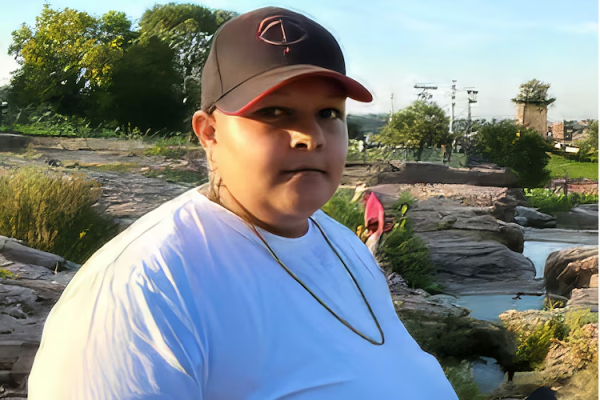
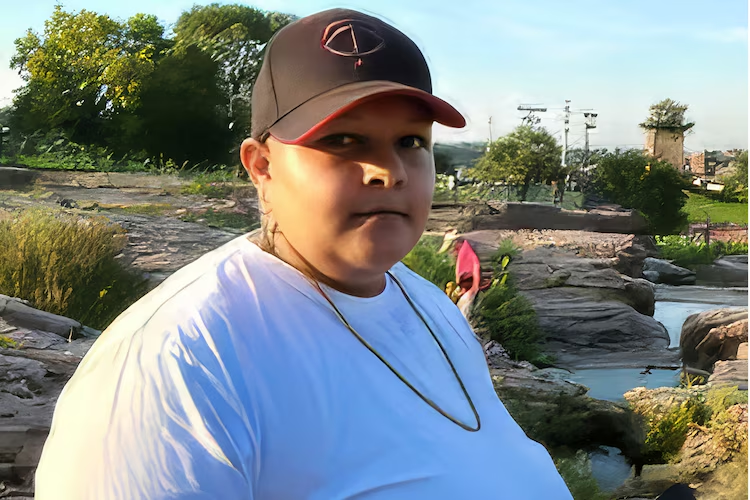
Gerika Mudra — an 18-year-old cis biracial lesbian high school student in Minnesota — filed a discrimination complaint against Buffalo Wild Wings, alleging that, while enjoying dinner with a friend around the Easter holiday in April, a female employee at the chicken restaurant’s Owatonna location followed her into the women’s restroom and demanded proof of her female gender.

Minnesota has no laws restricting restroom use by transgender people. However, Mudra’s lawsuit — filed with the Minnesota Department of Human Rights by the LGBTQ+-inclusive legal group Gender Justice — alleges that the employee violated the Minnesota Human Rights Act, a law that explicitly prohibits discrimination in public accommodations based on sexual orientation and gender identity.

The employee reportedly pounded on a bathroom stall door and said, “This is a women’s restroom. The man needs to get out of here.” When Mudra exited the stall, she told the employee, “I am a lady,” NBC News reported. The server reportedly responded, “You have to get out now.”

In response, Mudra unzipped her hoodie to show that she has breasts. (Mudra was wearing a shirt that covered her chest.) The employee reportedly said nothing in response, but left the restroom. Buffalo Wild Wings didn’t respond to NBC News’ request for comment.

“This wasn’t the first time something like this happened, but this is like the worst time,” Mudra said in a video created by Gender Justice. “This one… she was like, mad, screaming. She made me feel very uncomfortable.”

“After that, I just don’t like going in public bathrooms. I just hold it in,” she added. “I want to be able to use the bathroom in peace.”

Mudra’s stepmother, Shauna Otterness, said she was “enraged” upon hearing about the incident, which she called “cruel and humiliating.”

“We know Gerika was targeted because of how she looks,” Otterness said. “She didn’t do anything wrong. She just didn’t fit what that server thought a girl should look like. I was shocked and heartbroken by how many people shared similar stories after I posted about it online.”

“This shouldn’t be normal,” Otterness added. “We can do better, and we have to.”

The Minnesota Human Rights Act explicitly forbids discrimination based on gender identity, whether real or perceived. As such, if the employee’s behavior arose from the suspicion that Mudra was trans, the employee’s actions are still potentially illegal. Additionally, the law requires businesses to train staff, enforce anti-discrimination policies, and ensure their spaces are safe and welcoming to everyone, Gender Equity noted.

While Minnesota doesn’t have laws restricting trans people’s restroom use, 19 states do. Republicans nationwide have repeatedly accused trans women of “invading” women’s spaces to harm girls and women. No evidence shows that trans-inclusive restroom policies contribute to a rise in restroom-related assaults.

Gender Justice also noted that nearly one-third of LGBTQ+ people report experiencing harassment for using a bathroom, and nearly 60% of trans people have avoided using public restrooms out of fear of harassment or violence.

“The transphobia that’s happening, it really affects everyone and it’s really bad for everyone because… there’s expectations about what women should look like, what women’s bodies should look like. And if you don’t meet those stereotypes, you’re gonna be targeted,” said Jess Braverman, Gender Justice’s legal director.

Holding one’s bodily waste to avoid restrooms can result in increased urinary tract infections, constipation, the presence of blood in the urine, and even kidney disease, according to the American Medical Association. Exclusionary bathroom policies can also contribute to increased anxiety, depression, and suicidality amongst trans individuals, according to the National Institutes of Health.

“Black girls and women also face relentless policing of their appearance and identity. In schools, they are suspended at six times the rate of white girls, often for subjective reasons tied to how they dress, speak, or wear their hair,” Gender Justice added. “These same biases follow them into places like restaurants and bathrooms where they are often treated as suspicious or out of place for simply being themselves.”

Morgan Peterson, Gender Justice’s executive director, said, “A growing culture of suspicion and control is targeting trans, gender-nonconforming, and Black girls and women—anyone who doesn’t match narrow ideas of how women should look or behave. When people are harassed just for existing, none of us are truly safe.”

Cis women are regularly harassed because of transphobic restroom policies

In March, Phoenix cops burst into a women’s restroom to remove a butch lesbian, accusing her of being a man. That same month, a 6’4″ cisgender female Walmart employee was followed into a women’s restroom by a customer who verbally assaulted her because he thought she was trans.

In January, anti-trans Rep. Lauren Boebert (R-CO) reportedly told a cis woman in a Capitol women’s restroom, “You shouldn’t be here,” before storming back into the restroom with her transphobic colleague, Rep. Nancy Mace (R-SC), only to realize the woman wasn’t trans.

“I made an error regarding a mistaken identity,” Boebert said in a statement after the incident. “I apologized, learned a lesson, and it won’t happen again.”

In November 2022, a cisgender woman harassed another cis woman with short hair in the public restroom of the Rampart Casino in Las Vegas, Nevada, because she thought she was transgender.

In May 2016, 22-year-old cis woman Aimee Toms was called “disgusting,” flicked off, and escorted out of the bathroom because a woman mistook her for being trans.

In other words, anti-trans restroom policies encourage people to harass the very women and girls that the laws purport to protect.

What states are the best for LGBTQ+ people? These are the top 15

Read more at The Advocate.
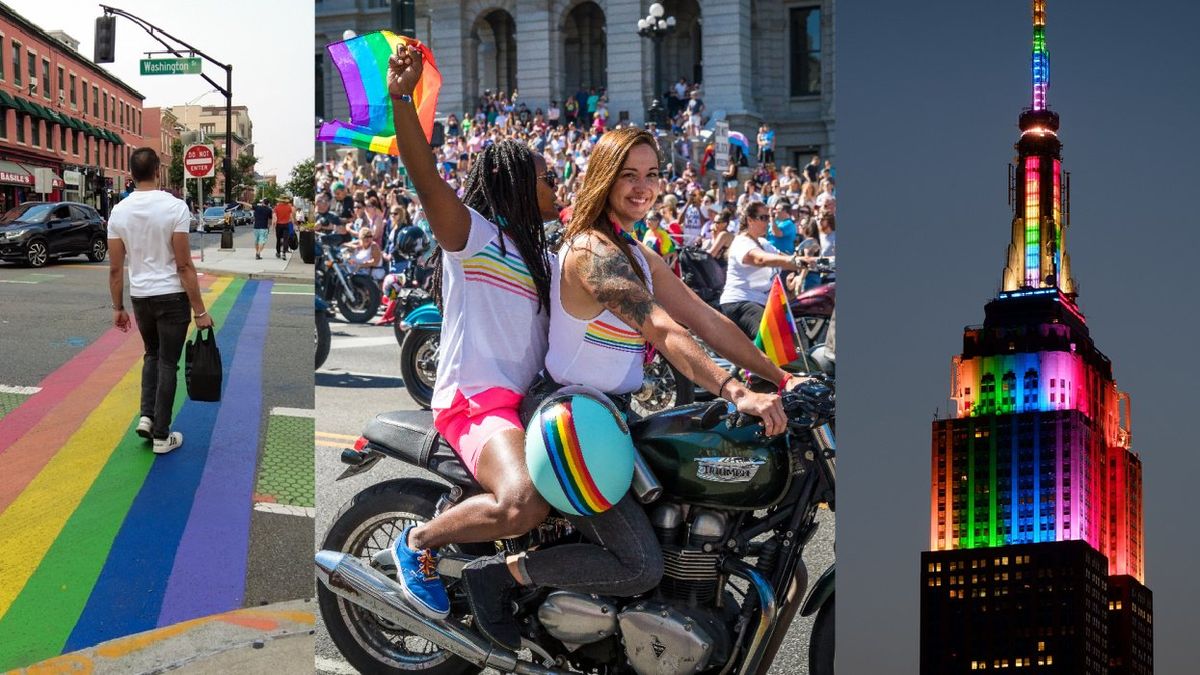
\u200bRainbow crosswalk in Hoboken (L); Women on motorcycles at Denver Pride (M); Empire State Building in rainbow colors (R)

Kirkam / Shutterstock.com; Philipp Salveter / Shutterstock.com; anaglic / Shutterstock.com

Rainbow LGBTQ+ Pride crosswalk in Hoboken, New Jersey (L); Women on motorcycles at Pride celebration in Denver, Colorado (M); Empire State Building in NYC lit up in rainbow colors (R)

    Legislative attacks on the LGBTQ+ community have been pushed everywhere from city councils to the White House — but there are still some areas that are safe.

    Over 1,000 anti-LGBTQ+ laws have been proposed across every state legislature in the U.S. over the past two years, according to the American Civil Liberties Union, and 126 have passed into law. Less than two months into the 2025 legislative session, 390 laws targeting LGBTQ+ people have been proposed.

    Still, marriage equality and anti-discrimination protections based on sexual orientation and gender identity are still guaranteed federally by U.S. Supreme Court rulings (for now). On top of that, at least 15 states have “shield laws” protecting access to gender-affirming care and abortion.

    Based on laws surrounding marriage, family rights, health care, education, and youth collected by the Movement Advancement Project, here are the 15 best states for LGBTQ+ people.

    Related: What states are the most dangerous for LGBTQ+ people? Here are the worst 15

    California
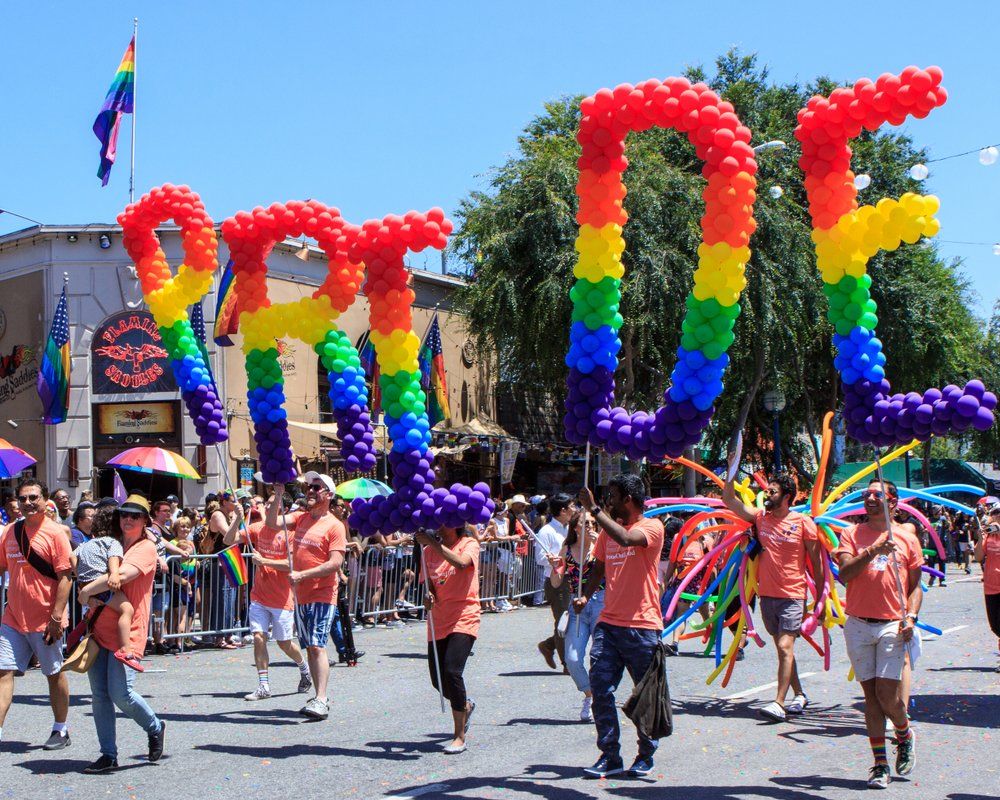
    West Hollywood Pride balloons

    GrandAve / Shutterstock.com

    Pride celebration in West Hollywood, California – June 9, 2019

      Nondiscrimination laws: California has nondiscrimination laws in employment, housing, health care, education, public accommodations, and credit/lending.

      Marriage equality and parental rights: California has adoption and foster care nondiscrimination protections for LGBTQ+ parents, second-parent adoption for unmarried couples and confirmatory adoption, and recognition for parents using assisted reproductive technologies. It also has family leave laws, which include LGBTQ-inclusive definitions.

      Education and youth policies: California does not restrict discussion of LGBTQ+ identities in classrooms, and instead requires curriculum to be LGBTQ-inclusive, which parents are not required to be notified of. It does not prevent transgender students from participating in sports or using school facilities based on their identities, and it does not require staff to forcibly out LGBTQ+ students to their guardians.

      Healthcare access and rights: California has “shield” laws protecting access to gender-affirming care for youth, as well as abortion. The state has also banned so-called conversion therapy for youth. Health insurance companies, including Medicaid, are not allowed to deny coverage related to gender transition. However, they are not required to cover fertility treatments.

      Criminal justice: California’s hate crime laws encompass sexual orientation and gender identity, and it has banned the so-called “LGBTQ+ panic” defense. While the state does not criminalize HIV, it does have sentencing enhancements for sex-related convictions for those with HIV.

      Colorado
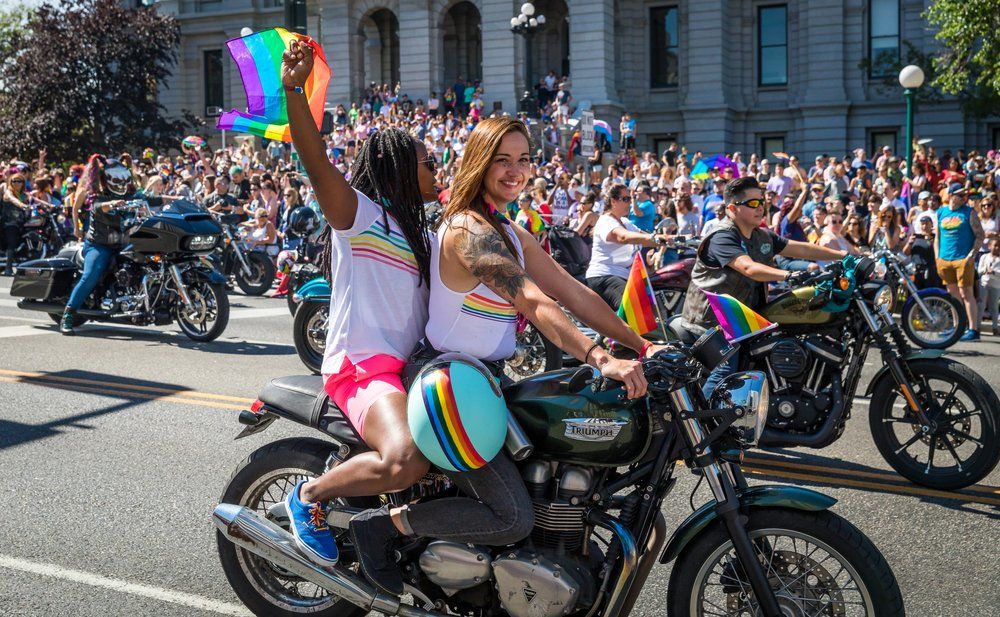
      Women on motorcycles at Denver Pride celebration

      Philipp Salveter / Shutterstock.com

      Women on motorcycles at Pride celebration in Denver, Colorado, USA – June 16th 2019

        Nondiscrimination laws: Colorado has nondiscrimination laws in employment, housing, education, health care, public accommodations, and credit/lending.

        Marriage equality and parental rights: Colorado has adoption and foster care nondiscrimination protections for LGBTQ+ parents, second-parent adoption for unmarried couples and confirmatory adoption, and recognition for parents using assisted reproductive technologies. It also has family leave laws, which include LGBTQ-inclusive definitions.

        Education and youth policies: Colorado does not prevent transgender students from participating in sports or using school facilities based on their identities, and it does not require staff to forcibly out LGBTQ+ students to their guardians. It does not restrict discussion of LGBTQ+ identities in classrooms, and instead requires curriculum to be LGBTQ-inclusive, which parents are not required to be notified of.

        Healthcare access and rights: Colorado has “shield” laws protecting access to gender-affirming care for youth, as well as abortion. The state has also banned so-called conversion therapy for youth. Health insurance companies, including Medicaid, are not allowed to deny coverage related to gender transition. However, state employees who are transgender do not have inclusive health benefits. Insurance companies are also not required to cover fertility treatments.

        Criminal justice: The state’s hate crime laws encompass sexual orientation and gender identity, and it has banned the so-called “LGBTQ+ panic” defense. Like California, Colorado does not criminalize HIV, but it does have sentencing enhancements for sex-related convictions for those with HIV.

        Connecticut
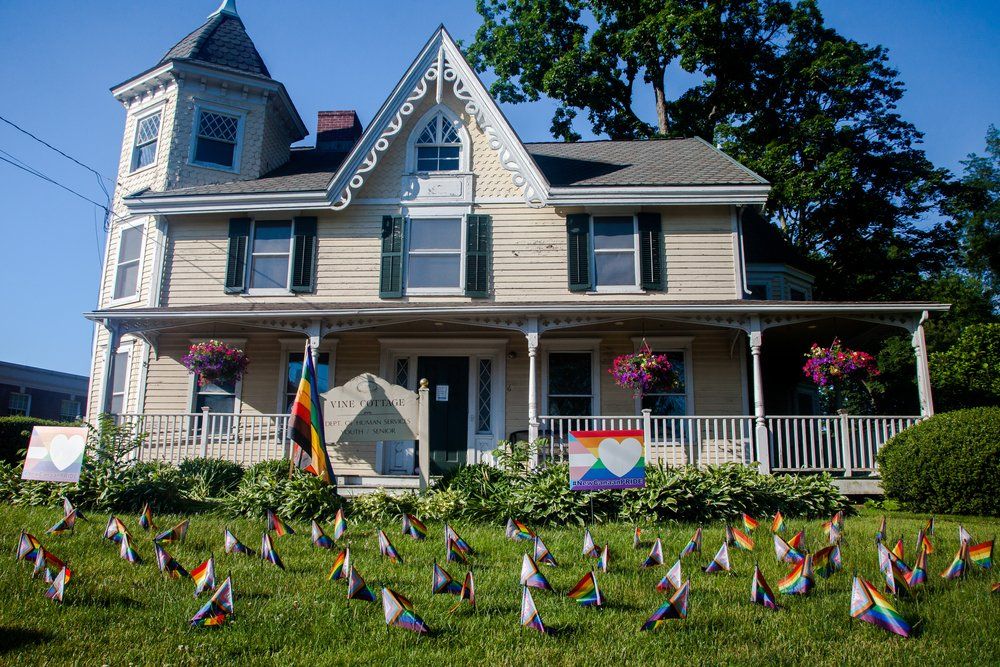
        Pride flags outside Vine Cottage CT

        Miro Vrlik Photography / Shutterstock.com

        LGBTQ+ Pride flags outside Vine Cottage in New Canaan, Connecticut – June 13, 2021

          Nondiscrimination laws: Connecticut has nondiscrimination laws in employment, housing, education, public accommodations, and credit/lending. It does not have nondiscrimination laws for private healthcare, and it does have a broad “Religious Exemption” law.

          Marriage equality and parental rights: Connecticut has adoption and foster care nondiscrimination protections for LGBTQ+ parents, second-parent adoption for unmarried couples and confirmatory adoption, and recognition for parents using assisted reproductive technologies. It also has family leave laws, but their LGBTQ-inclusive definitions are not as robust as those of California or Colorado.

          Education and youth policies: Connecticut does not restrict discussion of LGBTQ+ identities in classrooms, but it does not have LGBTQ-inclusive curriculum. It does not prevent transgender students from participating in sports or using school facilities based on their identities, and it does not require staff to forcibly out LGBTQ+ students to their guardians.

          Healthcare access and rights: Connecticut has “shield” laws protecting access to gender-affirming care for youth, as well as abortion. The state has also banned so-called conversion therapy for youth. Health insurance companies, including Medicaid, are not allowed to deny coverage related to gender transition. Private insurance is required to cover some fertility treatments, but Medicaid is not.Criminal justice:Connecticut’s hate crime law encompasses sexual orientation but not gender identity. It also does not have nondiscrimination laws for LGBTQ+ people in jury selection.

          Illinois
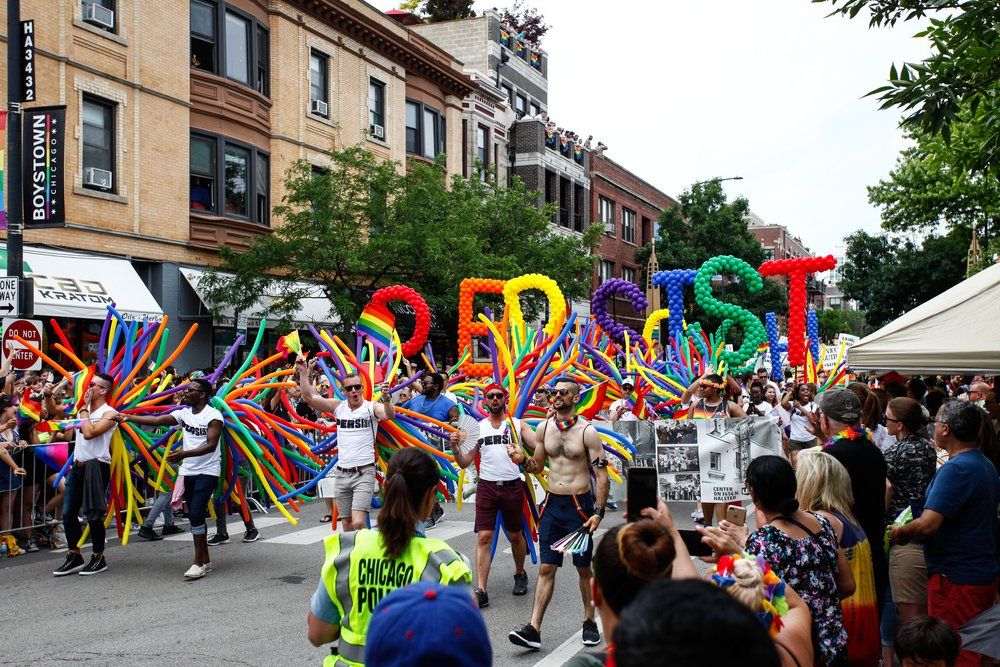
          "Persist" balloons at Chicago

          Dominique Robinson / Shutterstock.com

          LGBTQ+ Pride in Chicago, Illinois – June 30th 2019

            Nondiscrimination laws: Illinois has nondiscrimination laws in employment, housing, health care, education, public accommodations, and credit/lending. However, it does have a broad “Religious Exemption” law.

            Marriage equality and parental rights: Illinois has adoption and foster care nondiscrimination protections for LGBTQ+ parents, second-parent adoption for unmarried couples, and recognition for parents using assisted reproductive technologies. It also has family leave laws, which include LGBTQ-inclusive definitions. It does not have confirmatory adoption.

            Education and youth policies: Illinois does not restrict discussion of LGBTQ+ identities in classrooms, and instead requires curriculum to be LGBTQ-inclusive, which parents are not required to be notified of. It does not prevent transgender students from participating in sports or using school facilities based on their identities, and it does not require staff to forcibly out LGBTQ+ students to their guardians.

            Healthcare access and rights: Illinois has “shield” laws protecting access to gender-affirming care for youth, as well as abortion. The state has also banned so-called conversion therapy for youth. Health insurance companies, including Medicaid, are not allowed to deny coverage related to gender transition or fertility treatments.

            Criminal justice: Illinois’ hate crime laws encompass sexual orientation and gender identity, and it has banned the so-called “LGBTQ+ panic” defense.

            Maine
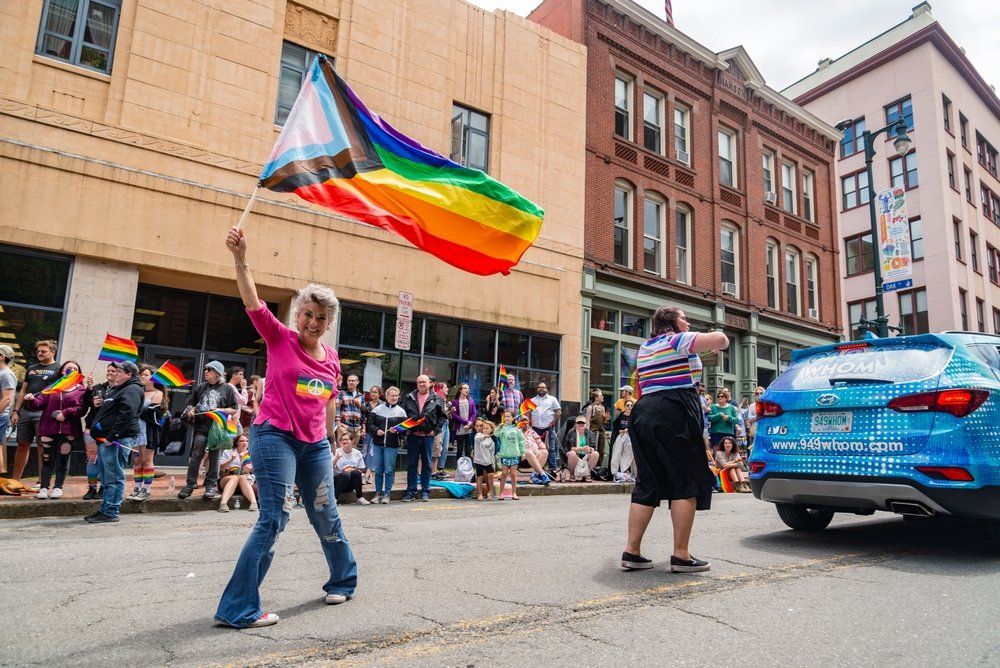
            Woman waving flag at Pride in Portland, Maine

            Enrico Della Pietra / Shutterstock.com

            LGBTQ+ Pride in Portland, Maine – June 18, 2022

              Nondiscrimination laws: Maine has nondiscrimination laws in employment, housing, health care, education, public accommodations, and credit/lending.

              Marriage equality and parental rights: Maine has adoption and foster care nondiscrimination protections for LGBTQ+ parents, second-parent adoption for unmarried couples and confirmatory adoption, and recognition for parents using assisted reproductive technologies. It also has family leave laws, which include LGBTQ-inclusive definitions.

              Education and youth policies: Maine does not restrict discussion of LGBTQ+ identities in classrooms, but it does not have LGBTQ-inclusive curriculum. It does not prevent transgender students from participating in sports or using school facilities based on their identities, and it does not require staff to forcibly out LGBTQ+ students to their guardians.

              Healthcare access and rights: Maine has “shield” laws protecting access to gender-affirming care for youth, as well as abortion. The state has also banned so-called conversion therapy for youth. Health insurance companies, including Medicaid, are not allowed to deny coverage related to gender transition. Private insurance is required to cover some fertility treatments, but Medicaid is not.Criminal justice:Maine’s hate crime laws encompass sexual orientation and gender identity, and it has banned the so-called “LGBTQ+ panic” defense.

              Maryland
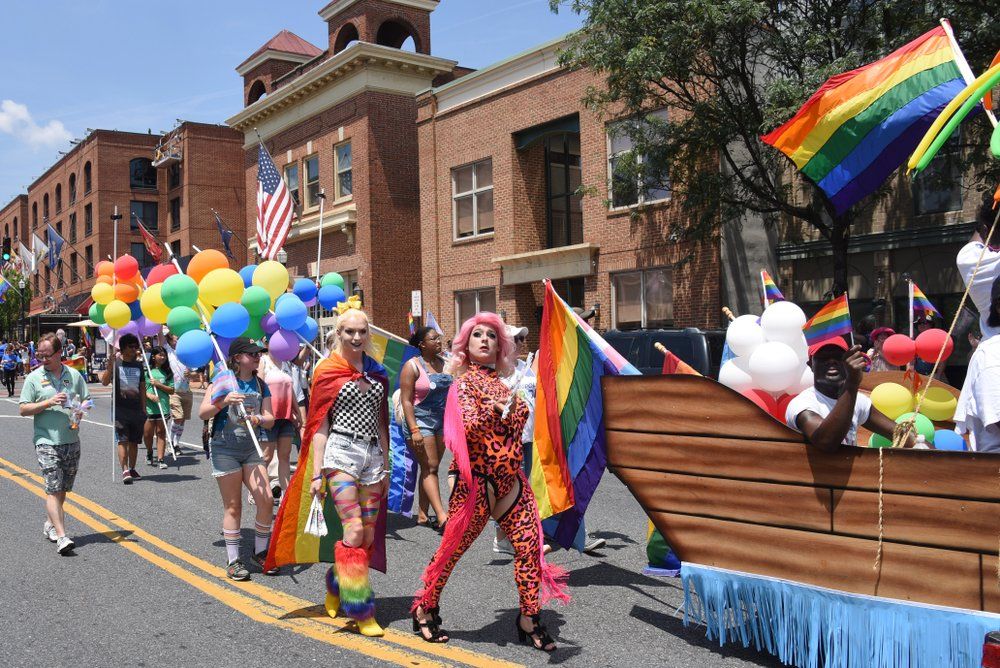
              Marchers and floats in the first Annapolis Pride parade

              Keri Delaney / Shutterstock.com

              The inaugural Pride Parade in Annapolis, Maryland – June 29, 2019

                Nondiscrimination laws: Maryland has nondiscrimination laws in employment, housing, health care, education, public accommodations, and credit/lending.

                Marriage equality and parental rights: Maryland has adoption and foster care nondiscrimination protections for LGBTQ+ parents, confirmatory adoption, and recognition for parents using assisted reproductive technologies. It does not second-parent adoption for unmarried couples. It also has family leave laws, but their LGBTQ-inclusive definitions are not as robust as others.

                Education and youth policies: Maryland does not restrict discussion of LGBTQ+ identities in classrooms, but it does not have LGBTQ-inclusive curriculum. It does not prevent transgender students from participating in sports or using school facilities based on their identities, and it does not require staff to forcibly out LGBTQ+ students to their guardians.

                Healthcare access and rights: Maryland has “shield” laws protecting access to gender-affirming care for youth, as well as abortion. The state has also banned so-called conversion therapy for youth. Health insurance companies, including Medicaid, are not allowed to deny coverage related to gender transition. Private insurance is required to cover some fertility treatments, but Medicaid is not.

                Criminal justice: Maryland’s hate crime laws encompass sexual orientation and gender identity, and it has banned the so-called “LGBTQ+ panic” defense. It does have a law criminalizing the transmission of HIV.

                Massachusetts
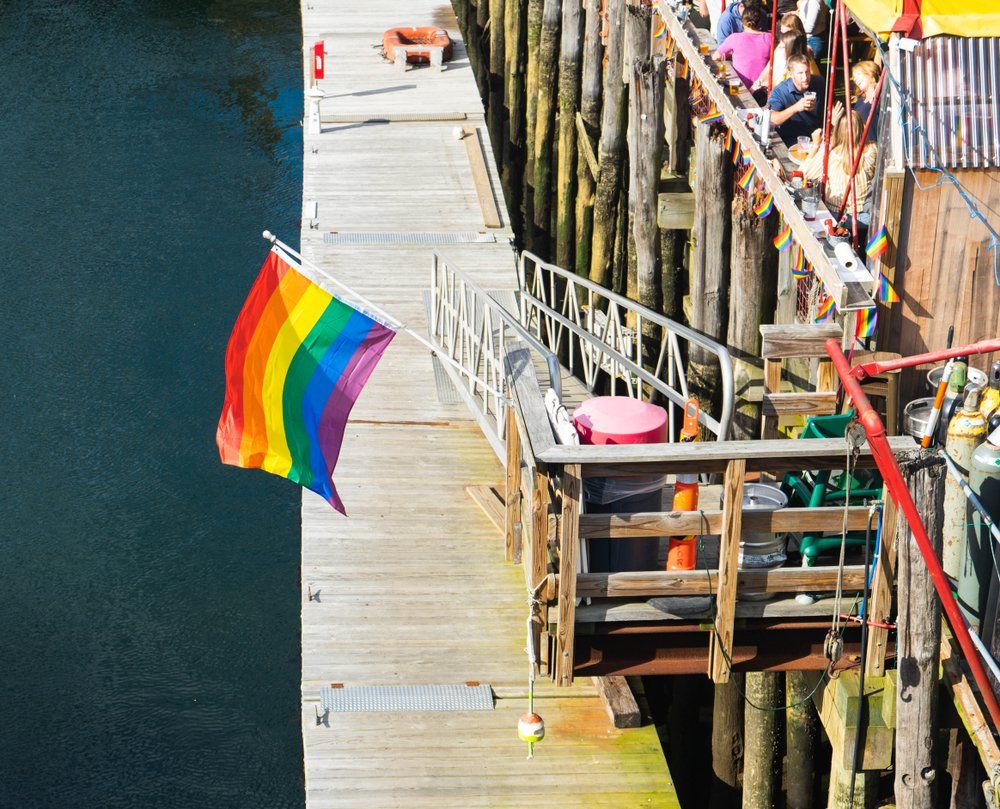
                Pride flag over Boston Seaport

                Michael Moloney / Shutterstock.com

                LGBTQ+ Pride flag waving in the wind over the Boston Seaport – JUNE 2, 2019

                  Nondiscrimination laws: Massachusetts has nondiscrimination laws in employment, housing, education, public accommodations, and credit/lending. It has nondiscrimination laws for gender identity in private healthcare, but not for sexual orientation.

                  Marriage equality and parental rights: Massachusetts has adoption and foster care nondiscrimination protections for LGBTQ+ parents, second-parent adoption for unmarried couples, and recognition for parents using assisted reproductive technologies. It also has family leave laws, which include LGBTQ-inclusive definitions. It does not have confirmatory adoption.

                  Education and youth policies: Massachusetts does not restrict discussion of LGBTQ+ identities in classrooms, but it does not have LGBTQ-inclusive curriculum. It does not prevent transgender students from participating in sports or using school facilities based on their identities, and it does not require staff to forcibly out LGBTQ+ students to their guardians.

                  Healthcare access and rights: Massachusetts has “shield” laws protecting access to gender-affirming care for youth, as well as abortion. The state has also banned so-called conversion therapy for youth. Health insurance companies, including Medicaid, are not allowed to deny coverage related to gender transition. Private insurance is required to cover some fertility treatments, but Medicaid is not.

                  Criminal justice: Maryland’s hate crime laws encompass sexual orientation and gender identity, but it has not banned the so-called “LGBTQ+ panic” defense. It does not have nondiscrimination protections based on gender identity for jury selection.

                  Minnesota

                  Lowry Avenue Bridge in Minneapolis lit in Rainbow Colors

                  Shuttershock Creative

                  Lowry Avenue Bridge in Minneapolis lit in Rainbow Colors in Honor of Orlando Victims

                    Nondiscrimination laws: Minnesota has nondiscrimination laws in employment, housing, health care, education, public accommodations, and credit/lending.

                    Marriage equality and parental rights: Minnesota has adoption and foster care nondiscrimination protections for LGBTQ+ parents. It does have family leave laws, which include LGBTQ-inclusive definitions. It does not have second-parent adoption for unmarried couples, confirmatory adoption, nor recognition for parents using assisted reproductive technologies.

                    Education and youth policies: Minnesota does not restrict discussion of LGBTQ+ identities in classrooms, but it does not have LGBTQ-inclusive curriculum. It does not prevent transgender students from participating in sports or using school facilities based on their identities, and it does not require staff to forcibly out LGBTQ+ students to their guardians.

                    Healthcare access and rights: Minnesota has “shield” laws protecting access to gender-affirming care for youth, as well as abortion. The state has also banned so-called conversion therapy for youth. Health insurance companies, including Medicaid, are not allowed to deny coverage related to gender transition. However, they are not required to cover fertility treatments.

                    Criminal justice: Minnesota’s hate crime laws encompass sexual orientation and gender identity, and it has banned the so-called “LGBTQ+ panic” defense.

                    Nevada
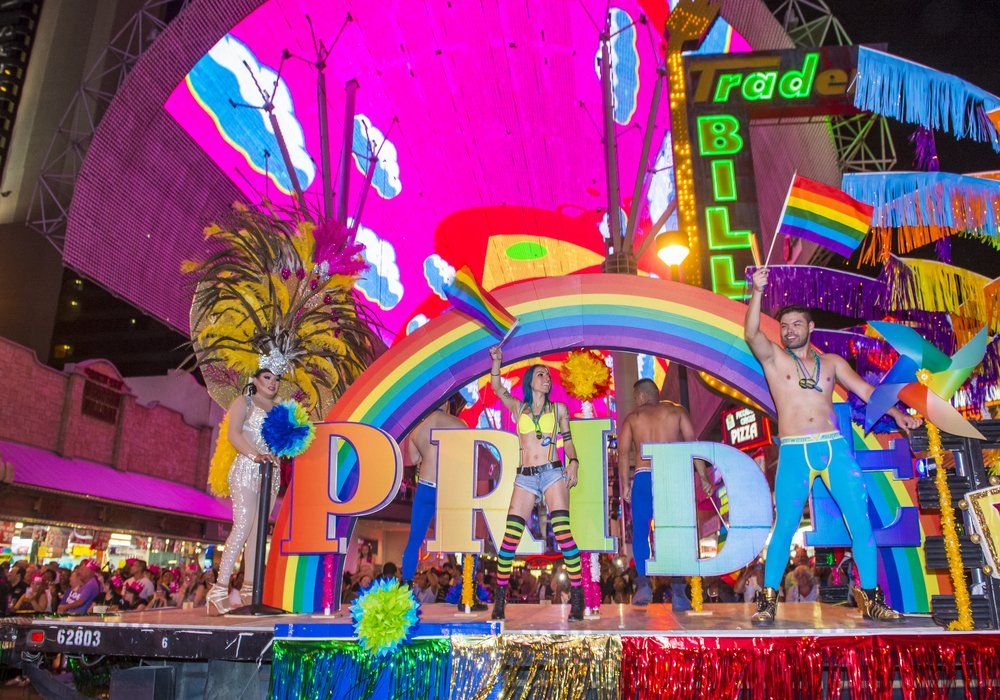
                    Las Vegas Pride parade float

                    Kobby Dagan / Shutterstock

                    LGBTQ+ Pride parade in Las Vegas, Nevada – October 21 , 2016

                      Nondiscrimination laws: Nevada has nondiscrimination laws in employment, housing, health care, education, public accommodations, and credit/lending.

                      Marriage equality and parental rights: Nevada has adoption and foster care nondiscrimination protections for LGBTQ+ parents, second-parent adoption for unmarried couples, and recognition for parents using assisted reproductive technologies. It also has family leave laws, which include LGBTQ-inclusive definitions. It does not have confirmatory adoption.

                      Education and youth policies: Nevada does not restrict discussion of LGBTQ+ identities in classrooms, and instead requires curriculum to be LGBTQ-inclusive, which parents are not required to be notified of. It does not prevent transgender students from participating in sports or using school facilities based on their identities, but it does not require staff to forcibly out students who change their gender identity to their guardians

                      Healthcare access and rights: Nevada does not have shield laws for gender-affirming care and abortion. The state has also banned so-called conversion therapy for youth. Health insurance companies, including Medicaid, are not allowed to deny coverage related to gender transition. However, they are not required to cover fertility treatments.

                      Criminal justice: Nevada’s hate crime laws encompass sexual orientation and gender identity, and it has banned the so-called “LGBTQ+ panic” defense. It does not have nondiscrimination protections based on gender identity for jury selection.

                      New Jersey
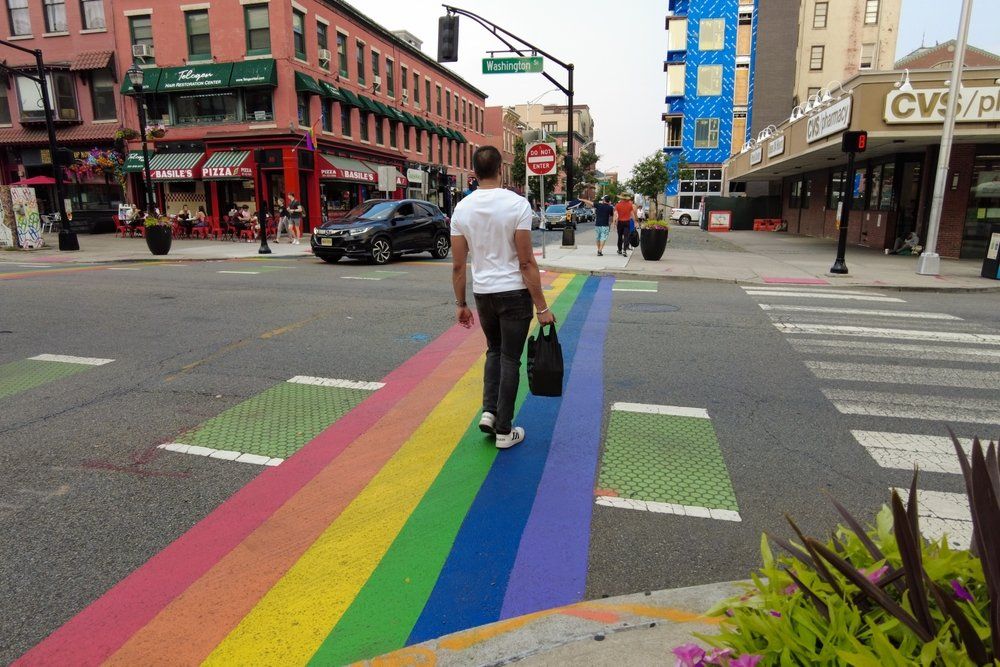
                      Rainbow crosswalk in Hoboken, New Jersey

                      Kirkam / Shutterstock.com

                      Rainbow LGBTQ+ Pride crosswalk in Hoboken, New Jersey, – June 25, 2023

                        Nondiscrimination laws: New Jersey has nondiscrimination laws in employment, housing, education, public accommodations, and credit/lending. It has nondiscrimination laws for gender identity in private healthcare, but not for sexual orientation.

                        Marriage equality and parental rights: New Jersey has adoption and foster care nondiscrimination protections for LGBTQ+ parents, and second-parent adoption for unmarried couples and confirmatory adoption. It also has family leave laws, which include LGBTQ-inclusive definitions. It does not have recognition for parents using assisted reproductive technologies.

                        Education and youth policies: New Jersey does not restrict discussion of LGBTQ+ identities in classrooms, and instead requires curriculum to be LGBTQ-inclusive, which parents are not required to be notified of. It does not prevent transgender students from participating in sports or using school facilities based on their identities, and it does not require staff to forcibly out LGBTQ+ students to their guardians.

                        Healthcare access and rights: New Jersey has “shield” laws protecting access to gender-affirming care for youth, as well as abortion. The state has also banned so-called conversion therapy for youth. Health insurance companies, including Medicaid, are not allowed to deny coverage related to gender transition. Private insurance is required to cover some fertility treatments, but Medicaid is not.

                        Criminal justice: New Jersey’s hate crime laws encompass sexual orientation and gender identity, and it has banned the so-called “LGBTQ+ panic” defense. It does not have nondiscrimination laws for LGBTQ+ people in jury selection.

                        New York
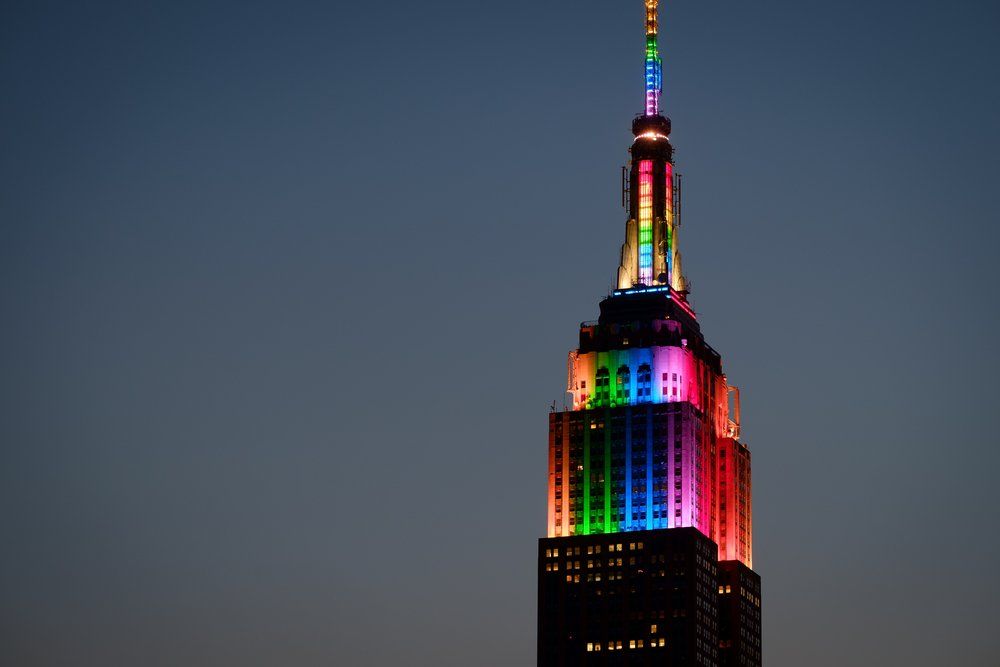
                        Empire State Building in rainbow colors

                        anaglic / Shutterstock.com

                        Empire State Building in rainbow colors in honor of the Orlando shooting victims, New York City – June 26, 2016

                          Nondiscrimination laws: New York has nondiscrimination laws in employment, housing, health care, education, public accommodations, and credit/lending.

                          Marriage equality and parental rights: New York has adoption and foster care nondiscrimination protections for LGBTQ+ parents, second-parent adoption for unmarried couples, and recognition for parents using assisted reproductive technologies. It also has family leave laws, which include LGBTQ-inclusive definitions. It does not have confirmatory adoption.

                          Education and youth policies: New York does not restrict discussion of LGBTQ+ identities in classrooms, but it does not have LGBTQ-inclusive curriculum. It does not prevent transgender students from participating in sports or using school facilities based on their identities, and it does not require staff to forcibly out LGBTQ+ students to their guardians.

                          Healthcare access and rights: New York has “shield” laws protecting access to gender-affirming care for youth, as well as abortion. The state has also banned so-called conversion therapy for youth. Health insurance companies, including Medicaid, are not allowed to deny coverage related to gender transition. Private insurance and Medicaid are also required to cover some fertility treatments.

                          Criminal justice: New York’s hate crime laws encompass sexual orientation and gender identity, and it has banned the so-called “LGBTQ+ panic” defense.

                          Oregon
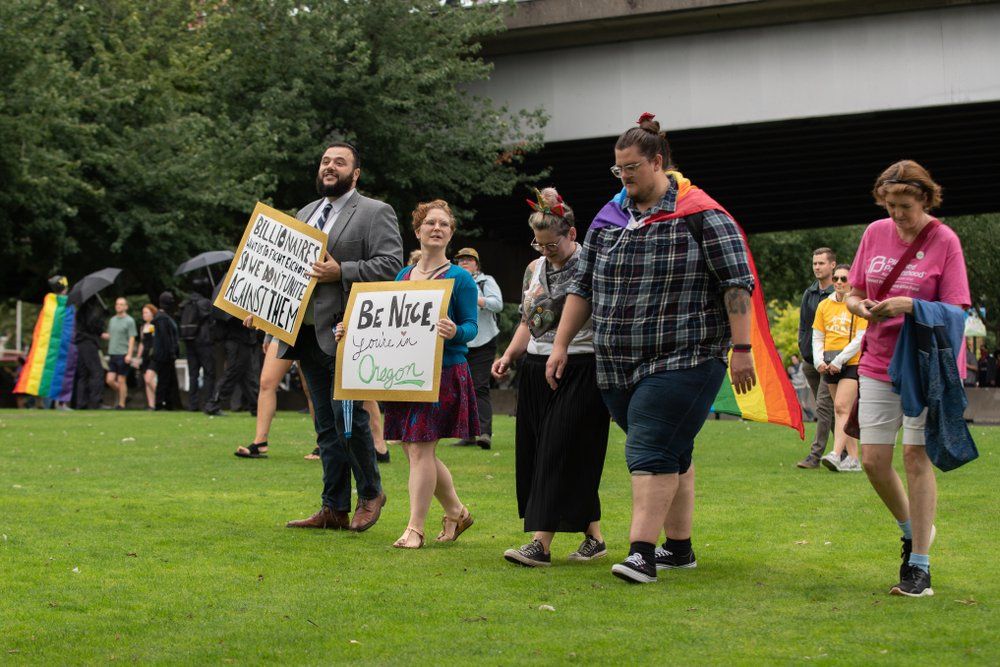
                          Protestors wear rainbow flag capes and carry a sign reading "Be nice, you're in Oregon"

                          Alexander Oganezov / Shutterstock.com

                          Protestors wear rainbow flag capes and carry a sign reading “Be nice, you’re in Oregon” at anti-fascism protest in Portland, Oregon – August 17, 2019

                            Nondiscrimination laws: Oregon has nondiscrimination laws in employment, housing, health care, education, and public accommodations. It does not have nondiscrimination laws in credit/lending.

                            Marriage equality and parental rights: Oregon has adoption and foster care nondiscrimination protections for LGBTQ+ parents and second-parent adoption for unmarried couples. It does have family leave laws, which include LGBTQ-inclusive definitions. It does not have confirmatory adoption, nor recognition for parents using assisted reproductive technologies.

                            Education and youth policies: Oregon does not prevent transgender students from participating in sports or using school facilities based on their identities, and it does not require staff to forcibly out LGBTQ+ students to their guardians. It does not restrict discussion of LGBTQ+ identities in classrooms, and instead requires curriculum to be LGBTQ-inclusive, which parents are not required to be notified of.

                            Healthcare access and rights: Oregon has “shield” laws protecting access to gender-affirming care for youth, as well as abortion. The state has also banned so-called conversion therapy for youth. Health insurance companies, including Medicaid, are not allowed to deny coverage related to gender transition. However, they are not required to cover fertility treatments.

                            Criminal justice: Oregon’s hate crime laws encompass sexual orientation and gender identity, and it has banned the so-called “LGBTQ+ panic” defense.

                            Rhode Island
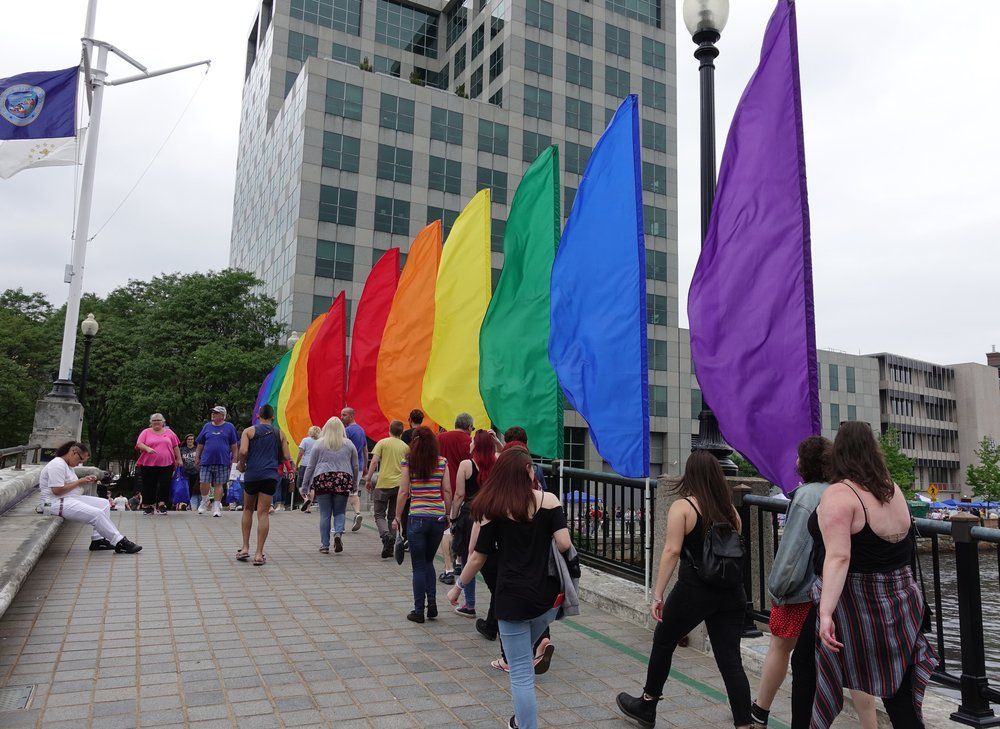
                            Rainbow flags on bridge over water in Providence, Rhode Island

                            Anthony Ricci / Shutterstock.com

                            Pride festival in downtown Providence, Rhode Island – June 17, 2017

                              Nondiscrimination laws: Rhode Island has nondiscrimination laws in employment, housing, education, public accommodations, and credit/lending. It has nondiscrimination laws for gender identity in private healthcare, but not for sexual orientation. It also has a broad “Religious Exemption” law.

                              Marriage equality and parental rights: Rhode Island has adoption and foster care nondiscrimination protections for LGBTQ+ parents, second-parent adoption for unmarried couples and confirmatory adoption, and recognition for parents using assisted reproductive technologies. It also has family leave laws, but their LGBTQ-inclusive definitions are not as robust as others.

                              Education and youth policies: Rhode Island does not restrict discussion of LGBTQ+ identities in classrooms, but it does not have LGBTQ-inclusive curriculum. It does not prevent transgender students from participating in sports or using school facilities based on their identities, and it does not require staff to forcibly out LGBTQ+ students to their guardians.

                              Healthcare access and rights: Rhode Island has “shield” laws protecting access to gender-affirming care for youth, as well as abortion. The state has also banned so-called conversion therapy for youth. Health insurance companies, including Medicaid, are not allowed to deny coverage related to gender transition. Private insurance is required to cover some fertility treatments, but Medicaid is not.

                              Criminal justice: Rhode Island’s hate crime laws encompass sexual orientation and gender identity, and it has banned the so-called “LGBTQ+ panic” defense. It does not have nondiscrimination laws for LGBTQ+ people in jury selection.

                              Vermont
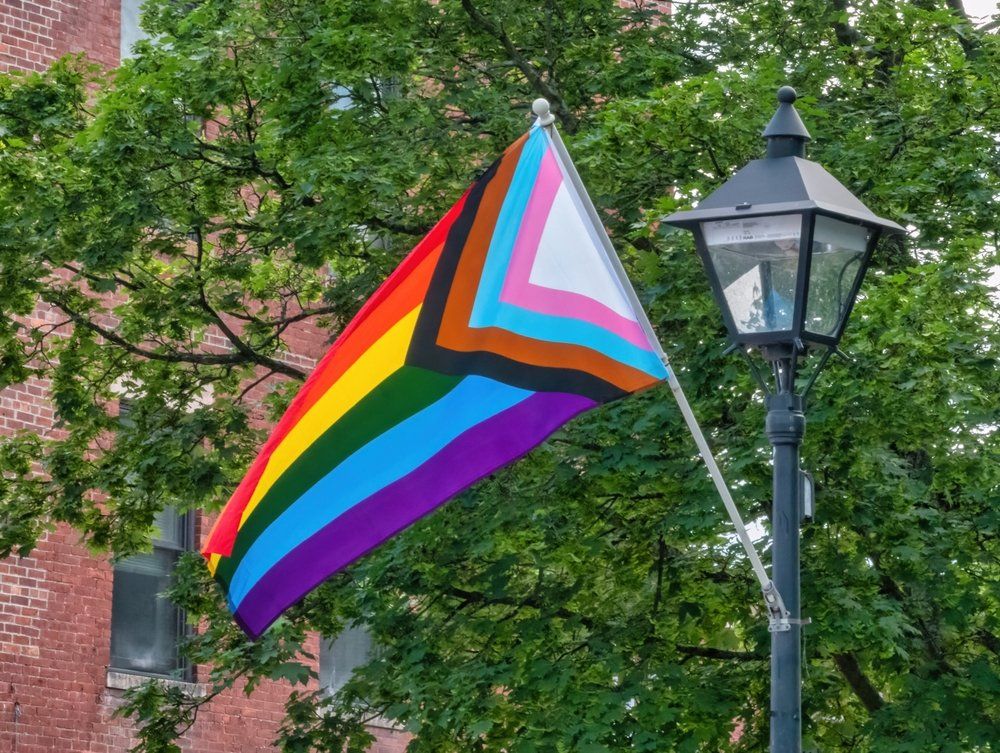
                              Pride flag on lamppost in Montpelier, Vermont

                              Charles Patrick Ewing / Shutterstock.com

                              LGBTQ+ Pride flag on lamppost in Montpelier, Vermont – June 11, 2022

                                Nondiscrimination laws: Vermont has nondiscrimination laws in employment, housing, health care, education, public accommodations, and credit/lending.

                                Marriage equality and parental rights: Vermont has adoption and foster care nondiscrimination protections for LGBTQ+ parents, second-parent adoption for unmarried couples, and recognition for parents using assisted reproductive technologies. It also has family leave laws, which include LGBTQ-inclusive definitions. It does not have confirmatory adoption.

                                Education and youth policies: Vermont does not restrict discussion of LGBTQ+ identities in classrooms, but it does not have LGBTQ-inclusive curriculum. It does not prevent transgender students from participating in sports or using school facilities based on their identities, and it does not require staff to forcibly out LGBTQ+ students to their guardians.

                                Healthcare access and rights: Vermont has “shield” laws protecting access to gender-affirming care for youth, as well as abortion. The state has also banned so-called conversion therapy for youth. Health insurance companies, including Medicaid, are not allowed to deny coverage related to gender transition. However, state employees who are transgender do not have inclusive health benefits. Insurance companies are also not required to cover fertility treatments.

                                Criminal justice: Vermont’s hate crime laws encompass sexual orientation and gender identity, and it has banned the so-called “LGBTQ+ panic” defense. It does not have nondiscrimination laws for LGBTQ+ people in jury selection.

                                Washington
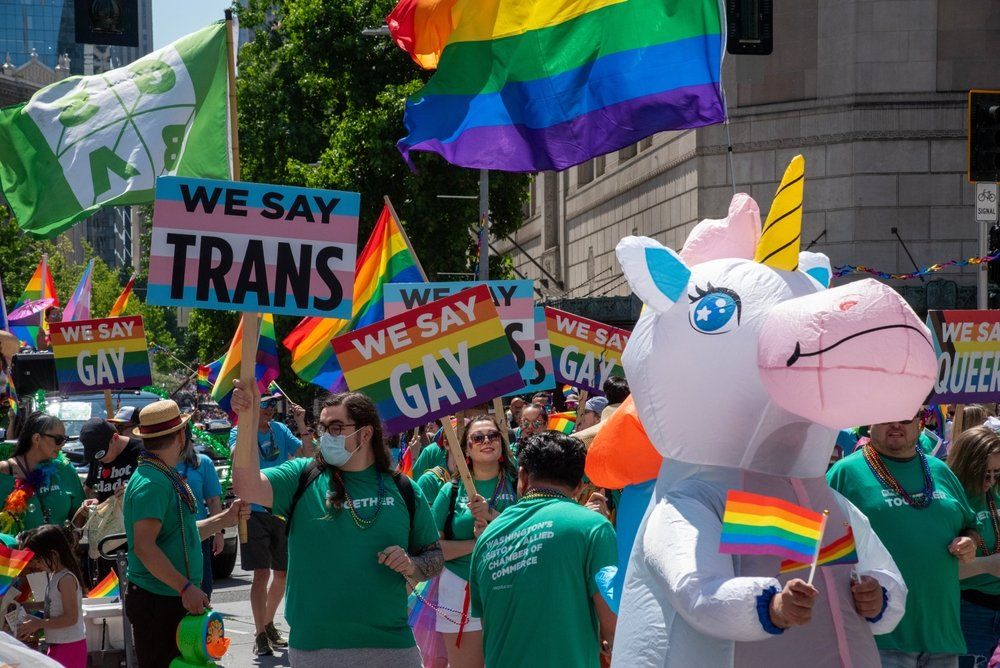
                                People carrying "We say trans" and "We say gay" signs at Seattle Pride

                                SeaRick1 / Shutterstock.com

                                People carrying rainbow signs reading “We say trans” and “We say gay” at LGBTQ+ Pride in Seattle, Washington – June 25, 2023

                                  Nondiscrimination laws: Washington has nondiscrimination laws in employment, housing, health care, education, public accommodations, and credit/lending.

                                  Marriage equality and parental rights: Washington has adoption and foster care nondiscrimination protections for LGBTQ+ parents and recognition for parents using assisted reproductive technologies.. It does have family leave laws, which include LGBTQ-inclusive definitions. It does not have second-parent adoption for unmarried couples, nor confirmatory adoption.

                                  Education and youth policies: Washington does not restrict discussion of LGBTQ+ identities in classrooms, and instead requires curriculum to be LGBTQ-inclusive, which parents are not required to be notified of. It does not prevent transgender students from participating in sports or using school facilities based on their identities, and it does not require staff to forcibly out LGBTQ+ students to their guardians.

                                  Healthcare access and rights: Washington has “shield” laws protecting access to gender-affirming care for youth, as well as abortion. The state has also banned so-called conversion therapy for youth. Health insurance companies, including Medicaid, are not allowed to deny coverage related to gender transition. However, they are not required to cover fertility treatments.

                                  Criminal justice: Washington’s hate crime laws encompass sexual orientation and gender identity, and it has banned the so-called “LGBTQ+ panic” defense. It does have a law criminalizing the transmission of HIV.

                                  Honorable mentions
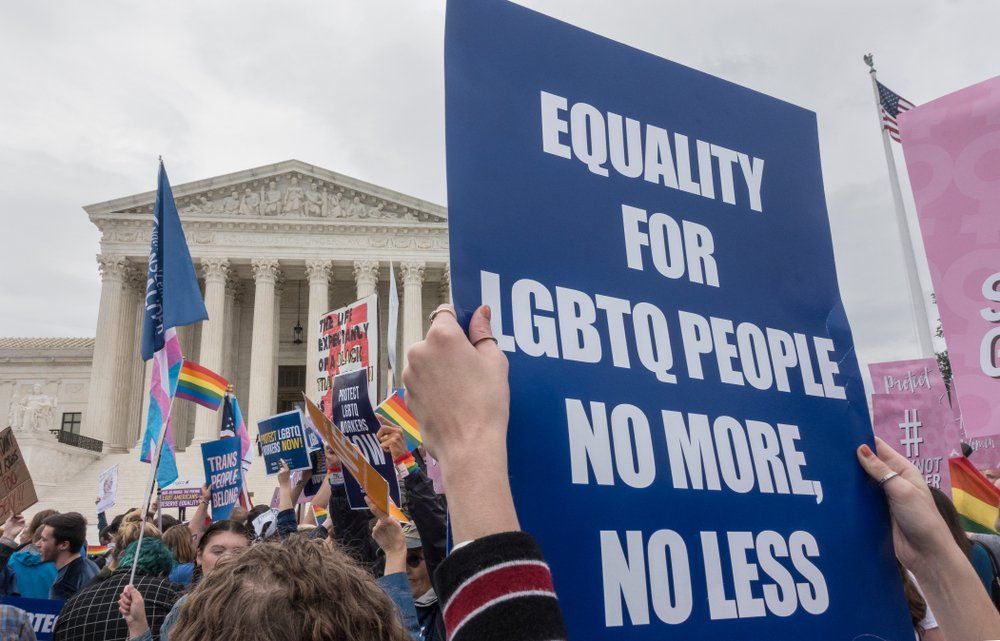
                                  Sign outside SCOTUS reading "Equality for LGBTQ people no more, no less"

                                  Bob Korn / Shutterstock.com

                                  Rally for LGBTQ rights outside Supreme Court in Washington, D.C. – OCT. 8, 2019

                                    Washington, D.C. also ranked high on MAP’s assessment, though it does not currently have statehood.

                                    Other states that ranked above average include: Delaware, Hawaii, Michigan, New Hampshire, New Mexico, and Virginia.

                                    I talked to 4 trans refugees to find out how they’re building new lives in blue states

                                    *This is being reported by LGBTQNation.

                                    Karma Yoakum had been part of a community of political activists in Texas for years. However, as the relentless tide of anti-trans legislation kept rising, it became clear that it was time for them to relocate, recover their energies, and take on a different role in the larger fight. 

                                    Finding a new home in the Pacific Northwest, Karma was able to do just that. But the road wasn’t without its challenges, and finding their new community required intention and perseverance once they had recovered a little bit of who they were by living in a state that wasn’t trying to persecute them for their existence.

                                    As anti-trans sentiment and legislation have been on the rise across the United States in recent years, many trans and nonbinary people have made the difficult decision to flee red states. In moving to a bluer state, trans people are making a choice based on safety, but that doesn’t make it an easy choice. It means leaving behind a home and community you have built over years or your whole life because of the machinations of people who hate you. While a new state can fix a lot of problems, building a new community doesn’t happen overnight. The president’s re-election and the introduction of federal anti-trans bills have created a flashpoint for even more trans people to seek safer pastures in states that might protect them.

                                    I wanted to understand the challenges and opportunities that trans people face when starting over and building a new community in a blue state. I spoke with four trans and nonbinary people who have relocated in the last six to twelve months. They shared the challenges, the successes, and advice for others who are considering relocating to a sanctuary state.

                                    Why trans people are leaving their red state communities

                                    Major relocations often happen around an institution, such as going to college or starting a new job. But moves like those come with some built-in community-building support. 

                                    Relocating as a refugee from a red state can be a more lonely affair. Most of the people I spoke with found that building a new community felt like work exacerbated by not having the same connections and support systems they had in the communities they left behind.

                                    Clark Roman had been well-established in St. Louis. Both Clark and his boyfriend had owned their own houses and had a strong community of friends and chosen family in the city. But he says he saw the writing on the wall in 2023 when the Missouri attorney general enacted a de facto ban on trans hormones and trans healthcare that included adults. While his emergency rule was blocked by a judge and then withdrawn, the legislature went on to pass a gender-affirming care ban for trans youth. It was clear where things were headed, and Clark moved to Minneapolis a few months later.

                                    Leaving behind a large community, both queer-centric and otherwise, Clark has found it hard to make more connections in his new city. At the center of it is the challenge of the modern age: balancing work and social life. “The honest truth is I have a very, very stressful job and I have not had the space in my life to build community the way I want.” He noted that it felt like he had to “treat building a new community as a second job.”

                                    Karma also struggled to make connections when they first relocated from Texas to Washington state. After living in Texas for years, they reached a point where they found themselves saying, “I’m feeling scared and trapped and there’s absolutely nothing keeping me in Texas anymore.”

                                    Karma moved 2,000 miles to Seattle but found a problem when they arrived. While their new home was more welcoming to the gender diverse, there was still culture shock to get over. “Where is everybody? I heard it was this wonderful panacea, a place where I would be welcomed. So, I looked around and I learned what the Seattle chill was. And it’s not a horrible thing, it’s just a difference in culture, because I’m used to southern culture.”

                                    Chris (his name has been changed to protect his privacy)  echoed Karma’s frustrations over Washington state’s laid-back attitude to building community. Like Clark, Chris was living in St. Louis, saw the anti-trans legislation in Missouri in 2023, and concluded that “living in Missouri as a trans human, [he] was at risk.” He made the move to Washington state in 2024 while watching the coming election without much hope.

                                    While St. Louis had its flaws, Chris was leaving behind a lot of queer community and resources. He had worked with the St. Louis Metro Trans Umbrella Group for nearly 20 years, enjoyed events and meetups, and collected queer friends through meets at clubs, bars, and drag shows. But the same culture shock that Karma experienced has made it hard to build new connections: “It’s been honestly a huge struggle, much more than I anticipated.”

                                    While it’s important to know that people are struggling with finding new communities in their new states, it’s not all doom and gloom. Clark and Chris have both been able to stay in touch with parts of their communities from before their moves through travel and online communication. While that’s not always the same, it’s a nice option to have. I also spoke with Mira Lazine – an LGBTQ Nation contributor – who relocated from Cincinnati to Minneapolis and had a different sort of experience.

                                    While the Ohio governor vetoed HB 68, which banned gender-affirming care for minors, he then introduced care guidelines for the state. “These rules were basically going to amount to a total care ban for all adults in Ohio,” explained Mira. “And it even would include some aspects of conversion therapy and mental health treatment.” 

                                    It was time to relocate, and someone recommended Minneapolis. For Mira, finding a new community in this queer-friendly space came a lot easier.

                                    “Within the first week of moving here, I went to a few coffee shops, and everyone, like the baristas, were trans, and they were recommending me support groups to join, discord servers I can join, like the whole nine yards. And it’s just been way easier to meet people and meet other queer people and form connections here.” 

                                    While Karma and Chris suffered from culture shock, Mira found herself among other transplants to the state who had their relocation in common: “Probably like 80% of the queer people I’ve met aren’t originally from Minnesota, so we’re all like, yeah, we need community, let’s build one.”

                                    Finding new communities in blue states

                                    All of the people that I spoke with had been in their new homes for less than a year. While there have been struggles, they have been able to find resources and spaces to start that community-building process and are in different places in their journeys.

                                    Clark noted that his struggle to find community in Minneapolis is probably the biggest dissatisfaction in his life right now. But he can see a light at the end of the tunnel through some of the community spaces that he is attending. “The synagogue I go to is very open and trans-friendly. So that was helpful.” Clark is also looking at getting more involved with Transplants, a group for LGBTQ+ people who have relocated to Minneapolis and St. Paul. 

                                    Chris has found that his work at a university in Washington provides some space for community building. “Their DEI office held a holiday event for, I guess, everyone, but the folks who showed up to that event were primarily queer folks and persons of color. And that was fantastic.” 

                                    Chris still faces challenges, even at the events. He told me that he has been going to meet-up groups, Portland Pride, the Ingersoll Gender Center, and more, but he wasn’t satisfied with the results. Chris suggested that part of that problem might be visibility: “I am stealth, so at my workplace, I’m not fully out [as trans]. Where I landed is sort of a purple city in a blue state. I’m typically able to pass as male and not be questioned at all, which is, is nice, but at the same time, it’s hard because I think visibility might help me connect with more queer people.”

                                    For Karma, their initial struggles with community-building in Seattle began to bear fruit around the one-year mark. “I did the things that I’ve tried before, and I figured, if they’ve worked everywhere else, they ought to work here. Maybe it just takes a little longer. And yeah, that was it. It takes a little longer.”

                                    Karma found that organizations were the key. They found like-minded people when they returned to playing music with the local band that is part of the LGBTQ+ band organization, Pride Bands Alliance, an international group that Karma has worked with since the 1990s. Similarly, local chapters of a national support network have provided success in community building: “PFLAG, all you have to do is show up to a meeting. There are people there that if you need a hug, they are instant family. And people that aren’t instant family are there because they want support.”

                                    Karma also reached into her past in political activism and found that, post-move, they had the energy to continue in their new home. “The third place that I decided to get involved was the Gender Justice League. Dealing with legislation, dealing with victims of violence here in the Seattle area. So, supporting our community, advocating like crazy.” After months of struggling to find their people, Karma now finds that barely a day on their calendar doesn’t include a community event, a catch-up, or a coffee meet.

                                    No regrets

                                    Everyone’s experience with relocating to a bluer state will be unique. However, there was one ringing agreement amongst all the people that I spoke with: no regrets. When asked what advice they had for someone considering a move, Clark, Chris, Mira, and Karma all urged people to relocate if they felt it might help.

                                    Clark grieves what he left behind but recognizes that it was the right call for him, and he’s going to keep trying to find his new community. “I think it’s dissatisfying at first. But it’s important to [show] up repeatedly because I think that repeated showing up [is] how I made my community originally in St. Louis.” 

                                    Chris echoed those sentiments, noting that he has no regrets and that it has been “completely worth it.” Watching recent election results come in wouldn’t have been fun anywhere, but he was glad to be in a safe space for it all “despite challenges and some loneliness.”

                                    Karma isn’t even considering going back. “I would say do it. The relief that I felt by at least being in a community where I know that I’d no longer have to deal with local politics.”

                                    “In Texas, the local politics were against me,” they said. “At least here, I know locally and statewide, my representatives really do represent everybody, and they have my back. And that has made so much a difference in my life.”

                                    No evidence of hate crime in ‘torture’ killing of transgender man in upstate New York

                                    *This is being reported by ABC News

                                    Investigators probing what they described as the torturous killing of a 24-year-old transgender man in upstate New York, allegedly at the hands of five people, say they have found no evidence that the homicide was a hate crime.

                                    The remains of the victim, identified as 24-year-old Sam Nordquist of Minnesota, were discovered on Wednesday in a field in Benton, New York, in Yates County, according to Capt. Kelly Swift, a New York State Police investigator.

                                    Swift said investigators suspect that Nordquist was tortured and killed in neighboring Ontario County and moved “in an attempt to conceal a crime.”

                                    “Based on evidence and witness statements, we have determined that Sam endured prolonged physical and psychological abuse at the hands of multiple individuals,” Swift said Friday during a news conference.

                                    A criminal complaint obtained by Rochester, New York, ABC affiliate WHAM alleged that the suspects sexually assaulted Nordquist with a “table leg and broomstick.” The complaint further alleges that the suspects subjected Nordquist to “prolonged beatings by punching, kicking and striking [Nordquist] with numerous objects, including but not limited to sticks, dog toys, rope, bottles, belts, canes and wooden boards.”

                                    According to the complaint, the torture allegedly took place in room 22 at Patty’s Lodge in Hopewell, New York, in Ontario County between Jan. 1 and Feb. 2.

                                    Swift said investigators executed a search warrant at the hotel on Thursday, specifically searching room 22 for evidence.

                                    “In my 20-year law enforcement career, this is one of the most horrific crimes I have ever investigated,” Swift added. “My thoughts are with Sam’s family during this time.”

                                    Suspects charged with murder

                                    The suspects arrested in the case were identified by Swift as Precious Arzuaga, 38, of Canandaigua, New York; Jennifer Quijano, 30, of Geneva, New York; Kyle Sage, 33, of Rochester, New York; Patrick Goodwin, 30, also of Canandaigua; and Emily Motyka, 19, of Lima, New York.

                                    Ontario County District Attorney James Ritts said all five suspects have all been charged with second-degree murder under the state’s depraved indifference statute. He said the suspects have been arraigned and are being held without bail at the Ontario County Jail.

                                    It was unclear if the suspects had hired or were appointed attorneys to represent them.

                                    No indication of a hate crime

                                    In a joint statement released on Sunday, the state police and Ritts addressed whether investigators are pursuing hate crime charges against the suspects.

                                    “At this time we have no indication that Sam’s murder was a hate crime,” the joint statement reads. “To help alleviate the understandable concern his murder could be a hate crime, we are disclosing that Sam and his assailants were known to each other, identified as LGBTQ+, and at least one of the defendants lived with Sam in the time period leading up to the instant offense.”

                                    Authorities said they released the information after getting “multiple inquiries from across our community, New York State and the entire nation.”

                                    In the statement, officials noted that under the New York State penal code, a hate crime is defined as an offense committed “in whole or in substantial part because of a belief or perception regarding the race, color, national origin, ancestry, gender, gender identity or expression, religion, religious practice, age, disability or sexual orientation of a person regardless of whether the belief or perception is correct.”

                                    “We are still in the early stages of this investigation,” the joint statement reads. “While significant evidence has been obtained, we are continuing to follow up on leads brought to State Police. We urge the community not to speculate into the motive behind the murder as we work to find justice for Sam.”

                                    Governor described the killing as ‘sickening’

                                    New York Gov. Kathy Hochul said in a statement released Sunday that she had directed the State Police to provide any support and resources to Ritts’ office “as they continue their investigation, including into whether this was a hate crime.” The statement further said that Hochul had directed the New York State Division of Human Rights Hate and Bias Prevention Unit to offer assistance and support “to all community members affected by this terrible act of violence,” adding, “There must be justice for Sam Nordquist.”

                                    Hochul also said that she had instructed the New York State Office of Victim Services to offer support to Nordquist’s family.

                                    “The charges against these individuals are sickening and all New Yorkers should join together to condemn this horrific act,” Hochul said in the statement. “We are praying for Sam Nordquist’s family, community and loved ones who are experiencing unimaginable grief.”

                                    ‘Beyond depraved’

                                    “The facts and the circumstances of this crime are beyond depraved,” Ritts said Friday during the press conference. “This is by far the worst homicide investigation that our office has ever been part of. No human being should have to endure what Sam endured.”

                                    Nordquist’s family filed a missing person report with the Canandaigua Police Department on Feb. 9, after last hearing from Nordquist on Jan. 1, according to a missing-person flyer issued by the Missing People in America organization.

                                    According to the flyer, Nordquist’s family said he left Minnesota on Sept. 28, 2024, with a round-trip plane ticket to New York. The family, according to the flyer, alleged that he met a woman online who convinced him to visit her.

                                    The family, according to the flyer, claimed Nordquist was planning to fly back to Minnesota within two weeks, but never boarded his return flight.

                                    “I don’t understand why someone would do that to another person,” Kayla Nordquist, Sam’s sister, told Saint Paul, Minnesota, ABC affiliate KSTP. “Sam was amazing and would give the shirt off his back to anyone.”

                                    When asked Friday about the missing-person flyer, Swift declined to comment.

                                    Swift would not disclose details of the abuse, saying the investigation is in its early stages. However, she said, Nordquist was “subjected to repeated acts of violence and torture in a manner that ultimately led to his death.”

                                    Swift said more arrests were possible and asked anyone with information about the crime to contact state police investigators.

                                    Ritts said he anticipates a grand jury will take action in the case “very quickly.”

                                    Multiple vigils for Nordquist are being scheduled this week in several states, including one Monday evening at the Wood Library in Canandaigua, New York, according to Family Counseling Service of the Finger Lakes, which is hosting the event. Two other vigils are planned for Monday night in Nordquist’s home state of Minnesota, including one outside the Minnesota State Capitol building in Saint Paul.

                                    On Tuesday evening, vigils are scheduled to take place at the Phelps Arts Center in Phelps, New York, and at The Presbyterian Church in Geneva, New York. On Thursday, a vigil is scheduled to take place on the Main Plaza in downtown New Braunfels, Texas, about 30 miles northeast of San Antonio.

                                    Trans trailblazer Leigh Finke is currently under intense national attack from right-wing groups

                                    This blog originally appeared at LGBTQ NATION.

                                    She has been falsely accused of supporting pedophilia due to her efforts to protect LGBTQ+ individuals from such harmful accusations.

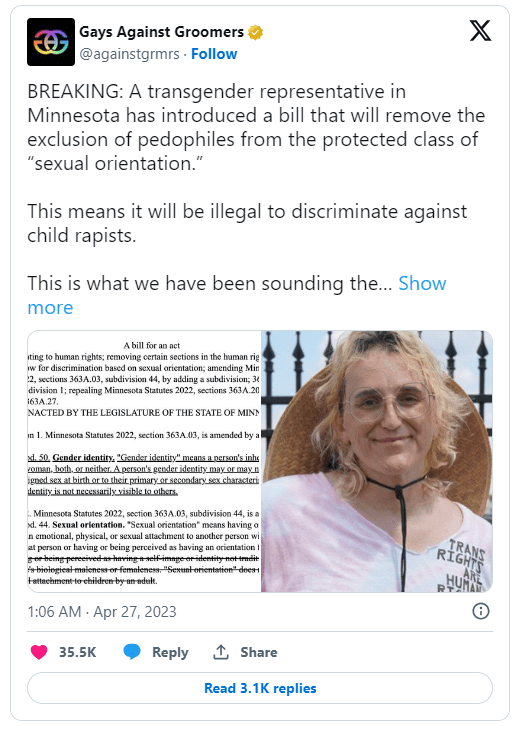
                                    Minnesota State Rep. Leigh Finke (D) describes the relentless right-wing campaign against her, including attacks from within the House and a national hate group, Gays Against Groomers. “There were attacks from inside the House, with some members using their time on the floor to target me. Gays Against Groomers also joined in, fueling a nationwide campaign against me that has never really slowed down,” Finke tells LGBTQ Nation.

                                    Finke has been falsely accused of supporting pedophilia, a claim with no evidence to back it up. She reports receiving death threats and having to increase her security measures, including regular meetings with the Sergeant at Arms and state troopers, as well as changes to her email and voicemail protocols.

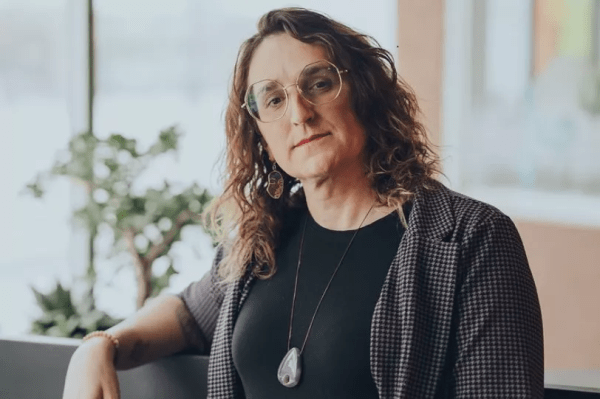
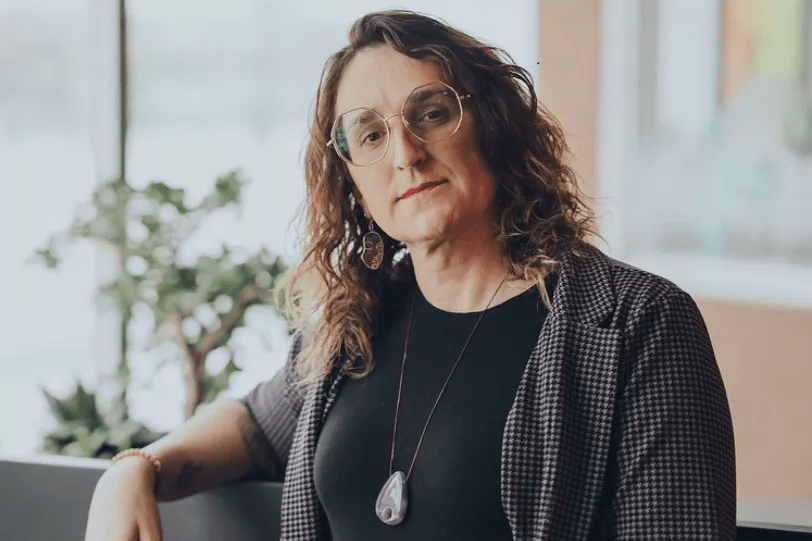
                                    Since her election to the Minnesota House of Representatives in 2022, Finke has been in the spotlight. Representing District 66A in northern St. Paul, an area with a vibrant queer community, she stands as the first openly trans state legislator in Minnesota. Finke has made history by serving as a representative who authentically connects with and represents her constituency.

                                    Finke’s distinct presence in the Minnesota House of Representatives is evident in both her policies and personal style. Known for her dyed pink or purple hair, tattooed arms, and black leather jackets over skirts and dresses, she consciously stands out to ensure queer individuals see themselves represented in a legislator capable of enacting meaningful change.

                                    With a background in activism, including work with the state’s ACLU chapter and as a documentarian, Finke has made significant strides in office. Her achievements include passing the landmark trans refuge bill, which ensures safe passage for those seeking gender-affirming care from other states, codifying trans rights under the Minnesota Human Rights Act, securing millions in HIV care funding, and advocating for more inclusive shelters for homeless LGBTQ+ individuals.

                                    While her political prominence has garnered her accolades, such as being named one of USA Today’s Women of the Year in 2023, it has also attracted considerable backlash. Finke faces intense vitriol, particularly from a segment of the Republican party in Minnesota that exploits her advocacy for trans protections as a liability against supporters. This mirrors national attacks, including dehumanizing language, misgendering, and targeted harassment.

                                    One of her most controversial actions involved revising the outdated wording in the 1993 Human Rights Act, which previously stated, “sexual orientation does not include a physical or sexual attachment to children by an adult.” While this wording aimed to exclude pedophilia, Finke and LGBTQ+ rights advocates were concerned it could be used to unjustly label queer individuals as pedophiles. Her attempt to remove this language drew fierce criticism from right-wing groups, including Gays Against Groomers and figures like Rep. Marjorie Taylor Greene (R-GA), despite a PolitiFact fact check debunking the false claims that she was trying to “make pedophilia a protected class.”

                                    Read more about this photo.

                                    The right-wing Daily Caller and Fox News intensified their attacks on Finke, contributing to a surge in online harassment directed at her from right-wing circles.

                                    LGBTQ Nation has confirmed that Finke indeed received death threats, a fact supported by public documentation from civil rights attorney Alejandra Caraballo on X.

                                    Read more about this photo.

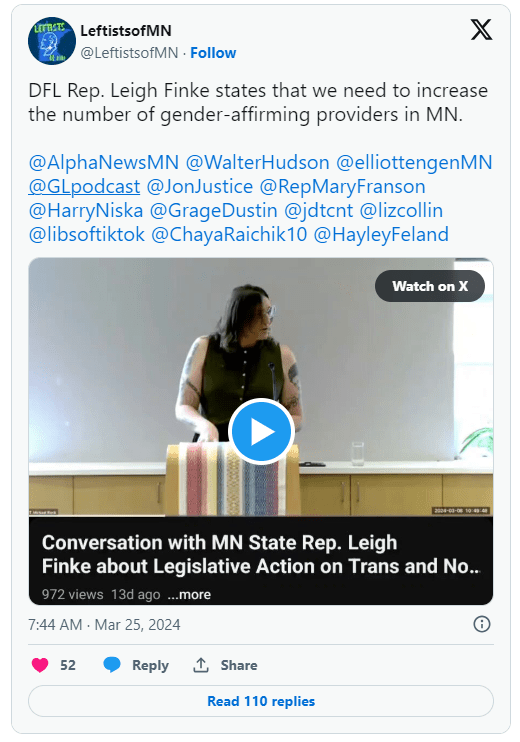
                                    Minnesota conservatives often spotlight Finke, especially when she speaks positively about gender-affirming care. Both large and small accounts launch attacks against her. LGBTQ Nation has identified several of these accounts, including “@LeftistsofMN,” a prominent right-wing account that monitors notable left-wing figures in the state, and “Action 4 Liberty,” a right-wing activist organization.

                                    The attacks on Finke weren’t confined to the right-wing outrage machine; they also came from within the state House.

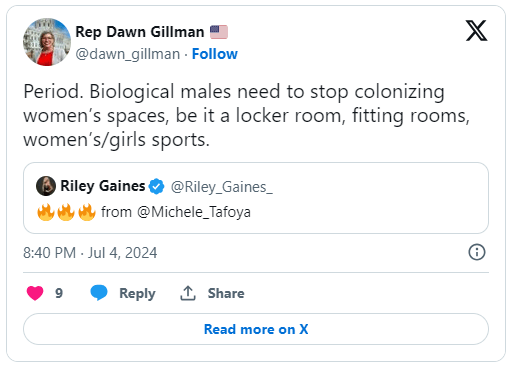
                                    Finke has pointed to social media attacks from Minnesota right-wing lawmakers, describing them as just a fraction of the vitriol she endures from some of her colleagues. One notable example came from state Rep. Dawn Gillman (R), who remarked, “Period. Biological males need to stop colonizing women’s spaces, be it a locker room, fitting rooms, women’s/girls sports,” which Finke interpreted as a direct attack on her.

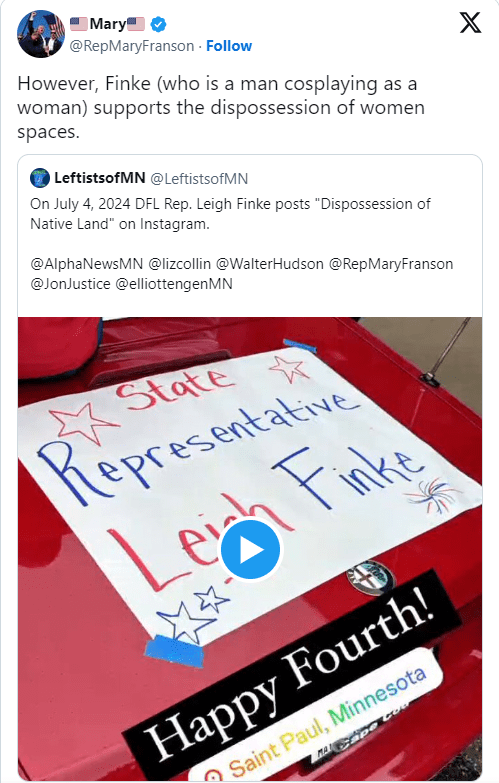
                                    Another instance came from state Rep. Mary Franson (R), who publicly stated, “However, Finke (who is a man cosplaying as a woman) supports the dispossession of women [sic] spaces.”

                                    Finke’s colleagues have not faced the same level of attacks. While some allies experience a degree of criticism, the majority of the focus has been on her.

                                    These relentless attacks have taken a toll on Finke’s health, but she remains committed to serving the people of Minnesota despite the challenges. “I continue to do the work I was brought to do. It has become a very heavy toll [on me] personally. It’s obviously hard to be attacked, but I have good support from my community, my family, and my colleagues at the House. There’s a faction of the Minnesota GOP that is not hesitant to use me as a political weapon, and that’s likely to continue,” she says.

                                    Finke acknowledges the impact of these attacks but is determined not to let them deter her. “I’m getting a bit better at not letting it affect me personally, but you never know what’s next,” she notes. Her resolve is unwavering; she plans to push back by continuing her work and winning elections. “I will do what I’ve always done—ignore the specific attacks and advocate for what I believe is right. Trans people have always existed and deserve basic dignities, human rights, freedom, safety, and security. That will remain my message.”

                                    Finke’s strategy includes focusing on legislative achievements and building a strong connection with her constituents. She engages directly with her community through door-to-door outreach, supporting fundraisers, and helping colleagues with their campaigns. Her goal is to maintain the Democratic trifecta in Minnesota, which facilitates the passage of progressive legislation and addresses constituents’ needs effectively.

                                    In addition to her work on queer rights, Finke is interested in expanding her focus to issues of incarceration and justice. “The needs of the trans community are urgent, and I’ll concentrate on that until we reach a place where I don’t need to. When the time comes, I’d like to broaden my efforts to include other areas.”

                                    Her actionable steps include advancing the Equal Rights Amendment to enshrine LGBTQ+ rights in the state constitution and improving support for queer youth in schools. Finke’s overarching aim is to strengthen her role as an advocate for both the LGBTQ+ community and marginalized groups more broadly. “I’ve been an activist for many years, involved in LGBTQ rights, the Black Lives Matter movement, and reproductive justice. My commitment to advocating for full human and civil rights will continue, whether it’s for incarcerated individuals, Black and brown communities, those with disabilities, or any group impacted by white supremacy and patriarchy.”

                                    Read more.

                                    Florida’s surgeon general defies scientific consensus amid measles outbreak | The Washington Post

                                    This blog originally appeared at THE WASHINGTON POST.

                                    Florida Surgeon General Joseph Ladapo in 2021.

                                    As a Florida elementary school grapples with a growing measles outbreak, the state’s top health official is providing advice that contradicts scientific consensus, potentially putting unvaccinated children at risk of contracting one of the most contagious pathogens on Earth, according to clinicians and public health experts.

                                    In a letter to parents at a Fort Lauderdale-area school following six confirmed measles cases, Florida Surgeon General Joseph A. Ladapo failed to urge parents to vaccinate their children or to keep unvaccinated students home as a precaution.

                                    Instead of following the “normal” recommendation that parents keep unvaccinated children home for up to 21 days — the incubation period for measles — Ladapo stated that the state health department “is deferring to parents or guardians to make decisions about school attendance.”

                                    Ladapo’s controversial decision continues a pattern of defying public health norms, especially regarding vaccines. Last month, he called for halting the use of mRNA coronavirus vaccines, a move widely condemned by the public health community.

                                    Ben Hoffman, president of the American Academy of Pediatrics, criticized Florida’s guidance, stating that it contradicts longstanding and widely accepted public health recommendations for measles, a disease that can lead to severe complications, including death.

                                    “It contradicts everything I’ve ever heard and read,” Hoffman stated. “It goes against our policy and what the Centers for Disease Control and Prevention would recommend.”

                                    In 2024, measles outbreaks have surged, with the CDC recording at least 26 cases across 12 states, doubling the count from the previous year. Apart from the six cases identified in the Florida school, instances have been documented in Arizona, California, Georgia, Maryland, Minnesota, Missouri, New Jersey, New York City, Ohio, Pennsylvania, and Virginia.

                                    The surge in measles outbreaks is attributed to the increasing number of parents seeking exemptions from childhood vaccinations. This trend has emerged in the wake of political opposition to COVID-19 mandates and widespread dissemination of misinformation regarding vaccine safety.

                                    In January, the CDC issued a caution to healthcare providers to remain vigilant for additional measles cases. Contagion can occur from four days before the onset of a rash until four days after.

                                    Because measles virus particles can persist in the air and on surfaces for up to two hours after an infected individual departs, up to 90 percent of non-immune individuals may contract measles if exposed. Those who have been infected or have received both doses of the MMR vaccine are 98 percent protected and highly unlikely to contract the disease. This is why public health officials usually recommend vaccination during outbreaks.

                                    “The measles outbreak in Florida schools is a result of too many parents failing to ensure their children are protected by the safe and effective measles vaccine,” explained John P. Moore, a professor of microbiology and immunology at Weill Cornell Medical College. “And why is that? It’s because anti-vaccine sentiment in Florida is propagated from the top of the public health hierarchy: Joseph Ladapo.”

                                    When requested for comment, the Florida health department provided a link to Ladapo’s letter.

                                    Ladapo’s reluctance to utilize public health measures mirrors the efforts of conservative and libertarian factions to weaken public health’s capacity to control diseases such as the highly contagious measles. In an outbreak in Ohio that commenced in late 2022, most of the 85 afflicted children were eligible for vaccination, but their parents opted against it, according to officials. In 2021, the state legislature curtailed health officials’ authority to mandate quarantine for individuals suspected of having an infectious disease.

                                    Ladapo’s communication with parents arrives amidst increased concern regarding the public health impacts of anti-vaccine sentiment, an ongoing issue that has resulted in declines in childhood immunization rates in various areas across the United States. Federal data released last year revealed that the percentage of kindergartners exempted from at least one state-required childhood vaccination reached its highest level yet during the 2022-2023 school year, standing at 3 percent.

                                    According to Paul Offit, a pediatric infectious diseases expert at Children’s Hospital of Philadelphia, Ladapo’s neglect to promote vaccination puts children at risk.

                                    “In light of the data showing measles as the most contagious vaccine-preventable disease, surpassing even influenza or COVID, is Ladapo attempting to suggest otherwise?” Offit questioned in an email.

                                    Measles is highly contagious, spreading swiftly, particularly affecting young children who receive their first dose of the vaccine between 12 to 15 months of age. The CDC advises two doses of the MMR vaccine, with the second typically administered between 4 to 6 years old.

                                    When measles vaccination coverage falls below 95 percent, it undermines herd immunity, facilitating the virus’s rapid spread. While Florida’s overall vaccination coverage stands at 90.6 percent, it doesn’t pinpoint areas with potentially lower coverage rates.

                                    If unvaccinated individuals fail to adhere to public health guidelines and stay home from school during the contagious period, the outbreak could escalate dramatically, posing a significant community risk. Patsy Stinchfield, President of the National Foundation for Infectious Diseases and a nurse practitioner in Minneapolis, has firsthand experience managing measles outbreaks, including the 2017 outbreak in Minnesota, which impacted 75 individuals, predominantly unvaccinated children.

                                    Approximately 1 in 5 unvaccinated individuals in the United States who contract measles require hospitalization, as reported by the CDC. Among children, up to 1 out of 20 develop pneumonia, which is the leading cause of death from measles in this age group. Additionally, around 1 child out of every 1,000 with measles experiences brain swelling, which can result in seizures and long-term consequences such as deafness or intellectual disability. Unvaccinated infants who contract measles face an even graver risk, with 1 in 600 developing a fatal neurological complication that may remain latent for years.

                                    This week, officials at Manatee Bay Elementary School, located approximately 20 miles west of Fort Lauderdale, confirmed six cases of measles. According to Broward County Schools Superintendent Peter B. Licata, out of the school’s 1,067 students, 33 have not been vaccinated with the MMR vaccine. During a school board meeting on Wednesday, Licata provided this information. Additionally, a district official mentioned that the district has organized “four vaccination opportunities,” comprising two sessions held at the school and two at other venues within the community.

                                    Florida health officials reported the first case on Friday, involving a third-grade child with no travel history abroad.

                                    School officials redirected inquiries to the Broward County school district, which stated it is adhering to guidance from the state health department.

                                    Forty-four out of 50 US states exacerbate inequality with ‘upside-down’ taxes.

                                    Recent studies reveal that the poorest fifth of households pay, on average, a tax rate 60% higher than the top 1% of households.

                                    An analysis has determined that 44 out of the 50 US states contribute to inequality by imposing a lower share of income taxes on the wealthy compared to lower-income individuals.

                                    The latest research reveals that state and local tax systems are ‘upside-down,’ with inadequate or absent personal income taxes in several states enabling wealthier Americans to evade taxes. This imbalance is exacerbated by a dependence on regressive sales and excise taxes, which disproportionately affect lower-income individuals.

                                    When surveying public opinion on a fair tax code, the consensus is overwhelmingly against the idea that the wealthiest should pay the least,” remarked Carl Davis, Research Director of the Institute on Taxation and Economic Policy (ITEP), the organization behind the analysis.


                                    “But despite this public sentiment, a significant disparity exists between what citizens desire and the tax systems currently in place in most states. It’s a concerning mismatch between public preferences and the actions taken by state legislators,” highlighted Carl Davis, Research Director of the Institute on Taxation and Economic Policy (ITEP).


                                    “Out of the 50 states, along with the District of Columbia, merely six states boast tax systems designed to alleviate rather than exacerbate inequality. On average, the poorest fifth of individuals face a tax rate 60% higher than the top 1% of households in the majority of states,” emphasized the report.


                                    “The ultra-wealthy receive notably favorable treatment from the tax system, with the top 1% contributing less than any other income group in 42 states. Additionally, in 36 states, the most impoverished residents are subjected to a higher tax rate than any other demographic,” highlighted the analysis.

                                    Ranked in order of regressive taxation, the states with the most inequitable tax systems are Florida, Washington, Tennessee, Pennsylvania, and Nevada. Conversely, the least regressive jurisdictions are the District of Columbia, Minnesota, Vermont, New York, and California.

                                    State-level policies, including tax cuts benefiting the affluent under the guise of stimulating economic activity, have exacerbated this issue, according to the report. In recent decades, inequality in the US has surpassed that of comparable countries. While certain pandemic-era measures, like a child tax credit, temporarily alleviated the burden on the poorest, many of these interventions have expired.


                                    “But we know this doesn’t have to be the case,” stated Aidan Davis, ITEP’s state policy director.


                                    “There’s a clear path to reverse regressive tax systems, and we’ve seen several states come close to achieving it. The regressive state tax laws we witness today are a deliberate policy choice, and it’s evident that lawmakers have better options available,” expressed Aidan Davis, ITEP’s state policy director.

                                    This article was updated on January 11, 2024. Due to inaccurate information provided to us, an earlier version incorrectly listed New Jersey as the fifth least regressive tax jurisdiction according to the ITEP report, when it should be California.

                                    LGBTQ activists in Minnesota are urging prosecutors to categorize the killing of a trans woman as a hate crime.

                                    This blog originally appeared at NBC News.

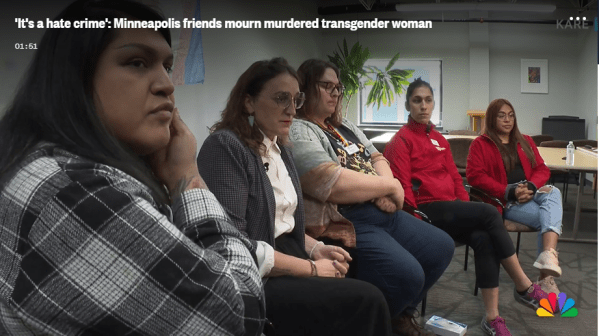
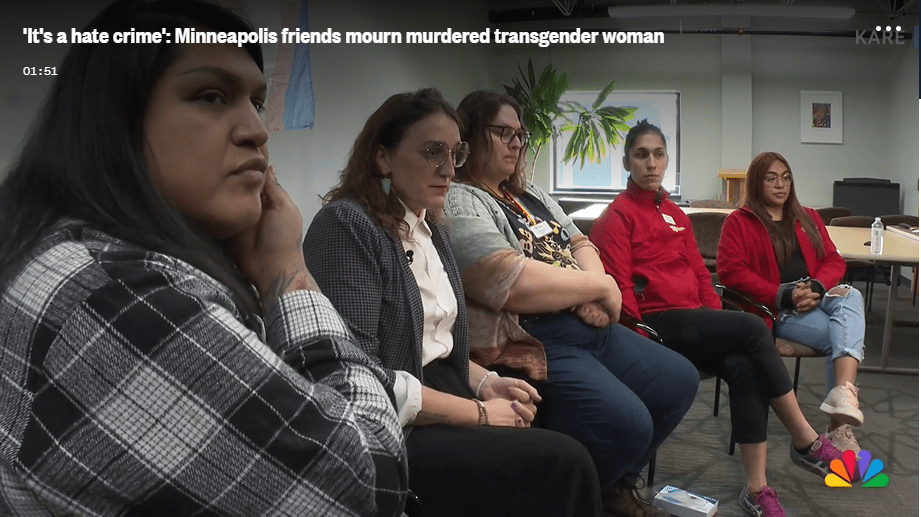
                                    Savannah Ryan Williams, 38, was fatally shot at close range last month, and prosecutors recently filed second-degree murder charges against a 25-year-old man in connection with her death.


                                    LGBTQ activists in Minnesota are urging prosecutors to classify the recent killing of a trans woman in Minneapolis as a hate crime. Additionally, they are advocating for lawmakers to enhance legal protections for a community that faces a disproportionate amount of violence.

                                    Savannah Ryan Williams, aged 38, was fatally shot in the head at close range last month. Prosecutors recently charged 25-year-old Damarean Kaylon Bible with second-degree murder in connection with the case. Bible is currently in custody with bail set at $1 million, and his next court appearance is scheduled for January 9. As of now, there has been no immediate comment from his attorney.

                                    According to the criminal complaint, Bible informed the police that he encountered Williams at a bus shelter near a light-rail station around 5 a.m. on Nov. 29. He claimed that Williams propositioned him for sex, and as she performed oral sex on him in a courtyard several blocks away, he began to feel “suspicious.” Bible stated that he shot her in the head from close range. The complaint mentions that from jail, Bible later confessed to his father that he had “just murdered someone.” He expressed remorse for the killing, acknowledging that he wasn’t God but felt compelled to commit the act.


                                    It marked the second assault on a transgender woman in the vicinity of the station in the current year. In February, two individuals admitted guilt in severely beating a trans woman during a robbery. However, prosecutors determined that the motive behind that assault wasn’t rooted in bias. Additionally, the local LGBTQ community faced unrest due to an unsolved shooting at an predominantly queer and trans punk rock event in August, resulting in one fatality and six injuries.

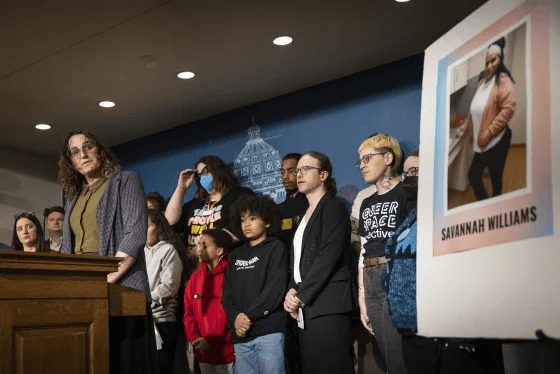
                                    Leigh Finke spoke at a news conference on Thursday regarding the murder of Savannah Williams in St. Paul, Minnesota.

                                    Family members, advocates, and leaders of the Queer Legislative Caucus gathered at the state Capitol on Thursday to mourn Savannah Williams and call for enhanced protections for all individuals. They emphasized the vulnerability of trans women of color, like Williams, who face disproportionate levels of violence. Williams’ family identified her as Cuban and Native American and urged against judgment.


                                    “Savannah should be alive today. Her death is a result of transphobia, a deadly and pervasive issue in America,” stated Democratic Rep. Leigh Finke, the first openly transgender legislator in the state, during a press conference.

                                    The Human Rights Campaign, a proponent of LGBTQ rights, reported in its annual review last month that it had documented 335 cases of violence against transgender and gender non-conforming individuals, with at least 33 deaths in the previous 12 months. The organization highlighted that the victims were predominantly young and people of color, with Black transgender women being disproportionately affected.

                                    “The surge in violence against transgender and gender non-conforming individuals is a national tragedy and a source of national shame,” stated Kelley Robinson, President of the Human Rights Campaign in the report.

                                    Amber Muhm, acquainted with Williams through trans support programs, urged the prohibition of the “trans panic defense,” a practice banned in at least 18 other states but not in Minnesota.

                                    According to the LGBTQ+ Bar, a national legal advocacy group that prefers the more inclusive term “LGBTQ+ panic defense,” it’s a strategy in which defendants blame their violent actions on their victims because of antipathy toward their real or perceived sexual orientation or gender expression. One prominent case where it appeared was the murder trial of two men who brutally beat 21-year-old college student Matthew Shepard in Wyoming in 1998 and left him tied to a fence to die.

                                    Muhm also urged the 2024 Legislature to build upon the protections established this year for trans youth and others.

                                    “We deeply miss Savannah, and she should be with us today,” Muhm expressed to the press. “Though our hearts are shattered, we will persist in our fight, push forward, and strive to make Minneapolis the most supportive trans community in the country.”

                                    Hennepin County Attorney Mary Moriarty stated that she couldn’t delve into the specifics of the case due to the ongoing investigation. However, Moriarty, who identifies as queer, emphasized that transgender individuals “deserve to live authentically and be free from threats and violence.” She pledged to prosecute the case thoroughly and fairly.

                                    Minnesota lacks a dedicated hate crime statute, but it permits lengthier sentences for crimes driven by bias. A conviction for second-degree murder in Minnesota can result in a sentence of up to 40 years.

                                    “If the investigation provides adequate evidence to establish bias motivation beyond a reasonable doubt, we will prosecute accordingly,” Moriarty stated.

                                    CORRECTION (Dec. 12, 2023, 5:15 p.m. ET): In a prior version of this article and its headline, there was an error in stating when Damarean Kaylon Bible was charged. The correct information is that he was charged last week, not this week.

                                    Transgender adults in Florida are blindsided that a new law also limits their access to health care

                                    This blog originally appeared at AP News.

                                    TALLAHASSEE, Fla. (AP) — Debate surrounding Florida’s new restrictions on gender-affirming care focused largely on transgender children. But a new law that Republican presidential candidate and Gov. Ron DeSantis signed last month also made it difficult – even impossible – for many transgender adults to get treatment.

                                    Eli cuddles his dog on the couch at his home in Casselberry, Fla., May 29, 2023. Eli and his fiancé Lucas, both transgender men, plan to move to Minnesota with their dog and two cats later this year. The Associated Press is not using Eli’s and Lucas’ last names because they fear reprisal.


                                    The discussions in the Legislature surrounding the ban on gender-affirming care for minors in Florida have had a significant impact on transgender individuals like Eli and Lucas, who are a couple. As trans men, they have been closely following the debates, with Democrats warning about the increased risk of suicide among trans children if the ban is implemented, and Republicans sharing misguided stories of mutilated kids. However, what caught Eli and Lucas off guard was the realization that the bill’s language would also disrupt their own lives.

                                    Feeling blindsided by the lack of communication and discussions in their circles, Eli, aged 29, expressed the challenges they now face. The couple, like many other transgender adults in Florida, is confronted with difficult choices. They must decide whether to uproot their lives and seek access to gender-confirming care elsewhere, as the restrictive regulations in Florida make it a test case for limitations on care for adults. This situation has left individuals like Eli and Lucas, as well as clinics providing gender-affirming services, grappling with uncertainty and trying to navigate a challenging landscape.

                                    CLICK HERE TO READ THE ORIGINAL BLOG

                                    Blog at WordPress.com.

                                    Up ↑