Economic Ramifications of Roe v. Wade on Various Sectors
The author argues that the challenges faced by universities and companies are wrongly attributed to a lack of available talent due to Roe v. Wade. In my view, this perspective is flawed. The declining birth rate is more likely a consequence of inadequate support for parents from both our society and the government.
Childcare and healthcare expenses are exorbitant, placing the majority of the burden on women. Young couples and women are apprehensive about residing in locations where complications during pregnancy could lead to severe health consequences. Personally, I’m aware of several individuals of childbearing age who are relocating from Missouri for work or education due to these concerns.
Physicians are departing from conservative states due to concerns about potential lawsuits. Military families are reluctant to be stationed in states governed by Republicans. I’m aware of a business owner losing a prospective employee precisely for this reason.
The assertion in the letter that Catholic Church institutions are not experiencing a decline in membership due to the Church’s stance on abortion is absurd. Many students at Catholic universities are not Catholic, and churches along with their affiliated grade schools are shuttering throughout the region.
One of the numerous reasons the Church struggles to retain or draw in members is its outdated perspective. If individuals disagree with abortion, they can choose not to undergo one. For men who hold a different view, the solution is to avoid impregnating a woman. However, imposing restrictive laws to control women’s reproductive choices should cease.
A Missouri school board, led by conservatives, has decided to eliminate elective courses on Black history and literature, following the rescinding of an anti-discrimination policy adopted five months earlier in the wake of George Floyd’s killing.
In a 5-2 vote on Thursday night, the Francis Howell School Board decided to discontinue offering Black History and Black Literature courses, which had been part of the curriculum at the district’s three high schools since 2021. Over 100 students enrolled in these courses this semester in the predominantly white suburban area of St. Louis.
In July, the board rescinded an anti-racism resolution and directed the removal of copies from school buildings. This resolution had been implemented in August 2020 during the nationwide unrest following the killing of George Floyd by a police officer in Minneapolis.
The resolution committed the Francis Howell community to “strongly oppose any racism, discrimination, and unjust violence against individuals, irrespective of their race, ethnicity, nationality, immigration status, religion, sexual orientation, gender identity, or ability.”
The resolution and the available courses became a focus for five recently elected board members, who gained control since last year’s election and in April, supported by the conservative political action committee Francis Howell Families. All seven members of the board are of Caucasian descent.
The PAC’s website vehemently opposes the courses, claiming they incorporate principles of critical race theory. However, numerous experts assert that the scholarly theory, which focuses on the idea that racism is systemic in the nation’s institutions, is not taught in K-12 schools.
The resolution and course offerings faced opposition from the five new board members who assumed control since their election last year, backed by the conservative political action committee Francis Howell Families. All seven board members are white. The PAC’s website strongly opposes the courses, claiming they involve principles of critical race theory, though many experts assert that the scholarly theory, centered on the idea that racism is systemic in the nation’s institutions, is not taught in K-12 schools.
“You’ve certainly taught me not to underestimate how low you will go to show your disdain toward the Black and brown communities’ experiences and existence,” remarked Harry Harris, a Black father, addressing the board.
Another speaker, Tom Ferri, urged the board to prioritize more significant issues, such as addressing the high turnover among teachers.
“Tapping into a diverse talent pipeline would be an excellent strategy to mitigate attrition, but who from a diverse background would want to work in a district embroiled in culture wars?”
Board Vice President Randy Cook Jr., elected in 2022, stated that the Francis Howell courses, which he and others opposed, employed “Social Justice Standards” developed by the Southern Poverty Law Center with an inclination toward activism.
“I don’t oppose teaching Black history and Black literature, but I do object to teaching it through a social justice framework,” Cook expressed in an email on Friday. “I don’t believe it’s the public school’s responsibility to teach social justice and activism.”
In an email, district spokesperson Jennifer Jolls mentioned that new courses on Black history and literature “could be redeveloped and brought to the Board for approval in the future.”
During this semester, a total of 60 students across the three schools enrolled in the Black History course, while 42 students took Black Literature, as reported by the district.
Francis Howell is one of the largest school districts in Missouri, serving 16,647 students, with 7.7% of the student population identified as Black. The district is located on the far western edge of the St. Louis area, in St. Charles County.
The county’s substantial growth has aligned with the significant population decrease in St. Louis city. In 1960, St. Louis boasted 750,000 residents, while St. Charles County had 53,000. Presently, St. Louis is home to 293,000 residents, with a nearly equal distribution between Black and white residents. St. Charles County has experienced growth, reaching around 415,000 residents, with approximately 6% identifying as Black.
Racial tensions persist in the St. Louis area, heightened more than nine years ago when an 18-year-old named Michael Brown was fatally shot by a police officer in Ferguson, Missouri. The officer, Darren Wilson, faced no charges, triggering months of sometimes violent protests and serving as a catalyst for the nationwide Black Lives Matter movement.
In July, Cook defended the decision to revoke the anti-racism resolution, stating that the board “doesn’t need to be in the business of dividing the community.”
“We need to focus on educating students and steer clear of national politics,” he remarked.
The Black Literature course centers on contemporary and multi-genre literary works by Black authors, celebrating the dignity and identity of Black voices, as described by the district.
The Black History course delves into the roots of today’s world, providing a comprehensive understanding of the present through the history of Blacks. It spans from the ancient civilizations of Africa to the contemporary accomplishments and achievements of Black individuals today, according to the course description.
Since 2020, school board elections in the U.S. have evolved into highly charged political arenas, particularly in response to policies addressing the COVID-19 pandemic.
Political Action Committees (PACs) in numerous local districts have effectively supported candidates who pledged to combat teachings related to race and sexuality, eliminate books considered offensive, and oppose transgender-inclusive sports teams.
A ban on gender-affirming care for minors has officially come into effect in the state of Missouri.
The recently enacted legislation, referred to as the Missouri Save Adolescents from Experimentation (SAFE) Act, places restrictions on healthcare providers regarding the provision of gender-affirming care to minors for gender transition purposes. This law, effective immediately, prohibits healthcare providers from administering evidence-based treatments such as puberty blockers or hormones to minors unless they had already started such treatment prior to August 28, 2023. Furthermore, the legislation also forbids minors from undergoing gender-affirming surgeries, although it’s important to note that such procedures are typically not offered to children by healthcare providers.
Under this law, which is set to expire in August 2027, healthcare providers found in violation will face the revocation of their professional licenses. It’s worth noting that gender-affirming healthcare encompasses age-appropriate treatments aimed at alleviating the symptoms of gender dysphoria or distress in transgender and non-binary individuals. This type of care is endorsed by all major medical associations in the United States.
There exists a wealth of compelling evidence affirming the medical safety of this care, as well as its positive impact on the mental well-being of eligible individuals who undergo it.
The American Civil Liberties Union (ACLU), a civil rights organization, had initiated a legal challenge aimed at overturning the new healthcare ban in an effort to halt its implementation. However, their hopes were dashed last week when a judge ruled against them, permitting the law to take effect as originally planned.
The judge’s decision was based on the belief that there wasn’t sufficient evidence to warrant a preliminary injunction, which the ACLU had requested. The medical and scientific evidence presented in court was deemed “conflicting and unclear.”
It’s important to note that while individuals aged 18 and older can still access gender-affirming care in Missouri, this care is not covered by Medicaid. Additionally, those in correctional facilities face significant restrictions in receiving such treatment.
Tom Bastian, representing the ACLU, commented on the judge’s ruling, stating, “Although we are disappointed with the court’s decision, we remain committed to defending the rights of transgender individuals in Missouri and will continue our efforts to do so.”
In the midst of these developments, Yamelsie Rodriguez, the CEO of Planned Parenthood in Southwest Missouri, expressed her concerns, stating, “Transgender and gender-expansive youth in Missouri are facing the distressing prospect of having their rights stripped away, unless a higher court steps in to intervene. They are grappling with fear and anger over Missouri politicians employing ideology and unsubstantiated science to deny them essential healthcare and to invalidate their very existence. We stand in solidarity with them.”
Rodriguez firmly asserted that politicians should not be delving into or dictating the scope of care provided within medical examination rooms.
Additionally, another law has been enacted in Missouri this week, significantly restricting transgender student-athletes by mandating their participation on sports teams that align with the sex assigned to them at birth.
Missouri now joins the ranks of over 20 states that have implemented policies prohibiting gender-affirming care for minors. According to the Human Rights Campaign, at least seven more states are contemplating the introduction of similar laws or policies.
At least 21 states have enacted laws restricting or banning transition-related care for transgender minors, and most of those states face lawsuits.
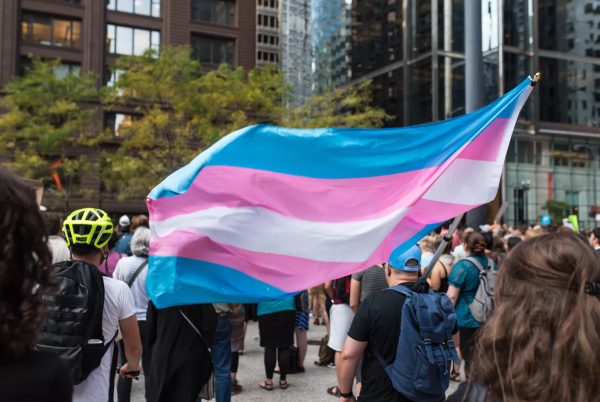
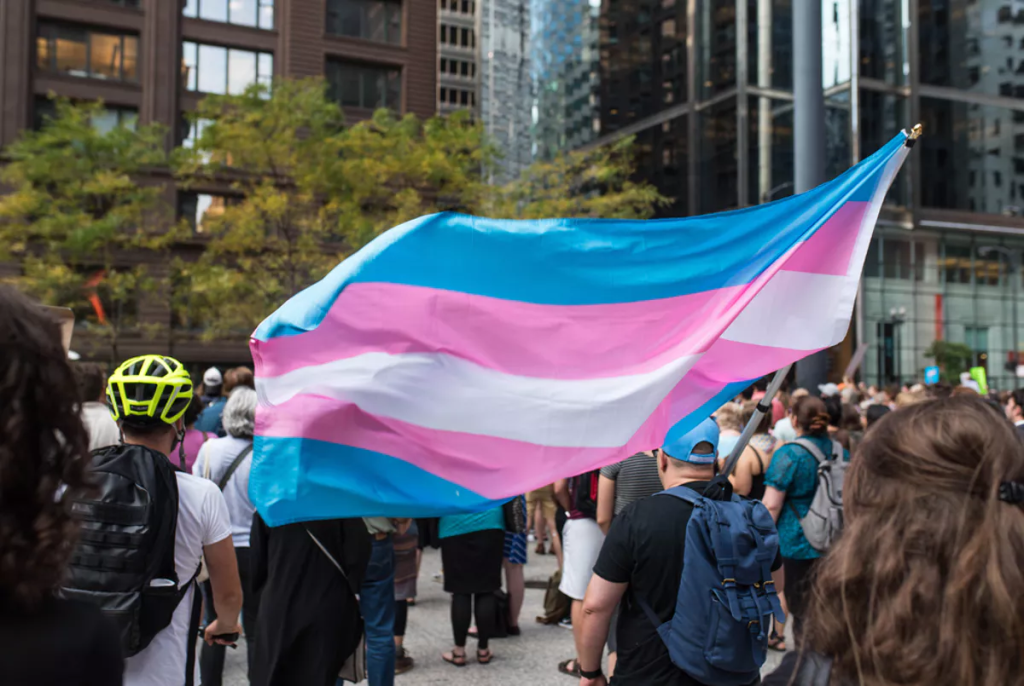
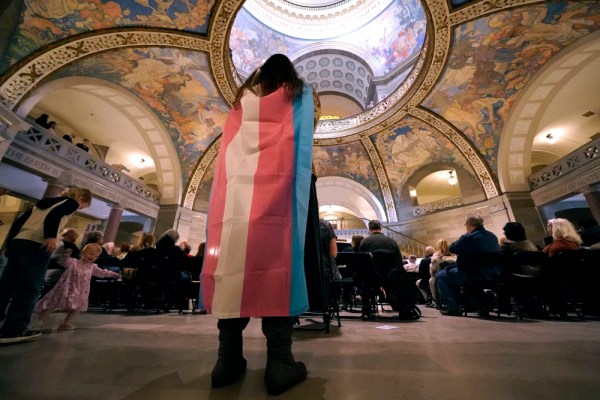
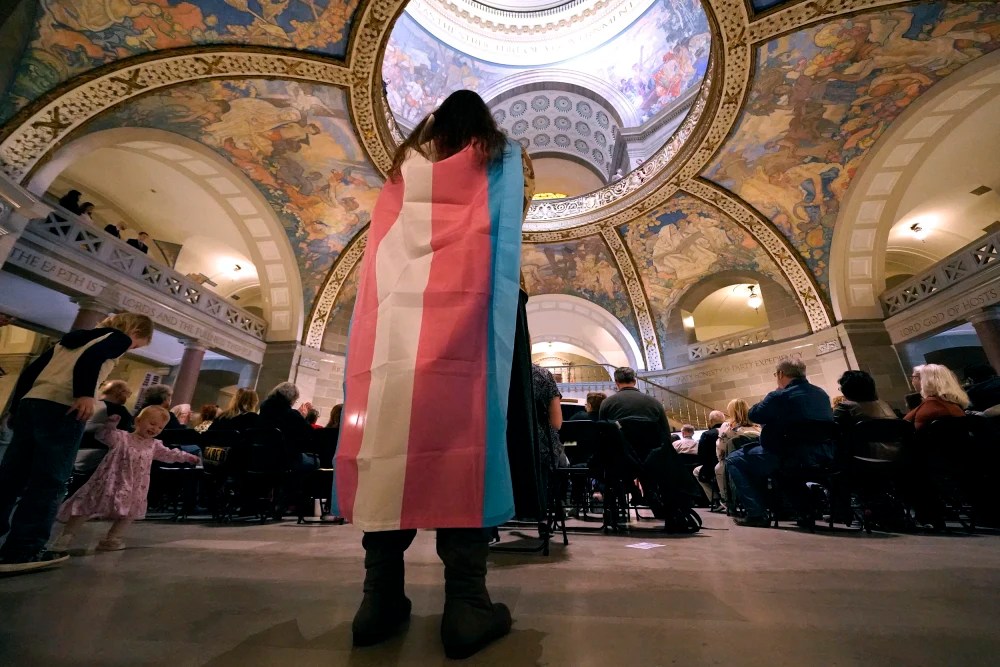
A counter-protester wears a transgender flag as other rally in favor of a ban on gender-affirming health care on March 20 at the Missouri Statehouse in Jefferson City.
The American Academy of Pediatrics reaffirmed its support for gender-affirming medical care for transgender children on Thursday, even as the treatments face a growing push for bans and restrictions from Republican lawmakers across the U.S.
The board of directors for the group, which represents 67,000 pediatricians, unanimously voted to reaffirm its 2018 position on the treatments. The board also voted to provide additional documents to support pediatricians, including clinical and technical reports, and to conduct an external review of research regarding the care.
“The additional recommendations also reflect the fact that the board is concerned about restrictions to accessing evidence-based health care for young people who need it,” Mark Del Monte, the academy’s CEO, said in a statement released by the group, calling the restrictions enacted by states “unprecedented government intrusion.”
“We therefore need to provide the best and most transparent process possible,” he said.
At least 21 states have now enacted laws restricting or banning gender-affirming medical care for transgender minors, and most of those states face lawsuits. A federal judge struck down Arkansas’ ban as unconstitutional, and federal judges have temporarily blocked bans in Alabama and Indiana.
The judge who struck down Arkansas’ ban cited the position of the groups in his ruling against the ban. Arkansas has appealed the judge’s decision.
People opposed to such treatments for children argue they are too young to make such decisions about their futures.
Every major medical group, including the academy and the American Medical Association, has opposed the bans and has said the treatments are safe if administered properly.
The academy and the AMA support allowing children to seek the medical care, but they don’t offer age-specific guidance.
(KFF Health News)- Hal Dempsey wanted to “escape Missouri.” Arlo Dennis is “fleeing Florida.” The Tillison family “can’t stay in Texas.”
They are part of a new migration of Americans who are uprooting their lives in response to a raft of legislation across the country restricting health care for transgender people.
Missouri, Florida, and Texas are among at least 20 states that have limited components of gender-affirming health care for trans youth. Those three states are also among the states that prevent Medicaid — the public health insurance for people with low incomes — from paying for key aspects of such care for patients of all ages.
More than a quarter of trans adults surveyed by KFF and The Washington Post late last year said they had moved to a different neighborhood, city, or state to find more acceptance. Now, new restrictions on health care and the possibility of more in the future provide additional motivation.
Many are heading to places that are passing laws to support care for trans people, making those states appealing sanctuaries. California, for example, passed a law last fall to protect those receiving or providing gender-affirming care from prosecution. And now, California providers are getting more calls from people seeking to relocate there to prevent disruptions to their care, said Scott Nass, a family physician and expert on transgender care based in the state.
But the influx of patients presents a challenge, Nass said, “because the system that exists, it can’t handle all the refugees that potentially are out there.”
In Florida, the legislative targeting of trans people and their health care has persuaded Arlo Dennis, 35, that it is time to uproot their family of five from the Orlando area, where they’ve lived for more than a decade. They plan to move to Maryland.
Dennis, who uses they/them pronouns, no longer has access to hormone replacement therapy after Florida’s Medicaid program stopped covering transition-related care in late August under the claim that the treatments are experimental and lack evidence of being effective. Dennis said they ran out of their medication in January.
“It’s definitely led to my mental health having struggles and my physical health having struggles,” Dennis said.
Florida first. Alabama follows. Legislators in Louisiana and Ohio are currently debating legislation that is similar to the Florida statute. A similar bill will be his top priority during the following session, according to Texas Governor Greg Abbott.
At least a dozen states across the country are proposing new legislation that, in some ways, will resemble Florida’s recent contentious bill, which some opponents have dubbed “Don’t Say Gay.”
You must be logged in to post a comment.