

This blog originally appeared at ABC NEWS.
The Nebraska Supreme Court has upheld a law that restricts access to both medical care for transgender youth and abortion.

OMAHA, Neb. — The Nebraska Supreme Court has ruled that a state law combining abortion restrictions with measures limiting gender-affirming health care for minors does not breach a state constitutional amendment requiring bills to address only one subject.
The court acknowledged that abortion and gender-affirming care are distinct types of medical care but concluded that the law falls under the broad category of medical care, thus complying with Nebraska’s single-subject rule. Chief Justice Mike Heavican, writing for the majority, referred to an 1895 ruling, emphasizing that a bill with a general object and a title that fairly expresses the subject does not violate the single-subject rule.
The ruling came in response to a lawsuit filed by the American Civil Liberties Union (ACLU) on behalf of Planned Parenthood of the Heartland. The lawsuit challenged the law, which restricts abortion to 12 weeks of pregnancy, bans gender-confirming surgery, and limits hormone treatments for transgender minors. The ACLU’s arguments that the hybrid law violated Nebraska’s single-subject rule were rejected by the high court.
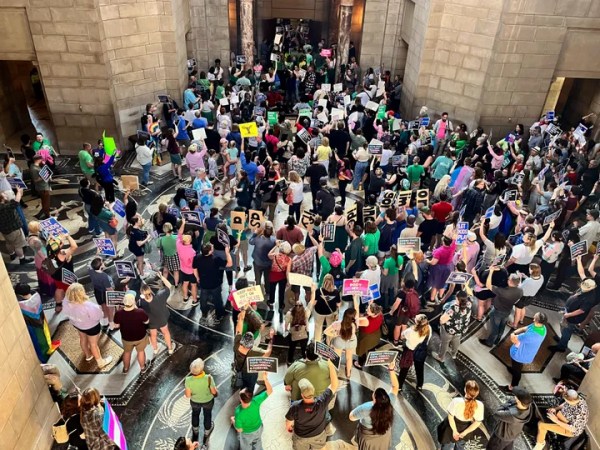
Originally, Nebraska lawmakers proposed separate bills: one banning abortion at around six weeks of pregnancy and another restricting gender-affirming treatments for minors. The Legislature combined these measures into a single bill after the six-week abortion ban faced a filibuster. This combination was one of the most controversial pieces of legislation in the 2023 session, leading to an extended filibuster by some lawmakers.
A district judge had previously dismissed the lawsuit, prompting the ACLU to appeal. During the high court arguments, state attorneys argued that combining the measures under health care did not breach the single-subject rule, while Planned Parenthood contended that the Legislature had recognized abortion and transgender care as separate issues by introducing them as distinct bills.
Justice Lindsey Miller-Lerman’s dissent criticized the majority for applying inconsistent standards, accusing the court of giving undue leeway to the Legislature. She argued that the bill should have adhered strictly to the constitutional requirement for a single subject.
Opponents of the ruling expressed disappointment. ACLU Nebraska Executive Director Mindy Rush Chipman and Planned Parenthood North Central States President and CEO Ruth Richardson criticized the decision, emphasizing its potential negative impacts on Nebraskans, particularly in rural areas and among marginalized communities.
Nebraska Governor Jim Pillen and the state’s attorney general praised the ruling. Pillen highlighted his role in advocating for the bill’s passage.
Since the U.S. Supreme Court overturned Roe v. Wade in 2022, many Republican-controlled states have enacted abortion bans. Currently, 14 states have bans at all pregnancy stages, while Nebraska and North Carolina have implemented 12-week bans. Similarly, many GOP-controlled states have restricted gender-affirming care for minors, with 22 states enforcing such measures.
In contrast, several Democratic-controlled states have adopted policies to protect abortion and gender-affirming care access, including efforts to shield healthcare providers from out-of-state investigations.
Nebraska voters may have the final say on abortion access with two potential ballot questions in November: one proposing to add a right to abortion to the state constitution and another to enshrine the 12-week ban in the state constitution.
 fleeredstates.blog
You must be logged in to post a comment.