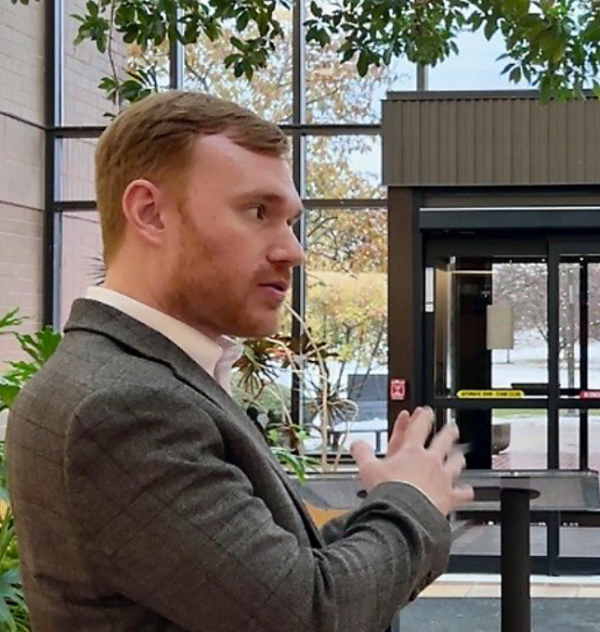
Jim Petras is leading Cleveland Heights in turning the next page in its governance, assuming office as city’s newly-elected mayor in January.
“[I’m] very grateful to our current mayor, Tony Cuda, for allowing me total access to our city staff. I’ve been listening and learning from them, and I look forward to taking over on Jan. 1,” Petras said.
Petras is a longtime Cleveland Heights resident and lifelong midwesterner, growing up in Pittsburgh and moving to Ohio to attend Case Western Reserve University. He’s served on city council since 2024, and now, is marking a pivotal moment in the city’s history.
Beginning next year, Petras said, he will become the only openly LGBTQ mayor in Ohio.
“Here in Cleveland Heights our motto is, ‘All are welcome.’ And so I look forward to being a good leader for that motto, and helping us to live up to that motto,” Petras said.
Around 400,000 LGBTQ adults live in Ohio, but the community continues to facing underrepresentation in state and municipal government. Petras’ win could soon help bridge that gap.
Constituent Harriet Applegate said she’s looking forward to seeing more representation of the community in local government.
“We have as much diversity of talent as we have diversity of ethnicities and people and lifestyles,” she said. “We’ve got so much talent, and much of that talent is willing to give up itself and help out the city.”
Cleveland Heights has a number of LGBTQ inclusive policies, including a ban on conversion therapy, gender-neutral parental leave and declaring itself a “safe haven” for gender-related care.
Still, Applegate said, Petras’ win could lead to major changes across all communities.
She said she’s hoping to see Petras address several longstanding issues around the city.
“There’s something of a racial divide, and I think that needs to be addressed. I think the new mayor has plans to do that,” Applegate said. “… He campaigned on, you know, fixing the streets, and that’s huge for people. I mean, just the basic city services have not been met for the last few years.”
Petras’ mayoral campaign included improving city infrastructure and boosting the local economy, which he said, continue to be among his top priorities.
“I’m focused on getting our 2024 audit completed, and I’m also very interested in our core city services,” he said. “So that means improving our snow plowing leaf pickup, doing a better job with resurfacing streets. And I also want to build relationships with nearby cities and other organizations.”
And while his term hasn’t officially begun, Petras said, he’s already kickstarting plans for building a better future for the city.
“We’re sitting down with staff to learn more about our current snow removal process. I look forward to diving in more deeply,” Petras said. “Also looking forward to putting together, for example, a five-year plan for our streets so that we can make sure that our streets are in good shape and that none of them get forgotten about.”
The Whitehall City Council voted unanimously to pass an LGBTQ-inclusive nondiscrimination ordinance and a conversion therapy ban at their regular meeting on Tuesday.
The Columbus suburb became the 37th location in Ohio to pass LGBTQ-inclusive nondiscrimination protections and the 14th location to ban conversation on minors.
Joseph Soza, Equality Ohio’s Central Ohio organizer, lives right on the border of Columbus and Whitehall.
“I was previously living with the awkward scenario of having legal protections at home, but not in many of the public spaces I frequent in Whitehall,” Soza said in a statement. “Until we achieve statewide nondiscrimination protections, I know that most Ohioans find themselves in a similar situation. While I’m grateful for the initiative taken by cities like Whitehall, it continues to be disappointing that we don’t have these protections statewide.”
Whitehall’s nondiscrimination ordinance covers a range of identities – including sexual orientation, gender identity and gender expression – with protections extending to employment, housing and public accommodations. The ordinance contains an exception for religious institutions to give preference to those who share their religion, provided that such “offerings are not for commercial purposes or supported by public funds.”
Whitehall’s conversion therapy ban prohibits mental health professionals from engaging in “any practices or treatments that seek to change a [minor’s] sexual orientation or gender identity, including efforts to change behaviors or gender expressions or to eliminate or reduce sexual or romantic attractions or feelings toward individuals of the same gender.”
Both the nondiscrimination protections and the conversion therapy ban are housed under Whitehall’s prohibition on “unlawful discriminatory acts or practices.” Violations could result in a civil penalty of up to $2,500.
Ohio does not have statewide LGBTQ-inclusive nondiscrimination protections, despite decades of attempts by legislators. The Ohio Fairness Act, which would grant these protections, currently sits in the Ohio House (HB 136) and Senate (SB 70), but has not been scheduled for a hearing in either chamber.
There also is no statewide ban on conversion therapy on minors, despite many years of attempts by legislators. A bill to ban conversion therapy on minors currently sits in the Ohio House (HB 300) and Senate (SB 71), but has not been scheduled for a hearing in either chamber.
LGBTQ+ advocates point to Whitehall as an example of what can be achieved locally, despite the lack of movement in the Columbus Statehouse.
“Equality Ohio is embarking on a journey to flip the state back to equality through our bold new local advocacy strategy,” said Dwayne Steward, executive director of Equality Ohio. “We have won before. And we will win again. But only if we do so together.”
Ohio Gov. Mike DeWine (R) vetoed three anti-LGBTQ+ provisions in the state’s latest budget bill yesterday, in a partial victory for civil rights that still leaves several assaults on LGBTQ+ identity signed into law.
The budget passed by Republicans over Democrats’ objections included a raft of measures targeting the LGBTQ+ community, including a prohibition on flying the Pride flag on state property; defunding shelters that welcome trans youth; language defining sex in the state as binary; removing library books related to sexual orientation or gender identity from areas accessed by minors; and denying Medicaid funding for mental health services for transgender people.
DeWine vetoed the prohibition on the Pride flag, the defunding of youth shelters, and the mandate on library materials.
“The budget is supposed to be a reflection of Ohio’s shared values,” Equality Ohio said in a statement shared with the Columbus Dispatch after the governor vetoed the provisions. The group said lawmakers tried to make the bill “a vehicle for cruelty.”
“But because of community action—because we showed up, we sent emails, we made calls, and we told your stories — some of that cruelty was stopped in its tracks,” the organization said.
DeWine, a lifelong conservative and former United States senator, was circumspect in explaining the reasoning behind his vetoes.
On the subject of youth shelters, DeWine told reporters, “We want homeless shelters to be open for everyone. That’s kind of it.”
Of the library provision, which ordered books addressing LGBTQ+ identity kept “out of sight” of minors, the governor said, “As parents or grandparents, no one wants their child to have a book or something that is inappropriate, something that is obscene. But I just felt that the language did not work.”
The provision banning the Pride flag would have limited flags flown on state properties to the American flag, the Ohio flag, the POW/MIA flag, and flags of official state agencies.
Wins for MAGA Republicans in the GOP-dominated Ohio House and Senate included copycat language from the president’s “gender ideology” executive order mandating the government recognize only two biological sexes, male and female, as well as a ban on Medicaid funding for mental health services for transgender people.
How the latter would be enforced in a mental health setting has yet to be tested and will likely be challenged in court.
DeWine also let stand a prohibition on distributing menstrual products in men’s public restrooms.
Republican leaders can override any of DeWine’s line-item vetoes between now and the end of the two-year legislative session in December 2026. The GOP holds overwhelming and veto-proof majorities in both the House and Senate.
In January 2024, Republicans overrode DeWine’s veto of a bill banning gender-affirming care for minors and trans women and girls from participating in school sports in the state.
More than two dozen Ohio lawmakers are supporting a bill that would designate the weeks between Mother’s Day and Father’s Day “Natural Family Month.”
Though the bill, introduced by Republican state Reps. Josh Williams and Beth Lear, doesn’t define “natural family” in its text, critics say it is intended to exclude LGBTQ families and promote marriage and childrearing between heterosexual, monogamous couples only.
When asked whether “Natural Family Month” will also recognize gay couples and parents with adopted children, Williams said in an emailed statement to NBC News that “the purpose of the month is to promote natural families—meaning a man, a woman, and their children—as a way to encourage higher birth rates.”
He added, “This is not about discriminating against other family structures, but about supporting the one most directly tied to the creation and raising of children.”
Lear did not return a request for comment.
After introducing the bill earlier this week, Williams and Lear said in joint statements that the initiative is intended to promote child rearing.
“At a time when marriage is trending downward and young couples are often choosing to remain childless, it’s important for the State of Ohio to make a statement that marriage and families are the cornerstone of civil society, and absolutely imperative if we want to maintain a healthy and stable Republic,” Lear said.
Dwayne Steward, the director of statewide LGBTQ advocacy group Equality Ohio, told a local queer news site that the bill is both bad policy and a “calculated act of strategic erasure.”
“It not only invalidates the existence of single parents and countless other caregivers, but it takes direct aim at LGBTQ+ families across our state,” Steward told the Buckeye Flame. “The so-called ‘Natural Family Foundation,’ the group pushing this legislation, has made their ideology clear: if you’re not a heterosexual, monogamous couple with children, you don’t count as a family at all.”
Steward, who did not immediately return NBC News’ request for comment, added, “As an adoptive parent, myself, I feel this erasure personally. This bill is not just offensive; it’s dangerous.”
Last year, Ohio considered eight bills targeting LGBTQ people, according to a tally by the American Civil Liberties Union. Two of those — a provision that requires school personnel to notify parents of “any request by a student to identify as a gender that does not align with the student’s” birth sex, and a measure that prohibits certain transition-related medical care for minors — became law.
Karma Yoakum had been part of a community of political activists in Texas for years. However, as the relentless tide of anti-trans legislation kept rising, it became clear that it was time for them to relocate, recover their energies, and take on a different role in the larger fight.
Finding a new home in the Pacific Northwest, Karma was able to do just that. But the road wasn’t without its challenges, and finding their new community required intention and perseverance once they had recovered a little bit of who they were by living in a state that wasn’t trying to persecute them for their existence.
As anti-trans sentiment and legislation have been on the rise across the United States in recent years, many trans and nonbinary people have made the difficult decision to flee red states. In moving to a bluer state, trans people are making a choice based on safety, but that doesn’t make it an easy choice. It means leaving behind a home and community you have built over years or your whole life because of the machinations of people who hate you. While a new state can fix a lot of problems, building a new community doesn’t happen overnight. The president’s re-election and the introduction of federal anti-trans bills have created a flashpoint for even more trans people to seek safer pastures in states that might protect them.
I wanted to understand the challenges and opportunities that trans people face when starting over and building a new community in a blue state. I spoke with four trans and nonbinary people who have relocated in the last six to twelve months. They shared the challenges, the successes, and advice for others who are considering relocating to a sanctuary state.
Why trans people are leaving their red state communities
Major relocations often happen around an institution, such as going to college or starting a new job. But moves like those come with some built-in community-building support.
Relocating as a refugee from a red state can be a more lonely affair. Most of the people I spoke with found that building a new community felt like work exacerbated by not having the same connections and support systems they had in the communities they left behind.
Clark Roman had been well-established in St. Louis. Both Clark and his boyfriend had owned their own houses and had a strong community of friends and chosen family in the city. But he says he saw the writing on the wall in 2023 when the Missouri attorney general enacted a de facto ban on trans hormones and trans healthcare that included adults. While his emergency rule was blocked by a judge and then withdrawn, the legislature went on to pass a gender-affirming care ban for trans youth. It was clear where things were headed, and Clark moved to Minneapolis a few months later.
Leaving behind a large community, both queer-centric and otherwise, Clark has found it hard to make more connections in his new city. At the center of it is the challenge of the modern age: balancing work and social life. “The honest truth is I have a very, very stressful job and I have not had the space in my life to build community the way I want.” He noted that it felt like he had to “treat building a new community as a second job.”
Karma also struggled to make connections when they first relocated from Texas to Washington state. After living in Texas for years, they reached a point where they found themselves saying, “I’m feeling scared and trapped and there’s absolutely nothing keeping me in Texas anymore.”
Karma moved 2,000 miles to Seattle but found a problem when they arrived. While their new home was more welcoming to the gender diverse, there was still culture shock to get over. “Where is everybody? I heard it was this wonderful panacea, a place where I would be welcomed. So, I looked around and I learned what the Seattle chill was. And it’s not a horrible thing, it’s just a difference in culture, because I’m used to southern culture.”
Chris (his name has been changed to protect his privacy) echoed Karma’s frustrations over Washington state’s laid-back attitude to building community. Like Clark, Chris was living in St. Louis, saw the anti-trans legislation in Missouri in 2023, and concluded that “living in Missouri as a trans human, [he] was at risk.” He made the move to Washington state in 2024 while watching the coming election without much hope.
While St. Louis had its flaws, Chris was leaving behind a lot of queer community and resources. He had worked with the St. Louis Metro Trans Umbrella Group for nearly 20 years, enjoyed events and meetups, and collected queer friends through meets at clubs, bars, and drag shows. But the same culture shock that Karma experienced has made it hard to build new connections: “It’s been honestly a huge struggle, much more than I anticipated.”
While it’s important to know that people are struggling with finding new communities in their new states, it’s not all doom and gloom. Clark and Chris have both been able to stay in touch with parts of their communities from before their moves through travel and online communication. While that’s not always the same, it’s a nice option to have. I also spoke with Mira Lazine – an LGBTQ Nation contributor – who relocated from Cincinnati to Minneapolis and had a different sort of experience.
While the Ohio governor vetoed HB 68, which banned gender-affirming care for minors, he then introduced care guidelines for the state. “These rules were basically going to amount to a total care ban for all adults in Ohio,” explained Mira. “And it even would include some aspects of conversion therapy and mental health treatment.”
It was time to relocate, and someone recommended Minneapolis. For Mira, finding a new community in this queer-friendly space came a lot easier.
“Within the first week of moving here, I went to a few coffee shops, and everyone, like the baristas, were trans, and they were recommending me support groups to join, discord servers I can join, like the whole nine yards. And it’s just been way easier to meet people and meet other queer people and form connections here.”
While Karma and Chris suffered from culture shock, Mira found herself among other transplants to the state who had their relocation in common: “Probably like 80% of the queer people I’ve met aren’t originally from Minnesota, so we’re all like, yeah, we need community, let’s build one.”
Finding new communities in blue states
All of the people that I spoke with had been in their new homes for less than a year. While there have been struggles, they have been able to find resources and spaces to start that community-building process and are in different places in their journeys.
Clark noted that his struggle to find community in Minneapolis is probably the biggest dissatisfaction in his life right now. But he can see a light at the end of the tunnel through some of the community spaces that he is attending. “The synagogue I go to is very open and trans-friendly. So that was helpful.” Clark is also looking at getting more involved with Transplants, a group for LGBTQ+ people who have relocated to Minneapolis and St. Paul.
Chris has found that his work at a university in Washington provides some space for community building. “Their DEI office held a holiday event for, I guess, everyone, but the folks who showed up to that event were primarily queer folks and persons of color. And that was fantastic.”
Chris still faces challenges, even at the events. He told me that he has been going to meet-up groups, Portland Pride, the Ingersoll Gender Center, and more, but he wasn’t satisfied with the results. Chris suggested that part of that problem might be visibility: “I am stealth, so at my workplace, I’m not fully out [as trans]. Where I landed is sort of a purple city in a blue state. I’m typically able to pass as male and not be questioned at all, which is, is nice, but at the same time, it’s hard because I think visibility might help me connect with more queer people.”
For Karma, their initial struggles with community-building in Seattle began to bear fruit around the one-year mark. “I did the things that I’ve tried before, and I figured, if they’ve worked everywhere else, they ought to work here. Maybe it just takes a little longer. And yeah, that was it. It takes a little longer.”
Karma found that organizations were the key. They found like-minded people when they returned to playing music with the local band that is part of the LGBTQ+ band organization, Pride Bands Alliance, an international group that Karma has worked with since the 1990s. Similarly, local chapters of a national support network have provided success in community building: “PFLAG, all you have to do is show up to a meeting. There are people there that if you need a hug, they are instant family. And people that aren’t instant family are there because they want support.”
Karma also reached into her past in political activism and found that, post-move, they had the energy to continue in their new home. “The third place that I decided to get involved was the Gender Justice League. Dealing with legislation, dealing with victims of violence here in the Seattle area. So, supporting our community, advocating like crazy.” After months of struggling to find their people, Karma now finds that barely a day on their calendar doesn’t include a community event, a catch-up, or a coffee meet.
No regrets
Everyone’s experience with relocating to a bluer state will be unique. However, there was one ringing agreement amongst all the people that I spoke with: no regrets. When asked what advice they had for someone considering a move, Clark, Chris, Mira, and Karma all urged people to relocate if they felt it might help.
Clark grieves what he left behind but recognizes that it was the right call for him, and he’s going to keep trying to find his new community. “I think it’s dissatisfying at first. But it’s important to [show] up repeatedly because I think that repeated showing up [is] how I made my community originally in St. Louis.”
Chris echoed those sentiments, noting that he has no regrets and that it has been “completely worth it.” Watching recent election results come in wouldn’t have been fun anywhere, but he was glad to be in a safe space for it all “despite challenges and some loneliness.”
Karma isn’t even considering going back. “I would say do it. The relief that I felt by at least being in a community where I know that I’d no longer have to deal with local politics.”
“In Texas, the local politics were against me,” they said. “At least here, I know locally and statewide, my representatives really do represent everybody, and they have my back. And that has made so much a difference in my life.”
Ohio’s “Parents’ Bill of Rights” won’t go into effect for two more weeks, but House Republicans are already proposing amendments, including one that would penalize districts that used students’ chosen names and pronouns without parent permission.
Reps. Jonathan Newman (R-Troy) and Josh Williams (R-Sylvania Township) introduced House Bill 190 on Monday, which would require public schools to have parent permission to refer to a student by a name or pronoun that differs from what is listed on their birth certificate. Schools that violate the “Given Name Act” would be denied state funding and open themselves to lawsuits.
“It’s to make sure that parents can exercise, reconstitute the right to control the upbringing of their children, even inside of school buildings,” Williams said.
The bill also bans public school employees or contractors from requiring students or staff to respect students’ chosen names or pronouns. Even with parent permission, schools would not be allowed to subject staff or students to “adverse action” for declining to use a student’s preferred name and pronouns.
Although students older than 18 could personally request to be addressed differently under HB 190, teachers could not. The proposed bill would ban school employees from sharing their pronouns or titles if they differ from what is listed on the employee’s personal birth certificate. Williams said requiring students to use teachers’ pronouns makes young students affirm that genders can be changed.
After Florida enacted a similar ban in 2023, the state faced lawsuits from transgender and gender variant teachers, including high school teacher Katie Wood. A federal judge issued a preliminary injunction that said the state’s ban on preferred pronouns violated Wood’s First Amendment rights, and a federal court heard oral arguments in October 2024. However, the court withdrew its interest in the case on Feb. 26, before a ruling was issued.
The law would not apply to derivatives, or generally accepted nicknames, of birth names. For instance, if director Spike Lee were an Ohio student, he could be called Shelton or Shel, from his given name Shelton Jackson Lee. However, he would need written permission to be called Spike under HB 190.
“We’ve got big problems and issues to deal with in our schools, in higher education,” Ohio House Minority Leader Rep. Allison Russo (D-Upper Arlington) said. “What we’re seeing and this sort of going back to pronouns and attacking diversity, equity and inclusion, it’s a distraction.”
The Given Name Act also establishes a complaint system through the Department of Education and Workforce. If the department determines a school district violated the law, the state would then withhold 10% of the school’s funding every month until the state determined they were now compliant. The bill also allows families to sue for monetary relief if a district or staff member knowingly violates it.
“There’s always discretionary funds that the Supreme Court has noted that we provide to school districts that we’re not constitutionally required to provide,” Williams said. “So that’s a funding mechanism that if school districts don’t want to comply with state law, there has to be some repercussions.”
HB 190 would update the Parents’ Bill of Rights, which will go into effect on April 9 and already requires schools to alert parents and guardians if a student requests to go by a name or pronoun that is different from what was assigned at birth.
Columbus City Schools students with preferred names in the district system had their names reverted back to what is on their birth certificate.
This mainly affected transgender and nonbinary students, and they were not notified that this was happening.
Students and teachers were caught off guard on March 19 when attendance was called and they realized preferred names were changed in the district’s system, called Infinite Campus.
“He found out about the rescinded name change policy at school,” one parent with a transgender son said. “His fourth-period teacher advised him to go to the office because his preferred name was not listed in Infinite Campus. My son started to go to the office and in a panic ran to the bathroom to call me at work.”
“To have that happen on such a grand scale and to not even see it coming, I don’t think that there are any words to describe the feelings that folks had when that happened,” said Izetta Thomas, the lead organizer with the Columbus Education Justice Coalition.
Thomas said she has been talking to parents and students since the day of the change.
“Those names that were in the system were actually there with parent consent and permission, because there was a form that parents had to fill out for that change to even be in the system at all,” Thomas said.
The parent said the past few weeks since the name changes have been long and difficult for their son and their family.
“My son has not physically been back to school since March 19,” the parent said. “For his safety, we unenrolled from his previous school. Now, his educational opportunities have been taken from him.”
Columbus Schools Superintendent Dr. Angela Chapman sent out a letter to students, parents and staff on Friday acknowledging that no warning was given. In the letter, Chapman said in part, “We did not provide prior notice this was occurring, nor did we ensure support was in place to prioritize the emotional well-being of everyone impacted.”
Chapman also apologized for how the district handled this situation.
The letter cited recent Ohio laws like the bathroom bill and the Parents’ Bill of Rights as reason why the names were changed, but Thomas said that none of these laws require school districts to revert trans students’ names.
“A lot of the information that we’ve been getting from folks at the district is that it was anticipatory,” Thomas said. “An apology is not enough. An apology is not accountability, and that’s what we’re looking for, is accountability.”
The parent did say Chapman called them personally to apologize, but they said she offered little in solutions.
Thomas said a number of people from the Columbus Education Justice Coalition will be at the next Columbus Board of Education meeting to show their support for impacted students and families.
Ohio’s ban on gender-affirming care for transgender minors is unconstitutional and should be tossed out, an appeals court ruled Tuesday.
The three-judge panel on the Tenth District Court of Appeals overturned a decision by a Franklin County judge that allowed the law to take effect last year. The GOP-controlled Legislature voted in early 2024 to override Gov. Mike DeWine’s veto of House Bill 68, but advocates quickly sued on behalf of two transgender girls and their families.
“It is difficult to understand why our legislature believes adults are equipped to make decisions about gender-affirming medical care for themselves but not for their minor children,” Judge Carly Edelstein wrote in the decision.
House Bill 68 prevents doctors from prescribing hormones, puberty blockers or gender reassignment surgery before patients turn 18. It also bans transgender girls and women from playing on female school sports teams, although the lawsuit didn’t target that piece of it.
The law allows Ohioans younger than 18 who already receive hormones or puberty blockers to continue, as long as doctors determine stopping the prescription would cause harm. It does not ban talk therapy, but mental health providers must get permission from at least one parent or guardian to diagnose and treat gender dysphoria.
The American Civil Liberties Union argued the law violates the right of transgender Ohioans to choose their health care under the Ohio Constitution.
“The state’s ban is discriminatory, baseless and a danger to the well-being of the same Ohioan youth lawmakers claim to want to protect,” said Harper Seldin, an attorney for the ACLU. “It’s also part of a sweeping effort to drive trans people out of public life altogether by controlling our health care, our families and our lives.”
Republican Attorney General Dave Yost, who is running for governor in 2026, pledged to appeal the decision.
The White House has denounced the incident that occurred over the weekend.
President-elect Donald Trump has yet to take office, but are we already witnessing the impact of the racist rhetoric that shaped the election? Last week, a white supremacist openly used the N-word during a Senate committee meeting in Michigan. Now, Nazis are marching through the streets of Ohio.
On Saturday, November 16, a group of neo-Nazis marched through the streets of Columbus, Ohio, waving flags adorned with red swastikas and shouting racial slurs. Around a dozen individuals took part in the display, dressed in black pants, shirts, and face-covering attire.
The White House has now issued a statement condemning their actions. The Anti-Defamation League reports that there were 7,567 white supremacist incidents in 2023, marking a record high.
ABC News has reported that White House spokesperson Andrew Bates issued a statement saying that President Joe Biden “abhors the hateful poison of Nazism, Antisemitism, and racism.”
“Hate directed against any of us is a threat to every single one of us,” Bates added. Columbus public safety dispatchers received reports of the men marching around 1:30 p.m., and the footage has since gone viral on social media.
Before the White House issued its statement, Columbus Mayor Andrew Ginther called the march a “cowardly display” and affirmed that the city would always stand against “hatred and bigotry.”
“We will not allow any of our neighbors to be intimidated, threatened, or harmed because of who they are, how they worship, or whom they love,” the Democratic mayor wrote on X.
According to CNN, Republican Ohio Governor Mike DeWine also spoke out against the troubling trend of “spewing vile and racist speech against people of color and Jews.” “There is no place in this state for hate, bigotry, antisemitism, or violence, and we must denounce it wherever we see it,” DeWine stated.
No arrests were made during the event, although WBNS reported that officers briefly detained some of the participants. On Sunday, November 17, Columbus community leaders organized a unity march to demonstrate solidarity and affirm that hate will not be tolerated.
The bill affects all students across the state and will limit the rights of thousands of transgender individuals if signed into law by the governor.
On Wednesday, the Ohio State Senate approved Senate Bill 104, a transgender bathroom ban for all students in the state, including those in higher education.
Titled the “Protect All Students Act,” the bill passed with a 24-7 vote, strictly along party lines.
The bill states, “A school shall designate each student restroom, locker room, changing room, or shower room that is accessible by multiple students at the same time, whether located in a school building or in a facility used by the school for a school-sponsored activity, for the exclusive use by students of the male biological sex only or by students of the female biological sex only.”
The bill will soon be sent to Governor Mike DeWine (R) for either approval or veto. While he is expected to sign it, the Associated Press reports that he will first conduct a legal review.
The ban exempts school faculty, children under 10 who require family assistance, and individuals with disabilities.
Rather than defining gender, the bill relies on the concept of biological sex, which it defines as “the biological indication of male and female, including sex chromosomes, naturally occurring sex hormones, gonads, and nonambiguous internal and external genitalia present at birth, without regard to an individual’s psychological, chosen, or subjective experience of gender.”
The bill does not address or provide exceptions for intersex individuals, who do not fit neatly into traditional biological sex categories.
The Ohio Center for Christian Virtue strongly supports the bill. “Today is a huge victory for children and families in Ohio,” said David Mahan, the group’s policy director, calling it “common-sense legislation.”
However, Jocelyn Rosnick, Policy Director for the American Civil Liberties Union of Ohio, expressed strong opposition. “We are incredibly disheartened by the Ohio General Assembly’s continuous attacks against transgender and gender non-conforming individuals across Ohio. Senate Bill 104 is a cruel invasion of students’ rights to privacy, which could result in unwarranted governmental disclosures of private, personal information.”
She added, “If allowed to go into effect, SB 104 will create unsafe environments for trans and gender non-conforming individuals of all ages. This bill ignores the material reality that transgender people endure higher rates of sexual violence and assaults, particularly while using public restrooms, than people who are not transgender. All Ohioans deserve to access the facilities they need, in alignment with their gender identity, without fear of harassment or bullying. The ACLU of Ohio remains steadfast in our commitment to standing with trans Ohioans and is closely considering next steps.”














 fleeredstates.blog
You must be logged in to post a comment.