Every Anti-LGBTQ Bill Defeated in Florida’s 2025 Legislative Session

*This is a press release from Equality Florida.

 The 60 days of Florida’s legislative session have concluded. While lawmakers will have to come back in the following weeks to finalize the budget, LGBTQ Floridians and allies across the state are celebrating a resounding and inspiring win: every anti-LGBTQ bill filed in the 2025 legislative session was defeated.

This is more than a policy victory; it’s a testament to the unstoppable force of people power, coalition-building, and a growing refusal to let hate go unchallenged.

“Once again, we’ve done what many thought was impossible: not one anti-LGBTQ bill passed this session,” said Nadine Smith, Executive Director of Equality Florida. “We improved on the tremendous defeat of 21 out of 22 anti-LGBTQ bills last session for a complete sweep this session, defeating every anti-LGBTQ bill. That’s not luck — that’s the strength of our grassroots movement. It’s students and seniors, faith leaders and frontline workers, parents and teachers, standing together and making sure lawmakers hear us loud and clear: we will not back down.”

In 2024, 21 of 22 anti-LGBTQ bills were defeated — many were expected to return this year with greater force, buoyed by the largest Republican supermajority in Florida history and a national climate increasingly hostile to LGBTQ issues — particularly transgender issues. But instead of escalation, lawmakers showed restraint, perhaps weary from years of pushing culture war bills that do nothing to address the real challenges Floridians face. Only four anti-LGBTQ bills were filed in 2025 — and every one of them failed:

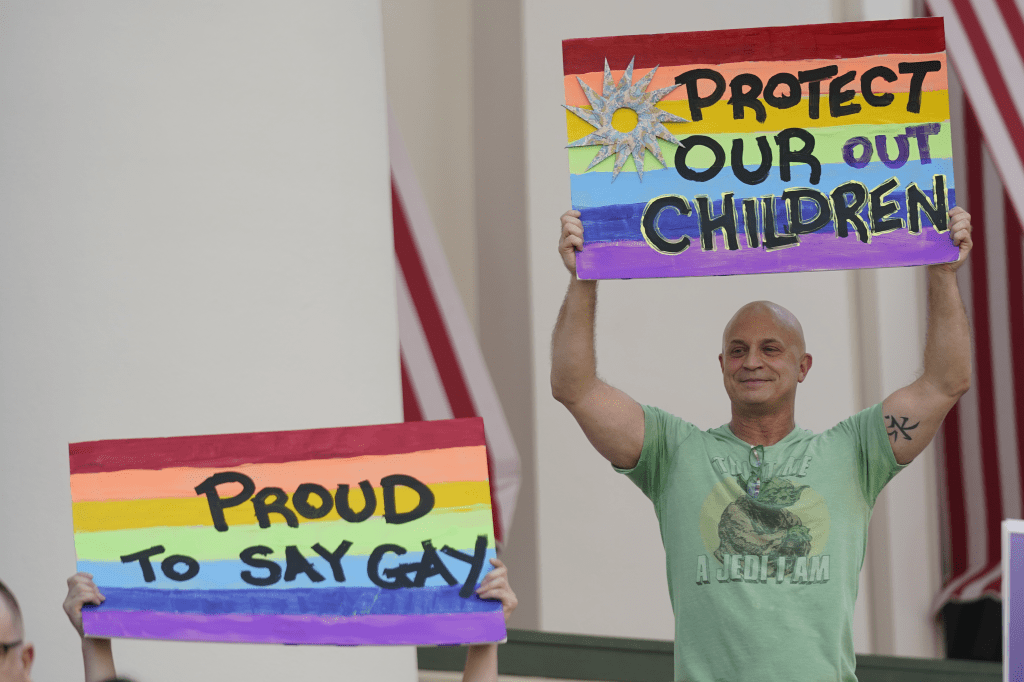
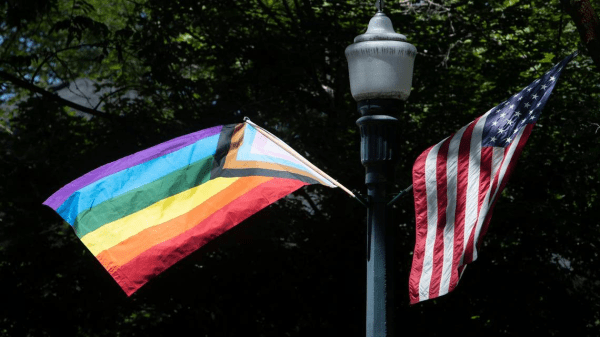
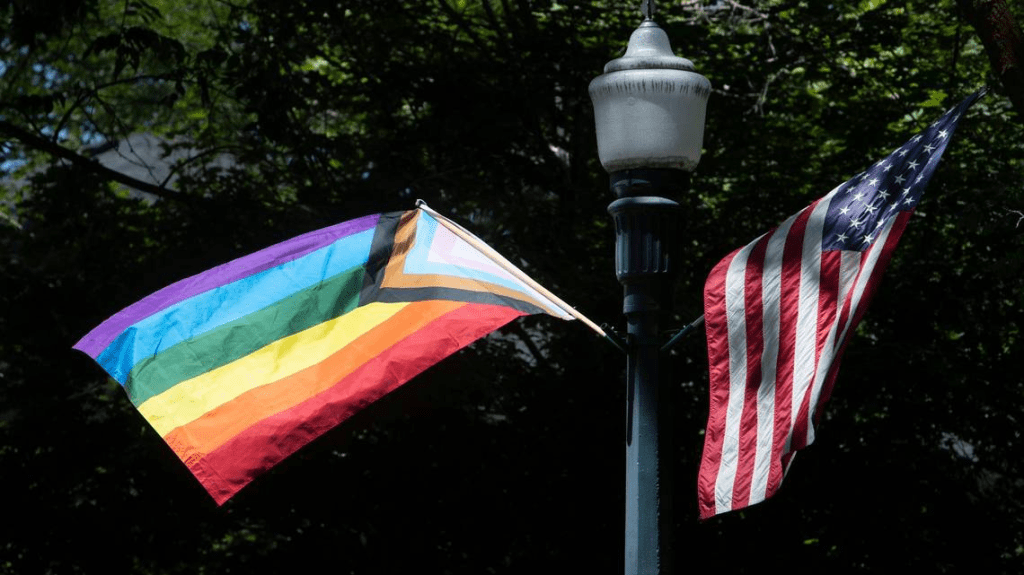
  • Pride Flag Ban (HB 75/SB 100), a bill banning government agencies, including public schools and universities, from displaying any flag that represents a “political viewpoint,” including Pride Flags.
  • Don’t Say Gay or Trans at Work (HB 1495/SB 440), a bill aimed at censoring public workplace discussions of LGBTQ issues, and enabling harassment of transgender employees.
  • Anti-Diversity In Local Government (HB 1571/SB 420), a bill attempting to ban cities and counties from recognizing, supporting, and protecting the LGBTQ community and other minorities
  • Banning Diversity & Equity In State Agencies (HB 731/SB 1710), a bill that would defund a broad range of activities and positions under the guise of banning DEI in state agencies and would ban state contractors and grantees from using state funds for DEI.

This powerful blockade against anti-LGBTQ extremism was built by a broad coalition of everyday Floridians. They showed up to the Capitol every single day of session, testified in legislative hearings, sent messages to lawmakers, and organized from the Panhandle to the Keys. This session alone, over 400 grassroots lobbyists came to Tallahassee for our largest advocacy week ever. Over 16,000 Floridians sent emails to legislators, and our Pride At The Capitol participants met face-to-face with lawmakers more than 325 times over the course of session. These direct actions continue the momentum building that has grown Equality Florida’s base by more than 165,000 people in just two years, reaching nearly half a million strong in total.

“This win belongs to every person who stood up, spoke out, and locked arms with their neighbors to stop the attacks before they could advance,” Smith added. “And while we celebrate, we know the fight isn’t over. This session still delivered real harm to democracy and equity that impacts all Floridians — and we are just as committed to undoing that damage and building a Florida that truly belongs to all of us.”

TX Republicans freak out over resolution honoring late Planned Parenthood president: It’s “horrific”

*This is being reported by LGBTQNation.

A group of anti-choice Republicans reportedly spent 16 minutes on the Texas House floor on Thursday speaking out against a resolution honoring the late Cecile Richards, a Texas native and the longtime president of Planned Parenthood. Richards, the daughter of former Texas Gov. Ann Richards (D), died of brain cancer on January 20.

State Rep. Nate Schatzline (R) kept pushing after state House Speaker Dustin Burrows (R) said there was no procedure in place that would allow a formal opposition to a single memorial or congratulatory resolution on a resolutions calendar.

“So it is the only way we can actually kill this horrific resolution is to vote down the resolutions calendar?” Schatzline asked.

“That is your choice, Mr. Schatzline,” Burrows replied, rejecting the group’s request to postpone the resolution as well.

“There’s no possible way that any one of our members can come and speak against recognizing an abortionist on the Texas House floor today?” Schatzline clarified.

“That is not a proper parliamentary inquiry,” Burrows said.

“You are not denying that you are in fact responsible for Planned Parenthood being honored today on today’s calendar!” said state Rep. Brian Harrison (R). “It’s an outrage!” Earlier, Harrison called Richards a “famed abortionist.”

State Rep. Wes Virdell (R) added, “Is it standard procedure to honor people who have killed millions of unborn babies?”

The speaker responded again, “That is not a proper parliamentary inquiry.”

Richards spent her entire life fighting for progressive causes. During her 12 years at the helm of Planned Parenthood, she transformed the organization into the political dynamo it is today. According to the Texas Tribune, the donor and volunteer base grew from 3 million to 11 million during her tenure.

After she died, President Joe Biden said she “fearlessly led us forward to be the America we say we are.”

“Carrying her mom’s torch for justice,” he continued, “she championed some of our Nation’s most important civil rights causes. She fought for the dignity of workers, defended and advanced women’s reproductive rights and equality, and mobilized our fellow Americans to exercise their power to vote. She was a leader of utmost character and I know that her legacy will continue to inspire generations to come.”

More Than 850 Anti-LGBTQ Bills Filed So Far in 2025 — the Most in US History

*This is reported by Truthout.

Over the past five years, Republican lawmakers have turned anti-trans legislation into a full-blown political obsession. What began as a handful of bills targeting sports participation and so-called religious exemptions has metastasized into a sweeping campaign against nearly every facet of transgender life — bathroom access, IDs, medical care, even the legality of one’s identity. In 2020, there were just over 100 bills aimed at LGBTQ+ people. In 2025, that number has ballooned to more than 850, the vast majority singling out transgender Americans. What we are witnessing now is not a legislative trend — it’s a coordinated nationwide crusade.

In 2020, most anti-trans legislation centered on banning transgender youth from sports — a proposal that, at the time, was considered extreme. The political optics of attacking LGBTQ+ people so soon after the Obergefell ruling were poor, and the memory of North Carolina’s disastrous bathroom ban was still fresh. That law, which forced trans people to use restrooms that didn’t align with their gender identity, backfired spectacularly and was widely credited with helping sink Republican prospects in the 2018 midterms in the state.

Nevertheless, some Republicans had identified sports as a way to get their foot in the door to further discrimination. The president of the American Principles Project, Terry Schilling, detailed how this was the case: “The women’s sports issue was really the beginning point in helping expose all this because what it did was, it got opponents of the LGBT movement comfortable with talking about transgender issues.”

In the years that followed, the volume and severity of anti-trans legislation escalated dramatically. Over 200 bills were proposed in 2022, and more than 500 in 2023, with each legislative session raising the ceiling on what Republicans considered politically palatable. Sports bans, once fringe, became boilerplate by 2021. The next year, states that had passed sports bans moved swiftly to criminalize gender-affirming care, and drag bans and bathroom restrictions emerged as the new line of attack. Today, those once-extreme measures are commonplace, and Republicans are setting their sights on even broader targets: bans on ID changes, adult healthcare restrictions, and increasingly punitive measures that chip away at the basic legal recognition of trans lives. Some bills have even been proposed to criminalize transgender identities altogether.

As of 2025, a staggering 867 bills have been introduced targeting transgender people across the United States. Of these, 122 would ban gender-affirming care for some segment of the trans population. Another 77 seek to bar transgender people from certain bathrooms — a threat made more tangible as arrests for alleged “wrong bathroom” usage have begun to mount. Seventy-three bills aim to eliminate legal recognition of transgender people entirely, often by revoking updated driver’s licenses, stripping correct gender markers, and invalidating identification documents. Others target drag (and transgender people dressed in the “wrong clothes”) or require schools to forcibly out transgender students. A newer, especially chilling category would classify gender-affirming care or even social transition as child abuse, opening the door for state-sanctioned removal of trans youth from supportive homes. So far, 51 anti-trans bills have been signed into law this year, with many more advancing through state legislatures.

As state legislatures escalate their assault on transgender rights, the federal government under Trump has doubled down — punishing blue states for protective laws, banning transgender people from military service, investigating teachers for affirming trans students, defunding hospitals that provide care, and targeting organizations simply for acknowledging the word “transgender.” In scope and intensity, 2025 has become the most punishing year yet for transgender people in America. The goal is unmistakable: to make it nearly impossible for transgender people to live openly, safely, and with dignity in public life.

Texas Democrat schools GOP congressman for his ignorant comments about intersex people

*This is being reported by LGBTQNation.

Texas state Rep. Andy Hopper (R) displayed his ignorance about LGBTQ+ issues recently by making incorrect statements about intersex people during a House floor debate. Hopper made his comments while supporting an amendment to eliminate state funding to the University of Texas at Austin for offering its LGBTQ+ and diversity, equity, and inclusivity (DEI) programs and degree plans, Advocate reported.

Under questioning by state Rep. Lauren Ashley Simmons (D), Hopper first claimed that biological sex and gender identity are “one and the same.” Simmons replied, “That’s not true, but moving on,” and then asked about his thoughts on intersex people.

“I don’t even know what that means, ma’am,” Hopper replied before asking for a definition. A recording of his reply captured audible gasps and laughter at his response.

Intersex individuals have innate variations in physical traits that differ from typical expectations for male or female bodies, including variations in reproductive organs, hormones, or chromosome patterns. An estimated 1.7% of infants are born intersex — roughly the same number of people born with red hair. Many intersex individuals are forced to undergo irreversible surgeries to make their anatomies resemble stereotypical male or female bodies and are also subject to stigma and discrimination.

“You are not sure what intersex people are, if they exist or not, but you want to defund a program about something that you don’t understand,” she said. “That’s why I’m seeking clarification.”

She then said, “I’ll take it really slow: Since the beginning of time, people have been born with either ambiguous genitalia or with or without ovaries… And so, those people, from a biological standpoint, exist — they’re not mythical.”

“Those intersex individuals are still XX or XY,” Hopper said, referring to chromosomes that can determine someone’s biological sex. “So, you can’t change that.”

However, as soon as Hopper commented, state Rep. Valoree Swanson (R) whispered into Hopper’s ear, “Andy, that’s not true” — her words amplified by a microphone.

Intersex people can have variations in their sex chromosomes, including people with Jacob’s Syndrome (XYY), Klinefelter syndrome (XXY), and triple X syndrome (XXX).

Video of the interaction gained numerous web comments, with some critics saying that Hopper demonstrated why Republicans shouldn’t eliminate the Department of Education.

Republicans have largely opposed DEI and LGBTQ+ initiatives, calling them a divisive form of indoctrination.

Slovakia could ban gay couples from adopting & nonbinary people from existing

*This is reported by LGBTQ Nation.

Slovakia is considering changes to its constitution to limit LGBTQ+ people’s rights.

This past Wednesday, lawmakers voted to advance the amendments that, if adopted, would limit adoption to only heterosexual married couples and define all people as only being male or female.

The Christian-majority Central European nation currently does not recognize same-sex relationships at all, and its constitution was amended in 2014 to state that marriage “is a unique union between a man and a woman.” But anyone can adopt a child under current Slovak law.

Slovakia also does not recognize nonbinary people under the law, according to Amnesty International. The proposed constitutional amendments would write that lack of recognition into the constitution, making it harder for the legislature to change it later.

Other changes that were advanced on Wednesday include allowing healthcare providers to refuse abortion care and requiring parental approval for sex education in schools. The legislature is also considering lower gestational limits for abortion and a ban on in-vitro fertilization and surrogacy.

“This swathe of amendments is an attempt to buttress an increasingly hostile environment for LGBTIQ+ people, undermine gender equality, rule of law, and broader human rights protections in Slovakia,” said Director of Amnesty International Slovakia Rado Sloboda. “Constitutionalizing the possibility to refuse abortion care on ‘conscientious objection’ grounds would put people’s health and lives at grave risk.”

“If passed, these draconian measures would further undermine gender equality and deepen the crackdown on LGBTIQ+ people’s rights, mirroring the dangerous practices of other countries in the region, such as Hungary and Poland. Members of the Slovak Parliament must vote to reject this multi-pronged assault on human rights.”

Bloomberg reports that 81 lawmakers supported the changes in the first reading yesterday, and they will require at least 90 votes to pass the next round of voting. The nation’s parliament has 150 members.

Slovakia is a European Union member state, and the rollbacks of LGBTQ+ and reproductive rights could lead to tensions with European Union laws.

Prime Minister Robert Fico of the left-nationalist Direction—Social Democracy party returned to power in 2023 with a socially conservative platform.

Iowa State students, city leaders mourn loss of LGBTQIA+ center, hold ‘funeral’ on campus

*This is reported by the Ames Tribute

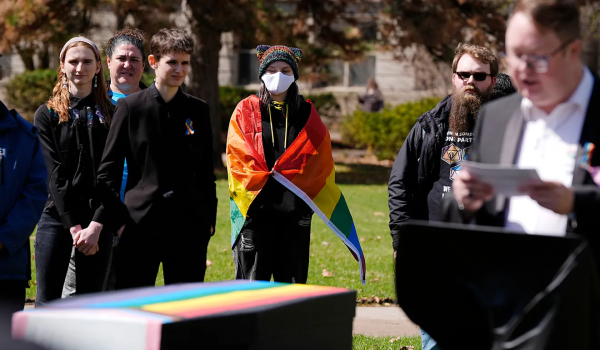
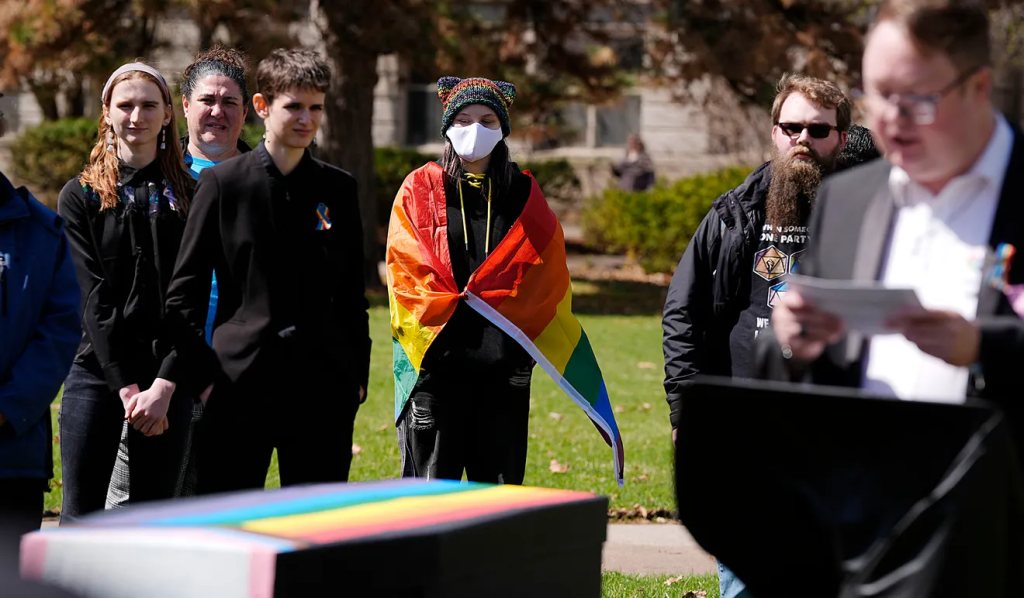
A coalition of Iowa State University students and Ames community members held a makeshift funeral Wednesday for Iowa State’s LGBTQIA+ center.

About 50 people gathered in front of Parks Library around a makeshift coffin painted with the LGBTQIA+ flag. Many were wearing black, sporting pride pins or holding pride flags.More: Iowa State students plan on campus ‘funeral’ for Center for LGBTQIA+ Student Success

Iowa State’s Center for LGBTQIA+ Student Success, often referred to as “The Center,” must be restructured and rebranded due to Senate File 2435.

The law, which will take effect on July 1, 2025, prohibits state universities like Iowa State from starting, maintaining or funding DEI offices or positions unless required by law or for accreditation. The Iowa Board of Regents imposed directives and a Dec. 31 deadline to eliminate functions like the Center.

Holding a ‘funeral’ for a community resource

ISU Students Against SF 2435 Coalition published a mock obituary and shared it with the Ames Tribune prior to Wednesday’s event. The obituary said the Center was “killed” on Dec. 31, “with the assistance of Iowa State University.”

“This marks a great loss for the community, and we encourage those impacted to join us and find community in these trying times,” the mock obituary reads.

Several students addressed the crowd on Wednesday, noting how the Center provided them with a safe space to connect with their community. They said they are frustrated that it’s closing. Several said the presence of the Center was a key factor in attending the university.

The Center is a place where LGBTQIA+ students could go for safety and support, Iowa State student Silvera Dudenhoefer said on Wednesday.

“It was a space that celebrated queer joy and accomplishment, academically and personally,” Dudenhoefer said. “Above all, it was a clear mark that LGBTQIA+ students mattered to this school.”

By removing the LGBTQIA+ from the Center, Dudenhoefer said the Board of Regents has “shown who they’re willing to push aside in an effort to comply.”

The Center, according to Iowa State’s website, is still open from 8 a.m. to 5 p.m., Monday through Friday, on the fourth floor of the Iowa State Memorial Union. Iowa State now lists The Center under the umbrella of multicultural student affairs.

‘The Center’ has been a LGBTQIA+ student resource for more than 30 years

Iowa State University’s Lesbian Gay Bisexual and Transgender Student Services (LGBTSS) opened on Nov. 8, 1992, and was housed above Student Services. It was initially staffed by student volunteers until 1997, when four full-time staff members were brought on.

The LGBTSS was rebranded as The Center for LGBTQIA+ Student Success in 2019 and relocated to the Memorial Union.

The Center is “a space for you to be yourself, find and build community, get involved, and explore lesbian, gay, bisexual, transgender, queer, intersex, asexual, and ally life at Iowa State University,” according to the school’s website.

Senator Quirmbach voices support for ‘encouraging’ campus environment

Senator Herman Quirmbach of Ames attended Wednesday’s gathering and addressed the crowd. He said Iowa State has a responsibility to provide a supportive and encouraging environment for every student, regardless of their background.

“This university is failing in its moral responsibility,” Quirmbach said. “The members of the Board of Regents are failing. And the legislature? Don’t get me started.”

Iowa State graduate student Amanda Thomas assured the gathered students that they have allies willing to support them.

“When attacks like this hurt my friends, my family, my coworkers and my peers, it hurts me and that’s not okay,” Thomas said. “Allies are here, even if you can’t see them.”

Reverand Kelli Clement from the Unitarian Universalist Fellowship of Ames said students are learning to take the “stone in their shoe” that came with Senate File 2435 being passed.

“When you find your people, it is a holy moment,” Clement said. “And the loss of this center does not mean that your people go away.”

Students against SF-2435 protest Iowa law

The ISU Students Against SF 2435 coalition was formed to combat the law’s ensuing impact. The group’s first protest was held Oct. 24. The students protested the law again on Nov. 20. 

The group also filed a pair of petitions on Change.org, one for the Board of Regents and another for the Iowa Legislature.

Florida GOP advances bill that would legalize anti-LGBTQ+ workplace discrimination

*This is being reported by LGBTQNation.

Florida state Republican lawmakers have advanced a bill that would allow public employees and state contractors to openly discriminate against LGBTQ+ co-workers without fear of punishment.

The so-called “Freedom of Conscience in the Workplace Act” (S.B. 440) would forbid public employers from requiring workers to use transgender people’s personal pronouns and forbid employers from punishing any employee for expressing “a belief in traditional or Biblical views of sexuality and marriage, or … gender ideology.”

The legislation would also remove “nonbinary” gender options from employment forms and forbid any entities from requiring workers to undergo LGBTQ+ cultural competence training. The bill would not apply to private employers.

“The bill really does promote government employees and contractors to harass transgender individuals by allowing them to intentionally misgender them by using disrespectful pronouns and having no consequences,” Florida state Sen. Kristen Arrington (D) said, according to Advocate. “And this is a license to discriminate free from accountability.”

The Senate Government Oversight and Accountability Committee initially declined to vote on the bill last week after receiving hundreds of comment cards opposing it. However, the committee ultimately voted 5-2 along party lines to advance it. It now heads to the state’s Senate Judiciary Committee for consideration.

Florida resident Claudia Thomas, the first out gay commissioner of Sanford City, said the bill insults LGBTQ+ people like her and wastes government resources, Florida Politics reported.

“I would love to get back to trying to solve my city’s problems about water, clean water, housing, etc,” Thomas said. “And if I have to start wasting my time talking about pronouns and people not respecting my friends, it would make me sad.”

The bill is just one of several anti-LGBTQ+ bills currently being considered by state legislators, according to the statewide LGBTQ+ advocacy organization Equality Florida.

One bill would ban local governments from enacting diversity, equity, and inclusion (DEI) policies (including any recognition of Pride Month) by defunding these initiatives and removing local officials who promote them. Another would prohibit any taxpayer funds from supporting DEI initiatives in state agencies, among state contractors, or grantees.

Yet another bill would ban Pride flags on government property, and another would restrict the ability of people under the age of 18 to seek reproductive healthcare without parental consent.

However, Democratic lawmakers have also introduced legislation that would formally repeal the state’s ban on same-sex marriage, repeal the so-called “Don’t Say Gay” law, which forbids instruction on LGBTQ+ issues in K-12 schools, eliminate so-called “LGBTQ+ paníc defenses in queer-bashing criminal cases and restore parents’ rights to access gender-affirming care for trans kids.

Finland PM Orpo: Legislative ban on conversion therapy unlikely to proceed this term

*This is being reported by YLE.

Finnish Prime Minister Petteri Orpo (NCP) has told the Uutissuomalainen news group that he considers it unlikely a proposal to ban conversion therapy will move forward during his government’s term in office.

On Friday, MPs overwhelmingly approved a citizens’ initiative aimed at banning sexual orientation and gender identification conversion therapy.

Conversion therapy is the practice of attempting to turn members of sexual minorities into heterosexuals using a variety of different methods. The practice is usually carried out by priests, pastoral care workers, youth workers and others in some conservative religious communities.

Among Finland’s coalition government’s parties, the ban was supported by the NCP and the Swedish People’s Party, while it was opposed by the Finns Party and the Christian Democrats.

“Since there is no government programme document about the matter, and government parties do not share a unified position about banning conversion therapy, I do not believe the matter will progress during this governmental term,” Orpo told Uutissuomalainen, according to the news group.

Justice Minister Leena Meri (Finns) said on Friday that the justice ministry does not have time to prepare legislation to ban conversion therapy, as there is a long list of projects listed in the government programme that are waiting to move forward.

Idaho bill bans government from flying LGBTQ+ rainbow flags. Here’s how it impacts Boise

*This is being reported by the Idaho Statesman.

LGBTQ+ Pride flags in Boise’s North End remain in limbo after Idaho lawmakers passed a bill that bans the flags in some public spaces.

House lawmakers Friday approved amendments to House Bill 96, which allows government entities to display only certain flags, such as the official Idaho, U.S. and state flags. The bill still needs Gov. Brad Little’s signature to become law.

“The ultimate goal is for us to fly flags that unite and don’t divide,” said Sen. Ben Toews, R-Coeur d’Alene, during a floor debate.

Earlier this year, photographs given to legislators on the House floor included the Pride flags along Harrison Boulevard, where flags are flown during Pride Month in June, and at Boise City Hall. Boise spokesperson Maria Weeg said the bill would likely impact the city’s Pride flags, but in a later message told the Idaho Statesman that the city hasn’t officially engaged on the bill and “we don’t usually comment on bills that have not been signed into law.”

As written, the bill would ban the Harrison Pride flags, because the Ada County Highway District controls the medians, ACHD spokesperson Rachel Bjornestad previously told the Statesman. Those flags have been stolen or vandalized four years in a row. Proponents said the legislation is important to preserve neutrality, and even conservative flags would be banned. But critics said the bills target marginalized communities because it’s a direct response to the Pride flags flown in Boise.

“Now, when we want to celebrate and unite under this rainbow flag and support our community, that is going to be taken from us by the state,” said Senate Minority Leader Melissa Wintrow, D-Boise. “We welcome everyone in my district.”

The bill’s passage comes days after Little signed House Bill 41, which bans schools from displaying flags and banners that “promote political, religious or ideological viewpoints.” A week before, a Meridian teacher’s posters drew local and national headlines, according to previous Statesman reporting. West Ada School District officials had told Sarah Inama, a world civilization teacher, to take down two signs, including one with “Everyone is welcome here,” above hands of different skin tones.

Community members have responded by marking welcoming messages outside West Ada schools, according to previous Statesman reporting, as well as making and wearing shirts with the sign’s message. Utah this week became the first state to prohibit Pride flags in both schools and all government buildings.

Trinidad & Tobago bans homosexuality… again

*This is being reported by LGBTNation.

Trinidad and Tobago has reinstated its ban on homosexuality, which was lifted by the Caribbean nation’s High Court in 2018.

That year, the High Court in the Christian-majority nation ruled in a lawsuit brought by LGBTQ+ activist Jason Jones that Sections 13 and 16 of the Sexual Offenses Act are “irrational and illegal” because they violate the rights to privacy and freedom of expression.

“What I think the judge pointed out was ‘here every creed and race find an equal place,’ and I think we must all come together now and embrace each other in true love and respect,” Jones said at the time.

But on March 25, the Court of Appeals reversed that decision, saying that only Parliament can overturn the country’s ban on homosexuality. The Court of Appeals also reduced the maximum sentence associated with homosexuality to five years in prison. Prior to 2018, the maximum penalty was 25 years in prison.

“Judges cannot change the law,” Tuesday’s ruling states. “We give effect to Parliament’s intention…. It is, therefore, left to Parliament to repeal the criminalization of buggery and the related offense of gross indecency by legislation. It is an emotive issue which engages vibrant discussion in the court of public opinion.”

“Parliament is ultimately responsible for ensuring that laws reflect the evolving standards of a democratic society. That is their role and function. Any provisions found to be unconstitutional must be taken from the statute books by Parliament through legislative reform and not by judicial overreach.”

Jones spoke out against the Court of Appeals decision.

“We are talking about the rights of some 100,000 LGBTQIA+ citizens in [Trinidad and Tobago],” he told Trinidad and Tobago Newsday. “Why are we spending all this money and retaining these laws?”

“The modernization of our democracy is at stake here, and this is the beginning of this modernization.”

According to 76crimes.com, the ruling brings the total number of countries banning homosexuality up to 66. The African nation of Mali also recently criminalized homosexuality.

In the original 2018 case, religious conservatives argued that God’s wrath would be visited on Trinidad and Tobago if the anti-homosexuality laws were overturned. Conservatives argued that legalizing homosexuality would violate their religious beliefs.

The judge said the ruling “is not an assessment or denial of the religious beliefs of anyone.”

Christian conservatives also told the press that they’re worried about “homosexual rights trumping heterosexual rights.”

Blog at WordPress.com.

Up ↑