Around 100,000 March In Budapest Pride In Open Defiance Of Hungary’s Ban

*This is reported by Huffpost.

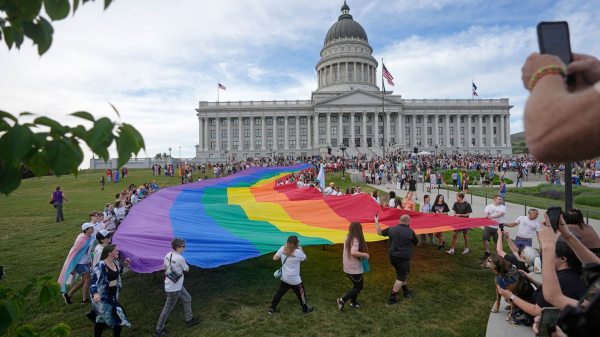
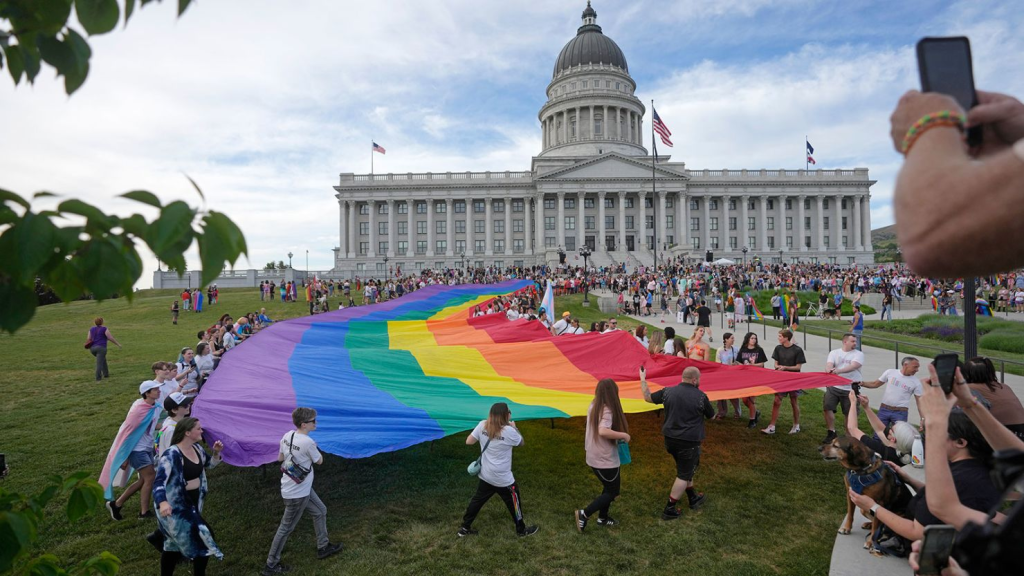
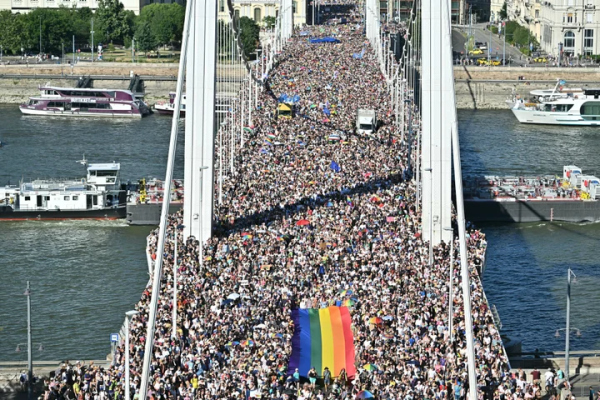
Around 100,000 people defied a government ban and police orders Saturday to march in what organizers called the largest LGBTQ+ Pride event in Hungary’s history in an open rebuke of Prime Minister Viktor Orbán’s government.

Marchers gambled with potential police intervention and heavy fines to participate in the 30th annual Budapest Pride, which was outlawed in March by Orbán’s right-wing populist governing party.

The march began at Budapest City Hall and wound through the city center before crossing the capital’s Erzsébet Bridge over the Danube River. Police diverted the crowd from its planned route to keep it separated from a small group of far-right counterprotesters, while members of Hungary’s LGBTQ+ community and masses of supporters danced to music and waved rainbow and anti-government flags.

One marcher, Blanka Molnár, said it was “a fantastic feeling” that more people had attended the Pride march than ever before despite it being outlawed. She said it was “increasingly important” for Hungarians, “even those who have never been to Pride before,” to push back against the government’s policies.

“This isn’t just about LGBQT+ rights, it’s also about the right to assemble and about standing up for each other and not allowing (the government) to oppress us,” she said.

The massive size of the march, which the government for months had insisted would no longer be permitted in Hungary, was seen as a major blow to Orbán’s prestige, as the European Union’s longest-serving leader’s popularity slumps in the polls where a new opposition force has taken the lead.

Orbán and his party have insisted that Pride, a celebration of LGBTQ+ visibility and struggle for equal rights, was a violation of children’s rights to moral and spiritual development — rights that a recent constitutional amendment declared took precedence over other fundamental protections including the right to peacefully assemble.

The law fast-tracked through parliament in March made it an offense to hold or attend events that “depict or promote” homosexuality to minors underage 18. Orbán earlier made clear that Budapest Pride was the explicit target of the law.

Authorities installed additional cameras throughout the city center before the march, and were expected to use facial recognition tools to identify individuals who attend the banned event. According to the new law, being caught attending Pride could result in fines of up to 200,000 Hungarian forints ($586).

Marcher András Faludy said the “hysteria” that has emerged in Hungary over the Pride march in recent months was “damn pathetic. It’s nonsense.”

“I could use an uglier word because I’m extremely angry, but I won’t,” he added.

The ban was the latest crackdown on LGBTQ+ rights by Orbán’s government, which has already effectively banned both same-sex adoption and same-sex marriage and disallowed transgender individuals from changing their sex in official documents.

Police rejected several requests by organizers in recent weeks to register the Pride march, citing the recent law. But Budapest Mayor Gergely Karácsony joined with organizers and declared it would be held as a separate municipal event — something he said doesn’t require police approval.

But Hungary’s government remained firm, insisting that holding the Pride march, even if it’s sponsored by the city, would be unlawful. Hungary’s justice minister this week warned Karácsony that organizing Pride or encouraging people to attend would be punishable by up to a year in prison.

Many marchers expressed their belief that the Pride march represented a struggle not just for the protections of the rights of sexual minorities, but for the democratic future of their country.

Participant Zsófia Szekér said the number of attendees showed that a major part of society desired a new direction for Hungary.

“I think we can only achieve change if so many people take to the streets,” she said.

Salt Lake City adopts four flags to represent residents, visitors

*This press release is from the Mayor’s Office of Salt Lake City.

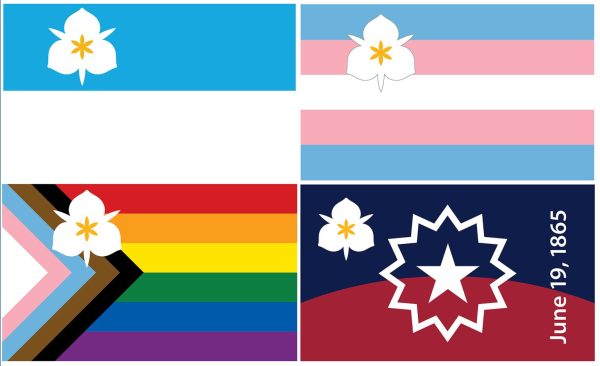
Salt Lake City Mayor Erin Mendenhall proposed adopting three new City flags, in addition to the traditional Sego Lily Flag, on Tuesday to most accurately reflect the values of the City and its residents. The Salt Lake City Council adopted the flags via ordinance in its formal meeting.

The three additional city flags celebrating human rights include: 

  • The Sego Celebration Flag, representing the history of Juneteenth and the City’s Black and African American residents;
  • The Sego Belonging Flag, representing the City’s LGBTQIA residents and broader acceptance of this community; and
  • The Sego Visibility Flag, representing the City’s transgender residents and a commitment to seeing and celebrating their lives. 

“Our City flags are powerful symbols representing Salt Lake City’s values,” said Mendenhall. “I want all Salt Lakers to look up at these flags and be reminded that we value diversity, equity and inclusion—leaving no doubt that we are united as a city and people, moving forward together.”

House Bill 77, passed during the 2025 legislative session, narrowed the types of flags a city can display publicly on government property unless a flag meets the criteria outlined in the bill as an “exempted flag.” It was important to the Mendenhall administration that the City work within the constraints of recent legislation while continuing to uphold Salt Lake City’s values.

“Like other civic symbols, these flags reflect our shared humanity and the values that help everyone feel they belong—no matter their background, orientation or beliefs,” said Salt Lake City Council Chair Chris Wharton. “While the state has restricted which flags public buildings can fly, I’m glad we can still uphold our community’s values within the law.”

The three new flags were chosen because versions of them have been consistently displayed at City Hall during Mayor Mendenhall’s time in office and are representative of our community’s diverse, loving, and accepting values.

In all three flags, the sego lily in the upper corner of these designs is the City’s most recognized emblem, clearly identifying that each flag is representative of Salt Lake City specifically. 

In 2020, Salt Lake City adopted its current flag following a community-driven redesign: a field of blue over white with a white sego lily with three petals in the upper hoist canton. Salt Lake City is the only state capital with a three-word name. Despite the harsh environmental climate it lives in, the sego lily is a symbol of resilience, exemplifying Salt Lake City and its residents. Over the past five years, the sego lily and the City’s flag have grown to be highly recognized symbols and sources of pride in the city.

The City flags will continue to fly alongside the State of Utah and American flags.

Utah schools, government buildings will soon be fined if they fly this flag

*This is being reported by WFMY 2.

Utah became the first state to prohibit flying LGBTQ+ pride flags at schools and all government buildings after the Republican governor announced he was allowing a ban on unsanctioned flag displays to become law without his signature.

Gov. Spencer Cox, who made the announcement late Thursday night, said he continues to have serious concerns with the policy but chose not to reject it because his veto would likely be overridden by the Republican-controlled Legislature.

Starting May 7, state or local government buildings will be fined $500 a day for flying any flag other than the United States flag, the Utah state flag, military flags or a short list of others approved by lawmakers. Political flags supporting a certain candidate or party, such as President Donald Trump’s signature “Make America Great Again” flags, are not allowed.

The ban also prohibits teachers from hanging any restricted flag in their classroom.

The new law could stoke conflict between the state and its largest city. City buildings in liberal Salt Lake City typically honor Pride Month each June by displaying flags that celebrate its large LGBTQ+ population. Local leaders have illuminated the Salt Lake City and County Building in rainbow lights to protest the flag ban each night since the Legislature sent it to Cox’s desk.

Andrew Wittenberg, a spokesperson for Salt Lake City Mayor Erin Mendenhall’s office, said their attorneys are evaluating the law and the capital city does not yet have information on what it will do once the law takes effect.

The bill’s Republican sponsors, Rep. Trevor Lee and Sen. Dan McCay, said it’s meant to encourage “political neutrality” from teachers and other government employees. Opponents argued it aims to erase LGBTQ+ expression and take authority away from cities and towns that don’t align politically with the Republican Legislature.

In a letter to legislative leaders explaining his decision, Cox said he agreed with the “underlying intent” of the bill to make classrooms politically neutral but thought it went too far in regulating local governments. He also noted that by focusing narrowly on flags, the law does not prevent other political displays such as posters or lighting.

“To our LGBTQ community, I know that recent legislation has been difficult,” Cox said. “Politics can be a bit of a blood sport at times and I know we’ve had our disagreements. I want you to know that I love and appreciate you and I am grateful that you are part of our state. I know these words may ring hollow to many of you, but please know that I mean them sincerely.”

Cox’s decision came hours after the Sundance Film Festival announced it was leaving its home of four decades in Park City, Utah, for Boulder, Colorado. The flag bill created eleventh-hour tensions as some residents worried it would push the nation’s premier independent film festival out of state. Festival leaders said state politics ultimately did not influence their move from conservative Utah to liberal Colorado. They did, however. make “ethos and equity values” one of their criteria in a nationwide search for a new home and referred to Boulder in their announcement as a “welcoming environment.”

Utah’s flag law goes further than one signed last week in Idaho that only applies to schools. But Idaho Republicans are also advancing a separate bill to ban government buildings from displaying certain flags.

Florida lawmakers have advanced a proposal to ban pride flags and others that represent political viewpoints in schools and public buildings after similar measures failed in the past two legislative sessions. Some federal agencies, including the Department of Veterans Affairs, also have limited which flags can fly at their facilities.

Other flags permitted under the Utah law include Olympic and Paralympic flags, official college or university flags, tribal flags and historic versions of other approved flags that might be used for educational purposes.

This week, Cox also signed laws phasing out universal mail-in ballots and banning fluoride in public drinking water. Other significant new laws require app stores to verify users’ ages and mandate firearm safety instruction in elementary school classrooms.

National Park Service cracks down on Pride leaving LGBTQ+ rangers feeling betrayed

This blog is originally appeared at Advocate.

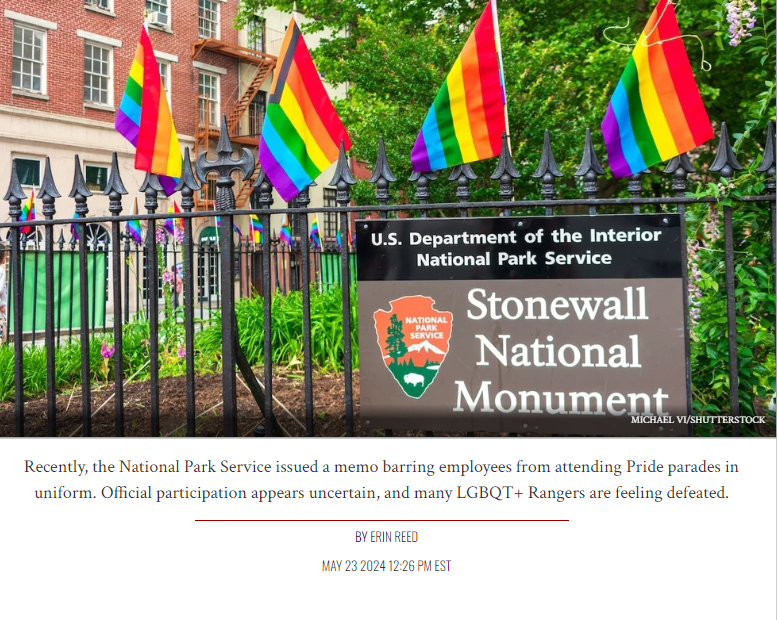
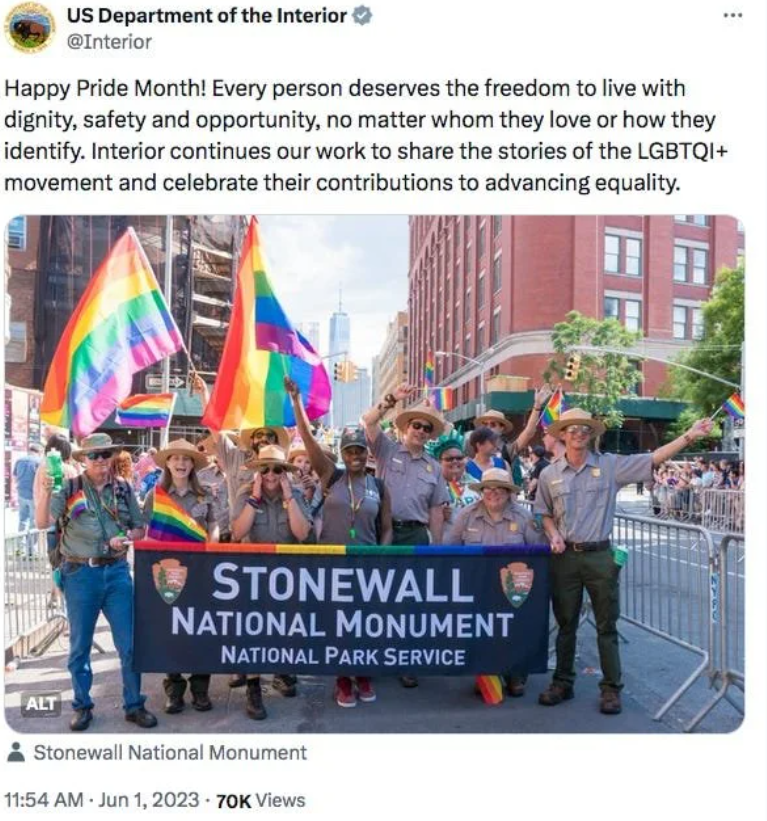
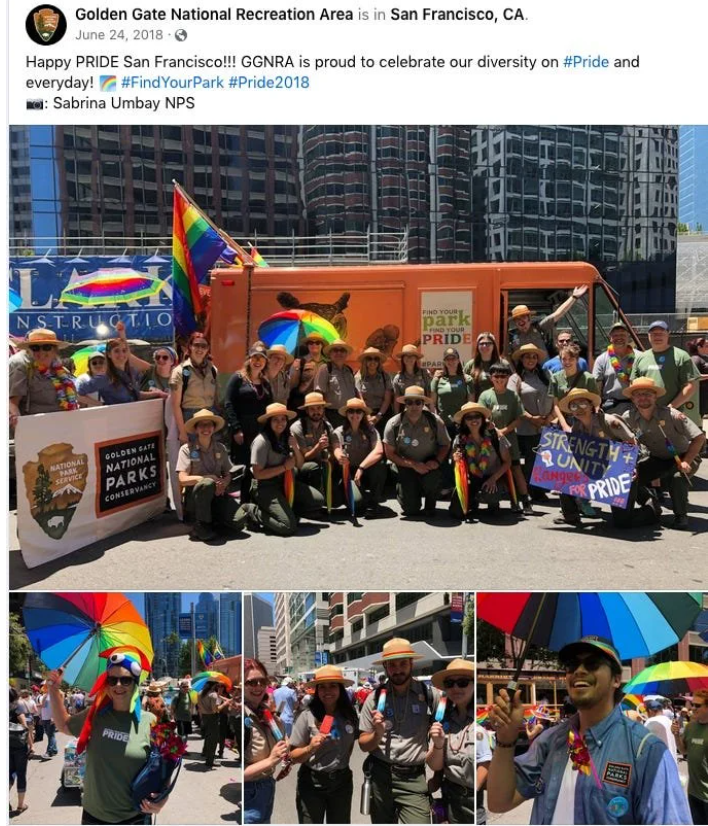
On May 17, the National Park Service (NPS) made an official ruling that park rangers and other employees are no longer allowed to attend Pride events and parades in uniform. This marks a reversal of a long-standing tradition of NPS participation in Pride parades across the U.S., including the presence of official delegations. Anonymous LGBTQ+ NPS employees have expressed feelings of betrayal, noting that participation in major city Pride events is now in question, as several parade applications remain unprocessed and approvals are unclear. The decision comes at a time of heightened scrutiny on LGBTQ+ issues nationwide, with increasing crackdowns on Pride flags and LGBTQ+ rights—largely driven by Republican lawmakers and appointees. This time, however, the policy change is being driven by the NPS itself, under the leadership of a director appointed by President Biden.

The new directive was first shared in an internal memo to NPS staff, which did not specifically mention Pride but highlighted that “requests from employees asking to participate in uniform in a variety of events and activities, including events not organized by the NPS,” are in conflict with agency policy. The memo cited a policy stating that NPS employees cannot wear their uniforms to events that might be interpreted as supporting “a particular issue, position, or political party.” LGBTQ+ employees, however, have criticized this application of the policy, arguing that Pride is about identity and diversity, not a political stance or issue. They pointed out that under the previous guidelines, NPS employees were able to participate in Pride events with approval, and that internal Employee Resource Group (ERG) documents, such as the “OUTsiders Guide to Pride,” had endorsed such participation for years.

In a follow-up statement, the NPS argued that the ERG guide conflicts with official policy and that discussions are underway to review it and other related documents. The agency also emphasized that its participation in Pride celebrations could be perceived as an endorsement of a particular “issue of public concern,” which they described as a justification for limiting official participation. In their view, what has long been seen as a celebration of diversity and inclusion is now categorized as a political statement, with the NPS deeming official participation in such events “extremely limited.”

The decision sparked immediate concern among National Park Service employees and LGBTQ+ advocates. Many pointed out that the NPS has a long history of participating in Pride parades across the country, even under the Trump administration, which was known for its efforts to restrict LGBTQ+ representation in federal agencies, including at embassies. Employees also highlighted the significant role the NPS plays in managing Stonewall National Monument, a site dedicated to LGBTQ+ history and civil rights. Notably, the founding documents of Stonewall National Monument explicitly state that its purpose is “to preserve and protect Christopher Park and the historic resources associated with it” and “to interpret the Stonewall National Historic Landmark’s resources and values related to the lesbian, gay, bisexual, and transgender civil rights movement.” This has raised questions about how the NPS can reconcile this mission with its new stance on Pride participation.

One NPS employee, speaking anonymously, revealed that several requests for Pride parade participation are currently “collecting dust” on desks, waiting for approval for representation in major city Pride events. When asked about the decision to categorize Pride festivals as an “issue of public concern,” the employee responded, “Pride is not political, it’s not a cause, you just are LGBTQ+. It’s a celebration of who we are.” They added, “Morale is just so low right now. There’s not a lot of fight left in us.”

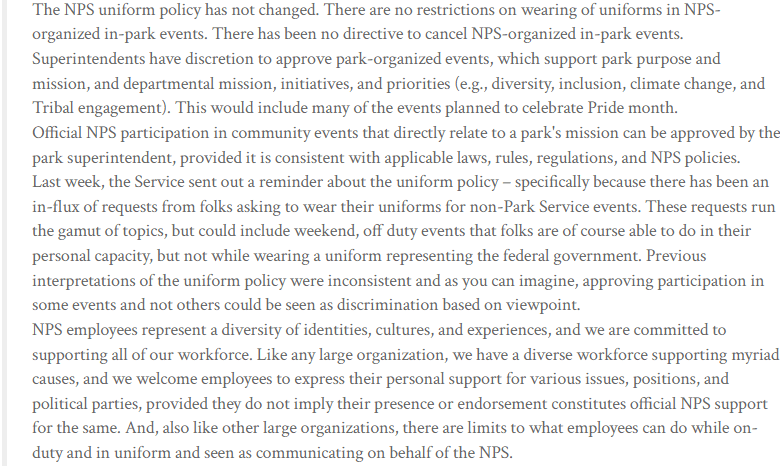
I reached out to an NPS spokesperson for clarification on whether the agency would continue participating in major city Pride events this year, as it has in previous years. The spokesperson responded that the policy “had not changed,” noting that “previous interpretations of the uniform policy were inconsistent” and that approving participation in some events while denying others could be perceived as “discrimination based on viewpoint.” While the spokesperson confirmed that in-park Pride events have not been canceled, they did not clarify whether NPS employees would continue to participate in major U.S. city Pride parades or celebrations. Attempts to follow up on this question went unanswered.

The characterization of Pride as a potentially “political” event raises concerns, particularly given the founding documents of Stonewall National Monument, which directly reference the “resources and values” of the LGBTQ+ community. NPS resources currently available on the site encourage people to “Celebrate Pride” and emphasize that “The LGBTQ experience is a vital facet of America’s rich and diverse past.” The resource underscores the importance of not making LGBTQ+ people invisible, stating, “By recovering the voices that have been erased and marginalized, the NPS embarks on an important project to capture and celebrate our multi-vocal past.” By barring employees from wearing Pride symbols or participating in Pride events, the NPS may unintentionally appear to be erasing and marginalizing its LGBTQ+ employees—contradicting its own stated mission.

National Park Service employees have marched in uniform in Pride parades for years. In 2014, for example, Christine Lenhertz, a member of the NPS, requested permission for a group of LGBTQ+ park employees to wear their uniforms while participating in a Pride parade. Initially denied, the group filed a complaint, prompting a ruling from the Office of the Solicitor for the Department of the Interior, which determined there was no reason to prevent them from marching in uniform. Since then, NPS contingents have regularly participated in Pride events across the country.

The future of Pride parade participation for NPS employees in uniform remains uncertain. While it seems that some Pride events within National Parks, like those at Stonewall, may still take place, external participation in major city Pride events appears to be on hold in at least some locations across the U.S. The possibility of individual or smaller LGBTQ+-affiliated Park Ranger contingents joining city Pride celebrations looks even less likely, with little hope of approval for participation.

You can read the full response from an NPS spokesperson to the request for comment here:

Blog at WordPress.com.

Up ↑