What are the safest places for gay and trans people? See where your state ranks

*This is reported by USA Today.

As Oklahoman legislators push to restrict trans rights and overturn the 2015 Supreme Court decision legalizing gay marriage, Zane Eaves says his identity as a transgender man has put a target on his back in his home state.

One of 18,900 trans adults in Oklahoma, Eaves has received death threats as has his wife of 10 years and their two children.

“All the hatred and political stuff going on” are driving this Oklahoma lifer from the place he was born and raised, Eaves, 35, said. He has only crossed the state line three times in his life, but in recent weeks, he made the difficult decision to move his family to North Carolina to be closer to friends and allies. 

“I am just trying to stay alive and keep my marriage,” Eaves said.

Oklahoma ranks 44th in the nation on a list released Monday of the most and least welcoming states for lesbian, gay, bisexual, transgender and queer Americans.

More and more, the question of where LGBTQ+ people feel safe is one of blue vs. red, according to advocacy group Out Leadership.

LGBTQ+ equality fell across the board for the third straight year, according to Out Leadership’s State LGBTQ+ Business Climate Index shared exclusively with USA TODAY. But the sharpest declines came in Republican-led states. 

While progressive strongholds championed supportive policies and protections, conservative states elected a slate of leaders who openly oppose gay and trans rights and sponsored an unprecedented wave of anti-LGBTQ+ legislation, Out Leadership CEO and founder Todd Sears said.

So-called “Don’t Say Gay” bills, religious exemptions and other legislation tanked the rankings of 19 red states in the Out Leadership index, according to Sears. 

Today, the divide between states that roll out the welcome mat and less hospitable parts of the country is wider than ever, he said.  

The least and most welcoming LGBTQ+ states

Each year for the last seven, Out Leadership has released the State LGBTQ+ Business Climate Index to gauge the overall climate for gay and transgender people state by state, mapping out where they will face the most and the least discrimination and hardship. 

Out Leadership’s index measures the impact of state government policies and prevalent attitudes about the LGBTQ+ community, weighing factors such as support for young people and families, health access and safety, political and religious attitudes, work environment and employment and nondiscrimination protections.

The Northeast had six of the 10 highest-ranked states, while the Southeast had six of the lowest-ranked.

Massachusetts, led by the nation’s first openly lesbian governor, Democrat Maura Healey and New York, which guaranteed gender-affirming care and LGBTQ+ refugee protections, tied for first place in this year’s index, with Connecticut and New Jersey close behind.

The least LGBTQ+ friendly state was Arkansas, which ranked last for the third straight year. South Carolina, Louisiana, South Dakota and Alabama also received low scores.

The states that had the largest gains in the index were Kentucky and Michigan, which Out Leadership attributed to “pro-equality” leadership from governors Andy Beshear and Gretchen Whitmer, both Democrats. The steepest declines were in Ohio, Florida and Utah, all led by Republican governors.

Where are the safest places to live?

The Out Leadership index was created as a LGBTQ+ inclusion reference guide for business leaders. But gay and trans people soon began using it to figure out where they should – and should not – live and work, never more so than now as rights rollbacks from the Trump administration and red statehouses hit close to home.

Opposition to transgender rights was a central plank in Trump’s presidential campaign and since taking office he has signed a series of executive orders recognizing only male and female genders, keeping trans athletes out of women’s sports, banning trans people from serving in the military and restricting federal funding for gender-affirming care for trans people under age 19. 

Even states seen as safer for LGBTQ+ people have been navigating these edicts around trans athletes. Trump threatened to cut federal funding to California if a trans girl competed in a state track and field event held Saturday.

AB Hernandez, a junior from Jurupa Valley High School in Riverside County, shared first place in the high jump and triple jump and second in the long jump. She shared the awards podium with her cisgender competitors under a new rule drafted by state athletics officials days before the event to mollify critics.

Republican-led states have been in the vanguard of anti-trans legislation, causing greater geographic polarization and prompting fears among LGBTQ+ residents, even those who live in liberal cities.

Jordan McGuire, a 27-year-old gay man in North Dakota, said the years he spent living in the Deep South taught him about the repressive discrimination routinely faced by gay and genderqueer people. 

At the same time, socially progressive cities in conservative states like Fargo and Grand Forks are no longer the safe havens they once were, he said. 

Now that his fiancee is transitioning to female, the couple is exploring a move to a “sanctuary” state that will be safer for them. 

“It feels like five or 10 years ago, trans people were not under the same microscope they are now and that has definitely influenced our move,” McGuire said. “Yeah, people were prejudiced but it wasn’t a witch hunt. They weren’t looking for people in bathrooms and schools. But now things are so polarized.”

That rising anxiety was captured in a post-election survey from UCLA’s Williams Institute which found that nearly half of transgender people had already fled unsupportive communities and nearly 1 in 4 were considering uprooting their lives. 

The most frequently cited reasons for wanting to move were concerns about LGBTQ+ rights – 76% – the sociopolitical climate – 71% – anti-trans rhetoric and climate – 60% – and anti-trans laws and policies – 47%. 

LGBTQ+ Americans on the move

Interest in relocating to friendlier states is even higher today than it was after Trump’s reelection, say nonprofit workers who aid trans and gender-diverse people relocate to more liberal states with broader protections. 

So far in 2025, Rainbow Railroad in Canada has received more than 3,000 requests from LGBTQ+ people living in the United States, up more than 1,000% from the same time last year, according to communications director Timothy Chan.

Nearly all requested international relocation support. For now, Rainbow Railroad can’t aid Americans with resettlement services because of immigration restrictions, Chan said. 

TRACTION has heard from a record number of people from states as far away as Texas, Oklahoma and Arkansas with many of them reporting being threatened or feeling unsafe in their homes and neighborhoods, said Michael Woodward, the executive director of the trans-led organization in Washington state. 

Trans and gender-diverse people historically face financial hardship due to systemic oppression and discrimination, and need assistance finding jobs and housing as well as with interstate moving expenses that can run tens of thousands, Woodward said.

TRACTION used to get a few applications a week until Trump won a second term. In the two weeks following the election, “we received as many requests for assistance as we’d received in the entire life of the project thus far,” he said. 

After the inauguration, TRACTION started getting three to five applications every day. With one employee and a handful of volunteers, his organization is struggling to keep up with demand, Woodward said.


Trans Activism in Real Estate – LGBTQ REALTORS Discuss Red States ,Blue States and Better Countries

What happens when real estate meets resistance, advocacy, and identity? In this candid conversation, LGBTQ+ real estate professionals Callen Jones, Bob McCranie, Kimber Fox, and Leslie Wilson sit down to discuss the evolving challenges of being openly queer in an industry—and a country—facing political pushback.

🏳️‍🌈 Topics covered include: How anti-LGBTQ+ legislation affects clients and agents The role of advocacy in real estate Why “just doing business” isn’t neutral anymore Personal stories from the frontlines of inclusion in housing

📍 Whether you’re an agent, ally, or advocate, this video unpacks the real stakes of LGBTQ+ visibility in today’s market.

Why Every Realtor Needs MULTIPLE State Licenses—Protect Yourself from Political Fallout

Are you a real estate agent in a politically unstable or conservative state? Discover why smart REALTORS® are getting licensed in multiple states to protect their careers from sudden political shifts, discrimination, or licensing denial. In this video, we explain:

✅ Why holding real estate licenses in multiple states is crucial in 2025

✅ How anti-LGBTQ+ laws and political agendas are threatening professionals

✅ Steps to apply for additional real estate licenses quickly and affordably

✅ Best states to consider for backup licensure

✅ Real stories from agents facing political backlash

Real estate license reciprocity allows licensed agents to obtain a license in another state without completing all standard pre-licensing education requirements. Reciprocity agreements vary by state, with some offering full reciprocity to all states and others providing partial or no reciprocity. Below is a summary of reciprocity agreements and the associated education requirements for select states:

Alabama Reciprocity: Full reciprocity with all states. Requirements: Complete a 6-hour course in Alabama real estate law and pass the Alabama portion of the licensing exam.

Colorado Reciprocity: Full reciprocity with all states. Requirements: Pass the Colorado state portion of the real estate exam.

Florida Reciprocity: Mutual recognition agreements with Alabama, Arkansas, Connecticut, Georgia, Illinois, Kentucky, Mississippi, Nebraska, Rhode Island, and West Virginia. Requirements: Pass a 40-question Florida-specific real estate law exam with a score of at least 30.

Georgia Reciprocity: Full reciprocity with all states. Requirements: Hold a current, active license in another state and pass the Georgia state portion of the licensing exam. Illinois Reciprocity: Reciprocity agreements with Colorado, Connecticut, Florida, Georgia, Indiana, Iowa, Nebraska, and Wisconsin. Requirements: Pass the Illinois state portion of the licensing exam.

Mississippi Reciprocity: Full reciprocity with all states. Requirements: Pass the Mississippi state portion of the licensing exam.

Virginia Reciprocity: Full reciprocity with all states. Requirements: Complete a 60-hour “Principles of Real Estate” course and pass the Virginia state portion of the licensing exam.

Wisconsin Reciprocity: Reciprocity agreements with Illinois and Indiana. Requirements: Agents from these states are exempt from Wisconsin’s education requirement; agents from other states must complete a 13-hour education requirement.

It’s important to note that many states without formal reciprocity agreements may still allow experienced agents to waive certain requirements, such as the national portion of the licensing exam or pre-licensing education. However, they often require completion of state-specific education or examinations. For example:

Iowa: Offers reciprocity with Arkansas, Georgia, Louisiana, Massachusetts, Minnesota, Mississippi, and North Dakota. Applicants must prove they took the real estate exam in another state, submit their certificate and license history, and undergo a criminal background check.

Kentucky: Offers reciprocity with Ohio, Tennessee, and West Virginia. Requirements vary based on the state and license type but generally include completing a 40-hour reciprocal license course and submitting to a background check.

South Carolina: Extends reciprocity to licenses from other states held within six months before applying. Brokers must have been active for at least three years. Additional requirements include passing the state portion of the exam and submitting certification(s) of licensure from any jurisdictions in which you’ve held a license in the last five years. For the most accurate and up-to-date information, it’s advisable to consult the real estate commission or regulatory authority of the state where you seek licensure.

LGBTQ+ Exodus: Why Americans Are Moving to Spain – Learn How

Check out the podcast with Bob McCranie of Texas Pride Realty Group HomeSmart Stars hosting Lyle Ellerbach about his move to Spain.

Is Spain becoming the new LGBTQ+ safe haven? More and more LGBTQ+ Americans are choosing to relocate to Spain, seeking a better quality of life, greater acceptance, and stronger legal protections. In this video, we explore the reasons behind this growing migration trend. We delve into: LGBTQ+ Rights in Spain: Examining the progressive laws and social attitudes that make Spain a welcoming destination. Cost of Living & Lifestyle: Comparing the financial and lifestyle differences between the US and Spain for LGBTQ+ individuals. LGBTQ+ Community in Spain: Discovering the vibrant queer scenes in cities like Madrid, Barcelona, and beyond. Healthcare & Safety: Understanding the accessibility of healthcare and the feeling of security reported by LGBTQ+ expats. Personal Stories: Hearing firsthand accounts from LGBTQ+ Americans who have made the move. Whether you’re considering a move yourself or simply curious about this trend, this video offers valuable insights into the LGBTQ+ migration from the US to Spain.

LGBTQ+ adults are not okay & red states could pay a financial price

*This was originally published on LGBTQNation.

With increasing attacks on LGBTQ+ rights over the past few years, it is no surprise that LGBTQ+ adults are struggling with their mental health. A new study from the Human Rights Campaign (HRC) Foundation details how these struggles can adversely affect state economies and serves to remind lawmakers that when LGBTQ+ people suffer, the country follows.

In the HRC Foundation’s 2024 LGBTQ+ Climate Survey, 71.5% of adults reported that anti-LGBTQ+ legislation has negatively impacted their health or well-being in the past year.

44.3% of LGBTQ+ adults and 63.5% of trans adults also said anti-LGBTQ+ legislation has harmed their mental health or the mental health of their loved ones, and 66.1% of LGBTQ+ adults, along with 83.4% of trans adults, said anti-LGBTQ+ legislation has made them feel less safe.

The report found that as a result of these fears, one in five LGBTQ+ adults are considering moving to a new state and one in 20 are trying to change jobs. Half of LGBTQ+ adults said anti-LGBTQ+ legislation has already impacted their choices of where to live and work in the last year, and one in five said they’ve refused a job or home in states with anti-LGBTQ+ legislation. 4% say they have already left their state or have taken steps to leave, and one in 20 are trying to change jobs due to anti-LGBTQ+ legislation.

“It is mentally exhausting to live in a state where the legislature and governor bully communities of color and LGBTQ+ communities,” said one cisgender lesbian woman who participated in the study. “It takes a toll. We will be moving from this state.”

A gender-questioning person from New York added, “I purposely turned down a dream job in a state where these laws were passed. Also, the laws affect my work, as I am a physician and cannot practice the full spectrum medicine I would like to.”

One cis queer woman stated that the laws “have radically impacted my queer & trans household” and that they are “actively shopping to relocate to MI or ME, leaving behind a business, a gorgeous home & property, a high-income career, and a non-profit we run in the queer community.”

Shoshana Goldberg, public education and research program director at the HRC Foundation, told The Advocate that this will no doubt hurt the economics of the states and businesses being abandoned.

“I think states stand to lose economically by continuing to support these laws. They risk losing the tourism and business travel dollars, such as those from the 30 percent of LGBTQ+ adults, in the last year alone, who have avoided, canceled, and/or refused to travel to states with anti-LGBTQ+ legislation,” she says. “They risk losing the taxable income from LGBTQ+ adults, and families of LGBTQ+ youth, who are looking to move to a new state where they and their children can live openly and freely … and companies headquartered in these states risk losing customers.”

She added, “The LGBTQ+ Community holds $1.4 trillion in purchasing power, and unsupportive companies stand to lose us as customers — as well as lose allies, particularly Millennials and Gen Z, who data shows are looking to spend their money on those companies that support their values of equality.”

She also warned that companies who halt DEI practices risk not only losing customers but also top talent.

North Texas’s First LGBTQIA+ Affordable Senior Housing Development Completed

*This was first published for The Architect’s Newspaper

The U.S. has always been a difficult country to “age in place”—seniors who can’t find lodging with a loved one are often relegated to nursing homes, if they can afford the fees. The situation gets even more precarious for LGBTQIA+ seniors, who commonly see bias in the rental application process, and get turned down for apartments at high rates.

Things are especially dire in Texas, where state law doesn’t protect individuals from housing discrimination based on their sexual orientation, although LGBTQIA+ individuals are still protected under the federal Fair Housing Act. This exacerbates the problem and puts even more people at risk of poverty and social isolation.

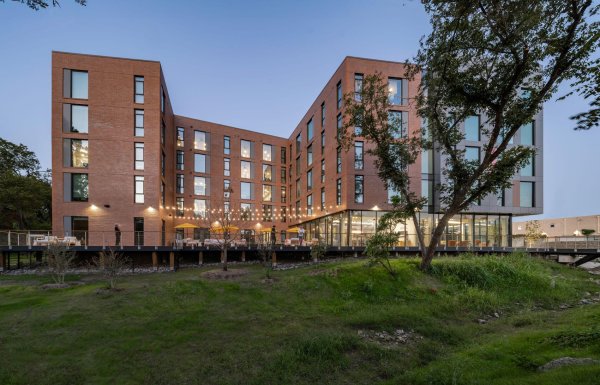
Perkins&Will’s Dallas studio recently completed a new affordable housing project to help combat this public health crisis. Today, Oak Lawn Place in Dallas represents north Texas’s first affordable housing development of its kind, the architects shared. It offers 100 percent affordable housing for LGBTQIA+ seniors, 55 years of age and older.

Karen Chen of Sunshine Studios created a bespoke mural on every floor of the building. (James Steinkamp)

The Dallas neighborhood of Oak Lawn has been the beating heart of north Texas’s LGBTQIA+ community for decades. Oak Lawn Place was built with the developer Matthews Southwest, Volunteers of America, and Resource Center, one of the largest LGBTQIA+ community centers in the country and a key north Texas HIV/AIDS service organization.

“I’m seeing Oak Lawn Place transform people’s lives,” Resource Center CEO Cece Cox said in a press statement. “A project like this elevates everyone and makes Dallas a better place.”

In plan, Oak Lawn Place is shaped like a C. This was meant to increase natural light exposure within every unit; this feature also provides a protective wing that surrounds an outdoor deck, hidden from public view. The deck has great views of the site’s sloping topography and a nearby creek.

Mural by Karen Chen of Sunshine Studios (James Steinkamp)

Karen Chen of Sunshine Studios created a bespoke mural on every floor of the building, which helps with wayfinding. Oak Lawn Place was designed with maximum accessibility in mind—everything from the hallway seatings, elevator lobbies, to wheelchair-friendly doorways are meant to provide a positive user experience.

The design of Oak Lawn Place is economical and efficient, yet still manages to have splashes of color here and there; the facade has a rainbow flag to signify all are welcome. The 80,000-square-foot building has a total 84 units. It’s within walking distance of public transit options and Resource Center’s Community Center.

The building has a shared kitchen and other community-building amenities. (James Steinkamp)

“Oak Lawn Place helps make Dallas a more inclusive, inviting city—for those considering moving here and for those wondering, as a queer person, ‘Will I truly feel welcome? Are there spaces in Dallas for me?’ We are honored and proud to bring this project to life,’” Cox continued.

A new healthcare facility, Resource Center Health, will open across the street from Oak Lawn Place later this year.

Elevate Your Listings with Jimmy Mackin’s 2024 Attraction Playbook

In this segment of the webinar, Jimmy Mackin explores the strategies that not only defined but also revolutionized the real estate landscape in Q4 of 2023, resulting in an impressive acquisition of 8,000 listings.


Envision 2024 as an expansive terrain of opportunities, where you, as the architect of your success, possess the ability to shape the outcomes. This mega webinar transcends being merely an event; it serves as your guiding compass for navigating the intricacies of the upcoming year.


Join me and a formidable roster of real estate experts for this Mega Webinar on Launching BIG in 2024! We’ll be revealing tried-and-true marketing strategies, methods to attract additional listings, tips on enhancing your mental resilience, and practices to keep you at the forefront with the latest industry insights.

Embark on more than just a fleeting glimpse into success; immerse yourself in an in-depth exploration of the core principles that have the potential to mold and redefine your entire business trajectory throughout the entirety of 2024.

This unique opportunity provides a comprehensive understanding of the strategic foundations and key insights that can position your business for unparalleled growth and achievement in the upcoming year.

As we delve into these fundamental principles, you’ll not only gain valuable knowledge but also equip yourself with the tools and strategies necessary to navigate the dynamic landscape of the real estate industry successfully.

his immersive experience goes beyond the surface, offering a profound exploration of the principles that will be instrumental in steering your business towards unprecedented success and prosperity in the evolving market conditions of 2024.

Blog at WordPress.com.

Up ↑