A Moscow court Friday found an LGBTQ travel agent who had killed himself in custody a year ago guilty of extremism, as Russia increasingly targets individuals it says undermine “traditional” values.
The posthumous ruling came a year after 48-year-old Andrei Kotov was found dead in his cell in a Moscow pre-trial detention centre.
Russia has heavily targeted the LGBTQ community under President Vladimir Putin, and Friday’s ruling against somebody who had died a year earlier is seen as a particularly symbolic example of how zealous the crackdown is.
Kotov, who ran a travel company called Men Travel, had said he was beaten by 15 men when he was arrested in November 2024.
The Moscow Golovinsky court found him guilty of taking part in “extremist activity” as well as using underage people for pornography, the independent Mediazona website reported from inside the court.
His lawyer had said in December 2024 that Kotov’s body was found in his cell and that investigators told her he died by suicide.
Rights groups have accused authorities of using the case as a show trial — not dropping it after his death to scare LGBTQ people.
In November 2024, Kotov described his arrest in court: “Fifteen people came to me at night, beat me, were punching me in the face.”
Putin has for years denounced anything that goes against what he calls “traditional family values” as un-Russian and influenced by the West.
In 2023, Russia’s Supreme Court banned what it called the “international social LGBT movement” as an “extremist organisation”.
Human Rights Watch has said that the ruling “opened the floodgates for arbitrary prosecutions of individuals who are LGBT or perceived to be, along with anyone who defends their rights or expresses solidarity with them”.
Russia has never been a hospitable environment for LGBTQ people, but has become far more dangerous since Moscow’s Ukraine offensive, which massively accelerated the country’s hardline conservative turn.
Six months into Russia’s invasion of Ukraine in 2022, Lilia Khvylka had a decision to make.
The transgender Ukrainian, who grew up on the Crimean Peninsula, was already living under Russian occupation; Vladimir Putin invaded and annexed that Ukrainian territory in 2014.
Now Khvylka was under house arrest for posting pro-Ukrainian messages on social media, she told Mezha, an independent Ukrainian news outlet.
“They opened a case against me under Article 207.3 of the Criminal Code of the Russian Federation – discrediting the Armed Forces of the Russian Federation. This is a very serious crime, which they classify as terrorism. They were going to set a preventive measure for me literally in the coming days.”
Khvylka had already been outfitted with an ankle bracelet to monitor her movements.
She recalled taking part in the Revolution of Dignity in 2014, which ousted pro-Russian President Viktor Yanukovych and restored the 2004 Constitution of Ukraine.
The same year, Putin invaded Crimea.
“When the Russian authorities arrived, freedom of speech completely disappeared. Ukrainian activists and journalists immediately began leaving or disappearing,” Khvylka said.
At the same time, Khvylka was navigating her transition.
“At 16, I already knew I would undertake a transgender transition, because I am a girl. But I was very afraid to go to doctors in Russia or talk to anyone about it.”
In Crimea, she was forced to hide her identity; there, she was known as Illya Gantsevskyi.
Facing the prospect of 15 years in prison for her posts and terrified her true identity would come to light, Khvylka fled. The so-called head of the Republic of Crimea, Sergey Aksyonov, had already declared war on LGBTQ+ people.
“I cut off my bracelet and ran away,” she said.
Khvylka left the peninsula through Russia and Belarus, holding only a Ukrainian birth certificate. Volunteers, whom she found online through an underground network of supporters, helped in her getaway.
With her flight to freedom, Khvylka avoided a fate that other LGBTQ+ Ukrainians have been unable to escape.
“This included torture, torment, public humiliation, bodily injuries, and sexual violence,” said human rights lawyer Karolina Palaychuk.
Documented testimonies from people in the Kherson region, occupied by Russia for nine months at the start of the war, confirm the terror inflicted on LGBTQ+ people in the Russian-occupied territory.
“One of the people who gave these testimonies said that he was stopped at a checkpoint, his phone was checked, they saw the relevant content, and they immediately threw him into a basement,” said Iryna Yuzyk, manager for the Center for Human Rights, ZMINA. “There, they beat him, forced him to wear a red dress, took him to interrogations in a red dress, naked, they tormented him. He was lucky to survive.”
Another captive was Diana, a 24-year-old lesbian.
“She used to work as a shop assistant. She had colorful hair; they drew attention to her. They came with searches to her home, found a rainbow flag, and also threw her into the basement, where there were another 15 people. Then they lined them up and shot them at random. Only four survived.”
Human rights advocates are advising all LGBTQ+ Ukrainians — in particular activists who have a history of advocacy in conflict with Russia’s 2023 Supreme Court ruling declaring the LGBTQ+ community a “terrorist organization” — to leave the occupied territories, where protection under Ukrainian law no longer applies.
According to NGO Prozhektor, at least 50 people who’ve left the occupied territories have endured torture and violence due to their LGBTQ+ identity.
Seven victims have filed statements; thirteen are witnesses to other crimes.
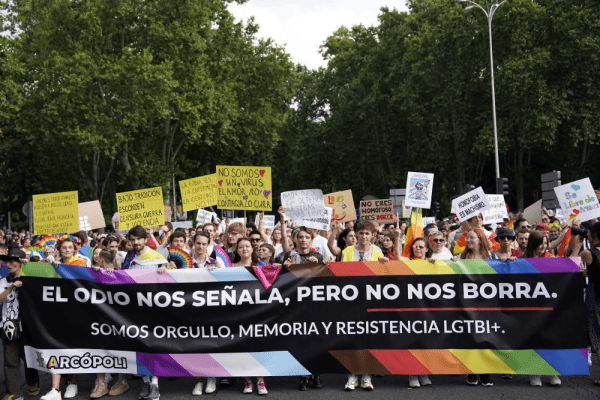
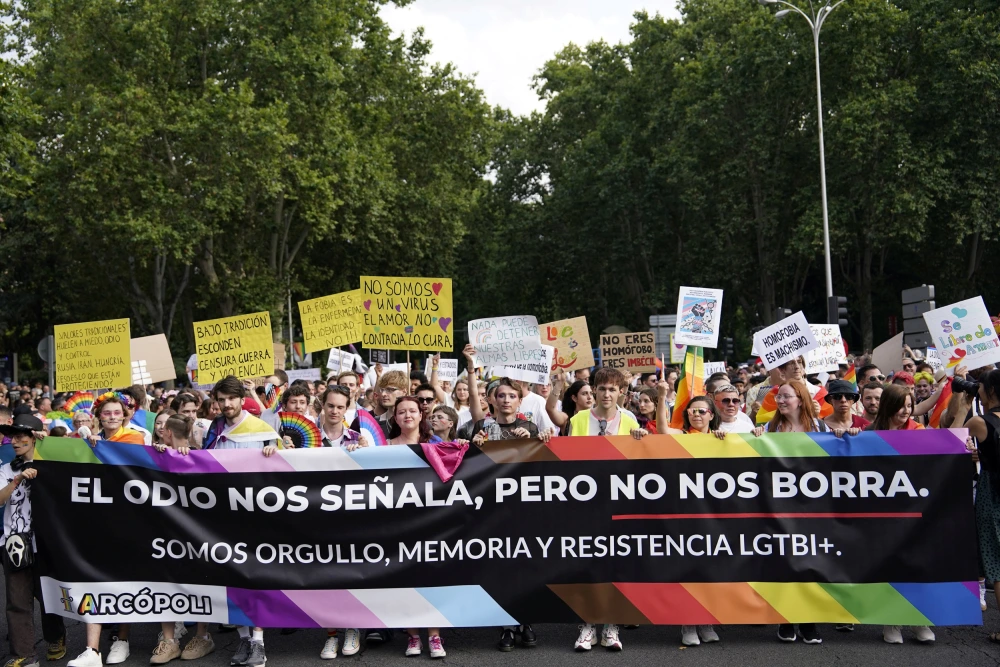
When Diana, a bisexual Russian asylum seeker, took part in her first Madrid Pride festival last year, she was delighted to see people waving the white-blue-white flag that has become a symbol of Russian opposition to its war on Ukraine.
She was also ecstatic to be among around 100 Russians who were waving LGBTQ flags and chanting, “Russia without Putin.” It felt surreal, said the 24-year-old, who did not want to give her last name for fear of retaliation.
“I couldn’t believe I would not be sent to prison. Everyone around was so happy,” she recalled as she marched again for Pride in the Spanish capital in July.
Also taking part was Ilia Andreev, who was vigorously waving a bright pink Mr Gay contest flag as the float he was perched on crept slowly through the crowds. For the 23-year-old, who fled Russia’s anti-LGBTQ laws in 2023, it was a moment to savour.
“I can be proud,” he said in Spanish.
The occasion was a far cry from the repression that drove him and other LGBTQ Russians out of their homeland in recent years, with many seeking refuge in Spain, which ranks fifth in the 2025 ILGA-Europe Rainbow Index, which ranks countries’ legal and policy practices.
“Spain is internationally recognized as a country that respects human rights and in particular the rights and freedoms of the LGBTQI+ community,” said Elma Saiz, the minister for Inclusion, Social Security and Migration, on International LGBTQI+ Pride Day in June.
Asylum applications from Russians more than doubled to 1,694 in 2023 from 684 in 2022, with Russia becoming one of the top 10 origin countries for applications in Spain, according to the Spanish Commission for Refugees (CEAR).
Of those processed, 59.7% received refugee status.
Elena Munoz, coordinator of the legal team at CEAR, said there had been a rise in Russian LGBTQ-related applications, although data on specific motives for asylum applications are not yet being collected.
The main reasons Russians gave for leaving their home included forced recruitment into the armed forces and the deteriorating human rights situation, including regarding gender identity and sexual orientation.
As well as introducing a raft of anti-LGBTQ laws, Russian President Vladimir Putin has been using the LGBTQ community as a political scapegoat, said Marc Marginedas, a journalist and expert in Russian affairs.
“Propaganda has fostered a climate comparable to Nazi Germany,” Marginedas said, saying Putin was using an “external enemy” to rally society and distract from military failures.
Legal crackdown in Russia
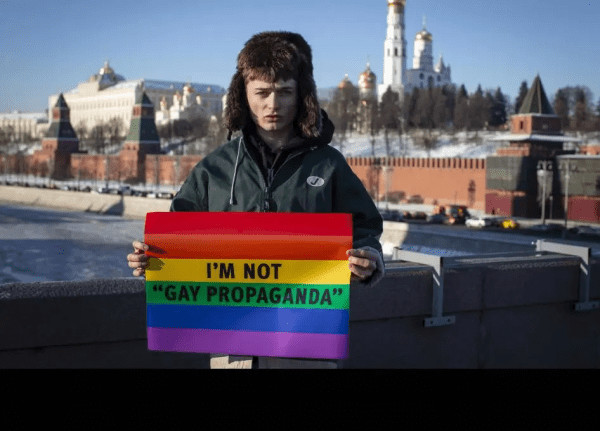
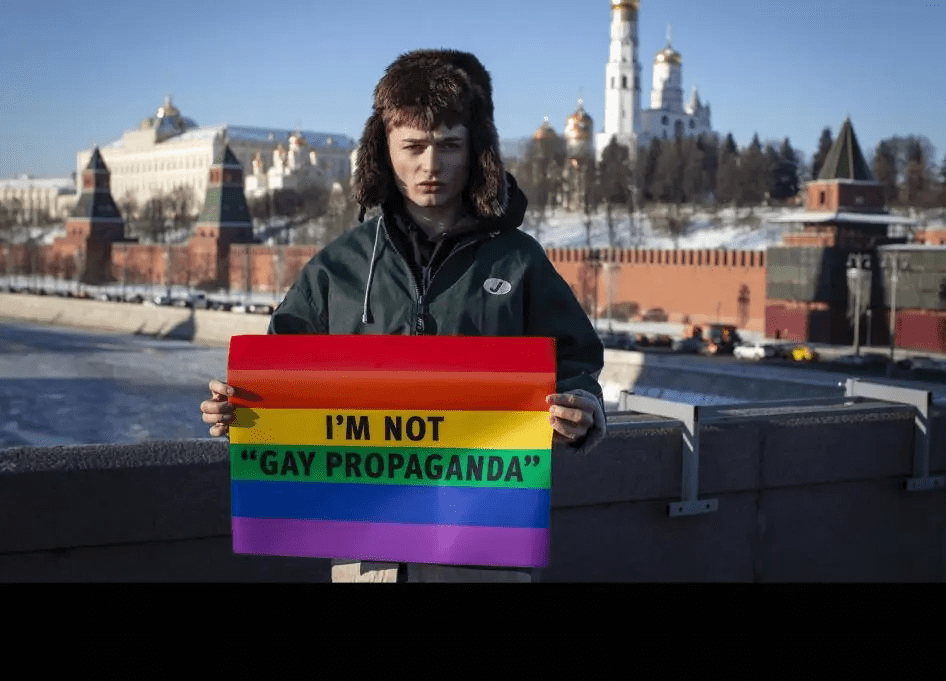
In 2013, Russian lawmakers passed a government-sponsored ban on distributing “propaganda of nontraditional sexual relationships” among minors.
In December 2022, after Russia launched its invasion of Ukraine, Putin signed an amendment to the law, extending the prohibition to all age groups.
The crackdown has led to the arrest of journalists, lawyers and human rights activists, with many others leaving the country.
Andreev, who worked as a TV journalist in the city of Kazan in southwestern Russia, said he had to hide his identity after he was accused of spreading “LGBTQ+ propaganda.”
“When I once wore earrings on air, I was called in by the news director and the executive program producer. She told me they had received many calls complaining about so-called gay propaganda because of the earrings,” he said.
He decided to come to Spain in 2023 on the recommendation of a friend, who had also moved.
Diana said she was fired after her boss saw her kiss her partner. She did not want to give details of her job or where she lived for fear of retribution.
While on holiday in Georgia in 2022, her home in Russia was visited by authorities because of her volunteer work with Ukrainians in Russian-occupied areas, and she decided she could not return. Growing anti-LGBTQ rhetoric in Georgia pushed her to move to Spain two years later.
Red tape and barriers
Andreev and Diana both applied for asylum and are still waiting for a ruling.
The legally mandated six-month process often stretches much longer, even up to two years. After six months, asylum seekers are allowed to seek work.
But it can take months to get an initial appointment with immigration authorities, and without this, asylum applicants cannot access state aid or support from organizations like CEAR.
Delays are also driving an illegal black market.
According to NGOs, Spanish police and officials, criminals collect immigration appointments using bots and then sell these so-called “mafia de citas,” or mafia appointments, for hundreds of euros on WhatsApp or Telegram to desperate asylum seekers.
And now things are getting for Russians hoping to submit asylum claims in Spain.
From July 12, Spain requires Russian citizens to obtain transit visas to pass through the country.
In the past, Russians would buy a ticket with a layover in Spain and then seek asylum during their stopover.
“It makes it difficult to reach safe territory, in this case Spain, because they no longer have a legal and safe route,” said Munoz, adding that reforms were needed to make the system more efficient.
The Ministry of Foreign Affairs, which is responsible for visa policy, did not respond to requests for comment.
While they await their asylum decisions, Diana and Andreev are rebuilding their lives.
Andreev, who volunteers in an LGBTQ rights group, has found a home in a small town near Madrid and is working on his Spanish — he hopes to return to journalism one day. But he has struggled to build new relationships.
The stress of job hunting and trying to get all the documents he needs, plus the time it takes up make it hard to focus on building connections, he said.
Diana now has stable online work and says she has found her chosen family in Madrid, mainly thanks to online networks of LGBTQ+ Russians who offer each other support.
She feels free, even if she still fears Russian retaliation.
“If I want, I can date women, I can date men, I can date whoever. I’m not in a hurry. Why would you be in a hurry? The Spanish lifestyle relaxes you a little bit.”
Alexei was married to a woman in Russia before fleeing both his marriage and the country for the safe haven of Argentina.
“[In Russia] there’s a lot of pressure to be in a relationship at a young age,” the 24-year-old dental student told the Herald. “I thought that being in a heterosexual marriage would stop people from asking so many questions.”
In recent years, Russians have emigrated to Argentina in droves to avoid conscription in the Russia-Ukraine war. Others, meanwhile, have fled a country that has grown increasingly hostile to its LGBTQ community under the authoritarian rule of President Vladimir Putin.
Over a period of weeks, the Herald spoke with several such emigrés about their experiences in Buenos Aires — and why they ultimately decided to abandon their native Russia. Because their sexual preferences and political views could violate Russian law against “illegal propaganda,” several asked to be identified exclusively by their first names.
“I’ve been dreaming of living in a gay-friendly country since I learned I was gay,” said Sergei Vakhrushev, a blogger based in Buenos Aires.
Vakhrushev was bullied relentlessly as a teenager in the small port city of Vladivostok and finally came out after moving to Moscow. Even then, he was only willing to tell a few close friends, as an adult.
Pride celebrations criminalized
As recently as 2010, conditions for the LGBTQ community in Russia were not significantly worse than in most western countries. But in 2013, Vladimir Putin signed into law a ban on the distribution of “propaganda” depicting “non-traditional sexual relationships” to minors. The ban’s definition of “propaganda” was purposefully ambiguous, which left a range of activities, from pride celebrations to public displays of affection, subject to criminal penalty.
In the years after the law went into effect, the government increased its attacks on LGBTQ representation in media and public affairs. As a result, hate crimes against queer people in Russia jumped drastically, with one study finding that attacks had tripled. For many in the LGBTQ community, going to the police was often not an option, as doing so was tantamount to confessing to a crime.
Like in other hostile societies, these persecuted groups have developed strategies to navigate Russia’s social and political pressures. But after Putin invaded Ukraine in February 2022, many in the queer community felt a new urgency to leave the country.
One such Russian was Nika, 29. She was able to access hormone replacement therapy in Russia when she began her transition in 2019, legally changing her name to reflect her gender identity.
When the Russian government criminalized all gender-affirming healthcare in July 2023, Nika had been living in Argentina for over a year. And by the time Russia expanded its propaganda law to apply to anyone, regardless of age, she had already made a new life for herself in Buenos Aires. “They decided to search for new targets,” Nika said. Under the new law, “existing is propaganda.”
Like many queer Russian immigrants, Nika applied for asylum when she first arrived in Argentina. During the application process, which she described as “chaotic,” she knew few Russians with whom she could compare her experience. As more emigrés arrived and shared their stories, however, she found — and helped build — a community of her own.
‘I just wanted to hold hands’
Many queer Russian immigrants expressed surprise at the extent to which members of the LGBTQ community in Argentina could openly express themselves.
“I just wanted to hold hands with a man and not feel judged,” said Vitalii Panferov, a psychologist based in Buenos Aires. “Even in Moscow, I would only do that at night, where no one could see in the dark. When I got to Argentina, I saw so many gay couples holding hands freely.”
Vitalii initially moved to South Africa in October 2022 to get legally married. He and his partner moved to Buenos Aires the following January. They ended up initiating divorce proceedings later that year.
As he was going through this difficult process, Vitalii found a not-for-profit support group for LGBTQ people in abusive relationships run by a Russian psychologist. In Russia, such a service would be considered illegal.
In Vitalii’s telling, the group not only helped him get back on his feet but inspired him in his own psychological practice, which primarily consists of counseling gay men and couples.
Vakhrushev hopes to get married and raise a family — something that would have been impossible in Russia. In November 2023, he came out to his mother and sister, who still live in Vladivostok, after attending his first Pride march in Argentina.
“I knew I was safe here,” he said.
‘I feel good for the first time’
Kirill Dolgov found it impossible to be openly gay in Russia. A former employee of the Russian government, he told the Herald that he was forced to change careers after being repeatedly questioned about his sexuality. In 2022, Dolgov finally moved to Argentina, where he co-founded a marketing firm with a fellow Russian emigré.
“I feel good for the first time,” he said.
After living a “closed life” in Russia, Dolgov works to foster opportunities and social spaces for other queer Russian immigrants in Argentina by collaborating with fellow emigrés and hosting events.
He also manages a wine company, Bodegas Arte, which hires immigrant artists from Russia to design its labels, each drawing inspiration from Argentine culture. It doesn’t make much money, but he claims it has helped familiarize him with Latin American markets while supporting the Russian community.
In October, Bodegas Artes co-sponsored the queer film festival Side to Side at the LGBTQ cultural center Casa Brandon in the Villa Crespo neighborhood of Buenos Aires. The festival was first held in St. Petersburg but has been barred from showing films in Russia since 2021.
Last year’s event marked the first of its kind held outside of Europe and offered films with Russian, English, and Spanish subtitles — as well as an opportunity for queer Russians to mingle with Argentina’s LGBTQ community.
“Queer expats will often turn to other queer expats because both have the experiences of being sexual dissidents and foreigners, in common,” explained Ryan Centner, a professor of urban geography at the London School of Economics who studies LGBTQ expatriate populations. “Queer expatriates often feel the most ease and trust with other queer people. You don’t have to explain or strategize in the same way that you likely would when engaging with someone who is not queer.”
Last year, Jeny, a 44-year-old art teacher, launched Feria DA! — a bazaar at the LGBTQ bar and social club Feliza in Almagro where queer Russian artists and small business owners can advertise and sell their products. As she told the Herald, many of its vendors are struggling to make ends meet amid the rising cost of living.
Jeny hopes to educate people not just about Russian arts and culture but about the diversity within the Russian immigrant population.
“There’s a problematic stereotype that all Russians in Argentina are rich,” she said.
Recent events at Feria DA! have included lesbian speed dating and queer tango, as well as sales of everything from Russian food to artisanal jewelry and ceramics.
‘I don’t want to go back into the closet’
On February 1, thousands took part in anti-fascist pride marches across Argentina and the West to protest Javier Milei’s attacks on the “LGBT agenda” at the 2025 World Economic Forum. While some Russian immigrants considered the comments harmless compared to the oppression they experienced in Russia, others expressed concern that the country that had provided them sanctuary was regressing.
When Max, 29, sought asylum in Argentina in January 2023, they discovered that they were able to indicate “other” on their application form. It was the first time that they had been able to identify as nonbinary in an official capacity.
Although they acknowledged that the 2023 elections in Argentina were democratic, Max admitted to the Herald that they sometimes feel as though they’ve left “one dictatorship for another.”
“We are not the kinds of refugees this government wants,” Max said. “Do we have the luxury of tolerating what’s happening in Argentina?”
Nika likewise noted that after escaping a ruthlessly anti-LGBTQ regime, “it feels like Groundhog Day. We are used to preparing for the worst. I don’t want to go back into the closet.”
“I see people scared or skeptical [about Milei’s comments], but we already lived it,” she added. “I want to share our experience.”
Here to stay
The LGBTQ Russian community in Buenos Aires largely organizes on Telegram, a messaging application commonly used in the Russian-speaking world. A single queer channel has well over 1,000 members.
Kirill described the group as one “big family” comprising people from many different backgrounds. Not everyone gets along all of the time — what community does? — but its members generally “want to help people with their troubles.”
Not long after his divorce, Panferov joined a Russian-Argentine choir in the hopes of making new friends. It was the first time he said that he didn’t feel judged by his fellow Russians for his sexuality.
“After living in Argentina for a while, you start to realize that it’s actually less normal to be judgmental,” he told the Herald. “That kind of judgment is not okay here.”
After escaping Russia a little over two years ago, Alexei started learning Spanish and immersing himself in his new home. “I never considered staying in my bubble,” he said, referring to the Russian immigrant community.
Even so, he is grateful for the support he received from fellow Russians in navigating the asylum process and finding work early on. He told the Herald that he invites fellow Russian queer people to his clinic for dental work as a way to practice and pay it forward.
“99% of the Russians I know [here] are gay,” he laughed. “We help each other however we can.”

 fleeredstates.blog
You must be logged in to post a comment.