
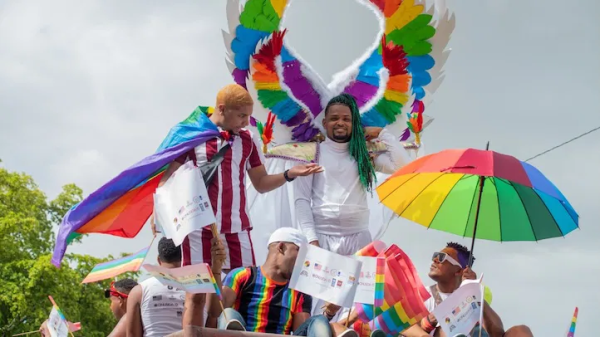
Read more at LGBTQ Nation.
The Dominican Republic’s Constitutional Court recently struck down provisions that criminalized consensual same-sex conduct by officers in the country’s National Police and Armed Forces.
Codes of Justice for the two security forces previously punished same-sex “sodomy” by officers with up to two years in prison. No equivalent penalties existed for heterosexual sexual acts.
The court ruled that those references to sodomy are “not in accordance with the Constitution,” and ordered their removal.
The court emphasized that the criminalization of same-sex conduct in the security forces lacked “a legitimate constitutional interest or aims to strengthen and improve institutional efficiency.”
“No regulation issued by state authorities or private individuals may diminish or restrict in any way a person’s rights based on their sexual orientation, an essential aspect of personal privacy and the free development of personality,” the court said in a resounding affirmation of the personal rights and freedoms of LGBTQ+ people in the Dominican Republic.
“For decades, these provisions forced LGBT officers to live in fear of punishment simply for who they are,” said Cristian González Cabrera, a senior researcher with Human Rights Watch, which filed an amicus brief in the case last year.
“This ruling is a resounding affirmation that a more inclusive future is both possible and required under Dominican law.,” Cabrera added.
The Human Rights Campaign (HRC) called the ruling, made public on Tuesday, “a landmark victory for equality, ending a regime of state-sanctioned discrimination that violated the human rights of lesbian, gay, bisexual, and transgender officers.”
“This positive outcome represents the first case of general applicability advancing equality and dignity for LGBTI people in the Dominican Republic,” said Anderson Javiel Dirocie De León, one of the lawyers who brought the legal challenge against the policy. “There is still a long way to go, but it sets a historic precedent in the fight against discrimination based on sexual orientation.”
The Dominican Republic lags behind other island nations in the Caribbean on the issue of LGBTQ+ rights. The country doesn’t recognize same-sex unions, lacks discrimination protections, has outlawed adoption by gay couples, and doesn’t recognize nonbinary citizens. There are, however, no LGBTQ+ censorship laws in the country, and gender-affirming care remains legal there.
In the Caribbean region, five Anglophone countries — Grenada, Guyana, Jamaica, Saint Vincent and the Grenadines, and Trinidad and Tobago — still have laws on the books that criminalize consensual same-sex conduct, a relic of British colonialism. Similar laws are widespread in Africa as well.
“President Luis Abinader and Congress should use the momentum of this landmark ruling to advance long-overdue protections for LGBT people,” said HRC’s González. “By moving forward with laws addressing discrimination and violence, the Dominican Republic can align itself with progress in Latin America and demonstrate a genuine commitment to equality and dignity for all.”


 fleeredstates.blog
You must be logged in to post a comment.