After Trans People, Trump Now Erasing Bisexual People From Stonewall National Monument

Read more at Erin in the Morning.

Earlier this year, the Trump administration digitally erased transgender people from the Stonewall National Monument, scrubbing them from the history they helped shape. The decision sparked widespread protests at the civil rights landmark and raised alarm about broader efforts to censor transgender people from the public record. Now, new signs suggest the administration has set its sights on another target: bisexual people. Key historical and cultural pages associated with the Stonewall site have been updated to describe the uprising as a milestone for “gay and lesbian rights,” quietly removing any mention of bisexual or transgender individuals.

Signs that the pages dedicated to Stonewall were being tampered with emerged early in Trump’s second presidency. Before the first update, the Stonewall National Monument page acknowledged that “before the 1960s, almost everything about living openly as a lesbian, gay, bisexual, transgender, or queer (LGBTQ+) person was illegal.” The revised version then stated, “almost everything about living openly as a lesbian, gay, bisexual (LGB) person was illegal.” Now, a new version of the page indicates that “Before the 1960s, almost everything about living authentically as a gay or lesbian person was illegal.”

You can see the changes here:

The changes were not limited to the front page. In the “History and Culture” section, the page once indicated “Stonewall was a milestone for LGBTQ civil rights that provided momentum for a movement.” Then it was changed to “Stonewall was a milestone for LGB civil rights that provided momentum for a movement” by the Trump administration. Now, the page says that it was a milestone for “gay and lesbian” civil rights. Likewise, the page now reads that living “openly as a member of the Stonewall comunity |SIC| was a violation of law,” rather than living as an openly LGBTQ+ person, as it had previously read.

The erasure is historically inaccurate. Stonewall was heavily led by transgender and gender-nonconforming leaders like Sylvia Rivera, Marsha P Johnson, and Zazu Nova. At Stonewall, Sylvia Rivera famously stated that while she did not “throw the first Molotov cocktail,” she did throw the second. Transgender woman Zazu Nova is among those credited with “throwing the first brick,” sparking the uprising. Marsha P. Johnson, another key figure in the protests that followed, played a critical role in shaping the movement.

Likewise, bisexual people played a pivotal role in the Pride movement that emerged from Stonewall. Brenda Howard, a bisexual rights activist often referred to as “the mother of Pride,” helped organize the rally that became the Christopher Street Liberation Day March on the first anniversary of the uprising. Both transgender and bisexual people have long viewed Stonewall as a civil rights milestone—and for good reason. Living openly as either in the 1960s carried enormous risk, and both communities were targeted in the police raid that sparked the movement.

These edits were not the only ones made to Stonewall since Trump took office. Individual pages dedicated to transgender figures instrumental in the Stonewall uprising were also altered to erase transgender references. The changes were often sloppy and rushed, revealing the haphazard nature of the effort. In one glaring example, Sylvia Rivera’s section originally stated, “At a young age, Sylvia began fighting for gay and transgender rights.” The revised version read, “gay and rights,” with the word “transgender” removed entirely, rendering the sentence nonsensical:

Bisexual, transgender, and queer people were at the forefront of the Stonewall movement. Though the language was still evolving, many of the patrons defied conventional categories of gender and sexuality, refusing to be neatly classified. Erasing them from Stonewall is not only historically false—it is a deliberate act of political revisionism. The recent removal of “bisexual” from official Pride histories is a warning: attacks on transgender people will never stop with us. They are part of a broader effort to narrow the scope of who is allowed to belong, to be seen, and even to be remembered.
NYC’s Stonewall monument excludes trans flags this year, but activists are defying the ban

*This is reported on LGBTQ Nation.

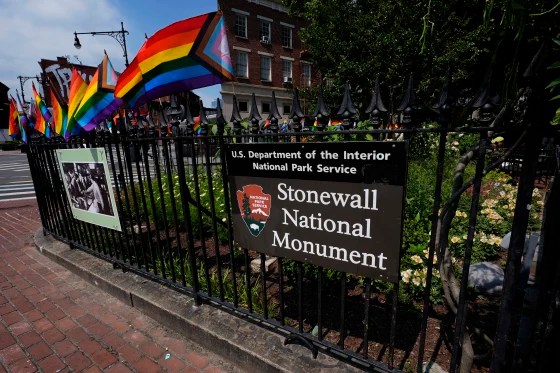
For the past nine years, the transgender flag was included among those that flew around the Stonewall National Monument in Christopher Park during Pride Month. However, the National Park Service(NPS) will no longer be displaying the Transgender Pride flag or the Progress Pride flag, stating a change of protocol as the reason.

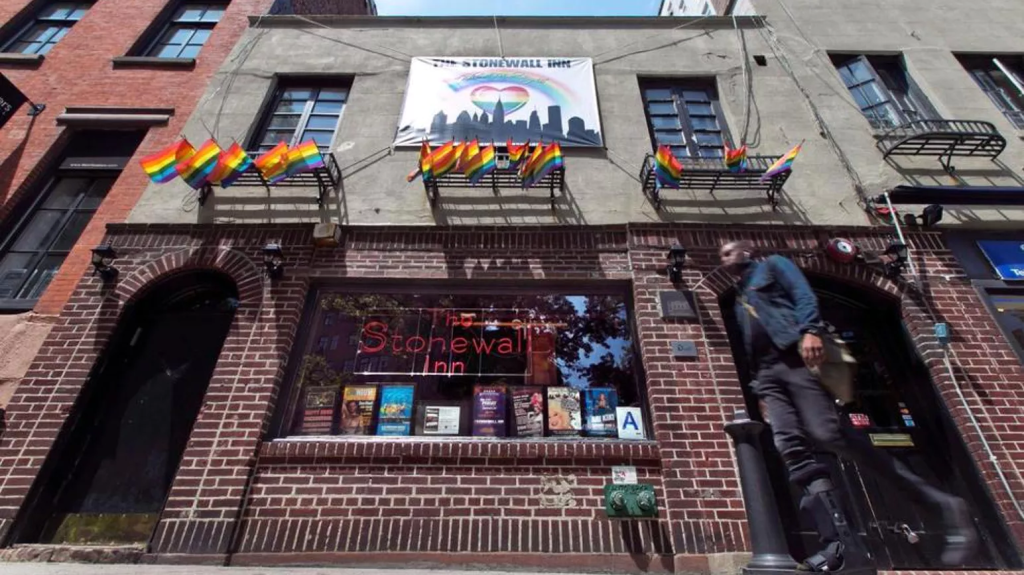
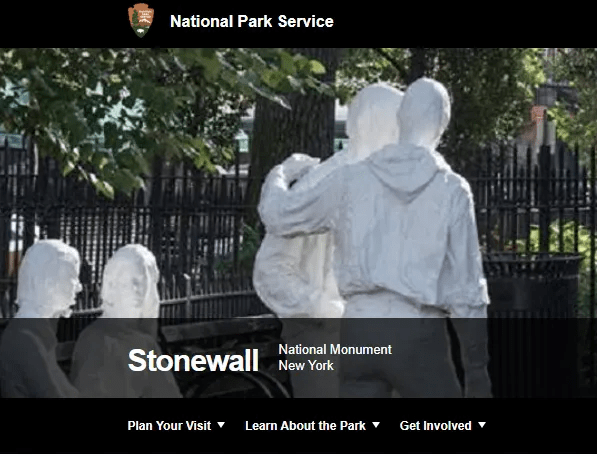
The New York City monument commemorating the Stonewall Uprising of 1969 is the first U.S. National Monument dedicated to LGBTQ+ rights, having been designated as such in 2016 by then-President Barack Obama. It has since become tradition for the monument, located in a park across the street from the Stonewall Inn, to be adorned with various Pride flags, including the trans flag. NPS funds the installation of these flags. This year, however, NPS told photographer, advocate, and installation creator Steven Love Mendez that the park will not allow Trans or Progress Pride flags this year.

The censorious move comes after the Trump administration wiped all references to trans and nonbinary people from the monument’s website in February, as part of his wider initiative to purge trans and nonbinary people from all references and resources provided by the federal government. The removal of trans people from a monument in which a transgender person was considered a key figure has led to outrage, with many coming to the monument to protest.

Speaking to CBS, Mendez comments, “It’s a terrible action for them to take.” he continues, “I used to be listed as an LGBTQ activist, and now it says ‘Steven Menendez, LGB activist,’” Menendez said. “They took out the Q and the T.”

The trans-exclusionary initialism of “LGB” is sometimes used by transphobes to encourage a social and ideological split between gay, lesbian, and bisexual people and transgender people, based on their differing gender experiences.

Upon learning of the monument’s trans erasure, many New Yorkers and tourists came to the monument to set up unauthorized pride flags in protest, including smaller trans flags planted in the soil.

Jay Edinin of Queens, New York, was one of the people who brought his own flag and told CBS, “I’m not going to stand by and watch us be erased from our own history, from our own communities, and from the visibility that we desperately need right now.”  

Willa Kingsford of Portland, Oregon, stated, “I think it’s absurd. I think it’s petty,”

Patty Carter of Los Angeles, California, stated, “It’s horrible. They’re changing all of our history.”

The Stonewall Riots, to which the monument is dedicated, to began on June 28, 1969. During that time law enforcement commonly raided queer bars since New York had outlawed homosexuality and “cross-dressing.” During the raid at the Stonewall Inn, the LGBTQ+ community decided they had reached their tipping point and fought back against law enforcement. The resulting six days riots were said to have marked the beginning of the LGBTQ+ rights movement and became the reason why Pride Month is celebrated in June.

Two of the most notable figures in this uprising were Marsha P. Johnson and Sylvia Rivera, both trans women. It is believed that Johnson instigated the riot by throwing a brick at a police officer. Rivera is also considered to be a key instigator; she is said to be one of the first people to fight back against the police, to which many quote her as saying, “I’m not missing a minute of this—it’s the revolution!”

References to transgender and queer removed from Stonewall National Monument’s web page

*This was first reported by NBC News.

References to transgender and queer people were erased from the Stonewall National Monument’s web page, marking one of the latest moves of the current administration after President Donald Trump said the government would recognize male and female as the only biological sexes.

The page used to say “LGBTQ+,” according to an archived version of the National Park Service’s website. It now only says “LGB.”

Stacy Lentz, co-owner of the Stonewall Inn and the chief executive of the nonprofit Stonewall Inn Gives Back Initiative, said the Trump administration was trying to “erase trans people from history and from existing.” A protest is scheduled for noon on Friday.

“There is no Pride without Trans folks leading that fight! Trying to erase them from the Birthplace of the modern LGBTQ+ rights movement will not happen! We need to show up and speak out for our trans and nonbinary siblings who are under attack,” Lentz wrote in an Instagram post announcing the protest.

In a joint statement, the Stonewall Inn and the Stonewall Inn Gives Back Initiative said it was “outraged.”

“This blatant act of erasure not only distorts the truth of our history, but it also dishonors the immense contributions of transgender individuals – especially transgender women of color – who were at the forefront of the Stonewall Riots and the broader fight for LGBTQ+ rights,” the statement read.

“Let us be clear: Stonewall is transgender history. Marsha P. Johnson, Sylvia Rivera, and countless other trans and gender-nonconforming individuals fought bravely, and often at great personal risk to push against oppressive systems,” it continued. “Their courage, sacrifice, and leadership were central to the resistance we now celebrate as the foundation of the modern LGBTQ+ rights movement.”

The statement said removing the word transgender is an attempt to marginalize the people who fought for change in the community. They called it a “direct attack on transgender people” and demanded the word be added back to the website.

National Park Service cracks down on Pride leaving LGBTQ+ rangers feeling betrayed

This blog is originally appeared at Advocate.

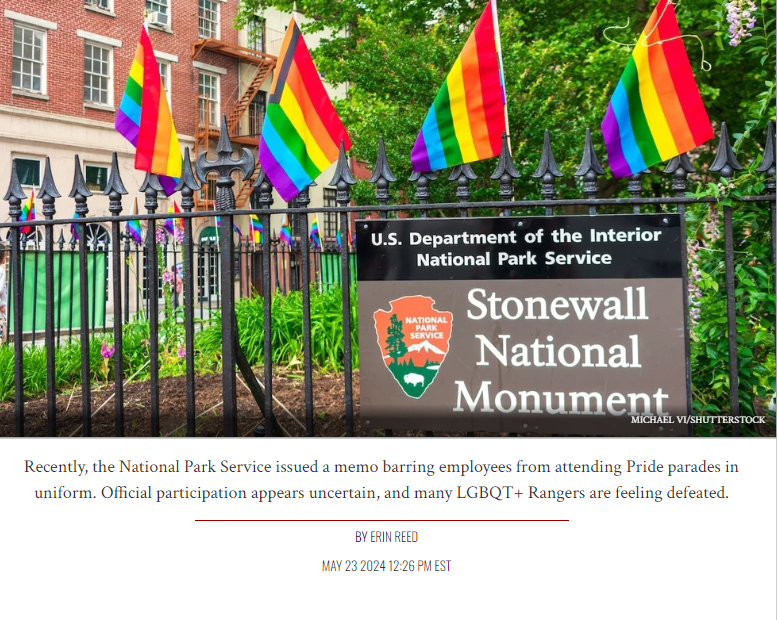
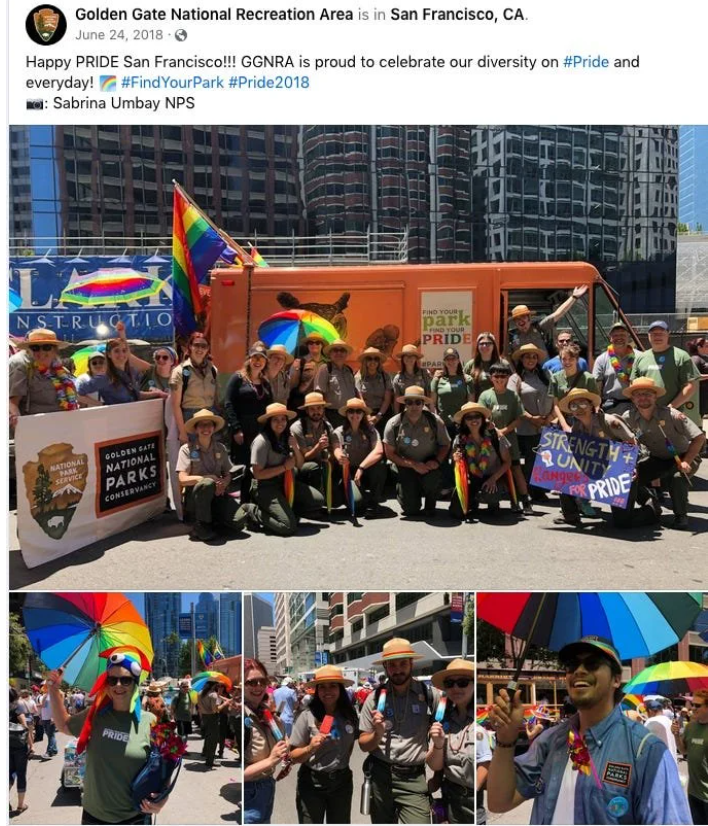
On May 17, the National Park Service (NPS) made an official ruling that park rangers and other employees are no longer allowed to attend Pride events and parades in uniform. This marks a reversal of a long-standing tradition of NPS participation in Pride parades across the U.S., including the presence of official delegations. Anonymous LGBTQ+ NPS employees have expressed feelings of betrayal, noting that participation in major city Pride events is now in question, as several parade applications remain unprocessed and approvals are unclear. The decision comes at a time of heightened scrutiny on LGBTQ+ issues nationwide, with increasing crackdowns on Pride flags and LGBTQ+ rights—largely driven by Republican lawmakers and appointees. This time, however, the policy change is being driven by the NPS itself, under the leadership of a director appointed by President Biden.

The new directive was first shared in an internal memo to NPS staff, which did not specifically mention Pride but highlighted that “requests from employees asking to participate in uniform in a variety of events and activities, including events not organized by the NPS,” are in conflict with agency policy. The memo cited a policy stating that NPS employees cannot wear their uniforms to events that might be interpreted as supporting “a particular issue, position, or political party.” LGBTQ+ employees, however, have criticized this application of the policy, arguing that Pride is about identity and diversity, not a political stance or issue. They pointed out that under the previous guidelines, NPS employees were able to participate in Pride events with approval, and that internal Employee Resource Group (ERG) documents, such as the “OUTsiders Guide to Pride,” had endorsed such participation for years.

In a follow-up statement, the NPS argued that the ERG guide conflicts with official policy and that discussions are underway to review it and other related documents. The agency also emphasized that its participation in Pride celebrations could be perceived as an endorsement of a particular “issue of public concern,” which they described as a justification for limiting official participation. In their view, what has long been seen as a celebration of diversity and inclusion is now categorized as a political statement, with the NPS deeming official participation in such events “extremely limited.”

The decision sparked immediate concern among National Park Service employees and LGBTQ+ advocates. Many pointed out that the NPS has a long history of participating in Pride parades across the country, even under the Trump administration, which was known for its efforts to restrict LGBTQ+ representation in federal agencies, including at embassies. Employees also highlighted the significant role the NPS plays in managing Stonewall National Monument, a site dedicated to LGBTQ+ history and civil rights. Notably, the founding documents of Stonewall National Monument explicitly state that its purpose is “to preserve and protect Christopher Park and the historic resources associated with it” and “to interpret the Stonewall National Historic Landmark’s resources and values related to the lesbian, gay, bisexual, and transgender civil rights movement.” This has raised questions about how the NPS can reconcile this mission with its new stance on Pride participation.

One NPS employee, speaking anonymously, revealed that several requests for Pride parade participation are currently “collecting dust” on desks, waiting for approval for representation in major city Pride events. When asked about the decision to categorize Pride festivals as an “issue of public concern,” the employee responded, “Pride is not political, it’s not a cause, you just are LGBTQ+. It’s a celebration of who we are.” They added, “Morale is just so low right now. There’s not a lot of fight left in us.”

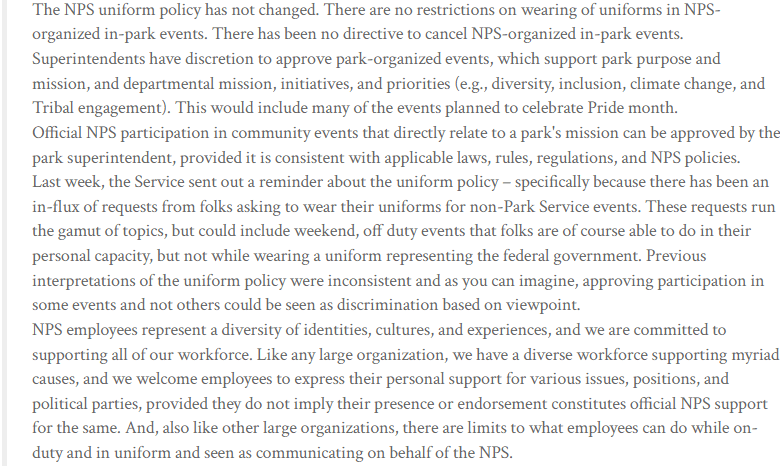
I reached out to an NPS spokesperson for clarification on whether the agency would continue participating in major city Pride events this year, as it has in previous years. The spokesperson responded that the policy “had not changed,” noting that “previous interpretations of the uniform policy were inconsistent” and that approving participation in some events while denying others could be perceived as “discrimination based on viewpoint.” While the spokesperson confirmed that in-park Pride events have not been canceled, they did not clarify whether NPS employees would continue to participate in major U.S. city Pride parades or celebrations. Attempts to follow up on this question went unanswered.

The characterization of Pride as a potentially “political” event raises concerns, particularly given the founding documents of Stonewall National Monument, which directly reference the “resources and values” of the LGBTQ+ community. NPS resources currently available on the site encourage people to “Celebrate Pride” and emphasize that “The LGBTQ experience is a vital facet of America’s rich and diverse past.” The resource underscores the importance of not making LGBTQ+ people invisible, stating, “By recovering the voices that have been erased and marginalized, the NPS embarks on an important project to capture and celebrate our multi-vocal past.” By barring employees from wearing Pride symbols or participating in Pride events, the NPS may unintentionally appear to be erasing and marginalizing its LGBTQ+ employees—contradicting its own stated mission.

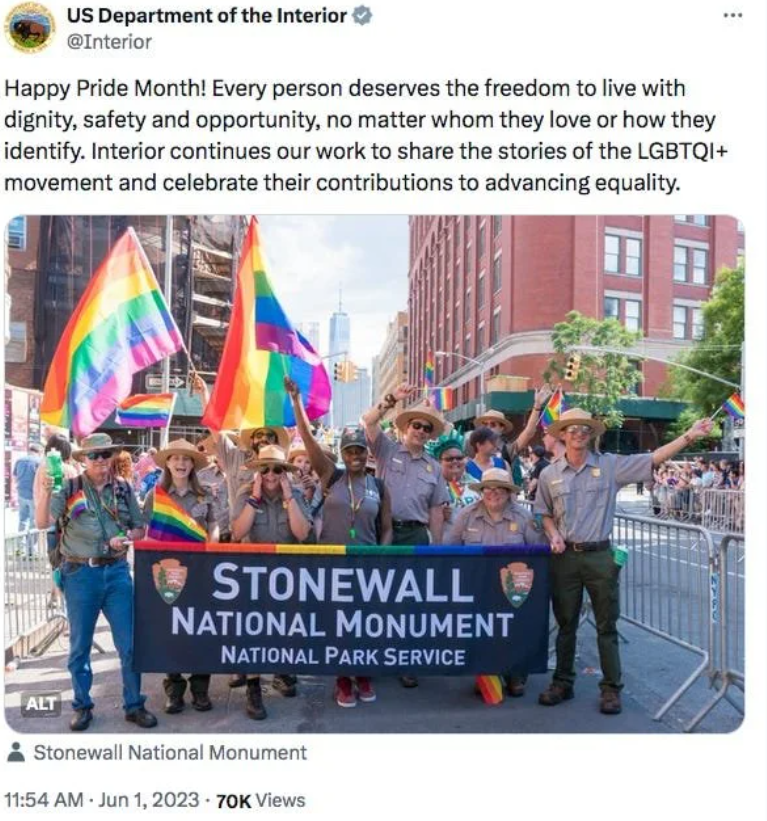
National Park Service employees have marched in uniform in Pride parades for years. In 2014, for example, Christine Lenhertz, a member of the NPS, requested permission for a group of LGBTQ+ park employees to wear their uniforms while participating in a Pride parade. Initially denied, the group filed a complaint, prompting a ruling from the Office of the Solicitor for the Department of the Interior, which determined there was no reason to prevent them from marching in uniform. Since then, NPS contingents have regularly participated in Pride events across the country.

The future of Pride parade participation for NPS employees in uniform remains uncertain. While it seems that some Pride events within National Parks, like those at Stonewall, may still take place, external participation in major city Pride events appears to be on hold in at least some locations across the U.S. The possibility of individual or smaller LGBTQ+-affiliated Park Ranger contingents joining city Pride celebrations looks even less likely, with little hope of approval for participation.

You can read the full response from an NPS spokesperson to the request for comment here:

Blog at WordPress.com.

Up ↑