
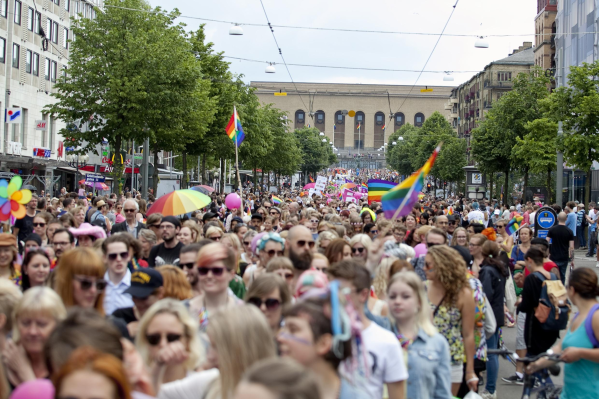
The Swedish Migration Board has posted the following information for LGBTQ asylum seekers.
If you have a well-founded fear of being persecuted because of your sexual orientation, gender, gender expression, gender identity or other membership in a certain social group, you may be a refugee and have the right to protection in Sweden. This is stated in the Refugee Convention, Swedish law and EU rules.
Asylum application and rules
Persecution can be threats or violence against your life or health. It can also be about laws and regulations or people’s views that mean that you are subjected to serious violations because of your sexual orientation. It can be, for example, punishment or extensive discrimination such as not being able to go to school, choose a job or receive healthcare.
The right to express yourself and engage politically without fear of persecution regardless of ethnicity, religion, gender or sexual orientation are also examples of what can give you the right to stay in Sweden.
It does not matter whether the persecution comes from the authorities of your home country or if your family or other people threaten you. The Swedish Migration Board will then investigate what could happen to you if you return to your home country in the future and whether the authorities there are unable or unwilling to protect you against the persecution that you say you are at risk of.
The Swedish Migration Board will register you as an asylum seeker with the name, date of birth and legal gender that appears on your identity documents. Swedish law does not allow us to register you with a different name, but if you wish to use a different address or pronoun, you should tell us so that we can make a note of this.
Investigation
When the Swedish Migration Board decides whether you need protection and can therefore be granted a residence permit in Sweden, an investigation will be carried out with you to understand what your life has been like and why you are afraid of returning to your home country. If the reason is your sexual orientation, gender expression or gender identity, it is important that you tell us as early as possible.
Read more about how to apply for asylum
The Swedish Migration Board knows that it can be difficult to tell someone you have never met about such things. It may even be the first time you have talked about it with someone and the boundaries of what feels personal and private are different for everyone. It is important that you still tell us as much as possible about all your reasons for asylum. The more details you can talk about, the better basis the Swedish Migration Board has for its decision. The investigator will also ask questions about your sexual orientation, your gender expression or gender identity, the thoughts and feelings you have had about it and your relationships with family, friends and the society you have lived in. We are bound by confidentiality and do not tell people who are not working on your case about what you tell us.
If you feel that the officer conducting your investigation does not understand what you are saying, or if you have information that the officer does not ask for, you must tell them as soon as possible. Do not wait until you have received a decision on your case.
You have the opportunity to express your gender preferences for the interpreter, caseworker and assistant so that you feel safe during the asylum process, and the Swedish Migration Board will then try to help you with your preferences. If you are over 18 years of age, you will meet your assistant and your caseworker alone without other co-applicants. You can request an assistant with special knowledge of the situation of LGBTQ people if you know of, or receive help in finding, such an assistant.
If you are under 18 years old
The Swedish Migration Board must listen to all children seeking asylum and find out whether the children need protection here. It is therefore important that you tell the Swedish Migration Board about your life in your home country and what you think would happen to you if you went back there. If you are under 18 and have guardians with you in Sweden, the Swedish Migration Board must ask them if we can talk to you without them being in the room. If you do not have your parents with you in Sweden, it is your guardian who decides whether we can talk to you alone. If you want to talk to your case officer without your parents or guardian, it is important that you say so.
The interpreter
Words and concepts in Swedish and your own language can mean different things. The most important thing is that you describe your own feelings and experiences and explain how they relate to why you are afraid.
If you do not understand the interpreter or if you think the interpreter may not be translating everything you say impartially, you should speak up. Also, keep in mind that the interpreter may not always know the specific words used to talk about sexual orientation, gender identity or gender expression. It may therefore be a good idea to also explain to the interpreter what the words you are using mean to you.
Accommodation
In most of the Swedish Migration Board’s accommodation, two or more people of the same gender share a room. The wait during the asylum process can make the accommodation situation stressful and conflicts can arise in the accommodation.
It is important that you tell us as soon as possible about what you need or if you feel unsafe where you live. If there are problems in the accommodation that you need help solving, you must tell us. Speak to the caseworker at the reception unit or the staff at the accommodation where you are registered.
Health
In some cities there are clinics for, for example, sexual health and counselling for specific target groups. Examples of target groups could be women, young people or LGBTQ people. Ask your caseworker for more information.
Voluntary organizations
You always have the right to contact voluntary organisations during the asylum process for advice and support. The more information you have about your rights and possible options, the better prepared you are for the different stages of the asylum process. RFSL is one such voluntary organisation that works for LGBTQ rights, providing special support and social meeting places for LGBTQ asylum seekers.
RFSL NewcomersLink to another website, opens in a new window.






 fleeredstates.blog
You must be logged in to post a comment.