Puerto Rico Supreme Court recognizes ‘X’ as third gender for birth certificates in landmark decision

*This is reported by The Advocate.

Puerto Rico’s Supreme Court has mandated that the government include an “X” gender marker on birth certificates in a ruling issued on Monday. A group of nonbinary Puerto Ricans filed the case, and the ruling allows for the representation of those who identify outside of the gender binary.

“Puerto Rico’s current Birth Certificate Policy is not supported by a rational basis, and therefore violates the Equal Protection Clause of the Fourteenth Amendment,” the justices wrote in their 19-page decision.

The court found that while the government might have a legitimate interest in maintaining an accurate record of each citizen’s sex assigned at birth, lawyers for the government “failed to articulate why this particular interest is furthered by treating nonbinary individuals differently than binary individuals.”

Puerto Rico’s Supreme Court has mandated that the government include an “X” gender marker on birth certificates in a ruling issued on Monday. A group of nonbinary Puerto Ricans filed the case, and the ruling allows for the representation of those who identify outside of the gender binary.

Keep up with the latest in LGBTQ+ news and politics. Sign up for The Advocate’s email newsletter.

“Puerto Rico’s current Birth Certificate Policy is not supported by a rational basis, and therefore violates the Equal Protection Clause of the Fourteenth Amendment,” the justices wrote in their 19-page decision.

The court found that while the government might have a legitimate interest in maintaining an accurate record of each citizen’s sex assigned at birth, lawyers for the government “failed to articulate why this particular interest is furthered by treating nonbinary individuals differently than binary individuals.”

RELATED: Trump’s ‘two genders’ executive order will hurt millions of Americans: study

A federal court in 2018 ordered Puerto Rico to permit transgender individuals to change their gender markers, but nonbinary individuals were left unable to accurately reflect their gender identity on official records. Six nonbinary plaintiffs filed suit in court, and the court on Monday ruled in their favor.

Puerto Rico’s Supreme Court has mandated that the government include an “X” gender marker on birth certificates in a ruling issued on Monday. A group of nonbinary Puerto Ricans filed the case, and the ruling allows for the representation of those who identify outside of the gender binary.

Keep up with the latest in LGBTQ+ news and politics. Sign up for The Advocate’s email newsletter.

“Puerto Rico’s current Birth Certificate Policy is not supported by a rational basis, and therefore violates the Equal Protection Clause of the Fourteenth Amendment,” the justices wrote in their 19-page decision.

The court found that while the government might have a legitimate interest in maintaining an accurate record of each citizen’s sex assigned at birth, lawyers for the government “failed to articulate why this particular interest is furthered by treating nonbinary individuals differently than binary individuals.”

RELATED: Trump’s ‘two genders’ executive order will hurt millions of Americans: study

A federal court in 2018 ordered Puerto Rico to permit transgender individuals to change their gender markers, but nonbinary individuals were left unable to accurately reflect their gender identity on official records. Six nonbinary plaintiffs filed suit in court, and the court on Monday ruled in their favor.

“Their request is simple: to be permitted to have a gender marker on their birth certificate that reflects their true gender identity, like everyone else,” the justices wrote of the plaintiffs in their decision. “Specifically, Plaintiffs request the Court to order the Demographic Registry of Puerto Rico to modify its application to amend a Puerto Rican birth certificate, to include an option to change one’s gender marker to an ‘X.’”

The justices found the government’s current birth certificate gender identification policy discriminatory and that there was no rational reason to deny the plaintiff’s request.

“The current Birth Certificate Policy of the Commonwealth of Puerto Rico arbitrarily distinguishes between binary and nonbinary individuals and subjects nonbinary individuals to disfavored treatment, without any justification for doing so,” the justices concluded in their ruling. “In such cases, it is the duty of the federal courts to intervene, to guarantee the equal protection of all persons under the law.”

Puerto Rico’s Republican Governor Jenniffer González Colón indicated that she would consult with government lawyers before determining her future course of action.

Puerto Rico Representative Jorge “Georgie” Navarro Suárez announced he was introducing a non-binding resolution condemning the ruling.

“The Federal Court’s ruling represents a challenge to the administrative and social stability of Puerto Rico,” Navarro Suárez said in a statement announcing the resolution. “While we fully respect human dignity and rights, we firmly believe that traditional gender identification based on male and female provides essential clarity and consistency in the administrative processes of the Demographic Registry.”

Navarro Suárez is a member of the New Progressive Party (PNP), which advocates for statehood with the U.S. Both of Navarro Suárez’s brothers were recently arrested on federal corruption charges. Edgardo Navarro Suárez and Ricardo Luis Suárez were arrested in April and charged with financial fraud and money laundering of federal funds meant for relief during the global economic shutdown. Prosecutors claim the two brothers and a third man attempted to bribe a bank official to help facilitate over $2 million in allegedly bogus COVID-19 relief funds.

Moving company employee terminated after attacking trans woman in Nashville

*This is reported by WSMV 4. We have removed the repeated misuse of the word “allegedly” from the story.

 A Nashville moving company has confirmed to WSMV4 that it has terminated one of its employees after a recent attack against a transgender woman.

Black Tie Moving released a statement on Monday confirming the employee’s termination and condemning the assault.

“We were made aware of an incident that took place over the weekend at a storage facility in Nashville, TN, involving one of our employees and another individual, a member of the LGBTQ+ community,” Black Tie Moving said. “Security footage captures a physical altercation that is deeply troubling and entirely unacceptable.”

Black Tie Moving added that the employee was immediately terminated and the company is fully cooperating with the Metro Nashville Police Department’s investigation into the incident.

Following the incident, MNPD confirmed that its Specialized Division is investigating the attack at the Extra Space Storage facility on Charlotte Avenue on Friday.

Extra Space Storage confirmed to WSMV4 that it’s turned over the security camera footage of the incident to police for the Specialized Division’s investigation.

“While the property has security features like video surveillance, cylinder locks, and coded doors and gates, we do not have on-site security. At the time, the store was staffed by a single employee,” the facility told WSMV4.

The victim also made the following post about the assault:

A trans teen is fleeing the country after enduring years of hate for being good at track

*This is reported by LGBTQ Nation.

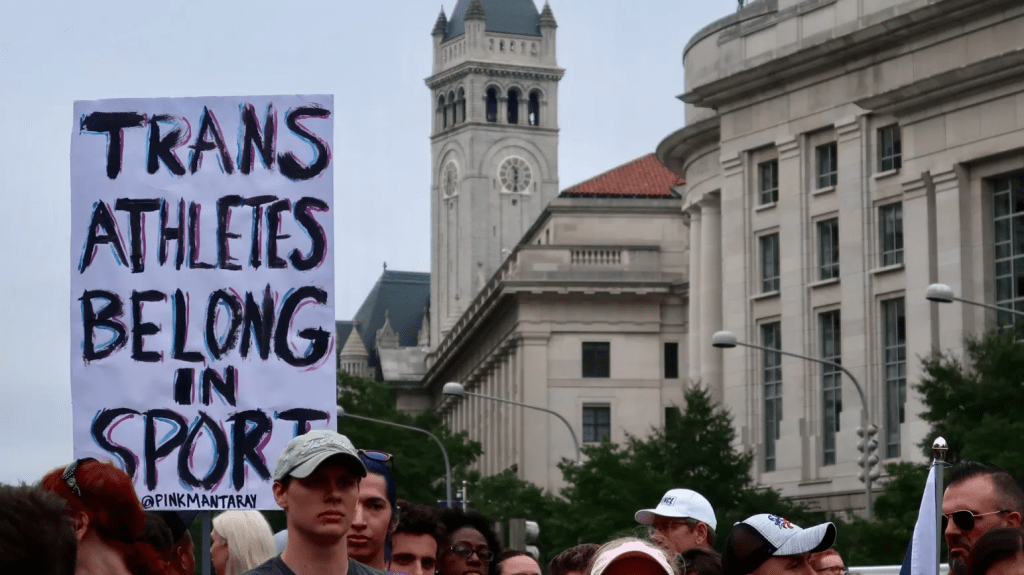
A teenage trans athlete is fleeing the country with her mother after experiencing severe bullying and harassment by right-wing media, fellow athletes, and politicians.

11th grader Ada Gallagher currently runs on the girls’ track team at Portland, Oregon’s McDaniel High School. She first became part of the national debate over trans athletes in 2023 when she won the state championship in the 200-meter race. A report from that time said the crowd met her victory with a chorus of boos, a sentiment that quickly spread across the country as the anti-trans right got its hands on the story.

Gallagher, who now competes with a security guard by her side, has endured years of death threats and vile insults, and she has also been a focal point of conservative media outlets.

Most recently, a video of Gallagher winning a March 19 400-meter race in a landslide was shared widely among conservatives. She also won the 200-meter race at the same meet.

Prominent anti-trans activist Riley Gaines – who has built an entire career off of tying for 5th place with a trans athlete three years ago – shared the video on X and misgendered Gallagher, writing, “Does he have no shame? Do his PARENTS have no shame?”

Gallagher’s mother, Carolyn, was not able to celebrate her daughter’s win like any mother should, as she knew the hate it would bring. She told Oregon Live she thought, “I know the optics of this are going to be horrible.”

But she wished people understood that the meet consisted of a total of three schools and that neither of the other two had strong competitors in the race Gallagher won so easily. She also wished people knew that, despite what Fox News claimed, Gallagher did not set a season record in the 400-meter race and actually ran a massive five seconds slower than she did in the same event at state the previous year, where she got second place.

For as long as she could, Gallagher tried to rise above it all, to keep her head in the game and just do what she loves: run.

But it has finally become too much.

“When they call me a predator, that’s the worst one. I hate it so much,” Gallagher told Oregon Live.

Only six days after Gallagher’s victory in March, the U.S. Department of Education’s Office for Civil Rights began investigating Portland Public Schools and the Oregon School Activities Association (OSAA), alleging the organizations are violating Title IX by allowing trans athletes to participate in sports on the teams that align with their gender (OSAA policy states it “endeavors to allow students to participate for the athletic or activity program of their consistently asserted gender identity while providing a fair and safe environment for all students”).

A statement from Portland Public Schools Superintendent Kimberlee Armstrong in the wake of the lawsuit expressed a dedication to protecting vulnerable students.

“I stand firm in our legal responsibilities, and I deeply value every student’s right to be treated with dignity, safety, and respect. PPS is in full compliance with Oregon state law, which may differ from federal guidance. We are actively working with our legal and state partners to navigate this complex legal landscape.”

“While I am limited in what I can share at this time due to the sensitive nature of the matter and our duty to protect student privacy, I want to be clear: my commitment—and our district’s commitment—to doing what’s right for all students, especially those most vulnerable, remains unwavering.”

But Gallagher and her mother hope all the noise will quiet down once they leave for Canada, where Carolyn was born and raised, despite the fact that Gallagher is devastated to leave her team, her friends, and especially, her girlfriend.

As Oregon Live states, Gallagher “joined the track team last spring not because she believed she would win, not out of some desire to manipulate the system and compete where she could win, but because her friends urged her to. Because they wanted her there.”

Now the team captain, she says the team is “the only place where people really know me.”

“I think people think I want to be this spotlight for trans people,” she said. “Not at all. I just like running.”

While competing is what also leads her to endure all this hate, she said it all goes away during the 23 or so seconds she is running.

“You hear the feet around you hit the ground,” she said. “Senses are heightened. There’s nothing to think about, it’s just track.”

Texas Senate approves bill strictly defining man and woman based on reproductive organs

*This is reported by The Hill.

The Texas Senate has sent legislation to Gov. Greg Abbott (R) that would strictly define genders across state law based on male and female reproductive organs — potentially creating new hurdles for transgender and intersex Texans whose gender identity would revert to the sex they were assigned at birth in state records.

Abbott spokesman Andrew Mahaleris confirmed to The Hill on Wednesday that the governor plans to approve the measure.

“The State of Texas recognizes only two sexes — male and female,” Mahaleris said. “Governor Abbott looks forward to reaffirming this universal truth and signing HB 229 into law.”

Supporters of the legislation said that it follows a directive Abbot issued earlier this year that state government in “Texas recognizes only two sexes — male and female.”

Abbott cited in the directive an executive order that President Trump signed shortly after his January inauguration that designates male and female as the only sexes recognized by the federal government and on a biological basis.

“All Texas agencies must ensure that agency rules, internal policies, employment practices, and other actions comply with the law and the biological reality that there are only two sexes—male and female,” Abbott wrote in his January letter to state agencies.

The latest Senate-approved bill, dubbed the “Women’s Bill of Rights,” defines sex as “an individual’s biological sex, either male or female.” Under the legislation, a woman or female is an “individual whose biological reproductive system is developed to produce ova” and a male or man is “someone whose reproductive system is developed to fertilize the ova of a female.”

Additionally, it defines “mother” as “a parent of the female sex.”

Critics of the measure argue that the bill oversimplifies sex, gender and a broad spectrum of personal experiences.

“If a law forces non-binary Texans, who are real people, into categories that don’t reflect their lived experiences or identities … that would actually become discrimination in practice,” state Sen. José Menéndez (D) said during the floor debate on the bill before its passage. “That’s a concern that I have.”

State Sen. Mayes Middleton (R), who sponsored the bill, said that it would preserve women’s designated spaces, like restrooms and prisons, based on “biological reality.” He noted that it carries no criminal or civil penalties.

“For our entire history we never had to define this because common sense dictated we didn’t, but unfortunately, that seems to have changed,” he said in the floor debate.

Abbott has previously pushed back against past criticism for signing laws that target LGBTQ people. He approved legislation in 2023 and 2021 to bar transgender athletes from competing in women’s and girls sports in Texas schools and colleges.

Trans man says he was detained after using women’s restroom in South Carolina

TRENDING

LGBTQ+ VoicesPoliticsTransgenderVideoBecome a MemberScroll To Top

By continuing to use our site, you agree to our Private Policy and Terms of Use.

Accept

News

Trans man says he was detained after using women’s restroom in South Carolina

Sand Dollar Social Club Folly Beach South Carolina alongside footage still of trans man Luca Strobel

©2025 Google Maps Data; footage still via tiktok @fulltimecowboy

Sand Dollar Social Club (left) and Luca Strobel

Anti-trans lawmakers want to force trans men to use the women’s restroom. Here’s what happened when one did.

*This is reported by The Advocate.

A 25-year-old South Carolina trans man has gone viral on TikTok, saying he was accosted in a bar by staff, called slurs, and detained by police after using the women’s restroom.

Luca Strobel, who posts under the Tiktok handle @FulltimeCowboy, said he had gone to pick up his friend, Caroline Frady, also 25, at Sand Dollar Social Club in Folly Beach on the night of Friday, May 16, to be her “sober ride” home.

After a lengthy drive to the bar, Strobel said he stepped inside to use the men’s room. However, there were no stalls—only urinals, rendering it inaccessible to him as a trans man.

At first, an employee warned both Strobel and his friend against entering the bathroom of the “opposite” sex, but after a brief back-and-forth, Strobel said he believed he had permission to do so. He also said he and Frady were the only two people in the restroom, which Frady confirmed to Erin in the Morning.

That’s when a man who said he was the bar owner burst into the women’s room, peering over the stall to look at Strobel as he used the restroom.

“They’re looking over the top of the stall at me without my clothes on,” Strobel said in the video. “They can fully see me naked other than me having my shirt on, and they just start screaming that there’s ‘a man’ in here.”

He said the owner and employee ejected him and his friend from the bar — grabbing and pushing them out as they reportedly called Strobel anti-trans slurs. The police were waiting at the door, Strobel said.

The officer cuffed him “so tight that I can’t even feel my fingers,” Strobel said. “I still have a bruise on my knuckle.” Meanwhile, his arresting officer allegedly kept calling him a “little girl.”

“We didn’t get booked, but we did get cuffed, and when we got to the station, we were asking a bunch of questions that they refused to answer,” Strobel said. “They just kept saying, ‘Take it up in court, take it up in court, take it up in court.’”

Sand Dollar Social Club could not be reached for comment. The Folly Beach Public Safety Department did not respond to a request for comment.

In a follow-up video, Strobel said he was released on $500 bond, hit with a trespass notice barring him from entering Sand Dollar Social Club, and issued a ticket for public intoxication and disorderly conduct. Frady said she received the same.

In an interview with Erin in the Morning, Strobel emphasized that he had not consumed a single drink — he was there for the sole purpose of being the designated driver. He says officers did not breathalyze him.

There is no state law in South Carolina preventing a trans man (or any man) from using the women’s room in public accommodations, such as a bar. However, there has been an avalanche of anti-trans bills nationwide seeking such mandates, including in South Carolina, where lawmakers enacted a version of this policy targeting schools in 2024, and re-introduced it in 2025.

In other words, Strobel was using the bathroom that many conservative lawmakers and anti-trans pundits want to force him to use — and he got arrested anyway, seemingly because of the panic surrounding gendered bathrooms.

This kind of harassment is no stranger to trans and gender nonconforming people—in April, a trans girl in Florida was arrested for using the women’s bathroom in an act of protest against that state’s anti-trans bathroom bill. She washed her hands in the sink before being escorted out by police. In February, cisgender lesbian in Arizona made headlines after documenting her own experience having police interrogate her gender while she was using a women’s restroom.

Erin in the Morning’s 2025 anti-trans legislation risk map designates South Carolina as a “high risk” state to travel to. Last year, Republican Gov. Henry McMaster signed a trans-affirming health care ban for minors into law.

Strobel says he believes the bar staff knew he was trans because his shirt revealed his top surgery scars. Nonetheless, he said he refuses to “go stealth,” or hide his trans identity, because he believes that trans visibility in the South is important.

“Of course my safety is important to me, but at the end of the day, I want people to know that we exist,” Strobel told Erin in the Morning. “I want people to know that it’s OK, that just because you live here doesn’t mean that you can’t be who you are.”

On the other hand, Strobel said this recent incident has made him feel that he may no longer have a choice; that the risk of further transphobic violence is too great to remain. Strobel said he is raising funds to relocate somewhere that he can finally, after all these years, not just feel authentic, but be safe.

Trans Activism in Real Estate – LGBTQ REALTORS Discuss Red States ,Blue States and Better Countries

What happens when real estate meets resistance, advocacy, and identity? In this candid conversation, LGBTQ+ real estate professionals Callen Jones, Bob McCranie, Kimber Fox, and Leslie Wilson sit down to discuss the evolving challenges of being openly queer in an industry—and a country—facing political pushback.

🏳️‍🌈 Topics covered include: How anti-LGBTQ+ legislation affects clients and agents The role of advocacy in real estate Why “just doing business” isn’t neutral anymore Personal stories from the frontlines of inclusion in housing

📍 Whether you’re an agent, ally, or advocate, this video unpacks the real stakes of LGBTQ+ visibility in today’s market.

Hockey star kicked out of women’s restroom by ‘gender police’ who thought she was a man

*This is reported by Outsports.

Hockey star Madison Packer played in five All-Star Games and is the second-highest goalscorer in the history of the Premier Hockey Federation, which was the forerunner to the National Women’s Hockey League.

Packer is widely recognized as an icon of women’s sports. Yet not for the first time, Packer recently found herself being misgendered as a result of gender policing she believes is escalating in line with heightened anti-trans rhetoric.

Two weeks ago, the 33-year-old posted an Instagram story to say that in late April she had been “forcibly removed” from a women’s bathroom stall in a Florida nightclub.

She was prompted to go public after learning of a woman who was kicked out of a Boston hotel bathroom, having been ordered by an attendant to “prove” she was female.

Packer, who spent eight seasons with the Metropolitan Riveters in the NWHL and PHF, wrote “sounds familiar” when sharing an article about the incident on social media.

She describes her own experience in Florida as “humiliating” and connects it directly to the ongoing discourse in society that suggests trans people pose a threat in women’s spaces.

“The entire bathroom situation is absurd,” Packer tells Outsports.

“The fear-mongering and outright propaganda we have perpetuated against the trans community in this country is pathetic.”

Packer says she had been with her wife and their friends at the club in Naples, Fla., when she left them to visit the restroom.

“Upon walking in, the female bathroom attendant several times said, ‘Sir sir,’ as to get my attention,” recalled Packer. “I am a cis female. I don’t respond to ‘sir.’”

During her playing days, the former power forward was a vocal leader on and off the ice, partnering with You Can Play on the organization’s LGBTQ advocacy initiatives.

She ignored the attendant and headed into a stall. 

It was then that Packer felt the attendant pulling her backwards by the shoulder.

“Again, she addressed me as ‘sir’ and told me I was in the wrong bathroom. We proceeded to argue over the bathroom I was in until I showed her my driver’s license.”

In Florida, trans people are prohibited by law from using public bathrooms and gendered facilities that align with their gender identity in all government-owned buildings, including K-12 schools and colleges.

The law applies only to facilities run by the state, but there have been several reports of trans, nonbinary and gender nonconforming people being challenged when using restrooms inside private businesses.

The Movement Advancement Project lists five other states — Arkansas, Montana, South Dakota, Utah and Wyoming — as having passed bathroom bills similar to that of Florida.

For women like Packer, who in her own words is “masculine presenting,” the chances of being confronted in a restroom are by no means limited to certain states. 

She says that a few years ago, she was also involved in a physical altercation with a male bouncer in the bathroom of a bar in Connecticut.

It’s natural for her to speak out about the damage done by gender policing. After announcing her retirement from hockey last November, Packer and her wife, Anya Battaglino, started a podcast called “These Packs Puck” in which they discuss queer parenthood and navigating life after pro sports.

Battaglino is also a former NWHL player. She came out as gay via an Outsports essay in 2018; the couple married the following year, and they now have two kids together.

On the latest episode, they talk about how being challenged in Florida left Packer “very upset” on what was, by coincidence, Lesbian Visibility Day. The couple had posted to Instagram to mark that awareness day, using an old photo taken in a Palm Springs restroom to make a point.

Anya wrote the caption: “Minding mine. (Wish the government would do the same).”

A little over a week later, Packer shared more details of her confrontation after reading online about what had happened in the Boston hotel.

In its reporting of that incident, CBS News quoted the executive director of PFLAG Greater Boston, Nina Selvaggio, who said: “For gender nonconforming lesbians, women in general, being harassed in public restrooms is a tale as old as time.

“I do think the surge in national anti-trans rhetoric is contributing to an increased policing of women’s bodies and their expression of gender.”

Packer told Outsports she agrees “wholeheartedly” with Selvaggio’s comments.

“I find it infuriating that we’re now going as far as to dictate or try to regulate what ‘female’ looks like.

“I’ve shared locker rooms and bathrooms with straight men, gay men, gay women, straight women, trans men, and trans women… I’ve never once had an altercation or inappropriate exchange with a trans person.

“I think we’re concerning ourselves with the wrong groups when it comes to restroom safety.”

Trans woman now fears travelling without legal gender documents. She’s not alone.

*This is reported by LGBTQ Nation

Transgender woman Michelle Rosenblum, of Ventura, California, has been planning a family vacation to Hawaii, but recent law changes regarding identification documents have made her wary of travel.

After President Donald Trump’s election to a second term last November, Rosenblum had been rushing to get her identification in order as a safety precaution.

According to Rosenblum, she updated her California birth certificate to show she had transitioned and renewed her passport.

Rosenblum was shocked to receive a letter from the State Department telling her she needed to correct her information on her passport application to show her biological sex at birth.

As Rosenblum prepares to fly, she fears that the discrepancies between her California Real ID and her passport will create problems when traveling. While the federal government requires Real ID for air travelers, states oversee the gender marker listed on the IDs.

Rosenblum is now debating traveling with a stack of documents, such as her birth certificate, Social Security card, and a court order showing her gender change.

Rosenblum tells The Los Angeles Times, “In the 10 years that I’ve been transitioned, I have never felt like, ‘Whoa, I need to get all my papers together.’ I was never concerned about traveling.” 

Rosenblum’s experience echoes similar concerns that trans people have about traveling, as noted in a recent survey conducted by the Williams Institute at the UCLA School of Law. In the survey, 302 trans, nonbinary, and other gender non-conforming American adults were surveyed — nearly a third said they were travelling less frequently as a result of the 2024 election.

Though the survey was conducted a month before Trump’s official inauguration. Trump’s campaign focused heavily on attacking the rights of trans people. On the day of his inauguration, President Trump issued an executive order directing the federal government to no longer acknowledge the existence of trans people in any capacity. This led the State Department, which issues passports to U.S. citizens, to announce they no longer accept gender markers that do not align with a person’s sex assigned at birth.

Trump’s continual attacks on the trans community in his official capacity as president have emboldened many GOP members to begin proposing anti-trans legislation in their home states, making travel even less desirable.

In the survey, nearly 70% of respondents said they’d be less willing to vacation in states they viewed as more hostile to trans people, particularly states that hold a GOP majority.

The survey also showed that 48% of respondents were considering moving to or had already moved to states they viewed as safer, particularly states with a liberal majority, such as Washington, California, New York, and Minnesota.

Lead author of the survey, Abbie Goldberg, wrote, “When you feel that you need to consider moving, you’ve been pushed to a certain point…. If you’re a trans person living in the U.S., particularly in a state with not a lot of protections and some explicitly anti-trans legislation, you’re thinking about your physical safety, your children’s safety at school, the possibility you could be fired from your job, and no way to push back.”

Rosenblum said she is grateful to live in California, where she is protected by anti-discrimination laws but as she gets ready for vacation, she said, “It feels like people are trying to shove me back into the closet.”

A Bill That Would Ban Pornography in the U.S. Also Takes Aim at Trans People

*This is reported by Them.

Republicans in Congress have introduced a bill that would dramatically redefine the U.S. legal definition of “obscenity” to include any sexual content, escalating the right-wing campaign to define transgender people as inherently pornographic and obscene.

On May 8, Utah Sen. Mike Lee reintroduced his “Interstate Obscenity Definition Act” (IODA) with support in the House from Illinois Rep. Mary Miller. Lee is a fervent anti-trans Republican, having previously pressured Amazon to stop selling a trans-themed children’s book and supported legislation to ban trans students from school sports leagues. Miller, meanwhile, is perhaps best known for intentionally misgendering trans Rep. Sarah McBride earlier this year, and for declaring in 2022 that the overturning of Roe v. Wade was a “historic victory for white life.”

The bill would add a new definition of “obscene” speech to the Communications Act of 1934: if passed, obscenity would be redefined as anything which “appeals to the prurient interest in nudity, sex, or excretion”; “depicts, describes, or represents, an actual or simulated sexual act […] with the objective intent to arouse, titillate, or gratify the sexual desires of a person”; and “lacks serious literary, artistic, political, or scientific value.” (Legally, appealing to the “prurient interest” means that something elicits sexual desire in the viewer.)

The bill was referred to the Senate Committee on Commerce, Science, and Transportation. This is the third time Lee has introduced IODA, as Mashable noted, following IODA’s defeat in 2022 and 2024.

IODA had not yet received any cosponsors at time of writing, meaning it’s uncertain whether the bill will gain enough Congressional support to pass. But its intent is nevertheless chilling for U.S. free speech law, advocates say. “Obscene” speech — which is not protected by the First Amendment — was defined in the 1973 Supreme Court case Miller v. California, in which the Court established a three-pronged test to determine whether a given image or statement is legally obscene. Under the “Miller test,” speech is considered obscene if “the average person, applying contemporary community standards,” would consider it appealing to the prurient interest, and if it also depicts sexual activity “in a patently offensive way.”

IODA’s text would effectively remove the Miller test’s reliance on “community standards” and whether material is “patently offensive” from obscenity law, making it significantly easier to bring legal cases against any depiction of sexual activity — whether through photography, film, or even the written word.

Jacob Mchangama and Ashkhen Kazaryan, representing the think tank The Future of Free Speech, called IODA “dangerous” in an editorial for MSNBC on Tuesday. “By discarding the concept of community standards, the IODA removes a key safeguard that allows local norms to shape what counts as obscenity,” Mchangama and Kazaryan wrote. “Without it, the federal government could impose a single national standard that fails to account for regional differences, cultural context or evolving social values.”

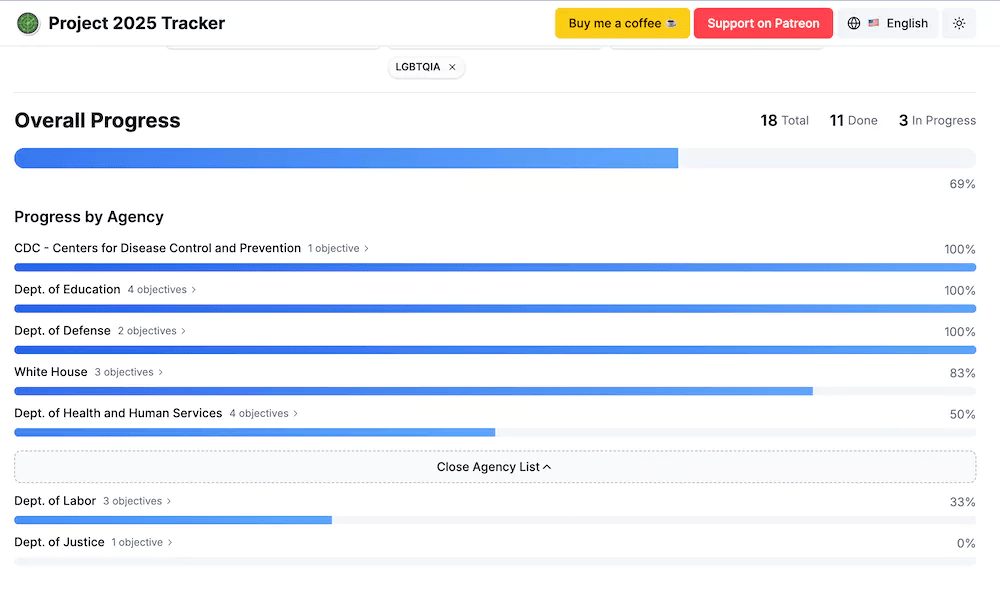
By making standards for obscenity more subjective, IODA could also open the door for conservatives to legally declare trans people in general to be “obscene.” Lee is a longtime ally of the Heritage Foundation, the far-right think tank responsible for drafting Project 2025, a massive policy blueprint for President Donald Trump’s second term. (Trump tapped Project 2025 architect Russell Vought to head the Office of Management and Budget in February.) The sprawling 920-page document falsely declares that trans people are a threat to children, that transitioning itself is equivalent to pornography, and that pornography must be outlawed in the U.S.

“Pornography [is] manifested today in the omnipresent propagation of transgender ideology and sexualization of children,” Project 2025’s forward reads in part. “Its purveyors are child predators and misogynistic exploiters of women [….] Pornography should be outlawed. The people who produce and distribute it should be imprisoned. Educators and public librarians who purvey it should be classed as registered sex offenders. And telecommunications and technology firms that facilitate its spread should be shuttered.” The document also claims that children in public schools “suffer the toxic normalization of transgenderism with drag queens and pornography invading their school libraries,” referencing right-wing campaigns against Drag Story Hour events and LGBTQ+ books of any kind.

“If you pull back and you look at the broad picture of censorship that’s going on, from any information about trans people to sexual health information, certainly to anything that has adult content, they are following their promises in Project 2025. And this is just another attempt,” Ricci Levy, president and CEO of the sexual freedom nonprofit Woodhull Freedom Foundation, told Mashable this week.

The right-wing campaign against “obscenity” and anything deemed “pornographic” is moving forward at the state level as well. In January, Oklahoma State Sen. Dusty Deevers, a Republican, introduced legislation that would ban all pornography across the board and establish a maximum sentence of 30 years in prison for “trafficking” in porn. New age verification laws made Pornhub inaccessible in 16 states earlier this year, covering most of the Southern U.S.

It’s not just Republicans who are pushing for such laws, however. Arizona Gov. Katie Hobbs, a Democrat, signed another such age verification bill into law earlier this week. And in Congress, Republican Sens. Marsha Blackburn and Majority Leader John Thune joined with Democrats Richard Blumenthal and Minority Leader Chuck Schumer to reintroduce the Kids Online Safety Act on Wednesday, which free speech advocates say would threaten LGBTQ+ speech while failing to protect children online.

“Its outrageous that Democrat lawmakers are still willing to go along with this charade just to score ‘protect the children’ political points,” wrote Evan Greer, director of the free speech nonprofit Fight for the Future, in a Bluesky post reacting to KOSA’s return on Wednesday.

Military ordered to identify troops with “symptoms consistent with gender dysphoria” to kick out

*This is reported by LGBTQ Nation.

The military has been ordered to identify troops who either have or may have gender dysphoria, the psychological term for the distress caused by one’s gender identity and sex assigned at birth not being the same. The goal is to get started on forcing transgender people out of the military ahead of the June 6 date set by Defense Secretary Pete Hegseth to start the purge.

Earlier this month, the Supreme Court ruled that the administration could start forcing transgender people out of the military, while several legal challenges to the trans military ban are being heard by lower courts. Hegseth then said that transgender service members would have until June 6 (or July 7 for those in the reserves) to voluntarily leave the military and have a chance to keep some of the benefits they accrued in their time in the armed services.

Orders issued yesterday, Advocate reports, will have each branch of the military start identifying transgender people to kick out after June 6. It tells each branch to identify people who have a diagnosis of gender dysphoria or “symptoms consistent with gender dysphoria” and review their medical records.

“Commanders who are aware of service members in their units with gender dysphoria, a history of gender dysphoria, or symptoms consistent with gender dysphoria will direct individualized medical record reviews,” the directive says. It also reaffirms that gender-affirming care is banned for transgender active-duty members of the military.

Stars and Stripes reports that an unnamed senior Defense Department official explained that commanders can now start medical screenings for servicemembers who don’t identify as transgender but who they suspect may have gender dysphoria.

“[This] is also consistent with what we expect and require of commanders generally, to ensure that their service members are fit and capable for duty — whether it’s under this policy or any other qualification where they may have concern that that service member requires medical intervention or is not able to perform their duties,” they said.

“The implementation requires some steps to ensure that those who go forward in service remain eligible to meet the high standards of the department. The department requires high standards to ensure that the force is ready to fight and win the nation’s wars as called upon.”

On May 8, Hegseth issued a memo saying that transgender servicemembers would have until June 6 to voluntarily start the process of leaving the military and get an honorable discharge, which would make them eligible for voluntary separation pay, as well as some health care and employment assistance benefits.

“There’s no guarantee to access to your pension or severance or an honorable discharge,” said Rae Timberlake of the trans service member organization Sparta Pride. They are one of the estimated 1000 transgender service members choosing to leave the military voluntarily now in order to get some of the benefits they have been earning throughout their career that might not be available if the military forces them out for being transgender after June 6.

“This is not voluntary,” they said. “This is a decision that folks are coming to under duress.”

National Center for Lesbian Rights attorney Shannon Minter told Advocate that the May 15 memo is “disturbing.”

“From the beginning this policy has been implemented in a rushed and chaotic manner that is completely unnecessary and deeply disrespectful to these service members, who deserve at the very least clear information and an orderly process so that they can make informed decisions that will have such a profound effect on their lives and their families,” he said.

“It is also deeply concerning that the separation codes that this guidance indicates will appear on the records of officers who are involuntarily separated will create the false impression that they are some sort of risk to national security. This is grossly untrue and will needlessly limit their civilian employment opportunities.”

The purge stems from an executive order issued in January that said that trans people can’t lead “an honorable, truthful, and disciplined lifestyle and that not using pronouns associated with a person’s sex assigned at birth violates the military’s “high standards for troop readiness, lethality, cohesion, honesty, humility, uniformity, and integrity.” This runs counter to actual studies of transgender people in the military that have found that they can serve without issue.

The executive order led to several lawsuits challenging it, including a lawsuit filed in Washington state brought by seven transgender servicemembers and one trans person who wants to join the military. A federal judge in that case issued a temporary injunction, blocking the Department of Defense from implementing the ban while the court heard the case.

Trump’s Department of Justice (DOJ) appealed the injunction, but the U.S. Court of Appeals for the Ninth Circuit refused to lift it. So, the DOJ appealed to the Supreme Court, which lifted the injunction earlier this month.

Stars and Stripes reports that there are around 4200 service members with a diagnosis of gender dysphoria.

Blog at WordPress.com.

Up ↑