A federal judge on Tuesday blocked President Donald Trump’s administration from refusing to issue passports to transgender and nonbinary Americans nationwide that reflect their gender identities.
U.S. District Judge Julia Kobick in Boston expanded, opens new tab a preliminary injunction she issued in April that allowed six transgender and nonbinary individuals who challenged the policy to obtain passports consistent with their gender identities or with an “X” sex designation while the lawsuit moves forward.
Kobick did so after concluding the policy the U.S. Department of State adopted pursuant to an executive order Trump signed likely discriminated on the basis of sex and was rooted in an irrational prejudice toward transgender Americans that violated the U.S. Constitution’s Fifth Amendment.
While Kobick’s April ruling was limited in its scope, the judge, an appointee of Democratic President Joe Biden, on Tuesday granted the case class action status and halted the policy’s enforcement against transgender, nonbinary and intersex passport holders.
Kobick said granting class action status to two categories of passport holders was appropriate given that the administration’s actions affected them uniformly “by preventing them from obtaining passports with a sex marker consistent with their gender identity.”
Li Nowlin-Sohl, a lawyer for the plaintiffs at the American Civil Liberties Union, called the ruling “a critical victory against discrimination and for equal justice under the law.”
White House spokeswoman Anna Kelly in a statement called the decision “yet another attempt by a rogue judge to thwart President Trump’s agenda and push radical gender ideology that defies biological truth.”
The case is one of several concerning an executive order Trump signed after returning to office on January 20 directing the government to recognize only two biologically distinct sexes, male and female.
The order also directed the State Department to change its policies to only issue passports that “accurately reflect the holder’s sex.”
The State Department subsequently changed its passport policy to “request the applicant’s biological sex at birth,” rather than permit applicants to self-identify their sex, and to only allow them to be listed as male or female.
Prior to Trump, the State Department for more than three decades allowed people to update the sex designation on their passports.
In 2022, the Biden administration allowed passport applicants to choose “X” as a neutral sex marker on their passport applications, as well as being able to self-select “M” or “F” for male or female.
The Trump administration is using its anti-trans actions to try to dismantle civil rights for both trans and cis women alike – and it’s taking an unusual route to do so.
The Department of Energy (DOE) is seeking to rescind the section of Title IX that says schools must allow students to play on sports teams with the opposite sex if there is no team for their sex available (unless the sport is a contact sport). The rule has allowed girls to play on boys’ teams in schools that don’t offer an equivalent girls’ team.
The DOE claims the policy “ignore[s] differences between the sexes which are grounded in fundamental and incontrovertible reality” and says eliminating it aligns with Donald Trump’s anti-trans executive order, “Keeping Men Out of Women’s Sports.”
The rescission of the rule would only apply to schools that receive funding from the DOE, which provides money to some schools for research and other programs, such as its Renew America’s School grant to assist with energy upgrades.
What’s more, the administration is exploiting a loophole to try to rush the rule change through without the standard 60-day public comment period. The DOE is using a process called a direct final rule (DFR), which does not require the formal rulemaking process but is typically used for simple changes, such as form updates.
The DFR process allowed the rule change to take effect on July 15 unless “significant adverse comments” had been submitted by June 16. Thousands of comments were submitted, though they are not visible to the public. It’s not clear whether the rule will officially take effect.
If the rule does change, it will not only affect trans athletes. Schools that receive DOE funding will no longer be required to allow cisgender girls to play on boys’ teams when a girls’ team does not exist.
Shiwali Patel, senior director of safe and inclusive schools for the National Women’s Law Center, told K-12 Divethe change is “blatant sexism, and harmful to women and girls.”
″The Trump administration is trying to gut long-standing Title IX protections that intend to provide women and girls with more opportunities to play sports, and without following the legally required rulemaking process, no less.”
Patel added that the administration clearly “doesn’t actually care about ‘protecting’ women and girls,” as it has used this claim to justify its crusade against trans rights, especially when it comes to trans student-athletes.
Julia Martin, director of policy and government affairs at legal and consulting group The Bruman Group, explained that the administration was able to keep the proposed rule change under wraps for so long because no one would have expected it to come from the DOE, as the Department of Education typically handles these kinds of policies.
The proposed change, in fact, was slipped into the middle of a list of 47 so-called “burdensome and costly regulations” outlined in a DOE press release in May announcing the department’s plan for a major overhaul to puportedly “save the American people an estimated $11 billion and cut more than 125,000 words fro the Code of Federal Regulations.”
“Part of what I see happening is this sense of overwhelm,” Kel O’Hara, senior attorney for policy and education equity at Equal Rights Advocates, told HuffPost. “There’s so much happening that it’s hard to follow. [The Trump administration] is trying to put these things through back doors, which makes it hard for the people who normally keep an eye on these things to catch it.”
O’Hara said the administration’s use of the DFR process is also worrisome for the future of other civil rights protections. “The really concerning part from my perspective is that this could essentially provide a blueprint for dismantling civil rights protections across the board.”
A second proposed rule change also seeks to rescind similar Title IX protections for education programs. The administration is also using the DFR loophole to try to push this change through on the same timeline.
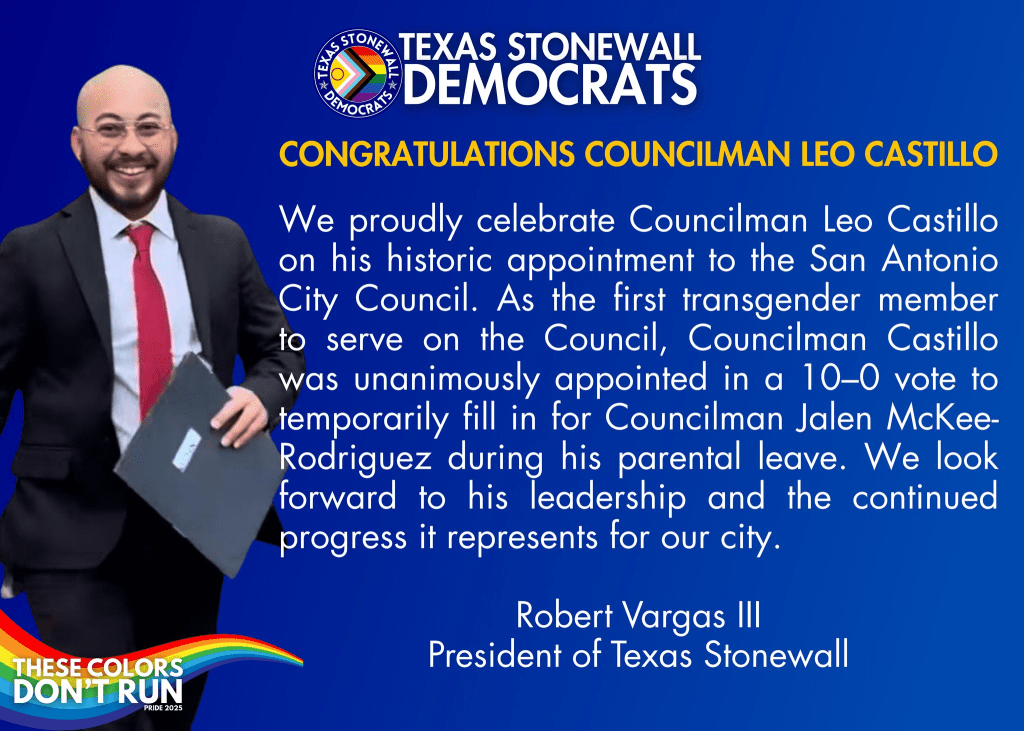
An East Side San Antonio council district will make history again with its incoming, temporary council member.
City Council voted 10-0 to select Leo Castillo, a social media and marketing manager for Thrive Youth Center, to serve as the interim District 2 council member while Councilman Jalen McKee-Rodriguez is out on his upcoming parental leave.
McKee-Rodriguez, who was the first openly gay man elected to the San Antonio City Council, believes Castillo will be the first openly transgender man to serve as a public official in Texas.
At least two transgender women have held public office in Texas before: former New Hope Mayor Jess Herbst and former Judge Phyllis Frye.
“Today is a huge win for our community and another reason to celebrate Pride Month,” McKee-Rodriguez said during the council meeting on Thursday. “At a time when our community is under attack, especially the trans community, this is going to be a — this was a historic vote.”
“I think this just definitely highlights the fact that, you know, trans people are people, and we deserve every opportunity like anybody else,” Castillo told reporters afterward. “And so I’m just really excited to sit with that and celebrate that with my community.”
Castillo was sworn in after Thursday’s vote but will not officially take the seat until Aug. 1. McKee-Rodriguez is expected to return to the council by the end of September.
Castillo and McKee-Rodriguez met at the University of Texas at San Antonio almost nine years ago, and Castillo has been a political volunteer for McKee-Rodriguez.
“It’s just been really incredible just following Jalen along on his journey. And so I thought, ‘you know what, I think I’d be the best person to step up,’” he said.
McKee-Rodriguez said it “just so happens” that Castillo is a member of the LGBTQ+ community
“Leo’s been a very strong member of our community,” McKee-Rodriguez said. “He’s been an advocate who’s organized around many of the same issues that I’ve organized around, including public safety reform, civic engagement, and LGBTQIA rights.”
No-fuss appointment
Though 12 other people applied for the position, including several who had run against McKee-Rodriguez in the past, Castillo cruised to his appointment.
After a first round of short interviews on Wednesday, the council could have chosen up to three finalists for further consideration. But after just 15 minutes of closed-door discussion, they tapped Castillo as the lone finalist.
Thursday’s interview process took roughly 10 minutes before the council officially appointed Castillo as the interim council member.
District 1 Councilwoman Sukh Kaur was away from her seat for the final vote, but she had supported his selection at Wednesday’s meeting.
Alicia Williams, McKee-Rodriguez’s director of constituent services, also told council members that the district staff preferred Castillo for the role, saying he had worked alongside the office “with consistency, humility, and deep care for the people of the district.”
These were the other applicants for the temporary position:
Ruben Arciniega — Certification specialist, ran for D2 council seat in 2019
Brian Benavidez — Owner of bike tour company
Joseph Bravo — Former chief of staff for former D7 Councilwoman Ana Sandoval
Dori Brown — Accountant, ran for D2 council seat in 2021
Chris Dawkins — President of marketing and advertising company, ran for D2 council seat in 2021
Eric Estrada — Nonprofit executive director
Anslem Gentle — Security consultant
Jennifer Martinez — Financial services executive
Stephen Parker — Retired, ran for city council in 1991
Rose Requenez-Hill — Retired, president of Government Hill Alliance, ran for D2 council seat in 2023 and 2025
Carla Sisco — IT business relationship manager, ran for D2 council seat in 2025
Kizzie Thomas — Educator, ran for D2 council seat in 2025
Decision to take leave
McKee-Rodriguez and his husband are expecting their first child, a baby girl, in July, during the council’s traditional recess.
Shortly after his re-election, McKee-Rodriguez announced he planned to take eight weeks of parental leave in August and September.
That falls during the hectic city budget process, when council members hammer out the details of the city’s multi-billion-dollar spending plan. McKee-Rodriguez has said he wants his district to have a voice if he can’t be there full-time.
“And so for me, it was most important that District 2 have a stable voice that was most aligned with mine and that they know that they can trust and rely on. And so… I’ve gotten a lot of positive feedback from that,” he told KSAT of his decision to take leave..
The situation appears to be unique in the city’s history.
“We are not aware of any previous temporary appointment to fill a seat during parental leave,” city spokesman Brian Chasnoff told KSAT after McKee-Rodriguez’s initial announcement.
The last time a council member temporarily vacated their seat was former District 10 Councilman Clayton Perry in the wake of a 2022 drunken hit-and-run crash.
Just over two weeks after Perry went on a leave of absence, the council chose former Councilman Mike Gallagher to fill in for him, following a similar selection process. Gallagher ended up serving six weeks before Perry returned to finish out his term.
While largely avoiding the same level of heated pushback of years’ past, Texas lawmakers passed several bills that give LGBTQ+ people in Texas, specifically transgender residents, less opportunity to receive care and maintain their identities in state records.
Texas legislators filed over 100 anti-trans bills through the session, some containing provisions that have been shot down in years’ prior while others proposed new restrictions. Less than 10 were ultimately approved by lawmakers.
The new bills that are likely to be signed by Gov. Greg Abbott represent a yearslong movement from state conservatives to find new ways to restrict the presence of trans and LGBTQ+ Texans, advocates say. The bills that failed may also be resurrected by lawmakers in future sessions. Here’s what to know.
State definitions of man and woman
Several bills filed in the Legislature aimed to craft legal definitions of sex and gender in addition to their target goals — but House Bill 229 makes that goal its sole purpose, establishing state definitions for male and female and applying those definitions across statute.
HB 229 defines a woman as “an individual whose biological reproductive system is developed to produce ova,” and a man as “an individual whose biological reproductive system is developed to fertilize the ova of a female.”
Most immediately, the bill will bolster an already existing block from stateagencies on changes to gender markers on state documents, which was backed by a nonbinding opinion from Attorney General Ken Paxton in March. The bill may also force those who have already switched their documents to match their identified gender to have changes reverted when they are renewed.
The longer-term effects of HB 229 are still not immediately apparent, as references to man and woman are used hundreds of times in statute and may ripple into other laws affecting people’s lives. Texas joins 13 other states that have also crafted their own definitions, and several other bills that also passed in the state have individual definitions for related terms like “biological sex.”
President Donald Trump issued an executive order named “Defending Women From Gender Ideology Extremism” in January providing federal definitions of male and female. Similarly, HB 229 has been dubbed the “Women’s Bill of Rights” by supporters, claiming it protects women in the state from men invading their spaces.
Abbott released an executive order of his own shortly after Trump’s affirming the president’s directive, but did not provide his own definitions. In a May post on social media, the governor said he would immediately sign HB 229 into law.
New requirements for medical records and insurance coverage
Tightening the ability to change the gender on state records like drivers’ licenses has been a key issue for conservative lawmakers for years, and while HB 229 sets a precedent in disallowing new changes, another bill creates new requirements entirely. Senate Bill 1188 creates a new section on all state medical records listing patients’ assigned sex at birth and any physical sexual development disorders. It also bans changes to those gender markers for any reason other than clerical errors, and creates civil penalties for medical professionals who do change them.
House Democrats opposing the measure during floor discussion worried that SB 1188 may scare medical providers into inputting vague or inaccurate health information out of fear of fiscal or legal retribution. The bill does allow the new section to include information on a patients’ gender identity, however health care services must opt-in to provide it.
The bill also creates restrictions on where health care providers can store patient data and the physical servers they use to store them, and new regulations on how artificial intelligence can be used to create diagnoses.
SB 1188 is not the only bill opponents have said will create a chilling effect on the LGBTQ+ community. Some bills may be more immediate in blocking options people have to do things like change their state records, but others like SB 1188 and Senate Bill 1257 may reduce what resources are available. SB 1257 was signed by Abbott in May and mandates that insurance companies provide coverage for gender detransitioning care if they already cover gender transition care.
Proponents of the law claim it enforces responsibility onto insurance companies. The law is not a ban on gender-affirming care, however opponents worry it may act as one by incentivizing insurance companies to pull coverage altogether rather than take on potential new costs.
SB 1257 is the first legal mandate for detransition care in the United States, making Texas a testing ground for insurance companies’ appetite to keep or pull coverage. Similar bills in Arizona, Florida and Tennessee did not pass out of their respective state legislatures in 2024.
Less protections and resources for LGBTQ+ youth
Medical gender transition care for minors was banned in Texas by the Legislature in 2023, a restriction that was upheld by the state Supreme Court in 2024. House Bill 18, primarily an overhaul of rural health care including a rural pediatric mental health care program, bans minors from accessing its resources for gender-affirming mental health counseling “inconsistent with the child’s biological sex.”
The current gender transition care ban for minors does not include mental health services, only puberty blockers, hormone therapy and surgery, which is rare for those under 18. Another proposal headed to Abbott’s desk, House Bill 1106, asserts that parents who do not recognize or affirm their child’s gender identity cannot be held liable for abuse or neglect because of that lack of recognition.
More restrictions on LGBTQ+ presence in schools
Access to materials and resources related to LGBTQ+ subjects are also being restricted by legislators through two key bills primarily aimed at schools. Senate Bill 12 bans Texas schools from teaching about sexual orientation or gender identity and forbids student clubs “based on” those subjects.
The bill would prevent clubs like Gay-Straight Alliances and pride clubs, which are often tailored toward anti-bullying initiatives in schools. Opponents of the bill claim a ban on those clubs would cut off LGBTQ+ students from communities and resources that can save lives.
“One of the deadliest things that our youth go through is experiencing the perception at least of isolation, and GSAs are a powerful way that we can combat that and make sure that our youth are getting support,” said Ash Hall, ACLU Texas’ policy and advocacy strategist for LGBTQIA+ rights.
While SB 12 restricts instruction and student groups, Senate Bill 13 gives school boards and new advisory councils greater oversight to remove books from school libraries that go against “local community values.” Some lawmakers and advocates worry school boards and advisory councils would be able to restrict books containing LGBTQ+ material.
A third bill, Senate Bill 18, would have banned “drag-time story hours” at municipal libraries and cut funding to those who host them, however that bill was unintentionally killed by Lt. Gov. Dan Patrick after a procedural error at the end of the Senate’s deadline to pass bills.
Bills that failed to pass
The small set of bills passed by legislators shift the state’s treatment of LGBTQ+ Texans significantly, but still represent a fraction of what lawmakers proposed. House Bill 239, this session’s bathroom ban bill, was one of the over 100 bills that did not survive and was never heard by lawmakers despite half of the House signing on as coauthors. House Bill 2704 sought a similar ban through private lawsuits rather than criminal charges, but was never picked up by lawmakers.
Also left unheard was House Bill 3817, filed by Rep. Tom Oliverson, R-Cypress, which would have created a new felony charge for “gender identity fraud” if a person represented themselves as a gender besides the one they were assigned at birth to state agencies or employers.
Advocates like Johnathan Gooch, communications director for Equality Texas, say that the Legislature has kept its course on anti-trans legislation for the last few sessions, and that bills that didn’t get picked up by legislators may be at the forefront of future sessions.
“We’re hearing rhetoric that we’ve heard for a very long time and just more, more bills, a variety of new ways to narrow the rights of trans people,” Gooch said. “It just doesn’t come as a mistake that the number of bills is escalating.”
Citing President Trump’s threat to cut off federal education funding for school districts that provide protections for LGBTQ people, school board members in the Montezuma-Cortez district in southwestern Colorado are poised to remove sexual orientation and gender identity from the district’s nondiscrimination policy.
“Our district uses federal grant monies and Trump has indicated those grants are at risk if any district continues to support certain previously protected classes like sexual orientation, gender expression, or gender identity,” Mike Lynch, a school board member and the policy committee chair, said at a board meeting late last month.
The proposed policy changes in Montezuma-Cortez represent just one example of how some Colorado school districts are rushing to comply — or over-comply — with federal ultimatums based on questionable legal foundations. Many legal experts say the Trump administration cannot, on its own, exclude transgender people from federal anti-discrimination law and that Colorado law, which includes protections for LGBTQ people, supersedes school district policy anyway.
But efforts to remove protections at the local level send harmful messages about who is valued and who isn’t, they say.
“I think it does damage to queer students because it signals that this school district … doesn’t believe that these students are worthy of protection,” Scott Skinner-Thompson, associate professor of law at the University of Colorado Boulder.
Montezuma-Cortez, a conservative-leaning district with about 2,400 students, has taken other steps to curtail LGBTQ symbols and school activities in recent years. The school board is scheduled to take a final vote on the proposed nondiscrimination policy on June 24.
MB McAfee, a retired social worker and district resident, said she doesn’t know of any case where federal funds were withheld by the Trump administration, but worries about that possibility, particularly when it comes to money for students with disabilities.
But she’s also angry about the proposed policy changes, calling them “another step toward exclusion.”
“If we do that,” she asked, “then what’s going to be next?”
School districts react to funding threats
Trump has targeted transgender rights since his first day in office. In January and February, he issued several executive orders on the topic, including one that describes sex as determined at conception and unchangeable and another that threatens to withhold federal funds from schools that allow transgender girls to play girls sports.
The Trump administration has moved to strip federal funding from Maine because that state allows transgender girls to compete on girls’ teams. A judge blocked the federal government from withholding school lunch money while the case continues.
So far, no school district has lost money because of policies protecting transgender students. But Lynch emphasized that risk when he explained the proposed policy revision to the school board in May.
Asked by Chalkbeat what executive order or federal guidance required the removal of “sexual orientation” from the policy, Lynch later said by email that he’d mistakenly cited the term when he spoke to the board about federal dollars being in jeopardy.
For now though, “sexual orientation” isn’t being restored to the policy, he said.
Montezuma-Cortez isn’t alone in making changes spurred by the Trump administration. Officials from several Colorado districts, including Woodland Park and District 49 near Colorado Springs, have cited Trump’s executive orders in pushing policy changes or other efforts aimed at revoking protections for transgender students.
In May, District 49 sued the state and the Colorado High School Activities Association arguing that Colorado law and the association’s policy violate students’ constitutional rights by allowing transgender youth to play on school sports teams that match their gender identity.
Montezuma-Cortez school board members had little to say about the implications of the proposed nondiscrimination policy changes.
Asked about the legal or practical implications, Lynch said he’s not an attorney and doesn’t know. School board President Sheri Noyes did not respond to Chalkbeat’s request for comment. Vice President Ed Rice declined to respond to specific questions from Chalkbeat, saying by email that the policy’s opening sentence “answers everything.”
As proposed, that sentence says, “The Board is committed to providing a learning and work environment where all members of the school community are treated with dignity and respect.” The current version of the policy says “safe learning and work environment” but the revision takes out the word “safe.”
They stood in formation at Falcon Stadium, diplomas in hand, having met every standard of physical endurance, academic excellence, and military discipline. But, on Thursday, when the time came for the U.S. Air Force Academy’s class of 2025 in Colorado Springs, Colorado, to commission as second lieutenants, three cadets were quietly held back.
They are the first out transgender cadets to graduate from the Academy. And under a newly reinstated Trump administration ban, they will not be allowed to serve.
One of them, Hunter Marquez, had spent years preparing to become a combat systems officer. He earned dual degrees in aeronautical engineering and applied mathematics. He passed the Air Force’s fitness standards for men. And he did so as himself, having transitioned while enrolled at the Academy. “I really want to stay in for as long as possible, fight this out,” Marquez toldThe Colorado Springs Gazette.
But the rules changed. On May 6, the U.S. Supreme Court allowed the Trump administration to begin enforcing Executive Order 14183, which bans transgender people from military service. The unsigned order—issued without full argument and over the dissent of the Court’s three liberal justices—overturned a Washington state lower court’s preliminary injunction and gave the Pentagon the green light to begin separations.
Marquez, along with the two other graduates, was placed on administrative absence, barred from taking the oath, and warned he might need to repay the cost of his education if he refused to leave voluntarily, the paper reports. That education—funded by taxpayers—is valued in the hundreds of thousands of dollars. According to The Gazette, Marquez was later told by Air Force officials that if he is involuntarily separated, he won’t be billed. But the message was clear: his government does not want him in uniform.
And yet, there is no question he met the standard. “We want warfighters. We want people with grit, that are resilient. They have done all that,” a U.S. Air Force Academy staff member told The Gazette, speaking anonymously for fear of retaliation. All three cadets passed physical fitness tests for both men and women. All three graduated with distinction.
What disqualifies them is not their performance but their identity.
Marquez is a plaintiff in Talbott v. United States, one of the central legal challenges to the policy. In a sworn statement, he wrote that the executive order describes people like him as “undisciplined,selfish, and dishonest.” “None of those are correct descriptions of my character or my abilities,” he wrote. “I have achieved alongside my peers throughout my time at the Academy.”
The policy is not theoretical. It is personal. It has required cadets like Marquez to trek across dorms to find gender-compliant restrooms and showers. It has forced them to race through final semesters in case they’re expelled before graduating. And it has turned what should have been a joyful week of ceremonies into a lesson in resilience.
Marquez, now 23, is applying to the University of Colorado Boulder to earn an advanced degree in aerospace engineering. He is still receiving medical benefits and cadet pay, but he knows that may be temporary. “There’s still a lot of anger and frustration and sadness,” he said. “Just because I have worked so hard to be a second lieutenant in the Air Force, and at the very end that was taken from me.”
Academy alumni have responded with solidarity. Nearly 1,000 graduates have signed an open letter defending transgender cadets and midshipmen. “Being transgender is in no way incompatible with any of our Academies’ cherished virtues and values,” the letter reads, according to Military.com.
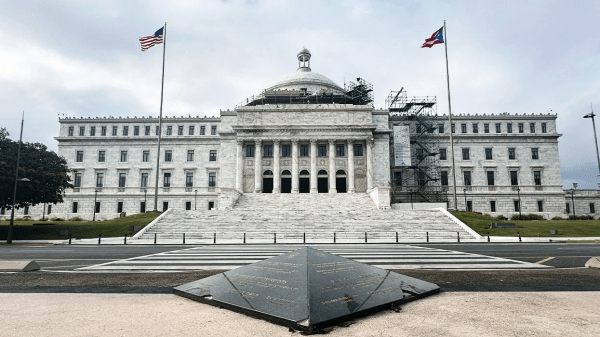
Puerto Rico’s Supreme Court has mandated that the government include an “X” gender marker on birth certificates in a ruling issued on Monday. A group of nonbinary Puerto Ricans filed the case, and the ruling allows for the representation of those who identify outside of the gender binary.
“Puerto Rico’s current Birth Certificate Policy is not supported by a rational basis, and therefore violates the Equal Protection Clause of the Fourteenth Amendment,” the justices wrote in their 19-page decision.
The court found that while the government might have a legitimate interest in maintaining an accurate record of each citizen’s sex assigned at birth, lawyers for the government “failed to articulate why this particular interest is furthered by treating nonbinary individuals differently than binary individuals.”
Puerto Rico’s Supreme Court has mandated that the government include an “X” gender marker on birth certificates in a ruling issued on Monday. A group of nonbinary Puerto Ricans filed the case, and the ruling allows for the representation of those who identify outside of the gender binary.
“Puerto Rico’s current Birth Certificate Policy is not supported by a rational basis, and therefore violates the Equal Protection Clause of the Fourteenth Amendment,” the justices wrote in their 19-page decision.
The court found that while the government might have a legitimate interest in maintaining an accurate record of each citizen’s sex assigned at birth, lawyers for the government “failed to articulate why this particular interest is furthered by treating nonbinary individuals differently than binary individuals.”
A federal court in 2018 ordered Puerto Rico to permit transgender individuals to change their gender markers, but nonbinary individuals were left unable to accurately reflect their gender identity on official records. Six nonbinary plaintiffs filed suit in court, and the court on Monday ruled in their favor.
Puerto Rico’s Supreme Court has mandated that the government include an “X” gender marker on birth certificates in a ruling issued on Monday. A group of nonbinary Puerto Ricans filed the case, and the ruling allows for the representation of those who identify outside of the gender binary.
“Puerto Rico’s current Birth Certificate Policy is not supported by a rational basis, and therefore violates the Equal Protection Clause of the Fourteenth Amendment,” the justices wrote in their 19-page decision.
The court found that while the government might have a legitimate interest in maintaining an accurate record of each citizen’s sex assigned at birth, lawyers for the government “failed to articulate why this particular interest is furthered by treating nonbinary individuals differently than binary individuals.”
A federal court in 2018 ordered Puerto Rico to permit transgender individuals to change their gender markers, but nonbinary individuals were left unable to accurately reflect their gender identity on official records. Six nonbinary plaintiffs filed suit in court, and the court on Monday ruled in their favor.
“Their request is simple: to be permitted to have a gender marker on their birth certificate that reflects their true gender identity, like everyone else,” the justices wrote of the plaintiffs in their decision. “Specifically, Plaintiffs request the Court to order the Demographic Registry of Puerto Rico to modify its application to amend a Puerto Rican birth certificate, to include an option to change one’s gender marker to an ‘X.’”
The justices found the government’s current birth certificate gender identification policy discriminatory and that there was no rational reason to deny the plaintiff’s request.
“The current Birth Certificate Policy of the Commonwealth of Puerto Rico arbitrarily distinguishes between binary and nonbinary individuals and subjects nonbinary individuals to disfavored treatment, without any justification for doing so,” the justices concluded in their ruling. “In such cases, it is the duty of the federal courts to intervene, to guarantee the equal protection of all persons under the law.”
Puerto Rico’s Republican Governor Jenniffer González Colón indicated that she would consult with government lawyers before determining her future course of action.
Puerto Rico Representative Jorge “Georgie” Navarro Suárez announced he was introducing a non-binding resolution condemning the ruling.
“The Federal Court’s ruling represents a challenge to the administrative and social stability of Puerto Rico,” Navarro Suárez said in a statement announcing the resolution. “While we fully respect human dignity and rights, we firmly believe that traditional gender identification based on male and female provides essential clarity and consistency in the administrative processes of the Demographic Registry.”
Navarro Suárez is a member of the New Progressive Party (PNP), which advocates for statehood with the U.S. Both of Navarro Suárez’s brothers were recently arrested on federal corruption charges. Edgardo Navarro Suárez and Ricardo Luis Suárez were arrested in April and charged with financial fraud and money laundering of federal funds meant for relief during the global economic shutdown. Prosecutors claim the two brothers and a third man attempted to bribe a bank official to help facilitate over $2 million in allegedly bogus COVID-19 relief funds.
*This is reported by WSMV 4. We have removed the repeated misuse of the word “allegedly” from the story.
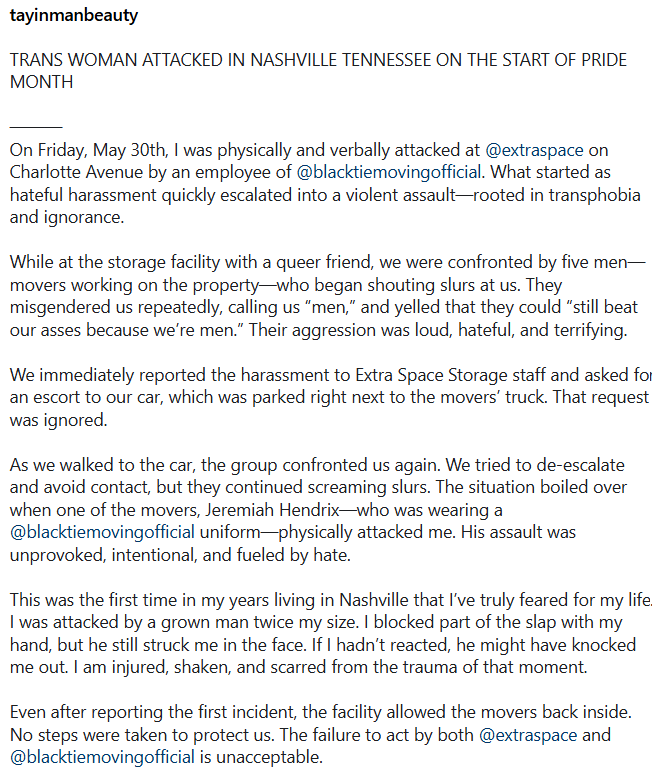
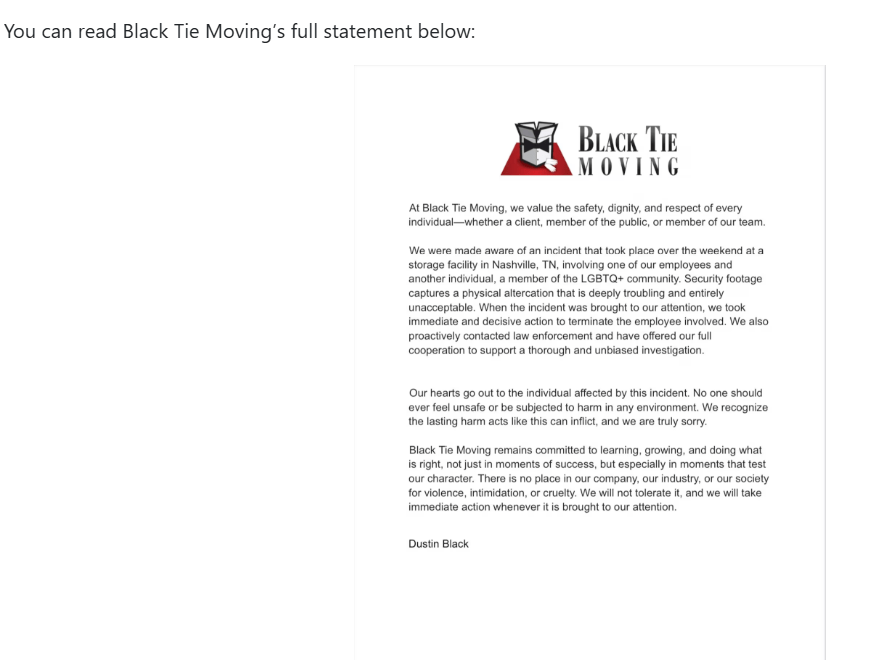
A Nashville moving company has confirmed to WSMV4 that it has terminated one of its employees after a recent attack against a transgender woman.
Black Tie Moving released a statement on Monday confirming the employee’s termination and condemning the assault.
“We were made aware of an incident that took place over the weekend at a storage facility in Nashville, TN, involving one of our employees and another individual, a member of the LGBTQ+ community,” Black Tie Moving said. “Security footage captures a physical altercation that is deeply troubling and entirely unacceptable.”
Black Tie Moving added that the employee was immediately terminated and the company is fully cooperating with the Metro Nashville Police Department’s investigation into the incident.
Following the incident, MNPD confirmed that its Specialized Division is investigating the attack at the Extra Space Storage facility on Charlotte Avenue on Friday.
Extra Space Storage confirmed to WSMV4 that it’s turned over the security camera footage of the incident to police for the Specialized Division’s investigation.
“While the property has security features like video surveillance, cylinder locks, and coded doors and gates, we do not have on-site security. At the time, the store was staffed by a single employee,” the facility told WSMV4.
The victim also made the following post about the assault:
A teenage trans athlete is fleeing the country with her mother after experiencing severe bullying and harassment by right-wing media, fellow athletes, and politicians.
11th grader Ada Gallagher currently runs on the girls’ track team at Portland, Oregon’s McDaniel High School. She first became part of the national debate over trans athletes in 2023 when she won the state championship in the 200-meter race. A report from that time said the crowd met her victory with a chorus of boos, a sentiment that quickly spread across the country as the anti-trans right got its hands on the story.
Gallagher, who now competes with a security guard by her side, has endured years of death threats and vile insults, and she has also been a focal point of conservative media outlets.
Most recently, a video of Gallagher winning a March 19 400-meter race in a landslide was shared widely among conservatives. She also won the 200-meter race at the same meet.
Prominent anti-trans activist Riley Gaines – who has built an entire career off of tying for 5th place with a trans athlete three years ago – shared the video on X and misgendered Gallagher, writing, “Does he have no shame? Do his PARENTS have no shame?”
Gallagher’s mother, Carolyn, was not able to celebrate her daughter’s win like any mother should, as she knew the hate it would bring. She told Oregon Live she thought, “I know the optics of this are going to be horrible.”
But she wished people understood that the meet consisted of a total of three schools and that neither of the other two had strong competitors in the race Gallagher won so easily. She also wished people knew that, despite what Fox News claimed, Gallagher did not set a season record in the 400-meter race and actually ran a massive five seconds slower than she did in the same event at state the previous year, where she got second place.
For as long as she could, Gallagher tried to rise above it all, to keep her head in the game and just do what she loves: run.
But it has finally become too much.
“When they call me a predator, that’s the worst one. I hate it so much,” Gallagher toldOregon Live.
Only six days after Gallagher’s victory in March, the U.S. Department of Education’s Office for Civil Rights began investigating Portland Public Schools and the Oregon School Activities Association (OSAA), alleging the organizations are violating Title IX by allowing trans athletes to participate in sports on the teams that align with their gender (OSAA policy states it “endeavors to allow students to participate for the athletic or activity program of their consistently asserted gender identity while providing a fair and safe environment for all students”).
A statement from Portland Public Schools Superintendent Kimberlee Armstrong in the wake of the lawsuit expressed a dedication to protecting vulnerable students.
“I stand firm in our legal responsibilities, and I deeply value every student’s right to be treated with dignity, safety, and respect. PPS is in full compliance with Oregon state law, which may differ from federal guidance. We are actively working with our legal and state partners to navigate this complex legal landscape.”
“While I am limited in what I can share at this time due to the sensitive nature of the matter and our duty to protect student privacy, I want to be clear: my commitment—and our district’s commitment—to doing what’s right for all students, especially those most vulnerable, remains unwavering.”
But Gallagher and her mother hope all the noise will quiet down once they leave for Canada, where Carolyn was born and raised, despite the fact that Gallagher is devastated to leave her team, her friends, and especially, her girlfriend.
As Oregon Live states, Gallagher “joined the track team last spring not because she believed she would win, not out of some desire to manipulate the system and compete where she could win, but because her friends urged her to. Because they wanted her there.”
Now the team captain, she says the team is “the only place where people really know me.”
“I think people think I want to be this spotlight for trans people,” she said. “Not at all. I just like running.”
While competing is what also leads her to endure all this hate, she said it all goes away during the 23 or so seconds she is running.
“You hear the feet around you hit the ground,” she said. “Senses are heightened. There’s nothing to think about, it’s just track.”
The Texas Senate has sent legislation to Gov. Greg Abbott (R) that would strictly define genders across state law based on male and female reproductive organs — potentially creating new hurdles for transgender and intersex Texans whose gender identity would revert to the sex they were assigned at birth in state records.
Abbott spokesman Andrew Mahaleris confirmed to The Hill on Wednesday that the governor plans to approve the measure.
“The State of Texas recognizes only two sexes — male and female,” Mahaleris said. “Governor Abbott looks forward to reaffirming this universal truth and signing HB 229 into law.”
Supporters of the legislation said that it follows a directive Abbot issued earlier this year that state government in “Texas recognizes only two sexes — male and female.”
Abbott cited in the directive an executive order that President Trump signed shortly after his January inauguration that designates male and female as the only sexes recognized by the federal government and on a biological basis.
“All Texas agencies must ensure that agency rules, internal policies, employment practices, and other actions comply with the law and the biological reality that there are only two sexes—male and female,” Abbott wrote in his January letter to state agencies.
The latest Senate-approved bill, dubbed the “Women’s Bill of Rights,” defines sex as “an individual’s biological sex, either male or female.” Under the legislation, a woman or female is an “individual whose biological reproductive system is developed to produce ova” and a male or man is “someone whose reproductive system is developed to fertilize the ova of a female.”
Additionally, it defines “mother” as “a parent of the female sex.”
Critics of the measure argue that the bill oversimplifies sex, gender and a broad spectrum of personal experiences.
“If a law forces non-binary Texans, who are real people, into categories that don’t reflect their lived experiences or identities … that would actually become discrimination in practice,” state Sen. José Menéndez (D) said during the floor debate on the bill before its passage. “That’s a concern that I have.”
State Sen. Mayes Middleton (R), who sponsored the bill, said that it would preserve women’s designated spaces, like restrooms and prisons, based on “biological reality.” He noted that it carries no criminal or civil penalties.
“For our entire history we never had to define this because common sense dictated we didn’t, but unfortunately, that seems to have changed,” he said in the floor debate.
Abbott has previously pushed back against past criticism for signing laws that target LGBTQ people. He approved legislation in 2023 and 2021 to bar transgender athletes from competing in women’s and girls sports in Texas schools and colleges.




















 fleeredstates.blog
You must be logged in to post a comment.