Angry UK mob rampages trans picnic, burning Pride flag & threatening to stab people

*This is being reported by LGBTQNation.

Several men tore down Pride flags and threatened to stab several attendees of a transgender picnic event last Thursday — one man even burned one of the flags. Event organizers reported the incident to police but said that they didn’t expect a positive outcome.

The group behind the event, Trans Mutual Aid Manchester, held a “Trans Picnic in the Park” event in Platts Field Park from 4 p.m. to 8 p.m. last Thursday. Though the organizers said the picnic featured “sunshine and lovely food,” they also said a group of men tried to violently harass and intimidate picnic goers.

“The first pair tore down a Progress Pride flag we had raised to show where we were to people coming to the event, and after threatening to violently assault one of our members with a knife, had his partner burn the flag in front of our group, before leaving,” Trans Mutual Aid Manchester wrote in an Instagram post.

In a second incident, three men approached the picnic while “shouting abuse, then tore down the remaining trans and nonbinary pride flags before running off with them, the organization added.

“Whilst thankfully no one in our community was physically harmed, thanks in part to the intervention of several of our members, this blatant attack on our right to feel safe as a community is a disgusting display of the impunity and hatred with which parts of our society treat their trans siblings,” the Instagram post continued.

While organizers reported the incidents to police, they said that they “do not expect any positive outcome from this” and added, “This was an obvious attack on our community, perpetrated by those who know they will face no repercussions for their attack.”

“We hope this can be something of a wake-up call to know the kind of rampant abuse we face by those who know they can attack us freely.”

The organization said it would take additional safety and security measures for future events and asked for allies outside of the community to help defend trans and nonbinary individuals.

Anti-trans sentiment in the U.K. has increased over the last year following the release of The Cass Review, a report claiming that gender-affirming care has no benefits for trans youth. The report has been widely criticized for excluding the experiences of trans people and trans-affirming medical studies. Nevertheless, government officials have repeatedly cited the report while restricting access to gender-affirming care for trans kids.

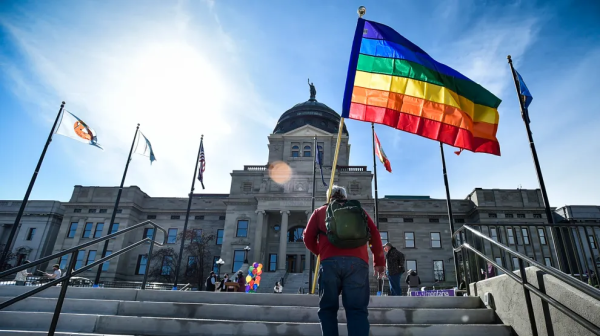
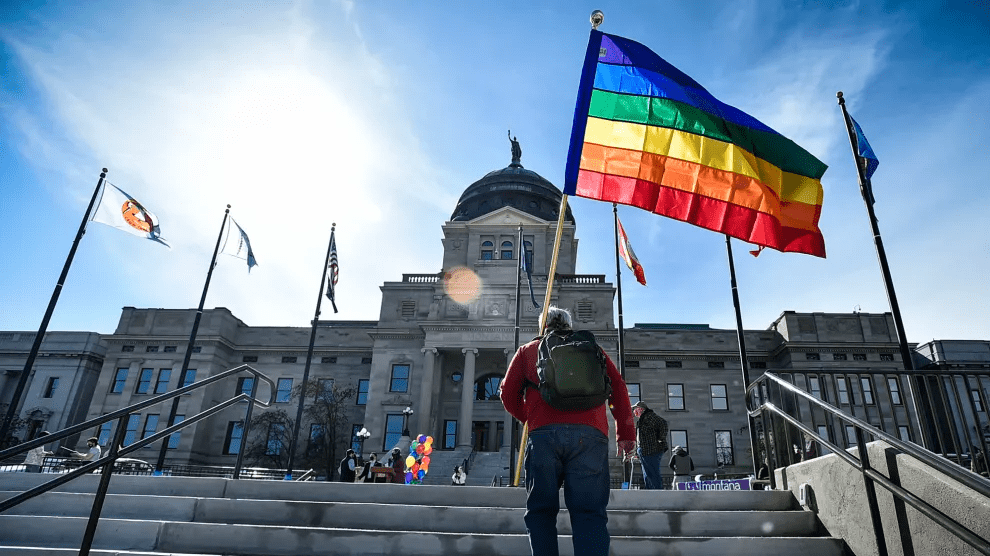
Montana’s anti-transgender bathroom restrictions are on hold under a judge’s order

*This is being reported by the AP News.

A judge on Wednesday temporarily blocked a Montana law that restricts transgender people’s use of bathrooms in public buildings.

The measure, which Republican Gov. Greg Gianforte signed into effect last week, threatened to deprive transgender people of their constitutional right to equal protection under the law, Montana District Court Judge Shane Vannatta ruled. The law prevents people from using restrooms in public buildings that do not align with the sex they were assigned at birth.

The five people who sued over the law were likely to prevail, Vannatta added in his ruling.

The new law “is motivated by animus and supported by no evidence that its restrictions advance its purported purpose to protect women’s safety and privacy,” Vannatta wrote.

The judge’s order will be in effect at least until an April 21 hearing on whether it should continue to be blocked while the lawsuit moves ahead.

Gianforte spokesperson Kaitlin Price said the governor will defend the law “and the privacy and safety of women and girls.”

“We’re not surprised to see far-left activists run to the courts to stop this common sense law,” Price said in an emailed statement. “A man shouldn’t be in a women’s restroom, shouldn’t be in a women’s shower room and shouldn’t be housed in a women’s prison.”

The American Civil Liberties Union praised the ruling.

“Today’s ruling provides enormous relief to trans Montanans across the state. The state’s relentless attacks on trans and Two Spirit people cannot withstand constitutional scrutiny by the courts,” said a statement by Alex Rate, ACLU of Montana’s legal director.

The law passed this year despite opposition from Democrats who worried it would complicate daily life for two fellow lawmakers who are transgender and nonbinary. They included Rep. Zooey Zephyr, a Missoula Democrat who in 2023 was silenced and sanctioned by her Republican colleagues for comments she made on the House floor.

The law would require public buildings including the state Capitol, schools, jails, prisons, libraries and state-funded domestic violence shelters to provide separate spaces for men and women. It defines the sexes based on a person’s chromosomes and reproductive biology, despite a recent state court ruling that declared the definitions unconstitutional.

The order wasn’t unexpected, bill sponsor Republican Rep. Kerri Seekins-Crowe said in an emailed statement.

“I am thankful that there is a team of Montanans devoted to protecting women’s spaces from men who desire to invade them,” said Seekins-Crowe.

At least a dozen other states already have variations of bathroom bans on the books, many directed at schools. Even more states, including Montana, have passed laws to ban gender-affirming medical care for transgender children and keep trans girls out of girls sports.

Montana’s law allows people to sue a facility if it does not prevent people from using restrooms or changing rooms that do not align with their sex assigned at birth. They can recover nominal damages, generally $1, and the entity could be required to pay the plaintiff’s legal fees.

Trans student’s arrest for violating Florida bathroom law is thought to be a first

*This is being reported by NBCNews.

A transgender college student declared “I am here to break the law” before entering a women’s restroom at the Florida State Capitol and being led out in handcuffs by police. Civil rights attorneys say the arrest of Marcy Rheintgen last month is the first they know of for violating transgender bathroom restrictions passed by numerous state legislatures across the country.

Capitol police had been alerted and were waiting for Rheintgen, 20, when she entered the building in Tallahassee March 19. They told her she would receive a trespass warning once she entered the women’s restroom to wash her hands and pray the rosary, but she was later placed under arrest when she refused to leave, according to an arrest affidavit.

Rheintgen faces a misdemeanor trespassing charge punishable by up to 60 days in jail and is due to appear in court in May.

“I wanted people to see the absurdity of this law in practice,” Rheintgen told The Associated Press. “If I’m a criminal, it’s going to be so hard for me to live a normal life, all because I washed my hands. Like, that’s so insane.”

At least 14 states have adopted laws barring transgender women from entering women’s bathrooms at public schools and, in some cases, other government buildings. Only two — Florida and Utah — criminalize the act. A judge on Wednesday temporarily blocked Montana’s new bathroom law.

Rheintgen’s arrest in Florida is the first that American Civil Liberties Union attorneys are aware of in any state with a criminal ban, senior staff attorney Jon Davidson said.

Rheintgen was in town visiting her grandparents when she decided to pen a letter to each of Florida’s 160 state lawmakers informing them of her plan to enter a public restroom inconsistent with her sex assigned at birth. The Illinois resident said her act of civil disobedience was fueled by anger at seeing a place she loves and visits regularly grow hostile toward trans people.

Hate influencer Chaya Raichik harasses trans teacher & forces her to resign

*This is reported by LGBTQNation and a follow up to our earlier article breaking this news.

English teacher Rosia Sandri was left “heartbroken” after submitting her resignation on March 31 following a campaign of hate against her that followed a TikTok video she posted highlighting her experience as a trans woman in education. That video was shared by transphobes, who called for her to be fired.

Sandri came out as a trans woman seven years ago and taught English for three years at Red Oak High School in Ellis County, Texas. Sandri said her colleagues at the Red Oak Independent School District (ROISD) supported her, and she didn’t directly come out to her class but instead started dressing differently.

Students who noticed asked if they should call her by a different name or use certain pronouns; she told them they could call her “whatever they were comfortable with” but preferred she/her pronouns.

Sandri also has a TikTok account where she posts informative videos educating people on what it is like to be trans, and she filmed some videos after hours in her classroom.

Many of her former students follow her on that account and express their support in comment section, writing “best teacher ever” and “We miss you, stay strong. Lovely makeup.”

These videos, unfortunately, caught the attention of anti-trans influencer Chaya Raichik, who runs LibsOfTikTok. Raichik reposted one of Sandri’s videos, deadnaming and misgendering her. In the clip, Sandri talked about her pupils being supportive of her journey.

“They call me ‘ma’am. ’ They call me ‘miss,’” she said. “They use my correct pronouns and know my correct name, and it’s incredibly affirming.”

Raichik asked her over 4 million followers, “Would you feel comfortable with this person teaching your kid?”

Raichik is notorious for using her social media following to single out LGBTQ+ people and allies, presenting their innocuous interactions with children as “grooming.” Her followers harass and threaten businesses and institutions that support LGBTQ+ people, some going as far as to send bomb threats to children’s hospitals for providing gender treatment to trans youth. Schools targeted by Libs of TikTok faced similar repercussions.

Sandri was out sick when Libs of TikTok reposted her video but stated that she started receiving threats and harassment on her personal and school email. The human resources department at ROISD and the deputy superintendent reported that they have also received threats and have placed Sandri on administrative leave for two days while the school launches an investigation.

Texas state Rep. Brian Harrison (R) shared the Libs of TikTok post and called for Sandri to be fired.

“As the State Representative for Red Oak ISD, I am demanding that THIS TEACHER BE IMMEDIATELY TERMINATED!” Harrison tweeted.

On Monday, Sandri agreed with the school that she would resign.

“When I signed that resignation, it felt like my dream was being taken away from me,” Sandri told NBC“I’m not going to get hired again as a teacher in Texas, and that hurts. It hurts I have to leave my students in the middle of the year…they keep on messaging me and asking if it’s illegal to be a trans teacher.”

Harrison later told NBC News that he was proud to have helped remove Sandri from her job.

“Any teacher who claims to get gender euphoria from their minor students and teaches them that boys can become girls should be terminated immediately,” Harrison said.

Despite this, Sandri has stated that she still wants to be a teacher and hopes to find a way.

Governor stands with trans kids & won’t take ‘soul-sucking path’ of sacrificing their rights

*This is reported by LGBTQNation.

Illinois Gov. J.B. Pritzker (D) has never shied away from standing up to Donald Trump, and he has also made it clear he supports the LGBTQ+ community.

At a recent Human Rights Campaign dinner in Los Angeles, Pritzker reaffirmed his commitment to supporting queer folks and resisting Trump.

“The Trump administration and his Republican lackeys in Congress are looking to reverse every single victory this community has won over the last 50 years,” Pritzker said. “And right now it’s drag queens reading books and transgender people serving in the military. Tomorrow, it’s your marriage license and your job they want to take.”

“Bending to the whims of a bully will not end his cruelty. It will only embolden him. The response to authoritarianism isn’t acquiescence. Bullies respond to one thing, and one thing only, a punch in the face.”

He also spoke directly to transgender youth to tell them they are not alone.

“And in the midst of this existential fight, this battle that seems to consume everything, well, let’s not take the soul-sucking path of sacrificing the most persecuted for that which we deem to be most popular.”

“I know that there are transgender children right now looking out at this world and wondering if anyone is going to stand up for them and for their simple right to exist. Well, I am. We are. We will.”

He also spoke about his mother’s activism for LGBTQ+ rights and reproductive rights and declared, “I have to laugh when I hear the right-wing carry on about the dangers of exposing kids to trans people or same-sex couples, because I’m living proof that introducing your kids to the gay agenda might result in them growing up to be governor.”

Pritzker has long advocated for LGBTQ+ people as governor. In 2023, he signed a landmark bill making Illinois the first state to make it illegal for libraries to ban books.

Trump uses child abuse awareness proclamation to bash transgender people

*This is reported by Axios.

President Trump‘s decision to target transgender care in a proclamation declaring April National Child Abuse Prevention Month “betrays” the month’s purpose, LGBTQ advocates said.

Why it matters: Framing the trans youth experience as “abuse” further stigmatizes an already vulnerable community, as the Trump administration tries to erase trans people from American life through policies limiting access to health carecareerssportseducation and more.

Driving the news: Trump’s Thursday proclamation singled out transgender care, labeling it a form of child abuse without acknowledging the most common risk factors for neglected or abused children.

  • “It is deeply disingenuous for Trump to use National Child Abuse Prevention Month as a platform to attack and stigmatize the trans community,” Ash Lazarus Orr, a spokesperson for Advocates for Trans Equality, told Axios.

Reality check: Gender-affirming care is supported as both medically appropriate and potentially life saving for children and adults by major medical associations, including the American Medical Association, the American Academy of Pediatrics and the American Psychiatric Association.

  • Drugs like puberty blockers are temporary and reversible. They are given to trans youth and non-trans youth who experience early onset puberty.

What they’re saying: Trump’s proclamation “is vile and upsetting but importantly it is just a press release,” Chase Strangio, co-director of the ACLU’s LGBT & HIV Project said in a statement on Instagram.

  • “It does not change the law or direct any agency action. But it does continue to suggest that the government is moving towards efforts to explicitly criminalize trans life and support of trans people.”

“Using the language of ‘child protection’ to justify the oppression of trans youth betrays the very values this month is meant to uphold,” Orr said.

  • “Denying trans youth medical care won’t change who they are.”

“Supporting a child — regardless of their gender identity — is an act of love, period,” Jarred Keller, a Human Rights Campaign spokesperson, said.

  • “The idea that affirming a child’s gender identity constitutes something harmful is an insult to the parents who support their transgender children with compassion and understanding.”

Threat level: Trump wrote that “a stable family with loving parents” is a safeguard against child abuse, but most victims are abused by a parent, according to the National Children’s Alliance.

By the numbers: In 2022, a reported 434,000 perpetrators abused or neglected a child, per the alliance.

  • 76% of children were victimized by a parent or legal guardian in substantiated child abuse cases, meaning that child protective services agencies determined that abuse or neglect occurred.

Zoom out: Trump in January signed an executive order to defund youth gender-affirming care and a separate one threatening funding for K-12 schools that accommodate transgender children.

  • American hostility toward trans people has prompted U.S. allies to issue travel advisories for trans travelers, warning them that they must designate one “sex” on their travel forms and it has to reflect the gender they were assigned at birth.

Ts Madison’s ‘Starter House’ opens its doors to trans women in Atlanta

*This is being reported by Out.com

Trans icon Ts Madison has now opened a groundbreaking new initiative — dubbed as a “Starter House” — for trans women in Atlanta, GA, coinciding with 16th annual Transgender Day of Visibility. The trans advocate has partnered with NAESM, a historic Black HIV/AIDS organization, to launch a groundbreaking housing initiative aimed at supporting Black trans women engaged in sex work.

Located in Ts Madison’s former residence, the facility offers Black trans individuals access to safe housing, gender-affirming healthcare, economic opportunities, and holistic support.

The grand opening stirred deep emotions for the RuPaul’s Drag Race judge. “This morning I was having withdrawals because this is a big thing. Like, this is my house. I’m like, I’m giving my house to the community. That means people are going to be transitioning in and out and in and out of this house. I built a legacy here, but I’m still attached to this house. These are girls that are disenfranchised. These are girls that are homeless. These are girls that are trying to find another way in their life.”

The Ts Madison Starter House is part of A New Way of Life’s SAFE Housing Network, a global coalition of over 30 organizations focused on providing reentry support for women who have been incarcerated. Founded in 1998, the SAFE Housing Network aims to reduce incarceration rates in the U.S. by offering safe housing, assisting individuals in healing from the trauma of their experiences, and empowering them to take a leadership role in the movement to end mass incarceration.

Dominique Morgan, the Executive Director of the project, emphasized the importance of community support. “I think so many of us feel the fear of what’s happening in this climate, and so many folks feel like, oh my goodness, are we going to make it. And what today really symbolizes for me is that we have answers happening all over the place, and that we have the power to decide how we show up for each other.”

This facility will serve as a vital stepping stone for women, providing safe, affirming housing that prioritizes dignity and stability. To learn more and/or make a donation to the project, visit the official page for the Ts Madison Starter house.

North Texas teacher resigns after backlash over TikTok pronoun video

*This is being reported by WFAA.

 For seven months, Red Oak ISD was a sanctuary for Rosalyn Sandri. She described it as a place where she pursued her lifelong dream of being a teacher.

But today, she’s no longer in the classroom.

Sandri, an English teacher, shared a video on TikTok talking about how her students had embraced her pronouns and showed respect by addressing her as “ma’am.”

“When I told them I changed my pronouns, they jumped right into it,” she said on Tuesday.

But Sandri said when the post was reposted on X, formerly known as Twitter, by the account Libs of TikTok, it went viral, racking up 3.2 million views.

That’s when the backlash began.

Sandri said she began receiving death threats and hateful emails, even through her school email account.

“I got a notice that told me to eat a bullet,” she said.

The video also caught the attention of Texas State Representative Brian Harrison, who publicly called for her resignation.

“Schools are for education, not indoctrination,” Harrison said over Zoom on Tuesday.

“Teaching children, minors, that boys can become girls, and girls can become boys is at odds with objective reality. And the biological reality is that there are only two sexes,” said Harrison.

In a statement to WFAA, Red Oak ISD confirmed that Sandri resigned effective immediately on Monday, March 31.

“In light of recent attention, Red Oak High School English teacher Sandri has resigned, effective March 31, 2025. Any other information is a personnel matter, and we are not at liberty to discuss.”

Sandri said she felt she had no choice but to step away for her safety and the safety of the school and students.

“When I resigned, I felt like I was signing away my ability to teach in the state of Texas. I don’t know that another school will touch me now,” she said.

“Being a teacher is all I ever wanted to do since I was five years old,” she said.

Now, she fears her career in Texas is over.

I talked to 4 trans refugees to find out how they’re building new lives in blue states

*This is being reported by LGBTQNation.

Karma Yoakum had been part of a community of political activists in Texas for years. However, as the relentless tide of anti-trans legislation kept rising, it became clear that it was time for them to relocate, recover their energies, and take on a different role in the larger fight. 

Finding a new home in the Pacific Northwest, Karma was able to do just that. But the road wasn’t without its challenges, and finding their new community required intention and perseverance once they had recovered a little bit of who they were by living in a state that wasn’t trying to persecute them for their existence.

As anti-trans sentiment and legislation have been on the rise across the United States in recent years, many trans and nonbinary people have made the difficult decision to flee red states. In moving to a bluer state, trans people are making a choice based on safety, but that doesn’t make it an easy choice. It means leaving behind a home and community you have built over years or your whole life because of the machinations of people who hate you. While a new state can fix a lot of problems, building a new community doesn’t happen overnight. The president’s re-election and the introduction of federal anti-trans bills have created a flashpoint for even more trans people to seek safer pastures in states that might protect them.

I wanted to understand the challenges and opportunities that trans people face when starting over and building a new community in a blue state. I spoke with four trans and nonbinary people who have relocated in the last six to twelve months. They shared the challenges, the successes, and advice for others who are considering relocating to a sanctuary state.

Why trans people are leaving their red state communities

Major relocations often happen around an institution, such as going to college or starting a new job. But moves like those come with some built-in community-building support. 

Relocating as a refugee from a red state can be a more lonely affair. Most of the people I spoke with found that building a new community felt like work exacerbated by not having the same connections and support systems they had in the communities they left behind.

Clark Roman had been well-established in St. Louis. Both Clark and his boyfriend had owned their own houses and had a strong community of friends and chosen family in the city. But he says he saw the writing on the wall in 2023 when the Missouri attorney general enacted a de facto ban on trans hormones and trans healthcare that included adults. While his emergency rule was blocked by a judge and then withdrawn, the legislature went on to pass a gender-affirming care ban for trans youth. It was clear where things were headed, and Clark moved to Minneapolis a few months later.

Leaving behind a large community, both queer-centric and otherwise, Clark has found it hard to make more connections in his new city. At the center of it is the challenge of the modern age: balancing work and social life. “The honest truth is I have a very, very stressful job and I have not had the space in my life to build community the way I want.” He noted that it felt like he had to “treat building a new community as a second job.”

Karma also struggled to make connections when they first relocated from Texas to Washington state. After living in Texas for years, they reached a point where they found themselves saying, “I’m feeling scared and trapped and there’s absolutely nothing keeping me in Texas anymore.”

Karma moved 2,000 miles to Seattle but found a problem when they arrived. While their new home was more welcoming to the gender diverse, there was still culture shock to get over. “Where is everybody? I heard it was this wonderful panacea, a place where I would be welcomed. So, I looked around and I learned what the Seattle chill was. And it’s not a horrible thing, it’s just a difference in culture, because I’m used to southern culture.”

Chris (his name has been changed to protect his privacy)  echoed Karma’s frustrations over Washington state’s laid-back attitude to building community. Like Clark, Chris was living in St. Louis, saw the anti-trans legislation in Missouri in 2023, and concluded that “living in Missouri as a trans human, [he] was at risk.” He made the move to Washington state in 2024 while watching the coming election without much hope.

While St. Louis had its flaws, Chris was leaving behind a lot of queer community and resources. He had worked with the St. Louis Metro Trans Umbrella Group for nearly 20 years, enjoyed events and meetups, and collected queer friends through meets at clubs, bars, and drag shows. But the same culture shock that Karma experienced has made it hard to build new connections: “It’s been honestly a huge struggle, much more than I anticipated.”

While it’s important to know that people are struggling with finding new communities in their new states, it’s not all doom and gloom. Clark and Chris have both been able to stay in touch with parts of their communities from before their moves through travel and online communication. While that’s not always the same, it’s a nice option to have. I also spoke with Mira Lazine – an LGBTQ Nation contributor – who relocated from Cincinnati to Minneapolis and had a different sort of experience.

While the Ohio governor vetoed HB 68, which banned gender-affirming care for minors, he then introduced care guidelines for the state. “These rules were basically going to amount to a total care ban for all adults in Ohio,” explained Mira. “And it even would include some aspects of conversion therapy and mental health treatment.” 

It was time to relocate, and someone recommended Minneapolis. For Mira, finding a new community in this queer-friendly space came a lot easier.

“Within the first week of moving here, I went to a few coffee shops, and everyone, like the baristas, were trans, and they were recommending me support groups to join, discord servers I can join, like the whole nine yards. And it’s just been way easier to meet people and meet other queer people and form connections here.” 

While Karma and Chris suffered from culture shock, Mira found herself among other transplants to the state who had their relocation in common: “Probably like 80% of the queer people I’ve met aren’t originally from Minnesota, so we’re all like, yeah, we need community, let’s build one.”

Finding new communities in blue states

All of the people that I spoke with had been in their new homes for less than a year. While there have been struggles, they have been able to find resources and spaces to start that community-building process and are in different places in their journeys.

Clark noted that his struggle to find community in Minneapolis is probably the biggest dissatisfaction in his life right now. But he can see a light at the end of the tunnel through some of the community spaces that he is attending. “The synagogue I go to is very open and trans-friendly. So that was helpful.” Clark is also looking at getting more involved with Transplants, a group for LGBTQ+ people who have relocated to Minneapolis and St. Paul. 

Chris has found that his work at a university in Washington provides some space for community building. “Their DEI office held a holiday event for, I guess, everyone, but the folks who showed up to that event were primarily queer folks and persons of color. And that was fantastic.” 

Chris still faces challenges, even at the events. He told me that he has been going to meet-up groups, Portland Pride, the Ingersoll Gender Center, and more, but he wasn’t satisfied with the results. Chris suggested that part of that problem might be visibility: “I am stealth, so at my workplace, I’m not fully out [as trans]. Where I landed is sort of a purple city in a blue state. I’m typically able to pass as male and not be questioned at all, which is, is nice, but at the same time, it’s hard because I think visibility might help me connect with more queer people.”

For Karma, their initial struggles with community-building in Seattle began to bear fruit around the one-year mark. “I did the things that I’ve tried before, and I figured, if they’ve worked everywhere else, they ought to work here. Maybe it just takes a little longer. And yeah, that was it. It takes a little longer.”

Karma found that organizations were the key. They found like-minded people when they returned to playing music with the local band that is part of the LGBTQ+ band organization, Pride Bands Alliance, an international group that Karma has worked with since the 1990s. Similarly, local chapters of a national support network have provided success in community building: “PFLAG, all you have to do is show up to a meeting. There are people there that if you need a hug, they are instant family. And people that aren’t instant family are there because they want support.”

Karma also reached into her past in political activism and found that, post-move, they had the energy to continue in their new home. “The third place that I decided to get involved was the Gender Justice League. Dealing with legislation, dealing with victims of violence here in the Seattle area. So, supporting our community, advocating like crazy.” After months of struggling to find their people, Karma now finds that barely a day on their calendar doesn’t include a community event, a catch-up, or a coffee meet.

No regrets

Everyone’s experience with relocating to a bluer state will be unique. However, there was one ringing agreement amongst all the people that I spoke with: no regrets. When asked what advice they had for someone considering a move, Clark, Chris, Mira, and Karma all urged people to relocate if they felt it might help.

Clark grieves what he left behind but recognizes that it was the right call for him, and he’s going to keep trying to find his new community. “I think it’s dissatisfying at first. But it’s important to [show] up repeatedly because I think that repeated showing up [is] how I made my community originally in St. Louis.” 

Chris echoed those sentiments, noting that he has no regrets and that it has been “completely worth it.” Watching recent election results come in wouldn’t have been fun anywhere, but he was glad to be in a safe space for it all “despite challenges and some loneliness.”

Karma isn’t even considering going back. “I would say do it. The relief that I felt by at least being in a community where I know that I’d no longer have to deal with local politics.”

“In Texas, the local politics were against me,” they said. “At least here, I know locally and statewide, my representatives really do represent everybody, and they have my back. And that has made so much a difference in my life.”

Kentucky Re-Legalizes Conversion Therapy, Restricts Adult Access to Gender-Affirming Care

*This is being reported by THEM.

Kentucky’s legislature has overridden Gov. Andy Beshear’s veto of a bill that allows conversion therapy to resume in the state and that bans Medicaid funds from being used for gender-affirming care, including for adults. Beshear also allowed a bill banning incarcerated people from receiving or continuing to receive publicly funded gender-affirming care to pass into law without his signature.

On Wednesday, the Kentucky House and Senate, which are both controlled by Republicans, voted to override Beshear’s veto of House Bill 495, per the Lexington Herald-Leader. The bill reverses the governor’s September 2024 executive order, which banned so-called conversion therapy from being practiced on youth in the state. Though HB 495 was originally only meant to roll back the ban on the harmful, discredited practice, the bill was additionally amended to add a ban on the use of Medicaid funds for gender-affirming care for trans adults, per the Herald-Leader. HB 495 has an emergency clause, meaning that it takes effect immediately. According to the Kentucky Lantern, the House voted to override the veto 78-20, and the Senate voted 31-6.

However, Beshear did not veto Senate Bill 2, which bans gender-affirming care for incarcerated trans people. At a press conference in December, Beshear stated that “convicted felons do not have the right to have any and all medical surgeries paid for entirely by tax dollars, especially when it would exceed the type of coverage available to law-abiding citizens in the private sector,” according to The Hill. As the publication noted, though, the state has never provided a gender-affirming surgery for an incarcerated person. Even so, gender-affirming care, including surgery, is medically necessary. As the ACLU’s Chase Strangio told Them in September, “Courts have consistently held that blanket denials of medical care, including medical treatment related to gender dysphoria, are unconstitutional,” since the denial of that care could violate the Eighth Amendment, which prohibits cruel and unusual punishment.

According to the Kentucky Lantern, there are only 67 trans people incarcerated in Kentucky prisons, all of whom will be forced to stop gender-affirming hormone therapy if that care is paid for with public funds. At a February hearing, Louisville psychologist Jacks Gilles testified against the bill, stating that stopping that care “will result in negative outcomes, including increased anxiety, disturbances in social and familial relationships, depression, suicidality and death,” according to the Lantern. “Gender-affirming medical care is not experimental, it’s not elective, and it’s not cosmetic,” Gilles said.

Beshear has previously been hailed as an outspoken advocate for the trans community. In a November 2024 op-ed for the New York Times, the governor pleaded with his fellow Democrats to not scapegoat trans people for the party’s loss. Though the legislature overrode his veto, in 2023 Beshear did attempt to put a stop to a wide-sweeping anti trans bill that banned minors from receiving gender-affirming care, prohibited trans kids from using the bathrooms that align with their identities at school, and banned discussion of LGBTQ+ topics in elementary schools.

In a statement posted to Facebook, Chris Hartman, the executive director of statewide LGBTQ+ advocacy organization Fairness Campaign, called the passage of the bills “a sad day in Kentucky.”

“Two anti-LGBTQ+ bills will become law with devastating consequences for our community,” he said, calling both bills “cruel” and that they “have no place in our Commonwealth.”

Blog at WordPress.com.

Up ↑