In this powerful conversation, we sit down with Rowan Murphy, co-author of Why Are We Like This? Stories of Transformation, a book exploring the extraordinary global response to Netflix’s Heartstopper. Rowan shares his personal journey as a transgender gay man in his early 50s, including: His lived experience navigating identity, visibility, and authenticity Why he ultimately chose to leave the United States How growing civil rights restrictions on LGBTQ people are shaping real-life decisions The deep emotional and psychological impact Heartstopper has had on LGBTQ audiences worldwide.
Kansas Republicans are trying to take away currently valid driver’s licenses from transgender people in the state if they have corrected the gender marker on them in a new bill that has also been expanded – under a sneaky maneuver that allows changes to a bill without a public hearing – to be one of the “most extreme” bathroom bills in the nation.
H.B. 2426 was already very anti-trans. It defines “gender” under the law in terms of “chromosomes,… hormones, gonads and nonambiguous internal and external genitalia present at birth” and says that driver’s licenses can only have someone’s sex assigned at birth on it. The bill instructs the state government to invalidate all driver’s licenses that do not have a gender marker on them that reflects a person’s sex assigned at birth and to reissue new driver’s licenses.
But state Republican lawmakers expanded the bill last week, adding a strict anti-trans bathroom ban to a bill already seeking to ban trans Kansanians from changing the gender markers on their driver’s licenses.
The legislators used a state procedure called gut-and-go, which allows lawmakers to completely replace an existing bill’s language with pretty much anything they want while bypassing a public hearing.
Even before the addition of the bathroom amendment, Kansas lawmakers were already trying to push the bill through with as little public input as possible.
Republicans introduced the gender marker aspect of the bill with less than 24 hours’ notice before a public hearing. But residents nonetheless rose to the occasion, submitting hundreds of testimonies opposing the bill.
“You had a bill introduced one day at 3:58 p.m., it was scheduled for a hearing the next day, less than 24 hours notice,” state House minority leader Brandon Woodard (D) told theTopeka Capital-Journal. “Testimony had to be submitted by 10 a.m., and yet Kansans cobbled together hundreds of pieces of testimony that we were still able to print and submit.”
Republicans, Woodard said, “do those sorts of things in an attempt to shield. They know that the public’s not on the side with them. That’s not civil. When we delivered those pieces of testimony, the committee assistant said, ‘Oh my goodness, this is going to take me days and days to upload.’ I said, ‘Next time, the chair should consider giving people and Kansans a couple of days notice.’”
After all that, the Republicans weren’t done. Democrats are enraged over the addition of the bathroom amendment, proposed by State Rep. Bob Lewis (R). “We all thought that this bill was probably a bathroom bill, and now it’s showing its true colors,” state Rep. John Carmichael (D) told the Kansas Reflector.
“What this bill is about, with this amendment, is making it so that people who are transgender or people who are intersex have no safe place to go to the bathroom.”
“This is an attempt to obfuscate what we’re doing here,” Carmichael added. “If you’re in favor of a lack of transparency, if you’re in favor of taking bill numbers and playing them like a shell game, this is the amendment for you.”
Lewis claimed the amendment was “for privacy concerns and for public safety concerns.”
“I think this is a necessary bill,” he told the Capital-Journal.
Trans journalist Erin Reed called the bill “the most extreme anti-transgender measure in the United States,” explaining that it could punish trans people who use the bathroom that does not align with their sex assigned at birth with a misdemeanor with possible jail time.
But what “turbocharges it,” she said, is a provision allowing individual people to sue trans people for using the bathroom they deem “incorrect.”
“Critically, nothing in the provision limits its application to publicly owned buildings,” Reed explained. “As written, it would not only be the first bathroom bounty law to target transgender people directly, but also the first to extend a bathroom ban into private spaces—effectively creating the nation’s first private bathroom ban if enacted by empowering bounty hunters to search for trans people in bathrooms.”
Reed said she confirmed with multiple legal experts and lawmakers that, despite the bill appearing to only target public spaces, it would also apply to private bathrooms.
The bill is supported by Kansas Attorney General Kris Kobach (R). Republicans have made it a major priority and are trying to pass it as quickly as possible. Democratic Kansas Gov. Laura Kelly will likely veto it if it makes it to her desk.
“If passed,” Reed said, “what follows would be the bill’s most consequential test: an effort to override that veto in a Legislature where Republicans currently hold a veto-proof majority, but where some may view the bill as too extreme. For transgender people in the state, that effort may be the most consequential in years.”
Two of Wisconsin’s largest pediatric hospitals have stopped providing gender-affirming care for transgender youth, Wisconsin Public Radio reports.
Children’s Wisconsin and University of Wisconsin (UW) Health have ended the treatment for minors, after pressure from the Trump administration. Advocates say the end of gender-affirming medical care will lead to negative mental health effects for trans youth.
In a statement, Children’s Wisconsin cited “escalating legal and federal regulatory risk” facing providers across the nation as the reason it is “currently unable to provide gender-affirming pharmacologic care.” The hospital added that LGBTQ+ children should be treated with “support, respect, dignity, and compassion.”
The hospital will continue to offer mental health services for patients and families.
In December, the Department of Health and Human Services, under the direction of Secretary Robert F. Kennedy Jr., announced plans to end all Medicaid and Medicare funding for hospitals that provide gender-affirming care to minors.
“Under my leadership, and answering President Trump’s call to action, the federal government will do everything in its power to stop unsafe, irreversible practices that put our children at risk,” Kennedy said, announcing the funding threat. “This administration will protect America’s most vulnerable. Our children deserve better — and we are delivering on that promise.”
In reality, gender-affirming medications for young people are considered by every major American medical association to be safe, reversible, and essential to the well-being of trans youth.
UW Health said its hospital system will pause prescribing puberty blockers and hormone therapy for patients under 18 years old “due to recent federal actions.” The hospital remains committed to providing “high-quality, compassionate” care to LGBTQ+ patients, officials said in a statement.
“We recognize the uncertainty faced by our impacted patients and families seeking this gender-affirming care and will continue to support their health and well-being,” they said.
Steve Starkey, executive director for OutReach LGBTQ+ Community Center in Madison, said the consequences of ending the care will be grave.
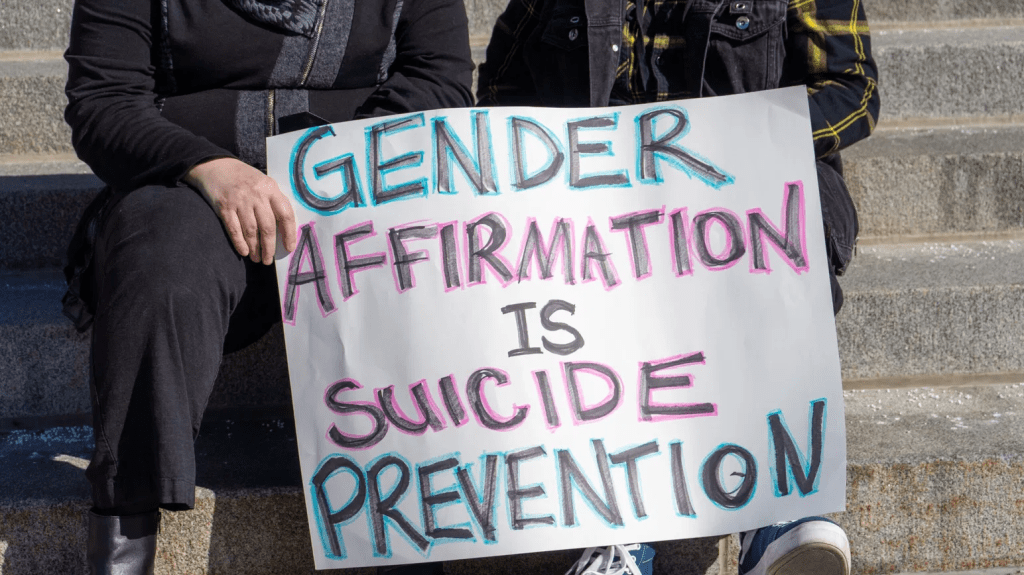
“It will definitely have a negative impact on the rates of suicide, and the mental health of the trans community” in general, he said. “It affects trans adults as well, because it’s like an attack on all trans people.”
Starkey pointed to rates of suicide and suicidal ideation, which are already high for the trans community.
A 2023 study by the Williams Institute at the UCLA School of Law found that more than 80% of trans adults had suicidal thoughts, while more than 40% had attempted suicide.
“For trans people of all ages, being able to express themselves in the gender that they feel that they are is important for their mental and physical health,” Starkey said. “By not allowing trans people to do that, to have the support, it just means that they are not able to be wholly who they are.”
In the last week alone, hospitals and clinics in Orange County, Riverside, and San Diego, California — and in Tacoma, Washington too — announced plans to shutter gender-affirming care programs for trans youth.
A year ago this week, Trump issued an executive order vowing to end what he called the “chemical and surgical mutilation” of children with gender-affirming care. Republicans have used these terms to outrage people and vilify medical providers of the care, but puberty blockers and hormone replacement therapies don’t “mutilate” kids, and gender-affirming surgeries are rarely (if ever) conducted on minors.
A protester at Children’s Hospital of Orange County this week described the same care as life-saving.
“I’m a transgender woman, and I’m here to tell you that denying people this gender-affirming care doesn’t make gender dysphoria go away,” Stephanie Wade, chair of Lavender Democrats of Orange County, told LAist. “All it does is make it metastasize into suicidal depression. And I’ve been there. I dealt with this as a child. We can’t take this away from kids.”
If you or someone you know is struggling or in crisis, help is available. Call or text 988 or chat at 988lifeline.org. The Trans Lifeline (1-877-565-8860) is staffed by trans people and will not contact law enforcement. The Trevor Project provides a safe, judgement-free place to talk for youth via chat, text (678-678), or phone (1-866-488-7386). Help is available at all three resources in English and Spanish.
Missouri’s Supreme Court upheld the state’s ban on gender-affirming care for minors this week, along with a prohibition on Medicaid coverage of gender-affirming care for anyone in the state.
As the Missouri Independent reports, the court’s unanimous decision upholds a 2024 circuit court ruling in a case challenging Senate Bill 49. The law, signed by Gov. Mike Parson (R) in 2023, bans minors from accessing any form of gender-affirming care, including puberty blockers, hormone replacement therapy, and surgeries. It also bans the state’s Medicaid program from covering gender-affirming care for people of all ages.
The challenge against the law was brought by Lambda Legal and the ACLU of Missouri on behalf of three families of transgender young people, medical providers, and LGBTQ+ advocacy organizations, who argued that the law should be subject to heightened scrutiny, a more rigorous legal standard applied to cases involving the classification of individuals by specific characteristics like gender.
According to the Missouri Independent, the state Supreme Court rejected that argument, as had the lower court. While plaintiffs had argued that the law discriminates on the basis of sex and transgender status, Judge Kelly Broniec wrote in the court’s decision that S.B. 49 “classifies only based on medical use and age.”
The court’s reasoning echoes that in the U.S. Supreme Court’s ruling last year in United States v. Skrmetti, which held that Tennessee’s ban on gender-affirming care for trans youth does not discriminate on the basis of sex or transgender status.
As the Missouri Independent notes, Supreme Court precedent allows lawmakers broad discretion when it comes to issues “fraught with medical and scientific uncertainty.”
While for decades there has been broad scientific consensus — including among all major American medical associations — that gender-affirming care is safe, evidence-based, and often lifesaving for minors experiencing gender dysphoria, conservative organizations and some American media outlets have made massive strides in recent years in sowing doubt about that consensus.
In September, Lambda Legal attorney Nora Huppert argued that the lower court’s decision upholding S.B. 49 included “legal and factual errors.” But writing for the Missouri Supreme Court this week, Broniec nonetheless said that the state had “demonstrated the ongoing debate among medical and ethical experts regarding the risks and benefits associated with the treatments at issue.”
The court also rejected arguments that the Medicaid ban violates Missouri’s constitution, with Broniec noting that adults in the state can still pay out-of-pocket to receive gender-affirming care.
Gillian Wilcox, director of litigation at the ACLU of Missouri, responded to the decision saying that it “not only allows the state to target transgender Missourians access to health care but also leaves everyone’s health care options at the whims of politicians, should certain care ever fall into the political arena.”
The Trump Administration ended $25 million in annual federal support to the nonprofit Trevor Project, which provides a suicide hotline for LGBTQ youth. But now, thanks to a $45 million donation from MacKenzie Scott, the nonprofit says they are on a mission to help those who need it most. And they’re seeing more demand than in years past.
Two bills in Florida advanced out of committee last week that would give the state attorney general more power to investigate and press felony charges against health care professionals who provide gender-affirming care in the state, including against therapists who discuss gender issues with minor patients and pharmacists who fill prescriptions that may be used as gender-affirming care.
Last week, the Criminal Justice Subcommittee passed H.B. 743 in a 12-5 vote, Florida Politics reports. The bill would allow state Attorney General James Uthmeier to sue health care practitioners for up to $100,000 per violation for providing gender-affirming care to minors. Mainstream medical organizations support gender-affirming care for trans kids because it has been shown to be life-saving and safe.
S.B. 1010 would make it a felony for doctors, school counselors, or psychologists to advise minors on gender-affirming care or “aid or abet” another health care professional in helping minors get gender-affirming care. The bill gained near-unanimous support from the state senate’s Committee on Children, Families, and Elder Affairs, according to the Florida Phoenix.
If that version of the bill passes, medical professionals could get a $100,000 fine per violation and up to five years in prison.
“We have to uphold the principles and standards that made this country great, biblical, constitutional law, and order at all costs. And sometimes that stings,” state Rep. Taylor Yarkowsky said at last week’s hearing.
The bill’s sponsor, state Rep. Lauren Melo (R), stressed that pharmacists would be punished under her bill, something she says is necessary because, she claimed, health care professionals are “committing fraud” by prescribing gender-affirming care medications but recording the purpose of the medications as something other than gender-affirming care.
“What we’re seeing is there’s coding that’s actually being used that is becoming the problem, and hundreds of thousands of dollars is spent per child for them to transition and codes are being misrepresented where they are saying that it’s an indoctrination disorder instead of saying it’s a gender identity disorder,” she said.
Democrats stressed that the bill could have unintentional side effects. State Rep. Kelly Skidmore (D) said that the bill is not about gender-affirming care but is being pushed by state Attorney General Uthmeier to expand his power.
“It is about giving one individual and maybe his successors authority that they don’t deserve and they cannot manage,” she said, referring to Uthmeier’s involvement in the Hope Florida scandal, where state Republicans are accused of laundering money and committing fraud. “They’ve proven that they cannot be trusted. This is a terrible bill.”
State Rep. Mike Gottlieb (D) said that doctors might be scared from prescribing hormonal medications to people with severe menstrual symptoms lest a pharmacist misinterpret the reason for the prescription.
“You’re going to see doctors not wanting to prescribe those kinds of medications because they’re now subject to a $100,000 penalty,” he said. “We’re really not considering what we’re doing and some of the collateral harms that it’s having.”
Behavioral health care professional Savannah Thompson told WUSF that the bill would make it more difficult for doctors to even talk to trans patients.
“This could increase the feelings of fear from my clients who are under 18, but it also can increase the likelihood that these professionals won’t be able to talk with their clients, honestly and openly, to give them the care and the support that they deserve and need,” she said.
The U.S. agency that enforces laws prohibiting workplace discrimination on Thursday rescinded legal guidance that had strengthened protections against unlawful harassment for LGBTQ workers and women who have abortions.
The U.S. Equal Employment Opportunity Commission voted 2-1 to repeal the 2024 guidance, which had incorporated major court rulings and laws passed in the roughly 25 years since the agency last updated its guidance.
The five-member EEOC can make rules and issue guidance explaining how federal laws that protect workers from discrimination based on characteristics such as race, sex, religion and disability should be applied. A separate arm of the agency, led by the general counsel, vets discrimination complaints filed by workers and can broker settlements and bring lawsuits against employers accused of violating those laws.
EEOC guidance is not legally binding, but lays out a blueprint for how the commission will enforce anti-discrimination laws and is often cited by judges deciding novel legal issues.
Since President Donald Trump took office last year, his appointees at the EEOC have stopped pursuing most cases involving transgender workers and have launched probes into workplace diversity policies and alleged antisemitism on college campuses.
The repeal of the 2024 guidance was expected and comes less than three months after the U.S. Senate confirmed Trump nominee Brittany Panuccio to the commission, restoring a quorum of three members and giving Republicans a 2-1 majority.
The commission in the 2024 guidance had adopted a broad view of the type of conduct that amounts to unlawful workplace harassment, saying it included discriminating against employees because they have abortions or use contraception and refusing to use transgender workers’ preferred names and pronouns.
EEOC Chair Andrea Lucas, a Trump appointee, ahead of Thursday’s vote said the EEOC had overstepped its authority by issuing guidance that imposed new obligations on employers rather than interpreting existing law.
But critics of the move said it could discourage employers from preventing harassment and leave workers without recourse when they face it.
“This action is likely to increase the amount of harassment that occurs in workplaces across the country,” a dozen former EEOC and U.S. Department of Labor officials said in a joint statement before the vote. Most of the officials were appointed by Democratic presidents.
The 2024 guidance covered an array of topics, including a landmark 2020 Supreme Court ruling in Bostock v. Clayton County that said workplace discrimination based on sexual orientation or gender identity is a form of unlawful sex discrimination. The commission had said that while Bostock involved a gay worker’s termination and not harassment claims, the Supreme Court’s reasoning in the decision extended to cases alleging harassment of LGBTQ workers.
A federal judge in Texas last year had blocked that portion of the guidance, saying that finding was novel and was beyond the scope of the EEOC’s powers in issuing guidance. Two other judges separately barred the agency from enforcing the guidance against religious organizations that sued.
For LGBTQ+ people, safety has never been an abstract idea. Concerns for our community show up in legislation, healthcare and how the government treats its citizens. In the United States, where LGBTQ+ rights are being rolled back at both the state and federal level following President Donald Trump’s reelection, many people are quietly asking the same question: where, if anywhere, does stability still exist, and what does real safety actually look like?
That question shapes real decisions. Not just about travel, but about long-term plans, family, work, medical care and whether it is possible to build a future without constant political uncertainty. International data from organizations including ILGA-Europe and Equaldex, alongside migration analysis and residency reporting from Get Golden Visa, points to a widening global divide. Some countries are strengthening legal protections and expanding access to care. Others are narrowing definitions of who is protected under the law, often by targeting transgender people first and testing how much rollback the public will tolerate.
The countries highlighted here represent a snapshot of places that currently offer strong legal protections and relative social stability for LGBTQ+ people. This is by no means an exhaustive list, and conditions can change quickly as governments shift and political climates evolve. Still, these examples help illustrate what safety looks like when it is embedded into legal systems, healthcare infrastructure, and public accountability, rather than left to cultural goodwill or temporary leadership.
One country that consistently ranks at the top is Malta. It has held the number one position on ILGA-Europe’s Rainbow Index for multiple consecutive years, a reflection of both legal protections and enforcement. Same-sex marriage has been legal since 2017, conversion therapy is banned nationwide, and gender identity is explicitly protected under the constitution. Legal gender recognition is based on self-determination, without medical or psychiatric requirements, and those protections extend into healthcare, employment, education, and family law, creating long-term security rather than symbolic inclusion.
Iceland also continues to stand out for both legal protections and social acceptance. Same-sex marriage has been legal since 2010, non-binary gender markers are recognized, and gender-affirming care is available through the public healthcare system. Comprehensive anti-discrimination laws are paired with high levels of public trust in institutions, which means LGBTQ+ protections are not constantly relitigated or politicized, but treated as settled rights reflected in daily life.
.Finland has taken meaningful steps in recent years, particularly for transgender people. A 2023 update to its law allows transgender adults to change their gender through self-determination, removing medical gatekeeping that had long been criticized by advocacy groups. While non-binary recognition remains limited, Finland’s strong social safety net and political consensus around equality have kept LGBTQ+ rights largely outside culture war framing, offering stability rather than constant legal vulnerability.
Spain has long been viewed as one of Europe’s most LGBTQ+-affirming countries, and recent legislation has reinforced that reputation. Same-sex marriage has been legal since 2005, and a 2023 gender self-identification law allows people to change legal gender without medical or psychological evaluations. Conversion therapy is banned, and public opinion surveys consistently show strong support for LGBTQ+ equality, particularly in major cities where protections are paired with visible community infrastructure.
In North America, Canada has become a focal point for LGBTQ+ Americans seeking stability. Same-sex marriage has been legal since 2005, non-binary gender markers are available on federal identification, and conversion therapy was banned nationwide in 2022. Advocacy organizations and international reporting have documented a rise in inquiries from U.S. LGBTQ+ residents since the 2024 election, especially among transgender people weighing whether legal protections at home will continue to erode.
The Netherlands remains one of the most legally secure environments for LGBTQ+ people. As the first country to legalize same-sex marriage, it continues to offer robust anti-discrimination protections and publicly funded gender-affirming healthcare. For some U.S. citizens, the Dutch-American Friendship Treaty has made relocation more feasible, a trend that has accelerated since the 2024 US presidential election.
None of these countries are immune to political change, and none represent a perfect solution. But in 2026, they show what becomes possible when LGBTQ+ safety is treated as a structural commitment rather than a cultural preference. As rights erode in some places, the countries that choose to protect them are defining where dignity, stability, and the possibility of a future still exist.
Decriminalized Sodomy: St. Lucia, Niue (reported in 2025; it happened in 2024).
Decriminalized Sodomy in Armed Forces: Dominican Republic
Repeal of Sodomy Laws Proposed: Guyana, Sri Lanka; Massachusetts (USA)
Court Challenges Pending: Grenada, Trinidad & Tobago, Zambia, possibly also St Vincent & the Grenadines and Jamaica
Criminalization Proposed: Niger
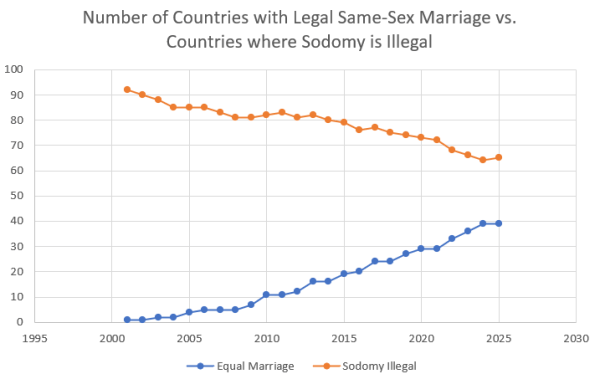
The net change in the number of criminalizing states was zero, thanks to losing two states as we gained two others, keeping the total at 65. The same thing happened in 2024, when Mali and Iraq criminalized sodomy while Namibia and Dominica decriminalized it. The number of criminalizing states hasn’t dropped since 2023, when Cook Islands and Mauritius decriminalized. And in fact, prior to 2024, no state had made sodomy a crime since 2019.
It should also be noted that the four states that criminalized sodomy in 2024-25 are all internationally recognized sovereign states with large populations, while the four decriminalizing states include three microstates, two of which aren’t sovereign.
Looking ahead to 2026, we can probably expect the criminalization wave across West Africa to continue into Niger, and possibly some other former French colonies in the area. As for decriminalization, our most likely candidates are Guyana, whose president vowed to decriminalize during last fall’s elections, and Grenada, the last of five Caribbean countries where a constitutional challenge was pending before the local courts. We may see a court challenge go ahead in Zambia this year as well, though the timeline is not currently clear. We’re also unlikely to get a result on the Privy Council appeal of Trinidad & Tobago’s sodomy law until 2027 or later. It also appears that efforts to get decriminalization passed in Sri Lanka have stalled.
Recognition of same-sex unions — 2025 tally and 2026 preview
Equal Marriage Brought into Effect: Liechtenstein, Thailand (both passed in 2024)
Equal Marriage codified: Guanajuato (Mexico)
Codification of Equal Marriage Proposed: Brazil;Virginia, Ohio, Oregon, Missouri (USA, by referendum); Aguascalientes, Chihuahua (Mexico)
Constitutional Ban on Same-Sex Marriage: Gabon (passed 2024)
Criminalized Same-Sex Marriage: Burkina Faso
Constitutional Ban on Gay People Adopting: Slovakia
Limited Recognition of Same-Sex Unions: Suriname, Turks & Caicos Islands (UK), Japan, India, European Union (court ruling affecting Poland, Bulgaria, Slovakia, Romania, yet to be implemented)
Court Challenges for Equal Marriage Pending: Japan, Botswana
Civil Union Bill Pending: Poland, Lithuania, Nagasaki (Japan)
Same-Sex Adoption Legalized: Guanajuato (Mexico – Codified), Czechia (stepchild only; passed in 2024), Thailand (passed in 2024)
Ended Discrimination against Same-Sex Couples in Adoption: Luxembourg, Israel, Chile
Surrogacy Legalized: Western Australia
Despite the number of developments listed above, we’ve entered a period where advances in same-sex marriage rights have slowed down, and we should be upfront about that going into 2026. We didn’t win same-sex marriage anywhere, and courts and governments only granted limited civil unions or relationship recognition for a specific limited rights in a handful of jurisdictions.
2026 doesn’t appear to offer much hope for advances, either. A supreme court case in Japan could go either way – or could even find that banning same-sex marriage is unconstitutional but order no solution. Sint Maarten (Netherlands) appears to just be waiting for a court challenge to copy the successful challenge in its partner states Aruba and Curacao in 2024, but none has been filed as far as I can see. And no other states in Europe or Latin America appear open to it now, with one asterisk.
At time of writing, the US military has imposed a regime change in Venezuela, removing its sitting president/dictator Nicolas Maduro to stand trial in New York. Who knows who’ll be running Venezuela by the end of 2026? Trump has ruled out the opposition leader who won a Nobel Peace Prize last year, and he insists that the US will be running the country somehow. Meanwhile, Maduro’s vice president has assumed the presidency with the support of Maduro’s supreme court. It’s easy to imagine a democratic Venezuela that is more amenable to LGBT rights than Maduro – there have been intermittent discussions about it in government since 2009. But it’s also easy to imagine that a US-imposed leader may not be keen to advance LGBT rights while dependent on Trump’s support, or another despot taking over in the event of a power vacuum.
Various countries in Africa and in parts of the Muslim world have proposed bills that would impose criminal sanctions on same-sex marriage, including Ghana and Niger. We’ll have to watch out for these.
Poland’s government agreed to a weak civil union bill in the last week of December, but it remains to be seen if even that will survive a threatened presidential veto. And Lithuania’s government has been lukewarm to codifying civil unions into law after the 2025 court ruling made them possible.
Discrimination, hate crime, and conversion therapy protections — 2025 tally and 2026 preview
Gender Identity Discrimination Ban Ordered by Court: Kenya
Discrimination Protections Removed: USA (Trump executive order); Iowa (gender identity protections repealed); UK (supreme court ruled trans women aren’t women under equality law)
SOGIE Discrimination Bans Proposed: Ukraine, Montenegro; Castille & Leon and Asturias (Spain)
Constitutional Ban on SOGIE Discrimination Proposed: Oregon, Ohio, Missouri, Vermont, Connecticut (USA, by referendum)
Conversion Therapy Banned: Spain (penalties enhanced); South Australia & New South Wales (passed 2024); Chiapas, Tamaulipas, Durango, San Luis Potosi & Guanajuato (Mexico, banned federally since 2024); Quezon City (Philippines); New South Wales, South Australia (Australia, both passed in 2024)
Conversion Therapy Bans Proposed/Pending: UK, Ireland, Netherlands, Luxembourg, Austria, Switzerland, Colombia; Tasmania, Western Australia (Australia); Gibraltar (UK)
LGBTQ Hate Crime Laws: Australia (Nationwide)and Victoria and Tasmania; Karnataka (India)
Hate Crime Law Proposed: Mexico
Hate Crime Law Enhancements Proposed: Canada, Argentina, Ukraine, Romania, UK
Blood Donation Ban Ends: Australia
Blood Donation Ban Reinstated: Greece
Once again, we saw very limited gains in 2025 across these fields, though there were some milestones. The court finding that sexual orientation discrimination is banned under the Dominican Republic constitution is a major development that will likely have ripple effects going forward. And the developments across Australia have been positive even if they were mostly traced to last year.
Looking ahead to 2026, we’re probably heading into another bad year in the United States, which will likely only be mitigated or reversed if Democrats pull off major electoral victories in mid-term and state legislative elections in November. But the supreme court also looks likely to strike down all conversion therapy ban laws across the country during this session too.
Prospects look a little bit brighter in Europe, where applicant EU countries are all racing to shore up their LGBTQ human rights standards and discrimination rules as part of the accession negotiation process. I think the European countries with proposed conversion therapy bans also seem likely to actually pass them this year – maybe the Australian states too.
Freedom of expression and assembly — 2025 tally and 2026 preview
New Laws Banning LGBTQ Expression/Pride Events Passed: Hungary, Kazakhstan (signed in 2026), Burkina Faso
These laws, modeled after the “LGBT Propaganda” laws passed by Russia back in 2013 and Uganda’s “Anti-Homosexuality Act” from 2024, have been multiplying in recent years in countries in Russia’s orbit and across Africa. The EU is doing work to push back against such laws, but with limited success.
Hungary will hold elections in the spring, which will present the best chance to get a less hostile government in power — and hopefully they can reverse the worst anti-LGBT and anti-democratic actions of the Orban regime.
Trans-specific issues — 2025 tally and 2026 preview
Gender Recognition Law Passed: Cuba; Veracruz (Mexico); New South Wales, ACT (Australia, passed in 2024)
Gender Care Banned/Restricted: USA (Supreme Court decision upholding bans in 27 states); Brazil; Sweden (passed 2024); New Zealand; Queensland (Australia)
Trans Sports Ban Proposed: Colorado, Washington (USA, referendum pending)
Transfemicide Laws Passed: Nayarit, Mexico City, Baja California, Baja California Sur, Campeche, and Mexico (Mexico)
Trans people made some substantial gains in 2025, particularly in Mexico, but also suffered some huge setbacks as a global anti-trans movement increasingly found its footing with right-wing governments. In particular, anti-trans activists have found success pushing bans on gender care for minors, but the agenda is clear that they want to expand this to all gender care and legal gender recognition cases.
Looking ahead to 2026, I think Mexico and the EU and its applicants are the likeliest states to see positive developments, though the anti-trans movement in Europe has been strong too. Unfortunately, I don’t think we’re going to see a change in the trajectory of the USA on these issues unless Democrats win big in November.
Utah House Speaker Mike Schultz (R) says his Republican majority intends to permanently ban gender-affirming care for minors this year. The move comes more than seven months after the release of a Utah Department of Health and Human Services (DHHS) report, mandated by a Republican-backed state law, which found that medical evidence actually supports access to gender-affirming healthcare for minors, a different result than many conservatives were hoping for.
Utah already has what former state Rep. Mike Kennedy (R) — who now represents the state’s third district in Congress — described to Deseret News as a “permanent” ban on gender-affirming care for minors. Passed in January 2023, S.B. 16 banned gender-affirming surgeries for minors — despite such surgeries being exceptionally rare — and instituted an indefinite moratorium on providing puberty blockers and hormone replacement therapy (HRT) to minors for the purposes of gender-affirming care.
Kennedy, who co-sponsored S.B. 16, admitted to Deseret News that characterizing the law’s ban on puberty blockers and HRT as a “moratorium” was essentially a tactic to win over lawmakers who wanted more data on the effects of such treatments. The ban, he said, is already effectively permanent unless Utah lawmakers act to lift it.
S.B. 16 also ordered the state DHHS to commission a review of medical evidence around puberty blockers and HRT prescribed for the treatment of gender dysphoria in minors, with the goal of lawmakers using the report’s findings to inform future policy decisions.
That review, conducted by the University of Utah’s Drug Regimen Center, was released last May, and as Mother Jones reported at the time, its conclusions “unambiguously” supported the benefits of gender-affirming care for trans young people.
However, Utah Republicans, including Schultz, Kennedy, and state Rep. Katy Hall — who co-sponsored S.B. 16 — have dismissed the report.
“Common sense is common sense,” Schultz told Deseret News. “I don’t need a report, one way or the other, to tell me that. I just firmly believe that minors should not be transitioning.”
At the same time, however, Schultz told the outlet that he agrees with a separate review of the DHHS report by anti-trans advocacy group Do No Harm. The group’s review, published early last month, claims that the DHHS report does not meet the standards of a true systematic review of medical evidence, according to Deseret News.
“Unlike true systematic reviews, it does not assess the reliability of studies and whether the research can provide guidance for weighing the risks and benefits of medical intervention for children with gender dysphoria,” Do No Harm’s report claims.
A spokesperson for University of Utah Health defended the Utah DHHS review, telling Deseret News in a statement that it was based on “an extensive body of research regarding the safety and efficacy of these treatments.”
“Our review also found that the consensus of that evidence is that the treatments are safe in terms of changes to bone density, cardiovascular risk factors, and metabolic changes; and they are effective in terms of positive mental health and psychosocial outcomes,” the statement read, according to Deseret News.








 fleeredstates.blog
You must be logged in to post a comment.