Utah House Speaker Mike Schultz (R) says his Republican majority intends to permanently ban gender-affirming care for minors this year. The move comes more than seven months after the release of a Utah Department of Health and Human Services (DHHS) report, mandated by a Republican-backed state law, which found that medical evidence actually supports access to gender-affirming healthcare for minors, a different result than many conservatives were hoping for.
Utah already has what former state Rep. Mike Kennedy (R) — who now represents the state’s third district in Congress — described to Deseret News as a “permanent” ban on gender-affirming care for minors. Passed in January 2023, S.B. 16 banned gender-affirming surgeries for minors — despite such surgeries being exceptionally rare — and instituted an indefinite moratorium on providing puberty blockers and hormone replacement therapy (HRT) to minors for the purposes of gender-affirming care.
Kennedy, who co-sponsored S.B. 16, admitted to Deseret News that characterizing the law’s ban on puberty blockers and HRT as a “moratorium” was essentially a tactic to win over lawmakers who wanted more data on the effects of such treatments. The ban, he said, is already effectively permanent unless Utah lawmakers act to lift it.
S.B. 16 also ordered the state DHHS to commission a review of medical evidence around puberty blockers and HRT prescribed for the treatment of gender dysphoria in minors, with the goal of lawmakers using the report’s findings to inform future policy decisions.
That review, conducted by the University of Utah’s Drug Regimen Center, was released last May, and as Mother Jones reported at the time, its conclusions “unambiguously” supported the benefits of gender-affirming care for trans young people.
However, Utah Republicans, including Schultz, Kennedy, and state Rep. Katy Hall — who co-sponsored S.B. 16 — have dismissed the report.
“Common sense is common sense,” Schultz told Deseret News. “I don’t need a report, one way or the other, to tell me that. I just firmly believe that minors should not be transitioning.”
At the same time, however, Schultz told the outlet that he agrees with a separate review of the DHHS report by anti-trans advocacy group Do No Harm. The group’s review, published early last month, claims that the DHHS report does not meet the standards of a true systematic review of medical evidence, according to Deseret News.
“Unlike true systematic reviews, it does not assess the reliability of studies and whether the research can provide guidance for weighing the risks and benefits of medical intervention for children with gender dysphoria,” Do No Harm’s report claims.
A spokesperson for University of Utah Health defended the Utah DHHS review, telling Deseret News in a statement that it was based on “an extensive body of research regarding the safety and efficacy of these treatments.”
“Our review also found that the consensus of that evidence is that the treatments are safe in terms of changes to bone density, cardiovascular risk factors, and metabolic changes; and they are effective in terms of positive mental health and psychosocial outcomes,” the statement read, according to Deseret News.
A Republican legislator in Utah is trying to change a road named for civil rights leader Harvey Milk so that it honors anti-LGBTQ+ MAGA podcaster Charlie Kirk.
Milk, a San Francisco city councilmember in the 1970s, was one of the first out LGBTQ+ people elected to public office and was integral in leading the fight against California’s Briggs Initiative, which would have banned gay people from being teachers. Kirk spoke out against LGBTQ+ rights and said that it was “God’s perfect law” that called for people to stone gay people to death. Both of them were shot to death.
Utah Rep. Trevor Lee (R) introduced a bill to change Salt Lake City’s Harvey Milk Blvd to “Charlie Kirk Blvd” earlier this week.
In an interview with ABC4, Lee claimed that the only reason he chose Harvey Milk Blvd to be renamed – and not any other road in the state – was because Milk was from California. Kirk was from Arizona but was died in Orem, Utah.
“From the vast majority of Utahns, they would say that Harvey Milk does not have any connection to Utah whatsoever,” Lee said about his bill. “But Charlie Kirk does now, especially after being assassinated in the state of Utah.”
ABC 4 noted that Harvey Milk Blvd. isn’t a state road and that the city government is in charge of naming it, which could mean that the state legislature doesn’t have the authority to rename it.
Lee has a long history of anti-LGBTQ+ legislation. He introduced a bill earlier this year to ban Pride flags in government buildings. His bill would have allowed Nazi and Confederate flags because, he argued, those are “historic,” while it would ban the rainbow flag.
Also this year, Lee threatened to withdraw state funding from the state’s NHL team, the Utah Mammoths, because the team posted a rainbow-colored version of its logo for Pride Month and wrote “Happy Pride” on social media.
“Utahns overwhelmingly don’t support pride month,” Lee said at the time. Lee has not cited any proof for his ability to speak for the “vast majority” of people in his state. He represents Utah House of Representatives District 16, a district of around 40,000 inhabitants that includes parts of Layton.
In 2022, Lee said on a podcast that Utah Gov. Spencer Cox (R) “might even be transgender because he’s all for everything they say and do.” Cox is not transgender and has signed anti-trans legislation.
“Was that before or after he vetoed a bill for tr***ies?” Lee said, using an anti-trans slur.
Lee then claimed to speak for Black people, saying that “a lot of my friends who are Black, they’d be like, yeah, man, I don’t agree with all that LGBTQ stuff.”
“I’m like, that’s embarrassing. I wouldn’t want to be associated with those people,” Lee said.
He said that it was “crazy white liberals who do not have another purpose in life” who need to stop supporting LGBTQ+ rights and “start families and make babies.”
That same year, the Salt Lake Tribune found that Lee was running a secret account on Twitter to attack LGBTQ+ people while posting imagery associated with the “DezNat” or “Deseret Nation” movement, a rightwing movement that advocates for a Mormon, white ethnostate. The movement is not supported by the Church of Jesus Christ of Latter-day Saints.
“Yes, than our spineless governor can stop acting like he needs to let transsexuals destroy our girls in sports,” he wrote on that account in one post.
In another post, he shared a meme that accused LGBTQ+ teachers of trying to turn kids transgender, a rightwing myth used to advocate banning LGBTQ+ people and allies from being teachers.
In 2021, he posted that a meme calling Pride Month “Satanic” was “amazing.”
“Doing things that are explicit, you know, people that are topless, that are running around in underwear and they have children there,” Lee said in an interview at the time about Pride. “Yeah, I think that’s satanic. I think that’s horrible.”
Lee also said that “teachers should be paid less not more” with the hashtag “#deznat.”
*This press release is from the Mayor’s Office of Salt Lake City.
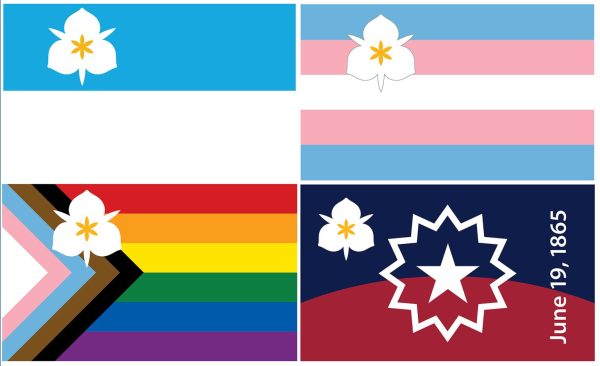
Salt Lake City Mayor Erin Mendenhall proposed adopting three new City flags, in addition to the traditional Sego Lily Flag, on Tuesday to most accurately reflect the values of the City and its residents. The Salt Lake City Council adopted the flags via ordinance in its formal meeting.
The three additional city flags celebrating human rights include:
The Sego Celebration Flag, representing the history of Juneteenth and the City’s Black and African American residents;
The Sego Belonging Flag, representing the City’s LGBTQIA residents and broader acceptance of this community; and
The Sego Visibility Flag, representing the City’s transgender residents and a commitment to seeing and celebrating their lives.
“Our City flags are powerful symbols representing Salt Lake City’s values,” said Mendenhall. “I want all Salt Lakers to look up at these flags and be reminded that we value diversity, equity and inclusion—leaving no doubt that we are united as a city and people, moving forward together.”
House Bill 77, passed during the 2025 legislative session, narrowed the types of flags a city can display publicly on government property unless a flag meets the criteria outlined in the bill as an “exempted flag.” It was important to the Mendenhall administration that the City work within the constraints of recent legislation while continuing to uphold Salt Lake City’s values.
“Like other civic symbols, these flags reflect our shared humanity and the values that help everyone feel they belong—no matter their background, orientation or beliefs,” said Salt Lake City Council Chair Chris Wharton. “While the state has restricted which flags public buildings can fly, I’m glad we can still uphold our community’s values within the law.”
The three new flags were chosen because versions of them have been consistently displayed at City Hall during Mayor Mendenhall’s time in office and are representative of our community’s diverse, loving, and accepting values.
In all three flags, the sego lily in the upper corner of these designs is the City’s most recognized emblem, clearly identifying that each flag is representative of Salt Lake City specifically.
In 2020, Salt Lake City adopted its current flag following a community-driven redesign: a field of blue over white with a white sego lily with three petals in the upper hoist canton. Salt Lake City is the only state capital with a three-word name. Despite the harsh environmental climate it lives in, the sego lily is a symbol of resilience, exemplifying Salt Lake City and its residents. Over the past five years, the sego lily and the City’s flag have grown to be highly recognized symbols and sources of pride in the city.
The City flags will continue to fly alongside the State of Utah and American flags.
Utah became the first state to prohibit flying LGBTQ+ pride flags at schools and all government buildings after the Republican governor announced he was allowing a ban on unsanctioned flag displays to become law without his signature.
Gov. Spencer Cox, who made the announcement late Thursday night, said he continues to have serious concerns with the policy but chose not to reject it because his veto would likely be overridden by the Republican-controlled Legislature.
Starting May 7, state or local government buildings will be fined $500 a day for flying any flag other than the United States flag, the Utah state flag, military flags or a short list of others approved by lawmakers. Political flags supporting a certain candidate or party, such as President Donald Trump’s signature “Make America Great Again” flags, are not allowed.
The ban also prohibits teachers from hanging any restricted flag in their classroom.
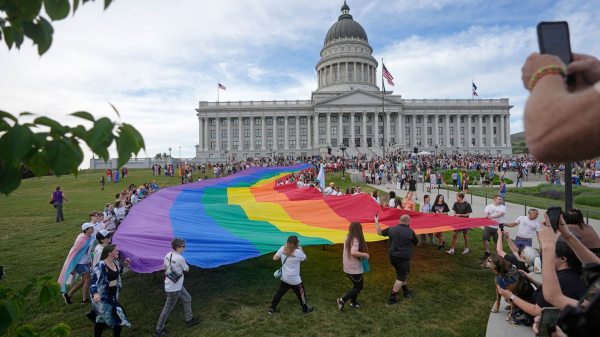
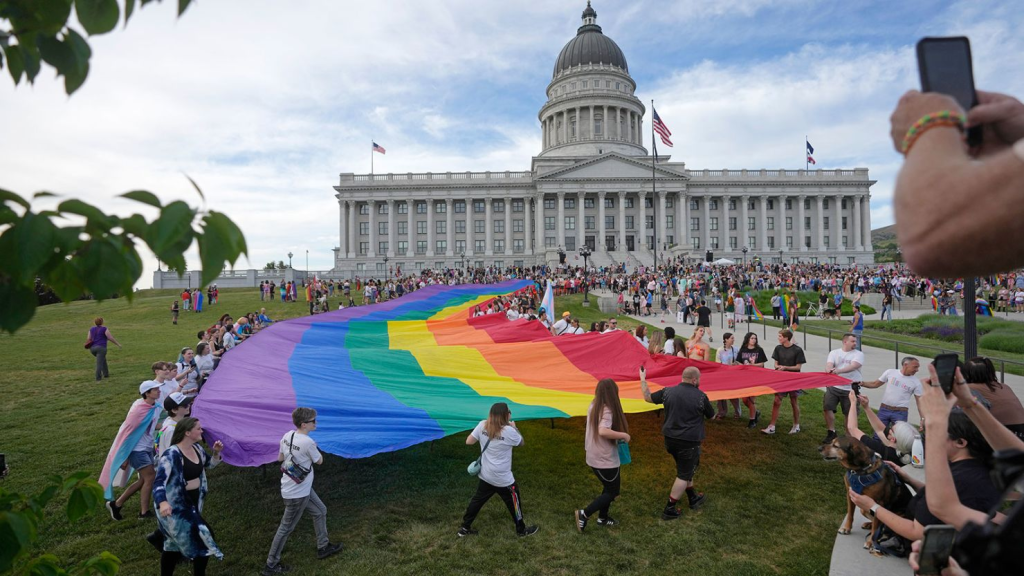
The new law could stoke conflict between the state and its largest city. City buildings in liberal Salt Lake City typically honor Pride Month each June by displaying flags that celebrate its large LGBTQ+ population. Local leaders have illuminated the Salt Lake City and County Building in rainbow lights to protest the flag ban each night since the Legislature sent it to Cox’s desk.
Andrew Wittenberg, a spokesperson for Salt Lake City Mayor Erin Mendenhall’s office, said their attorneys are evaluating the law and the capital city does not yet have information on what it will do once the law takes effect.
The bill’s Republican sponsors, Rep. Trevor Lee and Sen. Dan McCay, said it’s meant to encourage “political neutrality” from teachers and other government employees. Opponents argued it aims to erase LGBTQ+ expression and take authority away from cities and towns that don’t align politically with the Republican Legislature.
In a letter to legislative leaders explaining his decision, Cox said he agreed with the “underlying intent” of the bill to make classrooms politically neutral but thought it went too far in regulating local governments. He also noted that by focusing narrowly on flags, the law does not prevent other political displays such as posters or lighting.
“To our LGBTQ community, I know that recent legislation has been difficult,” Cox said. “Politics can be a bit of a blood sport at times and I know we’ve had our disagreements. I want you to know that I love and appreciate you and I am grateful that you are part of our state. I know these words may ring hollow to many of you, but please know that I mean them sincerely.”
Cox’s decision came hours after the Sundance Film Festival announced it was leaving its home of four decades in Park City, Utah, for Boulder, Colorado. The flag bill created eleventh-hour tensions as some residents worried it would push the nation’s premier independent film festival out of state. Festival leaders said state politics ultimately did not influence their move from conservative Utah to liberal Colorado. They did, however. make “ethos and equity values” one of their criteria in a nationwide search for a new home and referred to Boulder in their announcement as a “welcoming environment.”
Utah’s flag law goes further than one signed last week in Idaho that only applies to schools. But Idaho Republicans are also advancing a separate bill to ban government buildings from displaying certain flags.
Florida lawmakers have advanced a proposal to ban pride flags and others that represent political viewpoints in schools and public buildings after similar measures failed in the past two legislative sessions. Some federal agencies, including the Department of Veterans Affairs, also have limited which flags can fly at their facilities.
Other flags permitted under the Utah law include Olympic and Paralympic flags, official college or university flags, tribal flags and historic versions of other approved flags that might be used for educational purposes.
Ten years ago, Utah passed a landmark pair of bills that combined religious freedom protections with LGBTQ nondiscrimination protections.
Five years ago, many of the people behind what became known as the Utah Compromise spoke to me about why their balanced approach to religion and LGBTQ rights hadn’t yet caught on nationwide.
Last week, I checked in again with one of the key players to hear about where things stand today and whether she’s still hopeful that Utah’s “fairness for all” approach will spread to other states.
Robin Fretwell Wilson, a professor of law at the University of Illinois College of Law, told me that Utah remains united behind the Utah Compromise and has passed several more carefully constructed religion-related policies in recent years on topics like adoption and conversion therapy.
But she added that today, just like five years ago, it’s rare to find a lawmaker outside the Beehive State who is willing to plant their flag in the middle ground between opposing groups and champion balanced solutions to contentious conflicts.
“Right now, we’re mining a streak of meanness,” Wilson said. “Fairness for all doesn’t feel like it’s in the air.”
From 2015 to 2020, Wilson and other stakeholders met with policymakers from 10 to 15 other states about the fairness for all approach to lawmaking.
That list hasn’t grown over the past five years, and the federal Fairness for All Act from 2019, which drew inspiration from the Utah Compromise, hasn’t advanced in Washington.
However, the act’s supporters did score a big win in December 2022 when federal lawmakers passed the Respect for Marriage Act, which strengthened legal protections for married same-sex and interracial couples while affirming religious freedom rights.
The Respect for Marriage Act built on aspects of the Fairness for All Act and Utah Compromise, and it likely wouldn’t have passed if work hadn’t been done in the years preceding its introduction to educate lawmakers about the value of balancing religious freedom and gay rights, Wilson said.
But although it was significant, it feels like a missed opportunity to Wilson and others.
That’s because, instead of holding it up as an example of what’s possible when religious liberty advocates and LGBTQ rights advocates work together, the Biden administration chose to put the spotlight on the importance of protecting gay marriage.
“You can’t be doing something that marries up the interest of gay folks and religious folks on that scale and forget to say anything about the religious folks,” said Wilson, who was at the White House ceremony for the law.
Even before that event, Wilson placed her hope in state rather than federal policymakers because she’s long believed they’re better-positioned to find balance.
Today, as in 2020, as in 2015, she believes that states like Utah will lead the way to a world in which people of faith and LGBTQ individuals — and LGBTQ individuals who are people of faith — can live authentically in public and private without fear of retribution.
“I’ve never really placed my hopes in Congress. I’ve always placed my hope in state legislators,” Wilson said. “I’m hopeful because I’ve seen fairness for all become a script for Utah.”
Most of the extreme bills have failed to pass, but trans adults are closely monitoring statehouses with heightened anxiety.
This year, states have attempted to restrict transgender people from using public bathrooms and updating identity documents like driver’s licenses. Legislators in multiple states are working to redefine sex based on reproductive capacity and to exclude gender identity from discrimination protections.
So far, these bills aiming to weaken civil rights protections for trans people and bar them from public facilities haven’t made significant progress. According to the ACLU, only five anti-LGBTQ+ bills have been enacted into law this year. Additionally, several states notorious for advancing such legislation, like Florida, Utah, and West Virginia, have concluded their legislative sessions for the year.
Nonetheless, these efforts could have disastrous impacts on the lives of trans adults. Medical health professionals are concerned about the long-term physical and mental health effects of ongoing political attempts to restrict LGBTQ+ rights. Additionally, many of the active bills could create gaps in medical care for trans people during this period of heightened anxiety.
Currently, Ashton Colby is experiencing a state of chronic stress. As a 31-year-old white transgender man living near Columbus, Ohio, he has felt intense whiplash due to the unexpected changes in state policies on gender-affirming care over the past few months.
“With my fundamental, basic humanity being publicly debated and scrutinized, I feel gutted, dehumanized, and completely misunderstood for all that I am,” he said.
Colby has been stressed for years about anti-trans policies, but he never imagined that trans adults might be forced to go without medical care. In Ohio, that nearly happened. Republican Governor Mike DeWine proposed restricting gender-affirming care for adults instead of supporting a statewide ban on minors’ care. However, after public outcry, the state’s health agency announced it would not implement those restrictions for adults.
Colby initially feared he would lose his medical provider of eight years and considered moving to Denver. He also worries that if Republicans win the White House and Congress this year, his ability to access necessary documentation and his rights as a trans person will be at risk.
Dr. Carl Streed, president of the U.S. Professional Association for Transgender Health (USPATH), constantly contemplates the negative health outcomes for trans people who do not feel safe in society. He believes anti-trans policies will exacerbate isolation during what the surgeon general has called an epidemic of isolation and loneliness in the United States.
“These policies that restrict people’s public life are effectively directly harming them, both in terms of immediate issues around mental health, connection to community, accessing care in urgent situations, but long-term, we’re going to see worse health outcomes in probably the next five, ten years, if not sooner,” he said.
What do those worse health outcomes look like? Increased isolation and inability to participate in public life and engage in-person with the community lead to poorer cardiovascular fitness and a higher likelihood of high cholesterol and hypertension. This, in turn, increases the risk of heart attacks and strokes. Isolation is also associated with worse cognitive function and decreased memory, according to Streed.
“They’re definitely creating a complex patchwork of restricted public spaces,” remarked Streed, a primary care physician at the Boston Medical Center. “But the concern is that these are national discussions. What unfolds in Florida becomes a topic I discuss with my patients in the examination room.”
Transgender individuals in states without healthcare or public space restrictions may still feel anxious about such policies in other states, he noted. These restrictions can impact them even when visiting friends and family.
As of this year, the ACLU is monitoring around 200 active anti-LGBTQ+ bills in various state legislatures. While some bills have been defeated, the transgender community, along with much of the broader LGBTQ+ community, continues to experience heightened fear and anxiety.
Simone Chriss, an attorney with the Southern Legal Counsel in Florida and director of the organization’s transgender rights initiative, highlighted during a press call in February that Florida has implemented a series of often perplexing anti-LGBTQ+ policies designed to instill fear.
“The intention is to instill fear and confusion, making us uncertain about our rights, leading us to err on the side of caution. The vagueness and ambiguity are deliberate,” she asserted. Chriss addressed a gathering of advocates, locals, and members of the press at an emergency “town hall” aimed at clarifying the legal implications and debunking myths surrounding Florida’s new driver’s license policy.
Angelique Godwin, an Afro-Latina transgender woman and advocate with Equality Florida, shared with The 19th how transgender individuals in Florida have been rallying around each other amid increasing limitations on their everyday lives. Last spring, Godwin faced a setback in her healthcare access when Gov. Ron DeSantis signed a law barring patients from receiving gender-affirming care from nurse practitioners. Subsequently, she encountered difficulty refilling her prescription for estradiol valerate, an essential component of her gender-affirming care. This confusion stemmed from pharmacies refusing service to patients in the aftermath of the law’s enactment, a challenge also faced by other transgender individuals in Florida.
“Fortunately, I had a stash, my own little reserve of medications. But for people close to me who were affected, they had no access,” she explained. “It came out of nowhere for them.”
Later, Godwin discovered a facility in Tampa with a doctor who operated on a sliding-scale payment system, enabling her to continue her care. She also obtained coverage through the federal government’s health insurance marketplace, which provided further assistance. Additionally, she managed to maintain appointments with her regular doctor for mental health visits despite the new law.
Additional gaps in care have been filled by mutual aid grants and organizations like Folx Health, an LGBTQ+ telehealth provider. Folx mandates an in-person doctor’s visit, during which patients review and sign a consent form to ensure care aligns with state regulations.
“During those initial three months from June to August, many people faced challenges. However, since then, most of the individuals I’m acquainted with who are in Florida have remained.”
About 30 bills aiming to limit transgender individuals’ access to healthcare are currently progressing through state legislatures, according to the ACLU. These bills seek to prohibit gender-affirming care, including puberty blockers and hormone therapy, for transgender youth. Additionally, they aim to block insurance or Medicaid coverage for such care and impose restrictions on access to these services for incarcerated transgender individuals.
Accessing gender-affirming care is already challenging for transgender individuals in many parts of the country, even without additional state-level restrictions. For numerous trans individuals, obtaining essential healthcare necessitates traveling across state borders.
Dr. Angela Rodriguez, a plastic surgeon specializing in transgender care in San Francisco, frequently treats patients who journey to California. This isn’t solely due to a lack of trans-affirming care elsewhere; she’s had transgender individuals travel from places like Alabama, where finding quality dental or primary care is challenging.
Over the past few years, she has heard a recurring concern from patients from out of state: Who will provide ongoing care for them in the future?
“I have patients who choose to return, flying all the way from the East Coast, because they don’t feel comfortable discussing their needs with a local physician,” she noted. She collaborates with patients traveling from other states to ensure they have a support network in California to assist them post-surgery, whether it’s a loved one or a friend.
Dr. Johanna Olson-Kennedy, the president-elect of USPATH and a practitioner at Children’s Hospital Los Angeles, highlighted the deteriorating mental health of her adolescent and young adult trans patients due to the recent bans on gender-affirming care for minors in certain states. Additionally, her patients express concerns about their safety and ability to exist publicly, especially regarding the use of public restrooms. With extreme bathroom bans in states like Florida and Utah, coupled with eight other states prohibiting trans individuals from using restrooms aligning with their gender identity in school settings, the fears among trans youth are compounded.
“I don’t think people fully grasp the mental health toll of the pandemic, let alone the added weight of these laws,” she remarked. Olson-Kennedy emphasized that many of her patients, who are mostly preparing for college or graduate school, are opting to avoid states implementing anti-trans legislation when considering their educational pursuits.
Olson-Kennedy herself finds social media to be an unsafe space. As a provider of gender-affirming care, she faces hostility and politicization from Republican lawmakers, lobbyists, and far-right media figures.
“You should be shot when you leave your clinic because you can only handle so much hearing.” That’s not something that medical school curriculums teach. Pediatricians and children’s hospitals have never dealt with anything like this before.
Olson-Kennedy stated that more individuals should be aware of what gender-affirming care entails. She explained that the care is given over an extended period of time, with parents and guardians participating for kids, and it addresses the extreme hopelessness that many trans persons experience as a result of gender dysphoria.
“I wish people could see above their personal discomfort and ignorance and truly acknowledge the medical necessity of this therapy. It saves and transforms people’s lives, and it’s incredibly significant,” she remarked.
Following an incident where a Utah dad became belligerent at his high school-aged daughter’s recent junior varsity basketball game, alleging that a player on the opposing team was transgender, he has been banned from attending future games.
“I wasn’t born yesterday, I know that’s a boy!” the dad shouted at the principal.
Jeff Haney, spokesperson for Canyons School District, informed The Salt Lake Tribune that during a game on January 19, the dad in question was actively challenging the eligibility of a player, vocally expressing concerns based on his perception of the student-athlete’s gender.
The man, whose identity remains undisclosed, allegedly confronted the principals of both his daughter’s school and the opposing school after the incident. Both principals reassured him that every player on the court, including the 17-year-old girl in question, had met the eligibility requirements outlined by the Utah High School Athletics Association (UHSAA). UHSAA mandates that student-athletes provide a birth certificate to verify their gender, and for transgender students, proof of undergoing at least one year of hormone therapy is required.
“I wasn’t born yesterday, I know that’s a boy and you better be able to prove yourself because I am going to the top,” the man insisted after the game, according to one principal.
Haney said the man became so belligerent that he was asked to leave, and the principal of his daughter’s school banned him from future games. “We do not tolerate people coming into our community and our schools and harassing our student-athletes,” Haney said.
The incident on January 19 is the most recent case of parents challenging a student athlete’s gender in Utah since the passage of H.B. 11 in 2022. This law prohibits transgender girls in grades K–12 from participating in girls’ sports. However, the law is currently on hold due to a legal challenge initiated by the families of three transgender students. The legal proceedings are ongoing in court.
In 2022, the parents of two girls who secured second and third place in a Utah track event lodged complaints urging the Utah High School Athletics Association (UHSAA) to investigate the gender of the girl who claimed first place. David Spatafore, a spokesperson for UHSAA, disclosed that additional complaints had been received, asserting that the student did not “look feminine enough.” However, Spatafore clarified that upon investigation, it was found that the student had consistently identified as female since kindergarten.
According to The Salt Lake Tribune, there have been additional similar incidents in Utah, but the Utah High School Athletics Association (UHSAA) has not disclosed the frequency or the specific number of such occurrences.
Marina Lowe, policy director at Equality Utah, commented that these incidents offer a glimpse into what might become more common, especially with the enactment of legislation that allows the public to pass judgment on individuals’ physical characteristics, determining whether they are deemed feminine or masculine enough to participate in certain spaces.
Advocates for the LGBTQ+ community have cautioned that transgender sports bans and bathroom bills may lead to policing people’s gender presentation. In some states, such as Idaho, sports bans have included requirements for genital examinations. This stipulation could subject students under investigation to unnecessary and invasive examinations.
“This doesn’t just harm the trans community. It really harms us all,” Lowe said. “Because once we get in the business of policing someone’s appearance… all of us are going to be subject to this sort of inquiry potentially.”
A new study identifies a rugged group of states — Wyoming, Utah, Montana and Idaho — as the most affordable destinations for American retirees.
Clouds rise above the mountains of the Teton Range as seen from Grand Teton National Park in Jackson Hole, Wyoming on August 15, 2022.
If those places sound cold, consider some warmer states that rank nearly as high in cost of living and other affordability measures: Virginia (5th on the list), New Mexico (7th), Tennessee (10th), Georgia (12th) and South Carolina (15th).
According to a study conducted by Seniorly, a senior-living site, states were ranked based on eight financial factors important to seniors who are planning to retire on a budget. It is worth noting that the study did not consider lifestyle or climate factors typically associated with retirees moving to warmer states in the South. Instead, it focused on housing costs and living expenses, taking into account recent inflation and retirement account volatility.
Census figures indicate that over 200,000 Americans relocated to new states for retirement in 2022. The most popular destinations were Florida, North Carolina, Michigan, Arizona, and Georgia. While Florida and Arizona have long been favored retirement destinations, it’s worth noting that they have become more crowded and less affordable in recent years.
Despite the desire for warmer climates, a significant majority of older Americans, approximately three-quarters, express a preference to stay in their current homes and communities, as revealed by an AARP survey. This sentiment is often driven by a sense of attachment to the places where they grew up and raised their families, as well as the difficulty associated with changing healthcare providers.
As retirees evaluate their options, they are increasingly considering housing costs and living expenses, recognizing the impact of inflation and market volatility on their retirement savings. While Florida and Arizona continue to be popular choices, retirees are also exploring alternatives that offer a balance of affordability and quality of life.
House approves trans athlete ban for girls and women’s teamsThe bill would change Title IX’s definition of sex to one “based solely on a person’s reproductive biology and genetics at birth.” Senate passage is unlikely.
In Utah, third-grader Elle Palmer expressed her innermost feelings to a friend, revealing her plans to transfer schools in the hopes that her new classmates would recognize her as a girl. Meanwhile, in South Dakota, Asher Wilcox-Broekemeier found solace in punk rock music as he yearned to join the neighborhood boys playing outside. However, it wasn’t until Asher experienced menstruation and felt increasingly disconnected from his body that he realized he was meant to be one of the boys. These personal stories highlight the journeys of transgender individuals, illustrating the struggles and self-discovery they navigate from a young age. Their experiences shed light on the diverse paths individuals take to understand and embrace their true identities.
GOP state lawmakers in red states engage in an extraordinary crackdown on transgender civil liberties this year
According to an analysis by The Washington Post, this year’s state legislative sessions in the United States have seen a record number of bills targeting LGBTQ rights, particularly transgender rights. These bills have been introduced and passed into law at a higher rate than ever before in U.S. history.
Some notable examples include Iowa’s ban on transgender female athletes from participating in high school and college sports. This law also allows cisgender female athletes to sue school districts if they fail to comply with the ban. Utah has enacted a law prohibiting transgender youth from changing their gender markers on identification cards and birth certificates. Arkansas has granted transgender adults up to 15 years to file a medical malpractice lawsuit against their doctors for gender-affirming care received during their time as minors.
These laws, along with others, are set to take effect in the coming months. In total, at least 29 bills targeting transgender rights have become law in 14 states so far this year, surpassing the previous record of 20 such bills in 12 states from last year. It’s important to note that all these bills have been signed into law by Republican governors or enacted by GOP legislatures overriding vetoes from Democratic governors.
The analysis also reveals that a total of 408 similar bills have been introduced in 45 states this year, compared to 156 bills in 35 states last year, indicating a significant increase in legislative efforts targeting transgender rights.
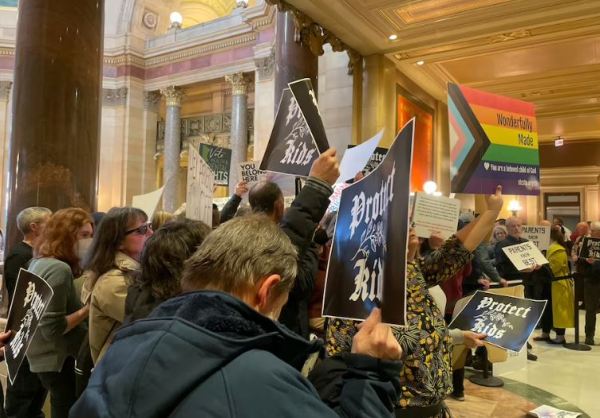
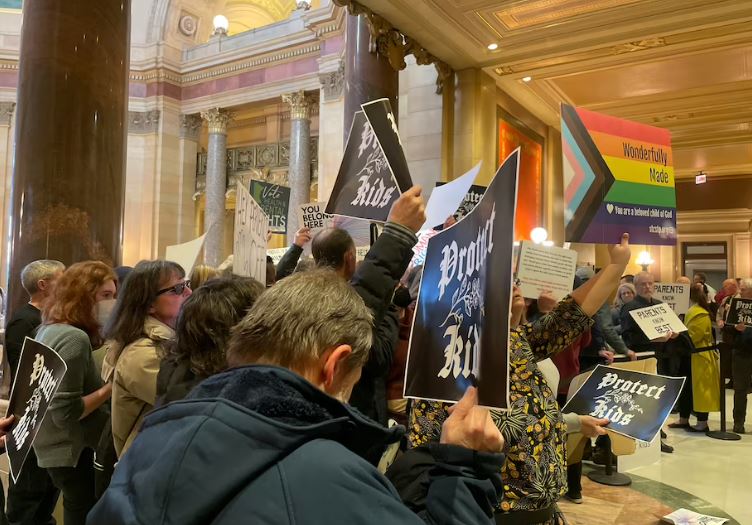
Protesters hold signs as they chant for and against a bill that would make Minnesota a transgender refuge state and strengthen protections for kids and their families who come to the state for gender-affirming care, in March. (Trisha Ahmed/AP)
“LGBTQ people are under fire, unlike possibly ever before and across virtually every aspect of our lives,” said Logan S. Casey, who serves as a senior researcher at Movement Advancement Project, which tracks the legislation. “This is part of a very clear and identifiable national effort in state legislatures that is and has been going on for years — and it’s really culminating this year.”














 fleeredstates.blog
You must be logged in to post a comment.