LGBTQ+ rights are on the ballot in 6 states this year. Here’s what you need to know.

Read more at LGBTQ Nation.

This November, voters in six states will decide on eight LGBTQ+-related ballot measures, including four anti-trans sports bans in Colorado, Arizona, Nebraska, and Washington; two measures restricting gender-affirming care for transgender youth in Colorado and Missouri; a measure that could out LGBTQ+ kids to their potentially unsupportive parents in Washington; and one pro-LGBTQ+ measure to remove a state same-sex marriage ban in Virginia.

“This isn’t actually about giving voters a say in democracy. It’s a political tactic by a small but vocal minority of extremists who want to turn out their base, driven by the fear and misunderstandings about people who are transgender,” said Adam Snipes, the director of strategic partnerships at the Ballot Initiative Strategy Center, during a September 30 GLAAD media briefing attended by LGBTQ Nation.

Snipes is correct: anti-trans measures are being used as “ballot candy” to increase Republican turnout at the polls.

But statewide anti-trans proposals have dramatically increased since 2015, the year that the US Supreme Court legalized marriage equality. In 2016, North Carolina passed an anti-trans bathroom bill. Since then, similar anti-trans measures have expanded to sports, educational policies, healthcare, and other areas.

Approximately 91% of anti-trans bills fail in state legislatures, GLAAD’s senior director of news and campaigns Barbara Simon said. But such legislation and ballot measures give anti-LGBTQ+ politicians and activists “a permission slip” that emboldens them to use marginalizing and dehumanizing rhetoric that harms vulnerable youth, Simon said.

“This is really part of a national MAGA playbook, which is about distracting voters from real issues facing families — like high healthcare costs, gas costs, housing costs — and instead just flaming fears about a small, really already vulnerable group of people… in this case, LGBTQ+ kids,” Washington’s first out lesbian state House Speaker, Rep. Laurie Jinkins (D), told the press briefing.

Anti-trans sports bans in Colorado, Arizona, Nebraska, & Washington

Colorado, Arizona, Nebraska, and Washington are all considering ballot measures with nearly identical language that would ban students who are transgender from playing school sports on sex-segregated teams that differ from the sex they were assigned at birth. None of these measures take intersexuality into account, leaving intersex students unsure about their place on the sports field.

Generally speaking, these measures fall largely on young girls and women to “prove” their sex, often with invasive medical exams that aren’t usually part of standard athletic exams. (Athletic medical exams usually focus on athletes’ eyesight, bone health, as well as respiratory, cardiovascular, or other issues that could affect overexerted athletes.)

Medical examinations to verify athletes’ sex can violate the privacy of all young girls and women — causing a decrease in their sports participation overall. Furthermore, such exams may not be covered by patients’ health insurance plans, adding an extra financial burden for low-income families.

These measures undermine local control by overriding policies and recommendations already put in place by local school boards and associations that have articulated what’s best for their students’ needs. These ballot measures also do nothing to address the sexism, abuse, and poor funding that harm girls and women and discourage them from participating in sports to begin with.

Arizona’s Proposition 318

Based on a 2022 Arizona law that federal courts had blocked from enforcement (before the US Supreme Court ruled such bans as constitutional last June), the so-called “Protect Girls’ Sports in Arizona Act” would require K-12 schools and private sports leagues to designate which sports are sex-segregated and then decide participation based on the sex listed upon each player’s birth certificate.

Additionally, schools and private leagues would have to ban trans athletes from restrooms, showers, and locker rooms that don’t match the sex they were assigned at birth. The measure would allow athletes to sue schools or leagues that violate its provisions.

Darrell Hill, the policy director for ACLU of Arizona, told KTAR that facilities and cities could interpret the law too broadly and restrict restroom and locker room access to trans kids and adults in various situations that have nothing to do with sports participation. “It can really act as a big barrier for trans people to participate in public life,” he said.

While the measure seems to “verify” athletes’ sex via birth certificates, state Sen. Mitzi Epstein (D) said it would “subject girls to invasive inspections and questions about their gender,” effectively harming all girls and women (and communicating that they are less valued than boys and men), “in an effort to score political points by discriminating against trans girls.”

The Arizona Interscholastic Association says no trans student-athletes have tried to compete in the state since the 2022 law was signed. It’s unclear whether any tried to compete before the 2022 law was signed.

Colorado’s Proposition 134

Proposition 134 would then require K-12 schools, colleges, and athletic associations to designate sex-segregated and co-ed sports and then forbid boys from participating on girls’ teams and vice versa.

The measure would define girls as people with female reproductive organs and boys as those with male reproductive organs, but it’s unclear how sex would be determined. While some supporters say a doctor-signed form or a DNA cheek swab could suffice, opponents warn that it could subject girls to invasive genital inspections.

Z Williams, a school parent and director of Bread and Roses Legal Center, told The Colorado Sun, “Kids have been playing sports with trans kids for decades…. Playing sports is an important and healthy part of growing up: People building a sense of who they are, learning how to work with a team, learning to lose. To take that away from kids simply for who they are is absurd. It is socially and politically cruel.” 

Chris Cook, the father of an 11-year-old transgender girl, told the aforementioned publication, “It would tell kids that simply participating in school sports could mean being questioned, scrutinized, or subject to invasive gender inspections to prove who they are. No child should have to live with that fear, and this doesn’t affect (just) transgender kids. When schools are asked to police students’ gender, any child who looks too tall, too strong, or doesn’t fit someone’s idea of what a girl should look like could be singled out.”

Nebraska’s Measure 442

Measure 442 would write into the state constitution a 2025 law, sponsored by state Sen. Kathleen Kauth (R), that already requires public K-12 and college athletes to play on teams matching their sex at birth. The measure defines one’s sex at birth as having a reproductive system that “does or at some point will produce, transport, and utilize” either eggs ( for a woman or girl) or sperm (for a man or boy).

The measure would apply to all athletic teams or sports sponsored by public schools, postsecondary educational institutions, private schools, or educational institutions that compete against public schools.

Interestingly, the state Supreme Court recently heard arguments challenging the measure’s legality. Opponents say that the ballot measure’s sponsors failed to “adequately inform the public of what they are trying to accomplish” when collecting signatures for the effort. The measure will appear on ballots regardless of the court’s decision; if the court rules against it, all votes upon it will simply be invalidated.

Washington’s Initiative IL26-638

IL26-638 would bar students who are “biologically male” from competing in K-12 schools and nonprofit sports teams designated for girls and women. The initiative would require every student who wants to compete in girls’ sports to obtain a signed statement from a health care provider verifying their sex. Students wanting to play on boys’ teams wouldn’t have to obtain any such statement.

The initiative permits three verification methods: genetic testing, testosterone measurement, or a visual examination of reproductive anatomy. Seeing as the first two methods are expensive and not covered by insurance, most parents will likely go for the third option, requiring kids to expose their genitals to adult medical professionals.

Over 100 doctors and other medical professionals recently released a statement against the initiative, with some saying they would refuse to conduct invasive exams to verify the sex of young girls and women.

“IL26-638 would make every girl in Washington who wants to compete in a female-only interscholastic sport prove her sex to a doctor, regularly, in order to play,” the Washington State PTA noted, calling the initiative “discriminatory,” “harmful,” and “disproportionate.”

Trans journalist Erin Reed noted that even if the measure passes, it could still face constitutional challenges under the longstanding legal precedent of Washington laws protecting trans students.

“Washington adopted an Equal Rights Amendment in 1972 declaring that ‘equality of rights and responsibility under the law shall not be denied or abridged on account of sex,’” Reed wrote. “That provision triggers strict scrutiny for claims of sex discrimination, a standard that would likely render a categorical ban on transgender participation in sports unconstitutional — particularly given the state’s more liberal judiciary.”

Restricting gender-affirming healthcare in Colorado and Missouri

Two states, Colorado and Missouri, both have ballot measures to restrict gender-affirming healthcare for trans youth. However, they differ in significant ways.

Colorado’s Proposition 135

Colorado’s Proposition 135 is a vaguely written measure that would forbid doctors from performing surgeries on anyone under 18 “for the purpose of altering biological sex characteristics,” including changes to sexual organs, body shape, facial appearance, or voice (even though such surgeries on minors are rare to nonexistent).

The measure would also ban state or federal funds, Medicaid, and private insurance from paying for these surgeries. Though the measure’s language doesn’t specifically mention transgender youth, its restrictions would apply to any young person. However, the law wouldn’t place any restrictions on prescribing hormone therapy, puberty blockers, counseling, or support for social transition.

The measure includes exceptions for male circumcision, people born with a “medically verifiable disorder of sex development,” and “acquired physical or chemical abnormalities,” meaning that intersex individuals could still be eligible for augmenting surgeries.

Nevertheless, the Colorado Medical Society opposes the measure (along with dozens of other LGBTQ+ and allied organizations statewide), saying it would interfere with doctors’ medical judgment. The measure is backed by Protect Kids Colorado, an organization led by anti-LGBTQ+ activist Erin Lee. 

Jax Gonzalez, political director at One Colorado, said the measure’s vague language around a minor’s “perception of sex or gender” leaves both patients and providers unclear about what procedures would be prohibited.

“All of us have gender and have lots of ideas about that, and so, does that mean that if a patient brings up a conversation about their own gender, regardless of their general identity, does that mean that that provider can’t treat them anymore?” Gonzalez, who is trans, told News From the States.

Missouri’s Amendment 3

Missouri’s Amendment 3 main purpose is to repeal the abortion-rights amendment that voters approved in 2024 and to make most abortions illegal in the state, except for ones that are conducted in cases of medical emergencies, fetal anomalies, and within the first 12 weeks of pregnancies caused by rape or incest.

The final clause in the measure would “prohibit gender transition procedures for minors,” which is curious, seeing as the state has banned gender-transition surgeries for minors since August 2023. The measure would also ban puberty blockers and hormone replacement therapy for minors.

Currently, state law forbids any new prescriptions of the aforementioned medications for trans youth until 2027; the measure would write this ban into the state constitution, meaning it would continue indefinitely.

Forcibly outing trans students to their parents in Washington

Washington voters will consider IL26-001, a measure that would repeal the state’s current parents’ rights laws and replace them with language taken verbatim from Louisiana. The measure would give parents unrestricted access to school, medical, and mental health counseling records without requiring student consent, including information on confidential conversations about a child’s sexual orientation or gender identity.

“When a student … is dealing with anxiety, they need trusted adults and mental health resources they can turn to that help them make sense of their world,” the American Civil Liberties Union (ACLU) of Washington wrote in opposition to the measure. “[Allowing parents to view sensitive counseling records is a] violation of privacy [that] can undermine the relationships that students may have with counselors and other trusted adults in schools.”

“The sad truth is not all students have a supportive adult they can turn to and talk about their sexuality, gender identity, or mental health without fear. Allowing schools to disclose private health information — as IL26-001 proposes — would severely impact a student’s stability at home, at a time when they need love and support, not punishment and rejection,” the ACLU of Washington added.

Indeed, statistics show that 40% of homeless queer youth say they were kicked out of their homes when their families learn of their identities, meaning that the measure could worsen at-home conflicts for LGBTQ+ students with unsupportive or abusive parents.

This initiative and the state’s ballot measure banning trans athletes are opposed by state Gov. Bob Ferguson (D), the state’s US Sen. Patty Murray (D), the Washington State Parent-Teachers Association (PTA), by the Washington State Nurses Association, the League of Women Voters, and domestic violence prevention groups, because they put kids at greater risk of violence and harm.

Defending marriage equality in Virginia

A bright spot on the somewhat gloomy horizon, Virginia’s Question 2 asks voters to remove the state’s 2006 constitutional ban on same-sex marriage and to add a right to marry regardless of a partner’s sex, gender, or race.

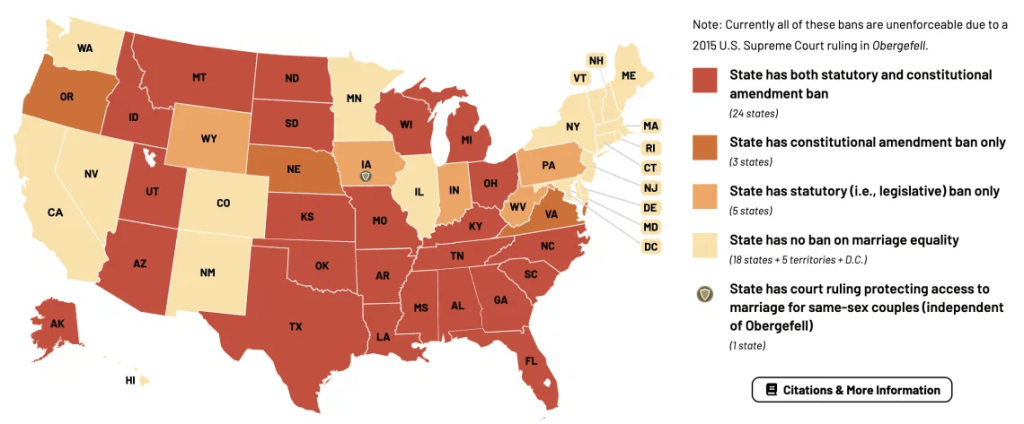
The state’s current ban, rendered inactive by the US Supreme Court’s 2015 Obergefell v. Hodges decision legalizing marriage equality, defines marriage as “only a union between one man and one woman” and bans any union, partnership, or legal status for unmarried couples that carries the rights and benefits of marriage. Question 2 would remove all of this language and acknowledge that “Marriage is one of the vital personal rights essential to the orderly pursuit of happiness.”

Virginians approved their state’s same-sex marriage ban in 2006, with 57% voting yes. A federal judge struck it down in 2014, but it stayed in the state constitution. State election officials say the ban would become enforceable again if the US Supreme Court ever overturned Obergefell v. Hodges, as some of the court’s conservative justices have threatened.

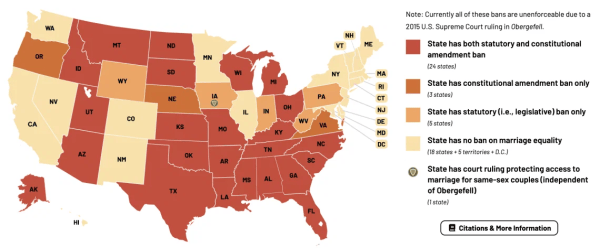
Currently, 24 states have dormant bans against same-sex marriage in both their state constitution and their statutes, five have such a ban in their statutes only, and three have such a ban in their constitution only, according to the Movement Advancement Project.

Since 2020, voters in four states have voted to repeal previously approved same-sex marriage bans. Nevada did in 2020, and California, Colorado, and Hawaii all did the same in 2024.

These ballot measures are about LGBTQ+ involvement in civic life

“As somebody who grew up trans, sports and other activities represented more than just competition,” Adrianna Suluai, the Policy & Advocacy Director at UTOPIA Washington, an organization dedicated to uplifting queer and transgender Pacific Islanders, told the press briefing.

“They were opportunities for me to participate, build confidence, and be around other young people and feel like I was a part of something. And when you’re a young person who may already feel different, sometimes simply having a place where you can show up and belong means everything,” Suluai added.

Suluai’s comment applies not only to the sports field but also to LGBTQ+ youth in classrooms, doctors’ and counselors’ offices, and the general public.

Because these ballot measures are often sold as ways to “protect children’ and strengthen “parental rights,” it’s all the more imperative that LGBTQ+ voters and allies understand them and share their potentially harmful consequences with other sympathetic voters.
Mid-Atlantic Progress: How LGBTQ+ Protections Stack Up in NJ, MD, DE, and VA

While the national conversation around LGBTQ+ rights often focuses on the West Coast or New England, the Mid-Atlantic region has quietly become one of the most dynamic legal battlegrounds in the country. From pioneering healthcare access to a historic marriage equality vote on the horizon, the laws of New Jersey, Maryland, Delaware, and Virginia tell a fascinating story of progress, defense, and active legal engineering.

Whether you are looking to relocate, working in advocacy, or just keeping tabs on civil rights, here is how these four neighbor states compare when it comes to protecting their LGBTQ+ residents.

1. New Jersey: The Brand-New Legislative Firewall

New Jersey has long held a “Safe Haven” designation from major equality groups, but until recently, its protection for transgender healthcare relied entirely on an executive order from the governor’s office. Because executive orders can be easily undone by a future administration, advocates pushed for years to codify these rules into permanent law.

  • The Big 2026 Update: On June 30, 2026, the New Jersey Legislature passed A2218/S2260, a comprehensive statutory shield law.
  • What the Law Does: This statute creates an absolute legal firewall. It legally prohibits New Jersey state courts, law enforcement, and medical boards from cooperating with out-of-state subpoenas, extraditions, or investigations targeting those who receive or provide gender-affirming care in New Jersey.
  • Everyday Protections: Under the Law Against Discrimination (LAD), New Jersey boasts some of the country’s strongest bans on discrimination in housing, employment, and public accommodations.

2. Maryland: Setting the Medicaid Gold Standard

Maryland is a powerhouse of structural equality, focused heavily on ensuring that legal protections translate to actual, affordable healthcare access.

  • The Trans Health Equity Act: Effective in 2024, this landmark law requires Maryland’s Medicaid program to cover comprehensive, medically necessary gender-affirming care. Rather than treating transition-related care as “cosmetic” or optional, Maryland codified it as a fundamental medical right.
  • Civil Rights & Safe Haven: The state’s “Fairness for All Marylanders Act” has protected gender identity and sexual orientation in housing, work, and public spaces since 2014. Additionally, Governor Wes Moore signed an executive order establishing Maryland as a safe state for out-of-state individuals seeking gender-affirming medical services.

3. Delaware: Protecting Rights Under Executive Defense

Delaware has strong, comprehensive civil rights statutes on the books protecting LGBTQ+ individuals from discrimination in housing, employment, and public spaces.

  • The Healthcare Shield: While Delaware has legislated shield protections for reproductive care (like abortion), its protections for gender-affirming care have largely been bolstered by the executive branch.
  • Executive Order 11: In June 2025, the Governor signed Executive Order 11. This directive prevents state agencies from cooperating with out-of-state investigations or extraditions related to lawful gender-affirming medical care provided within Delaware’s borders.
  • Identification: Updating birth certificates and driver’s licenses to match an individual’s gender identity is streamlined, requiring only a simple supporting statement from a licensed medical or social work professional.

4. Virginia: The Southern Battleground & The 2026 Ballot

Virginia occupies a unique space on this list. In 2020, it made history by passing the Virginia Values Act, becoming the first Southern state to enact comprehensive civil rights protections for LGBTQ+ residents in employment, housing, and public spaces. However, enforcement has faced political friction and rollbacks, particularly regarding school policies.

  • The 2026 Marriage Amendment: On November 3, 2026, Virginia voters will head to the polls to decide on a major, proactive constitutional referendum: the Repeal Same-Sex Marriage Ban Amendment.
  • What is at Stake: While same-sex marriage is federally protected under Obergefell v. Hodges, Virginia’s state constitution still contains outdated, unenforceable language banning same-sex unions. This referendum will officially strike that language and enshrine an affirmative, constitutionally protected right to marriage regardless of sex, gender, or race. It is one of the nation’s only proactive pro-LGBTQ+ ballot measures in 2026.

Side-by-Side: The Mid-Atlantic Landscape

StateNon-Discrimination LawsTransgender Healthcare ShieldState Medicaid CoverageNotable Highlight
New JerseyExplicit & Robust (LAD)Statutory Law (Passed June 2026)CoveredCompletely codified protections to survive shifting administrations.
MarylandExplicit & RobustExecutive OrderCovered (Trans Health Equity Act)Exceptional, legally mandated Medicaid coverage for gender-affirming care.
DelawareExplicit & RobustExecutive Order 11CoveredSeamless identity document updates via simple self-attestation.
VirginiaExplicit (Virginia Values Act)NonePartially Covered (highly variable)Currently voting to enshrine marriage equality in its state constitution.

The Takeaway

The Mid-Atlantic is a vital region for LGBTQ+ rights. While New Jersey has just finalized its legal fortress with a new legislative shield, Maryland leads the way in equitable healthcare funding, Delaware stands tall with deep executive protections, and Virginia remains the ultimate battleground—where the community is actively voting to secure the future of marriage equality at the ballot box.

What states are the best for LGBTQ+ people? These are the top 15

Read more at the Advocate.

Legislative attacks on the LGBTQ+ community have been pushed everywhere from city councils to the White House — but there are still some areas that are safe.

Over 1,000 anti-LGBTQ+ laws have been proposed across every state legislature in the U.S. over the past two years, according to the American Civil Liberties Union, and 126 have passed into law. Less than two months into the 2025 legislative session, 390 laws targeting LGBTQ+ people have been proposed.

Still, marriage equality and anti-discrimination protections based on sexual orientation and gender identity are still guaranteed federally by U.S. Supreme Court rulings (for now). On top of that, at least 15 states have “shield laws” protecting access to gender-affirming care and abortion.

Based on laws surrounding marriage, family rights, health care, education, and youth collected by the Movement Advancement Project, here are the 15 best states for LGBTQ+ people.

The states include California, Colorado, Connecticut, Illinois, Maine, Maryland, Massachusetts, Minnesota, Nevada, New Jersey, New York, Oregon, Rhode Island, Vermont, and Washington. Honorable mentions go to Washington DC, Delaware, Hawaii, Michigan, New Mexico, and Virginia.

You can read about each state in more detail in the Advocate’s article.

Virginia governor gives voters a chance to erase their state’s anti-marriage amendment

Read more at LGBTQ Nation.

Virginia Gov. Abigail Spanberger (D) signed legislation that sent several potential state constitutional amendments to voters this past Friday, including a measure that would remove the state’s ban on same-sex marriage from the state constitution, which was originally passed in 2006.

While the state’s ban on marriage equality has not been enforced since the 2015 Obergefell v. Hodges Supreme Court decision, which legalized marriage equality in all 50 states, advocates for its removal say that it is discriminatory and could be enforced if Obergefell were ever overturned.

“We want to make sure that Virginia families know that here in Virginia, it is not just a Supreme Court decision that protects them, but it is also our state constitution,” Spanberger said in comments during the signing ceremony. “It’ll be a big step for Virginia to ensure that every family knows that Virginia is a place that welcomes them, appreciates them, and sees them for the wonderful family and Virginians that they are.”

“So before I get too emotional on that one, I will start signing.”

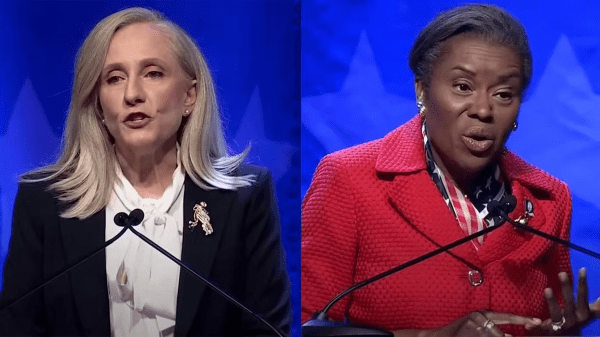
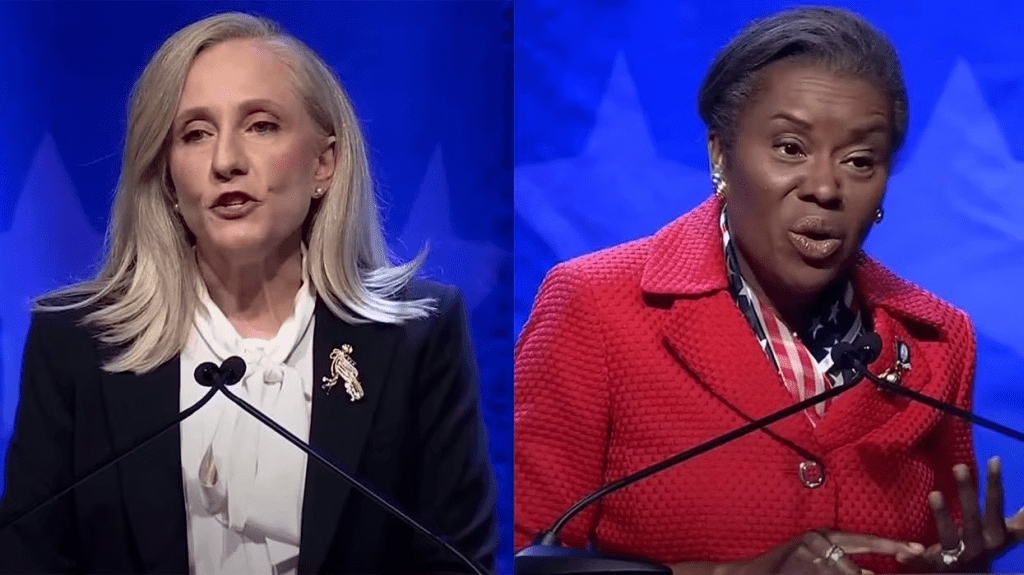
LGBTQ+ issues played a large role in the 2025 Virginia gubernatorial campaign, with Republican candidate Winsome Earle-Sears running ads throughout the election season that accused Spanberger of wanting “boys to play sports and share locker rooms with little girls” and letting “children change genders without telling their parents.”

At a debate later in the year, Spanberger pointed out Earle-Sears’ opposition to anti-discrimination laws and her opposition to marriage equality. Earle-Sears blurted out, “That’s not discrimination!” when Spanberger brought up how Earle-Sears believes “it’s OK for someone to be fired from their job for being gay.”

LGBTQ+ advocates hailed the marriage ballot initiative measure.

“Twenty years after banning marriage equality, it’s time for our commonwealth to fully complete our evolution – and finish the job on protecting marriage equality for all,” said Equality Virginia Executive Director Narissa Rahaman in a statement. “It’s up to all of us to vote on November 3, 2026 to safeguard marriage for all Virginians and remove the stain that exists in our constitution. We have come too far over the past 20 years to have any doubt that Virginia voters will support love and dignity for all couples this November.”

Spanberger also signed a bill that will send a reproductive rights amendment to voters in the fall. The proposed amendment would give Virginians a right to reproductive health care and include IVF, contraception, and abortion.

“This amendment protects families’ entire scope of reproductive needs,” said state Sen. Jennifer Boysko (D), who introduced it in the Virginia Senate.

“I look forward to spending ample time in advance of the 2026 elections campaigning to make sure that people understand the importance of this constitutional amendment,” Gov. Spanberger said last year, according to the Virginia Mercury.

Spanberger sent two other constitutional amendments to voters on Friday. One would automatically restore voting rights for convicted felons who finished their prison sentences (they currently have to appeal to the governer after their sentences are over to get their voting rights back), and the other would allow the state’s General Assembly to change the state’s congressional district map in the middle of decades in order to respond to other states doing the same, according to WOBC.

Virginia takes one step closer to enshrining marriage equality in its state constitution

Read more at LGBTQ Nation.

The Virginia Senate voted this past Friday in favor of repealing an amendment to the state constitution that defines marriage as only between a man and a woman.

Senate Joint Resolution 3, introduced by state Sen. Adam Ebbin (D), passed the chamber in a 26-13 vote and would ban the state “from denying the issuance of a marriage license to two adult persons seeking a lawful marriage on the basis of the sex, gender, or race of such persons.” It also requires Virginia to “recognize any lawful marriage between two adult persons and to treat such marriages equally under the law, regardless of the sex, gender, or race of such persons.”

A proposed Constitutional amendment must be voted on by two successive state legislatures before heading to the ballot, where voters ultimately decide its fate. Both chambers voted in favor of the resolution in 2025, and the House of Delegates already approved it again earlier this month. As such, the resolution will go to voters during the November 2026 elections.

Virginia’s 2006 constitutional ban on same-sex marriage has been unenforceable since the 2015 Supreme Court Obergefell v. Hodges decision that legalized marriage equality nationwide. In 2024, amid increasing threats that the Court may reexamine the decision, then-Gov. Glenn Youngkin (R) (who is generally anti-LGBTQ+) signed a bill codifying same-sex marriage in the Commonwealth.

The law now ensures same-sex marriage remains legal in Virginia regardless of any change in federal protections, but those championing the constitutional amendment say it’s still not enough.

“It’s time for the Virginia constitution to accurately reflect the law of the land. Full stop,” Ebbin said in a statement. “20 years ago, the Virginia Bill of Rights was unnecessarily stained in an overreaction. It’s past time to fix that and see that loving Virginia couples are not mistreated or discriminated against. I am confident that the voters will ratify this marriage equality amendment in November.”

“It’s about time Virginia gets this done,” added state Rep. Mark Sickles (D), who introduced the resolution in the House of Delegates. “All Virginia couples deserve the freedom to marry without fear that their rights could be rolled back. By advancing this amendment, we’re ensuring that the freedom to marry is protected by the people. It’s up to the voters now and I’m confident they’ll do the right thing in November.”

Virginia’s resolution comes after a new trend last year in which several Republican-led states introduced resolutions calling for the Supreme Court to overturn Obergefell. Two justices on the Supreme Court have openly stated that they want to overturn Obergefell, which has stirred fears in the LGBTQ+ community as the court has moved increasingly to the right.

In a victory for LGBTQ+ people, the Supreme Court opted in November not to hear an appeal from former Kentucky county clerk Kim Davis asking the court to reconsider its marriage equality decision.

Even if the Supreme Court had taken the case, Chris Geidner, the gay publisher and author of Law Dork, told LGBTQ Nation last year that he didn’t think a case like Davis’ would provide sufficient legal reasoning to overturn same-sex marriage entirely.

Rather, he said that a successful religious freedom or free speech challenge to Obergefell would do other “bad things,” like hollow out civil protections or public accommodations for same-sex couples, essentially inconveniencing or endangering them, but not outright denying them the right to a marriage license.

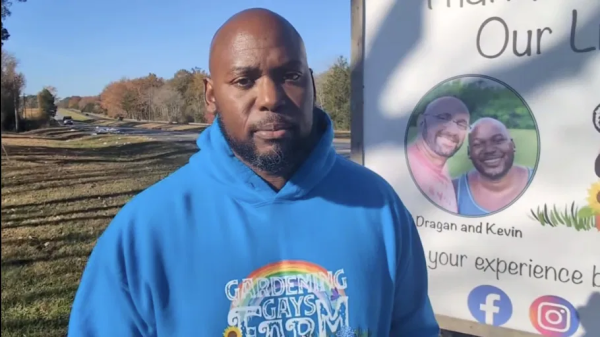
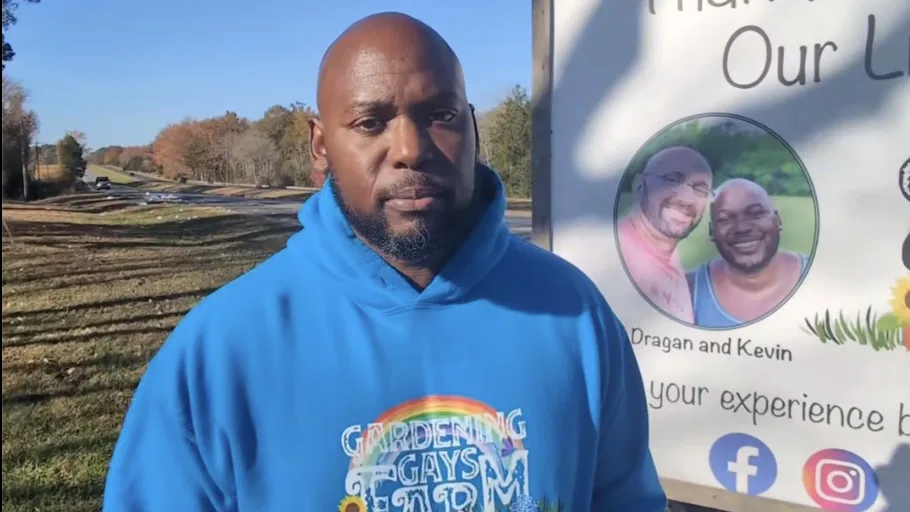
Gay couple’s farm vandalized with medical waste & human feces on election night

As Virginia Democrats celebrated big wins both at home and in other closely watched races across the country following Tuesday’s off-year elections, one gay couple in the state woke Wednesday morning to find that their farm had been vandalized — and not for the first time.

“It’s medical waste that is strewn all the way across the entrance of our farm,” Kevin Graham, the owner, along with his husband Dragan Kurbalija, of Gardening Gays Farm, told The Advocate. “There are bedsheets that have human feces and urine on them. You can smell the human waste while you’re out there standing near it.”

The couple, who bought the 27-acre farm on U.S. 301 in conservative King George County four years ago, told the outlet they believe this was an intentional act of anti-LGBTQ+ hate.

“It does not appear to be an accident,” Graham said. “You look up and down the roadway, and everywhere else is completely clear. The trash is only at our entrance.”

“Nobody puts human feces in a regular trash bag and drives it on the back of a truck to the dump,” Kurbalija added. “It definitely feels personal.”

King George County residents voted Gardening Gays Farm the county’s Overall Best Business, Best Family-Owned Business, and Best Agricultural Business this year.

But at the same time, this isn’t the first act of defacement they’ve endured. In a video posted to the farm’s Facebook account, Kurbalija explained that the couple found trash strewn at the farm’s entrance a few weeks ago.

“It seemed like an isolated incident, perhaps,” Kurbalija says in the clip, “but today, this is very intentional, very deliberate.”

The fact that the latest incident came on the heels of a Democratic sweep in Tuesday’s elections is not lost on Graham and Kurbalija. In Virginia, former U.S. Rep. and LGBTQ+ ally Abigail Spanberger (D) beat outgoing Republican Lt. Gov. Winsome Earle-Sears to become the state’s first female governor. Democratic candidates also won the races for the state’s lieutenant governor and attorney general, and Democrats also increased their majority in the Virginia House of Delegates, flipping at least 13 seats.

But, as The Advocate notes, Earle-Sears — whose campaign leaned heavily on anti-trans rhetoric cribbed from the president’s 2024 campaign — managed to carry King George County by a double-digit margin.

“We don’t lean into or talk politics with anybody,” Graham told the outlet. “But the fact that this happens after an election day, with what took place here in Virginia last night, really rubs you the wrong way even more than it would’ve on any other regular Wednesday.”

Still, Graham said he and Kurbalija are confident in their community’s support for Gardening Gays Farm. “They have our back, and there are people in this town who speak up for us when we’re not in the room.”

In the video posted to the farm’s Facebook account, Kurbalija explained that the couple called their business “Gardening Gays Farm” to make it clear to anyone who comes through their gates exactly who they are.

“When we moved into this community four years ago, we came, pulled up our boots, and got right to work, providing a safe space, providing a service, providing something that we thought this community needed and wanted,” Kurbalija said. “None of this is ever going to stop us from what we’re doing.”

GOP candidate claims firing people for being gay ‘is not discrimination’ in Virginia governor’s debate

Read more at the Advocate.

In a combative and chaotic debate Thursday nigh, in Norfolk, Virginia, Lt. Gov. Winsome Earle-Sears, the Republican candidate for governor, declared that opposing marriage equality and allowing employers to fire people for being gay “is not discrimination,” igniting a firestorm that has reverberated through Virginia politics and beyond.

The statement came during the only scheduled debate between Earle-Sears and Democratic nominee Abigail Spanberger, a former CIA officer and three-term member of Congress. The event, held at Norfolk State University and broadcast by TV station WAVY, was frequently interrupted by Earle-Sears’s outbursts, prompting moderators to repeatedly ask her to stop speaking over her opponent. “Please don’t interrupt,” one moderator said after Earle-Sears cut into Spanberger’s answer. Another warned, “Ms. Earle-Sears, we’re not going to be able to get to as many topics if we keep having to give Ms. Spanberger time.”

Spanberger, who leads in most polls, calmly cited Earle-Sears’s long record of opposing LGBTQ+ rights, including her refusal to support marriage equality or workplace protections for queer Virginians. “My opponent has previously said that she does not think gay couples should be allowed to marry,” Spanberger said. “She’s also said she thinks it’s OK for someone to be fired from their job for being gay.”

Before Spanberger could finish, Earle-Sears interjected, “That’s not discrimination.”

The remark drew immediate backlash online. The Human Rights Campaign, the nation’s largest LGBTQ+ civil rights organization, condemned the comment. Sam Lau, one of the organization’s spokespersons, said, “Yes, Lt. Gov. Earle-Sears, that is indeed discrimination. Vote for Abigail Spanberger.”

The Democratic Party of Virginia called the debate performance “atrocious,” and state Sen. Louise Lucas, who attended the event, wrote that Earle-Sears “took a page out of Donald Trump’s debate playbook — interrupt, interrupt, interrupt — anything to avoid real answers or substance.”

Even some Republicans criticized the lieutenant governor’s behavior. Former GOP U.S. Rep. Barbara Comstock said Earle-Sears “demonstrates her bigotry once again,” noting that she “wouldn’t stop babbling and talking over everyone when it wasn’t her time.”

Following the debate, the Spanberger campaign released a statement emphasizing Earle-Sears’s “decades-long, extreme record of opposing marriage equality and equal rights for all Virginians.” The campaign cited her opposition to bipartisan legislation protecting marriage equality that even Republican Gov. Glenn Youngkin signed, noting that she left a handwritten note on the bill stating she was “morally opposed.”

“Virginia families deserve better than a leader who refuses to protect their rights under the law,” Spanberger said in a statement. “The Lieutenant Governor last night showed Virginians that she is more focused on dividing people than solving problems. No company wants to grow in a state where the Governor excuses discrimination and supports firing workers because of who they are. Her comments tell businesses and families that Virginia is closed to the talent, investment, and innovation that keeps our economy strong.”

Democratic National Committee spokesperson Albert Fujii released this statement: “Winsome Earle-Sears is too extreme for Virginia. Her homophobic comments at last night’s debate are disqualifying and prove once again how out of step she is with Virginians. Virginians deserve a leader who will ensure Virginia is welcoming and affordable to everyone — and that champion is Abigail Spanberger. The DNC will keep fighting tooth and nail to ensure Abigail Spanberger wins big in November — the stakes could not be higher.”

Loudoun (VA) School Board approves LGBTQ proclamation despite opposition

Read more at Loundon Times-Mirror.

Loudoun County School Board proclamations are typically noncontroversial, but a proclamation recognizing October as LGBTQ+ History Month drew three no votes at the board’s Sept. 30 meeting.

Language in the proclamation says it honors the “history, achievements, and contributions of lesbian, gay, bisexual, transgender, and queer people” and celebrates “the strength, resilience, and impact of the LGBTQ+ community, whose contributions have enriched the cultural, educational, and civic life of Virginia and the world.”

The proclamation — whose approval comes as some 600 Republican-sponsored, anti-LGBTQ bills, including 17 in Virginia, have been proposed around the nation — includes a repudiation of discrimination.

“We reject discrimination based on gender identity, sexual orientation, and gender expression, and instead affirm kindness, acceptance, and respect as the foundation of our learning community,” the proclamation states. “Our school division is stronger when every student and staff member can live authentically and feels a true sense of belonging, and when we embrace the full diversity of our community.”

April Chandler, Algonkian; Linda W. Deans, Broad Run; board Vice Chair Anne P. Donohue, At Large; Arben Istrefi, Sterling; board Chair Melinda M. Mansfield, Dulles; and Sumera Rashid, Little River, voted yes.

Deana L. Griffiths, Ashburn; Karen “Kari” LaBell, Catoctin; and Lauren E. Shernoff, Leesburg, voted no.

The proclamation was initially included in the board’s consent agenda, which has items that are approved en masse.

However, Griffiths, who typically has abstained from voting on proclamations since taking office in 2024, wrote in an email that she moved the proclamation to the regular agenda, so she could speak about why she was voting against it.

“There is a meaningful difference between formally recognizing a group in history and promoting that group for its lifestyle to our students,” Griffiths said at the meeting. “It crosses the line into advocacy and raises serious concerns under the (Trump) executive order protecting our children from inappropriate content in our schools.

“Our communications must remain age appropriate and leave conversations about sensitive information to parents. Schools exist to teach children how to read, write, and think critically. Not engage them in conversations about sexuality at any age where they are far too young to process it.”

The January executive order from President Donald J. Trump that Griffiths referred to says people cannot identify as the opposite sex they were born as. It says the administration will “enforce all sex-protective laws to promote this reality,” including cutting federal funding used to “promote gender ideology.”

The Trump administration said in August it was suspending or terminating funding to Loudoun County Public Schools over its policy allowing transgender students to choose which bathroom or locker room they use. Federal money accounts for about $47 million of the current $2 billion LCPS budget.

Shernoff wrote in an email that some constituents complained to her after she voted for the proclamation last year about the way LGBTQ+ History Month was celebrated in schools. Specifically, their complaints were about how “certain spirit days” were celebrated and the effect on young students.

“I did some research into it and that in conjunction with knowing that LCPS also proclaims LGBTQ+ Pride Month in June, I decided to not support this,” Shernoff said. “I did however support the anti-bullying proclamation which specifically names and protects students based on their gender identity. I remain committed to ensuring all students are protected, safe, and can achieve to their fullest potential.”

LaBell said in an interview that she supported the proclamation last year because it was on the consent agenda and voting against it would’ve meant voting against everything on the agenda.

She said she opposed the proclamation because some of the issues it raises are “too political”  to promote in school and might be inappropriate for young students to discuss.

Like Shernoff, LaBell said she voted for the Pride Month and anti-bullying proclamations, but believes one proclamation related to LGBTQ issues annually is enough.

“You want history? Put it in Pride Month,” she said. “It just seems to me it’s being pushed more so than anything else in our school system at this point in time. And it’s a family issue. It shouldn’t be a political issue in our schools.”

Two groups that support LGBTQ rights criticized the rationale of Griffiths, LaBell and Shernoff.

Candice Tuck, an Equality Loudoun board member, said the proclamation isn’t about promoting sexuality.

“There have been many brave queer pioneers throughout history who have fought for civil rights, who have been inventors, and who have moved our democracy forward,” Tuck said in an interview. “There is no reason that the queer community cannot be recognized for those accomplishments without individuals in our community perverting their history.”

Meredith Ray, the head of Loudoun4All, noted in an email that Griffiths previously said she wouldn’t vote for any proclamations, but chose to single out the LGTBQ+ proclamation for criticism.

Ray called Griffiths’ decision “malicious” and said her remarks were “ignorant commentary” on the issue.

“Recognition of history is not ‘promotion of a lifestyle.’ LGBTQ+ students, staff, and families exist in Loudoun and deserve the same dignity as everyone else. Griffiths’ attempt to frame recognition as ‘inappropriate content’ is harmful, especially to young people who already face higher rates of bullying and mental health struggles when leaders stigmatize them,” Ray said. “In fact, decades of research show that inclusive education that teaches respect and representation is one of the most effective ways to prevent bullying and improve school climate.”

Virginia school board votes to refuse to follow administration’s anti-trans order

Read more at LGBTQ Nation.

A public school district in northern Virginia voted yesterday to keep its current pro-trans policies despite the administration’s orders to ban trans students from using the restrooms and locker rooms associated with their gender.

The Loudoun County School Board voted to maintain its current policies regarding the facilities just days after the U.S. Education Department (ED) ordered the district – along with four nearby school districts – to ban trans students from using the facilities associated with their gender. The administration claimed that letting trans students use the appropriate facilities violated Title IX, the law that bans discrimination on the basis of sex in education.

The current administration reversed President Joe Biden’s interpretation of Title IX, which found the statute’s prohibition on discrimination “on the basis of sex” includes anti-LGBTQ+ discrimination. The rules rely on the Supreme Court’s 2020 decision in Bostock v. Clayton County, which found that sex-based discrimination necessarily covers discrimination on the basis of sexual orientation and gender identity, because it’s impossible to discriminate against LGBTQ+ people without taking sex into account.

That is, denying trans students use of restroom facilities or making use of such facilities difficult solely because of their sex assigned at birth was, to the Biden administration, a form of illegal sex-based discrimination. And since many students can’t last an entire day of school without using the restroom, such discrimination could effectively deny trans students an education.

The ED investigated the Virginia school districts, saying it had gotten complaints alleging “that students in the Divisions avoid using school restrooms whenever possible because of the schools’ policies, and that female students have witnessed male students inappropriately touching other students and watching female students change in a female locker room.”

There is no evidence that trans people are a threat to cisgender girls and women in restrooms, but a 2021 study from UCLA’s Williams Institute found that trans people are four times more likely than cis people to be victims of violent crime.

The ED then ordered the schools to rescind their trans-inclusive policies within 10 days and to “adopt biology-based definition of the words ‘male’ and ‘female’ in all practices and policies relating to Title IX.”

But the school board in Loudoun County voted 6-3 to keep its current policy, explaining in a statement that they are following precedent set by the U.S. Court of Appeals for the Fourth Circuit. In 2020, that court affirmed a lower court decision in favor of trans student Gavin Grimm, who had sued his school district after he was told to use the bathroom in a bucket in a converted janitor’s closet and was called a “freak” at a school board meeting about his bathroom usage. The court found that Title IX and the Equal Protection Clause of the Constitution prohibited his school district from discriminating against him.

“Our priority remains the same: doing what is right for Loudoun County’s young people; focusing on educating our students and ensuring our schools are places where every child feels they belong,” the Loudoun County School Board said in a statement.

The other four school districts ordered to end trans equality have not yet said how they will proceed, but they have to respond by Friday, which will be the end of the 10-day period. Prince William County School Board members met with lawyers last week and issued a statement saying that it “continues to review and work through legal issues related” to the ED’s order and that the board “remains firmly committed to fostering a safe, inclusive, and respectful learning environment for all students and staff.”

‘Just trying to be kids’: Students, families speak out against federal ruling against schools’ transgender policies

Read more at the Prince William Times.

Fearful. Aggravated. Hurt. That’s how 16-year-old Ellie Bowling said she felt after the U.S. Department of Education told the Prince William County school division it must change its inclusive transgender policies or risk losing federal funding.

Ellie, who is trans, is a rising junior in Colgan High School’s Center for the Fine and Performing Arts. She’s excited to soon be driving and loves to be onstage. Last spring, she performed in the school’s production of “Guys and Dolls” and recently earned the role of “Candy” in the school’s fall production of “Zombie Prom.”

“I’m currently thriving in this environment; they created a great learning experience for me,” Ellie said of Prince William County schools.

Ellie was 11 when she started her transition. Since then, her parents, Adam and Erin Bowling, have legally changed her name and gender on government and school documents. After obtaining medical and psychological signoffs, Ellie began receiving gender-affirming hormone therapy at Children’s National Hospital in D.C.

At Colgan High, like all other Prince William County schools, transgender students use the bathrooms and locker rooms that match their gender identities in accordance with a regulation that guides how transgender and gender nonconforming students are treated in schools.

“I know that Colgan is a good place for me. I fit in well there, and that’s partially because these policies help me fit into this school and be able to find my place,” Ellie said. “Without these policies — I don’t know.”

The Bowlings are one of likely hundreds of Prince William County families facing uncertainty as the new school year approaches in less than two weeks. The schools are wrestling with the education department’s determination that its policies violate Title IX, a federal law that prohibits discrimination based on sex in educational settings that receive federal funding.

On July 25, the education department told five Virginia school divisions — Prince William, Fairfax, Loudoun, Arlington and Alexandria — they had 10 days to change their policies that allow transgender students to use the facilities that match their gender identities “or risk imminent enforcement consequences, including referral to the U.S. Department of Justice.”

School board has yet to act

The education department said its decision was based on a U.S. Supreme Court ruling in June that upheld Tennessee’s ban on gender affirming care for minors. The Northern Virginia school policies are based on an earlier case involving Virginia teen Gavin Grimm, who successfully sued Gloucester County schools in federal court to allow students to use restrooms that match their gender identities. In 2021, the U.S. Supreme court declined to review the case.

Babur Lateef, the Prince William County School Board chairman, called a special board meeting this week to receive legal advice on the decision, which will mostly be held in closed session. He declined further comment.

School board member Tracy Blake said he told parents to expect no changes when school begins on Aug. 18.  

“Trans students and families do not need to worry about coming back to school on the first day because there will be no disruptions for trans students or any students,” he said in an interview on Friday, Aug. 1.

Blake said he believes removing the regulation would be wrong.

“We can’t discriminate against one person,” he said. “Once you let one thing go, what happens then? Then it’s the next thing. We’ve already seen this in history, and all of our students have to feel safe.”

Ruling adds to challenges for transgender youth

The move by the U.S. Department of Education wasn’t unexpected because trans people have been targeted by the Trump administration, said Lisanne Boddye, a mother of seven, including a transgender teen and a gender expansive teen who both attend Potomac High School. Boddye is also a special education teacher at Potomac High and the wife of Prince William Supervisor Kenny Boddye. 

“My children, like thousands across the country, deserve to walk into their schools knowing they are respected, affirmed and protected,” Lisanne Boddye said. “When leaders target transgender students for exclusion or erasure, they send a chilling message — not just to those students, but to every family who believes in fairness, decency, and the right to learn without fear.”

About 3.3% of U.S. high school students identify as transgender, and about 2.2% of high school students are questioning their gender identity, according to a 2023 Centers for Disease Control and Prevention survey. That means about 1 in 20 high schoolers are either transgender or questioning their gender, or about 1,200 of the 24,000 students enrolled in Prince William County’s 13 high schools.

Delta Boddye, 16, a rising senior, rows on the Potomac High School crew team. She began transitioning two years ago and said her teachers have always used her correct name and “made sure they are affirming (her).”

“I’ve just been planning on just living as myself, just trying to be a kid, trying to be a student,” she said about returning to school.

But revoking the school’s policy could change that, she said. No matter the policy, Delta said she will insist that her correct name and pronouns are used at school.

The possible change in the school division’s policy comes on top of other challenges. Delta was considering joining the military but now can’t because of the recent ban on transgender troops. The Bowlings learned the Youth Pride Clinic at Children’s National Hospital, where Ellie is a patient, will no longer prescribe gender-affirming medications as of Aug. 30 due to “escalating legal and regulatory risks” to the hospital and its providers.

“This is supposed to be her happiest year, her senior year, and all of the horizons are supposed to be endless, and now most of them are not,” said Lisanne Boddye, who is an Army special operations veteran.

Both the Bowlings and Boddyes say they are speaking out not only for the safety and mental health of their own children, but for their trans classmates who may not have the same family and community support.

Equality Prince William, a nonprofit that advocates for the LGBTQIA+ community, sponsored a campaign urging the school board “to hold firm in their support for transgender and gender diverse students.” As of Aug. 5, 1,700 letters had been sent. 

“Title IX exists to prevent exactly this kind of discrimination,” said Glorya Jordan, a registered nurse who is on the board of Equality Prince William and is the mother of a transgender adult. “The attempt to rescind protections for transgender youth is not only illegal but deadly. Trans youth already face staggering rates of bullying, depression and suicide.”

“Let’s stop hurting our children because of what we are afraid of and do not understand,” said the Casa BruMar Foundation, a nonprofit based in Gainesville that provides resources for the LGBTQIA+ community. “Let’s allow our children to know that being different is not dangerous.”

Adam Bowling hopes people realize there is so much more to his daughter Ellie than just being trans and she deserves to be her authentic self at school. 

“Demonizing this group of people is just so wrong,” he said. “I just hope the majority of people hear stories like Ellie’s and realize that there are human beings that these decisions are affecting and it’s a life-or-death situation for some of them.”

Ellie wants people to know that she is a normal teenager.

“I hate how politicized trans youth is, because I am not a monster,” Ellie said. “There’s so much misinformation out there obviously for fear-mongering reasons. I’m not this predator who goes into women’s spaces just to, like, spy on them. I am a woman who is living her life.”

Blog at WordPress.com.

Up ↑