
Colorado’s Supreme Court has ruled that Donald Trump cannot run for president next year in the state, citing a constitutional insurrection clause.
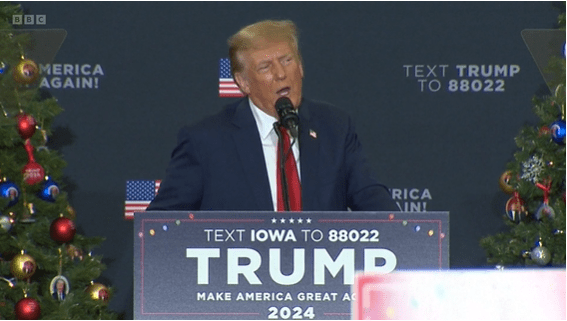
In a 4-3 decision, the court declared that Mr. Trump was ineligible as a candidate due to his involvement in an insurrection related to the US Capitol riot almost three years ago.
This doesn’t prevent Mr. Trump from running in other states, and his campaign has stated its intention to appeal to the US Supreme Court.
They asserted that the decision was “fundamentally flawed.”
The verdict specifically addresses the state’s primary election on March 5, during which Republican voters will select their favored presidential candidate. However, it may have repercussions for the general election in Colorado next November.
This marks the inaugural application of Section 3 of the 14th Amendment of the US Constitution to disqualify a presidential candidate.
The decision made on Tuesday, which has been temporarily suspended pending an appeal until the next month, is applicable solely in Colorado. Similar efforts to remove Mr. Trump from the ballot in New Hampshire, Minnesota, and Michigan have been unsuccessful.
Is Trump still eligible to run for president following the decision in Colorado?
In their ruling, the justices stated, “We do not arrive at these conclusions lightly. We are cognizant of the significance and gravity of the questions presently under consideration.”
“We are also conscious of our solemn responsibility to uphold the law impartially, unaffected by public sentiment regarding the decisions that the law requires us to make.”
The ruling overturns a previous decision by a Colorado judge, who determined that the insurrection ban of the 14th Amendment did not extend to presidents because the section did not explicitly reference them.
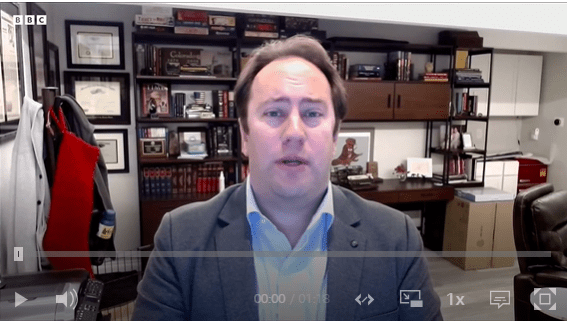
‘Ecstatic’: Attorney for Colorado plaintiffs reacts to the ballot outcome.
The identical lower court judge also concluded that Mr. Trump had engaged in an insurrection during the US Capitol riot. His supporters stormed Congress on January 6, 2021, while lawmakers were in the process of certifying President Joe Biden’s election victory.
The ruling by the Colorado Supreme Court becomes effective on January 4, 2024, which is the day before the deadline for the state to finalize its presidential primary ballots.
“Leaders of the Democratic Party are experiencing heightened concern over the significant and increasing lead President Trump has secured in the polls,” stated Mr. Cheung in a press release.
“They have abandoned confidence in the ineffective Biden presidency and are employing every means to prevent American voters from ousting them from office next November,” remarked Mr. Cheung.
Mr. Cheung further stated that Mr. Trump’s legal team would promptly submit an appeal to the US Supreme Court, where conservatives maintain a 6 to 3 majority.
Understanding the Legal Attempt to Remove Trump from the Ballot
Representatives for Mr. Biden’s re-election campaign chose not to provide a comment on the Colorado ruling. However, a senior Democrat associated with the campaign informed CBS News, the BBC’s US partner, that the decision would aid Democrats by reinforcing their assertion that the US Capitol riot constituted an attempted insurrection.
The source mentioned that it would also assist Democrats in highlighting “the glaring distinctions” between Mr. Trump and Mr. Biden.
Republican legislators criticized the ruling, with House of Representatives Speaker Mike Johnson denouncing it as “a thinly veiled partisan attack.”
He expressed, “Irrespective of political affiliation, every registered voter should not be deprived of the right to endorse our former president, who currently leads in every Republican primary poll.”
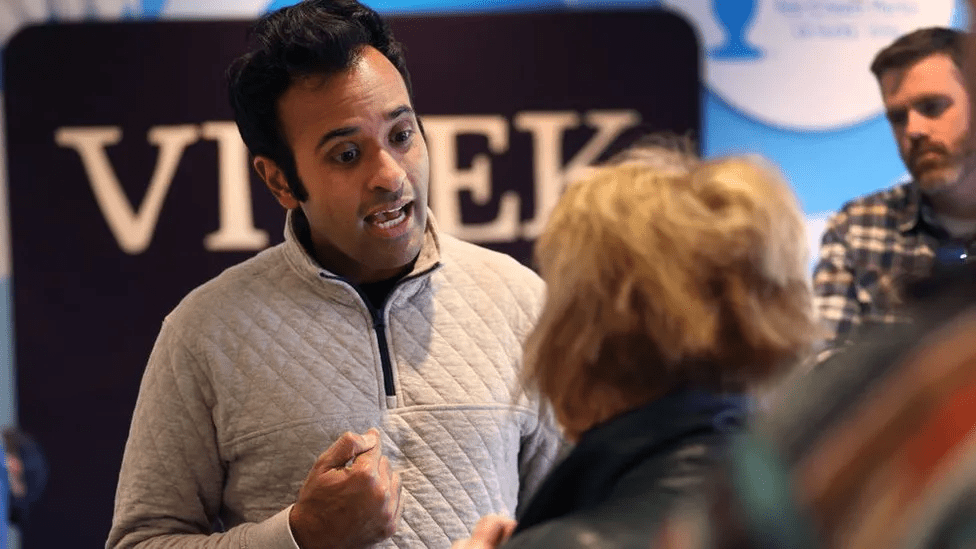
On the campaign trail, Mr. Trump’s rivals in the Republican primary also criticized the decision, with Vivek Ramaswamy vowing to withdraw his name from the ballot if Mr. Trump’s candidacy is not reinstated.
Mr. Trump, while speaking at a campaign event in Iowa on Tuesday night, did not comment on the ruling. However, a fundraising email sent by his campaign to supporters stated, “this is how dictatorships are born.”
The Colorado Republican Party also reacted, announcing that it would withdraw from the state’s primary process if the ruling was upheld.
Citizens for Responsibility and Ethics in Washington (CREW), the organization that initiated the case, expressed satisfaction with the ruling.
The group’s president, Noah Bookbinder, stated in a release, “It is not only historic and justified but is necessary to protect the future of democracy in our country.”
The 14th Amendment, ratified after the American Civil War, included Section 3 to prevent secessionists from resuming former government positions after southern states rejoined the Union.
The provision was applied to Confederate President Jefferson Davis and his vice-president, Alexander Stephens, both of whom had previously served in Congress. Its application has been rare since then.
In the previous presidential election, Mr. Trump faced a significant defeat in the state of Colorado. However, if courts in more closely contested states adopt a similar stance to Tuesday’s ruling, it could pose significant challenges for Mr. Trump’s White House aspirations.
In a one-week trial last month in Colorado, lawyers representing the former president argued that he should not be disqualified, contending that he did not bear responsibility for the US Capitol riot.
However, in its ruling, the majority of the Colorado Supreme Court disagreed.
They stated that Mr. Trump’s messages before the riot were a “call to his supporters to fight, and his supporters responded to that call.”
Carlos Samour, one of three dissenting justices, contended that the government could not “deprive someone of the right to hold public office without due process of law.”
“Even if we are convinced that a candidate committed horrible acts in the past—dare I say, engaged in insurrection—there must be procedural due process before we can declare that individual disqualified from holding public office,” he wrote.
Mr. Trump is currently confronting four legal cases, encompassing both federal and state charges in Georgia, linked to his alleged involvement in efforts to undermine the election.
 fleeredstates.blog
You must be logged in to post a comment.