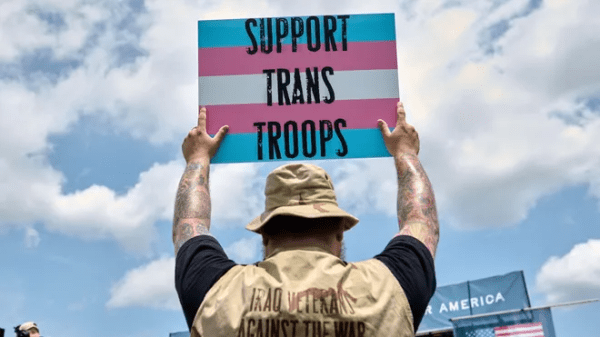
New Air Force policy denies transgender troops hearings before they’re discharged

Read more at WFMY.

 The Air Force says in a new memo that transgender airmen ousted under a recent Trump administration directive will no longer have the chance to argue before a board of their peers for the right to continue serving their country.

The memo dated Tuesday says military separation boards cannot independently decide whether to keep or discharge transgender airmen and instead “must recommend separation of the member” if the airman has a diagnosis of gender dysphoria — when a person’s biological sex does not match up with their gender identity.

Military legal experts who have been advising transgender troops told The Associated Press that the new policy is unlawful, and while they were not aware of the other services releasing similar memos, they fear it could serve as a blueprint across the military. Advocacy groups say the change threatens to weaken trust in the military’s leadership.

It is the second policy change the Air Force has taken in recent weeks to crack down on transgender service members. The Associated Press reported last week that the Air Force would deny transgender troops early retirement benefits and was moving to revoke requests already approved.

The Air Force declined to answer questions about the policy and its legal implications.

The service provided a statement saying the new guidance “is consistent with and responsive to Department of Defense policy regarding Service members with a diagnosis of, or history of, or exhibiting symptoms consistent with, gender dysphoria.”

How the boards usually work

The boards traditionally offer a quasi-legal hearing to determine if a service member set to depart is still of value to the military and should stay on. Fellow service members hear evidence of whatever wrongdoing occurred and about the person’s character, fitness and performance.

The hearings are not a formal court, but they have much the same structure. Service members are often represented by lawyers, they can present evidence in their defense and they can appeal the board’s findings to federal court.

The Pentagon’s policy on separating officers notes that they are entitled to “fair and impartial” hearings that should be “a forum for the officer concerned to present reasons the contemplated action should not be taken.”

This impartial nature means that the boards can sometimes reach surprising conclusions.

For example, the three active-duty Marines who were part of the mob that stormed the Capitol on Jan. 6, 2021, were retained.

The commanding officer of the USS McCain, a destroyer that collided with an oil tanker in the Pacific in 2017, killing 10, was not recommended for separation in 2019.

Military lawyers decry the Air Force change

Priya Rashid, a military lawyer who has represented service members before hundreds of separation boards, said she “has never seen an order like this.”

“I’ve seen people with three DUIs retained, I’ve seen people that beat their wives retained, I’ve seen all kinds of people retained because the board is empowered to retain anyone for any reason if they feel it’s in the best interest of the service,” she said.

Rashid said she and other lawyers working with transgender troops view the guidance as telling the boards to automatically order separation based solely on a diagnosis or symptoms of gender dysphoria.

She said that constitutes an unlawful command by the Air Force and upends impartiality.

“This instruction is essentially saying you will not make a determination of whether somebody has future potential in the service,” Rashid said.

The new Air Force guidance also prohibits recording the proceedings.

Rashid said the lack of an independent transcript would not only prevent Air Force leaders from reviewing the hearings to ensure they were conducted appropriately but would undercut any meaningful chance to appeal.

Stepped-up efforts to oust transgender troops

Pentagon officials say 4,240 troops have been diagnosed with gender dysphoria, which the military is using as an identifier of being transgender.

The Pentagon got the green light from Supreme Court in May to move forward with a ban on all transgender troops. It offered two options: volunteer to leave and take a one-time separation payout or be discharged at a later date without pay.

Some transgender troops decided to fight to stay by turning to the boards.

Senior Master Sgt. Jamie Hash, who has served in the Air Force since 2011, said she “wanted to face an objective board to be evaluated on my years of proven capability.”

“I wanted the board to see the assignments overseas and at the Pentagon, the deployments to different Combatant Commands, the service medals and the sustained operational and mission effectiveness,” she said in an interview.

But now, she said, that “the path ahead feels more uncertain than it ever has.”

Logan Ireland, a master sergeant in the Air Force with 15 years of service that includes a deployment to Afghanistan, was planning to retire early until his request was denied last week.

After that, he decided he would take a stand at the separation board.

“I chose the involuntary route because I believed in the promise of a fair hearing — judged on my service, my record and the facts,” he said.

“Now that promise is being ripped away, replaced with a process designed to decide my fate before I even walk in the room,” he said, adding that “all I’m asking for is the same fairness and justice every service member deserves.”

Both Ireland and Hash said they have yet to hear from their immediate superiors on what the new policy will mean for them.

Lawyers are worried it will set a precedent that will spread throughout the military.

Rashid said both the Army and Navy are “going to look at what the Air Force is doing as a standard of law … is this the minimum standard of law that we will afford our service members.”

Transgender troops warn the policy could have wider implications

Col. Bree Fram, a transgender officer in the Space Force who has long been seen as a leader among transgender troops, argued that the policy is a threat to other service members.

In an online post, Fram said it “swaps judgment for automation.”

”Today it’s gender dysphoria; tomorrow it can be any condition or class the politics of the moment calls for,” she argued.

If the new policy is allowed to sideline “evidence of fitness, deployment history, awards, and commander input — the very material boards were built to evaluate,” Fram said, it sends a message that performance is no longer relevant to staying in the military.

Cathy Marcello, interim director for Modern Military Association of America, said the change adds to a “growing loss of trust” because outcomes are determined by politics, not performance. The organization advocates for LGBTQ+ service members, military spouses, veterans, their families and allies.

“It’s a signal that identity, not ability or achievement, determines who stays in uniform and who gets a fair shot,” she said.

U.S. Air Force to deny retirement pay for transgender troops being separated from service

Read more at PBS.

The U.S. Air Force said Thursday it would deny all transgender service members who have served between 15 and 18 years the option to retire early and would instead separate them without retirement benefits. One Air Force sergeant said he was “betrayed and devastated” by the move.

The move means that transgender service members will now be faced with the choice of either taking a lump-sum separation payment offered to junior troops or be removed from the service.

An Air Force spokesperson told The Associated Press that “although service members with 15 to 18 years of honorable service were permitted to apply for an exception to policy, none of the exceptions to policy were approved.” About a dozen service members had been “prematurely notified” that they would be able to retire before that decision was reversed, according to the spokesperson who spoke on condition of anonymity to discuss internal Air Force policy.

A memo issued Monday announcing the new policy, which was reviewed by the AP, said that the choice to deny retirement benefits was made “after careful consideration of the individual applications.”

All transgender members of the Air Force are being separated from the service under the Trump administration’s policies.

Separation process has hit some bumps

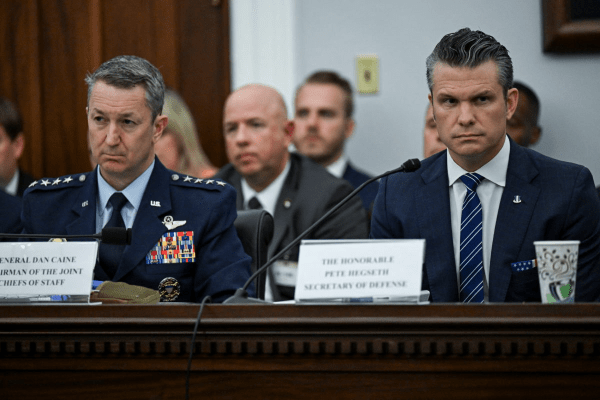
The move comes after the Pentagon was given permission in early May by the Supreme Court to move forward with a ban on all transgender troops serving in the military. Days later, Defense Secretary Pete Hegseth announced a policy that would offer currently openly serving transgender troops the option to either volunteer to leave and take a large, one-time separation payout or be involuntarily separated at later date.

A Pentagon official told reporters in May that they viewed the policy as treating “anyone impacted by it with dignity and respect.”

However, in late July, transgender troops told Military.com that they were finding the entire separation process, which has included reverting their service records back to their birth gender, “dehumanizing” or “open cruelty.”

Shannon Leary, a lawyer who represents LGBTQ+ people in employment discrimination cases, says she expects lawsuits to challenge Thursday’s decision. “It seems quite arbitrary on its face and cruel,” she said. “These military members have dedicated their lives to serving our country.”

Normally, Leary said, when early retirement is offered in the military, it’s available to all members who have served over 15 years. She said she expects other service branches to follow the Air Force’s path.

One Air Force service member says he’s ‘devastated’

Logan Ireland, a master sergeant in the U.S. Air Force who has 15 years of service, including a deployment to Afghanistan, is one of the airmen impacted by the policy. “I feel betrayed and devastated by the news,” he said.

Ireland said he was told that his retirement was being denied on Wednesday when his chain of command, “with tears in their eyes,” told him the news.

Officials have said that as of Dec. 9, 2024, there were 4,240 troops diagnosed with “gender dysphoria” on active duty, National Guard and Reserve. Pentagon officials have decided to use the condition and its diagnosis as the main way to identify troops who are trans.

However, the two are not an exact match — not every transgender person has the condition. As a result, there is an understanding that the actual number of transgender people within the military’s roughly 2 million troops may be higher.

Under the latest policy, active duty troops had until June 6 to voluntarily identify themselves and receive a payout while troops in the National Guard and Reserve had until July 7. Pentagon officials previously told reporters that they plan to lean on commanders and existing annual medical screenings to find any transgender service members who do not come forward.

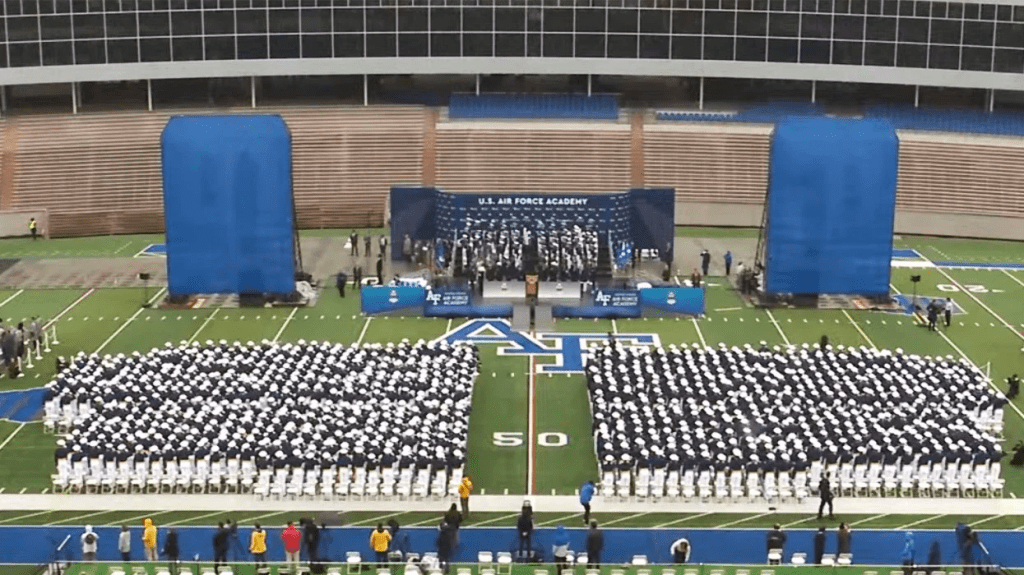
Cadets who met all Air Force Academy graduation standards denied commissions because they’re transgender

*This is reported by The Advocate.

They stood in formation at Falcon Stadium, diplomas in hand, having met every standard of physical endurance, academic excellence, and military discipline. But, on Thursday, when the time came for the U.S. Air Force Academy’s class of 2025 in Colorado Springs, Colorado, to commission as second lieutenants, three cadets were quietly held back.

They are the first out transgender cadets to graduate from the Academy. And under a newly reinstated Trump administration ban, they will not be allowed to serve.

One of them, Hunter Marquez, had spent years preparing to become a combat systems officer. He earned dual degrees in aeronautical engineering and applied mathematics. He passed the Air Force’s fitness standards for men. And he did so as himself, having transitioned while enrolled at the Academy. “I really want to stay in for as long as possible, fight this out,” Marquez toldThe Colorado Springs Gazette.

But the rules changed. On May 6, the U.S. Supreme Court allowed the Trump administration to begin enforcing Executive Order 14183, which bans transgender people from military service. The unsigned order—issued without full argument and over the dissent of the Court’s three liberal justices—overturned a Washington state lower court’s preliminary injunction and gave the Pentagon the green light to begin separations.

Marquez, along with the two other graduates, was placed on administrative absence, barred from taking the oath, and warned he might need to repay the cost of his education if he refused to leave voluntarily, the paper reports. That education—funded by taxpayers—is valued in the hundreds of thousands of dollars. According to The Gazette, Marquez was later told by Air Force officials that if he is involuntarily separated, he won’t be billed. But the message was clear: his government does not want him in uniform.

And yet, there is no question he met the standard. “We want warfighters. We want people with grit, that are resilient. They have done all that,” a U.S. Air Force Academy staff member told The Gazette, speaking anonymously for fear of retaliation. All three cadets passed physical fitness tests for both men and women. All three graduated with distinction.

What disqualifies them is not their performance but their identity.

Marquez is a plaintiff in Talbott v. United States, one of the central legal challenges to the policy. In a sworn statement, he wrote that the executive order describes people like him as “undisciplined,selfish, and dishonest.” “None of those are correct descriptions of my character or my abilities,” he wrote. “I have achieved alongside my peers throughout my time at the Academy.”

The policy is not theoretical. It is personal. It has required cadets like Marquez to trek across dorms to find gender-compliant restrooms and showers. It has forced them to race through final semesters in case they’re expelled before graduating. And it has turned what should have been a joyful week of ceremonies into a lesson in resilience.

Marquez, now 23, is applying to the University of Colorado Boulder to earn an advanced degree in aerospace engineering. He is still receiving medical benefits and cadet pay, but he knows that may be temporary. “There’s still a lot of anger and frustration and sadness,” he said. “Just because I have worked so hard to be a second lieutenant in the Air Force, and at the very end that was taken from me.”

Academy alumni have responded with solidarity. Nearly 1,000 graduates have signed an open letter defending transgender cadets and midshipmen. “Being transgender is in no way incompatible with any of our Academies’ cherished virtues and values,” the letter reads, according to Military.com.

Blog at WordPress.com.

Up ↑